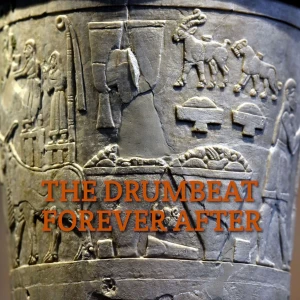
The Drumbeat Forever After
This podcast explores ancient history through multi-season arcs. Season 1 covers Neolithic domestications and social transformations. Season 2 focuses on the Chalcolithic period in Mesopotamia, including the rise of the first cities and the invention of writing. The currently airing Season 3 examines Early Dynastic Sumer.
Episodes
1: Introduction & Natufian Syro-Palestine, 13000-9600 BCE (Atrahasis)
(Re-recorded as of November 26, 2022)
Guests: Kelten, Annika
First, a brief introduction to the focus of the podcast: ten episodes on the Neolithic, about ten more on the Chalcolithic period (the Ubaid and Uruk periods), and then at least twenty episodes on Early Dynastic Sumer.
Then, after a quick jaunt through the Paleolithic, we visit the Epipaleolithic Natufian culture in Syro-Palestine (alias
2: Göbekli Tepe & Early Neolithic cereal domestication, 9600-8000 BCE (Ninurta vs Asag)
(Re-recorded as of November 28, 2022)
Guest: Kelten
First, the warrior-prince of an orderly Sumerian heaven hears of a challenge to his authority and sets out to meet it with his obsequious talking mace.
Then, we begin our look at the agricultural revolution with a look at the domestication process that turned wild large-seeded grasses on the fringes of Epipaleolithic forests into domestic staple
3: Early Neolithic Upper Mesopotamia, 9600-7000 BCE (Telipinu)
(Re-recorded as of November 28, 2022)
Guest: Jojo
First, we sing the wrath of Telipinu, which brought down countless ills upon the mortal world and ruined dinner in Hittite heaven.
Then, we continue our tour of the northern Fertile Crescent (alias Upper Mesopotamia, alias southeastern Anatolia, alias western Kurdistan), stopping in three villages: Hallan Çemi (to look at early pig management), Aşı
4: Jericho & Early Neolithic Palestine, 9600-7000 BCE (Joshua, Jesus & Satan)
(Re-recorded as of November 29, 2022)
Guest: Kelten
First, we look at the Hebrew Bible's narrative about the destruction of Jericho: the Israelites cross the Jordan, an angel alludes to Moses's first theophany, and Joshua orders his soldiers to kill every man, woman, & child in the city (except Rahab & her family) and destroy all their property (except their precious metals).
Then, we move southwe
5: Early Neolithic Iran & livestock domestication, 8200-6500 BCE (Animal proverbs, Enkidu)
(Re-recorded as of November 29, 2022)
Guests: Annika, Kelten
First, some Sumerian proverbs about animals, including written language's first merciful lion and Mr. Monkey's plaintive cry to his mother Lusalusa. Pigs, foxes, donkeys, mongeese, elephants— they're just like us!
Then, we learn how foragers' attempts to manage wild herds gradually transformed into a lifestyle centered around domestic li
7: Life, death, dinner parties, & the first pottery in Syria, 7000-5300 BCE (Inanna, Enki, & Ereshkigal, part 1)
(Re-recorded as of December 18, 2022)
Guests: Kirra, Victoria
First: Inanna, patron goddess of Unug, visits Enki in his hometown of Eridu and they start drinking. Will he make any ill-advised decisions vis-a-vis all the abstract concepts he's god of? Will he, having sobered up, send a cavalcade of mythical monsters after Inanna before she can get back home with all his stuff?
Then, an introduction
8: Gender, marriage, & property in Late Neolithic Syria, 7000-5300 BCE (Inanna & Ereshkigal, part 2)
(Re-recorded as of December 18, 2022)
Guests: Kirra, Victoria
First, we continue the story of Inanna's descent to the underworld, from last episode. She's dead and hanging from a hook on a wall in hell, so her vizier Ninshubur takes charge of the rescue effort!
Then, we visit Sabi Abyad in northern Syria. What can this site cluster tell us about the state of Late Neolithic gender relations and pol
9: Late Neolithic daily life: farming, herding, cooking, weaving, & brewing, 7000-5300 BCE (Inanna & Dumuzi, part 3)
(Re-recorded as of December 18, 2022)
Guests: Kirra, Victoria
First: Dumuzi, doomed by his wife Inanna to spend the rest of his life in the underworld, has a prophetic dream, and his sister Geshtinanna helps him interpret it. Can she save him from the galla-demons?
Then, we take a look at the entire Near East throughout the Pottery Neolithic, with a focus on the Halaf period (6250-5300 BCE), the p
10: Late Neolithic Iran & the Susiana plain, 6800-4700 BCE (Sumerian proverbs)
(Re-recorded as of December 19, 2022)
Guests: Kirra, Sheila
First: Sumerian proverbs, encompassing both practical advice and obscure references to shepherds' staves. To stand and to sit, to spur on the donkeys, to support the prince: who has the breath for that?
Then, some Samarran towns in central Mesopotamia develop irrigation techniques to grow crops like flax outside the dry-farming belt. Befo
11: The early Ubaid period in the southern delta, 6500-5300 BCE (Bird vs Fish)
Guest: Annika
First, we visit the chronological beginning of Sumerian cosmology again. As soon as Enki transforms the Tigris-Euphrates alluvial plain into marshland, our two combatants make themselves at home and immediately start insulting each other.
Then, an introduction to the Ubaid period in southern Mesopotamia (ca 6500-4200 BCE), specifically its climate and wetland ecosystem.
Then, we visi
12: Ubaid culture and the golden age of Eridu, 5300-4200 BCE (Enki & the world order)
Guests: Kelsey, Michaela
First, Enki, patron god of Eridu, creates the world, invents agriculture, blesses foreign lands, and produces the Tigris and the Euphrates as part of an extremely convoluted and mildly unsettling metaphor.
Then, a look at the Ubaid material culture, including pottery and figurines. Also, just for fun, head-shaping!
Then, we return to Eridu, the first city in Sumerian legen
13: Ubaid sea trade with the Persian Gulf, 5400-4500 BCE (Flood story, Home of the fish)
Guest: Annika
First, we start with the Sumerian flood story (which later inspired the flood stories in the Bible and the Epic of Gilgamesh), pieced together from fragmentary tablets. What does this have to do with the Arabian Neolithic?
Then, we meet the shepherds & fishers of the Arabian Neolithic during the Holocene Humid Period, living amidst forests, grasslands, rivers, and inland lakes la
14: Ubaid Northern Mesopotamia, 5300-4400 BCE (Nanna-Suen’s journey)
Guest: Kelsey
First, we meet the moon god Nanna-Suen (alias Sin, alias Ashimbabbar), as he prepares to journey from Ur upriver to the city of his father Enlil.
Then, a brief look at the Halaf culture (early-mid 5000s BCE) in late Neolithic upper Mesopotamia, which managed to avoid social hierarchy and wealth inequality millennia after developing agriculture and herding. How did they do it?
Then, t
15: Season One review
This is a quick review of everything so far, to prepare for a discussion about social complexity during the Ubaid period in episode 16. Perfect for anyone who wants to skip straight to all the interesting stuff starting in the late 4000s BCE.
Questions? Feedback? Email us at drumbeatforeverafter@gmail.com.
Follow us on Twitter and Instagram @drumbeatforever
Works cited
16: Ubaid society & the first Mesopotamian temples, 5300-4200 BCE (Thersites vs Odysseus)
Guest: Kelten
First, one of the common soldiers at Troy tells Agamemnon what everyone else is thinking and Odysseus threatens to smack him upside the head for it.
Then, in our last episode of Season One, we visit one of the other most famous cities in Mesopotamia. Unug, alias Uruk, alias Erech, alias Warka, home to Gilgamesh and Inanna and the biblical Nimrod, will be the world's largest city thro
17: The first Sumerian cities, Early-Middle Uruk periods, 4200-3500 BCE
Guest: Matt
I actually have recorded a myth for this one, but I haven’t edited it yet. Stay tuned for “Enki & Ninhursanga”, with listener Matt!
This episode kicks off Season Two with an all-new (as of Nov 2024) look at the Early Uruk period (ca 4200-3800 BCE). We start in Eridu, where we have the monumental stump of what must have been a very impressive temple, forcing us to look at a smaller
18: The foundation of Susa, 4500-3900 BCE (Inanna & An)
Guest: Kelsey
First, Inanna sets her mind to capturing the House of Heaven (that is, the E-anna) from her father, the sky-god An, after including it on her wedding registry proved too subtle of a request.
Then, we visit Susiana, the alluvial plain just east of the Ubaid homeland, just in time to see the foundation of Susa (modern Shush— it's had the same name for five millennia) and its first heyd
19: Tell Brak, the first city in West Asia, 4500-3600 BCE (Antigone, the Death of Enkidu)
Guest: Annika
First, Antigone gets caught burying her brother, a foolish judge arraigns her folly, and we wonder whether the good might actually desire a like portion with the evil.
Then, we visit Tell Brak in northeastern Syria (most famous for its "eye idols"), as it becomes southwest Asia's first city and the world's largest settlement (130 hectares, maybe as many as 24,000 people) in the early
20: The Middle Uruk expansion in the north, 4000-3500 BCE (Enmerkar & the lord of Aratta, part 1)
Guest: Kelten
First: Our hero Enmerkar, grandson of the sun-god Utu, demands tribute (in the form of labor and precious minerals) from the anonymous lord of faraway Aratta, with the blessing of his lover (and Utu's sister), the goddess Inanna.
Then, we kick off our mini-series on the Uruk expansion, a process of intensive economic and cultural interaction between the Sumerian plain and its neighbo
21: The Late Uruk expansion in the north, 3500-3200 BCE (Enmerkar & the lord of Aratta, part 2)
Guest: Kelten
First: the lord of Aratta devises a series of challenges to demonstrate his superiority over our hero Enmerkar, the august king of Unug, who casually invents written language two-thirds of the way through the story. Can he outsmart his nemesis in the mountains? Or, at the very least, ignore his specifications and send him something else entirely?
Then, we continue our mini-series on
22: The Uruk period in Susiana, 3900-3200 BCE (Enmerkar vs Ensuhkeshdanna)
Guests: Kirra, Jojo
First, Ensuhkeshdanna, the haughty lord of faraway Aratta, demands the submission of our hero Enmerkar, the wise king of noble Unug. When Enmerkar refuses to so debase himself, the lord of Aratta plots a campaign of economic sabotage by means of dark sorcery.
We finish up our tour of the Uruk world in Susiana, in southwestern Iran, picking up right after the end of the Susa 1 p
23: Unug (Uruk) and Late Uruk Sumer, 3500-3200 BCE (Hymns to Inanna)
Guest: Kirra
First, we sing the praises of Inanna, patron goddess of the city of Unug, whose home temple complex was the epicenter of the Uruk-period world system. Which god compares with her?
Then, we finally visit the namesake of the Uruk period, the city of Unug (or Uruk) itself. We continue our look at urbanization in Sumer with the Late Uruk period, as local networks of small villages arrayed
24: The Late Uruk industrial revolution in Unug, 3500-3200 BCE (Hoe vs Plow)
Guest: Liyan
First, another debate poem! Hoe, child of the poor, bereft even of a loincloth, starts a quarrel with the Plow. A surprising amount of Sumerian literature boils down to the logistical complexity of various tasks facing early state institutions, not least among them the upkeep of various agricultural tools.
Then, we look at the Late Uruk state from the perspective of its labor force. T
25: The invention of writing in Uruk IVA Unug, ca 3300-3200 BCE (Babel, Hymn to Nisaba)
Guest: Kelten
First, a familiar story that just happens to involve monumental construction projects, clay bricks, and universal language. Behold!
Then, we take a look at Unug around the 3200s BCE, when the Uruk expansion came to a close and the city center underwent another monumental renovation. Was this city ruled by the so-called “priest-king” depicted conducting rituals, leading troops in batt
26: Uruk III Unug, 3200-3000 BCE (Lugalbanda, part 1)
Guest: Kelten
First, the fragile peace has collapsed, and the virtuous king Enmerkar leads the army of fair Unug in an invasion of the faraway mountain kingdom of Aratta. However, en route to otherwise certain victory, the king's mightiest warrior, Lugalbanda, falls sick! His fellow soldiers, unable to help him and fearing the worst, lay him in a cave in the mountain wilderness as if it were his t
27: The Jemdet Nasr period in the land of Akkad, 3200-3000 BCE (Lugalbanda, part 2)
Guest: Kelten
First, we continue the story of Lugalbanda as he leaves his mountain cave. After he submits to the country of oppression, Zangara, the god of dreams, asks him for a space knife and goats of varying quality.
Then, we head up to central Mesopotamia to visit the land of Akkad during the Jemdet Nasr period, starting with the eponymous town of Jemdet Nasr, which produced over 200 tablets.
28: The Proto-Elamite period in Susa, 3200-2800 BCE (Lugalbanda, part 3)
Guest: Kelten
First: Anzu, the mythical bird guarding the mountains at the edge of the world, comes home to find that Lugalbanda has treated his beloved chick with the utmost generosity. In return, he makes several attempts to grant Lugalbanda his destiny.
Another fully new (as of Nov 2024) episode, which I’ve been waiting to post since summer 2022. This one is about the Proto-Elamite period, Iran
29: Wool & weaving in Mesopotamia, 3500-3000 BCE (Sheep vs Grain)
Guests: Jojo, Sami
First, at the dawn of cosmic time, Sheep and Grain descend from the abode of the gods, get drunk, and start a fight.
Then, after a quick historical introduction, we take a thorough look at the Uruk-period wool industry, from gathering sheep in one place for shearing to spinning thread to weaving (on various types of loom) to dyeing, fulling, sewing, and so on.
Then, we look at s
30: Late Chalcolithic metallurgy & the dawn of the Bronze Age, 4500-3000 BCE (Copper vs Silver)
Guest: Sheila
First, strong Copper casts his legitimate insults, insults of a miserable dog, against Silver. In my delusional hubris, I've arbitrarily pieced this particular debate text together from disparate fragments and granted it unnatural life beyond death via galvanic abominations beyond the comprehension of its original creator. As usual, I'm using the ETCSL translation.
Then, we track the
31: Introduction to Early Dynastic Sumer (& the historical Gilgamesh), 2900-2350 BCE (Gilgamesh vs Huwawa, version B)
Guest: Lily
First, we finally meet Gilgamesh! Cherished in Unug, heroic bearer of a scepter of wide-ranging power, noble glory of the gods, angry bull standing ready for a fight, etc. We read one of two Sumerian poems dealing with Gilgamesh's conquest of the remote Mountains of Cedar-felling and his fight against the mighty Ḫuwawa, the demigod who rules the mountains at the edge of the world!
The
32: Early Sumerians in Ur, 2900-2600 BCE (Gilgamesh vs the Bull of Heaven)
Guest: James
First: To punish Gilgamesh, Inanna sends the massive Bull of Heaven to ravage Unug. But, as it destroys farmland and drinks the rivers dry, Gilgamesh sits idle, drinking beer and listening to music!
Then, we visit Ur during the Archaic period (2900-2600 BCE) and finally take a look at the first certainly Sumerian writing. Administrative texts record a complex economy centered on the t
33: The golden age of Kish, 2900-2600 BCE (Gilgamesh vs Aga of Kish)
Guests: Kelten, James
First, Gilgamesh ignores the branch of the government standing between him and a unilateral declaration of war on King Aga of Kish, the mightiest kingdom in the Mesopotamian alluvium at the time. Infrastructure is boring, kings are always right, and war is always glorious!
Then, we look at the city of Kish during the Archaic period (2900-2600 BCE), which was apparently the se
6: Çatalhöyük, the Domuztepe death pit, & Late Neolithic Anatolia, 7400-5500 BCE (Nergal & Ereshkigal)
(Re-recorded as of December 3, 2022)
Guest: Victoria
First: Having insulted Ereshkigal (queen of the Sumerian underworld) by offending her messenger's honor at a dinner party in heaven, Nergal (god of war, plague, and death) has to travel down to the underworld to apologize to her in person. Will he be able to restrain his overweening libido?
Then, we tour Çatalhöyük (in modern south-central Turke
34: The Lower Diyala & the foundation of Mari, 2900-2600 BCE (Ningishzida’s journey to the nether world)
Guest: Annika
First, a classic sitcom setup: Ningishzida plans to sail a boat to hell with his friend (an ill-intentioned demon), but his sister Ama-shilama wants to tag along!
Then, we visit the construction site of Mari, a city built from scratch in the middle of nowhere around 2900 BCE, along with 150 km (90 mi) of canals to connect it to both the Euphrates and the Khabur river. You can do the
35: Shuruppak & the first Sumerian literature, 2600-2500 BCE (Instructions of Shuruppak)
Guest: Lily
First: the world's oldest known wisdom literature, in the form of a series of proverbs delivered from the eponymous Shuruppak (king of Shuruppak) to his son Zi-ud-sura (alias Utnapishtim, the Noah figure from the Sumerian flood myth). Only insults and stupid speaking receive the attention of the Land!
Then we visit the city of Shuruppak, in central Sumer. After a quick look at its earl
36: Interviews: Karrar Sabah on Eridu, Malath Feadha & Jaafar Jotheri on the geology of the Sumerian wetlands
Two interviews with three Iraqi academics!
I interviewed Karrar Sabah Al Ramahi, then a PhD student at Baghdad University, about his research on the city of Eridu! Furqan Salam helped with the translation.
We talk about its earliest settlement during the Ubaid period, its prominence as a temple town, the building projects of the kings of Ur, and the reason for its primacy in the Sumerian King List
37: The decline & fall of Kish, 2600-2300 BCE (Hymn to Shamash, Kesh temple hymn)
(Sorry I disappeared for three months! I burned myself out working on rewriting old episodes and had to focus on other stuff for a couple months. I'm back in the saddle now, with episodes written up to the end of the Sargonic / Old Akkadian period! Also, I switched my scripts from bullet-point outlines to full paragraphs written out, in hopes that it will take less time to edit audio. Let me know
38: Abu Salabikh and the first Semitic-language literature, 2600-2500 BCE (Debate between two women, Lugalbanda & Ninsuna)
Guests: Lily, Annika
First: a literary debate between two women (much of its meaning hidden beneath several layers of abstraction). It tells us a lot about public expectations of Sumerian housewives, but one could argue that it tells us more about their private anxieties (as envisioned by their husbands): sex, property, and enslaved women.
Then, we visit Abu Salabikh, the first major city downrive
39: Temples of Early Dynastic Nippur, 2900-2300 BCE (Enlil & Ninlil)
Guest: Stacy
First, a story about Enlil, the Sumerian god of kingship, and his future wife Ninlil; he sees her bathing in a canal in their hometown of Nippur, and the narrative isn't especially concerned how consensual the resulting sexual encounter is.
Then, we visit Nippur, a temple center which one scholar called the "Mesopotamian Vatican", starting with a cylinder seal from a very early level
Update on the show & beveled-rim bowls
Check out episodes 17-28, most of which I re-recorded and reuploaded recently.
New episodes on Early Dynastic Sumer coming soon.
40: Royal Tombs of Ur, 2600-2400 BCE (The death of Gilgamesh)
Guest: Sheila
We're so back! First, a Sumerian poem about Gilgamesh which mentions his trip to see Ziusudra (also known as Atrahasis, Utnapishtim, and/or Noah), which some have interpreted as evidence for the kind of mass human sacrifice we see in these tombs.
Then, the famous Royal Tombs of Ur, first excavated a century ago, with their famous treasures and aforementioned mass human sacrifice! For
41: Presargonic Lagash & Girsu, 2500-2300 BCE (Hymns to Nanshe)
Guest: Annika
We've never been more back! We start off this new miniseries on Presargonic Lagash with a series of hymns to Nanshe, patron goddess of Ningen near the Gulf Coast and sister of Ningirsu, patron goddess of the kingdom of Lagash.
Then, we take a boat trip up the "Going-to-Ningen canal" from the coastal town of Gu-abba, past Nanshe's hometown of Ningen, to the major Early Dynastic city o
Recommended

TED Talks Daily

Learn English B1 with Daily News | English Listening Practice

Talk About Talk - Executive & Leadership Communication Skills

English with Olivia | Slow Conversations & Vocabulary

Stand In The Circle

SLOW ENGLISH PODCAST (A1-A2) With Subtitles | Daily Videos | English With Us Podcast

Learn English A2 with Daily News | Simple English Listening Practice

پلی لیست | PlayList

Conspiracy Files with Paige Carter

Bad Friends

Learn 50 English Phrases While You Sleep | Everyday English Phrases & Vocabulary

This Past Weekend w/ Theo Von
