Wandering Thoughts
This podcast features conversations with experts in fields such as science and philosophy. It covers a wide range of intriguing topics. The show is available on YouTube, Spotify, and other major podcast platforms.
Episodes
Buddhism, Emptiness & the Illusion of Self | Prof. Jay Garfield
In this episode, Professor Jay Garfield and I explore Buddhist philosophy, Nagarjuna, emptiness, the two truths, no-self, compassion, and cross-cultural philosophy. We begin with his journey from logic and cognitive science into Buddhist philosophy, Tibetan epistemology, and his studies in India. Professor Garfield then explains the scale and diversity of Buddhist philosophy, including Theravada,
OCD, Intrusive Thoughts & Living With Uncertainty | Prof. Jon Abramowitz
In this episode, Professor Jon Abramowitz and I explore OCD, intrusive thoughts, compulsions, anxiety, uncertainty, reassurance, and exposure and response prevention. We discuss what OCD is, why it is much more than being tidy or washing your hands, and how intrusive thoughts can become distressing obsessions when they are treated as dangerous, meaningful, or morally important. Professor Abramowit
Stoicism, CBT & the Good Life | Tim LeBon
In this episode, Mr. Tim LeBon and I explore Stoicism, CBT, philosophical counselling, Stoic Week, and how ancient philosophy can be used practically in modern life. We discuss his work as a psychotherapist and CBT therapist, his involvement in Modern Stoicism, and the origins of Stoic Week as an experiment in trying Stoic exercises for everyday life. Mr. LeBon explains Stoicism as a philosophy of
How to Feel Loved | Prof. Harry Reis
In this episode, Professor Harry Reis and I explore love, relationships, intimacy, listening, vulnerability, attachment, loneliness, and his new book How to Feel Loved. We discuss the difference between being loved and feeling loved, why relationships are central to happiness and meaning, and why trying to “make” someone love you is usually the wrong approach. Instead, we explore how curiosity, li
How to Think Better in an Unreasonable World | Prof. William B. Irvine
In this episode, Professor William B. Irvine and I explore thinking, open-mindedness, Stoicism, audience capture, echo chambers, and how to become more reasonable in unreasonable times. We discuss his journey into philosophy, his work on thinking more and better, and how online platforms can tempt creators to chase numbers rather than produce genuinely valuable work. We also discuss how to choose
Computational Psychiatry, The Self & Brain Imaging | Prof. Karl Friston
In this episode, Professor Karl Friston and I explore brain imaging, dynamic causal modelling, statistical parametric mapping, computational psychiatry, and selfhood through active inference. We discuss how functional brain imaging works, how it helps reveal specialised brain regions, and how researchers study the connectivity and causal interactions between different parts of the brain. Professor
Bioelectricity, Collective Intelligence & Regeneration | Prof. Michael Levin
In this episode, Professor Michael Levin and I explore bioelectricity, collective intelligence, regeneration, aging, cancer, and the future of medicine. We discuss how cells communicate through electrical signals, how groups of cells coordinate to build bodies, limbs, organs, and faces, and how biology can be understood through goals, memory, problem-solving, and intelligence, not only chemistry.
Psychoanalysis, Personality & the Unconscious Mind | Prof. Nancy McWilliams
In this episode, Professor Nancy McWilliams and I explore psychoanalysis, personality, defenses, trauma, shame, narcissism, and the therapeutic relationship. We discuss what psychoanalysis is, why unconscious feelings and thoughts matter, and how personality styles develop from early adaptations to a person’s childhood environment. Professor McWilliams explains how therapists understand personalit
Why Science Depends on Ignorance, Failure & Uncertainty | Prof. Stuart Firestein
In this episode, Professor Stuart Firestein and I explore ignorance, failure, uncertainty, and how science really progresses. We discuss why science is driven by questions as much as facts, why education often rewards answers over curiosity, and how better questions can lead to deeper understanding. We also discuss why failure is not the opposite of success, but an essential part of discovery. Fin
Overcoming OCD: Intrusive Thoughts, Compulsions & Exposure Therapy | Prof. David Veale
In this episode, Professor David Veale and I explore OCD, intrusive thoughts, compulsions, avoidance, reassurance seeking, and how OCD is treated. We discuss what OCD is, why intrusive thoughts become powerful, how obsessions often attach to the things people value most, and why OCD is not simply being tidy, clean, or perfectionistic. Professor Veale explains different forms of OCD, including cont
Humanity’s Future: Existential Risk, AI & Life Beyond Earth | Lord Martin Rees
In this episode, Lord Martin Rees and I explore cosmology, the Big Bang, exoplanets, alien life, multiverses, and humanity’s long-term future. We discuss how our understanding of the universe expanded from Earth-centred views to galaxies, the Big Bang, and the possibility of many other worlds where life may exist. Lord Rees also explains why humans may still be near the beginning of our story, if
Stoicism, the Ethics of War & Moral Injury | Prof. Nancy Sherman
In this episode, Professor Nancy Sherman and I explore Stoicism, emotions, virtue, military ethics, moral injury, and what it means to live well. We discuss common misconceptions about Stoicism, especially the idea that being Stoic means suppressing emotion, and explore how Stoicism instead aims to train our emotions, judgments, and responses. We also discuss anger, proto-emotions, joy, distress,
Stoicism: Virtue, Emotions & Human Excellence | Gregory Lopez
In this episode, Gregory Lopez and I explore Stoicism as a practical philosophy of life. We discuss what Stoicism is, what the Stoics meant by virtue, excellence, and living according to nature, and why human beings are understood as rational and pro-social animals. Gregory explains Stoic psychology, including reason, emotion, impressions, assent, passions, value judgments, and why Stoicism is not
Life Lessons from Brazilian Jiu-Jitsu | Yousuf Nabi
In this episode, my grappling coach Yousuf Nabi and I discuss Brazilian Jiu-Jitsu, coaching, competition, mental health, and building community. Yousuf shares how he started training BJJ after first discovering the Gracie family through early MMA footage, and how that eventually led him to open Elements in Brighton as a way to create more training opportunities locally. We talk about how the gym e
Paradoxes, Logic & Buddhist Philosophy | Prof. Graham Priest
In this episode, Professor Graham Priest and I explore logic, paradoxes, metaphysics, and Buddhist philosophy. We discuss what logic is, what makes an argument valid, and how philosophers think about premises, conclusions, reasoning, and theories of logic. Professor Priest explains classical logic, non-classical logic, paraconsistent logic, contradictions, explosion, and why some philosophers thin
Çatalhöyük: Living Without Hierarchy | Prof. Ian Hodder
In this episode, Professor Ian Hodder and I explore Çatalhöyük, one of the world’s most important archaeological sites. We discuss what archaeology is, how excavation works, and why Çatalhöyük gives us such a rare insight into the beliefs, myths, art, and daily life of people living around 9,000 years ago. Professor Hodder explains the role of ancestors, vultures, wild animals, domesticating plant
What is Anarchism? | Prof. Ruth Kinna
In this episode, Professor Ruth Kinna and I explore anarchism, mutual aid, self-government, and anti-authoritarian political thought. We discuss what anarchism means, its history and major thinkers, including Proudhon, Bakunin and Kropotkin. We also examine property, violence, revolutionary change, community organisation, co-operatives, mutual defence and how anarchist ideas can be practised throu
Sex Differences, the Evolution of Mind & Mathematical Cognition | Prof. David Geary
In this episode, Professor David Geary and I discuss sex differences, mathematical cognition, and the evolution of the human mind. We explore why maths, reading, and writing are evolutionarily recent skills, how they build on older systems like language and number sense, and why children may struggle with maths or reading. We also discuss male and female cognitive similarities and differences, inc
Complexity, Scaling Laws & the Future of Humanity | Prof. Geoffrey West
In this episode, Professor Geoffrey West and I explore complexity, scaling laws, cities, biology, and the future of humanity. We discuss what makes a system “complex” rather than simple and why physics can describe so much of the universe through elegant equations, yet still struggles to capture the messy world of organisms, cities, companies, politics, poetry, conflict, and human society. We also
Anarchism, Democracy & Power | Dr. Sophie Scott-Brown
In this episode, Dr. Sophie Scott-Brown and I explore anarchism, democracy, political power, and the history of radical political thought. We discuss what anarchism is, why it is difficult to define, and why anarchist thought is often more pluralistic than people assume. Dr. Scott-Brown explains how anarchism challenges permanent structures of authority and how people already organise parts of eve
Animal Minds, Sentience & Our Relationship with Nature | Dr. Carl Safina
In this episode, Dr. Carl Safina and I explore animal minds, sentience, consciousness, and humanity’s relationship with the natural world. We discuss how other animals experience the world, what makes humans similar to and different from other species, and whether animals such as insects, worms, birds, mammals, dolphins, and octopuses may be conscious or sentient. Dr. Safina explains animal cultur
God: Arguments For and Against | Prof. Graham Oppy
In this episode, Professor Graham Oppy and I explore arguments for and against the existence of God. We discuss cosmological, design, moral, ontological, and other arguments, as well as naturalism, atheism, agnosticism, and how worldviews are formed. Professor Oppy explains what makes a philosophical argument strong, why disagreements about God are so difficult to resolve, and why he thinks there
Punished by Rewards | Alfie Kohn
In this episode, Mr Alfie Kohn and I explore why rewards can backfire just as punishment can. We discuss intrinsic and extrinsic motivation, why grades, praise, bonuses, and incentive systems can undermine genuine interest, and why rewards and punishments are ultimately two forms of control. Mr Alfie explains how parents can move away from conditional acceptance and towards working with children t
Learning Without A Teacher | Prof. Sugata Mitra
In this episode, Professor Sugata Mitra and I explore how education could change in a world shaped by the internet and artificial intelligence. We discuss his famous Hole in the Wall experiment, self-organised learning environments, and why groups of children can often teach themselves when they have access to technology, questions, and one another. Professor Mitra explains why the teacher’s role
Dementia: Risk Reduction & Management | Prof. Gill Livingston
In this episode, Professor Gill Livingston and I explore dementia: what it is, why it develops, and what can be done to reduce risk and support people living with it. We discuss Alzheimer’s disease, vascular dementia, amyloid plaques, tau tangles, cognitive reserve, and why diagnosis can be complex. Professor Livingston explains the major modifiable risk factors for dementia, including smoking, al
Empire, Colonialism, the EU & Russia | Prof. Anthony Pagden
In this episode, Professor Anthony Pagden and I explore empire, colonialism, nationalism, and the political history of Europe. We discuss what an empire is, why empires expand, and how colonialism and imperialism differ from one another. Professor Pagden explains how nationalism emerged from the decline of larger imperial structures, why political identities remain fragile, and how these questions
The Free Energy Principle: Consciousness, AI & Why We Predict | Karl Friston
In this episode, Professor Karl Friston and I explore the free energy principle: what it is, why it matters, and how it connects to neuroscience, consciousness, evolution, and artificial intelligence. We discuss Markov blankets, self-organisation, prediction error, active inference, and why living systems can be understood as trying to minimise surprise. Professor Friston explains how action, perc
Spinoza: God, Nature, Free Will & The Good Life | Prof. Steven Nadler
In this episode, Professor Steven Nadler and I explore the philosophy of Baruch Spinoza: his views on God, nature, free will, religion, and the good life. We discuss why Spinoza identified God with Nature, why this made him such a controversial figure, and whether he should be considered an atheist. Professor Nadler explains why Spinoza denied free will, yet still believed that human beings can be
How the Brain Predicts the Future | Prof. Reza Shadmehr
In this episode, Prof. Reza Shadmehr and I discuss how the brain predicts the future and why prediction may be one of its most fundamental functions. We explore the cerebellum, its evolutionary origins, and its role in movement, learning, error correction, and social behaviour. Prof. Shadmehr explains how ideas from engineering, robotics, and optimal control theory have shaped modern neuroscience,
How Does The Brain Process Language? | Prof. David Poeppel
In this episode, Prof. David Poeppel and I discuss the Dual Stream Model of Language and how the brain processes speech. We explore the roles of the dorsal and ventral language pathways, the concept of efference copy, neural oscillations, and brain-stimulation techniques such as TMS. We also discuss neural sampling rates and neuroimaging methods such as EEG and MEG. Prof. Poeppel explains spatial,
How Do You Transcend Nihilism? | Dr Nolen Gertz
In this episode, Dr. Nolen Gertz and I discuss nihilism, technology, meaning, and the modern human condition. We explore the difference between passive and active nihilism, and how technology can make distraction and escapism easier, pushing us away from confronting reality and deeper questions of meaning. We also discuss Heidegger’s philosophy of technology, existentialism, AI, religion, and the
Evidence-based Medicine | Dr Gordon Guyatt
In this episode, Gordon Guyatt & I discuss evidence-based medicine, a term and movement he helped create and develop. We explore what evidence-based medicine actually means, the hierarchy of evidence, randomised controlled trials, bias in research, and how evidence can be systematically summarised to improve clinical decision-making. We also discuss the origins and evolution of evidence-based
When Will We Go Beyond Morphine? | Prof. Allan Basbaum
In this episode, Prof. Allan Basbaum and I discuss the neuroscience of pain and humanity’s attempts to discover a drug beyond morphine that is effective but with minimal side effects. We talk about nociceptors, pain pathways, and different types of pain, alongside recent developments in drug design and emerging imaging technologies. We end the podcast with Prof. Allan’s advice for young aspiring s
Beyond Procedure: A Model For Effective Learning | Michael Eleftheriou
In this episode, Michael Eleftheriou and I explore how to achieve deep, genuine understanding and what it truly means to learn effectively beyond memorisation and mechanical procedure. We discuss Michael’s 4-step model for effective learning — order, structure, procedure, and depth — and why modern education often rewards shallow repetition instead of curiosity, creativity, and understanding.We ex
Postmodernism VS Objective Truth | Dr Stephen Hicks
In this episode, Dr. Stephen Hicks and I discuss postmodernism and its relationship to truth, meaning, and culture. We explore what postmodernism really is, its connection to nihilism, and how these ideas shape society from the top down and bottom up. We dive into poststructuralism, Jacques Derrida, and how writing styles reflect the philosophies they are trying to express. We also touch on impres
Is Consciousness An Illusion? | Prof. Keith Frankish
In this episode, Prof. Keith Frankish and I discuss illusionism, a theory of consciousness that says we’re mistaken in thinking our experiences have special inner “what-it’s-like” qualities (qualia). We talk about philosophical zombies, artificial consciousness, and whether science can truly account for subjective experience. We also reflect on the idea of God, the future of education, and Prof. F
Cosmopolitanism, Identity & Semantics | Prof. Kwame A. Appiah
In this episode, Kwame Anthony Appiah and I explore identity, race, and culture. Prof. Appiah shares his backstory, growing up in Ghana and eventually living in the UK and the US, and his journey from medicine to philosophy. We discuss the philosophy of language, social ontology, cosmopolitanism, cultural values, race, and nationality, and how to maintain cultural identity while respecting each ot
"The End Of Consciousness" | Prof. Hakwan Lau
In this episode, Hakwan Lau shares his thoughts on the direction the field of consciousness studies is heading. We explore key neuroscience concepts such as blindsight, neural feedback, and information pathways, alongside core ideas like attention and perception, and why philosophy remains a useful tool for defining these terms. The conversation then turns to the growing issue of sensationalism in
The Great Rift In Physics | Prof. Tim Maudlin
In this episode, Professor Tim Maudlin explains the great rift in physics. He talks about the violation of Bell’s inequality and explains the historical development of general relativity and quantum physics. We explore the collapse of the wave function, non-locality versus locality, and deterministic and non-deterministic theories. He shares his thoughts on free will, compatibilism, string theory,
The World’s Most Curious Person | Louka Nikos
Nikos Louka, recently a parliamentary candidate with Direct Democracy Cyprus, joins me to talk about learning, curiosity, and why the education system fails. We explore ideas around self-organization, evolution, trust in human nature, and how open-endedness fosters creativity and innovation. The conversation then moves into the history of the Gagauz people, where we explore ethnic identity, the in
Rethinking Consciousness | Prof. Michael Graziano
In this episode, Michael Graziano discusses what consciousness and subjective experience are, followed by his journey toward developing Attention Schema Theory. He explains how the brain builds schematic models, controls internal processes, and how attention evolved, also touching on ADHD and what traits make a being conscious. The conversation then moves to the evolution of consciousness, theory
Systems Science, Direct Democracy & the Future of Education | Dr. Yiannis Laouris
In this episode, Dr. Laouris discusses the insights he has gained from systems science and how they apply to other fields such as politics, where he is currently a parliamentary candidate for Direct Democracy Cyprus. We also explore his interdisciplinary journey, the importance of balancing depth with breadth, and the value of trial and error and giving people responsibility. The conversation touc
How Your Brain Learns To Be Conscious | Prof. Axel Cleeremans
In this episode, Professor Axel Cleeremans explains his radical plasticity thesis and talks about implicit learning. We explore how much of our knowledge is unconscious and automatic, and how consciousness may emerge through learning about our own mental processes. We also discuss the role of language, metarepresentation, and memory in developing higher levels of awareness. We consider whether con
Direct Democracy: A Bottom-Up Form Of Governance | Ioannis Damianou
In this episode, 22-year-old parliamentary candidate Ioannis Damianou explains a different form of governance—direct democracy. As a member of the new political party Direct Democracy Cyprus, he discusses how giving people direct influence over decisions could reshape modern politics, and why current systems often fail to represent those affected by them. We then move into education, where he chal
The Mentaculus, Laws Of Nature & Probabilities | Prof. Barry Loewer
In this conversation, Professor Barry Loewer discusses laws of nature, probability, and the Mentaculus. He explains the distinction between objective and subjective probability, examines the concept of chance, and engages with the work of David Lewis, and considers why the world exhibits patterns, introducing the Humean mosaic.He outlines the Mentaculus and its origins, and explains entropy and th
Gödel’s Theorem, Kant & the Limits of Knowledge | Prof. Adrian Moore
This episode features a conversation with Professor Adrian Moore. We begin with Professor Moore’s background and a discussion of what philosophy and metaphysics are. The conversation then looks at the evolution of modern metaphysics and the distinction between analytic and non-analytic philosophy. We discuss Immanuel Kant and the limits of knowledge, followed by Kurt Gödel, his theorem, and the Go
The Ethics of Doubt - Prof. Genia Schönbaumsfeld
In this episode, Genia Schoenbaumsfeld explains the Ethics of Doubt project, which studies the relationship between skepticism and virtue epistemology. We explore how doubt functions in belief formation, including Søren Kierkegaard’s idea that doubt arises from anxiety, and discuss Ludwig Wittgenstein’s ideas such as picture theory and language games. We also talk about intellectual courage and cu
A Spirituality Built on Science: Eternalism & Integrated Information Theory ~ Dr Adam Barrett
The podcast explores consciousness through Integrated Information Theory (IIT) and Dr. Barrett’s view that science can support a form of spirituality. Dr Barrett explains the notion of eternalism, the idea that past, present, and future all equally exist, and discusses how these ideas relate to meditation, death, illusionism, panpsychism, and broader questions about the nature of the universe and
The Primacy of Doubt: Prof. Tim Palmer on Chaos & Complexity
Do Quantum Androids Dream of Electric Cats? ~ Prof. Gerard Milburn
In this episode, Prof. Gerard J. Milburn explores the foundations of quantum mechanics—wave function collapse, measurement, and the meaning of the observer—before connecting these ideas to spacetime, irreversibility, and the relational nature of time. The conversation then moves into quantum technologies, revealing how quantum computers differ fundamentally from classical machines, why they can ac
Ask Questions To Thrive in the AI Age: Chaos Theory Pioneer Jim Yorke
Professor James Yorke is a pioneer in Chaos theory and coined the term chaos in Mathematics. In this episode, he explains the importance of asking questions and creating original problems to solve, as a way to provide worldwide impact in the age of AI. He explains Chaos Theory by inviting everyone to play a simple game and shares his views on how to better education.
How to Change the World through Systems Thinking
How do you change the world without making things worse somewhere else?
In this episode, Finn and I discuss Thinking in Systems by Donella H. Meadows and explore how systems thinking can create maximum positive impact. After reading the book, we make our own attempt at building a system, applying ideas like feedback loops and leverage points to something real.
We reflect on why quick fixes fai
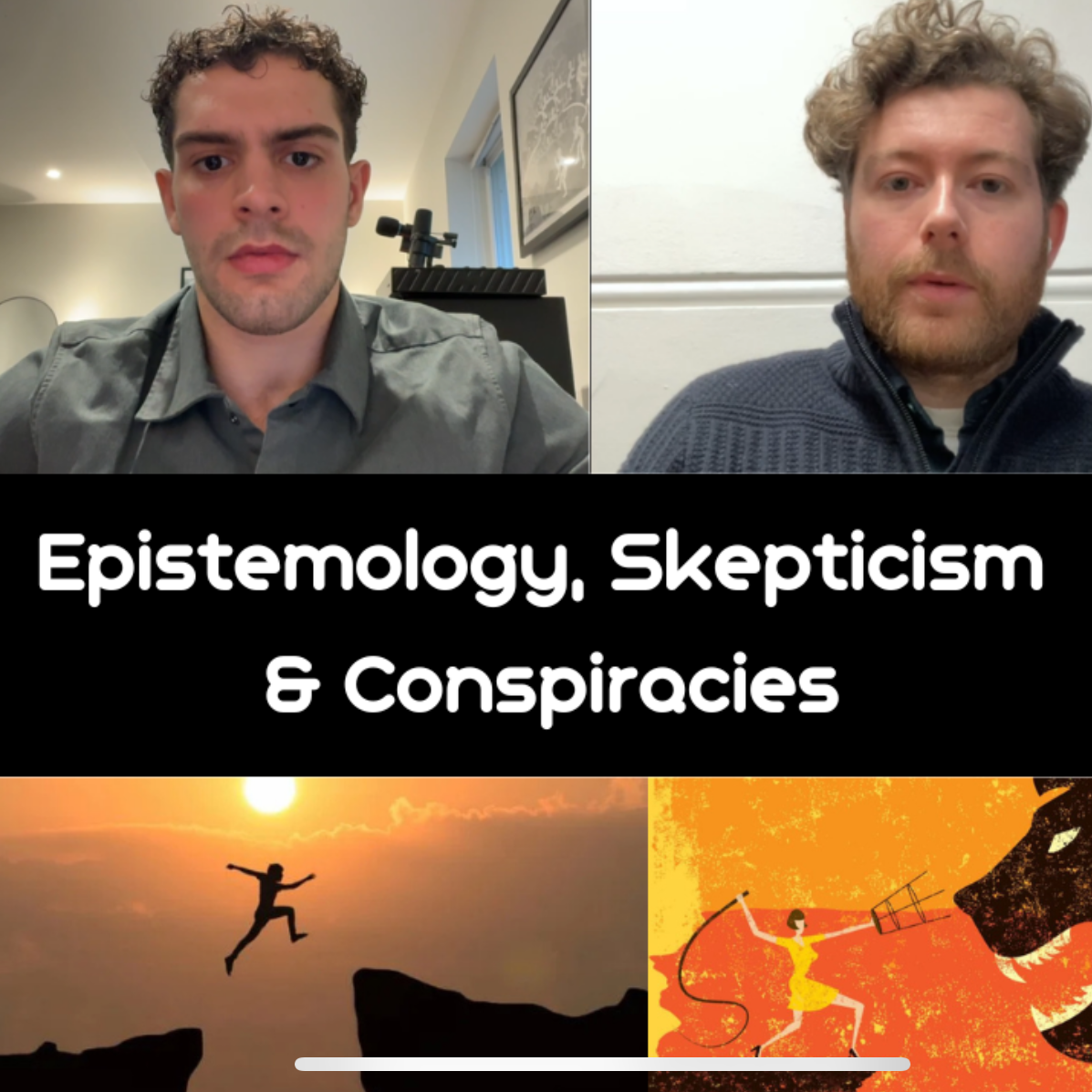
Dr Matthews on Virtue Epistemology, Skepticism & Conspiracy Theories
Dr. Matthews is a postdoctoral research fellow at the University of Southampton, studying the relationship between virtue epistemology, scepticism, and conspiracy theories as part of the Ethics of Doubt project. Join us for a conversation about knowledge, courage, and much more.
Is life worth living without inherent meaning? Wandering thoughts on the Myth of Sisyphus
Finn and I explore the Myth of Sisyphus, a man punished to push a rock up a mountain for eternity, only to fall down when he reaches the top. We talk about the double marathon I ran to put my self into the shoes of Sisyphus.
Wandering Thoughts on Artificial Intelligence 2/2
Finn and I continue our talk on artificial intelligence. We talk about Ian Banks’s novels of a future world that integrates AI well, we touch on what brings meaning to us in a world where AI does most jobs, and question if humans will date AI robots. Join us!
Wandering thoughts on Artificial Intelligence 1/2
Finn and I talk about Artificial Intelligence.
We touch on the AI race, Demis Hassabis, AGI and what would make an AI conscious. Join us!
Wandering Thoughts On Consciousness
In this episode, Finn and I explore consciousness. We walk through different philosophical frameworks of reality—such as materialism and idealism—and examine how our understanding of AI changes when we view it through these different lenses.
Wandering Thoughts on Attachment Theory
Finn and I talk about attachment theory. Attachment theory, developed by John Bowlby, explains how early relationships with caregivers shape our expectations of safety and connection. It argues that the need for closeness is a basic biological drive, not a weakness. Join us for this fun discussion
Wandering Thoughts on: Nothing By Frank Close
Finn and I discuss the book Nothing by Frank Close. Better audio next time.
Recommended

The Healer Revolution

Becoming: HER with Nikki Spoelstra

Booked, Blonde & Busy w/ Olivia Ponton

McKinsey on Consumer and Retail

megahired.com

Hard Knocks Podcast

Effective Weight Loss for Moms | High protein, Strength Training, Lose Weight, Meal Planning, Fat Loss, Healthy Habits

The Human-Animal Connection - Pet Life Radio Original

The Daily

World News Tonight with David Muir

English Vocabulary Help
The Joe Rogan Experience
