Whiskey & International Relations Theory
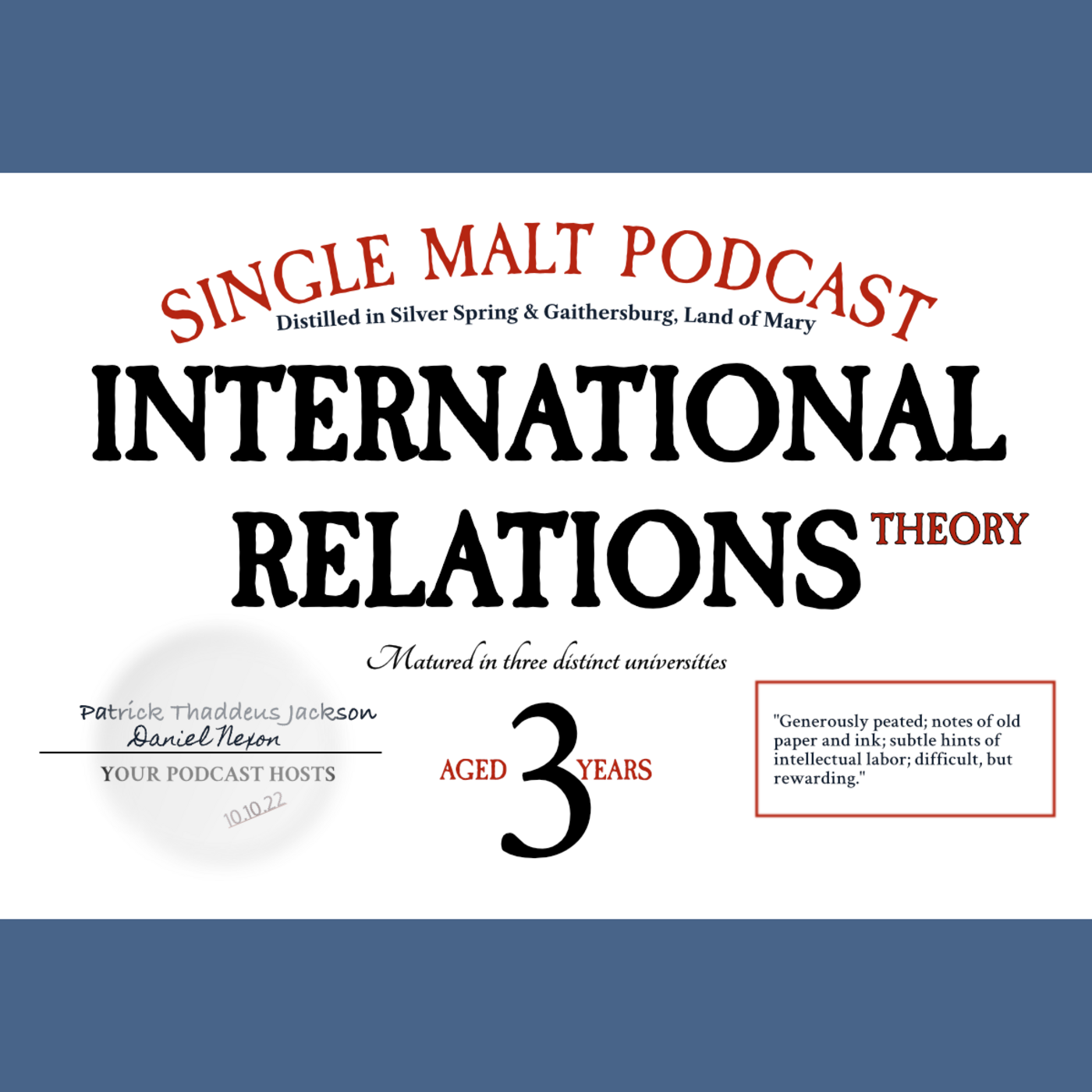
Patrick Thaddeus Jackson and Daniel Nexon, both international relations scholars, discuss important works in international relations theory. Each episode focuses on a particular scholarly book or article and unpacks its arguments in a conversational way. The hosts add a relaxed, informal tone by drinking whiskey while they talk, making academic theory more approachable.
Episodes
Episode 1: Gates of the West
We're baaack!In the inaugural episode of the second season of Whiskey and International Relations Theory, PTJ and Dan discuss Samuel Huntington's (in)famous 1996 book, The Clash of Civilizations and the Remaking of World Order. This episode's pairing: Glen Scotia Double Cask whisky. Other works mentioned include: Patrick Thaddeus Jackson, Facts and Explanations in International Studies...
Episode 33: Status? You Just Met Us!
[audio updated to fix a mixing error]The second installment of our live taping at the British International Studies Association annual convention in Glasgow is a "Whisky Optional" roundtable on status and international-relations theory. Our guests are: Ali Bilgic of Loughborough University, Michelle Murray of Bard College, Rohan Mukherjee of the London School of Economics, and Steven Ward
Episode 32: Social Forces, States, and Clydeside Whisky
Robert Cox's landmark article, "Social Forces, States and World Orders: Beyond International Relations Theory," appeared in the journal Millennium in 1981. Among other things, it introduced the distinction between "critical" and "problem-solving" theory to international-relations scholars. But this isn't just any old episode where Patrick and Dan ramble their way through some decades-old
Episode 31: Great Balls of Power
Back in 2019, Uri Friedman wrote that we "find ourselves—as you will have heard in the corridors of power and conference rooms of think tanks, and read in the government’s strategy documents and the media’s coverage of international relations—in an era of “great-power competition." "As Friedman noted, "great-power competition" has even" achieved hallowed acronym status—GPC..." It's been n
Episode 30: A Long, Strange Trek
It's our first "actual" installment of Whiskey & IR Theory in Space! We discuss Star Trek: The Next Generation's 'gay rights' episode, "The Outcast," which Dan uses to introduce his students to different modes of "reading" the politics of (and in) science fiction. PTJ and Dan summarize the episode (can you spoil an 30+ year-old TV show?), discuss their own reactions to it, and then Da
Episode 29: Introducing: Whiskey & IR Theory... in Space!
Patrick and Dan talk about the newest feature of the podcast: a series in which they combine their long-running seminars on (international) politics and science fiction.In each episode of "Whiskey & IR Theory... in Space!" Patrick and Dan will discuss a book, television episode, or film that they've assigned in classes past. Here, though, they introduce the series by talking about the
Episode 28: Are We Living in a Simulation... of Sovereignty?
PTJ and Dan discuss Cynthia Weber's 1994 book, Simulating Sovereignty: Intervention, the State and Symbolic Exchange. Weber examines "the justifications for intervention offered by the Concert of Europe, President Wilson's administration, and the Reagan-Bush administrations" and analyzes them via a combination of "critical international relations theory and foreign policy analysis." Topic
Episode 27: Everything is Relational
It's a nostalgia episode for our two hosts, Patrick and Dan.They tackle Mustafa Emirbayer's 1997 article in the American Journal of Sociology, "Manifesto for a Relational Sociology." According to Emirbayer, "Sociologists today are faced with a fundamental dilemma: whether to conceive of the social world as consisting primarily in substances or processes, in static 'things' or in dynamic,
Episode 26: Anarchy vs. The Anarchy
The University of Chicago's Paul Poast claims that G. Lowes Dickinson was the OG "modern" theorist of international relations—and also an "offensive realists." John Mearsheimer invokes Dickinson in Tragedy of Great Power Politics, but notes that Dickinson vocally supported the creation of the League of Nations. Brian Schmidt pays close attention to Dickinson in his work on the history of
Episode 25: The New Hierarchy Studies
Scholars of international relations don't agree on much, but they at least agree that anarchy (the lack of a common authority to make and enforce rules) is the defining feature of international politics, right? Not exactly. There's a long history of research that emphasizes the hierarchical character of international relations. Now a new wave of scholarship argues that international-relat
Episode 24: International Relations in China
What is the topography of international-relations theory in the People's Republic of China? What is the "Chinese School of International Relations?" Astrid Nordin (King's College, London), Yan Xuetong (Tsinghua University), and Qin Yaqing (Peking University) join the podcast to answer these – and other – questions about Chinese international-relations scholarship.
Episode 23: Being Academic and Pandemic Time
In this “Whiskey Optional” episode, PTJ facilitates a conversation among four colleagues from different countries and different kinds of academic institutions about the current global pandemic – not primarily about research on the pandemic, but about the experience of being an academic during the pandemic. Since part of that experience involves bringing our theoretical predilections to be
Episode 22: So a Deputy Foreign Minister and an Academic Realist Walk into a Bar
In 2014, John Mearsheimer authored a Foreign Affairs article in which he blamed that year's Ukraine crisis on the U.S., NATO, and the EU. The next year he gave a talk on the subject which the University of Chicago uploaded to YouTube.Last week the Russian Ministry of Foreign Affairs used excerpts from Mearsheimer's article and talk as part of its efforts to propagandize in favor of Russia
Episode 21: Constructivists All the Way Down
Is Constructivism best understood as a scholarly disposition, a body of theory, or an intellectual movement? Is it still relevant, or has it exceeded its shelf life? What if there are lots of Constructivists but they use different labels for their work?In our third "Whiskey Optional" episode, Dan Nexon sits down with Michelle Jurkovich (University of Massachusetts, Boston) . David McCourt
Episode 20: International Order
In this installment of "Whiskey Optional," Stacie Goddard (Wellesley), Evelyn Goh (Australian National University), and Kyle Lascurettes (Lewis and Clark) join the podcast. You'll never guess what the subject of discussion is. Unless you read the title of this episode. Then you'll know that it's about "International order." The panelists tackle such pressing questions as: What is internat
Episode 19: "W" Stands for "Canonical Realist"
PTJ and Dan pick up where they left off – on Chapter 5 of Arnold Wolfers' Discord and Collaboration. There's a lot going on, including a discussion of revisionism, the question of whether "friendship" is possible in world politics, and the distinction between "power" and "influence." They cover classic essays on, for example, the balance of power and "'National Security' as an Ambiguous S
Episode 18: Name Your Discord Server "and Collaboration"
Arnold Wolfers is one of the most important figures of "mainstream" mid-20th century international-relations theory, but is now mostly cited for his definition of "revisionism" and for perhaps his most famous essay, "'National Security' as an Ambiguous Symbol." Discord and Collaboration (1962) collects previously published essays and intersperses them with new ones that are aimed at makin
Episode 17: The Institutionalists Strike Back
Less than a year after the appearance of "The False Promise of International Institutions," the journal International Security published replies from Robert Keohane and Lisa Martin, John Ruggie, Clifford and Charles Kupchan, and Alexander Wendt. Patrick and Dan discuss this important moment in the "paradigm wars" of the 1990s and 2000s.
Episode 16: Promises, Promises
Patrick and Dan continue their nostalgic tour of 1990s international-relations theory and spend some time with John J. Mearsheimer's 1994 article "The False Promise of International Institutions." This episode runs over two hours, so you can always skip to: biographical material and the whisky selection (13:40); framing of the article (26:55); the article begins (33:50); realism according
Episode 15: Understanding Remains an Open Question
Patrick and Dan discuss J. Ann Tickner's 1997 article, "You Just Don't Understand: Troubled Engagements Between Feminists and IR Theorists." Topics include liberalism and feminist theory, articles as coalition-building efforts, and Australian whisky.
Episode 14: Campbell Writes Security, part 2
It's not quite Song of Ice and Fire territory, but we're sure a few people will be pleased that the second half of our discussion of David Campbell's Writing Security has dropped.
Episode 13: Campbell Writes Security, part 1
Patrick and Dan discuss a classic work of critical security studies, David Campbell's Writing Security. Topics include the construction of the Cold War and the film Rising Sun.
Episode 12: The Strange Regime
In a sequel (of sorts) to Episode 11, Patrick and Dan talk about Susan Strange's "Cave! hic dragones: a critique of regime analysis." Topics include a comparison of "American" and "European" IR, realism as critical theory, the evolution of liberal order (redux), and cats.
Episode 11: Embedded Liberalism
John Ruggie's 1982 article, which appeared in a special issue of International Organization on 'international regimes', is an important milestone for theories of hegemony, understandings of liberal (economic) order, and in the evolution of constructivism. Patrick and Dan revisit a piece they remember fondly from graduate school.
Episode 3: Bananas, Beaches and Bases, part 1
We discuss Cynthia Enloe's classic work of feminist international-relations theory. Note that this is a repost of the episode.
Episode 10: (Epilogue) Race and Securitization Theory
After we finished recording the material in Episode 9, we stayed on and talked some more. These are the parts we all agreed are worth posting. Featuring special guests: Jarrod Hayes, Nawal Mustafa, and Robbie Shilliam.
Episode 9: Race and Securitization Theory
Patrick and Dan host a panel discussion with Jarrod Hayes, Nawal Mustafa, and Robbie Shilliam. Their guests try to provide theoretical context for and some larger analysis of the recent controversy over claims that Securitization Theory is irredeemably marred by its putative reliance on colonial and racist scaffolding. This is a complete episode. The second part consists of an epilogue in
Episode 8: A Relational Theory of World Politics, part 2
Dan and Patrick finish out their discussion of Yaqing Qin's 2018 book. They focus on aspects of Qin's version of relational theorizing and reflect on some of his normative claims.
Episode 7: A Relational Theory of World Politics, part 1
Yaqing Qin's book marks, according to Astrid Nordin, a long-awaited "full-length English-language" outline of the "theorization of world politics by one of China's most influential and interesting scholars!" What did Patrick and Dan think of it? Listen to find out.
Episode 6: Wendt's (Article) World, part 2
The second half of our discussion of two of Wendt's most important articles in the development of "Constructivism" as an approach to the study of world politics.
Episode 5: Wendt's (Article) World, Part 1
Patrick and Dan talk about Alexander Wendt, drop some bits about the early history of Constructivism, and then discuss his important 1987 article, The Agent-Structure Problem in International Relations Theory. [Please note that older versions have some editing issues – which should be fixed now]
Episode 4: Bananas, Beaches and Bases, Part 2
We conclude our look at a classic work of feminist international theory. Note that Part 1 (Episode 3) displays out of order in some feeds.
Episode 2: Theory of International Politics, part 2
Patrick and Dan finish out their discussion of Waltz's classic work, Theory of International Politics.
Episode 1: Theory of International Politics, part 1
Patrick and Dan discuss Waltz's classic book and foundational text of structural realism, Theory of International Politics.
Recommended

Stand In The Circle
SLOW ENGLISH PODCAST (A1-A2) With Subtitles | Daily Videos | English With Us Podcast

Learn English A2 with Daily News | Simple English Listening Practice

پلی لیست | PlayList
Conspiracy Files with Paige Carter
Bad Friends

Learn 50 English Phrases While You Sleep | Everyday English Phrases & Vocabulary
This Past Weekend w/ Theo Von
Dateline NBC

Back to the 80s Radio

Crime Stories with Nancy Grace

Bible Tea
