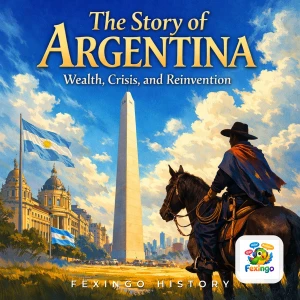
The Story of Argentina: Wealth, Crisis, and Reinvention — Fexingo History
This history podcast traces Argentina's transformation from a Spanish colonial outpost to one of the world's wealthiest nations and its subsequent cycles of crisis and reinvention. Hosts Lucas and Luna explore key political upheavals, including the Rosas dictatorship, Perón's populism, and the Dirty War, alongside the economic booms and busts from the grain export era through hyperinflation and the 2001 default. They also look at the cultural touchstones of Argentine identity, such as tango, football, Evita, and European immigration. The series continuously asks why a country with such resources fell into recurring chaos and what resilience and identity mean in that context.
Episodes

The 1953 Ezeiza Massacre: Perón's Turning Point
In 1953, Buenos Aires was the center of the world for labor rights, but beneath the celebrations lay a fracture line that would eventually split the movement. This episode explores the tense atmosphere leading up to the Ezeiza Massacre, focusing not on the famous 1973 event, but on the lesser-known violence of July 9, 1953. We look at how Juan Perón’s government handled internal dissent from anarc
The Yacyretá Dam: Argentina's Ecological and Political Disaster
In this episode, we trace the construction of the Yacyretá Dam on the Paraná River, a project that began in earnest during the military dictatorship of the late 1970s and ballooned into one of Latin America’s most costly infrastructure failures. We examine how the Corriente del Viento power station was built to generate electricity for Buenos Aires while flooding the Mbigua island ecosystem and di
The Secret War Behind Argentina's Golden Age
Argentina’s late 19th-century boom is often remembered for wheat exports and European immigration, but the foundation of that wealth was built on blood. This episode explores the Conquista del Desierto, General Julio Argentino Roca’s military campaigns that seized indigenous territory in Patagonia and the Pampas. We examine how the state justified this expansion as 'civilization' while systematica
The Forgotten War: Argentina's Defeat in the Paraguayan War
Episode 258 dives into the catastrophic conflict that nearly erased Argentina from the map: the War of the Triple Alliance. While previous episodes touched on the Gauchos and the Conquista del Desierto, this story reveals how those rugged frontier fighters were mobilized for a war against Paraguay that lasted five grueling years. We follow the disastrous campaigns of the early 1860s, where Argenti
The Secret Life of Borges: Myth, Mystery, and Magic
While most Argentine history focuses on political upheaval or economic collapse, this episode explores the quiet revolution of Jorge Luis Borges. We trace his journey from a childhood spent in Buenos Aires libraries to his role as a cultural icon who redefined Latin American literature. The conversation examines how his blindness shaped his visionary prose, his complex relationship with Peronism,
The Peróns and the Rise of Argentine Populism
This episode explores the explosive rise of Juan and Eva Perón in post-World War II Argentina, a period that fundamentally reshaped the nation’s political landscape. We trace how Colonel Juan Perón leveraged the labor unions, particularly the powerful CGT, to launch his presidential campaign in 1946. The narrative focuses heavily on Eva Duarte de Perón, whose transition from radio actress to the i
Argentina's Lost Railroads: The End of an Era
In the late nineteenth century, Argentina boasted one of the world's most extensive railway networks, a feat driven by British capital and the ambition of figures like Bartolomé Mitre. But by the 1940s, under Juan Perón, this foreign-owned infrastructure was nationalized in a move that reshaped the nation's economy and identity. This episode explores the rise of Ferrocarriles Argentinos, the compl
Argentina's 1905 General Strike: Labor's First Stand
In this episode of The Story of Argentina, Lucas and Luna explore the dramatic events of November 1905, when Buenos Aires was paralyzed by the first general strike in Latin American history. We look at how the Federación Obrera Regional Argentina (FORA) mobilized tens of thousands of workers across docks, bakeries, and tram lines, challenging the oligarchic government of President Roque Sáenz Peña
The 1982 Debt Crisis: Argentina's Economic Collapse
We trace the sudden unraveling of Argentina’s economic golden age in early 1982. Just months before the Malvinas War, a massive debt crisis triggered by global interest rate hikes and the peso devaluation sent the economy into freefall. We examine how President Raúl Alfonsín inherited this mess, the failed attempts to stabilize the currency with the Austral Plan later on, and the human cost of the
The Lost Jews of Argentina: The Toba Rebellion
This episode explores the tragic intersection of Jewish colonization efforts and indigenous resistance in early 20th-century Argentina. We examine the Baron de Hirsch Fund’s attempts to settle Jews in the Chaco Region, focusing on the Laguna Blanca colony. Lucas details how these settlers faced not just harsh environmental conditions, but also conflict with the Toba people who had inhabited the la
The Tango Wars: How a Dance Became Argentina's Soul
This episode explores the complex origins of tango, tracing its journey from the rough port districts of Buenos Aires to global sophistication. We examine the role of the lunfardo slang in shaping its lyrics, the cultural stigma that once labeled it vulgar, and the pivotal moment when European aristocracy embraced it as high art. Through the lives of figures like Carlos Gardel and the influence of
The Great Argentine Art Heist: Theft, Truth, and Identity
In this episode of The Story of Argentina, Lucas and Luna explore the audacious 2012 theft of Frida Kahlo’s 'Two Nudes' from the Museo Nacional de Bellas Artes. We trace the history of the museum itself, founded by Domingo Faustino Sarmiento’s vision of cultural enlightenment, and examine how the theft became a national scandal that forced a reckoning with institutional corruption and security fai
The Invisible Empire of the Argentine Pampas
We have talked about gauchos, independence, and political coups, but we haven't yet explored the invisible architecture that made Buenos Aires the richest city on earth in the late nineteenth century. This episode traces the rise of the estanciero class, those massive landowners who turned the pampas into a global breadbasket. We follow the story from the cattle drives to the frozen beef shipments
The Great Argentine Art Heist: Theft, Truth, and Identity
In 1994, a group of young men broke into the Museo Nacional de Bellas Artes in Buenos Aires and stole twenty-two paintings, including masterpieces by Frida Kahlo and Diego Rivera. This was not just a crime; it was a political statement born from the economic crisis that followed Argentina's neoliberal reforms. We explore how these students, calling themselves the 'Cuadrilla de los Nueve', justifie
The Yrigoyen Era: Argentina's Democratic Experiment
While previous episodes have explored the violent coups and economic crashes that define modern Argentina, this episode turns back to the early twentieth century to examine the rise of Hipólito Yrigoyen and the Radical Civic Union. We explore how universal male suffrage transformed a rigid oligarchy into a volatile democracy, detailing the 'Década Infame' that followed his second term. The convers
The Argentine Weight Watchers: How a Single Coin Tamed Inflation
In 1991, Argentina was drowning in hyperinflation that had rendered the peso worthless, with prices doubling every few days and citizens carrying bags of cash for basic goods. This episode traces the radical intervention by Economy Minister Domingo Cavallo, who engineered the Convertibility Plan to anchor the peso one-to-one with the US dollar. We explore the immediate shock therapy that stabilize
The Rise of the Toba Rebellion and Jewish Colonization
While Argentina’s history is often framed through European immigration and urban politics, the Chaco Region tells a different story. This episode explores the Baron de Hirsch’s ambitious project to settle Jewish refugees in the Argentine wilderness at Laguna Blanca and Moises Ville. We trace how these settlers clashed with the indigenous Toba people, leading to the violent uprisings known as the T
Argentina's White Fleet: The 1950s Space Program
Long before Argentina became a regional leader in satellite technology, it launched an ambitious, largely forgotten space program in the 1950s. This episode explores the Comisión de Investigaciones Espaciales (CIE) and its visionary head, Julio María Sala, who sought to put Argentine rockets in orbit during the height of the Cold War. We examine the collaboration with German V-2 engineers like Con
The Lost City of La Plata: Argentina's Utopian Blueprint
In 1882, Argentina’s president Domingo Faustino Sarmiento envisioned a capital city that would defy the chaos of Buenos Aires. He chose a site on the Río de la Plata to build La Plata, a city designed with perfect geometry, wide avenues, and green spaces intended to symbolize modernity and order. This episode explores the ambitious urban planning of architect Pedro Benoit, who laid out the grid ba
The Gauchos of the Pampas: Argentina's Wild Frontier
Long before the skyscrapers of Buenos Aires rose, the Argentine Pampas were ruled by horsemen who shaped a nation’s identity. This episode explores the golden age of the gaucho in the early nineteenth century, focusing on figures like Facundo Quiroga and the brutal politics of the frontier. We examine how these mounted cowboys navigated the power struggle between Unitarians and Federalists, often
The 1982 Malvinas War and Argentina's Identity
On this episode, Lucas and Luna explore the Falklands War, known in Argentina as the Guerra de las Malvinas. We look at the political miscalculations of General Leopoldo Galtieri and the Junta Militar that led to the invasion in April 1982. The conversation details the harsh reality of the conflict on the ground, from the freezing conditions of Goose Green to the naval blockade enforced by HMS End
The Rise and Fall of the Argentine Peso
In this episode, we trace the volatile history of Argentina’s currency, from the gold-standard stability of the late 19th century to the hyperinflation crises of the modern era. We explore how the Banco de la Nación played a central role in economic policy, often conflicting with private banks and international creditors. The conversation examines the 'convertibility' plan of the 1990s under Carlo
The Great Argentine Bank Heist of 1927
In the golden decade of the 1920s, Buenos Aires was a beacon of modernity, boasting electric trams and skyscrapers that rivaled Paris. Yet beneath this veneer of wealth lay a fragile economy dependent on foreign capital and volatile agricultural exports. In March 1927, this tension erupted in one of the most audacious crimes in Latin American history: the Banco de la Nación robbery. Led by a myste
The 1976 Coup and the Silent Victims
We revisit Argentina’s darkest chapter by focusing on the human cost of the 1976 military coup, rather than just the political maneuvering. Lucas and Luna explore the rise of the Proceso de Reorganización Nacional under Jorge Videla and the systematic terror orchestrated through ESMA. We discuss the role of Operation Condor in coordinating repression across South America and highlight the courageo
The White Fleet: Argentina's 1950s Space Program
Long before the V-2 rockets or Sputnik, Argentina was building its own orbital ambitions in the 1950s. This episode explores the story of the Comision de Investigaciones Espaciales (CIE) and its charismatic director, Dr. Julio María Sala. We trace how a small group of physicists and engineers in Buenos Aires managed to launch sounding rockets that reached the edge of space, despite political insta
Argentina's Lost Jews and the Toba Rebellion
In this episode, we uncover a startling chapter of Argentine history often overlooked in mainstream narratives: the intersection of Jewish philanthropy and indigenous resistance in the Chaco region. We explore the Baron de Hirsch Fund’s efforts to resettle European Jews on agricultural colonies like Laguna Blanca in the late nineteenth century, hoping to provide refuge from pogroms. But the land w
The Patagonian Uprising and the Cost of Order
In this episode, we turn our attention to the violent suppression of the 1920–1922 Patagonia Rebelde strikes, a chapter of Argentine history often overshadowed by urban politics. We examine the role of General Héctor Benigno Varela, appointed by President Marcelo Torcuato de Alvear to restore order in the southern ranches. The narrative explores how the Federación Agraria Argentina and anarchist u
The Patagonian Uprising: Argentina's Forgotten Revolution
In this episode, we explore the chaotic and often overlooked events of the 1920s in southern Argentina, focusing on the Patagonia Rebelde. We look at how the influx of European immigrants and the global economic boom created a fragile labor movement among sheep workers, which was brutally crushed by General Héctor Benigno Varela under the orders of President Marcelo Torcuato de Alvear. This wasn't
The Yacyretá Dam and the Parana Forest
This episode explores the environmental and social catastrophe of the Yacyretá Dam on the Paraná River, a project that began in the late 1970s and dragged into the new millennium. We examine how the dictatorship initially pushed the dam for energy independence while ignoring the displacement of indigenous communities like the Guaraní. The narrative follows the corruption scandals of the 1980s, whe
Argentina's Hidden Jewish Legacy: The Toba Rebellion
While we often trace Argentina’s modern identity through European immigration and the rise of Peronism, there is a profound, lesser-known chapter involving the country’s indigenous nations and a surprising wave of cultural transformation. In this episode, we explore the life and legacy of Father Alberto Hurtado, a Jesuit priest whose work with street children in Santiago and Buenos Aires became a
The Andes Cable Car That Conquered Argentina
In 1930, a young engineer named Julio Martínez proposed the unthinkable: span the massive gap between Buenos Aires and Córdoba with a cable car. The Ciudad Voladora project was a masterpiece of Art Deco engineering and national pride, designed to showcase Argentina’s industrial might on the eve of the Great Depression. We explore the ambitious blueprints, the political backing from President Hipól
Argentina's Forgotten War of Independence
We’ve spent the last twenty episodes mapping the physical and political landscape of modern Argentina, from the speculative land booms of the 1880s to the social upheavals of Peronism. But before Buenos Aires became the Paris of South America, there was a brutal, fragmented struggle for sovereignty that is often overshadowed by San Martín’s campaigns in Chile and Peru. This episode turns our gaze
The Lost Forests of the Argentine Litoral
This episode explores the ecological and cultural collapse of the Atlantic Forest, known locally as the Selva Paranaense. We trace the history from the indigenous Guaraní people who thrived there to the modern-day destruction driven by soy monoculture and hydroelectric dams like Yacyretá. Lucas and Luna discuss how the region's biodiversity was prioritized for export crops, leaving behind fragment
The Great Argentine Bank Heist of 1927
In the mid-1920s, Buenos Aires was a city of glittering facades and deep secrets. While the world celebrated Argentina's agricultural wealth, a quiet conspiracy was forming in the shadows of the financial district. This episode explores the 1927 Banco de la Nación incident, where a group of insiders orchestrated one of the most audacious bank heists in South American history. We follow the trail f
Argentina's 1976 Coup: The Silent Victims of Dirty War
This episode examines the military coup of March 24, 1976, which overthrew President Isabel Perón and initiated the Proceso de Reorganización Nacional. We focus on the systematic campaign of state terrorism known as the Dirty War, specifically the practice of forced disappearances where tens of thousands of citizens were detained in clandestine centers like ESMA. We explore the role of Operation C
Argentina's Lost Forests: The Atlantic Forest Collapse
While we’ve covered the political upheavals of Peronism and the military coups that shook Buenos Aires, there is a quieter, more devastating history unfolding in the shadows of those events. This episode explores the rapid destruction of Argentina’s Litoral region during the mid-twentieth century. We look at how state-sponsored logging, driven by nationalistic infrastructure projects like the Yacy
The Tragic Fall of Eva Perón: Fever, Power, and Legacy
This episode explores the final, devastating months of Eva Duarte de Perón’s life in 1952. We trace her rapid decline from a global icon to a dying woman, examining how her political power grew even as her body failed under metastatic cancer. Lucas details the secret medical treatments, the massive public mourning, and the immediate aftermath of her death, which reshaped Argentina’s political land
The Forgotten War That Shaped Argentina
This episode explores the complex and often overlooked legacy of the Triple Alliance War, particularly focusing on the internal dynamics and the role of Francisco Solano López. We examine the Battle of Riachuelo, a pivotal naval engagement that shifted the momentum of the conflict, and the subsequent campaigns like Tuyutí and Cerro Corá. The narrative delves into the human cost borne by Paraguay a
The Forgotten War That Shaped Argentina
In this episode, we explore the War of the Triple Alliance, one of the deadliest conflicts in Latin American history. We focus on Paraguay under Francisco Solano López and the devastating impact on its population. The war pitted Paraguay against Brazil, Argentina, and Uruguay from 1864 to 1870. We examine how López’s strategic errors and industrial ambitions led to national ruin. Lucas and Luna di
The Argentine General Who Defied Perón
In this episode of The Story of Argentina, Lucas and Luna explore the complex legacy of General Juan Domingo Perón through the lens of his most prominent critic: General Eduardo Lonardi. While history often simplifies mid-century Argentina into a binary struggle between Peronism and its enemies, the reality was far more fractured. We dive into the immediate aftermath of the 1955 Revolución Liberta
The Rise of Yrigoyen and Argentina's Democratic Experiment
This episode explores the political ascent of Hipólito Yrigoyen, leader of the Radical Civic Union, and his pivotal role in dismantling the oligarchic grip on Argentine politics. We examine the Sáenz Peña Law of 1912, which introduced secret male suffrage, and how it led to Yrigoyen’s unexpected victory in 1916. The narrative details his first presidency (1916–1922), focusing on his efforts to reg
The Forgotten Massacre of Curupayty
In 1865, the Triple Alliance War began not with a bang, but with a catastrophic miscalculation. While previous episodes have touched on the cholera outbreaks and the diplomatic tensions leading up to the conflict, this episode dives into the Battle of Curupayty, where Paraguay’s entrenched defenses decimated the combined forces of Brazil, Argentina, and Uruguay. We explore how Francisco Solano Lóp
The Forgotten Women of Argentina's Peronism
While Juan Perón and Eva Duarte dominate the narrative of mid-century Argentina, a quieter but equally powerful force shaped the movement: Evita’s sister, Alicia Mignacce. This episode explores the complex relationship between the two sisters, the rise of the Female Peronist Party, and the pivotal role women played in securing political power long before universal suffrage was fully realized. We e
The 1880s Buenos Aires Water Crisis: Cholera and the Sewer
In 1880, Buenos Aires was a city of horse-drawn carts, Italian immigrants, and an invisible disease that could empty a block in a week. This episode traces the cholera outbreak that exposed the limits of the city's water system — a network of shallow wells and open ditches that turned the Riachuelo into a source of death. We follow the doctors who mapped the epidemic, the engineers who pushed for
The 1880s Sheep Boom: Wool, Estancias, and Argentina's Global Stake
In the 1880s, Argentina rode a wool wave that transformed the pampas and connected Buenos Aires to the world's textile mills. This episode explores the rise of sheep farming, the estancia system that consolidated land and wealth, and the figures like José María Bustillo who built vast flocks. We trace the cycle from merino and Lincoln sheep to the export boom that made Argentina a commodity powerh
Argentina's 1910 Centenary: Riots, Bombs, and the Birth of Modern Buenos Aires
In 1910, Argentina celebrated a hundred years of independence with grand European-style festivities in Buenos Aires — but under the surface simmered class war. In this episode, Lucas and Luna explore how the centenary nearly went up in flames. They follow the anarchist bombings that closed the Opera House, the police crackdown that led to the death of a young boy, and the cautious liberal presiden
The 1878 Smallpox Epidemic and Buenos Aires' Vaccine War
In 1878, Buenos Aires confronted a smallpox epidemic that killed thousands and sparked a bitter public health battle over vaccination. This episode explores how the city's response under President Nicolás Avellaneda and the Society of Beneficence clashed with the antivaccination movement, leading to violent protests and a pivotal Supreme Court decision. We follow the work of doctors like José Marí
Argentina's 1918 Flu: The Spanish Flu in Buenos Aires
In 1918, the Spanish Flu arrived in Argentina through the port of Buenos Aires, carried by ships from Europe and North America. The epidemic hit the city hard, killing thousands, and exposed deep inequalities in housing and healthcare. This episode follows the virus's spread through the conventillos and barrios, the government's response under President Hipólito Yrigoyen, and the work of doctors l
The 1887 Grain Elevator That Gave Buenos Aires Its Skyline
In 1887, Buenos Aires got its first modern grain elevator, a concrete tower at Puerto Madero that would transform Argentina's export economy and reshape the city's silhouette. This episode follows the construction of the elevator, the engineers who designed it, and the dockworkers who unloaded the pampas' bounty into its silos. It's a story of wheat, steam, and the politics of port expansion — the
The 1910 Pestilence That Shaped Buenos Aires' Future
In 1910, Buenos Aires was a city of grand centennial celebrations — but beneath the fanfare, an invisible enemy was about to strike. This episode follows the bubonic plague outbreak that hit Argentina's capital during its hundredth anniversary of independence, revealing the fragile state of public health in a rapidly growing metropolis. We trace the arrival of the plague aboard ships from Brazil,
The 1885 Conventillo Fire That Changed Buenos Aires
In 1885, a devastating fire swept through a conventillo in the heart of Buenos Aires, killing dozens and exposing the brutal living conditions of the city's poor. This episode tells the story of that night, the overcrowded tenements that packed immigrants and criollos into disease-ridden rooms, and the public outrage that forced Argentina's elites to confront the slums they had long ignored. Throu
Argentina's 1882 Land Boom: The Speculative Frenzy That Shaped the Pampas
In 1882, Argentina was in the grip of a speculative land boom. As the Conquest of the Desert opened vast territories in Patagonia and the pampas, a wave of land fever swept through Buenos Aires. This episode tells the story of how the government of Julio Argentino Roca turned military conquest into a massive land giveaway, enriching a small elite and creating the latifundia system that still shape
The 1880 Federalization of Buenos Aires: City vs. Nation
In 1880, Argentina's capital city became a federal district, ending decades of tension between Buenos Aires province and the rest of the nation. This episode explores the political crisis, the armed uprising led by Carlos Tejedor, and the national government's victory under Nicolás Avellaneda. Lucas and Luna delve into the role of the National Guard, the Buenos Aires militia, and the final negotia
The 1874 Revolt of Mitre: Argentina's Civil War Aftermath
In 1874, Argentina's founding president Bartolomé Mitre took up arms against the government of Nicolás Avellaneda, igniting a brief but bloody civil war. This episode unravels the political crisis triggered by the fraudulent election of 1874, Mitre's alliance with the Autonomists, and the dramatic naval battle at Vuelta de Obligado. We follow the rebellion from its stirring call in Buenos Aires to
The 1876 Gaucho Revolt That Ended an Era
When the pampas caught fire in 1876, the gaucho world — free, horseback, untamable — made its final stand against the modernizing state. Lucas and Luna trace the last great rebellion of Argentina's rural horsemen, from its roots in the hated Ley de Leva conscription law to its crushing end under Julio Argentino Roca. They follow the rebel leader Gerónimo Solané, a man who rallied thousands of gauc
The 1876 Uprising of the Gauchos: Argentina's Last Rebellion
In 1876, as Argentina's elites celebrated the triumph of progress and the nation's integration into global markets, a group of gauchos in the province of Buenos Aires rose up in a desperate last stand against the forces of modernization. This episode explores the little-known rebellion led by Gerónimo Solané, a charismatic caudillo who rallied rural workers, small ranchers, and indigenous allies a
The 1946 Election That Made Peronism
In 1946, Argentina stood at a crossroads. The military government that had ruled since 1943 was finally calling elections, but the man everyone expected to win — Juan Perón — had been jailed just months before. This episode follows the extraordinary campaign that followed: Perón's release, his alliance with the labor movement, the infamous 'blue book' that backfired, the role of the descamisados,
The 1955 Buenos Aires Bombing and Peron's Fall
In June 1955, fighter jets from Argentina's own navy dropped bombs on Plaza de Mayo, killing over 300 civilians in an attempt to kill Juan Perón. This episode digs into that shocking moment — the feverish political climate, the internal church-state conflict that exploded after Perón legalized divorce and prostitution, the burning of churches that followed, and the failed coup that somehow ended w
Argentina's 1943 Revolution: The Origins of Peronism
In June 1943, a group of nationalist army officers overthrew Argentina's conservative government in a coup that would reshape the nation. This episode traces the GOU's rise, the role of figures like Pedro Pablo Ramírez and Edelmiro Farrell, and the unexpected ascent of Colonel Juan Perón from obscure labor official to vice president by 1944. We explore the coup's causes—fraud, corruption, and the
The 1865 Cholera War: Parana, the La Plata, and a Forgotten Frontier
In this episode, Lucas and Luna travel back to 1865, when the Triple Alliance War was just beginning and the Paraná River became a highway for disease. While Paraguay's Francisco Solano López marshaled troops, cholera crept upriver from the Atlantic, hitting the Allied river fleet at Corrientes and then the Argentine city of Paraná. Lucas unpacks how an outbreak that killed thousands — including t
The Day Buenos Aires Burned: The 1919 Tragic Week
One week in January 1919, Buenos Aires erupted. A strike at the Vasena metalworks spiraled into a citywide pogrom, as police, military, and armed civilian brigades hunted down workers and Russian-Jewish immigrants. Lucas and Luna walk through the Semana Trágica, from the first picket lines to the death squads, the role of the anarchist FORA and the socialist daily La Vanguardia, the tangled respon
Argentina's 1880 Conquest of the Desert in 200 Episodes
In the 200th episode of The Story of Argentina, Lucas and Luna step back from the narrative to examine the tools of history itself: maps, archives, and the digital projects reshaping how we understand Argentina's past. They revisit the Conquista del Desierto through the lens of digital mapping, explore how archives like the Archivo General de la Nación are being digitized, and discuss the rise of
Argentina's Gaucho: Myth, Reality, and the New Republic
In the 199th episode of The Story of Argentina, hosts Lucas and Luna take a fresh look at the gaucho — not as a romantic symbol, but as a real figure of the pampas whose world was upended by the rise of the estancia system. They trace the gaucho's origins among the mestizo horsemen of the colonial frontier, the criminalization under Juan Manuel de Rosas, and the eventual mythologizing in Martín Fi
The River of Silver: Argentina's Riachuelo and Its Legacy
In episode 198 of The Story of Argentina, Lucas and Luna trace the history of the Riachuelo, the river that shaped Buenos Aires and the nation. From its role as a highway for colonial silver and the establishment of the first settlement in 1536, to the slaughterhouses of the 19th century and the industrial pollution of the 20th, the Riachuelo is a mirror of Argentina's rise and struggles. Learn ab
The 1936 Wheat Boom and Argentina's El Dorado Myth
In 1936, Argentina's wheat harvest seemed like a miracle — bumper crops, soaring prices, and a government convinced the country had finally found its economic footing. But the boom was built on sand. This episode digs into the brief, dazzling wheat bonanza that promised to make Argentina the breadbasket of the world, and the structural cracks it concealed: land concentration, fragile export depend
The Silent Epidemic: Argentina's 1921 Famine in Santiago del Estero
In 1921, while Buenos Aires celebrated its centennial of independence, a famine swept through Santiago del Estero, a province most Argentines barely knew existed. This episode uncovers the forgotten crisis that exposed the limits of the country's export boom and the resilience of its rural poor. We follow the desperate migration of tens of thousands of criollos and indigenous people fleeing hunger
The 1940 Earthquake That Shook Argentina's Silence
In January 1940, a massive earthquake struck San Juan, leveling the provincial capital and killing thousands. But the disaster's aftermath exposed a deeper fragility in Argentina's national identity. As Lucas and Luna explore, the quake shattered not only buildings but also the myth of a modern, progressive nation. They trace the political fallout, the rise of catastrophic relief efforts, and the
The 1871 Yellow Fever Epidemic That Reshaped Buenos Aires
In 1871, Buenos Aires was a city on the rise, but a catastrophic yellow fever outbreak would kill thousands and forever change its social geography. This episode follows the epidemic from its first suspected cases in the working-class neighborhoods of San Telmo and Montserrat to the mass exodus of the wealthy to the northern suburbs, a flight that accelerated the city's north-south divide. We meet
The 1929 Meat Packing Strike: Buenos Aires' Forgotten Labor War
In 1929, as the Great Depression loomed, workers at the Swift and Armour meat packing plants in Berisso, near Buenos Aires, walked off the job in a strike that would reshape Argentina's labor movement. The strike, led by anarchists and communists, became a brutal test of state power under President Hipólito Yrigoyen. This episode follows the conflict from the first walkout to the violent crackdown
The 1868 Cholera Epidemic: Buenos Aires' Dark Summer
In 1868, a cholera epidemic swept through Buenos Aires, killing thousands and exposing the fragile infrastructure of a city on the rise. This episode of The Story of Argentina follows the outbreak's arrival via the port, the chaotic response by provincial authorities, and the heroic efforts of doctors like Dr. Francisco Muñiz, who stayed to treat the sick. We explore how the epidemic deepened clas
The 1809 Decembrist Uprising: Buenos Aires' First Cry for Independence
In this episode, Lucas and Luna step back from the well-known May Revolution of 1810 to uncover the failed 1809 Decembrist uprising in Buenos Aires — a conspiracy that nearly toppled Spanish colonial rule a full eight months early. Meet the ringleaders: Martín de Álzaga, the Spanish-born merchant who championed free trade; the criollo officers like Juan Antonio Fernández; and the French agent Satu
The Tragedy of Toba: A Native Nation's Last Stand
In 1917, the last great armed resistance of Argentina's native peoples came to a bloody end in the Chaco region. This episode follows the story of the Toba people, their decades of resistance against criollo expansion, and the massacre that marked the final defeat of indigenous sovereignty in the country. We look at the role of the Argentine Army, the Franciscan missions, and the cotton economy th
The Curious Death of Juan Lavalle: A Caudillo's End
In this episode of The Story of Argentina, Lucas and Luna dig into the strange and violent end of Juan Lavalle, the Unitarian general who survived exile and war only to be shot by a federalist firing squad in 1841 — and whose body was then smuggled across the Andes in a dramatic odyssey. They trace his role in the Argentine civil wars, his rivalry with Juan Manuel de Rosas, and the circumstances o
The 1919 Tragic Week: Buenos Aires Labor Uprising
In January 1919, Buenos Aires exploded. A strike at the Vasena metalworks became a general strike, then a pogrom, then a military clampdown that left hundreds dead. Lucas and Luna take you through the Semana Trágica, the role of the anarchist FORA and the syndicalist FOA, the police and military repression led by Luis Dellepiane, and the vigilante groups that attacked Jewish workers in Villa Cresp
Argentina 1930: The Coup That Ended an Era
In this episode, Lucas and Luna explore the military coup of September 6, 1930, which overthrew President Hipólito Yrigoyen and launched the so-called 'Infamous Decade' in Argentina. They discuss the economic turmoil of the Great Depression, Yrigoyen's faltering second term, the role of the military under General José Félix Uriburu, and the birth of a pattern of military intervention that would ha
The Revolution of 1890: Argentina's First Popular Uprising
In 1890, Argentina's export boom suddenly collapsed when the Baring Brothers bank failed, triggering a severe financial crisis. Amid soaring unemployment and political corruption, a new opposition movement called the Unión Cívica rose up. This episode tells the story of the Revolución del Parque — the armed uprising that shook Buenos Aires, forced President Miguel Juárez Celman to resign, and gave
Argentina 1910: The Centennial and the Myth of Progress
In 1910, Argentina threw a lavish centennial party to celebrate a hundred years since the May Revolution. The festivities showcased Buenos Aires as the 'Paris of South America'—with grand avenues, opera houses, and an influx of European immigrants. But beneath the glittering surface, social inequality simmered: anarchists and socialists organized strikes, the rural poor were excluded from the boun
Eva Perón and the Fundación That Transformed Argentina
In this episode, Lucas and Luna dive into the remarkable story of Eva Perón and the foundation she built between 1946 and 1952. More than a first lady, Evita created a parallel welfare state that built hospitals, schools, and housing for Argentina's descamisados. We explore the Fundación Eva Perón's enormous reach, from its medical campaigns to the controversial European tour she called the 'Rainb
The Bombing of Plaza de Mayo: Perón's 1955 Fall
In June 1955, Argentine navy and air force planes bombed Plaza de Mayo, killing hundreds in an attempt to kill Juan Domingo Perón. The attack failed, but three months later a military coup—the Revolución Libertadora—succeeded, sending Perón into exile. This episode traces the unraveling of Perón's second term, the devastating aerial assault on Buenos Aires, and the brutal crackdown that followed.
Argentina 1945: The Day the Descamisados Took the Plaza
On October 17, 1945, hundreds of thousands of workers converged on Buenos Aires' Plaza de Mayo to demand the release of Juan Domingo Perón. This episode tells the story of that pivotal day—how Perón, as Secretary of Labor, had built a base among the descamisados (shirtless ones), the opposition that jailed him, and the mass mobilization that forced the military to free him. We explore the symbolis
Recommended

Effective Weight Loss for Moms | High protein, Strength Training, Lose Weight, Meal Planning, Fat Loss, Healthy Habits

The Human-Animal Connection - Pet Life Radio Original

Infinite Health with Dr. Arasi Maran

The Daily

World News Tonight with David Muir

The Joe Rogan Experience

English Vocabulary Help

TED Talks Daily

Learn English B1 with Daily News | English Listening Practice

Talk About Talk - Executive & Leadership Communication Skills

English with Olivia | Slow Conversations & Vocabulary

Stand In The Circle
