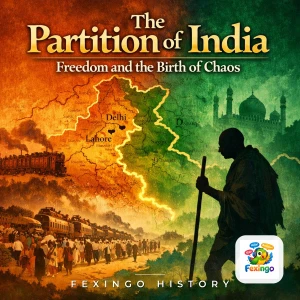
The Partition of India: Freedom and the Birth of Chaos — Fexingo History
Lucas and Luna examine the end of British rule in India and the violent partition of 1947 that created India and Pakistan. The series covers the 1935 Government of India Act, the Radcliffe Line, and figures such as Jinnah, Nehru, and Mountbatten. It explores the Lahore Resolution, the Calcutta killings, mass migrations, and the experiences of Sikhs and Kashmir. Through letters, memoirs, and survivor accounts, the hosts ask whether partition could have been avoided and how its wounds still shape South Asia today.
Episodes

The Radcliffe Line: The Two Weeks That Redrew South Asia
In 1947, British lawyer Cyril Radcliffe was handed a map of India and given five weeks to draw the border between two new nations. He arrived in Delhi with no prior knowledge of the region’s complex geography, relying on crude maps and incomplete data. Within days, he produced a boundary line that split villages, severed irrigation canals, and separated communities that had lived together for cent
Partition's Forgotten Doctors: The Medical Crisis of 1947
While historians obsess over maps and politicians, the human cost of Partition was also measured in gallons of blood lost to infection and gangrene. This episode explores the desperate medical infrastructure that collapsed under the weight of ten million refugees. We follow Dr. Nalini Ranjan Sarkar, who organized mobile surgical units in Punjab, and the chaotic triage at Malaviya Camp in Delhi. Wi
Gandhi's Fast and the Radcliffe Line
While historians have extensively covered the bureaucratic mechanics of the Radcliffe Line and the mass migrations that followed, this episode examines a different kind of boundary: the moral and political line drawn by Mahatma Gandhi in Delhi during October 1947. As communal violence erupted in the capital, Gandhi initiated an unprecedented hunger strike against Prime Minister Jawaharlal Nehru’s
Partition's Hidden Architects: The Clerks Who Redrew South Asia
While history remembers Lord Mountbatten and Muhammad Ali Jinnah, the line that split India was drawn by two men who had never set foot in the subcontinent. This episode explores the extraordinary story of Cyril Radcliffe and Sir Francis Mudie, tasked with dividing a population of four hundred million in just five weeks. We look at how they relied on local clerks like David Richardson and Henry Du
The Great Calcutta Killings: Partition's Bloodiest Week
This episode examines the Direct Action Day riots of August 1946 in Calcutta, often called the Great Calcutta Killings. We explore how Muhammad Ali Jinnah’s call for mass civil disobedience triggered three days of communal violence that left thousands dead and set the stage for the 1947 partition. Lucas details the role of Lord Wavell, the British Indian Army’s hesitation, and the political maneuv
Mountbatten's Secret: The 48-Hour Delay
Most histories focus on the Radcliffe Line’s drawing or the refugee crisis, but Episode 253 uncovers a pivotal moment of administrative chaos: the forty-eight-hour delay in announcing Partition. We explore why Lord Mountbatten moved the date from June 30 to August 17, and how this decision created a legal vacuum that allowed violence to metastasize. Lucas and Luna discuss the strategic reasoning b
The Radcliffe Line: How Two Weeks Redrew South Asia
In 1947, British lawyer Cyril Radcliffe arrived in India with barely any maps and just five weeks to draw the border between India and Pakistan. This episode explores the administrative chaos behind the Radcliffe Line, focusing on the Punjab and Bengal Boundary Commissions. We examine how local clerks like David Richardson and Henry Dunning struggled with incomplete census data and conflicting rel
Partition's Forgotten Bureaucrats: The Men Who Drew the Line
While history remembers Cyril Radcliffe and the political leaders who carved up South Asia in 1947, it often overlooks the exhausted clerks, surveyors, and junior administrators who did the actual work of drawing the Radcliffe Line. This episode explores the human cost borne by these unsung figures, from Sir Francis Mudie’s frantic mapping in Lahore to the British officials who arrived with little
The Radcliffe Line: Secrets of the 47-Day Boundary
In this episode, we pull back the curtain on one of history’s most astonishing administrative feats: how British lawyer Sir Cyril Radcliffe drew the border between India and Pakistan in just five weeks. We explore the impossible constraints he faced—never having visited the subcontinent, working from outdated maps, and lacking local advisors—and the sheer logistical chaos that followed. The narrat
The Radcliffe Line: How Two Weeks Redrew South Asia
In this episode, we explore the creation of the Radcliffe Line, the border that split India and Pakistan in 1947. We examine how British lawyer Cyril Radcliffe arrived in India with no prior knowledge of the region, yet was given just five weeks to draw a boundary affecting hundreds of millions of people. The conversation delves into the bureaucratic chaos, the reliance on outdated census data, an
Partition's Forgotten Clerks: The Men Who Drew the Line
While history often focuses on the political giants like Mountbatten, Jinnah, and Nehru who announced Partition, this episode turns its lens to the quiet architects of chaos. We explore the role of Sir Cyril Radcliffe, a British judge with no prior knowledge of India, who was handed the impossible task of drawing the borders for Punjab and Bengal in just five weeks. Through the eyes of civil serva
Partition's Last Refugees: The Migrants of 1947
While we have explored the mapmakers, the violence, and the political architects of India's partition, Episode 247 turns its lens to the millions who became strangers in their own homes. We examine the sheer logistical nightmare of the Great Migration, focusing on the human experience of the refugees who walked across the newly drawn Radcliffe Line. Lucas and Luna discuss the specific conditions f
Partition's Hidden Architects: The Clerks Who Redrew South Asia
We often focus on the grand political figures of 1947, but the actual division of Punjab and Bengal was executed by a small team of British civil servants working under extreme duress. This episode examines the work of Sir David Richardson, Henry Dunning, and their teams at the Punjab and Bengal Boundary Commissions, who had only five weeks to demarcate borders across millions of acres of complex,
Partition's Forgotten Villages: The Radcliffe Line's Human Cost
While we have covered the political architects and the map-drawing clerks who sliced South Asia in half, this episode turns to the villages that simply vanished overnight. We explore how the sudden imposition of the Radcliffe Line on August 17, 1947, left entire communities stranded on the wrong side of a border that didn't exist when they went to sleep. Through the lens of specific towns like Fer
Partition's Hidden Architects: The Clerks Who Redrew South Asia
While history books focus on Gandhi, Jinnah, and Mountbatten, the actual drawing of the Radcliffe Line was executed by two British lawyers who had never set foot in India before August 1947. This episode explores the bureaucratic machinery behind the Partition, examining how Sir Cyril Radcliffe and his team navigated complex demographic data, railway networks, and irrigation canals to carve out ne
The Great Bengal Famine of 1943: War, Policy, and Hunger
While the 1947 Partition is often defined by the drawing of borders and the resulting communal violence, the humanitarian catastrophe that preceded it offers a critical lens into how imperial policy failed under wartime pressure. This episode explores the Great Bengal Famine of 1943, where over two million people died not from a lack of food, but from distribution failures and wartime prioritizati
Partition's Forgotten Prisoners: The Lahore Conspiracy
In 1945, three soldiers of the Indian National Army stood trial in the Red Fort for treason against the British Empire. Subhas Chandra Bose had vanished, but Shah Nawaz Khan, Prem Kumar Dhillon, and Gurbaksh Singh Dhillon faced the firing squad for their role in fighting alongside Japanese forces during World War II. This episode explores how these trials became a flashpoint for Indian nationalism
Partition's Women: The Recovery Crisis of 1947
Episode 241 shifts focus from the cartographers and politicians to the human toll on women during the Partition of India in 1947. While earlier episodes covered Radcliffe’s lines and the abduction of children, this episode explores the systematic recovery of abducted women through V.P. Menon’s Ministry of Refugees. We examine the bureaucratic machinery behind the Women and Children Recovery Center
The Great Calcutta Killings: Partition's Bloodiest Week
While the Radcliffe Line drew borders on paper, the violence in Calcutta erupted before any border existed. In August 1946, just months before independence, Hindu Mahasabha and Muslim League militias clashed in a four-day pogrom that killed thousands. This episode examines Direct Action Day, the role of Jinnah and Patel, and how the British administration’s paralysis allowed neighborhoods to becom
Partition's Last Stand: The Battle for Kashmir
While most listeners know the Radcliffe Line and the mass migrations of 1947, few realize that the border was never fully closed. In this episode, we look at the immediate military crisis in Jammu and Kashmir following independence. We explore how Maharaja Hari Singh’s indecision led to tribal invasions from the northwest, and how Lord Mountbatten’s decision to delay accession until peace was rest
Partition's Shadow: The Missing Millions and Hidden Tragedies
We’ve traced the lines drawn by Cyril Radcliffe and listened to the voices of Sardar Patel, but there is a silence where millions should be. In this episode, we explore the demographic erasure that followed the 1947 migration. We look at Sir Francis Mudie’s desperate attempts to count the uncountable, and the stories of those who vanished into the fog of communal violence without ever reaching a r
Partition's Railway Wars: The Grand Trunk Road Battle
Episode 237 shifts focus from the bureaucratic drawing of borders to the visceral, chaotic reality of the railways that became arteries of death and survival. While previous episodes covered the Radcliffe Line and political maneuvering, this episode examines how the Punjab Boundary Force struggled to control a transport network in freefall after August 1947. We explore the strategic importance of
Partition's Lost Children: The Abduction Crisis
In Episode 236, we turn away from the cartography of the Radcliffe Line and the political maneuvering of Mountbatten to examine one of the most harrowing human consequences of Partition: the abduction and recovery of women and children. While earlier episodes covered the violence in Punjab and Bengal, this episode focuses on the state-sponsored machinery built to retrieve those deemed 'lost' acros
Sardar Patel and the Princely States Integration
While the Radcliffe Line divided British India into two nations, a different kind of boundary was being drawn across the subcontinent’s hundreds of semi-autonomous kingdoms. This episode explores how Sardar Vallabhbhai Patel, as Deputy Prime Minister and Home Minister, navigated the treacherous political landscape to integrate these princely states into the Indian Union. We examine the strategies
The Missing Census: How Partition Erased Identity
While the Radcliffe Line split territory, a quieter catastrophe unfolded in the archives. This episode explores the deliberate destruction of the 1941 census data and how the sudden absence of demographic records allowed communal tensions to escalate without factual checks. We examine the role of Sir Francis Mudie, who tried to use existing data to draw borders but found the records fragmented by
Partition's Forgotten Prisoners: The Lahore Conspiracy
While the Radcliffe Line drew borders across Punjab and Bengal, a different kind of trial was unfolding in the courts of New Delhi and Lahore. This episode explores the Lahore Conspiracy Cases of 1945–1948, focusing on the British prosecution of members of the Hindustan Socialist Republican Association who had allied with Subhas Chandra Bose’s Indian National Army during World War II. We examine h
The Great Calcutta Killings: Partition's Bloodiest Week
While the Radcliffe Line divides Punjab and Bengal on paper, it is in Calcutta that August 1947 truly ignites into chaos. This episode explores the Great Calcutta Killings, also known as Direct Action Day, where communal violence erupted with unprecedented ferocity just days before independence. We examine how Muhammad Ali Jinnah’s call for a general strike was met not with political protest, but
The Great Escape: Partition's Railway Network
While the Radcliffe Line was being drawn in secret, millions of Indians were boarding trains to cross a border that didn't officially exist yet. This episode explores the chaotic logistics of the 'Great Migration' of 1947, focusing on the railways that became arteries of survival and sites of horrific violence. We examine the role of the Indian Railways administration, the breakdown of order on li
Partition's Silent Victims: The Forgotten Harijan Migrations
While the Radcliffe Line and Sikh migrations dominate Partition history, a quieter, equally devastating displacement occurred among the Dalit communities known as Chamsars and Mazhabis. This episode explores how the logic of religious partitioning ignored caste entirely, leaving millions of untouchables stranded in hostile territory. We examine the tragic case of Ambedkar’s vision clashing with Ji
The Bengal Famine and Partition's Hidden Hunger
While the Radcliffe Line split land, it also severed supply chains, triggering a catastrophe that historians often overlook. This episode explores how the political division of Bengal in 1947 exacerbated the aftermath of the 1943 Bengal Famine, turning administrative borders into deadly barriers for grain transport. We examine the role of Lord Mountbatten’s rushed transfer of power, the failure of
Mountbatten's Delayed Partition Announcement
While previous episodes have detailed the cartographic struggles of Cyril Radcliffe and the human toll on the Sikh communities of Punjab, this episode turns to the political shockwave that preceded the maps. We examine Lord Mountbatten’s June 3rd announcement and the deliberate delay in publishing the Radcliffe Line until August 17th, two days after independence. Lucas traces how this information
Radcliffe's Mapmakers: The Clerks Who Drew India's Border
While Cyril Radcliffe gets the blame for the chaotic borders of 1947, this episode reveals the exhausted British civil servants who actually did the work. We explore how Sir David Richardson and Henry Dunning worked by candlelight in Calcutta, using census data that was decades old and maps that were wildly inaccurate. You will hear about the specific districts they struggled to divide, like Gurda
Jinnah's Final Days: The Ghost of Partition
In the summer of 1948, one year after the Radcliffe Line was drawn and the violence had settled into a grim silence, Muhammad Ali Jinnah lay dying in Karachi. While the world watched the border disputes and refugee camps, the architect of Pakistan faced his own mortality in a small house on Mazar-e-Quaid. This episode explores the final weeks of Jinnah’s life, focusing on the political vacuum he l
Partition's Lost Rivers: The Indus Waters Treaty
We left off discussing how a lawyer named Cyril Radcliffe drew borders in five weeks, cutting through villages and rivers with little regard for geography. But the physical map was only half the story; the hydrological one was far more volatile. In this episode, we look at the crisis that followed immediately after independence: the damming of rivers that had flowed freely for millennia. When East
Radcliffe's Mapmakers: The Clerks Who Drew India's Border
We’ve talked about the violence, the refugees, and even Cyril Radcliffe himself. But we haven’t looked at the people who actually held the pencils: the British civil servants like Sir David Richardson and Henry Dunning, who spent five weeks mapping a border through villages they’d never visited. This episode examines the bureaucratic machinery behind the Radcliffe Line — the committees, the maps,
The Radcliffe Line's Hidden Geography: Rivers and Borders
We have spent the last twenty episodes tracing the human cost of the Radcliffe Line, from the trains filled with corpses to the women who buried the dead. But we rarely looked at the map itself until it was too late. In this episode, Lucas and Luna examine how Sir Cyril Radcliffe, a British lawyer with no knowledge of India, used rivers as natural borders in Punjab and Bengal. We explore the speci
The Radcliffe Line's Forgotten Victims
In Episode 222, we examine the human cost of the Radcliffe Line through the lens of Gurdaspur district, where the boundary split vital water sources and communities apart. Lucas and Luna explore how Cyril Radcliffe’s rushed decisions left thousands stranded on the wrong side of the border, leading to immediate violence and long-term displacement. The conversation highlights specific figures like S
Mountbatten's Secret Map: The Untold Truth of Partition
We often think the Radcliffe Line was a sudden, chaotic mistake drawn by an outsider who had never seen India. But the reality is far more complex and deeply political. In this episode, we uncover how Lord Mountbatten’s decision to advance the transfer of power from June to August 1947 didn't just leave Cyril Radcliffe with only five weeks; it actively destroyed the groundwork for a fair boundary.
The Radcliffe Line's Human Toll: Women and Violence in Partition
While the Radcliffe Line is often discussed as a cartographic exercise, its true violence was enacted on the ground by ordinary people and armed mobs. This episode shifts focus from the politicians and boundary commissioners to the women who became symbols of honor, victims of abduction, and agents of survival during the summer of 1947. We explore how the concept of 'izzat' (honor) twisted into a
The Radcliffe Line: How a Lawyer Drew Borders in Five Weeks
In July 1947, Cyril Radcliffe arrived in Delhi with no experience of India and five weeks to draw the border that would split Punjab and Bengal. This episode explores the impossible task facing the British lawyer who had never visited the subcontinent before being appointed chairman of the boundary commissions. We examine how he relied on outdated maps, ignored ethnic and religious realities on th
The Forgotten Women of the Radcliffe Line
In 1947, while men drew borders on maps and soldiers guarded crossings, a quiet but desperate group of women became the unsung architects of survival. This episode explores the role of the All India Women's Conference and the Muslim Women’s League in navigating the chaos of Partition. We look at figures like Begum Abdullah and Khan Bahadur Jahanara, who organized relief camps in Lahore and Amritsa
The Women Who Wrote Partition's Hidden History
While we often focus on the politicians drawing borders or the soldiers moving troops, the true architects of survival during India's 1947 Partition were the women who kept families together amidst the chaos. This episode explores the little-known stories of female organizers like Begum Abdullah and Sarojini Naidu, who established relief camps and negotiated safe passage when official channels fai
The Women Who Buried the Dead: Partition's Unsung Heroes
In August 1947, as the Radcliffe Line carved Punjab into two, a group of Sikh and Hindu women in Lahore took on the grim task of burying the dead. This episode tells the story of the Amritsar-based 'Shanti Dal' — a volunteer corps of women who walked through riot-torn streets, collecting bodies and performing last rites when no one else would. We meet Dr. Vidya Sagar, a physician who ran makeshift
The Last Post: A Sikh Telegraphist's Partition
In August 1947, as the Radcliffe Line cut through Punjab, a young Sikh telegraphist named Gurbachan Singh stayed at his post in Lahore, sending the final messages of a collapsing administration. This episode follows his 72-hour shift, the coded dispatches that passed through his hands, and the moment he walked away from the key he had turned for years. It is a story of duty, displacement, and the
The Unmarked Grave: A Sikh Officer's Lost Partition
In the chaos of 1947, thousands of Sikh officers who had served the British Indian Army vanished into the turmoil of Partition. This episode follows the story of Captain Amarjit Singh, a decorated Burma campaign veteran who returned to his village in Sheikhupura only to be swept up in the violence and disappear. Through his letters, we trace the fate of soldiers caught between two new nations, the
The Missing Sikh Soldiers of Partition 1947
In August 1947, as the Radcliffe Line carved Punjab, thousands of Sikh soldiers in the British Indian Army found themselves posted to the wrong side of the new border. This episode tells the story of men like Captain Ajit Singh Sandhu, who returned from the Burma campaign to find his village Sheikhupura in Pakistan and his family gone. We follow the chaos of demobilization, the formation of the Pu
The Last Sikh Prisoner: A Forgotten Partition Trial
In the chaos of Partition, millions crossed the new border, but some were left behind. This episode tells the story of a Sikh soldier, Gurbachan Singh, who was captured and put on trial in Lahore in 1948. We explore the murky legal landscape of the new nation, the role of the Punjab Boundary Force, and the personal cost of loyalty to a vanished homeland. Lucas and Luna discuss the trial's forgotte
The Last Sikh Prisoner: A Forgotten Partition Trial
In this episode of Fexingo History, Lucas and Luna uncover the story of the last Sikh prisoner of the 1947 Partition—a man whose trial reveals how the new nations of India and Pakistan dealt with the violence that tore Punjab apart. Set against the backdrop of the Radcliffe Line and the chaos of the Punjab Boundary Force, the episode follows the case of a Sikh farmer arrested in Lahore for alleged
The Last Sikh Maharaja: Patiala's Partition
In this episode, we trace the final years of Maharaja Yadavindra Singh of Patiala, the last ruler of one of India's most powerful princely states, as he navigates the chaos of Partition. From the Phulkian dynasty's origins to the Maharaja's reluctant decision to merge his state into the new Indian Union, we explore the personal costs and political calculations behind his choices. We also examine t
The Last Sikh Refugee Camp: Kurukshetra 1947
In the autumn of 1947, as millions crossed the new border, one place became a symbol of both despair and survival: the Kurukshetra refugee camp. Spread across ancient pilgrimage grounds, it held over 300,000 displaced Sikhs and Hindus from West Punjab. This episode follows the camp's daily life through the eyes of a young refugee, a volunteer doctor, and a camp officer, as they grapple with scarce
The Last Sikh Refugees: A Lost Homeland
In August 1947, as the Radcliffe Line carved Punjab into two nations, millions of Sikhs faced an impossible choice: stay in a land now under Pakistani rule or flee to an uncertain future in East Punjab. This episode follows the harrowing journeys of Sikh refugees through the kafilas, the violent attacks at the Punjab Boundary Force's watch, and the desperate scramble for safety at Wagah and Attari
The Silk of Partition: How Merchants Lost Their Thread
In the chaos of August 1947, thousands of Muslim weavers in Banaras, the heart of India's silk trade, found themselves strangers in their own mohallas. The Radcliffe Line, drawn in five weeks by a man who'd never seen India, didn't just split Punjab and Bengal — it snapped the centuries-old threads of craft and commerce. This episode follows the journey of one silk merchant, Abdul Karim, who watch
The Last Train Out of Amritsar: A Partition Love Story
In August 1947, as the Radcliffe Line sliced through Punjab, a young Sikh couple—Gurpreet and Nasreen—faced an impossible choice. Their love story, set against the chaos of Partition, reveals the human cost of the new borders. Lucas and Luna trace their journey from a small village near Amritsar to the last train leaving for Lahore, through the kafilas and the bloodshed, to a separation that would
The Last Wagon: A Sikh Family's Flight at Partition
In this episode, Lucas and Luna follow the journey of one Sikh family — the Channas — as they flee their ancestral village in Sheikhupura district in August 1947, walking and riding in overcrowded lorries toward the new Indian border. Through their story, we see the collapse of the British Raj's authority, the role of the Punjab Boundary Force, the chaos at the Wagah border, and the quiet courage
The Dog Who Crossed the Radcliffe Line
In the chaos of August 1947, as millions fled across the new border between India and Pakistan, one small dog named Jimmy made the journey from Lahore to Amritsar—and back—carrying messages between a Sikh family and their Muslim neighbors. This episode follows the true story of a mongrel who became an unlikely courier during Partition, tracing the routes he took, the people he served, and what his
The Last Sikh Maharaja: Patiala's Partition
In this episode of Fexingo History, hosts Lucas and Luna revisit the final days of the British Raj through the eyes of Yadavindra Singh, the last ruling Maharaja of Patiala. As the Radcliffe Line carved through Punjab in August 1947, Singh faced an impossible choice: preserve his princely state's sovereignty or pledge allegiance to one of the new dominions. With Sikh refugees pouring into his terr
Punjab's Lost Libraries: Books Burned in Partition
When the Radcliffe Line split Punjab in 1947, it didn't just divide land — it scattered or destroyed some of South Asia's most precious libraries. This episode follows the fate of the Punjab Public Library in Lahore, the Sikh Reference Library, and the collections of the University of the Punjab, tracing how manuscripts, rare books, and archival records were looted, burned, or crossed the new bord
The Sikh Refugees of Partition: A Lost Homeland
In this episode of Fexingo History, Lucas and Luna explore the forced migration of Sikhs during the 1947 Partition of India. They trace the journey from the Sikh homelands in Punjab's Majha region to the refugee camps of East Punjab, and the creation of the new Sikh-majority state of PEPSU. Through the story of Giani Kartar Singh and the Sikh political leadership, they examine the failed promise o
The Last Governor: Partition's Final Days in Lahore
In this special 200th episode of Fexingo History, Lucas and Luna look at the closing days of British rule in Punjab through the eyes of Sir Evan Jenkins, the last Governor of Punjab. Jenkins, a career ICS officer, ran the province from January 1947 until the fall of the Raj, witnessing the breakdown of law and order, the rise of communal violence, and the impossible task of keeping a province on t
The Last Sikh Maharaja: Patiala's Partition
In August 1947, as the Radcliffe Line sliced through Punjab, one man tried to hold the Sikh state together: Maharaja Yadavindra Singh of Patiala. This episode follows the maharaja's frantic efforts to unite Sikh princes, his negotiations with Mountbatten and Jinnah, and his failed bid for a Sikhistan. We explore Patiala's princely state, its powerful PEPSU union, and the maharaja's role in the Par
The Men Who Drew the Line: Radcliffe's 36 Days
Before the Radcliffe Award was announced on August 17, 1947, two boundary commissions and a handful of lawyers had just 36 days to divide 175,000 square miles of Punjab and Bengal. This episode follows Sir Cyril Radcliffe, a London barrister who had never set foot in India, as he navigated conflicting claims, political pressure, and a deadline that made the border impossible to draw fairly. We loo
The Sikh Legion and the Partition of Punjab 1947
In 1947, as the Radcliffe Line split Punjab, the Sikh community faced an existential crisis. This episode follows the Sikh Legion, a volunteer force formed in the chaotic months before independence, and its role in the violent transfer of power. We explore Jathedar Udham Singh Nagoke's leadership, the failed Sikh demand for a separate state, and the mass migration that followed. Through the lens o
The Last Stand: Jinnah's Final Speech and the Birth of Pakistan
In this episode of Fexingo History, Lucas and Luna explore the final speech Muhammad Ali Jinnah delivered to the Constituent Assembly of Pakistan on August 11, 1947. They unpack the context of a leader dying of tuberculosis, the high stakes of nation-building amid communal violence, and the speech's famous declaration that religion would have nothing to do with the business of the state. The conve
The Jute Mill That Split Bengal: Narayanganj, 1947
In this episode, Lucas and Luna explore the fate of the jute mills of Bengal, the industry that powered the region's economy and became a flashpoint during Partition. They trace the story of Narayanganj, the 'Dundee of the East', where Hindu mill owners and Muslim workers found themselves on opposite sides of the new border. The episode follows the last months of British rule, the scramble to divi
Partition's Last Census: The Numbers That Split Punjab
When the British left India in 1947, they had to divide not just land and rivers but people. In this episode, Lucas and Luna explore the secret census of 1947 — the hurried headcount that tried to fix the exact location of the Radcliffe Line by mapping every village, every well, and every family in Punjab. The story follows the census officers who worked through the summer of violence, the British
The Currency of Chaos: Partition's Money Mess
In 1947, two dominions split more than land. They split a currency. This episode follows the rupee as it crossed the Radcliffe Line, the frantic printing at Nasik, the midnight demonetisation, and the banking chaos that pushed millions deeper into uncertainty. We meet the bankers and civil servants who had to invent a monetary system overnight, the families who found their savings worthless, and t
The Missing Trains of Partition: Rolling Stock and Ruin
In the chaos of 1947, as India and Pakistan divided their armies, currencies, and maps, a quieter disaster unfolded on the rails. The partition of the British Indian Railways left rolling stock stranded on the wrong side of the new border, and the resulting train service became a lifeline and a death sentence. In this episode, Lucas and Luna trace the journey of a single locomotive — the Ferozepur
The Missing Stamp: How a Postage Stamp Shaped Partition's Memory
In 1947, as India and Pakistan divided their postal systems, a single stamp became a symbol of the chaos. This episode follows the journey of the first Pakistani stamp, printed in India, and the frantic efforts to create a national identity through mail. We look at the role of the Nasik Security Press, the overprinting of Indian stamps, and the story of a postal clerk in Lahore who risked his life
The Radio Voice of Partition: All India Radio's Split
In 1947, as India and Pakistan tore apart, a new frontline emerged on the airwaves. This episode follows the partition of All India Radio — a bureaucracy split between Delhi and Lahore, with studios, transmitters, and even musical archives divided overnight. We meet the engineers who raced to build Pakistan's first broadcasting station, the announcers who chose sides, and the listeners who heard t
The Railway Men of Partition: Driving Through Fire
In August 1947, as the Radcliffe Line slashed through Punjab, the trains that carried millions to safety became moving targets. This episode follows the railway men — the drivers, guards, and stationmasters — who kept the wheels turning through the chaos. We hear the story of a Sikh driver who refused to abandon his Muslim fireman, a stationmaster in Amritsar who delayed a train to save hundreds,
The Boatmen of Partition: Crossing the Ravi
When the Radcliffe Line split Punjab in 1947, it left the Ravi river running through a new frontier. In this episode, Lucas and Luna follow the murky, waterlogged story of the boatmen who ferried millions of refugees across that river — and the chaos that turned a peaceful stream into a deadly border. We meet Dilawar Khan, a Muslim boatman from Lahore who risked his life to carry Sikh and Hindu fa
The Last Viceroy's Secret Wires: Mountbatten's Partition Cables
In this episode of Fexingo History, Lucas and Luna dig into the private telegrams and secret wires that Lord Louis Mountbatten exchanged with London during the final months of the Raj. They explore how the last Viceroy's personal correspondence shaped the rushed timeline of Partition, from the June 3 Plan to the Radcliffe Award. Along the way, they uncover the role of his press attaché, Alan Campb
The Women Who Sewed Partition's Flags
Before the Radcliffe Line was drawn, before the violence, there was a plan. In 1947, two nations needed flags, and a small group of women in Delhi and Lahore were asked to make them. But the flags they sewed were not just symbols — they were contested objects, caught between the old empire and the new states, between the Congress tricolour and the Muslim League's green. This episode follows the wo
Kashmir's Accession: Partition's Final Battle
In October 1947, as the ink on Partition's maps was still drying, a tribal invasion from Pakistan's North-West Frontier plunged the princely state of Jammu and Kashmir into crisis. Maharaja Hari Singh, hoping for independence, found himself trapped between a collapsing standstill agreement and the advancing lashkars. V.P. Menon's frantic flight to Srinagar, the hurried signing of the Instrument of
The Railway Split: Partition's Locomotive Dispute
When India and Pakistan were carved out in 1947, one of the most complex divisions was the railway network. This episode tells the story of the partition of the Indian Railways: how the North Western Railway was sliced in two, the bitter dispute over steam locomotives and workshops at Moghalpura and Jamalpur, and the human cost for railwaymen who had to choose sides. We examine the role of the Rai
The 11-Month Countdown That Doomed Partition
In June 1947, Lord Louis Mountbatten shocked India by advancing the British departure from June 1948 to August 1947—a decision that compressed the already fraught partition process into eleven frantic months. This episode traces how Mountbatten, backed by V.P. Menon and Prime Minister Attlee, became convinced that only speed could prevent a full-scale civil war. We examine the secret planning, the
Policing the Chaos: India's Police During Partition
This episode of Fexingo History examines the collapse of law and order during the Partition of India, focusing on the police forces of Punjab and Bengal. As millions migrated, the colonial police structure fractured along religious lines. We explore the ill-fated Punjab Boundary Force, the abandonment of police stations, and the decisions of individual officers—some who protected across communal l
The Lost Letters: Partition's Postal Divide
In August 1947, the Indian postal service was one of the largest in the world, delivering mail across a vast subcontinent. When partition came, it had to be split overnight. This episode follows the chaos and heartbreak of dividing the postal network: the staff who had to choose a new nation, the letters that ended up in the wrong country, and the frantic creation of Pakistan's first postal system
The Frontier Gandhi Khan Abdul Ghaffar Khan's Partition Tragedy
In this episode, Lucas and Luna explore the untold story of Khan Abdul Ghaffar Khan – the 'Frontier Gandhi' – a Pashtun leader who championed nonviolence and opposed the partition of India. We examine his Khudai Khidmatgar movement, the controversial 1947 referendum in the North-West Frontier Province, and his decades-long persecution in Pakistan. A powerful look at a forgotten peacemaker and the
The Great Bureaucracy Split: Partition's Civil Service
In this episode of Fexingo History, Lucas and Luna explore the division of India's civil service during the 1947 Partition. Beyond the maps and armies, the Indian Civil Service—the 'steel frame' of British India—had to be split between two nascent nations. We examine the agonizing choices faced by ICS officers like Sir Chandulal Trivedi and Sir Francis Mudie, the chaotic division of files and furn
Recommended

Stand In The Circle

SLOW ENGLISH PODCAST (A1-A2) With Subtitles | Daily Videos | English With Us Podcast

Learn English A2 with Daily News | Simple English Listening Practice

پلی لیست | PlayList

Conspiracy Files with Paige Carter

Bad Friends

Learn 50 English Phrases While You Sleep | Everyday English Phrases & Vocabulary

This Past Weekend w/ Theo Von

Dateline NBC

Back to the 80s Radio

Crime Stories with Nancy Grace

Bible Tea
