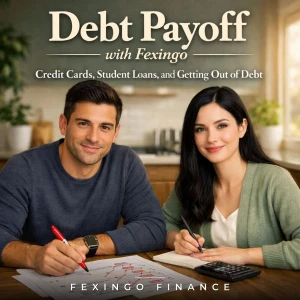
Debt Payoff with Fexingo: Credit Cards, Student Loans, and Getting Out of Debt
Debt Payoff with Fexingo is a personal finance podcast about credit cards and student loans. Hosts Lucas and Luna work through real listener scenarios, using specific balances, interest rates, and repayment terms. Lucas breaks down the math behind avalanche and snowball methods, transfer fees, minimum payments, and income-driven repayment. Luna explores the behavioral and relationship challenges, such as expiring 0% offers, hidden spending, and whether to pause saving for a home. Each episode ends with a practical next step, focusing on plans that listeners can realistically sustain.
Episodes

Why Your Debt Payoff Math Is Wrong
Most people think debt payoff is a simple subtraction problem, but the real bottleneck is behavioral friction. In this episode of Fexingo Business, Lucas and Luna dissect why the avalanche method often fails not because of math, but because of human psychology. We look at the specific case of a mid-level engineer in Austin who saved ten thousand dollars by switching from minimum payments to a zero
Why Your Debt Payoff Math Is Wrong
Most people treat debt payoff like a simple subtraction problem, but the real friction comes from behavioral mismatch. We break down why the mathematical optimal strategy often fails in practice and introduce the concept of cash-flow velocity. Using a specific case of a borrower with mixed high-interest credit cards and low-rate student loans, we show how aligning payment habits with income cycles
The Psychology of Debt Freedom
Most debt payoff guides focus on math, but psychology often dictates success. We explore how behavioral economics and identity shifts drive long-term financial health more than interest rates alone. Using the 'identity-based habit' framework from James Clear's Atomic Habits, we examine why some borrowers succeed while others relapse into credit card debt despite having a perfect spreadsheet. This
The Debt Snowball Method That Actually Works
We break down the behavioral mechanics behind the debt snowball strategy, using a real-world example of a borrower paying off high-interest credit cards before student loans. Discover why focusing on small wins can accelerate your payoff timeline and keep you motivated when the math says otherwise. This episode explores the psychology of momentum in personal finance.
#DebtSnowball #PersonalFinanc
The Hidden Cost of Your Minimum Payment Strategy
Most people think paying only the minimum on their credit cards is a safety net, but it is actually a wealth destroyer. In this episode, we break down the specific mathematics behind why carrying a balance at eighteen percent interest costs more than most annual salaries over a decade. Lucas walks through the compound interest formula using a real five thousand dollar scenario, while Luna challeng
How To Stop Using Debt To Fund Your Lifestyle
Most people treat credit cards like a checking account with extra steps, but the math on revolving balances reveals a hidden wealth tax that quietly erodes net worth. In this episode, Lucas and Luna break down why carrying a balance above five hundred dollars is not a strategic move but a lifestyle leak. They examine how high interest rates in late 2026 turn discretionary spending into permanent l
The Debt Payoff Trap of Ignoring Opportunity Cost
Most debt payoff guides focus on interest rates or psychological momentum, but Lucas and Luna examine a different variable: the hidden opportunity cost of paying off low-interest debt too aggressively. They break down how allocating extra cash to student loans with two percent interest might mean missing out on market returns that historically outpace that rate. Using a specific comparison between
The Inflation Hedge Against Your Debt
Lucas and Luna tackle the counterintuitive reality of carrying high-interest debt during a period of persistent inflation. While most financial advice demands immediate payoff, this episode explores how wage growth and asset appreciation can sometimes outpace the cost of borrowing. They examine specific scenarios where paying off a credit card balance too quickly might actually reduce your net wor
The Hidden Cost of Refinancing Your Student Loans
We dissect the 2026 student loan refinancing market where rates have finally cooled, but the fine print hides a dangerous trap: private lenders are now bundling deferred interest into your principal balance. Lucas and Luna examine a real case study of a nurse who saved on her monthly payment but lost three thousand dollars in compound growth over five years. We break down why 'payment reduction' i
The Opportunity Cost of Your Debt Payoff
Lucas and Luna explore a counterintuitive approach to debt elimination: prioritizing the acceleration of wealth-building assets over aggressive debt repayment. Using a concrete comparison between paying down a student loan versus maxing out a tax-advantaged retirement account, they examine the long-term mathematical impact of compound growth. With interest rates holding steady in early October two
The Income Tax Trap in Your Debt Payoff Plan
Most borrowers assume paying off debt is purely a math problem of interest rates and principal. But there is a hidden third variable that changes the equation entirely: your tax bracket. In this episode, Lucas and Luna dissect how the IRS effectively subsidizes high-interest debt through tax deductions for mortgage interest and student loan interest, while taxing investment gains at different rate
How To Negotiate Lower Credit Card Interest Rates
Most people think credit card interest rates are fixed and non-negotiable, but they are actually dynamic pricing tools. In this episode, Lucas walks through a real-world scenario where he successfully lowered his annual percentage rate by thirty percent using a specific retention script. Luna joins to discuss the behavioral economics behind why banks fear churn more than they admit. We break down
How To Negotiate Debt Like A Professional
Most borrowers accept the first interest rate offer on their credit cards and student loans as immutable law. This episode breaks down the specific negotiation scripts that worked for real people in Q3 of 2026, showing how a simple conversation with a retention agent can lower rates by fifty basis points without hurting your credit score. We look at the exact wording that triggers a supervisor rev
The Debt Ceiling Myth That Traps Borrowers
In this episode, we tackle the psychological barrier that keeps high-earners stuck in debt despite having the cash flow to pay it off. Lucas and Luna explore why the 'debt ceiling' is often a mental construct rather than a financial reality, using the case of Sarah, a senior engineer who avoided paying off her $40,000 student loans because she feared losing her emergency fund. We break down the sp
The Debt Dividend Strategy for 2026
Most people treat debt payoff as a pure subtraction exercise, but what if the timing of your payments could generate returns? In this episode, we explore the concept of 'debt dividends'—the hidden interest arbitrage between high-yield savings accounts and consumer debt. We break down why keeping a moderate balance on a low-interest card while maxing out a HYSA can sometimes be mathematically super
The Hidden Cost of Your Emergency Fund
Most people treat their emergency fund as a safe harbor, but in September 2026, that cash is quietly eroding. We examine how the Federal Reserve’s recent shift in monetary policy has created a dangerous gap between high-yield savings rates and the actual cost of living. Lucas breaks down why holding too much liquidity can hurt your net worth just as much as debt does, using a real-life case study
The Liquidity Squeeze of Rapid Debt Repayment
Most people think paying off debt fast is always the right move, but in a September 2026 market where interest rates have settled at a new normal, rapid payoff can starve your emergency fund and force high-interest borrowing later. Lucas and Luna break down the liquidity trap that catches disciplined borrowers who drain their cash reserves to zero out balances too quickly. They examine how keeping
The Liquidity Trap of Paying Off Debt Too Fast
Lucas and Luna dissect the counterintuitive reality that aggressively paying off low-interest debt can actually trap you in a liquidity crisis. Using the specific example of a household with three thousand dollars in high-yield savings versus four thousand dollars at five percent interest, they explore why keeping cash on hand often beats eliminating every cent of liability. The conversation ancho
The Liquidity Trap of Paying Off Debt Too Fast
Lucas and Luna explore why aggressively eliminating high-interest debt can sometimes backfire by draining your emergency fund. They examine the hidden opportunity cost of zero-balance accounts when market returns outpace interest rates, using a specific case of a borrower who missed a wealth-building window. This episode challenges the reflexive 'debt-free at all costs' mindset by introducing the
The Liquidity Trap of Paying Off Debt Too Fast
We explore the overlooked opportunity cost of aggressive debt payoff in a low-interest environment. Using a specific case of a homeowner with a three percent mortgage and high-yield savings, we examine why liquidity often beats mathematical purity. The conversation dives into behavioral finance, emergency fund sizing, and the hidden value of cash on hand versus interest savings. Lucas breaks down
The Inflation Tax on Your Debt
Most borrowers treat inflation as a macroeconomic headline, but it acts as a silent tax on your specific debt structure. We examine how rising consumer prices interact with fixed-rate student loans versus variable credit card balances in late 2026. Using the current ten-year Treasury yield of three point nine percent and an average credit card rate near twenty-one percent, we calculate the real co
Why Your Debt Payoff Order Is Backfiring
Most people assume paying off high-interest debt first is the only rational path. But in September 2026, with student loan interest rates stabilizing and credit card APRs hitting new highs, that strategy might be costing you more than just money. We examine a specific case where a borrower’s focus on minimum payments created a liquidity trap, preventing them from clearing low-interest obligations
The Debt Payoff Order That Actually Saves You Money
Most people pick a debt payoff strategy based on emotion or simple math, but rarely do they account for the hidden friction of switching payment processors. In this episode, Lucas and Luna examine why the 'Payment Processor Tax'—the time and error cost of managing multiple unique login portals, auto-debit setups, and varying statement cycles—often outweighs the theoretical interest savings of a pu
The Psychology of Debt Freedom
We explore why traditional math often fails when people try to pay off debt. Using a specific case study of a borrower named Sarah, we analyze the gap between logical strategy and human behavior. Lucas and Luna discuss how emotional friction impacts financial decisions more than interest rates do. This episode breaks down the behavioral economics behind sticking to a payoff plan versus abandoning
The Debt Ceiling Myth That Traps Borrowers
Most people believe they have a debt ceiling, but that illusion is keeping them stuck. In this episode, we examine the hidden friction of refinancing student loans when rates are volatile and how personal credit limits often distort risk perception. We break down the specific math behind moving high-interest consumer debt into lower-yield instruments without triggering a cascade of new fees. Liste
The Math Behind Your Debt Snowball
We break down the actual math of debt payoff strategies, comparing the emotional win of the snowball method against the cold hard savings of the avalanche approach. Using a specific scenario with three distinct debts, we show exactly where the interest savings come from and why your credit score might be lying to you about which method is better. This episode helps you decide which psychological l
The Behavioral Economics of Debt Freedom
Most people think debt payoff is a math problem, but this episode argues it is fundamentally a behavioral psychology challenge. We explore the concept of 'emotional interest'—the cognitive load and anxiety that accrue on every unpaid balance—and why standard financial advice often fails to address it. Using a specific case study of a household with mixed high-interest credit card debt and low-inte
The Emotional Interest Rate of Your Debt
We often treat debt payoff as a pure math problem, focusing on interest rates and amortization schedules. But for many households, the real burden isn't just the cost of capital; it is the cognitive load and emotional friction that comes with managing multiple balances. In this episode, we explore how the 'emotional interest rate' — the mental energy spent worrying about, tracking, and minimizing
The Debt Velocity Strategy for 2026
Lucas and Luna dissect the mechanics of debt velocity — how accelerating payments on high-interest balances creates a compounding effect that pays off more than the math suggests. They examine why most people fail to leverage this strategy, focusing on the behavioral friction of refinancing student loans in 2026 and the hidden opportunity cost of keeping low-rate debt. The episode offers a concret
The Credit Score Myth That Keeps You In Debt
Most people believe that carrying a balance on their credit card is essential for building credit, but this episode dismantles that persistent myth. We explore how the FICO scoring model actually works in September 2026, focusing on the specific mechanics of utilization reporting and why paying in full every month is still the superior strategy for long-term wealth. Lucas walks through the data fr
The Debt Tax That Silent Creditors Charge You
We break down the hidden cost of keeping debt on your books using a specific $45,000 portfolio example. Lucas and Luna explore how inflation and opportunity cost create a silent tax that erodes wealth faster than interest payments alone. This episode focuses on the real economic friction of carrying balances into 2026.
#DebtPayoff #PersonalFinance #InflationCost #OpportunityCost #CreditCardDebt #
The Hidden Cost of Debt Consolidation Loans
Most people assume consolidating debt into a single lower-interest loan is always the right move, but today we’re drilling into why that math can quietly fail. Lucas and Luna break down the specific trap of extending your payoff timeline to get a lower monthly payment, which often costs more in total interest over the life of the loan. We look at a real-world scenario involving student loans and c
The Zero-Sum Game of Debt Payoff
Most people treat debt payoff as a simple subtraction problem, but the real friction lies in opportunity cost. In this episode, Lucas and Luna dissect the 'opportunity cost trap' that keeps high-earners stuck in repayment limbo. We examine how the math of refinancing student loans interacts with mortgage interest deductions and retirement contributions in the current September 2026 tax environment
How Debt Payoff Timing Changes Everything
Most people think debt payoff is just about math, but the timing of your payments matters more than you realize. In this episode, we break down how paying on different days of the billing cycle can save you hundreds in interest, especially with credit cards that use average daily balance methods. We also look at student loan refinance windows in 2026 and why locking in rates before the Federal Res
The Debt Velocity Strategy for 2026
Most debt guides focus on which balance to pay first. Lucas and Luna explore a different lever: the velocity of your payments. By shifting from monthly to bi-weekly cycles, you can generate an extra monthly payment without changing your budget. This episode breaks down the math behind accelerating principal reduction in credit cards and student loans, using a specific five-year timeline to show ho
The Debt Trap Hidden in Your Auto-Debit Setup
Most people think auto-pay is the safest way to handle debt, but a specific banking loophole allows lenders to extract more interest than expected when payment dates fall on weekends or holidays. We break down how the 'business day delay' rule works for credit cards and student loans, why it can cost you hundreds of dollars in extra finance charges over time, and the precise manual override strate
The Hidden Cost of Minimum Payments on Your Credit Card
Most people think paying the minimum keeps their credit score intact, but this episode reveals how that habit quietly drains wealth through compounding interest. We break down a specific case study: a cardholder carrying a five thousand dollar balance at twenty percent APR. You will see exactly how many months it takes to clear that debt if only the minimum is paid, and why the total interest cost
The Real Cost of Refinancing Student Loans in 2026
In this episode, Lucas and Luna dissect the hidden trap of student loan refinancing. While rates have dropped slightly, the real danger lies in losing federal protections like income-driven repayment and forgiveness eligibility. We look at a specific case study of a teacher who refinanced for a half-percent rate cut but lost her path to Public Service Loan Forgiveness. The hosts break down when it
The Debt Avalanche Strategy That Actually Saves Money
Most people start paying off debt by targeting the smallest balance first, a method popularized by Dave Ramsey that prioritizes psychological wins over mathematical efficiency. But what if you flipped the script? In this episode, Lucas and Luna break down the avalanche method, where you focus on the highest interest rate regardless of the balance size. We look at a specific case study: two borrowe
The Hidden Cost of Your Debt Snowball Math
We break down the mathematical reality of the debt snowball versus the debt avalanche method. Using a concrete example of a teacher with $45,000 in student loans and $8,000 in credit card debt, we calculate the exact interest savings of prioritizing high-APR balances first. We explore why behavioral psychology often beats pure math, but also when strict financial optimization actually wins. This i
The Hidden Cost of Your Minimum Payment Grace Period
We break down why the standard twenty-one day grace period isn't a safety net but a strategic liability for those carrying balances. Lucas and Luna examine how daily compounding interest erodes principal during this window, using a specific three-thousand-dollar balance example to show exactly how much extra you pay by waiting until the final day. We also explore the mathematical advantage of maki
The Debt Snowball Psychology That Actually Works
Most financial advice tells you to attack high-interest debt first, but behavioral economics suggests a different path. We explore the 'debt snowball' method pioneered by Dave Ramsey and why clearing small balances quickly can trigger a psychological momentum that pure math often ignores. Using a concrete example of a household with mixed student loans and credit card debt, we break down why seein
The Hidden Cost of Your Minimum Payment Grace Period
We break down the specific mechanics of how daily balance compounding works against you when you only pay the minimum on your credit card. Using a concrete example of a two-thousand-dollar balance at eighteen percent interest, we show exactly how much extra you pay by missing one grace period versus carrying it month-over-month. Lucas explains the math behind the average daily balance method while
How Credit Card Companies Profit From Your Missed Payment
When you miss a credit card payment, the issuer doesn't just charge a late fee. There's a cascade of costs hiding in the fine print, and most cardholders only see the tip. In this episode, Lucas and Luna unpack what actually happens after a missed due date: the late fee itself, the penalty APR that can more than double your interest rate, and the less obvious hit to your credit score through payme
How Credit Card Companies Use the Minimum Payment Trap
In episode 171, Lucas and Luna dissect the minimum payment trap — why paying just the minimum can keep you in debt for decades, and how card issuers deliberately design it to maximize interest. They use a concrete example: a $5,000 balance at 22% APR, where paying $120 a month means nearly 30 years of payments and over $7,000 in interest. They explain the 'accelerated repayment' trick that can cut
How Credit Card Companies Profit From Your Payday
Credit card companies don't just profit from interest and fees — they also profit from the timing of your paycheck. In this episode, Lucas and Luna break down how issuers align billing cycles and payment due dates with your payday to maximize the chance you'll carry a balance. They look at the mechanics of the 'payday trap,' where a due date that falls a few days after your paycheck arrives can en
How Credit Card Companies Use the Credit Utilization Ratio
In episode 169 of Debt Payoff with Fexingo, Lucas and Luna unpack the credit utilization ratio — the percentage of your available credit that you're using — and how card issuers weaponize it against you. They explain why keeping your utilization low is often touted as a credit-score booster, but how it can quietly backfire: when you pay down a large balance, your utilization drops, and issuers may
How the Credit Card Repayment Cushion Works Against You
In this episode of Debt Payoff with Fexingo, hosts Lucas and Luna unpack the repayment cushion — the little-known buffer that credit card issuers apply when you pay more than the minimum. They explain how it works, why it can actually cost you more in interest, and how to avoid falling into its trap. With a concrete example of a $5,000 balance and a $300 payment, they show how the cushion misdirec
How Card Issuers Use the Cash Advance Trap
In this episode of Debt Payoff with Fexingo, Lucas and Luna unpack the cash advance trap—why using your credit card to get cash can be one of the most expensive moves you make. They break down how cash advances start accruing interest immediately, carry a higher APR than purchases, and often come with a fee that's a percentage of the amount. Using a concrete example, they show how a $200 cash adva
How Credit Card Companies Use the Billing Statement
In this episode of Debt Payoff with Fexingo, Lucas and Luna dive into the fine print of your credit card billing statement. They explain how issuers use the summary box, minimum payment warnings, and foreign transaction fees to shape your behavior and boost their profits. Learn why the 'new balance' isn't always what you owe, how payment due dates are strategically set, and how a little-known rule
How Credit Card Companies Use the Average Daily Balance Method
Episode 165 of Debt Payoff with Fexingo digs into the average daily balance method — the most common way card issuers calculate your interest charge. Lucas explains how the method actually works with a simple example, why your payment timing can shift your monthly interest by more than you'd expect, and how a mid-cycle purchase can cost you more than a larger balance does. Luna shares a real-world
How Credit Card Companies Use the Grace Period
This episode of Debt Payoff with Fexingo digs into the grace period — the roughly 21 days between your statement closing and your due date, when new purchases can avoid interest entirely. Lucas and Luna explore how issuers quietly undermine that interest-free window: two-cycle billing, the trailing interest on paid-off balances, and the trap of carrying a balance while still swiping. They walk thr
How Credit Card Companies Use the Daily Balance Trap
In Episode 163 of Debt Payoff with Fexingo, Lucas and Luna unpack the daily balance method—the fine-print billing practice that can turn an ordinary purchase into an unexpected interest charge. Using the example of a $1,000 laptop purchase, they show how a single day's timing can cost you $20, and why your grace period isn't as generous as it seems. They walk through a concrete calculation, compar
How Card Companies Use the Payment Due Date
In this episode of Debt Payoff with Fexingo, Lucas and Luna dive into the subtle ways credit card issuers manipulate payment due dates to maximize late fees and interest. They explain the concept of the 'due date shuffle,' how issuers can change your due date without clear notice, and why the timing of your payment within the billing cycle matters more than you think. Using a real-world example of
Why Paying More Than the Minimum Can Backfire
Paying more than the minimum on your credit card feels responsible. But in this episode, Lucas and Luna dig into a little-known credit card practice called 're-aging,' where extra payments can reset your billing cycle and delay interest charges — and how that can cost you more over time. They explain how the practice works, why card issuers use it, and what it means for your debt payoff strategy.
How Card Issuers Use the Purchase APR Loophole
Credit card issuers have a quiet trick hidden in the fine print: the purchase APR can jump far higher than the advertised rate—sometimes by ten points or more—without a late payment or a penalty. In this episode, Lucas and Luna dig into the purchase APR loophole that turned a routine balance into a thirty-percent trap. They walk through how a cardholder's regular spending can suddenly accrue inter
How Your Credit Limit Increase Can Trigger a Hard Pull
Many people assume that accepting a credit limit increase is harmless. But sometimes, that seemingly innocent button tap can trigger a hard inquiry on your credit report, temporarily knocking a few points off your score. In this episode, Lucas and Luna break down when and why credit card issuers perform hard pulls for credit limit increases, how to tell if you're being offered a pre-approved incre
How Credit Card Companies Use the Universal Default Clause
In Episode 158 of Debt Payoff with Fexingo, Lucas and Luna unpack the universal default clause — a hidden provision in many credit card agreements that lets issuers raise your interest rate when you miss a payment on an unrelated account. They explain how it works, why it feels like a double punishment, and what the Credit CARD Act of 2009 did and didn't fix. With a concrete example of how a singl
How Credit Card Companies Use the Debt Validation Letter
In Episode 157 of Debt Payoff with Fexingo, Lucas and Luna unpack the debt validation letter — the powerful tool credit card companies use to pressure you into paying debts that may not even be yours. They explain what a validation notice actually is, what rights you have under the Fair Debt Collection Practices Act, and the crucial 30-day window you must not ignore. Using a real-world example of
How Credit Card Companies Use the Balance Transfer Trap
In this episode, Lucas and Luna explore how credit card companies design balance transfer offers to keep you in debt. They break down the structure of a typical 0 percent introductory APR offer, explaining the hidden fees, the interest rate that applies after the promo period, and the way payments are allocated to the transferred balance versus new purchases. Using a specific example of a $10,000
How Credit Card Companies Use the Annual Fee
Credit card annual fees are a silent profit center. In this episode, Lucas and Luna break down how issuers structure annual fees to maximize revenue, when a fee is actually worth paying, and how to negotiate or avoid them. Using a concrete example of a $550 travel card, they show how the fee shifts the break-even math, how it interacts with sign-up bonuses and rewards, and why some cards quietly w
The Avalanche Method Could Cost You More Than You Think
In this episode of Debt Payoff with Fexingo, Lucas and Luna explore a surprising twist in the debt payoff playbook: why the avalanche method, often touted as the mathematically optimal way to tackle debt, can actually cost you more in the long run. Through the lens of a listener's story about paying off a high-interest credit card balance, they unpack the psychological and behavioral factors that
How Credit Card Companies Profit From Your Partial Payment
Lucas and Luna unpack the strategy behind credit card minimum payments with a focus on how issuers benefit when you pay more than the minimum but less than the full balance. They break down the payment allocation rules, how interest is recalculated daily, and why even a small extra payment can reduce your interest costs over time. Using a concrete example of a $5,000 balance at 22 percent APR, the
How Credit Card Companies Use the Debt Snowball Against You
In this episode of Debt Payoff with Fexingo, Lucas and Luna explore how credit card companies are actually fine with the popular debt snowball method—because it keeps you paying longer and accruing more interest. They break down why the avalanche method is mathematically superior, using a concrete example: a $10,000 balance at 24% APR versus a $3,000 balance at 18%. They discuss the psychological
How Credit Card Companies Use the Billing Cycle to Your Disadvantage
In this episode of Debt Payoff with Fexingo, Lucas and Luna dig into a subtle but costly credit card practice: billing cycles that stretch beyond 30 days. Using a real example of a 34-day billing cycle, they explain how card issuers can legally adjust your due date, shorten your grace period, and increase the interest you pay without breaking any rules. They walk through the fine print that allows
How Credit Card Companies Use the Repayment Cushion
On the 150th episode of Debt Payoff with Fexingo, Lucas and Luna unpack a subtle but powerful tool credit card issuers use to keep you in debt: the overpayment refund. When you pay more than your balance, the excess doesn't just sit there—it can be held as a 'credit balance' and used to offset future charges, effectively giving you an interest-free loan to the bank. The hosts trace how this practi
How Credit Card Companies Use the Payment Hierarchy
In this episode of Debt Payoff with Fexingo, Lucas and Luna uncover the payment hierarchy — the ordering credit card issuers use to apply your payments across balances with different interest rates. You'll learn why paying off a 0% balance early can backfire, how the Consumer Financial Protection Bureau's rules protect you, and the exact statement wording that reveals which balance gets paid first
How Credit Card Companies Use Balance Transfer Fees
In this episode of Debt Payoff with Fexingo, Lucas and Luna dig into balance transfer fees—the upfront cost that can quietly undermine your debt consolidation plan. They break down how a 3% or 5% fee affects your total payoff math, when a balance transfer still makes sense, and the tricks issuers use to hide the real cost. With a concrete example of a $5,000 balance and a 24-month 0% APR offer, th
Why Your Credit Score Drops When You Pay Off Debt
On this episode of Debt Payoff with Fexingo, Lucas and Luna explore a frustrating paradox: why your credit score can drop right after you pay off a loan or credit card. They break down the mechanics behind credit scoring models, including utilization ratio, credit mix, and account age, and explain why a temporary dip isn't a sign of failure. Using a concrete example of a listener who saw a 30-poin
How Credit Card Companies Use Your Payment Allocation
In this episode of Debt Payoff with Fexingo, Lucas and Luna dive into the hidden world of credit card payment allocation—how issuers decide where your payment goes when you carry balances at different APRs. They break down a real scenario: a $3,000 balance at 22 percent APR and a $1,000 balance from a balance transfer at 0 percent for twelve months. When you pay $500, where does that money land? L
How Credit Card Companies Use Pre-Authorized Debit Agreements
Episode 145 of Debt Payoff with Fexingo digs into a hidden trap: the pre-authorized debit agreement. Credit card companies can use that small print to take payment before your due date, even if you pay manually, causing bounced checks and cascading fees. Lucas and Luna break down a real scenario where a listener's careful plan was undone by an automatic payment clause. They explain how to spot the
How Credit Card Companies Use the Cash Advance Trap
In this episode of Debt Payoff with Fexingo, Lucas and Luna unpack the cash advance trap. They explain why taking a cash advance on your credit card is one of the most expensive decisions you can make, with interest rates that start accruing immediately, no grace period, and higher APRs. They walk through a realistic example: a $1,000 cash advance at a 24% APR that costs $20 in fees and starts acc
How Credit Card Companies Use the Two-Cycle Billing Method
In this episode, Lucas and Luna uncover the two-cycle billing method, a once-common credit card calculation that charged interest on balances from the previous billing cycle, not just the current one. They explain how it works, why it was banned in 2009 by the CARD Act, and how a modern equivalent, the 'average daily balance including new purchases' method, still catches cardholders off guard. Usi
How Credit Card Companies Use Grace Period Fine Print
When does a 0% APR offer actually cost you more than the interest you'd pay? In this episode, Lucas and Luna dig into the fine print of credit card grace periods—the 21- to 25-day window that can silently turn a 'free' purchase into a debt trap. They walk through how your statement date, payment timing, and even a single late payment can erase your grace period, and why carrying a balance from mon
How Credit Card Companies Use Arbitration Clauses Against You
In this episode of Debt Payoff with Fexingo, Lucas and Luna unpack the hidden power of mandatory arbitration clauses in credit card agreements. They explain how these clauses prevent you from joining class-action lawsuits, force you into private arbitration with no appeal, and why companies insert them specifically to limit your legal recourse. Using real examples and a recent study showing 78% of
How Minimum Payment Formulas Keep You in Debt
Credit card minimum payments sound like a safety net, but the math behind them often ensures decades of debt. In this episode, Lucas breaks down the standard formula—1% of the balance plus interest—and walks through a concrete example: a $5,000 balance at 18% APR that takes 17 years to pay off if you only make minimum payments. Luna asks whether paying the minimum is ever a smart move and challeng
How Credit Card Companies Set Your Payment Due Date to Trap You
In this episode of Debt Payoff with Fexingo, Lucas and Luna reveal how credit card issuers manipulate payment due dates to trigger late fees and penalty interest. They explain the typical 21-25 day window between statement closing and due date, how issuers can change your due date at will, and the hidden trap of weekend/holiday due dates. Learn why paying by mail is risky, how due dates are chosen
How the Fair Debt Collection Practices Act Can Reduce Your Debt
In episode 138 of Debt Payoff with Fexingo, Lucas and Luna explore how the Fair Debt Collection Practices Act (FDCPA) can be a powerful tool for reducing what you owe. Using a real listener case—Sarah, who was hounded by a collector for an old $5,000 credit card debt—they explain how invoking FDCPA violations led to a $3,000 settlement and a manageable payment plan. The hosts break down the three
How Credit Card Companies Use the Statute of Limitations Against You
Many consumers don't realize that old debts have a shelf life called the statute of limitations. But credit card companies and debt buyers often exploit this confusion, filing lawsuits on zombie debt or tricking people into restarting the clock. In this episode, Lucas and Luna break down how the statute of limitations works, why debt collectors sometimes sue after it expires, and what you can do t
How Credit Card Average Daily Balance Method Traps You
Ever paid off your credit card only to see interest charged anyway? It's probably because of the average daily balance method. In this episode, Lucas and Luna break down how card issuers calculate interest daily, how new purchases immediately start accruing interest when you carry a balance, and why that 'grace period' vanishes. Using a concrete example—$1,000 balance, $200 purchase, 18% APR—they
Recommended

Booked, Blonde & Busy w/ Olivia Ponton

McKinsey on Consumer and Retail

megahired.com

Hard Knocks Podcast

Effective Weight Loss for Moms | High protein, Strength Training, Lose Weight, Meal Planning, Fat Loss, Healthy Habits

The Human-Animal Connection - Pet Life Radio Original

Infinite Health with Dr. Arasi Maran

The Daily

World News Tonight with David Muir

English Vocabulary Help
The Joe Rogan Experience
TED Talks Daily
