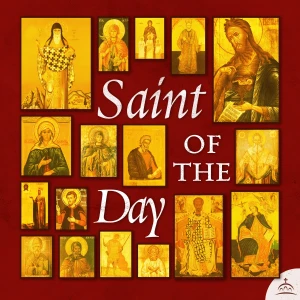
Saint of the Day
Saint of the Day is a daily podcast from Ancient Faith Ministries. Each episode tells the life and story of a saint commemorated that day in the Orthodox Church. The show is hosted by Dn. Jerome Atherholt. It offers brief, informative reflections on the lives of venerable Orthodox Christians.
Episodes
Saint Cosmas the Hymnographer (8th c.)
He was from Jerusalem. An orphan, he was adopted into the family of St John of Damascus (commemorated December 4). He became Bishop of Maiuma, a city on the coast of Palestine, which was later named Constantia. Like his adoptive brother he became a noted hymnographer: The Canon of the Cross (Sept. 14) and the Canon for Christ's Nativity, "Christ is born, give ye glory..." are his compositions.
Holy Martyr Zlata (Chryse)
"Born in the village of Slatina in the Meglin region [of Bulgaria], of poor peasants who had three other daughters, St Zlata was a meek and devout girl, wise with Christ's wisdom and golden ('zlata' means 'gold') not only in name but also in her God-fearing heart. When Zlata went out one day to get water, some shameless Turks seized her and carried her off to their house. When one of them urged he
Holy Martyrs Probus, Tarachus and Andronicus
All three suffered during the reign of Diocletian. Though born in three different places, the three were found to be Christians at Pompeiopolis in Cilicia, arrested together, and brought before the Governor, Numerian Maximus. Tarachus was sixty-five years old at the time of his arrest, but his captors showed no respect for his age, tormenting him as cruelly as the others. All three immediately and
Our Holy Father Philotheos Kokkinos,Patriarch of Constantinople
He was born in Thessalonika around 1300; his mother was a convert from Judaism. He entered monastic life, first at Mt Sinai, then at the Great Lavra on Mt Athos. The so-called "Hesychast controversy" was then raging, and St Philotheos became one of the firmest and most effective supporters of St Gregory Palamas (November 14) in his defense of Orthodoxy against western-inspired attacks on the doctr
Blessed Fool for Christ Andrew of Totma
"Saint Andrew came of a family of devout, unlettered peasants. He obtained an education by going to church and, on the death of his parents, became a novice at the Monastery of Galich, in the diocese of Kostroma. The Abbot, who was remarkable for his wisdom, discerned Andrew's spiritual gifts and encouraged him to undertake the unusual and difficult ascesis of Foolishness-for-Christ. Andrew left t
Saints Andronicus and Athanasia
Andronicus was a goldsmith who lived in Antioch during the reign of Theodosius the Great (379-395). He and his wife Athanasia were devout Christians who strove to follow Christ in all things. They gave a third of all that they earned to the poor, another third to the Church, and lived on the remainder. After they had two children, they agreed to live henceforth as brother and sister. Both their ch
Our Holy Mother Pelagia
"This Saint was a prominent actress of the city of Antioch, and a pagan, who lived a life of unrestrained prodigality and led many to perdition. Instructed and baptized by a certain bishop named Nonnus (November 10), she departed to the Mount of Olives near Jerusalem, where she lived as a recluse, feigning to be a eunuch called Pelagius. She lived in such holiness and repentance that within three
Holy Hieromartyr Polychronius
The son of peasants, he was known from his childhood for his piety and asceticism. Once, by his prayers, a spring of water sprang up near his village, where it was needed for the town's survival. When he came of age, Polychronius went to work in some vineyards near Constantinople. Even though he labored all day, he would eat only every two or three days. The master of the vineyard, seeing his stri
Holy Apostle Thomas
One of the Twelve Apostles, he was a Galilean by birth. His name means "twin." The twentieth chapter of St John's Gospel describes how, when he doubted the appearance of the Risen Lord, Christ appeared to him again, saying "Reach hither thy hand, and thrust it into my side; and be not faithless, but believing," at which Thomas cried out "My Lord and my God!" Through this one event the Holy Scriptu
Holy Martyr Charitina of Amissos
She was the handmaid (according to the Great Horologion) or adopted daughter (according to the Prologue) of an eminent Roman citizen named Claudius, during the reign of Diocletian. She was betrayed as a Christian to the governor Dometian, before whom she fearlessly confessed her faith. After she had endured many cruel tortures, the governor sent some dissolute youths to rape her. Having prayed to
Hieromartyr Hierotheos, Bishop of Athens
He was probably the first Bishop of Athens, ordained by the Holy Apostle Paul himself. St Dionysius (see October 3) describes St Hierotheos as his teacher and friend "after Paul." With St Dionysius, St Hierotheos was miraculously brought by the power of the Holy Spirit to be present with the Apostles at the Dormition of the Theotokos. He reposed in peace.
Hieromartyr Dionysius the Areopagite
He is mentioned in Acts 17:19-34. He was a learned Athenian, a member of the Athenian court on Mars Hill (Areos Pagos in Greek, from which the title 'Areopagite' comes). At the time of Christ's crucifixion, he was studying in Egypt and saw the sky darkened there for three hours when Christ breathed His last. He later married and had several children. When St Paul preached in Athens, Dionysius was
Hieromartyr Cyprian and Virgin-Martyr Justina
"Saint Justina, who was from Damascus, lived in virginity for the sake of Christ. Saint Cyprian, who was from Antioch, began as an initiate of magic and worshipper of the demons. A certain foolish young man who had been smitten with Justina's beauty hired Cyprian to draw her to love him; when Cyprian had used every demonic device he knew, and had failed, being repulsed by the power of Christ Whom
The Protection of Our Most Holy Lady the Theotokos and Ever-Virgin Mary
On October 1, 911, during the reign of Emperor Leo the Wise, an all-night vigil was being held at the Blachernae Church of the Mother of God in Constantinople, with many of the faithful crowding the church. St Andrew the Fool for Christ (commemorated tomorrow, October 2) was standing at the back of the church with his disciple Epiphanius. At around four in the morning, the most holy Theotokos appe
St Gregory the Enlightener, Bishop of Armenia
He was a nobleman, related to the imperial houses of Persia and Armenia. When these two houses went to war with one another, Gregory withdrew to Caesarea in Cappadocia, where he heard the Gospel proclaimed and came to faith in Christ. There he also married and had two sons. After his wife's death he returned to his homeland and served in the court of Tiridates, king of Armenia. When the king disco
Holy Martyr Dada and those with them
Dada was a high Persian official serving in the court of King Shapur II, and secretly a Christian. When he was appointed governor of a province some way from the court, Dada began to worship and proclaim Christ openly. This came to the attention of the King, who sent one of his sons, Gubarlahas, to try and execute him. Dada was condemned and condemned to be thrown into a fiery furnace. But when Da
St Chariton the Confessor of Palestine (350)
He was born in Iconium during the reign of Aurelian, and knew St Thecla. He was arrested, tortured and condemned to death for his Christian faith. But before his execution was carried out, the cruel Emperor Aurelian died, and Chariton was freed. He travelled to Jerusalem and took up the ascetical life in the Palestinian wilderness. Monks gathered around him, and in the course of his life he establ
Our Venerable Father Sabbatius, Founder of the Monastery of Solovki
He lived for many years as a monk at the Monastery of St Cyril of White Lake, where his ascetic struggles won him the respect of his brethren. To flee from the admiration of men he moved further north to Valaam Monastery. But he still attracted the good opinion of his community, so he secretly headed still further north, planning to reach the uninhabited Solovki Island in the White Sea (a large ba
Repose of the Holy Apostle and Evangelist St John the Theologian
The holy Apostle was, by the world's reckoning, the nephew of our Savior, since his mother Salome was the daughter of St Joseph the Betrothed. Called 'the beloved disciple,' St John was the only one of Christ's disciples to follow Him to the Cross. He was entrusted by the Savior with the care of the most holy Theotokos, and became like another son to her, providing for her care until the day of he
Our Holy Father Sergius of Radonezh
'Our righteous Father Sergius was born in Rostov, north of Moscow, about the year 1314. Named Bartholomew in baptism, he was brought up in Radonezh, and at the death of his parents he withdrew to the wilderness to become a monk. It is notable that without having been trained in a monastery, he was of such a spiritual stature as to be able to take up the perilous eremitical life from the beginning,
St Silouan, elder of Mt Athos
He was a Russian peasant who traveled to Mt Athos and became a monk in the Russian Monastery of St Panteleimon. He lived so simply, humbly and quietly that he might be forgotten had not Fr Sophrony (Sakharov) become his spiritual child and, after the Saint's repose, written a book describing his life and teaching: St Silouan of Mt Athos, one of the great spiritual books of our time. It was through
New Martyr John of Epirus
He was born to Muslim parents in Konitsa of Albania — the ancient region of Epirus. His father was a prominent ruler among the Muslims and a member of the Sufi order, sometimes called dervishes, a mystical Islamic sect. John himself became a prominent Sufi and settled in Joannina. Though not a Christian, he attended to his conscience and lived a sober and prayerful life.
Over time, he became inc
Venerable Cosmas, desert-dweller of Zographou, Mt Athos
"Saint Cosmas came from Bulgaria where his devout parents provided him with a good education in Slavonic and Greek. They wanted him to marry but he was drawn by the love of Christ and, unknown to them, made his way to the Holy Mountain of Athos to become a monk at the Bulgarian monastery of Zographou. On the feast of the Annunciation at the Monastery of Vatopedi, he saw a woman among those serving
Our Venerable Father Joseph of Zaonikiev Monastery
He was a peasant named Hilarion in the district of Vologda, and lived a simple, laboring life until he began to lose his sight. Not despairing, Hilarion went to all the churches nearby and asked that services of intercession be offered for him. One day, during the Divine Liturgy, Hilarion beheld a man in white clothing who told him that his name was Cosmas, blessed him, and told him that he would
Great Martyr Eustathius (Eustace) Placidas, with his family
Before baptism he was a renowned military commander under Trajan. While hunting in the woods, he met a great stag with a shining Cross between his antlers. Through the stag, the Lord spoke to Placidas (his pagan name) and told him to find a priest and be baptized into Christ. Returning home, he found that his wife Tatiana had also had a vision in which she was told to become a Christian. They were
Holy Martyr Zosimas the Hermit of Cilicia
Dometian, a prince and a fierce persecutor of Christians, was hunting in the mountains when he came upon an old man surrounded by wild beasts, who were as gentle and tame as lambs in his presence. When asked who he was, the old man answered that he was Zosimas, a Christian who had left the persecutors in the city to live among the beasts instead. Dometian, hearing that Zosimas was a Christian, ord
St Ariadne of Phrygia
She lived during the reign of the Emperor Hadrian in the town of Promisea in Phrygia. Though a Christian, she was the slave of a pagan nobleman named Tertullus. To celebrate his son's birthday, Tertullus ordered his entire household to come to a pagan temple and make sacrifice to the idols; but Ariadne stayed home, praying to the only true God. This infuriated Tertullus, who beat her, threw her in
Our Holy Father Lambert, Bishop of Maastricht
He was born to a noble family in Maastricht (in modern-day Netherlands). When his spiritual father Bishop Theodard was killed in 671, St Lambert was elected Bishop of Maastricht despite his youth. He was loved by his flock for his holiness, ascetic labors and almsgiving, but was driven from his see in 675 after his patron King Childeric II was assasinated. He withdrew to the Monastery of Stavelot
Holy Hieromartyr Cyprian of Carthage
He was born to wealthy and noble parents in Carthage (north Africa), and became a prominent lawyer in that city. Around the year 246 he embraced the Christian faith and was baptized by the priest Caecilianus. Immediately he gave all his goods to the poor and retired to a quiet place in the country to devote himself to prayer and study of Christian writings. In 248 or 249 he was elected Bishop of C
Holy Martyr Porphyrius
"An actor, he first mocked at Christians before Julian the Apostate. On one occasion, when he was mimicking the Christian mystery of Baptism, he was dipped into the water, pronouncing the words: 'In the name of the Father, and of the Son, and of the Holy Spirit.' When he emerged from the water, he cried out: 'Now I am a Christian!' Everyone thought that this was in jest, as always, but he held fir
The Universal Exaltation of the Precious and Life-giving Cross
"Saint Helen, the mother of Saint Constantine the Great, when she was already advanced in years, undertook, in her great piety, the hardships of a journey to Jerusalem in search of the Cross, about the year 325. A temple to Aphrodite had been raised up by the Emperor Hadrian upon Golgotha, to defile and cover with oblivion the place where the saving Passion had been suffered. The venerable Helen h
Holy Hieromartyr Cornelius the Centurion
This is the Cornelius who received St Peter into his household in Caesarea (Acts ch.10). He was then instructed in the Faith and baptised by St Peter, though he had been a pagan and a Gentile: a great turning point in the growth of the Church, for before this time many (including St Peter) had believed that the Church was meant only for the Jews. Tradition holds that St Cornelius later became a bi
Hieromartyr Autonomus, bishop of Italy (313)
He fled from Italy to Bithynia during Diocletian's persecutions. In Bithynia he converted so many pagans to faith in Christ that those whose hearts remained hard rose up against him and, while he was celebrating the Divine Liturgy in the Church of the Archangel Michael, slew him at the altar, killing many other worshipers with him. Two hundred years after his death, he appeared to a soldier named
St Euphrosynos the Cook of Alexandria
His icon is found in countless Orthodox kitchens. A simple and holy man, when he entered monastic life in Alexandria he was judged unfit for any service more demanding than kitchen work. There he labored without complaint, looked down upon by most of the other monks. One night the abbot dreamed that he was in Paradise, and there met Euphrosynos, who gave him a branch that bore three fragrant apple
Martyrs Menodora, Metrodora, and Nymphodora at Nicomedia
They were three sisters, raised in the Christian faith in Bithynia. Together they withdrew from the world and lived together in virginity on a lonely mountain, devoting themselves to prayer, fasting and labor. Though they wished only to live unknown to the world, their wonderworking gifts were discovered, and many people began to come to them for healing of ailments. In this way word of them reach
Our Holy Father Ciaran of Clonmacnoise (549)
Born to the family of a cartwright in Ireland, he entered monastic life when he was very young at the Monastery of Clonard, where he became a disciple of St Finnian (December 12). He became one of the 'Twelve Apostles of Ireland', all of them disciples of St Finnian. Ciaran founded the great monastery of Clonmacnoise (pronounced clon-mac-neesh) on the Shannon River, which became one of Ireland's g
New Martyr Athanasius of Thessalonika (1774)
He was born to a distinguished and pious Christian family in Thessalonika. After acquiring an unusually good education he spent a few years in Constantinople, then returned to his native city. He spoke both Turkish and Arabic well, and often conversed with Muslims. Once, while speaking with an emir, Athanasius pronounced the Muslim confession of faith to illustrate a point. The emir, seeing an opp
Martyr Sozon of Cilicia (208/304)
He began life as a pagan shepherd in Lycaonia. Coming to faith in Christ, he was baptized and received the name Sozon ("Save"). Thereafter he took every opportunity to proclaim the Gospel to his countrymen and to urge them to give up their idols. Entering a temple of Artemis in Cilicia, he cut off its golden hand, broke it into pieces, and distributed the gold to the poor. When he learned that bec
St Maxim (Sandovich), martyr of Lemkos, Czechoslovakia (1914)
St Maxim was born in the Austro-Hungarian Empire in 1888. At this time all Orthodox Churches had been captured and subjected to the "Unia," by which, though keeping the Orthodox liturgical rites, they were united to the Roman Catholic Church. Many of the Carpatho-Russian people were ignorant of the change and what it meant; others were unhappy with it but, in their subject condition, saw no altern
Holy and Glorious Prophet Zacharias, Father of St John the Baptist
Much of his story is told in the first chapter of Luke's Gospel. The Synaxarion continues:
'After the birth of Christ, Zacharias plainly declared the virginity of Mary and showed her truly to be the Mother of God; for he appointed her a place in that part of the Temple reserved for the virgins and so brought upon himself the hatred of the priests and levites.
'When John was six months old, Zac
Hieromartyr Babylas, bishop of Antioch, and those with him (251)
He was archbishop of Antioch at the time of the wicked Emperor Numerian. Once the Emperor came to Antioch and attempted to enter a church where Babylas was serving. Coming to the door, the Archbishop forbade the Emperor, as a pagan and a shedder of innocent blood, to enter the house where the True God was worshipped. Retreating in humiliation, the Emperor determined to take his revenge. Shortly af
Our Holy Father Joannicius, Archbishop and first Patriarch of Serbia (1354)
"Born in Prizrem, he served as first secretary to King Dušan. He became Archbishop in 1339, and in 1346 was raised to the rank of Patriarch. He was a zealous pastor, and brought order to the Serbian Church, being 'a great upholder of the Church's laws'. He entered into rest on September 3rd, 1349, and his relics are preserved at Pec´." (Prologue)
Martyr Mamas of Caesarea in Cappadocia (275), and his parents, Martyrs Theodotus and Rufina
He began his life in the cruelest of circumstances: both of his parents were imprisoned for their faith in Christ. First his father, Theodotus, died in prison, then his mother, Rufina, died shortly after his birth, so the infant was left alone in prison beside the bodies of his parents. But an angel appeared to the widow Ammia, telling her to go to the prison and rescue the child. Ammia obtained t
Our Holy Father Symeon Stylites (459)
Born in Syria, he was a shepherd, but at the age of eighteen he left home and became a monk, practicing the strictest asceticism. At times he fasted for forty days. After a few years at a monastery he took up an ascetical discipline unique at that time: mounting a pillar, he stood on it night and day in prayer. Though he sought only seclusion and prayer, his holiness became famous, and thousands w
Hieromartyr Cyprian, bishop of Carthage (258)
He was born around 190 to pagan parents in North Africa. Before baptism he was distinguished in Carthage as a teacher of philosophy and rhetoric. He came to faith in Christ and was baptized at a young age; as soon as he became a Christian he abandoned his prestigious teacher's position, sold his many possessions and gave all his wealth to the poor. He was ordained presbyter in 247, Bishop of Carth
Sts Alexander (340), John (595), and Paul the New (784), patriarchs of Constantinople
St Alexander took part in the First Ecumenical Council as delegate of Patriarch Metrophanes, who was too frail to attend; and succeeded Metrophanes on the Patriarchal throne. By his prayer to God that the Church might be spared the schemings of Arius, Arius was struck dead.
St John is, by one account, St John the Faster (Sept. 2), who reposed in 595; by another, St John Scholasticus (Feb. 21), w
Our Holy Mother Theodora of Salonica (879)
"A wealthy and devout woman, she lived on the island of Aegina, but, when the Arabs over-ran the island, she moved to Salonica. There, she gave her only daughter to a monastery, where she received the monastic name Theopista. Her husband Theodorinus died very soon, and then Theodora became a nun. She was a great ascetic. She often heard angelic singing, and would say to her sisters: 'Don't you hea
St. Moses of Ethiopia (400)
He is also called Moses the Black. He was a slave, but was cast out by his master due to his evil life. He then became the leader of a murderous band of robbers in Egypt. He came to repentance and took up monastic life in the desert under St Isidore of Sketis. For many years he struggled tirelessly, through prayer, fasting and vigils, with lustful and violent thoughts; he was finally freed of them
Our Holy Father Poemen (Pimen) the Great (450)
"He was an Egyptian by birth and a great Egyptian ascetic. As a boy, he visited various spiritual teachers and gathered proven experience as a bee gathers honey from flowers. Pimen once begged the elder Paul to take him to St Païsius. Seeing him, Païsius said: 'This child will save many; the hand of God is on him.' In time, Pimen became a monk and drew two of his brothers to monasticism. Their mot
Martyrs Adrian and Natalia and 23 companions of Nicomedia (4th c.)Martyrs Adrian and Natalia and 23 companions of Nicomedia (4th c.)
"Husband and wife, they were both of noble and wealthy families in Nicomedia. Adrian was the governor of the Praetorium and a pagan, and Natalia was a secret Christian. They were both young, and had lived in wedlock for thirteen months in all before their martyrdom. When the wicked Emperor Maximian visited Nicomedia, he ordered that the Christians be seized and put to torture. There were twenty-th
Holy Apostle Titus of the Seventy
He was a Greek from the island of Crete. Born and raised as a pagan, he came to faith in Christ through the ministry of the Apostle Paul, and labored with the Apostle in preaching the Gospel. St Paul in his epistles calls St Titus both "son" and "brother." He was ordained Bishop of Crete by St Paul, who wrote to him the Epistle that bears his name. He reposed in peace at the age of ninety-four.
New Hieromartyr Kosmas of Aitolia, Equal-to-the-Apostles (1779)
This recent Equal to the Apostles was born in Mega Dendron (Great Tree) in Aetolia. He became a monk on Mt Athos, where he lived and prayed for many years. But he was troubled by the ignorance of the Gospel that had fallen on many of the Orthodox people, living under the oppression of the Ottoman Turks. He went to Constantinople, where he studied the rhetorical arts and received the blessing of Pa
Hieromartyr Irenaeus, bishop of Lyons (202)
He was born in Asia Minor around the year 120, and was a disciple of Saint Polycarp, who was in turn a disciple of St John the Evangelist. He succeeded the martyred St Pothinus as Bishop of Lyons in Gaul (now France). He produced many writings contesting not only against paganism but against Gnostic heresies that were then troubling the Church. When Victor, Bishop of Rome, planned to excommunicate
Holy Martyr Eulalia of Barcelona (303)
She was born of Christian parents in Barcelona, and dedicated herself to a life of holiness, taking Christ as her bridegroom. When the persecutor Dacian came to Barcelona, Eulalia secretly left her parents' house by night and came before Dacian, denouncing him in front of many witnesses as a murderer of the innocent, and publicly confessing her faith in Christ. The wicked Dacian had her stripped a
Holy Martyrs Bassa and her sons Theognis, Agapios, and Pistis (4th c.)
"Bassa was the wife of a pagan priest, but she was secretly a Christian and brought her sons up in a Christian spirit. Her husband hated her for her faith, and handed her over to the judge for torture, together with her sons. After harsh torture, her sons were beheaded (it is thought, in Edessa in Macedonia). Bassa was filled with joy to see her sons thus gloriously finish their martyr's course fo
Holy Prophet Samuel (11th c. BC)
He was the last of the Judges of Israel, and was appointed by God to anoint the first two kings of Israel, Saul and David. Read the Old Testament book 1 Samuel for his story. Many believe that he is the author of the books of Judges, Ruth and the first 24 chapters of I Samuel.
Martyr Andrew Strateletes and 2,593 soldiers with him in Cilicia (~289)
"He was an officer, a tribune, in the Roman army in the time of the Emperor Maximian. A Syrian by birth, he served in his native land. When the Persians attacked the imperial Roman army, this Andrew was entrusted with the command in the battle against the enemy — whence his title: commander, strateletes. A secret Christian, although as yet unbaptised, Andrew commended himself to the living God, an
Martyrs Florus and Laurus of Illyria (2nd c.)
"Brothers in both the flesh and the spirit, they were both zealous Christians, and stonemasons by craft. They lived in Illyria. Some pagan prince set them to build a pagan temple. It happened during the course of their work that a fragment of stone splintered off and flew into the eye of the pagan priest's son, who was watching the building work with curiosity. Seeing his son blinded and bleeding,
Martyr Myron of Cyzicus (250)
He was a priest in Achaia. In the time of the Emperor Decius, when Antipater was governor of Achaia, the persecutors entered the church on the Feast of the Nativity, dragged Myron away from the service and put him to torture. He endured many horrible tortures, but would not worship the idols. Finally he was thrown to wild beasts. When Antipater saw the beasts greeting Myron affectionately, the per
Translation of the Image Not-Made-By-Hands of our Lord Jesus Christ from Edessa to Constantinople
The Third "Feast of the Savior" in August
While the Lord was preaching in Palestine, his fame reached a king Avgar of Edessa, who suffered from leprosy. Avgar sent a messenger named Ananias to ask whether the Lord could heal his illness. The king also charged Ananias, if he was unable to bring back Jesus Himself, to bring back a likeness of Him. When Ananias found Jesus, the Lord told him that he
The Dormition of Our Most Holy Lady the Theotokos and Ever-Virgin Mary
On the Cross, the Lord charged the Apostle John to care for His holy Mother. The Apostle settled her in a house in Jerusalem, where she lived for the rest of her days on earth, praying and offering counsel and encouragement to the Apostles. In her old age, the Archangel Gabriel appeared to her and told her that in three days' time she would enter into her rest. Giving thanks to God, she hastened t
Holy Prophet Micah (8th c. BC)
Read his prophecies (which include the prophecy that Christ would be born in Bethlehem, Micah 5:2) in the Old Testament book that bears his name. He was a contemporary of the prophets Isaiah, Amos and Hosea, and is ranked sixth among the "minor" prophets. It was he who prophesied that the Christ would be born in Bethlehem. (This is a different Micah from the one mentioned in 1 Chronicles 22:8, who
Holy Martyr Hippolytus of Rome and 18 Martyrs with him (258)
He was the pagan jailkeeper who guarded St Laurence (see August 10); seeing his prisoner's holiness and the wonders wrought by him, Hippolytus was convinced of the truth of the Faith and became a Christian. When St Laurence baptized him, he was granted a vision of heaven and said 'I see innocent souls in great joy.' He took Laurence into his own home, and his entire household were baptized, ninete
Martyrs Anicetas and Photius of Nicomedia (305)
These holy martyrs suffered victoriously in the year 305 (Prologue) or 288 (Great Horologion), during the reign of Diocletian, who visited Nicomedia to stir up a persecution of Christians there. Anicetas, one of the city governors, presented himself before the Emperor, boldly confessed his Christian faith, and denounced the worship of the idols. Anicetas was subjected to a series of cruelties: his
The Holy Martyr Susanna the Virgin, and those with her (295-296)
She was the daughter of Gavinius, a Christian priest in Rome, and the niece of Pope Gaius. The Emperor Diocletian's adopted son Maximian wished to marry Susanna, but she had no desire to marry any one, least of all a pagan. The patricians Claudia and Maxima were sent to Susanna by the Emperor to present Maximian's suit; but instead she turned both of them, and all their households, to the Faith. T
Holy Martyrs Archdeacon Laurence, Pope Sixtus, and others with them (258)
"This Saint, who was born in Spain, was the Archdeacon of the Church of Rome, caring for the sacred vessels of the Church and distributing money to the needy. About the year 257, a harsh persecution was raised up against the Christians by Valerian. Pope Sixtus, who was from Athens, was commanded to worship the idols, and refused; before his martyrdom by beheading, he committed to Laurence all the
Apostle Matthias (1st c.)
He was numbered among the Seventy. Then, when Judas who betrayed Christ had taken his own life, the disciples (120 men and women) convened to choose one who would take his place among the Twelve. They nominated two, Joseph (called Barsabas or Justus) and Matthias, then cast lots. The lot fell to Matthais, who henceforth was numbered among the Twelve (See Acts ch. 1). Accounts of his Apostolate aft
St Gregory of Sinai (Mt Athos) (1346)
One of the great ascetics, hesychasts and spiritual teachers of the Church, he did much to restore the knowledge and practice of Orthodox hesychasm. He became a monk at Mt Sinai. He traveled to Mt Athos to learn more of Orthodox spiritual prayer and contemplation, but found that these were almost lost even on the Holy Mountain. The only true, holy hesychast he found there was St Maximos of Kapsoka
Martyr Dometius of Persia (363) and two disciples
"Born a pagan in Persia in the time of the Emperor Constantine, he came to know the Christian faith as a young man, forsook his paganism and received baptism. He was so enchanted with the true Faith that he left all worldly things and became a monk in a monastery near the town of Nisibis. He lived among the brethren for some time, then withdrew into silence, going to Archimandrite Urbel, of whom i
The Holy Transfiguration of Our Lord, God and Saviour Jesus Christ
Read the account of Christ's holy Transfiguration (Metamorphosis in Greek) in Matthew ch. 17, Mark ch. 9, and Luke ch. 9. Appearing clothed in Light on Mt Tabor, the Savior fulfilled his promise to His disciples that "there are some standing here who shall not taste death, till they see the Son of man coming in His Kingdom" (Mt 16:28). Christ's Transfiguration is the image of the future state of t
Righteous Nonna (374), Mother of St Gregory
In her own lifetime she was a wonderworker through her holy prayers. She brought her husband back from idolatry to Christian faith; he later became bishop of Nazianzus. Her son Gregory's profound and devout writings bespeak the Christian upbringing she gave him. By her prayers she once saved St Gregory from perishing in a storm. She was a deaconess, and reposed in peace in 374.
Holy Seven Youths (the "Seven Sleepers") of Ephesus (250 & 5th c.)
During a persecution of Christians under the Emperor Decius, these seven Christian youths hid themselves in a cave outside Ephesus. When they were discovered, their persecutors sealed them in the cave to die; but God instead sent them a miraculous, life-preserving sleep. There they rested for about two hundred years. In the time of the Emperor Theodosius the Younger (408-450), a heresy that denied
Holy Myrrh-bearer Salome
She was the mother of the Apostles James and John, the wife of Zebedee, and the daughter of Joseph the Betrothed, who was a widower when he became betrothed to the Mother of God. She was a disciple of the Lord and one of the Myrrh-bearing women who first brought tidings of the Resurrection to the world.
Hieromartyr Stephen, Pope of Rome (257), and those with him
As Bishop of Rome from 254 to 257, he battled the Novatian heresy. By his prayers he once healed Lucilla, the daughter of the Roman tribune Nemesius; for this both father and daughter were baptized into Christ. Saint Stephen and twelve of his priests were beheaded during a celebration of the Liturgy, during the reign of Valerian.
St Nicholas, enlightener of Japan (1912)
Born in Russia in 1836, he became one of the great Orthodox missionaries of modern times. As a boy, he resolved to become a missionary in the far East. With the counsel and blessing of Bishop Innocent of Siberia and Alaska, he went to Japan in 1861 and joined a small Russian mission there. Though the mission's official purpose was to minister to the Russian consular community, the consul-general w
Righteous Eudocimus of Cappadocia (9th c.)
"Saint Eudocimus was from Cappadocia, the son of pious and most illustrious parents, patricians in rank. He especially cultivated chastity and mercy, the one by never meeting the gaze of a woman, the other by cheerfully providing the needs of the poor. When he was made military commander of Cappadocia, he continued in his righteous ways, showing mercy and uprightness in all his dealings. Having so
Venerable Angelina, Princess of Albania
She was the daughter of Scanderbeg, Albania's national hero. She married Stefan, Prince of Serbia, a kinsman of Scanderbeg who sought refuge in his court. Stefan, a gentle, God-fearing man, had been blinded by the Turkish Sultan. Princess Angelina, loving him despite his loss of his vision and his worldly kingdom, married him with her father's blessing. Together they had two sons, George and John.
Holy Martyr Seraphima (2nd c.)
She was a maiden from Antioch who lived (perhaps as a slave) in the house of Sabina, wife of a Senator. When Seraphima brought the senator's wife to faith in Christ, the governor summoned Seraphima before him. When she held firm in her faith, he cast her into prison and send several young men to her cell by night to defile her. When they arrived, she was praying to God, and an angel of the Lord ap
St Irene, Abbess of the Convent of Chrysovalantou (912)
"Saint Irene, who was from Cappadocia, flourished in the ninth century. Because of her great beauty and virtue, she was brought to Constantinople as a prospective bride for the young Emperor Michael (8422-867); however, as St Joannicius the Great foretold, it was God's will that she assume the monastic habit instead. She shone forth in great ascetical labors, and suffered many attacks from the dem
Holy Great-martyr and Healer Panteleimon (305)
He was born in Nicomedia; his father was a pagan, his mother a Christian. Through her he was taught the Christian Faith and baptized by St Hermolaus (July 26). He became a physician, and practiced his art with compassion and generosity, healing many more through his prayers as by his medicines. His parents had named him Pantoleon ("in all things a lion"), but because of his great compassion he was
Recommended

CBS Radio Mystery Theater | Old Time Radio

Solved Murders - True Crime Stories

紐約鳥|New York Aperture

The Swerve Podcast: Obscure Topics | Conspiracy Theories

The Bread and Banter Podcast

The Church of What's Happening Now: The New Testament

Busted Open

Deadline: White House

Crickets Corner

History of the Earthquake and Fire in San Francisco

Fox news

K-Drama Obsessed Mamas | Beyond “Just One More Episode!”
