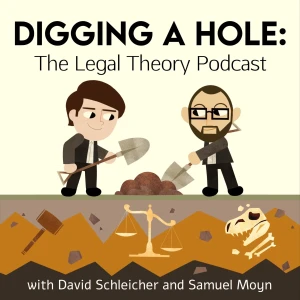
Digging a Hole: The Legal Theory Podcast
Digging a Hole is a legal theory podcast hosted by Yale Law School professors Samuel Moyn and David Schleicher. In each episode, they interview legal scholars and explore debates that take place within law schools. The show examines legal theory, doctrine, and academic controversies. It aims to make complex legal arguments accessible to listeners interested in law and policy.
Episodes

Joshua Specht
Summer is over, dear listeners. Sam spent his time reading hate mail from older Americans, while David has just moved around the corner from a senior assisted living facility. But more importantly, Digging a Hole is back for another season.In this week’s episode, we turn to the history of America’s obsession with land ownership. Here to take us from the rent wars of the 1840s up to the Great Finan
Sarath Sanga
Things are looking up, dear listeners. The semester is over, summer is nearly here, and David’s beloved Knicks are up 2-0 in the NBA Finals. In this week’s episode, we take a step back and do some introspection. Here to discuss whether you should trust Yale, and other elite universities, more than Jalen Brunson in the fourth quarter is friend and colleague Sarath Sanga, Professor of Law at Yale La
Lawrence Douglas
As gas reaches stratospheric prices and the cost of living continues to climb, war seems to be on everyone’s mind these days. What better time, then, to be joined by Lawrence Douglas, the James J. Grosfeld Professor of Law, Jurisprudence and Social Thought at Amherst College, to discuss his brand new book, The Criminal State: War, Atrocity, and the Dream of International Justice? The episode begin
Anton Jäger
Now that classes are over and the end of the semester is near, we’re back for several weeks of podcastmaxxing. So stay tuned for some great episodes in the coming weeks, dear listeners! Here to help us understand our current political moment and to diversify David’s reading list is Anton Jäger, a Departmental Lecturer in the History of Political Thought and Political Theory at University College,
Joshua Macey
Spring has sprung, dear listeners. Now that this dreadfully cold winter seems to be behind us, our power bills might finally come back down to Earth. Here to explain why your electricity bill is so expensive – and what to do about it – is Joshua Macey, a Professor of Law at Yale Law School. Macey’s research and teaching interests are wide-ranging, from energy and environmental law to bankruptcy an
Tara Leigh Grove
Reports of the pod’s death are greatly exaggerated, dear listeners. Despite the lengthy hiatus, we’re finally back with a terrific episode on judicial method, judicial power, and much more. To kick off the Spring installment of the pod, we’re incredibly fortunate to be joined by Tara Leigh Grove, the Vinson & Elkins Chair in Law at the University of Texas at Austin School of Law, who comes on
Jerusalem Demsas
It’s been quite an eventful month, dear listeners. After a few flight cancellations, Democrats decided it was time to finally reopen the government. The House released a cache of Epstein files that name President Trump. And Zohran Mamdani has officially been named king of New York. In these turbulent times, we’re lucky to be joined by Jerusalem Demsas—journalist, grade A pundit, and Editor & C
Natasha Piano
As one New York political dynasty comes to a close and as the government shutdown rampages on, it’s only fitting to have Natasha Piano on the pod to discuss elitism and the crisis of American democracy. Natasha Piano is an Assistant Professor of Political Theory in the Department of Political Science at UCLA. Piano joins us this week to discuss her new book, Democratic Elitism: the Founding Myth o
John Witt
This week, we descend from the ivory tower onto the beaches of Martha’s Vineyard for a discussion of the historical significance – and contemporary relevance – of the Garland Fund, the million dollar fund at the epicenter of the early Civil Rights movement. We’re thrilled to welcome our colleague John Witt, the Allen H. Duffy Class of 1960 Professor of Law at Yale Law School, to join us for a cele
Bob Bauer
It’s been a long (and eventful) summer. But the leaves are just beginning to turn and there’s a cool breeze in the air, which means it’s time for a new season of Digging a Hole! We kick off this season with a wide-ranging discussion on the limits of executive power, the role of courts in checking the executive branch, and what progressives should do after Trump 2.0. To help guide us through these
Richard Primus
We’ve had a lot of fun this spring, but a sweet summer scent is on the wind, and so we’re going to have to wrap up another successful season of Digging a Hole with today’s episode—it’s a real clambake. Courts have paid a lot of attention in recent years to what the executive branch can and can’t do: non-delegation, major questions, student loans, DOGE. The question of what the federal government a
Frances Lee and Stephen Macedo
Liberals have been introspecting (some may say self-flagellating) since the 2024 election, to varying degrees of convincingness and success. There’s the usual genre of complaints—NIMBYism, identity politics, the crisis of masculinity, forgetting about the factory man—but the one thing liberals agree on is that they can’t be blamed for following their good, apolitical science. Today’s guests want y
Abundance
In the face of what is inarguably bad governance and fake—but spectacular!—technocracy (the list goes on and on, but we’ll stop at AI-generated tariffs), we thought we’d take a moment to join the conversation about what good governance looks like. A couple of weeks ago, one of us reviewed Ezra Klein and Derek Thompson’s new book, Abundance, for the New York Times, and then the other one of us revi
Allison Powers Useche
Happy February, listeners, and welcome to season ten of Digging a Hole! When we started the pod five years ago, we had our eyes on the Grammys, or maybe the Emmys, whatever award show we could finagle our way into. Turns out we have bigger fish to fry than whether or not we’re more deserving of an award than Call Her Daddy — Greenland, anyone? We’re thrilled to be kicking off this season with some
Karen Tani
The start of a new year, the slouch towards the first days of the new semester, the last episode of yet another season of the pod: we’re feeling sentimental here at Digging a Hole HQ. As you take down your old calendars and put up the new, we’re going to take some time to engage in a tradition of ours at the pod and discuss the 2024 Harvard Law Review Supreme Court foreword, “Curation, Narration,
Dan Rodriguez
Now that the election is done and dusted, and we’ve had a chance to process somehow one of the least controversial presidential races of the last few decades, America’s back to business, with Congressmen threatening international institutions, the American public spending gobsmacking amounts of money for the holiday season, and California declaring a state of emergency over bird flu. Wait a second
2024 Election with Benjamin Wallace-Wells
The year is 2025. Department of Government Efficiency dons Elon Musk and Vivek Ramaswamy have broken ground on their new taxpayer-funded palace, the architectural plans of which look suspiciously like a Cybertruck. HHS Secretary RFK Jr. has received a standing ovation from Congress after announcing that children will be given brain worms at birth instead of vaccines. Attorney General Matt Gaetz ha
Brian Highsmith
On this week’s podcast, we’re going more local than we’ve ever gone before, discussing the pleasures and perils of the company town. Here to be our local guide through this topic, and discussing his forthcoming paper, “Governing the Company Town” is Brian Highsmith — a former student of David’s, Ph.D. candidate in Government and Social Policy at Harvard University, an academic fellow in law and po
Melissa Schwartzberg
Good news, listeners! Our rational and responsive representatives in Washington have agreed to keep the federal government running through December 20. (As far as we know, anyway.) You might be tired of the all the backroom dealing it seems to take to keep national parks open and the wheels of our country turning. Get it together, you grumble. But as realists in the world of legal theory, we wante
Jack Balkin
Welcome back, dear listeners, to season nine of Digging a Hole! We’re just as surprised as you are that we haven’t been taken off the air yet, but we’re here and ready to keep producing hit after hit— at least while Yale Law School keeps funding us, anyway. After a summer of roller-coaster legal and political action, we’re ready to help you navigate the turbulent times ahead. But before we get to
Dylan Penningroth
With the long weekend in the books, summer’s officially here. School’s out, and we can’t imagine why people would be thinking about American universities – has anything interesting or controversial been happening on campus recently? (Our field correspondent David Pozen reports.) Anyway, today’s episode is the last episode of the season, and we’re excited to let this one linger in your minds for th
Mehrsa Baradaran
We’re almost at the end of our season, just as the biggest sports leagues in the world come to the end of theirs (as our guest today says, it all revolves around oil, and maybe a bit of corruption and looting). Speaking of today’s guest, we’ve got on an expert in banking and the racial wealth gap whose biography will probably surprise you at every turn: Mehrsa Baradaran, Professor of Law at the Un
Kunal Parker
Dear listeners, this season has been riveting, and it’s been a little controversial. Some of you have written in (if you listen to this episode, you’ll see we’ve graced certain aggrieved parties with a response). We see you, we hear you, and boy, do we have a classic legal theory podcast for you. Today’s guest is Kunal Parker, Professor and Dean's Distinguished Scholar at the University of Mia
Noah Feldman
On today’s podcast, we’re excited to welcome back former Digging a Hole guest Noah Feldman, the Felix Frankfurter Professor of Law at Harvard Law School. We take a break from legal theory and indulge Feldman in a discussion about his new book, To Be a Jew Today: A New Guide to God, Israel, and the Jewish People. In this episode, which was adapted from a conversation between Feldman and Sam at Yale
David Pozen
Have you ever wondered about the legal history of the war on drugs? Even if you haven’t, we won’t mollycoddle you – this episode’s a trip. Our guest on today’s podcast is a scholar of constitutional law and information law known for really getting in the weeds and dunking what we think we know in an acid bath. We’re delighted to have joining us today the radical David Pozen, Charles Keller Beekman
Daryl Levinson
Listeners, law professors have been having a bit of a crisis. Those poor souls have been asking: is international law real? (No comment.) What about constitutional law – that has to be real, right? The New York Times ran an op-ed this week where con law professors more or less said, “no, but we’ll keep pretending as long as we can.” (As Calvin Trillin wrote in 1984, what if con law “really wasn’t
Robert Post
Welcome back, devoted listeners, and say hello to season eight of Digging a Hole, where we’ve got an extraordinarily stacked lineup just waiting in the wings. To make up for the cold, cold months where you had to get your legal theory fix from reading articles (boring) or attending faculty workshops (ugh), we’re kicking off the season with a mammoth episode about a mammoth book. Today’s guest is t
Cass Sunstein
Like George Santos’s tenure in Washington and Tim Scott’s rousing presidential campaign, all good things must come to an end, and so we wave goodbye to season seven of Digging a Hole. Our last guest of this season needs no introduction: according to our team of in-house scientists, if you stacked a penny for each citation he’s received, the tower of pennies would reach almost 1,000 feet high (whic
Jennifer Burns
It’s the last month of the year and soon (but not yet!), it’ll be the last podcast of the season. We had a lot of people write in about our last episode and so this Christmas, on behalf of all of you, we’ll ask Santa for more Digging a Hole. But before we leave out some milk and cookies, we’ve still got some great episodes for you. Today, we’ve got a pre-recorded episode that – can you believe it
Will Baude
Listeners – our apologies. We’ve given you interesting topic after interesting topic, distinguished guest after distinguished guest. But we’ve strayed from the promise of the podcast, which is legal theory, and legal theory means arguing ad nauseam about whether we’re positivists or normativists. For a recent intervention in that debate, we’re delighted to bring you today’s guest, William Baude, t
Daniel Ziblatt
Squarely in the heart of the Trump administration, Steven Levitsky and Daniel Ziblatt published a book titled How Democracies Die which proved enormously popular. Celebrities read it. Obama read it. Most people you know probably pretended to have read it. Five years later, Levitsky and Ziblatt are back with a sequel of sorts, arguing that in the United States, democracy might never have been fully
Emma Kaufman
As the Supreme Court moves forward with its administrative state agenda, we thought we’d get in on the action and make sure we understand what exactly that agenda even is. Lucky for us, we’ve got some friends who can shed light on that matter. On today’s episode, we’re joined by Emma Kaufman, Professor of Law at New York University Law School, to discuss her paper, co-authored with previous pod gu
J.B. Ruhl and Jim Salzman
After a long summer vacation, we’re thrilled to be back for season seven of Digging a Hole! Just a couple of weeks ago we were baking; now we’re surviving storm after storm, quivering and quaking. Climate change, huh? Here on the pod to discuss their forthcoming paper on how environmental law can help get us out of our existential crisis, “The Greens' Dilemma: Building Tomorrow's Climate I
David Schleicher
As Punxsutawney Phil to winter are we to summer; and today, we celebrate a very special end-of-season episode. Sam is joined by guest co-host Noah Rosenblum, Assistant Professor of Law at New York University School of Law, to discuss work by our very own David Schleicher. David’s new book, In a Bad State: Responding to State and Local Budget Crises, which is both a romp through the American histor
Julie Suk
The sun is shining, the flowers are blooming, and David’s back on the pod. More importantly, we’re thrilled this week to be joined by Julie Suk, Professor of Law at Fordham University School of Law in New York City, to discuss her new book After Misogyny: How the Law Fails Women and What to Do about It. After Misogyny, like much of Professor Suk’s scholarship, including her first book, is impressi
Duncan Kennedy
This episode, we swap out one legend of legal theory for another. Goodbye David, hello to our guest – the one and only Duncan Kennedy! As part of a course he’s teaching at Yale Law School, Foundations of American Legal Thought, Sam interviewed Professor Kennedy in front of a live audience on March 8, 2023. Professor Kennedy, the Carter Professor of General Jurisprudence, Emeritus, at Harvard Law S
Sam Issacharoff
This week, we’re joined by dual-wielding complex and aggregate litigation and law of democracy scholar Samuel Issacharoff to discuss his new book Democracy Unmoored: Populism and the Corruption of Popular Sovereignty. Sam Issacharoff, the Bonnie and Richard Reiss Professor of Constitutional Law at NYU Law and one of our leading democratic theorists, has written extensively on the role of courts in
James Bradley Thayer
Another episode, another student of David and Sam’s on the podcast. Except this time, we have a current student instead of a former one! In this episode, a joint Lillian Goldman Law Library book talk-Digging a Hole production that took place in front of a live audience on January 23, 2023, we interview Yale Law student Jake Mazeitis and Wick Cary Associate Professor at the University of Oklahoma A
Timothy Shenk
Happy new year and welcome to season six of Digging a Hole! We’re kicking this season off with a bang as Sam welcomes one of his former students – Timothy Shenk! Tim Shenk is an Assistant Professor in History at George Washington University and a prolific public writer who you may have read in the New York Times, Jacobin, or Dissent. More importantly for us, Professor Shenk is the author of the re
Greg Sargent & the Midterm Election
It’s time for an election recap! We’re joined by Greg Sargent, who covers elections for the Washington Post and who slides into Sam’s DMs regularly. We recorded this episode on Friday, November 11th as election returns are still coming in, but it’s clear that the “red wave” did not transpire. It looks like Democrats will hold the Senate and they have a small hope of retaining the House.
What lesso
Kate Klonick & the Twitter Takeover
In a matter dear to Sam and Dave’s livelihoods, we have a timely podcast to discuss Elon Musk’s Twitter takeover. There is no one better to get into the weeds of this issue than Kate Klonick. Kate is an Associate Professor of Law at St. John’s University Law School and a Visiting School at Harvard University’s Rebooting Social Media Initiative. She is a leading expert on social media companies, co
Jacob Grumbach
This week we have Jacob Grumbach on the pod! Jake is an Associate Professor of Political Science at the University of Washington and the producer of fantastic Twitter content @JakeMGrumbach. His new book Laboratories against Democracy discusses the causes and consequences of the nationalization of state politics.
To begin, Jake walks us through the three consequences. First, national partisan and
Gary Gerstle
Professor Gary Gerstle enters the arena to join our ongoing debate about neoliberalism. Gary, a leading historian of the United States, is the Paul Mellon Professor of American History Emeritus and Paul Mellon Director of Research in American History at the University of Cambridge. On today’s episode, we discuss his brilliant new book The Rise and Fall of the Neoliberal Order: America and the Worl
Taisu Zhang
Another podcast, another Metropolitan movie reference. This time we are joined by our colleague and friend, Taisu Zhang, Professor of Law at Yale Law School. We give you a sneak peak of Professor Zhang’s new book The Ideological Foundations of Qing Taxation: Belief Systems, Politics, and Institutions, which comes out in November. Taisu starts by explaining why understanding the Qing dynasty is a p
Ran Abramitzky & Leah Boustan
We are thrilled to welcome Professors Ran Abramitzky and Leah Boustan to the podcast to discuss their groundbreaking new book on immigration in America! Ran is the Stanford Federal Credit Union Professor of Economics at Stanford and Leah is a Professor of Economics at Princeton, where she also serves as the Director of the Industrial Relations Section. They are on the forefront of economic researc
Mary Ziegler
Much like 2000s fashion – we’re back! The long wait is over. Digging a Hole’s new season is here!
After a summer of landmark Supreme Court cases, we are excited to start the season with Mary Ziegler, one of the nation’s leading experts and historians of U.S. abortion politics. Professor Ziegler is the Martin Luther King, Jr. Professor of Law at the University of California Davis School of Law. She

Live Show!
For the last episode of the season, Digging a Hole hosted its first live show in front of a live student audience! David interviewed two current Yale Law School students – Nina Oishi and Caroline Grueskin – about recent papers they’ve written. We started by asking Nina about her recent paper “Rating Racial Equity: Examining BlackRock and Goldman’s New Racial Equity Initiatives in the Municipal Bon
Rick Pildes
On this week’s pod, Dave welcomes one of his former professors – Rick Pildes! Professor Pildes is the Sudler Family Professor of Constitutional Law at New York University Law School, an appointee to President Biden’s Commission on the Supreme Court of the United States, and a contributor to the New York Times. He’s a leading scholar on the legal issues concerning democracy, and in this episode, we
Lauren Benton & Rohit De
This week, Digging a Hole explores global legal theory and history to match up with Sam’s European adventures! We are lucky to be joined by two of our Yale colleagues, Lauren Benton, Barton M. Biggs Professor of History and Professor of Law, and Rohit De, Associate Professor of History and Associate Research Scholar in Law.
We begin by discussing global legal theory and the way that thinking about
Ukraine & Legal Theory
This week we have an emergency podcast episode on the war in Ukraine. We’re joined by our two colleagues and leading international law scholars – Oona Hathaway, the Gerard C. and Bernice Latrobe Smith Professor of International Law at Yale Law School, and Scott Shapiro, the Chalres F. Southmayd Professor of Law and Professor of Philosophy at Yale Law School.
In this conversation, which took place
Osita Nwanevu
On this week’s pod we have Osita Nwanevu, contributing editor at The New Republic, columnist at The Guardian, and author of the forthcoming book The Right of the People: Democracy and the Case for a New American Founding! In the interview, Osita discusses many of the major issues around media institutions today. Somehow David relates journalism to both roasted vegetables and dessert, so we either
Linda Greenhouse
For the second episode of Season 4, Linda Greenhouse joins the pod to discuss her new book Justice on the Brink about the Supreme Court! There is no one who better understands the evolution, context, and operations of the Court than Linda. She is a Clinical Lecturer in Law and a Senior Research Scholar in Law at Yale Law School. After covering the Supreme Court for the New York Times as a reporter
Joseph Fishkin & William Forbath
Guess who’s back, back again?! Back by popular demand, Digging a Hole returns for a 4th season! We have a star-studded line-up of guests this spring. Tired – guessing the Supreme Court nominee. Wired – guessing upcoming Digging a Hole guests.
You don’t have to guess for this week, though! We’re thrilled to kick off this season with Joseph Fishkin and William Forbath discussing their upcoming book
Ask Me Anything!
You asked -- we answered! In Digging a Hole’s first AMA (or really Ask Us Anything) episode, we answered your most pressing questions: Is it ethical to move into a gentrifying neighborhood? How should one read articles when considering potential academic appointments? What is cooler -- SCOTUS or the Federal Reserve? What is a professional failure we’ve experienced? Who is our dream sponsor for the
Nikolas Bowie
Our final guest for Season 3 is Nikolas Bowie, assistant professor of law at Harvard Law School and board member of the ACLU of Massachusetts, Lawyers for Civil Rights, the People’s Parity Project, and MassVote. In this episode, we dive into two of his recent articles -- “Antidemocracy” and “The Constitutional Right of Self-Government.” We begin by discussing the Court’s recent ruling in Cedar Poi
Jeannie Suk Gersen
This week on the pod we have Jeannie Suk Gersen, the John H. Watson Professor of Law at Harvard Law School and a columnist for The New Yorker! We begin by discussing Professor Suk Gersen’s documentary “The Crits,” which focuses on the development and legacy of the Critical Legal Studies (CLS) movement. Several modern ideas and movements have come out of and splintered from CLS. We compare the evol
Ed Glaeser
We’re back with more state, local, and urban issues -- maybe Sam has become a full convert! In this week’s episode, we’re joined by renowned urban economist Edward Glaeser, the Fred and Eleanor Glimp Professor of Economics and the Chairman of the Department of Economics at Harvard University. We begin by discussing The Survival of the City, Professor Glaeser’s new book written with David Cutler. I
Noah Feldman & Christopher Kang
It’s SCOTUS reform time! We are joined by Noah Feldman, the Felix Frankfurter Professor of Law at Harvard Law School, and Christopher Kang, the co-founder and chief counsel of Demand Justice and former Deputy Counsel to President Obama. Both of our guests testified to the Presidential Commission on the Supreme Court of the United States. On the pod, our guests explain what they think the Commissio
Rodriguez & Seifter
This week, we have an all-star duo in Daniel B. Rodridguez, the Harold Washington Professor of Law at Northwestern Law School, and Miriam Seifter, Associate Professor of Law at the University of Wisconsin Law School! Much to David’s joy, we get Sam deep into the muck of state and local government law. We begin by talking about Daniel and Miriam’s new projects -- The SLoG Law Blog and The State Dem
Isaac Chotiner
In this week’s episode, we interview New Yorker staff writer and principal contributor to the Q. & A. interview series Isaac Chotiner. We begin by discussing his challenging interviewing style, which has led to many notable and controversial moments. Seeking controversy himself, David asks why Isaac has seemingly interviewed every Yale Law School professor other than him. Isaac also describes
John Witt and Sam Moyn
Season 3 is here! In the first episode, John Fabian Witt, Allen H. Duffy Class of 1960 Professor of Law at Yale Law School, joins host David Schleicher to interview host Sam Moyn on his new book Humane: How the United States Abandoned Peace and Reinvented War. In the book, Sam interrogates efforts to make war more humane and the ramifications of this shift. We also discuss the chronology of when t
Ian Ayres and Frederick E. Vars
On our last episode of Season 2, Ian Ayres, professor of law and of professor of management at Yale University, and Frederick E. Vars, professor of law at the University of Alabama, join us to discuss their new book Weapon of Choice: Fighting Gun Violence While Respecting Gun Rights. In the book, Ayres and Vars outline decentralized and voluntary policies that can be immediately adopted at the sta
Oona Hathaway and Craig Jones
On this week’s episode, Oona Hathaway, professor of law at Yale Law School, and Dr. Craig Jones, lecturer in political geography at Newcastle University, discuss their views on law’s role in war and national security. Professor Hathaway’s recent article, National Security Lawyering in the Post-War Era: Can Law Constrain Power?, argues that our current system lacks external constraints on executive
Kate Andrias and Ben Sachs
Professors Kate Andrias, of the University of Michigan Law, and Benjamin L. Sachs, of Harvard Law School, join us to discuss their new article, Constructing Countervailing Power: Law and Organizing in an Era of Political Inequality. They argue the law can facilitate organizing by lower-income groups and that doing so can increase their political power in this new Gilded Age. We also discuss what t
Maggie Blackhawk and K-Sue Park
Professors Maggie Blackhawk and K-Sue Park join us to discuss their recent work diving into the erasure of Native people in legal scholarship, pedagogy, and doctrine. Professor Blackhawk tells us about her recent article, Federal Indian Law as Paradigm Within Public Law, which argues that Native history and federal Indian law are necessary to better understand and develop Constitutional law. Profe
Jamal Greene
Jamal Greene, Professor of Law at Columbia Law School, joins us to discuss his new book, How Rights Went Wrong: Why Our Obsession with Rights is Tearing America Apart, in which he argues that we need a new approach to adjudicating rights claims. We discuss the flaws he sees in our current system—namely his assessment that courts either offer an absolute right or total deference to legislatures, de
Stephen Sachs and Ernest Young
Stephen Sachs and Ernest Young, professors of law at Duke University, join us for a debate on the Erie doctrine. We pit these two scholars against one another to find out whether Erie was wrongly decided. Should state courts have the “last word” on interpretations of state law? Should we limit the role of general law? Does any of this matter?
Additional readings, including any referenced during th
Gabriel Winant
On this week’s episode we talk to Gabriel Winant, Assistant Professor of U.S. History at the University of Chicago, about his forthcoming book, The Next Shift: The Fall of Industry and the Rise of Health Care in Rust Belt America. In it, he focuses on the political economy of Pittsburgh since World War II—specifically, how blue-collar manufacturing jobs were eventually replaced by female-dominated
Claire Priest
On this episode we speak to our colleague, Claire Priest, about her new book, Credit Nation: Property Laws and Institutions in Early America. We discuss her research into the early American laws that commodified real and personal property as well as how those laws facilitated the rise of credit markets and helped entrench slavery. We also discuss the relationship between property owners and the st
Kate Shaw & Leah Litman
We’re kicking off Season 2 by chatting with the hosts of the Strict Scrutiny podcast, Kate Shaw and Leah Litman, about the future of the Supreme Court, reform proposals, and the Court’s past and present legitimacy.
Additional reading, including any referenced during the episode, are available on our website: DiggingAHolePodcast.com.
Omar Wasow
On our last episode this season, we speak with Omar Wasow, assistant professor of politics at Princeton, about his new article that studies how 1960s Black-led protests impacted voting patterns. A key finding is that, while peaceful protests improved Democratic vote share in the 1968 election, violent protests likely led to a shift towards Republicans. We discuss the role of media in framing the p
Tracey Meares
Yale Law School professor Tracey Meares joins us to discuss the past and future of police reform, including her government and academic work in this area. We touch on what the Obama administration did and didn’t do after Ferguson. We also discuss how calls for defunding the police and prison abolition play out in the policy sphere.
Additional reading, including those referenced during the episode,
John Goldberg and Benjamin Zipursky
John Goldberg, professor at Harvard Law School, and Benjamin Zipursky, professor at Fordham University School of Law, join us this week to discuss their new book Recognizing Wrongs in which they outline what principles underly tort law and why tort law matters. We discuss why they think tort law is more than just “accident law” or “ regulation” or an archaic leftover from a differen
Ross Douthat
Ross Douthat, a New York Times columnist and conservative political analyst, joins us this week to unpack the election. We discuss the ongoing political realignment. We dig into the future of economic populism on the right and the left. We also debate how each party might build its future coalition, including who might win the hotly-contested neoliberal vote.
Additional reading, including those re
Michael Klarman and Amna Akbar
Join us on this episode as we unpack the election with legal scholars Michael Klarman, Professor at Harvard Law School, and Amna Akbar, Professor at the Ohio State University Moritz College of Law. Michael’s forthcoming Harvard Law Review foreword outlines the threat President Donald Trump and the Republicans pose to democracy and how the Supreme Court has enabled them. Amna’s response article out
Matt Yglesias
On this episode, we talk to Vox co-founder and noted political and economics journalist Matt Yglesias about his new book One Billion Americans: The Case for Thinking Bigger. Matt argues that the U.S. should take active steps — allowing greater immigration and adopting a suite of policies that encourage people to have children — to increase the size of the U.S. population
Stephen Wertheim and Afroditi Giovanopoulou
On this episode we discuss the legal theory of the origins of American empire. Stephen Wertheim, Deputy Director of Research and Policy at the Quincy Institute for Responsible Statecraft, and Afroditi Giovanopoulou, PhD Candidate at Columbia University, join us to discuss their recent works on this subject and debate the role law played in U.S. efforts to reshape the postwar global order.
Wertheim
Cristina Rodríguez and Adam B. Cox
Cristina Rodríguez, Professor of Law at Yale Law School, and Adam B. Cox, Professor of Law at NYU, join us to discuss their new book, The President and Immigration Law, where they outline how the Executive Branch gained nearly-unchecked discretion over immigration policy, the implications of this are for the future of immigration policy, and what this system says about the nature of executive powe
Steven Teles
On our third episode, we speak to Steven Teles, Professor of Political Science at Johns Hopkins University and Senior Fellow at the Niskanen Center about his new book, Never Trump: The Revolt of the Conservative Elites, co-authored with Robert P. Saldin. He outlines what he thinks drove “Never Trumpers” (elite conservatives) to campaign against then-candidate Donald Trump and the role this group n
Amy Kapczynski
On this episode, we speak to Amy Kapczynski, Professor of Law at Yale Law School, about about her new article in the Yale Law Journal, “Building a Law-and-Political-Economy Framework: Beyond the Twentieth-Century Synthesis,” co-authored with Jedediah Britton-Purdy, David Singh Grewal, and K. Sabeel Rahman. The article outlines how approaches to law that center questions of market efficiency, neutr
Recommended

Learn English B1 with Daily News | English Listening Practice

Talk About Talk - Executive & Leadership Communication Skills

English with Olivia | Slow Conversations & Vocabulary

Stand In The Circle

SLOW ENGLISH PODCAST (A1-A2) With Subtitles | Daily Videos | English With Us Podcast

Learn English A2 with Daily News | Simple English Listening Practice

پلی لیست | PlayList

Conspiracy Files with Paige Carter

Bad Friends

Learn 50 English Phrases While You Sleep | Everyday English Phrases & Vocabulary

This Past Weekend w/ Theo Von

Dateline NBC
