
Money Patterns Decoded
Money is never just about money. It is a pattern — psychological, energetic, archetypal, and spiritual. Bestselling author Dan Desmarques decodes the invisible money patterns that keep most people trapped in cycles of scarcity, self-sabotage, and unfulfilled potential. Combining Sacred Geometry, Numerology, Rosicrucian inner alchemy, Gnostic wisdom, Stoicism, and other ancient traditions with practical modern application, each episode reveals one precise money pattern, its hidden mechanism, and the exact shift you can make today to align with true abundance. Direct. Contrarian. Spiritually precise. No fluff. Only usable truth.
Episodes
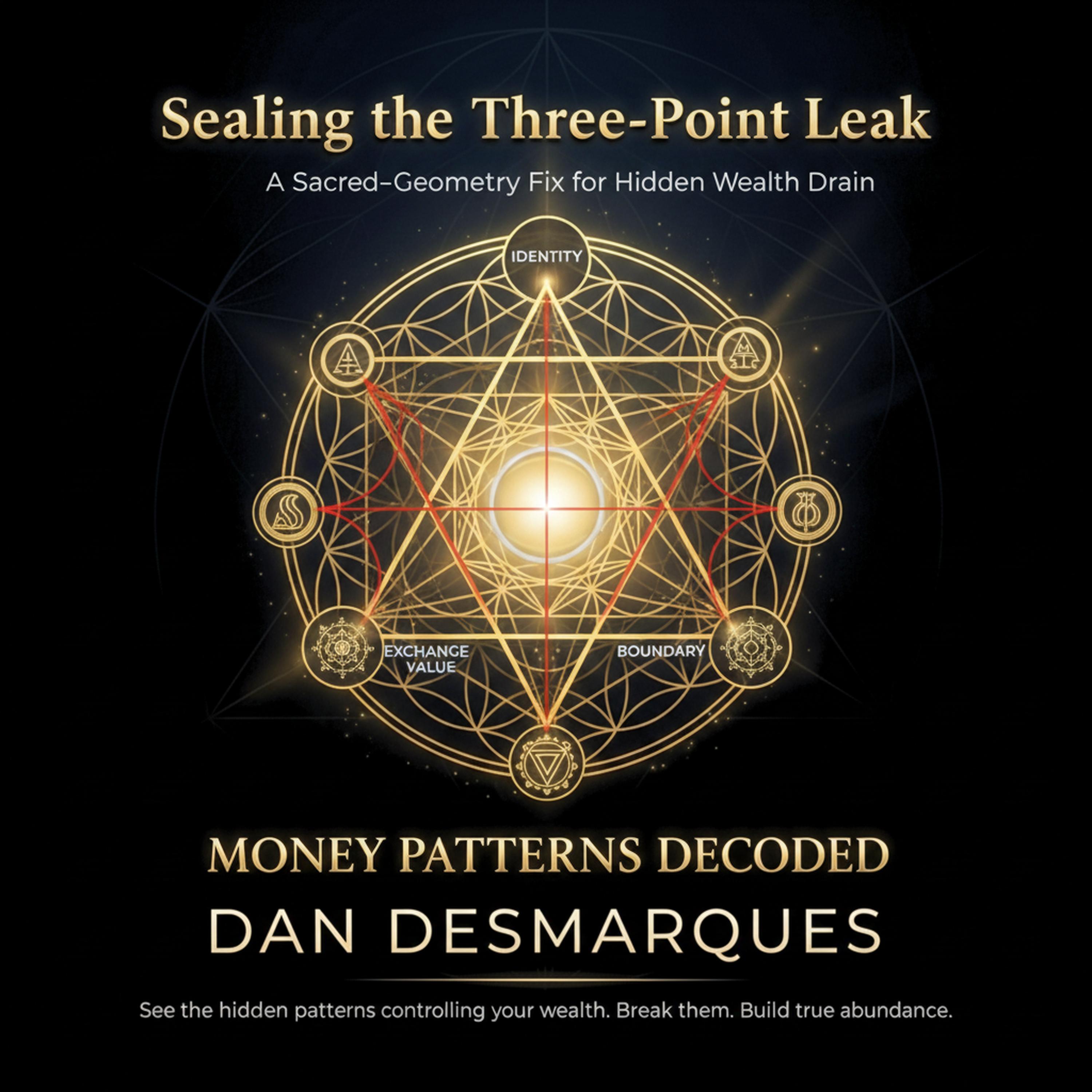
Sealing the Three-Point Leak: A Sacred-Geometry Fix for Hidden Wealth Drain
Dan unpacks the 'Three‑Point Leak' — a pervasive money pattern where your income, purpose, and boundaries form a triangular drainage that secretly siphons wealth. In seven focused minutes he maps the architecture: a sacred-geometry triangle whose vertices—identity (who you think you are with money), exchange value (what you charge and accept), and boundary (what you allow or protect)—become misali
The Mirror Contract: Rewriting Generational Scarcity with Numerology & Inner Alchemy
You inherit more than habits and stories—you inherit a contract: a Mirror Contract that reflexively reproduces your ancestors' financial fate. In this episode Dan decodes how a repeating numerical signature and an ancestral emotional ledger conspire to make your earnings 'look like' your lineage. You’ll get the precise psychological mechanism (shame, duty, and survival reflexes) and the esoteric a
The Anchor of Smallness: Rewiring the 'Not Enough' Node
Most money problems aren't spreadsheets; they're lodged beliefs that act like an anchor on your identity. In this episode Dan names the 'Anchor of Smallness'—the internal node that tells you there's never enough, so you tighten, bargain, and self-sabotage. You'll get a concise psychological map (childhood scarcity scripts, worth-currency confusion) and an esoteric map (how closed sacred forms, Ros
The Reciprocity Knot: Untying Obligation That Costs You Wealth
Most people confuse generosity with free flow and obligation with moral currency. In this episode I name a pattern I rarely hear discussed: the Reciprocity Knot. I'll expose how polite yeses, ancestral duty, and hidden social ledgers generate a psychological choke and an energetic tether that routes income away from you. I trace the mechanism: the inner people-pleaser and obligation complex (psych
The Keystone Shadow: Reclaiming Loyalty From Scarcity
This episode decodes the money pattern I call the Keystone Shadow: a hidden psychological and esoteric loyalty to scarcity that functions like a keystone in the arch of your inner economy. I expose how familiar comforts—identity, family roles, moral superiority, and fear of relational fallout—create reward loops that keep you defending lack. Then I trace the same structure in esoteric language: so
The Zero-Point Contract: Embracing the Beginner's Wealth
Most money work focuses on scaling, optimization, or ancestral scripts. This episode flips the lens: there's a subtle contract many of us sign that forbids the zero—the humble beginning. I call it the Zero-Point Contract: a mix of perfectionism, identity-preservation and spiritual pride that keeps you waiting for a 'right moment' and blocks the small, decisive acts that compound into real abundanc
The Prism of Exchange: Unifying Fragmented Money Selves
You think your money problems are about budgets or willpower. They’re usually about identity: you hold different money selves — the Saver, the Giver, the Rebel, the Spiritual — and they pull your resources in competing directions. In this episode I name the pattern I call the Prism of Exchange, expose the psychological fracture and the esoteric geometry behind it (how a fractured circle scatters f
The Folded Ledger: Unfolding Hidden Emotional Profits
Most financial advice addresses numbers; this episode exposes the place numbers hide—the folded ledger of emotion, memory and contract where profits are intentionally creased away. I’ll name the pattern, map its psychological hinge (shame, secrecy, and loyalty folds), reveal the esoteric architecture that keeps those folds weighted (archetypal ledger-keeping, inner alchemy of containment), and giv
The Hollow Mandala
Many of us run beautiful money rituals: monthly tithes, symbolic budgets, repeated affirmations—practices that feel whole and spiritually correct but cycle capital without building structure. I call this the Hollow Mandala: a sacred-looking pattern whose center is empty. In this episode I name the pattern, expose its two-part mechanism—the psychological comfort of ritualized motion and the esoteri
The Threshold Tax: Why Crossing Income Gates Triggers Self-Sabotage
Every time your income or pricing approaches a new tier something strange happens: you hesitate, sabotage, or unconsciously ‘pay’ a tax to stay small. In this 7-minute decode Dan names the pattern I call the Threshold Tax, exposes the psychological and esoteric gatekeepers that levy that charge, and gives one precise daily crossing practice that rewires your identity around expansion. You’ll get a
The Missing Denominator
Most people treat money like arithmetic: add income, subtract bills, hope the balance grows. But your inner life supplies the denominator — the scale of worth that divides or multiplies every dollar you earn. In this episode I name the pattern I call the Missing Denominator: a hidden internal unit of value that fails to scale with your income, so gains feel insignificant and abundance never lands.
The Polite Deficit
Dan exposes a subtle, overlooked money pattern he calls 'The Polite Deficit'—the cultural etiquette that makes you underprice, under-claim, say yes when you should say no, and translate approval into financial loss. In seven minutes he names the pattern clearly, traces the psychological mechanics (shame, approval-seeking, fear of standing out) and then maps an esoteric exchange geometry: polite ge
The Price of Comfort
In this seven-minute decode, Dan exposes 'The Price of Comfort' — the hidden money pattern where you habitually price your offers, set salaries, and accept income based on what other people feel comfortable paying instead of the value you actually create. Psychologically this pattern is rooted in attachment, approval loops, and a soft inner metric that defers to external comfort. Esoterically it c
The Broken Fibonacci: Restoring the Spiral of Compound Wealth
Most people think compounding is a math problem. It's not — it's a pattern problem. In this episode I decode a money pattern I call the Broken Fibonacci: a subtle interruption in how you sequence effort, savings, pricing and attention so that instead of a growing spiral you wind up with fragmented, stalled steps. I'll expose the psychological mechanism (fear, perfectionism, start-stop identity) an
The Silent Oath: Rewriting Unspoken Family Contracts That Drain Your Wealth
Most money problems are not transactions — they're promises you never signed but still obey. In this episode Dan decodes the 'Silent Oath': the unspoken family contracts and inherited vows (we don't talk about money, we don't deserve riches, we must be humble) that silently tax your income, sabotage offers, and lock generosity into shame. You'll get a clear map of how the pattern works: the psycho
The Mirror Tax: When Your Inner Reflector Discounts Your Worth
You keep losing money not because the world undervalues you, but because you habitually mirror other people's price-tags back onto yourself. In this episode Dan names 'The Mirror Tax' — the hidden pattern where internalized reflections of family, peers and authority become a psychic fee deducted from every offer, invoice and saving goal. We decode the twin mechanisms: the psychology of conditional
The Anchor Node: Break the Single-Point Scarcity That Caps Your Earnings
Most people carry one invisible anchor: a single price-point, shameful memory, or childhood ledger entry that magnetically limits what they believe they can earn. In this episode I name that pattern 'The Anchor Node,' show how it forms in early emotional pricing and then ossifies through neural habit and sacred-geometry fixation, and give you a precise, doable daily shift to loosen it. You’ll get
The Reciprocity Loop: Breaking One-Way Flows That Drain Your Wealth
Many people live inside an invisible contract: they are unconsciously wired to give more than they receive, or to receive without closing the energetic and practical loop. I call this pattern the Reciprocity Loop. In this episode I name the loop, trace its psychological origin (childhood approval economies, shame, survivor guilt), and expose its esoteric architecture — a torus-shaped flow that mus
The Tithe of Attention: How Your Focus Secretly Taxes Your Wealth
Most people treat attention like a free resource. It is not. In this episode I name the pattern I call the Tithe of Attention: the habitual surrender of focus to scarcity, comparison, and micro-worry that functions like a hidden tax on your finances. I expose the psychological mechanism—habitual threat loops, conditioned scarcity narratives, and attention biases—and the esoteric mechanism: how att
The Coin's Shadow: How Fragmented Identity Leaks Your Wealth
Most money problems aren’t about budgets or markets — they’re about identity. In this episode Dan names a precise pattern: the fragmented money self, where competing inner roles (the spender, the caretaker, the safe child, the rebel) each claim a slice of your finances and create invisible leaks. You’ll get a clear psychological diagnosis (how early role formation and shame-code scripts partition
The Lead-to-Gold Delay: Turn Habitual Procrastination into Alchemical Income
Procrastination is presented as a moral failing, but for money it functions as a predictable pattern that converts potential into perpetual latency. In this episode Dan names the pattern — the Lead-to-Gold Delay — and traces its twin mechanism: a psychological loop of perfectionism, fear of claiming worth, and avoidance; and an esoteric mirror in Rosicrucian alchemy where nigredo (neglect) prevent
The Hex-Flow Split: Restoring the Sacred Geometry of Give & Receive
Most scarcity feels like a personal flaw. The Hex-Flow Split reframes it as a structural misalignment: your give-centers and receive-centers live in different internal geometries, so value passes through you chopped, taxed and returned as scarcity. In this episode I name the pattern, expose its psychological mechanics (guilt, covert entitlement, split identity) and its esoteric shape — how a fract
The Phantom Exchange Rate: Re-denominate Your Emotional Currency
Most people price money in hard numbers while an invisible emotional FX table silently devalues their income. In this episode Dan names the pattern: the Emotional Exchange Rate — a lifetime of shame, loyalty, timing, and ancestral accounting that attaches negative multipliers to particular paychecks, customers, or income sources. You get the psychological anatomy (scripts, scarcity loops, identity
The Permission Ledger: How Small Denials Quiet Your Prosperity
Most scarcity is not a lack of money; it’s a ledger of permissions you never wrote for yourself. In this episode Dan names the "Permission Ledger" — the tiny, habitual denials (I don't deserve this, I can't charge that, I shouldn't invest in myself) that compound like fees on every transaction of your life. You’ll hear the exact psychological mechanism (shame, internalized thresholds, micro-bounda
The Sunk-Honor Pattern: When Past Loss Becomes a Moral Chain
Most people treat money lost as a moral sentence: proof they must play smaller, hoard harder, never risk again. I call this the Sunk‑Honor Pattern — a psychic and esoteric knot that turns past losses into vows, shame, and a conservative identity that caps income and investment. In this episode I decode the psychological mechanism (shame, identity fusion with loss, learned risk-avoidance) and the e
The Safety-Compression Pattern: When Financial Safety Shrinks Your Abundance Field
Dan decodes the Safety-Compression Pattern: the ordinary, almost virtuous habit of treating money as a fortress that paradoxically collapses opportunity. This episode traces the pattern's anatomy—childhood safety contracts, defensive budgeting that repels rather than preserves, and the esoteric dynamic where contraction of the energy field mirrors folded sacred geometry. You get a clear psychologi
The Invisible Contract Pattern: Renegotiating Your Future-Self's Scarcity Pledge
You may be living under a contract you never signed: a pattern where past vows, family promises, and an internalized future-self commit you to scarcity. This episode names the Invisible Contract Pattern, exposes how it operates both psychologically (discounting the future self, obligation bonds, guilt-based stewardship) and esoterically (spoken vows as soul-contracts, ancestral pacts, language tha
Generated Episode Idea
{"title":"The Shame-Interest Pattern: How Shame Compounds Against Your Wealth","one_liner":"A 7-minute decoding of how shame functions like compound interest—quietly eating your financial principal—and a precise daily 'principal-forgiveness' practice to halt the erosion and reclaim your earning bandwidth.","description":"Shame doesn't just make you feel small; it accrues like compound interest on
The Anchor-Value Pattern: Releasing the Low-Value Gravity That Holds Your Income Down
Most scarcity isn’t scarcity of money; it’s scarcity of value-perception. In this episode Dan names the Anchor-Value Pattern: the unconscious habit of anchoring offers, prices, and self-worth to a low baseline that creates a gravitational well pulling every earning opportunity down. He exposes the psychological mechanism—internalized comparison, scarcity identity, and micro-shaming loops—and the e
The Round-Number Ceiling: How Numerals Freeze Your Financial Momentum
Most people think numbers are neutral. They are not. In this episode Dan decodes the 'Round-Number Ceiling' — the invisible force that arrests income, pricing, and offers at neat, round numerals. We'll trace the psychology (completion bias, social signaling, fear of overreach) and the esoteric architecture (how certain numerals form closed energetic geometries that feel "finished") that together c
The Mirror-Price Pattern: Stop Pricing Yourself by Other People’s Reflections
You set prices, fees and worth based on the reflections you see in other people's eyes—the Mirror-Price Pattern. This episode decodes how social mirrors, childhood approval ledgers and subtle family numerologies conspire to make you underprice, over-accommodate, or freeze your offers. I expose the psychological mechanism (approval addiction, conditional worth, internalized market scripts) and the
The Spectator Account Pattern: Reclaiming Financial Agency
Many people treat money like a spectator sport: analyze, outsource, ritualize, and then wonder why flow stalls. In this episode I name the Spectator Account Pattern — the habit of removing your decision-point from the money field and delegating your financial soul to advisors, algorithms, ancestral scripts or performative rituals. I expose the psychological mechanism (projection of agency, learned
The Spiral-Entry Pattern: Seed the First Receive to Open Expanding Wealth
Most people mistake big breakthroughs for single events. The real secret is the small first acceptances you refuse. In this episode Dan names the Spiral-Entry Pattern: a hidden habit that withholds the first tiny monetary intake until conditions feel 'perfect', which aborts energetic nucleation and prevents compounding. Dan decodes the psychological mechanism (perfectionism, fear of contamination,
The Echo-Inheritance Pattern: Translating Ancestral Money Rhythms into Modern Abundance
Most money issues are not original problems — they are echoes. In this episode Dan Desmarques names the 'Echo-Inheritance Pattern': the way ancestral emotions, rituals, and unspoken financial stories set a tempo your nervous system obeys, long after the original circumstance has passed. You’ll get a tight decode of the psychological mechanism (implicit memory, attachment to family scarcity scripts
The Signature-Mismatch Pattern: When Your Earning Identity Is Out of Phase
Most money problems aren't about budgets or strategy — they're about identity geometry: the pattern your psyche and energy use when money passes through you. In this episode Dan names the 'Signature-Mismatch Pattern' — the quiet misalignment where your outer money persona (what you do to get paid) is out of phase with your inner earning architecture (how your soul, values and numerology want to re
The Permission-Debt Pattern: How Unpaid Permissions Quiet Your Cashflow
Most people treat money like a ledger of transactions and not a ledger of permissions. The Permission-Debt Pattern is the hidden internal account where denied permissions accumulate: permission to charge your worth, to receive gifts, to spend without guilt, to invest in yourself. Psychologically it looks like procrastination, shame, or chronic underpricing; esoterically it maps to a compressed ene
The Zero-Sum Reflex Pattern: Turning Others' Gain Into Your Growth
Most people treat other people's success like theft: a reflexive tightening that quietly narrows your earning orbit. In this episode Dan names the Zero-Sum Reflex Pattern—the automatic psychological and energetic loop that interprets external gain as internal loss. He decodes the mechanism: a childhood-installed scarcity narrative reinforced by sympathetic mirror neurons and a closed sacred-geomet
The Cloistered Ledger Pattern: How Hidden Financial Secrets Starve Abundance
Many people treat money like a secret: small wins, pricing decisions, debts, and receipts get tucked away in hidden mental ledgers. The Cloistered Ledger Pattern names that secret-keeping as an active scarcity architecture. In this episode Dan decodes the psychological mechanism—shame, protective concealment, and split identity—and the esoteric architecture: how folded contracts, blocked energetic
The Parity-Lock Pattern: When Equal Exchange Feels Dangerous
Many people stall not because they lack skill or opportunity, but because an internal governor insists everything must be 'paid back' instantly — a Parity-Lock that freezes receiving and collapses momentum. In this episode Dan decodes that invisible mechanism: the childhood and ancestral narratives that equate abundance with debt, the shadow reflex that rebalances by self-sabotage, and the esoteri
The Micro-Threshold Pattern: How Tiny Frictions Leak Your Abundance
Most money leaks aren’t dramatic; they’re microscopic thresholds you cross (or refuse) hundreds of times a day. In this episode Dan names the Micro-Threshold Pattern: the habit of stopping, deferring, or discounting because a subtle internal friction makes small financial steps feel unsafe. I’ll show how that psychological reflex is anchored in an esoteric law — energetic resonance and boundary ge
The Decimal Ghost Pattern: How Rounding and Mental Denominations Steal Your Worth
We treat pennies, cents and the ‘tail’ of prices like verbal static—insignificant. That habit is not neutral; it trains your nervous system to devalue worth, silently compresses your pricing identity, and creates a steady energetic drain I call the Decimal Ghost Pattern. In this episode Dan names the pattern, exposes the psychological mechanism (mental accounting, frictional neglect, shame around
Generated Episode Idea
{"title":"The Soul-Contract Fee Pattern: When Relationship Roles Quiet Your Bank Account","one_liner":"How the unspoken 'fees' built into your relationship roles silently siphon income—and a one-minute daily 'Contract Audit' that rewrites those invisible terms.","description":"Most money leaks are tracked in budgets; this one lives in human agreements. The Soul-Contract Fee Pattern names the invis
The Sacred Margin Pattern: Why Your Vanishing Buffer Collapses Abundance
Most people treat margins as accounting fluff. But in the architecture of abundance, that thin buffer—the Sacred Margin—is the structural gap that allows money to circulate. In this episode Dan names the pattern that shows up as chronic over-giving, constant reinvestment without reserve, and emotional exhaustion after wins. You’ll get a clear decode of the psychological mechanism (shame-based omni
The Self-Tax Pattern: How Your Inner Levy Sabotages Compound Growth
You quietly take a cut of every success. Not a ledger entry, but a felt levy: guilt, unworthiness, or a hidden rule that says ‘keep the win small.’ I call this the Self‑Tax Pattern. In plain, precise language this episode names the rule, reveals its two engines — the psychological levy (shame, fear of standing out) and the esoteric divisor (how your inner geometry fragments worth into untouchable
The Rhythm Misalignment Pattern: When Your Cashflow Beats Out of Phase
Most people treat money as transactions. I treat money as rhythm. In this episode I expose the Rhythm Misalignment Pattern: a hidden mismatch between your personal energetic cadence (psychology, habits, ancestral timing) and the external cycles that deliver income. You'll hear how ordinary behaviors — chasing every opportunity, neglecting your natural peak days, reacting to urgent noise — create a
Generated Episode Idea
{"title":"The Inheritance Invocation Pattern: How Family Money-Origin Stories Command Your Wealth","one_liner":"How the story of where your family’s money came from quietly writes the script for your earning, pricing, and willingness to receive — and a single daily narrative reset to reclaim your sovereign abundance.","description":"Most scarcity isn’t about present math — it’s a script whispered
The Anchor-Curse Pattern: How Your First Win Sets a Financial Ceiling
Most people treat their first financial win as nostalgia or luck. In truth it functions like an anchor: a numeric, psychic, and energetic imprint that sets your future ceiling. In this episode Dan decodes the Anchor‑Curse Pattern — how anchoring bias, early identity formation, and an occult imprinting of a ‘first‑number’ conspire to freeze your abundance trajectory. You’ll get a sharp psychologica
The Latent Symmetry Pattern: Why Your Inner Image Locks Your Income Shape
Most people treat money as a problem to solve; the Latent Symmetry Pattern shows money as a mirror seeking coherence. In this episode Dan names the pattern that keeps income stuck: an internal architecture where self-image, roles, and energetic proportions must match external numbers. You’ll get a clear decode of the psychological mechanism (identity equilibrium, fear of mismatch, corrective self-
The Sanctified Discount Pattern: When Humility Undercuts Your Fee
Many spiritually minded earners convert inner humility into chronic underpricing — treating lower fees as virtue rather than a structural limit on abundance. In this episode I name the Sanctified Discount Pattern, expose its psychological wiring (shame, approval hunger, moralized scarcity) and its esoteric architecture (numerology of self-worth, sacred geometry of boundary collapse, Rosicrucian in
The Invisible Contract Pattern
You never signed the family rules on paper, but their clauses lie heavy on your ledger. In this episode Dan exposes the Invisible Contract Pattern: the unspoken, intergenerational agreements that assign you roles, limits, and taboos around money. I map the psychological anatomy — loyalties, shame, and adaptive identity — and the esoteric architecture: how energetic signatures, mnemonic knots, and
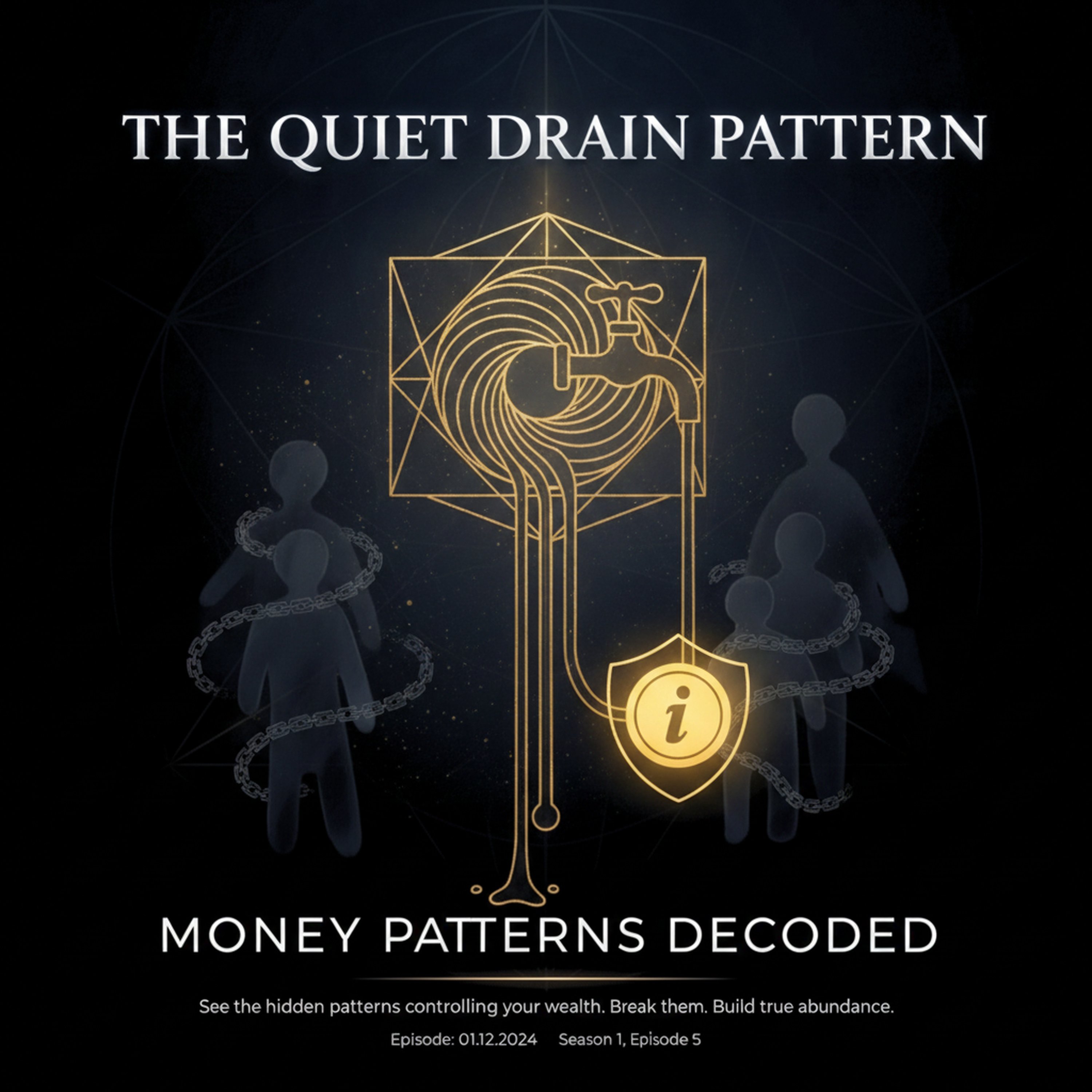
The Quiet Drain Pattern
Most money leaks are not spreadsheets; they are emotional subscriptions you pay every day: free labor to please, unpaid caretaking, silent apologies that cost you clients, friends, and the confidence to charge what you’re worth. In this episode Dan names the Quiet Drain Pattern, decodes the twin mechanisms that keep it running — psychological compulsion to be needed and an esoteric energetic apert
The False Witness Pattern: Stop Letting Imaginary Observers Control Your Money
Many money decisions are not made for your future; they are made before an imagined witness. You undercharge because someone might call you greedy, buy status symbols because someone might call you unsuccessful, or delay investing because failure would become visible. This is the False Witness Pattern: the psychological habit of outsourcing financial authority to an internal audience assembled fro
The Moral Ceiling Pattern: When Being Good Keeps You Financially Small
Many people say they want more money while unconsciously treating wealth as evidence of greed, exploitation, or spiritual compromise. This is the Moral Ceiling Pattern: a hidden agreement to remain financially limited so you can preserve a clean self-image. Dan exposes how this pattern appears psychologically through guilt, over-giving, undercharging, and reflexive rejection of profitable opportun
The Rescue Contract Pattern: When Saving Others Keeps You Financially Scarce
Some people do not overspend on themselves; they over-function financially for everyone around them. They lend before being asked, absorb family crises, waive their own boundaries, and call the pattern love. This episode names the Rescue Contract: an unconscious agreement that your worth depends on being the provider, fixer, or financial savior. Dan decodes its psychological mechanism—guilt, ident
The Deferred Self Pattern: When Your Future Gets All the Money
Many people organize their finances around a person they hope to become: the debt-free self, the successful self, the spiritually aligned self, or the self who has finally earned permission to relax. This is the Deferred Self Pattern. Psychologically, it turns every dollar into a verdict about the future, making present needs feel indulgent and long-term goals feel emotionally unreachable. Esoteri
The Open Loop Pattern: Why Unfinished Money Keeps Calling You Back
Some financial problems do not come from earning too little; they come from leaving too much unresolved. The Open Loop Pattern appears when unpaid bills, forgotten subscriptions, postponed paperwork, vague debts, and unmade decisions remain active in the background. Psychologically, unfinished tasks consume attention and create avoidance. Esoterically, they form energetic cords to the past, keepin
The Pendulum Pattern: Why Your Money Swings Between Deprivation and Indulgence
Some people do not have a spending problem or a saving problem; they have a pendulum problem. They swing from severe restriction to impulsive relief, then back again, repeating the same financial rhythm while believing each extreme will finally create safety. Dan Desmarques names the hidden pattern and shows how it operates psychologically: deprivation builds pressure, pressure seeks release, and
The Split-Source Pattern: Why You Distrust Money That Comes Too Easily
Some people work relentlessly for earned income but feel uneasy when money arrives through royalties, investments, partnerships, gifts, or a business system that works without constant effort. This is the Split-Source Pattern: the unconscious belief that money has different moral or energetic identities depending on how it arrives. Dan Desmarques reveals how this division can produce guilt, impuls
The Ancestral Loyalty Pattern: When Financial Growth Feels Like Betrayal
Financial growth can trigger an unexpected emotion: guilt. You earn more, save consistently, or consider a larger opportunity, and something inside you pulls back—not because the choice is irrational, but because prosperity feels like separation from your family or community. This episode decodes the Ancestral Loyalty Pattern, the hidden agreement that keeps you repeating inherited money limits so
The Translation Gap Pattern: When Spiritual Insight Never Becomes Financial Behavior
Many people collect powerful ideas about abundance, consciousness, and wealth, yet their bank accounts keep reflecting the same old pattern. This is the Translation Gap: the distance between what you say you believe about money and what your calendar, pricing, spending, and attention actually practice. Psychologically, the gap protects you from the discomfort of behavioral change while allowing yo
The Leaking Vessel Pattern: Why More Income Never Becomes More Wealth
Many people focus on opening the flow of money while ignoring the vessel meant to hold it. They earn more, receive a windfall, or create a promising opportunity, yet the money quickly dissolves into upgrades, obligations, random generosity, or unexamined consumption. This is the Leaking Vessel Pattern: financial growth without structural containment. Psychologically, novelty triggers permission to
The Effort-Value Confusion Pattern: Why Working Harder Keeps Your Income Small
Many capable people believe money rewards effort directly: more hours, more sacrifice, more exhaustion. That belief creates a hidden ceiling because effort is measurable but value is relational—the result, relief, clarity, speed, or transformation another person receives. This episode names the Effort-Value Confusion Pattern and shows how it turns diligence into underpricing, overdelivery, and qui
The False Finish Line Pattern: Why Reaching a Money Goal Makes You Sabotage It
Many people believe they want a specific financial milestone, yet their behavior changes the moment that milestone becomes possible. They delay invoices, make unnecessary purchases, abandon a promising offer, or create new obligations that restore the familiar struggle. This is the False Finish Line Pattern: using a money goal to escape discomfort rather than to build a stable identity. Dan expose
The Sacred Deadline Pattern: Why You Only Act When Money Becomes Urgent
Many people do not manage money until a bill is due, an account is low, or an opportunity is about to disappear. Then they become focused, resourceful, and decisive. This is the Sacred Deadline Pattern: unconsciously using urgency as a substitute for purpose. Psychologically, pressure narrows attention and temporarily silences doubt, so the nervous system learns to associate crisis with competence
The Financial Rescuer Pattern: Why Saving Everyone Else Keeps You Poor
You may believe you have a money problem, but the deeper pattern could be your unconscious need to rescue other people from financial consequences. This episode names the Financial Rescuer Pattern: earning, saving, or sacrificing not to build your own foundation, but to remain indispensable. Dan Desmarques reveals the psychological mechanism beneath it—the temporary significance, control, and belo
The Witness Premium Pattern: Why You Pay More to Prove You Belong
You do not always spend to obtain something. Sometimes you spend to be witnessed as successful, generous, sophisticated, or worthy of entry. This is the Witness Premium Pattern: paying extra, upgrading prematurely, or accepting financial strain because an audience—real or imagined—must confirm your identity. Dan Desmarques exposes the psychological mechanism behind status spending, social comparis
The Open Loop Pattern: Why Unfinished Money Decisions Drain Your Wealth
You do not need to be reckless to lose financial power. You can lose it through open loops: the unpaid bill you keep postponing, the subscription you meant to cancel, the price you never raised, the account you refuse to review, or the financial conversation you continually avoid. This episode names the Open Loop Pattern and exposes its two-layer mechanism. Psychologically, unfinished decisions co
The Identity Ceiling Pattern: Why Your Wealth Stops Where Your Self-Image Ends
Many people try to change their income while unconsciously defending the financial identity they already know. This is the Identity Ceiling Pattern: wealth expands only until it begins to contradict your self-image, then hesitation, under-asking, avoidance, or impulsive retreat restores the familiar level. Psychologically, the mind resists cognitive dissonance; esoterically, the pattern resembles
The Money Apology Pattern: Why You Shrink After You Get Paid
Many people believe their money problem is earning too little, yet the deeper pattern appears immediately after payment arrives: they apologize for their price, add unpaid labor, minimize the result, or spend the money quickly to escape the discomfort of having received it. This is the Money Apology Pattern. Psychologically, it often comes from confusing receiving with taking, visibility with dang
The Borrowed Desire Pattern: Why Chasing More Money Leaves You Empty
Many people do not have a money problem; they have a desire problem. They pursue a larger income, a prestigious purchase, or a public image of success because those goals were quietly borrowed from family, culture, peers, or an unconscious archetype of the “successful” person. The result is a subtle pattern: constant striving, financial decisions that impress others, and a growing sense that achie
The Scattered Offering Pattern: Why Divided Financial Attention Prevents Wealth from Compounding
You may not have an income problem or a discipline problem. You may have a concentration problem. The Scattered Offering Pattern appears when money is divided among countless goals, subscriptions, rescue missions, lifestyle upgrades, and half-started plans, leaving no single direction strong enough to create momentum. Dan Desmarques reveals the psychological mechanism: fragmented attention reduces
The Money Echo Pattern: Why You Keep Repeating Your Family’s Financial Role
What if your financial behavior is an echo before it is a choice? The Money Echo Pattern appears when you unconsciously repeat the role your family assigned you: the rescuer, the invisible one, the responsible provider, the rebel, or the one who must never surpass anyone. Psychologically, the role creates loyalty, guilt, and predictable decisions. Esoterically, it acts like an inherited symbol tha
The Premature Harvest Pattern: Why Imagining Future Wealth Makes You Spend It Before It Arrives
Many people do not lose money when it arrives; they lose it earlier, in imagination. The moment a raise, sale, bonus, or promising opportunity appears, they mentally spend the money, upgrade their obligations, or relax the discipline that would have created it. This is the Premature Harvest Pattern: confusing potential with possession. Dan Desmarques exposes the psychological mechanism—dopamine re
The Clocked Abundance Pattern: Why Trading Every Hour for Money Keeps You Financially Small
Many people believe they are paid for effort, so they respond to financial pressure by giving more hours, answering more messages, and making themselves permanently available. This creates the Clocked Abundance Pattern: a hidden agreement that money must be earned through exhaustion and can never outgrow personal time. Psychologically, the pattern confuses activity with value and makes rest feel i
The Unsealed Vessel Pattern: Why Money Leaks Away Without a Financial Container
Many people blame low income for their financial instability, yet the deeper problem is often an unsealed vessel: money enters, but no clear container is ready to preserve, direct, and multiply it. This episode names the pattern and exposes its two layers. Psychologically, an undefined financial structure forces every dollar to negotiate with impulse, anxiety, and competing demands. Esoterically,
The False Emergency Pattern: Why Money Urgency Keeps You Financially Reactive
Many people do not lose financial ground because they are careless; they lose it because every money signal feels like an emergency. A bill, opportunity, request, or temporary setback triggers immediate action, and urgency narrows perception until the most emotionally charged choice feels like the only choice. This is the False Emergency Pattern. Dan explains its psychological mechanism through th
The Martyr's Purse: Why Your Self-Sacrifice Is Bleeding Your Wealth Dry
In this episode, we decode the martyr archetype as a financial pattern—the unconscious compulsion to give away money, time, or opportunities to feel morally superior, loved, or safe. This pattern often stems from childhood programming that equates self-worth with suffering, and it manifests as chronic overspending on others, refusing to charge fair prices, or always bailing out friends and relativ
The Comparison Ledger: Why Your Neighbor's Bank Account Is Your Biggest Liability
This episode decodes the hidden pattern of financial comparison: how measuring your wealth against others creates a phantom ledger that distorts your decisions, fuels envy, and keeps you trapped in scarcity. Dan reveals the psychological mechanism of social comparison and the energetic cost of attaching your worth to external numbers. He then reframes this pattern through the lens of sacred geomet
The Discounted Self: Why You Keep Marking Yourself Down
In this episode, Dan Desmarques exposes the 'Discounted Self' pattern — the unconscious habit of pricing your time, talents, and needs below their real value. It's not modesty; it's a self-worth thermostat set in childhood, when being a 'good deal' felt safer than asking for what you deserve. You accept lower offers, buy the cheapest option for yourself, and minimize your needs, all while wonderin
The Fortress Fallacy: Why Your Money Walls Are Blocking the Abundance You Seek
This episode exposes the hidden pattern of financial defensiveness—hoarding, over-saving, and avoiding all risk as a subconscious attempt to feel secure. Psychologically, it's a fear response born from past scarcity wounds; esoterically, it's a blockage in the sacred circulation of energy. Using sacred geometry, we compare the closed square of a fortress to the open circle of natural flow, showing
Recommended

CBS Radio Mystery Theater | Old Time Radio

Solved Murders - True Crime Stories

紐約鳥|New York Aperture
The Swerve Podcast: Obscure Topics | Conspiracy Theories

The Bread and Banter Podcast
The Church of What's Happening Now: The New Testament

Busted Open

Deadline: White House

Crickets Corner

History of the Earthquake and Fire in San Francisco

Fox news

K-Drama Obsessed Mamas | Beyond “Just One More Episode!”
