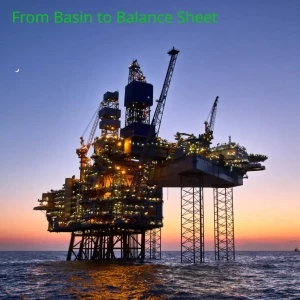
From Basin to Balance Sheet
From Basin to Balance Sheet is a personal podcast hosted by Jeff Parke. It features his thoughts and reflections on a variety of topics. The show offers a casual, introspective look at whatever is currently on his mind.
Episodes
Decommissioning - The Final Obligation
How much longer can a field keep going? When will the cost of operating it exceed the value of the oil it produces? And what will it cost to dismantle a structure that took years and billions of pounds to build?
Because even on the day that last barrel is produced, the work is far from over.
Deep beneath the seabed, wells must be permanently sealed. Miles of pipelines must be cleaned and made safe
Special *Managing Careers Against Uncertainty*
One of the realities of working in oil and gas is that the industry is cyclical, and those cycles can be severe.
I’m going to talk about why this industry repeatedly creates moments like these and what happens to us when the future we expected suddenly changes. This episode is a little more personal than the others, exploring how I think we can begin to respond in a way that gives us some influenc
New Owner, New Value - Mergers, Acquisitions & Divestments
Transactions are a fundamental part of the upstream life cycle. Companies merge. They buy competitors or individual assets. They combine parts of their portfolios into joint ventures. They sell fields that no longer fit their strategy, sometimes to companies whose entire business model is built around precisely that type of asset.
And that raises an interesting question. If two competent companies
Mature Assets - Managing the Decline
Decline is not just the passive final slope on a production graph. It is a sequence of choices. The team can drill between existing wells, repair damaged completions, improve sweep, remove processing constraints or connect nearby discoveries. Each action may add reserves, accelerate production or reduce cost. It may also consume capital that could earn a better return elsewhere.
The commercial tas
Reservoir Management - Delivering the Plan
A project is sanctioned using the best description available at the time combined with a statistical understanding of what our experiences elsewhere have taught us: seismic, a handful of wells, fluid samples and engineering assumptions, along with risk events to look out for with appropriate surveillance. Production then becomes a full-field experiment. Every pressure, rate and equipment failure a
Finance - Barrels to Dollars
Petroleum economics brings the consequences of substantial expenditure and significant uncertainty together in a common language. So when we say that a project is worth five hundred million dollars, or has an IRR of twenty-five per cent, there is a whole physical and commercial story sitting underneath that number.
And understanding it matters because almost every major upstream decision eventuall
Projects - Building the Asset
Should the field have a large standalone facility, or a smaller development tied back to existing infrastructure? Should it be built around twenty wells or twelve? Does it need large water-injection capacity from first oil?
These are detailed engineering questions. But more importantly, they are development-choice questions.
Get them broadly right, and good project execution can turn the concept i
Operations - Making it Work
This is the life for which the field must really be designed. Development planning and construction may occupy five or six years, but the facilities can operate for twenty-five years or more. Over that period, the undiscounted cost of operating and maintaining them may exceed the original capital investment. A design that looks efficient on the project schedule can therefore become an expensive bu
Facilities - The Path to Sales
The facility is where the development becomes physically visible. Steel vessels, pipework, compressors, pumps, tanks and control systems occupy a desert site, rise above the sea on a platform, or sit inside the crowded topsides of a floating production vessel. Their purpose is straightforward to describe but difficult to achieve: accept whatever the reservoir and wells deliver, separate the useful
Designing Wells for Value
The well is the point where geology becomes production capacity. Its productivity determines how many wells must be drilled, how large the facilities need to be, how quickly the field reaches plateau and how soon revenue begins to repay the investment. Its behaviour can also determine how much water must be processed, how much reservoir energy is wasted and how much oil is ultimately left behind.
What makes fluids move?
The seismic interpretation looks convincing. The appraisal wells have produced economic hydrocarbons. The volumetric range is large enough to excite people. There is already talk of plateau rates, export routes and first production dates.
But one question now matters more than almost any other:
How will the reservoir actually behave once we start producing it?
A discovery, no matter how large, is
Appraisal and the Value of Information
So far in this series, we’ve followed the upstream journey from exploration to drilling and the excitement of making a discovery.
It is three o’clock in the morning on a drilling rig. For weeks, the drill bit has been working its way through kilometres of rock, following a target first imagined from seismic reflections and geological history. Then the signs begin to change. Gas readings rise. The
The Size of the Prize
In the last episode, we explored the reservoir itself — porosity, permeability, pressure, fluids and the geological properties that determine whether hydrocarbons can actually flow.
But today we move into one of the most commercially important questions in the entire upstream business:
How much oil and gas is actually there?
Because finding hydrocarbons is not enough.
Companies need to estimate ho
Understanding the Reservoir
So far in this series, we’ve followed the upstream journey from exploration to drilling, and then into safety and environmental management.
But drilling a well is only part of the story.
Once the well reaches the target, a new set of questions begins.
How much oil or gas is actually present?
Will it flow?
At what rate?
Under what pressure?
How connected is the reservoir?
And how much of the oil or
Safety, the Environment and Risk
Today, we move into a topic that sits underneath every part of the upstream industry.
Safety.

From Prospect to Wellbore
Today’s episode is about drilling engineering: how the upstream industry connects a subsurface target to a production facility – with a wellbore.
Exploration
Exploration. Imagining and then finding hydrocarbons
The Field Life Cycle
Intro and overview of the field lifecycle
Recommended

megahired.com

Hard Knocks Podcast

Effective Weight Loss for Moms | High protein, Strength Training, Lose Weight, Meal Planning, Fat Loss, Healthy Habits

The Human-Animal Connection - Pet Life Radio Original

Infinite Health with Dr. Arasi Maran

The Daily

World News Tonight with David Muir

English Vocabulary Help

The Joe Rogan Experience

TED Talks Daily

Learn English B1 with Daily News | English Listening Practice

Talk About Talk - Executive & Leadership Communication Skills
