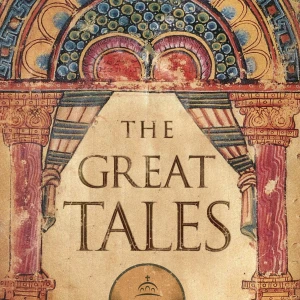
The Great Tales
The Great Tales explores how myth, legend, and story convey history, meaning, identity, and the highest truths about both the seen and unseen world. Hosted by Fr. Andrew Stephen Damick and Dcn. Seraphim Richard Rohlin, the podcast reads and reflects on the great epic tales — as well as the lesser ones — that ancient Israel and the Christian Church recorded, preserved, rewrote, and commented on. It considers stories that originated both inside and outside the people of God, treating them as sources of edification and insight. Each episode invites listeners to encounter these narratives more deeply alongside the hosts.
Episodes
Blood and Bow (Odyssey Pt. 5)
The twists and turns all come to an end as Dn. Seraphim and Fr. Andrew finally take a shot with Odysseus’s bow and see just who’s going to end up with the pious Penelope.
Music attribution:
Cold Journey by Alexander Nakarada (www.creatorchords.com)
Licensed under Creative Commons BY Attribution 4.0 License
https://creativecommons.org/licenses/by/4.0/
All Cretans Are Liars (Odyssey Pt. 4)
Fr. Andrew and Dn. Seraphim continue their read-through of the Odyssey with Odysseus's arrival back in Ithaca, and the various disguises he'll have to wear, lies he'll have to tell, and the one faithful hound who sees through it all...
The One with the Giants (Odyssey Pt. 3)
Fr. Andrew and Dn. Seraphim continue their read-through of the Odyssey with books 9–12, the "Apologoi," in which Odysseus tells the stories of his voyage from Troy. These are by far the most famous episodes when we think about the Odyssey, but can we trust him?
The Odyssey Part Deux-ly: Departed Suitors
Father Andrew and Dn. Seraphim pick up the Homeric threads again, wrapping up their discussion on The Odyssey. All the beauty and nostalgia of the homecoming, plus the brutality of the ancient world, are on full display in this second half.
The Man of Many Twists and Turns
Father Andrew and Dn. Seraphim return to the Bronze Age to tell the story of a man who was variously identified as the Trojan War's greatest hero or its greatest villain.
Kullervo: Born for Ruin
PARENTAL ADVISORY: THIS EPISODE CONTAINS CONTENT THAT MAY BE UPSETTING FOR CHILDREN. Kullervo is one of the most memorable figures in the Kalevala, the great poetic compendium of Finland. His compelling haplessness and dark story drew the interest of Tolkien and still command our attention today.
The Queen of Serpents
One of the greatest tales of Lithuania is Eglė, Queen of Serpents. We welcome our friend Fr. Gintaras Sungaila live from Lithuania to talk about this story as well as to share Baltic tales from the late medieval period which mix saints with pagan gods.
Fate the Mighty
How do you live in a collapsed civilization? Three Old English poems stand out for their reflection amidst loss - "The Ruin", "Deor," and "The Wanderer." Their elegiac power still sings across a thousand years and teaches in our own time of collapse, loss, and uncertainty.
Mermaid's Tale and Raven's Wing
Fr. Andrew and Dcn. Seraphim tell you three tales from medieval romance and legend -- tales concerning mermaids, monsters, and the Raven of St. Oswald.
Hagiography or Legend?
Special guest co-host Dcn. Nicholas Kotar joins us to tell the story of Russia’s strange tradition of mashing up saints’ lives with fairy tales.
O Death, Where is Your Sting Now?
The week after Bright Week, Fr. Andrew and Dcn. Seraphim read some of the most intense and exciting poems from the Christian tradition, both East and West, about the harrowing of Hell.
Three Bardic Beatdowns
Our hosts recap three legendary poetic showdowns: Väinämöinen vs. Joukahainen in the Kalevala, Homer vs. Hesiod in ancient Greece, and Taliesin vs. an entire court full of Celtic bards. Find out who's bussin' and who's suss, who was spitting fire and who got fired.
Burgundians Behaving Badly
We continue #HoaryNorthernWinter with a turn toward the German tellings of the Volsung story, the Nibelungenlied, and Þiðreks saga. Rather than being translations of the Norse material, these versions transform the story and characters and also tell some tales of their own.
The Scourge of God
#HoaryNorthernWinter continues with the final showdown with the Huns and the fall of the House of the Gjukings. While we're on the subject, we'll look more deeply into the ancient conflict with the Huns that scarred the pysche of Germanic storytellers for a thousand years.
The Quarrel of the Queens
#HoaryNorthernWinter continues as we come to one of the most famous scenes in the Volsunga Saga: the Quarrel of the Queens, the moment when everything breaks for Sigurd and the Gjukings. Atilla the Hun makes an appearance.
The Cup of the Gjukings
We continue #HoaryNorthernWinter as we resume the Volsunga Saga and find out what happens to our great dragon-slaying hero when he comes to the Hall of the Gjukings and is offered certain magical draughts...
The Rhizomatic Evolution of the Nibelung Dragon-Slayer
The story of Sigurd the dragon-slayer is one of the most celebrated tales in all of European literature—but it doesn't come to us in a single, authoritative form. Instead, it spreads like a root system across languages, centuries, and cultures: Old Norse sagas and Eddic poetry, Middle High German epic, Scandinavian ballads, and medieval German song. In this episode, we begin mapping that rhizomati
Dragonsbane of the North
Greatest among the Norse and Germanic tales is the Völsunga saga – the story of Sigurd the Dragon Slayer, the cursed ring of Andvari, and how a powerful family of storied warriors went up (literally) in flames. Let the #HoaryNorthernWinter begin!
The Beowulfian Apostle
Fr. Andrew and Dcn. Seraphim conclude their discussion of "Andreas," the Old English poem about St. Andrew rescuing St. Matthew from an island of cannibals.
One of the wildest stories involving the apostles is told in multiple early sources, from the 4th-century Greek "The Acts of Andrew and Matthias among the Anthropophagi" to Homily XIX in the 10th-century Old English Blickling Homilies to the
The Flood of St. Andrew
Delving into Old English sources, Fr. Andrew and Dcn. Seraphim read “Andreas,” the 10th-century poem that looks and sounds like Beowulf and tells the tale of how St. Andrew rescued St. Matthew from a city of cannibals.
Two Pilgrim Tales
Back from their pilgrimage to Scotland and Northumbria, Fr. Andrew and Dcn. Seraphim tell two tales from the road -- how St. Cædmon went from shepherd to hymnographer and how St. Oran insisted he be buried alive on Iona.
The Wight Stuff
It was a graveyard smash. From the fjords to the graves, it caught on in a flash! Our hosts tell some Viking-age ghost stories, from Grettir’s late-night tussles with draugr to Angantyr’s rude awakening. Prepare for a monster mash of restless dead, barrow brawls, and heroes who know how to crash the crypt.
In this very special episode recorded live at The Lord of Spirits Conference, Fr. Andrew St
Sleeping Beauty and the Bird Bombardier
The hosts of The Great Tales podcast read and discuss two strange, dark, wondrous, and perplexing fairy tales: Little Briar Rose (aka Sleeping Beauty) and The Juniper Tree.
Thunderstruck: The Thebaid of Statius
Join Fr. Andrew Stephen Damick & Dcn. Seraphim Richard Rohlin as they bring #HotThebanSummer to a close with Statius's Thebaid: an epic of impious hatred, monstrous serpents, and shocking horrors.
Seven Against Thebes
Fr. Andrew and Dcn. Seraphim continue their #HotThebanSummer with the story of the Seven Against Thebes -- the great war against the Bronze Age city of Thebes, which Hesiod said, along with the Trojan War, was one of the two great wars of the Fourth Age, the Age of Heroes.
O Tomb, My Bridal-Bed (Antigone Part 2)
Fr. Andrew and Dcn. Seraphim conclude their reading of “Antigone,” the tale of a sister who will stop at nothing to give her brother his burial.
Unwept, Unburied (Antigone Part 1)
Continuing the Oedipal story, Fr. Andrew and Dcn. Seraphim read the Sophocles play "Antigone," the tale of a sister who will stop at nothing to give her brother his burial.
Who Will Receive the Wandering Oedipus?
Continuing their series on the sad tales of Oedipus, Fr. Andrew and Dcn. Seraphim discuss the Sophocles play “Oedipus at Colonus,” in which the burial place of the cursed Oedipus becomes the center of a family feud.
The World Knows My Fame
Fr. Andrew and Dcn. Seraphim examine the tale of Oedipus as told by Sophocles in "Oedipus the King," the horrifying story of the man who kills his father and marries his mother. Why is this awful story so enduring? Why should Christians even read it?
From Myth to Fairy-Story
In this episode of The Great Tales, we journey from the tragedy of Oedipus to the Breton Lay of Sir Digory, exploring how fairy magic replaces fate—revealing grace beneath the surface. What if the old sorrows still echo, but now end in joy?
Legends from the Amber Sea
The podcast heads to Fr. Andrew's ancestral Baltic homeland of Lithuania, where we will explore three tales: The Tale of Sovijus, The Iron Wolf, and The Swan Queen.
The Mossy Face of Christ - with Dr. Martin Shaw
We’re joined by mythologist, storyteller, and seanchaí Dr. Martin Shaw. With him, we explore traditional storytelling, hear timeless tales, and search for the “mossy face of Christ” hidden in the wild edges of myth and memory.
Don't Look Back
The Great Tales hosts prepare for the Church’s harrowing of Hades by examining another famous descensus ad infernos, the story of Orpheus and the underworld. They’ll also briefly talk about how the Church Fathers refer to him as the “first theologian” of the Greeks.
Kebra Negast: The Glory of Kings (Part 2)
Richard and Fr. Andrew continue their discussion of he Kebra Negast, which tells the story of how the Ark of the Covenant was brought to Ethiopia and hidden there, waiting for the revelation of the Incarnation.
Kebra Negast: The Glory of Kings (Part 1)
The Kebra Negast is set within the frame narrative about the debate of the true glory of kings held at the First Council of Nicaea, it tells the story of how the Ark of the Covenant was brought to Ethiopia and hidden there, waiting for the revelation of the Incarnation.
The Epic of Keret - with Fr. Stephen De Young
King Keret, son of the great god El, has been widowed and lost all his children, and he fears the extinction of his house. Fr. Stephen De Young joins the podcast to discuss this ancient Ugaritic epic, lost in the Syrian desert for over 3,000 years.
Beowulf: An Enochic Apocalypse
The great Old English poem ‘Beowulf’ is one of the most intriguing and gripping stories from the early English Christian world. What few people know, however, is that this story about giants has roots in a much older apocalyptic tale – the Book of Enoch.
The Quest is Achieved (Grail Part 2)
The Great Tales continues the discussion of the Holy Grail in the story of Perceval. What does it actually mean to achieve the quest of the Holy Grail? And who may achieve it?
Who Serves the Grail? (Grail Part 1)
Arthur, King of the Britons, is the matter of the greatest of all Christian legends in the English language, and at the height of those legends is the Holy Grail. What exactly is this holy object? Did it ever come to England? And what does it mean to the Arthur legendarium?
The Wondrous Queen and the Chestnut Roan - with Dcn. Nicholas Kotar
Fantasy novelist and Russian language translator Dcn. Nicholas Kotar introduces two Russian fairy tales: “Marya Morevna, the Wondrous Queen” and “The Chestnut Roan.”
All Giants from Ymir Come (Prose Edda introduction)
The Eddas are the two great sources for Norse mythology. In this episode, Fr. Andrew and Richard introduce the Prose Edda of Snorri Sturluson, the 13th-century Icelandic historian, poet and politician.
In the Realms of Gold (Iliad Introduction Part 2)
Fr. Andrew and Richard conclude their first look at the Iliad, one of the foundational stories of Western civilization, discussing not only the basics for understanding the poem but also why it’s been so enduring for so much of human history
Sing the Rage (Iliad Introduction Part 1)
Fr. Andrew and Richard Rohlin take their first look at the Iliad, one of the foundational stories of Western civilization, and offer clues and insights as to how we should approach this daunting poem.
St. Basil and the Pagans
Myths, legends, and lore are part of Christian tradition. Historically, Christians read and used even the mythology of paganism. In this inaugural episode of The Great Tales, Fr. Andrew and Richard discuss what St. Basil the Great has to teach us about reading pagan myth.
Trailer for The Great Tales
A new live show from Ancient Faith Radio. Join Fr. Andrew Stephen Damick and Richard Rohlin this coming fall as they examine the legends and stories that continue to remain relevant to the Christian Church today. The live edition of this show will air on the first and third Thursdays of the month at 2pm Eastern / 11am Pacific.
Recommended

Effective Weight Loss for Moms | High protein, Strength Training, Lose Weight, Meal Planning, Fat Loss, Healthy Habits

The Human-Animal Connection - Pet Life Radio Original

Infinite Health with Dr. Arasi Maran

The Daily

World News Tonight with David Muir

The Joe Rogan Experience

English Vocabulary Help

TED Talks Daily

Learn English B1 with Daily News | English Listening Practice

Talk About Talk - Executive & Leadership Communication Skills

English with Olivia | Slow Conversations & Vocabulary

Stand In The Circle
