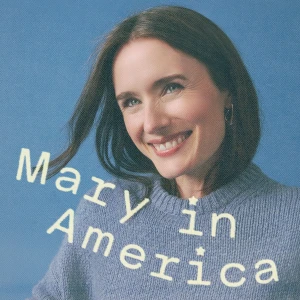
Mary in America
Mary in America is a weekly podcast hosted by journalist and author Mary Childs. In each episode she talks with thinkers, leaders, and other interesting people about how society's systems and institutions actually work. The show explores the structures we build, the stories we tell, the games we play, and the choices we make. It asks why things are the way they are, who shaped them, whether they should change, and whether change is possible.
Episodes
The Millionaires Hiding in Plain Sight
Over a decade ago, Eric Zwick got assigned an unusual project at the U.S. Treasury: Find out how much tax businesses were paying. But the data was a mess, so Eric and two friends helped comb through it and, in doing so, got to build a topographic map of business activity and profitability in America. And it suddenly revealed a class of people who had been hard to see before: the “everywhere millio
Min Jin Lee on Education, Grudges, and Her Current and Future Novels
When novelist Min Jin Lee writes a book, she goes deep. She spends years researching, interviewing relevant people whose experiences and jobs will comprise her characters and plot. In her new book American Hagwon, she threw herself into the intense schooling and education systems, and extracted lessons that are sincerely useful, which she unpacks in this episode, including: a focus on achievement
Why Being Unpopular is Expensive for Countries
Being a country’s central banker is a technical job. But, just like high school, if you are a popular central banker, it pays off. Aditi Sahasrabuddhe is a political scientist at Brown University, and has researched just how much it pays to be popular. It’s the kind of question that the field of economics largely neglects. Aditi looks at central-bank-likeability through the manifestation of swap l
Emily Oster Doesn't Mind the Haters
Emily Oster is not a doctor. She’s an economics professor at Brown University, and for years she’s been applying her economics lens and ability to read studies and analyze data to help decode health research. Her conclusions sometimes produce runaway hits – as in Expecting Better, her book upending the “conventional pregnancy wisdom” – and at other times are wildly unpopular – as with her recommen
The Bond Market Rules Everything Around Me/You/Us
Bonds around the world have been selling off, kind of a lot. And that selloff has sent interest rates on government debt to or near their highest in decades— for US government debt, but also debt from the UK, Germany, France, Japan. What gives? We pulled in one of the people who buys and sells those bonds, Ed Al-Hussainy, at Columbia Threadneedle, which manages a lot of money for other people and
Why do we love gold so much?
Gold was on a tear in August. People, investors, and central banks around the world were buying more and more, in large part because it’s seen as a stable alternative to the dollar, or to any currency. But…why? Why gold? What makes it so special? Friend of the show Jacob Goldstein wrote a book called Money: The True Story of a Made-Up Thing, and he explains the real, physical reasons why we love g
What Should Not Be For Sale?
If you live in the worlds of financial markets and economics, sometimes it can be hard to remember that not all of life can be neatly packaged into data points and lists of pros and cons. And Nobel-Prize-winning-economist and Stanford professor Al Roth is pretty convincing that markets are Good, and that, if you think it through, we *should* allow some kind of market in the trade of *some* human o
AI and Alienation
AI is creating unfathomable wealth for a handful of people, upending labor markets, and jacking up electricity bills for the rest of us. But somehow we have to figure out how to still be a society. We’ve done it before – AI is just the latest "General Purpose Technology" we have to adapt to. Many of the vectors we worry about here are even more pronounced abroad – visible inequality, inconsistent
The AI Hedge Fund Implosion That Wasn't
At the end of July, you may have heard the sound of a hedge fund blowing up. Situational Awareness, a fund focused on the new AI world, had a sudden firesale of its holdings. It seemed like an AI bubble barometer—a way to tell whether the markets have gone too far. Amelia Pollard, investment correspondent at the Financial Times, has been breaking stories on the drama every step of the way. And she
How to Get to Sesame Street
Making educational content for kids is fun, but also really hard to do well. Kids are not an ideal audience: they are prone to wandering away, getting distracted, not remembering the plot. Scott Cameron is the head of content & IP strategy at Sesame Workshop, which makes the beloved and long running show Sesame Street. We were curious what makes kid’s content good, what it can achieve, and what Se
AI can do it all. Chat, is that bad?
Jae Woo Lee loves coding. To him, it’s an art form, like poetry. He’s a legendary professor of computer science at Columbia, where he teaches advanced programming to hundreds of students a year. Which means he’s on the front lines of the war between AI and education. And what he is seeing…is not exactly heartening. He tells us why coding by hand is still an art worth learning, why it’s still impor
What is the International Criminal Court and why are "we" "dismantling" it?
The US Secretary of State Marco Rubio just announced his intention to “dismantle” the International Criminal Court “brick by brick.” Which raised some important questions. Like, what IS the ICC, actually? Where did it come from, and what power does it have? Why does the US want to dismantle it, and is that even possible? We sit down with Maria Elena Vignoli, a lawyer at Human Rights Watch who call
Has the Government Borrowed Too Much?
Martha Gimbel, economist and cofounder of the Yale Budget Lab, is a normal, cool person, but she has the same disease as me: she’s obsessed with the US debt. How much our government has borrowed. Like me, she thinks constantly about what the potential consequences of all that borrowing might be. So what happens when we’ve borrowed too much? How will we know if it’s happened? Is it already too much
How the Dollar Became a Weapon
The US dollar is completely dominant all around the world. It shows up in 90% of all foreign exchange transactions every day. Pretty much anywhere in the world, you can whip out a dollar and use it. Central banks around the globe hold dollars in reserve. And for the past few decades, US government officials have started to take advantage of that global dominance in a new way: using the dollar itse
How Much Does Extreme Heat Cost Us?
It’s really hot. Extreme heat is one of the more invisible – and pernicious – climate-related threats that we have to figure out how to live with. It claims 2.3 million lives every year, and reduces productivity 2-3%, for every one degree Celsius above 20 degrees. Kathy Baughman McLeod, CEO of Heat Resilience Action, has been trying for figure out what tools we can borrow from financial markets an
One Default After Another
Liaquat Ahamed is a legendary and Pulitzer-prize-winning author and economic historian who is obsessed with scouring history to find the worst possible unforced financial errors. He wrote The Lords of Finance, about 1929, and just published 1873: The Rothschilds, the First Great Depression, and the Making of the Modern World, which tells the story of a bond-fueled boom, bubble, and bust. The event
Gary Shteyngart, our National Psychic
Bestselling novelist Gary Shteyngart has spent the past 20 years predicting, with trademark pessimism and terrifying accuracy, the immediate future. His novel Super Sad True Love Story was written and published in the internet-as-savior optimistic early-2010s but predicts all of the negative consequences of technology that most of us failed to even remotely anticipate. The MySpaceification of form
Who Owns Ancient Art?
Did you hear the one about the lady in Austin, Texas who bought a marble bust at a Goodwill for $34.99 and it turned out to be a Roman antiquity? Well. When she took it to an auction house to sell it, she learned it had been looted during WWII. Which meant it had all kinds of history. To untangle what to do, that lady called Leila Amineddoleh, a lawyer who works to repatriate art where it "belongs
"Class Apartheid" in America (and cigarettes)
Xochitl Gonzalez is a bestselling novelist, but, to me, she’s an economist. Her books are about collisions between economic classes; she captures precarity and luxury, access and scrappiness, often with gentrification as the site of these collisions. She has this freakishly astute lens because, she says, she herself has “changed economic classes,” not once but three times — an experience she’s now
How to Price the Priceless
Al Roth won a Nobel prize for his work helping create a market for matching kidney donors with people who needed kidneys. You know what would really help people who need kidneys though? If they could just buy them. But almost no country allows that, because it feels like it would create bad outcomes, and because it feels gross. Al loves thinking about these awkward intersections of money and moral
Introducing Mary in America
Mary in America, a new show from journalist Mary Childs about why we are the way we are. Out now. Join us. Subscribe to the show!
YouTube
Instagram
TikTok
Website
Recommended

CBS Radio Mystery Theater | Old Time Radio
Solved Murders - True Crime Stories

紐約鳥|New York Aperture

The Swerve Podcast: Obscure Topics | Conspiracy Theories

The Bread and Banter Podcast

The Church of What's Happening Now: The New Testament

Busted Open

Deadline: White House

Crickets Corner

History of the Earthquake and Fire in San Francisco

Fox news

K-Drama Obsessed Mamas | Beyond “Just One More Episode!”
