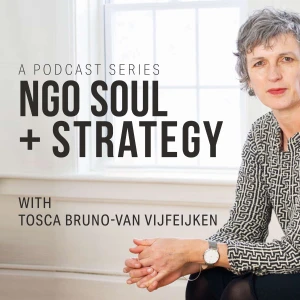
NGO Soul + Strategy
Tosca Bruno-van Vijfeijken 97 episodes Nov 10, 2025
NGO Soul + Strategy is a podcast for leaders of NGOs and other philanthropic organizations. It is aimed at people who are dissatisfied with the status quo, are willing to confront change directly, and see themselves as leaders who continue to learn. The show explores the soul and strategy behind leading mission-driven organizations.
Episodes
096: Leading Change at Scale: Oxfam International’s Journey with Amitabh Behar
SummaryIn this final episode of NGO Soul + Strategy, Tosca Bruno-van Vijfeijken sits down with Amitabh Behar, Executive Director of Oxfam International—one of the most recognized and influential global NGOs. Together, they explore what it means to lead transformative change inside a large, complex confederation while navigating a shifting political, economic, and cultural landscape.Their conversat
095: Time and Talent: Navigating the Nonprofit Sector’s Greatest Strategic Assets with Doug Trout
Summary In this episode, I am joined by Doug Trout, CEO of DRi Waterstone Human Capital, to explore how nonprofit organizations can better invest in, manage, and retain their people. From executive recruitment to culture-building and burnout, this conversation takes a deep dive into what it really takes to thrive in today’s complex nonprofit landscape.BioCEO of DRi Waterstone Human Capital, a firm
094. Breaking the Barriers to Innovation: Carlos Simon on Organizational Culture & Change in NGOs
SummaryInnovation is often treated as a buzzword—but few nonprofit leaders take a hard look at the cultural, structural, and leadership obstacles that keep it from taking root. In this episode, Tosca talks with Carlos Simon, an innovation strategist and longtime leader at World Vision, about what it really takes to build innovation-ready organizations. From internal mindsets to outdated processes,
093. Feminist Leadership in Action: A Conversation with Jayanta Bora
Summary: What does it really mean to lead through a feminist lens? In this episode of NGO Soul + Strategy, I sit down with Jayanta Bora, a seasoned People & Culture expert who has helped shape leadership practices across major NGOs. Drawing from his own matrilinear upbringing and decades of experience, Jayanta explores feminist leadership not as a gendered concept but as a deliberate, power-aw
092. How Culture Is Reality: Rethinking NGO Safeguarding with Andrew Henck
In this episode, I speak with Andrew Henck, a scholar-practitioner whose recent PhD research offers a nuanced take on organizational culture in humanitarian NGOs. Together, we explore how culture goes far beyond shared values—it is a lens through which organizations make sense of their reality. They also examine what this means for safeguarding, accountability, and leadership in NGOs, especially a
091. “$10M Landed in Our Account”—What Nonprofits Must Know About Transformational Gifts and Sudden Growth with Michael Randel
What happens when your nonprofit receives a transformational gift—seemingly out of the blue? In this episode, change management expert Michael Randel joins Tosca Bruno-van Vijfeijken to explore what nonprofits can learn from the MacKenzie Scott giving wave. Together, they discuss how to prepare for sudden funding growth, what risks to avoid, and how to communicate wisely during a time of high visi
090. Technology, Land Rights, and Leadership: A Conversation with Amy Coughenour Betancourt, CEO of Cadasta
Show NotesSummaryLand rights are at the heart of building a sustainable and equitable future. Yet securing these rights—especially for marginalized communities—remains a profound global challenge.In this episode of NGO Soul + Strategy, I sit down with Amy Coughenour Betancourt, President and CEO of Cadasta, a global social innovation organization dedicated to advancing affordable, accessible land
089: "I AM A CHANGE MAN”: How Arnold Dix Applied An Iconoclastic Leadership Approach at the International Tunnelling Association
SummaryThe International Tunnelling Association (ITA) plays a critical role in global infrastructure, ensuring clean water, sewage systems, and transport for millions while contributing to the UN Sustainable Development Goals (SDGs). But behind the technical achievements lies a deeper challenge—modernizing an industry traditionally dominated by European, American, and Australian professionals.In t
088. When You Have to Wind Down Your Nonprofit: How to do It Well, with Amy Miller-Taylor
SummaryWhat does it take to lead an organization through a responsible and strategic closure? In this episode, I speak with Amy Miller-Taylor, former Executive Director of Global Integrity, about her experience navigating the complex decision to wind down an organization while ensuring its legacy, people, and resources were safeguarded. We explore the financial and strategic challenges that led to
087. Coaching Leaders Through An African Lens: Nankhonde Kasonde-Van Den Broek
Western coaching models weren’t built for African leaders. So Nankhonde Kasonde, a Zambian international development as well as a leadership development specialist and certified coach, created something that was.Nankhonde's Bio:Nankhonde Kasonde is a Zambian international development specialist, certified leadership coach, and the founder of Zanga, an African leadership assessment and HR anal
086: The Modern Development Leader, How to Manage Change and All That: Torrey and Tosca in Conversation Part 2
Summary:What are the attributes of the modern humanitarian and development leader? Why modern? In what ways? How does one become one?Torrey’s Bio:As a certified coach with twelve years’ experience in international development Torrey Peace facilitates rising and established leaders in the humanitarian and development world to become the leaders they admire, or “people centered leaders.” She has ta
085: The Modern Development Leader, How to Manage Change and All That: Torrey and Tosca in Conversation Part 1
Summary:This is part one of a two-part conversation between two podcast hosts: Torrey Peace and myself. Torrey’s podcast is The Modern Humanitarian and Development Leader. Torrey and I tackle two broad topics: in this first part of our conversation, Torrey interviews me:How do people in development agencies experience organizational change? What is the psychology of organizational change that a de
084: Towards Ubuntu 2.0? A Wide-Ranging Leadership Conversation with Martin Kalungu-Banda
SummaryWhat does the concept of Ubuntu teach us about leadership, community, and the well-being of people in organizations?How can African leadership models inform and enhance global approaches to management and organizational development?How do we navigate the challenges of avoiding romanticizing Ubuntu while honoring its depth and practical value?In this NGO Soul + Strategy podcast episode, Mart
083: African Solutions for African Problems: Consulting Strategies with Faye Ekong @ RavelWorks
SummaryHow does an African management consulting company that expressly sets itself up to offer African solutions to African problems communicate its identity? What are some key differences in organizational development needs and cultural norms between development agencies in the Global South and Global North?How can concepts like Ubuntu and Ujama inform leadership models in ways that resonate acr
082: Human Emotions in a Poly-Crisis: How To Get To More Effective NGO Campaigning with Diya Deb @ MindWorks
SummaryHow can nonprofit organizations leverage human emotions to enhance the impact of their campaigns?What can NGOs learn from cognitive science to create more effective, empathetic communication strategies during a time of poly-crisis?How can organizations shift from traditional advocacy approaches to more agile, psychology-driven methods for mobilizing communities?In this NGO Soul+Strategy pod
081. Leadership Lessons From African Cultures, With Albert Momo
SummaryWhat are the key principles of African leadership that nonprofit leaders globally could benefit from adopting?How does the African concept of Ubuntu translate into practical leadership strategies for nonprofit organizations?How does African leadership balance individual and collective success, and how might nonprofit teams benefit from seeking the same balance?In this NGO Soul+Strategy podc
080. Avoid These Leadership Mistakes When Managing Organizational Change With Michael Randel
SummaryIs it that people resist change? That they fear change? Or rather that people fear loss?As a change management consultant, what is the most difficult or frustrating while supporting clients with change management efforts?What is one word most alive right now in the world of change management support?In this NGO Soul+Strategy podcast episode, I interview Michael Randel, Founder of Randel Con
079. Leadership in Africa Redefined With Taaka Awori of Busara Africa
SummaryWhat does it Busara's tagline mean: 'transformational leadership, from the inside out'?To what extent are there truly different global south-normed leadership models?Does personality still play an important role as well, in addition to national or regional cultural differences in leadership approaches?In this NGO Soul+Strategy podcast episode, I interview Taaka Awori, Founder
078. Which INGO Roles Are Still Legitimate, Relevant, and Needed (and Which No Longer): Dylan Mathews @ Peace Direct
SummaryHow should INGOs discern what roles are still relevant, legitimate, and needed, at this moment in civil society history? And which roles they therefore should *stop* playing?Is there more here, over and beyond stopping service delivery? (Which on its own is quite the shift)In this NGO Soul+Strategy podcast episode, I interview Dylan Mathews, Chief Executive Officer at Peace Direct. Peace
077. Let’s Work Through This: Conflict Mediation in Social Sector Organizations With Nathalie Thompson
SummaryConflict management and mediation are skills that come up frequently as a weak area in many of our social sector organizations. And these days, more than ever conflict is on the rise within our organizations. So how can we work through our conflicts more skillfully and effectively?Nathalie has answers for us. She's a trainer conflict mediator (as well as a Corentus, Inc. team coach) wh
076. Trends in Direct Fundraising: Keeping It Real With Erica Waasdorp
SummaryWhat constitutes a culture of philanthropy within nonprofits and NGOs? It's a term easily bandied around, but how do I see when it's in place?How has the field of direct giving by small donors, and monthly giving as one donor practice in particular changed in the last 10-20 years?Are there hurdles to be overcome in persuading donors to adopt monthly giving? Finally, there is a lot
075. What Happens When a Start-Up Nurtures an Evidence-Based Culture: The Taimaka Project
SummaryWhat does the name Taimaka mean?To what extent are there challenges, as an organization, when you aim for evidence-based decision-making?What kind of culture is needed to truly live the aspiration of being evidence-based?In this NGO Soul+Strategy podcast episode, I interview Dr. Umar Abubakar and Justin Graham, co-founders and co-directors of The Taimaka Project -- an NGO working in Gombe s
074. Can Nonprofit Program Evaluation Truly Be Made Easy? Chari Smith
SummaryQuite a few smaller size social sector organizations assume that program evaluation is too complex or demanding an undertaking for them. Is that the case, though?If we want to introduce program evaluation to staff, leadership, and boards who have not yet been inducted into the importance of program evaluation: what are the most effective questions to generate genuine interest in and motivat
073. From a Hub and Spoke to a Horizontal Network Model: Anu Kumar @ Ipas
SummaryWhat are the main benefits of a network structure, where power, authority, and leadership are dispersed and shared across regions, from an effectiveness perspective? What are the most important enabling habits, practices and behaviors that go with that, as a change leader?And what are the most valuable network-related frameworks, concepts, resources, and tools at work in moving towards this
072. When Nonprofits Deal With Internal Strife: Conflict Mediation to the Rescue With Daniel Genberg
SummaryConflict within our organizations: we often don't really want to face them, but they are very much there. The result? Plenty of passive aggression to go around. What are the implications of such forms of conflict avoidance?In other NGOs on the other hand -- especially in the last few years it seems -- internal strife has come out into the open - sometimes spilling into the media in an
071. Onward With Reimagining INGO Models: Charles Kojo Vandyck @ RINGO/WACSI
SummaryWhat are some structural things that are wrong in development aid and in civil society?Which mindsets most need to be decolonized when it comes to the relationship between global South civil society organizations (CSOs) and INGOs?Global North-founded INGOs need to be reimagined. How, in turn, do global South-founded NGOs have to change to take over many roles that INGOs currently still fulf
070. Mastering a graceful AND effective leadership exodus: Ignacio Saiz
SummaryLeadership transitions are tricky -- and potentially risky -- moments in a nonprofit's life. What are the most common pitfalls or aspects that get overlooked when nonprofits -- and outgoing leaders themselves -- tackle such leadership transitions?What key strategies and tactics are essential to ensure a smooth leadership transition and maintain organizational stability?What are the hab
069. Navigating Organizational Politics: A Team Coach’s Guide - with Alexander Caillet @ Corentus
SummaryWhat should I imagine, practically, when a team coach starts to support my team?What does a well-known team coach find the most rewarding about working with nonprofit teams?Can a team coach detect any differences in team behaviors or tendencies between their for-profit and nonprofit clients? In this NGO Soul+Strategy podcast episode, I interview Alexander Caillet, CEO and co-founder of Cor
067. DEI trends in US development agencies, by the numbers – Shiro Gnanaselvam @ Social Impact
SummaryWhat is the state of DEI in US-founded international development organisations (both for-profit and nonprofit), and how has this state changed since 2021? What has been the action, as compared to the professed intentions for action? In this NGO Soul+Strategy podcast episode, I interview Shiro Gnanaselvam, President and CEO at Social Impact, on DEI (Diversity, equity, and inclusion) trends
067. Life after leadership: Sam Worthington, former President and CEO @ InterAction
SummaryWhat is life after leadership like?What happens to you as a person when you leave a high-powered, highly visible role in civil society?What happens with your sense of identity? Does this also perhaps touch on ego as well?What offers new meaning and purpose, when we live our life-after-leadership?In this NGO Soul+Strategy podcast episode, I interview Sam Worthington, former President and CEO
066. How to navigate the big scaling quandary: Amy Ragsdale @ Spring Impact
SummaryWhat is scaling? And how is it different from growing?What’s the role of partner strategies or multiplier strategies in scaling?What are the implications of scaling in an era of decolonizing aid, localizing development, and shifting roles of nonprofits and NGOs, shifting power, authority and decision rights?In this NGO Soul+Strategy podcast episode, I interview Amy Ragsdale, Director at Spr
065. How you should transition into a new role as a leader: Adama Coulibaly @ Oxfam
SummaryWhat are the vital steps a senior leader have to take as they step into a new leadership role? What to do and what to expect when you are transitioning into that new role?And, separately, to what extent are African leadership models and frameworks different from global North ones? Most importantly, what could global North imprinted leadership models learn from African ones? In this NGO So
064. Positive power for organizational integrity: Bhavika Patel + Alex Cole-Hamilton
SummaryWhat should we think of when we consider organization integrity issues?How do you distinguish between positive and negative forms of power?How do we nurture power for organizational integrity? These are the fairly complex questions that we address in the podcast today.In this NGO Soul+Strategy episode, I interview Bhavika Patel, Senior Adviser for Equalities and Inclusion at Oxfam Great Br
063. Decolonizing think tanks, policy research organizations and consulting agencies: Ajoy Datta
SummaryHow can the feelings of people who work in organizations both facilitate and suppress change?What makes people attach reputation and credibility to another person? And how does this relate to diversity, equity, and inclusion efforts, and these may work out in practice?What's the problem with think tanks from the perspective of a decolonization goal, and what has been the problem histor
062. Nonprofit operations CAN be a driver of transformation: Kim Kucinskas @ Humentum
SummaryHow should we think about the ‘collective journey to equitable development’ of Northern-founded NGOs, national NGOs and their funders?What obstacles stand in the way of continuing on that journey? Why does Humentum argue that NGO operating models need to enable ERA (Equitable, Resilient, and Accountable) development, and how does that need to come about?In this NGO Soul+Strategy podcast e
061. Between high profile civic disobedience and building broad public support: A youth activist
SummaryHow does a climate change activist movement such as Extinction Rebellion (XR) chose among strategies and tactics on the spectrum between more 'radical' actions such as civic agitation, (nonviolent) disobedience, high-profile stunts that may lead to arrests and more 'mainstream' actions that may (or may not?) help them build a more broad public base?How does Extinction Re
060. Should climate activists pivot their campaigning strategies from agitation to broadening public support? Aseem Prakash
SummaryEnvironmental activism, environmental justice and equity concerns: what, if anything, is challenging about holding all of these three concerns at the same time?Can a better integration or balance be achieved between these 3 concerns?To what extent is radical activism cyclical in nature because it is hard to keep activists motivated for peak public mobilization moments?In this NGO Soul+Strat
059. Potential and peril when NGOs aspire to use a network structure: Doris Bäsler, formerly @ Oxfam
SummaryWhat are the strengths of a confederated nonprofit organizational structure and what are its inherent weaknesses and limitations?What is a ‘diversified network’ type of organizational structure?To what extent does having a confederated organizational structure, as well as the aspiration to be a diversified network, Impact the nature, legitimacy, adaptability, and quality of decision-making?
058. Can civil society get better at anticipating futures? Heather Hutchings, Danny Vannucchi and the International CS Centre
SummaryWhat is the difference between forecasting and foresight, as a skill and an area of work?What are the pitfalls when international civil society organizations (ICSOs) apply crisis frameworks to trends that are actually longer-term, intersecting, and systemic?Decolonization and diversity: how are these big current discussions and areas for taking action intersecting with what sometimes is cal
057. From transnational advocacy networks to transscalar activism: Beth Bloodgood & Chris Pallas
SummaryWhat is ‘transscalar activism’ in a nutshell? And how is it different from what academics call the 'Boomerang' model of international advocacy NGO networks?When did international NGO advocacy begin attracting the attention of academics, and why? What had shifted at that point, what had changed?What was the dominant narrative in academia for a long time? And what was wrong with tha
056. Philanthropy that’s less colonial in mindset and practices: John Hecklinger @ Global Fund for Children
SummaryWhat’s problematic about philanthropy in the ways the sector has practiced it for many decades?Are there limits to trust-based philanthropy?How do boards of grant-making philanthropies such as the Global Fund for Children have to change their composition, mindset, and oversight practices to lessen a compliance and upward accountability lens and to make themselves more responsive to actual n
055. Digital advocacy NGOs: a necessary, complementary force: Nina Hall
SummaryWhat are the characteristics of 'digitally native' campaigning organizations?How do digital NGO campaigning organizations compare and contrast with traditional, 'brick and mortar' NGOs?Do digitally native civil society organizations and traditional NGOs sufficiently seek to complement each other, in order to maximize impact? I don't think they do.In this NGO Soul+St
054. NGO scandals: causes, consequences and prevention + recovery strategies: Cassandra Chapman
SummaryINGOs have been rocked by scandals and allegations of abuse of power, discrimination etc. in the last 5-10 years. What kind of different types of scandals can we distinguish in our sector?Which factors that affect nonprofit scandals remain understudied?What's the distinction between integrity violations and competency violations? And should we be getting more concerned as a sector abou
053. Change is not a project: Hazem Fahmy on CARE Egypt’s Country Office transition towards full membership
SummaryA number of NGOs have aimed to strengthen their global legitimacy by adding more global South members/affiliates. Is this truly a valuable strategy? Does it help with legitimacy to be more 'globally balanced'? What are the hard lessons learned about how to manage this process? And how do local civil society as well as government respond? Hazem Fahmy, the CEO of the CARE Egypt Foun
052. Influence and power in complex NGOs: leadership insights from John Samuel @ Oxfam
SummaryWhat is most difficult or challenging about operating as a leader in a place like Oxfam?What does it take to lead from a political frame in NGOs?Rational persuasion: is it overrated? In this NGO Soul+Strategy podcast episode, I interview John Samuel, Oxfam Asia Regional Director on influence and power in complex NGOs. John is an expert on Organizational Development. He is also the founder o
051. Charity Navigator's changing expectations and its impacts on US nonprofit behaviors: Michael Thatcher, Charity Navigator's CEO
Charity Navigator is a free online resource for US-based donors, an intermediary rating agency with 11 million unique users per year. It currently rates just about 200.000 US-registered nonprofits, both domestic and internationally operating ones, and is quite influential in driving the behavior of donors and, indirectly, of nonprofits that are rated on the platform.Charity Navigator has changed t
050. Innovation in social change organizations: shepherds or adopters? Emma Proud
SummaryWelcome to our 50th podcast episode! In this episode, we continue to zero in on what it takes to adopt and shepherd innovation through social change organizations. I interview Emma Proud, head of Learning and Adapting at Brink, an agency that coaches and consults on behavioral innovation approaches. Emma’s Bio:Head of Learning and Adapting at BrinkFormer Director of Organizational Agility a
049. Women and positional power in faith based NGOs: Martha Holley Newsome @ Medical Teams Int.
SummaryWhat are the strengths of faith-based organizations that secular NGOs may have reason to covet?On the other hand, what weaknesses or potential blind spots may faith-based organizations face?And is there anything specific, or ‘typical’ about being a woman top leader in a faith-based NGO?In this NGO Soul+Strategy podcast episode, I interview Martha Holley Newsome, President & CEO of Medi
048. How to kindle innovation in large development agencies: Soren Vester Haldrup @ UNDP
SummaryDo you work in a large NGO or UN agency, and wonder how the heck you are supposed to stimulate innovations in such a sizable, potentially quite bureaucratic organization?Do you assume that organization size and structure matter when it comes to creating a good climate for innovation?And is lack of innovation funds as big an issue as we make it out to be?In this podcast episode, I interview
047. Crisis leadership skills during war: Pact's Alyona Gerasimova in Ukraine
SummaryLeadership in crisis contexts.Many NGOs regularly work in contexts of crisis, or war. The war in Ukraine was one of those contexts, and it led quite a few NGOs to reallocate programming resources toward the Ukrainian population.PACT is a US-founded NGO which has worked in Ukraine for many years. In this podcast episode, I took the opportunity to ask Alyona Gerasimova, its Country Director,
046. Signaling your financial trustworthiness lowers your NGOs impact by half: George Mitchell and Thad Calabrese
SummaryDid you know....When nonprofits signal they are financially trustworthy, they actually give up to half of their potential impact.Why is this "financial trustworthiness signaling behavior” so pervasive, when it has this high a cost?In this podcast episode, I interview George Mitchell, Professor of Nonprofit Management at Baruch College, City University of New York – and a long-time co
045. What we as NGO leaders need to do to spur innovation: Dermot O'Gorman @ WWF Australia
SummaryWhat can we learn from civil society leaders who wish to spur the adoption and implementation of innovations?How do humans – within organizations, and particularly in NGOs – react to change?What is the best advice when leading NGOs through innovation, from a senior team leader’s perspective?Today, I am interviewing Dermot O'Gorman of WWF Australia on the do's can don'ts of NG
044. Disability rights: how NGOs go about actually claiming them - Susan Sygall @ Mobility International USA
SummaryWhy has it taken so long to mainstream disabled people's concerns, when 15% of the global population has some form of disability?Has it been helpful to see disability integrated into Diversity, Equity, and Inclusion (DEI) approaches -- or have there been some downsides to this approach?Are there disadvantages to being perceived as a single-issue organization (i.e. disabled people’s org
043. How I practice virtual leadership in a complex membership organization - Lysa John @ CIVICUS
SummaryWhat works in establishing personal relationships and developing trust and bonding in the virtual space, when we as leaders have never met our colleagues face to face?Some NGO leaders and managers started their jobs at the beginning of the pandemic and led entirely virtually for a long stretch - onboarding, developing personal relationships, bonding, trust development - the whole deal. Ly
042. Feminist leadership: organizational practices to make it real -- Kirthi Jayakumar & Leila Billing
SummaryToday, I am interviewing Kirthi Jayakumar of World Pulse and founder of the Gender Security Project, and Leila Billing, senior advisor on youth, gender, and social movement building on Feminist Leadership. Leila, along with Natalie Brook, runs an open enrollment Feminist Leadership training program (We are Feminist Leaders), and Kirthi is one of its alumni.As some NGOs and development organ
041. Rest, reset, resilience: how my mind journeyed when I took a sabbatical - Chris Proulx @ Humentum
SummaryWhat happens when NGO leaders take a 4 months sabbatical? What happens to the mind -- what journey does it go on during a 4 month's rest from work?What happens, especially when we are talking about a leader who was already quite steeped in mindfulness and meditation before he started his sabbatical?In this podcast episode, I discuss with Chris Proulx, Global Director at Humentum the t
040. Can NGOs Stay Human-Centered while Embracing Smart Tech? Beth Kanter and Allison Fine
SummaryThe new generation of 'smart technology' - chatbots, AI, machine learning, natural language processing, robots etc. can bring major benefits to nonprofits - if they can discern what they need to do to remain human-centered in their choice of technology. And if they remain aware of the potential for bias in AI-generated data, given its profound potential negative impact?What can
039. How NGO CEOs are thinking about operating model changes, right now: Christine Sow of Humentum
SummaryChristine Sow is the CEO of Humentum, a global support organization for NGOs who wish to enhance their operational performance. Humentum helps NGOs translate their aspirations into operating models that give them the ability to deliver on those aspirations.In that capacity, and given that Humentum among others facilitates peer sharing among CEOs on lessons learned in improving operating mod
038. Exploring Possible Futures for Conservation NGOs: Anca Damerell @ Luc Hoffman Institute
SummaryWhat is the future for conservation NGOs? Is there a future? If so, what kinds of roles, mandates, organizational culture, and capabilities do conservation NGOs of the future need to embrace? That was the question that a small team of consultants, including yours truly, tried to address by providing 15 - sometimes bold -- propositions for changes in roles and mandates. In this episode, I in
037. We need to rethink the 'virtue narrative' surrounding NGOs: Aseem Prakash
SummaryWhy might the assumptions we frequently make about the ‘virtue narrative’ that surrounds NGOs be problematic? Aren't they meant to create social good in the world?In this podcast episode, I discuss this with Aseem Prakash, a well-known academic who focuses on nonprofits as well as on environmental activism, particularly focused on climate change. Aseem wrote an article, problematizing
036. Why the NGO Halo Effect is problematic: a conversation with Isabel De Bruin Cardoso
SummaryWhat is the 'halo effect' when it comes to NGOs, and why does it matter?Here's a rough definition of ‘the halo effectj. The term comes out of the psychological academic literature: if the first impression of a person or an entity is positive for a person, this tends to stick with people. This tends to be the case for NGOs: NGOs are assumed to be ‘good’; thus they are glorifie
035. Chasing impact - ever more elusive? One more exchange with Chris of MZN
Tosca is in conversation with Christian Meyer zu Natrup, Managing Director of MzN International, a boutique consulting firm that focuses both on nonprofits in international development, and on businesses that wish to do good, in this final episode of our 3 part joint podcast series. The other 2 episodes cover ‘Chasing innovation’ (episode #33) and ‘Chasing funding’' (episode #34).SummaryNonp
034. How to generate greater innovation capability in your nonprofit: observations of an innovation coach
SummaryNGOs are sometimes labeled fairly critically as 'dinosaurs' or 'legacy organizations'. How can they create a more innovation-ready or innovation-friendly culture? What can NGOs learn from other types of organizations when it comes to generating more innovation, either in the broader civil society sector or outside of it?What stands in the way, in terms of organizationa
033. Chasing funding - will it ever end? A back-and-forth with Chris of MZN
Tosca is in conversation with Christian Meyer zu Natrup, Managing Director of MzN International, in the second episode of our 3 part, joint podcast series. The other 2 episodes cover ‘Chasing Innovation’ (episode #032) and ‘Chasing impact’ (episode #34, expected to be aired around Feb 23).SummaryGood projects/programs need good funding. But why do some organizations continue to grow and some stagn
032. Chasing Innovation: can we do better as NGOs? In discussion with Chris Meyer of MzN International
Tosca is in conversation with Christian Meyer zu Natrup, Managing Director of MzN International, in the first episode of of a three-part podcast series. The other two episodes which will air in February 2022 will cover ‘Chasing Funding’ and ‘Chasing Impact’SummaryAre INGOs inherently inefficient, slow and lack innovation to the point that they will go, or ought to go, extinct?And if not, what shou

031. What you can do to excel in virtual team leadership: Monica Maassen @ Oxfam
SummaryMonica is a change management specialist par excellence. She is also thoughtful about all things management and leadership. How does she see the linkages between change management and virtual/hybrid team leadership - something we all got thrown into big time in the last 2 years (if we did not already practice it before)? What is the biggest thing(s) we may be missing about not working in
030. Reinventing social change by overcoming self-limiting belief systems: Nell Edgington
SummaryNell Edgington, a well known American consultant who serves US domestic nonprofits is of the opinion that nonprofit leaders maintain too many self-limiting beliefs and mindsets.In her new book 'Reinventing social change: Embracing abundance to create a healthier and more equitable world' she explains how these self-limiting beliefs have seeped into the collective mindset and DNA
029. Potential and peril when NGOs collaborate with social movements: May Miller-Dawkins
Summary What are the biggest limitations social movements encounter, time and again? What are the good examples of positive collaboration between INGOs and social movements? And what characteristics, what attributes made that collaboration positive? In this podcast episode, I discussed with May Miller-Dawkins about the potential and peril when NGOs collaborate with social movements. May’s Bio:
028. Strategic planning when your CSO faces fundamental uncertainties: Dave Algoso, facilitator & consultant
SummaryHow has strategic planning changed during the pandemic?What are general blind spots when it comes to strategic planning in our social sector?What are jazzy new approaches to strategic planning that civil society organizations should consider?And what are the warning signs, as a strategy consultant, that tell you you should not get involved?In this podcast episode, I discuss with Dave Algoso
027. People, resistance to new ideas and the power of removing friction: interview with Loran Nordgren
SummaryWhy do people resist new ideas, including inside organizations, and including with regard to organizational change initiatives? And what can we as change managers/leaders do about this?What's more important: making your new idea more 'shiny', more attractive, or removing obstacles that stand in the way of people accepting new ideas?Would resistance to new ideas play out diffe
026. Right Work and Right Team: how the Ultra-Poor Graduation Initiative (BRAC) is aspiring to become a truly diverse, global entity - Rasha Natour
Summary What are the advantages and disadvantages (if any) when an organization is in a position to start almost as if with a new slate after a large core grant infusion, and thus can propel an ambitious DEI agenda?And how do local authorities and national governments in global South countries respond to a localization push by an initiative like the Ultra Poor Graduation Initiative, part of the l
025. Gabriela (Oxfam), Julia (ActionAid), and Sofia (CARE): a celebration of Latina women's leadership
Summary How often does it happen that three of the biggest INGOs are all headed by three Latina women. Not often -- and definitely a reason to celebrate.Sofia, Julia and Gabriela discuss their perspectives on leadership When it comes to crafting the new employee experience after COVID, what changes in that experience stand out?To what extent the interviewees experience that women leader still cann
024. Organizational ethics, integrity, power and governance: Alex Cole-Hamilton
Summary What is wrong with the current approach to organizational ethics and integrity in NGOs?Why is using a lens of power analysis so helpful to bring INGO governance into focus?Only by looking at the very core of how organizations work, we can begin to achieve the deep and effective change needed across the sector. In this episode, we discuss organizational ethics and integrity concerns in ING
023. What's a feminist leader to do about social power in organizations: Srilatha Batliwala
Summary What is social power? And how does this concept relate to Feminist Leadership? And how does it show up in organizational dynamics within civil society organizations (CSOs)?Are there any cross-cultural aspects to Feminist Leadership?I discussed these topics during an interview with Srilatha Batliwala, senior advisor at CREA and Gender at Work, a well-known social movement 'pracademic&a
022. How to lead organizational change when you are the first person of color in top leadership: Dorothy Nyambi, CEO of MEDA
Summary Dorothy Nyambi took on the top leadership role in MEDA two years ago as the only person of color in the senior leadership team. She since then has led change with that awareness in mind:What do we mean by culture change, and how to see and operationalize it?Politics and power within an organization, from a change leader’s perspective.How to lead and manage organizational change? What frame
021. Positional power games and ‘feminist bureaucrats’ in multilateral organizations: Joanne Sandler's observations
SummaryHow does Feminist Leadership ‘perform’ when a leader has to make hard choices?How well has feminist leadership served organizations during the past year of the pandemic-related crisis, or other periods of crisis?What kind of worthy values and interests might ‘compete’ with those called for by feminist leadership, and how should leaders resolve this?I discussed these topics during an interv
020. Feminist leadership and 'deep power structures’ within organizations: Aruna Rao, co-founder of Gender at Work
What are the political or other strategies and tactics that a feminist leader can use to analyze the presence of ‘deep structures’ of power within organizations?What can a feminist leader practically do to change these power structures?And in what scenarios does Feminist Leadership shine in particular ways?I discussed these topics during an interview with Aruna Rao, Co-founder and chair of the boa
019. Politics, power and feminist leadership within NGOs - Lisa Veneklasen's take on things
Organizational leaders have to balance competing values. What kind of worthy values and interests might ‘compete’ with those called for by Feminist Leadership (FL) and how should leaders resolve those? What to do when we need to hold individual staff or teams to account for underperformance, given FL’s emphasis on being developmental, its focus on staff care, etc.? When do leaders decide that they
018. Power as finite resource or as unlimited good: Paul O’Brien at Oxfam America on influencing NGOs
What's a global North-founded influencing NGO to do to stay relevant, credible, and effective? And should influencing NGOs see power as an infinite resource -- that can be grown and shared and in principle is unlimited in nature -- or as a limited asset that needs to be fought for? Finally, how does a seasoned advocacy NGO leader look upon the current moment as a combination of crisis and o
017. What's all this talk about feminist leadership? An interview with Abby Maxman, CEO, Oxfam America
What’s all this talk about feminist leadership? An interview with Abby Maxman, Oxfam America’s CEO Feminist leadership seems to be in ascendance in the INGO sector. Now, our sector is a bit prone to fads and fashions -- so should we take this seriously? Is this leadership model here to stay? And what are its potential, its power as well as its limitations? This is what I explore in a short serie
Recommended

The Great Detectives of Old Time Radio| Daily Mystery Dramas
TED Business

Ranger Bill | Old Time Radio Adventure & Family Drama

زن بودن

Christmas Old Time Radio

The Adventures of Superman | Old Time Radio

Booked, Blonde & Busy w/ Olivia Ponton

The Human-Animal Connection - Pet Life Radio Original
Medicine with Meaning

Homemaking with Jesus | Weekly Devotionals, Biblical Application, Simple Living, Home Management, Healthy Relationships

Disney+ Hulu Throwbacks Podcast

The Daily
