
Clinical Deep Dives
Clinical Deep Dives is a podcast for clinicians and learners who want understanding, not just information. Using classic medical and surgical texts as a guide and the generative power of AI, each episode explores ideas with curiosity and clarity. Designed for learning on the move and knowledge that actually sticks.
Episodes
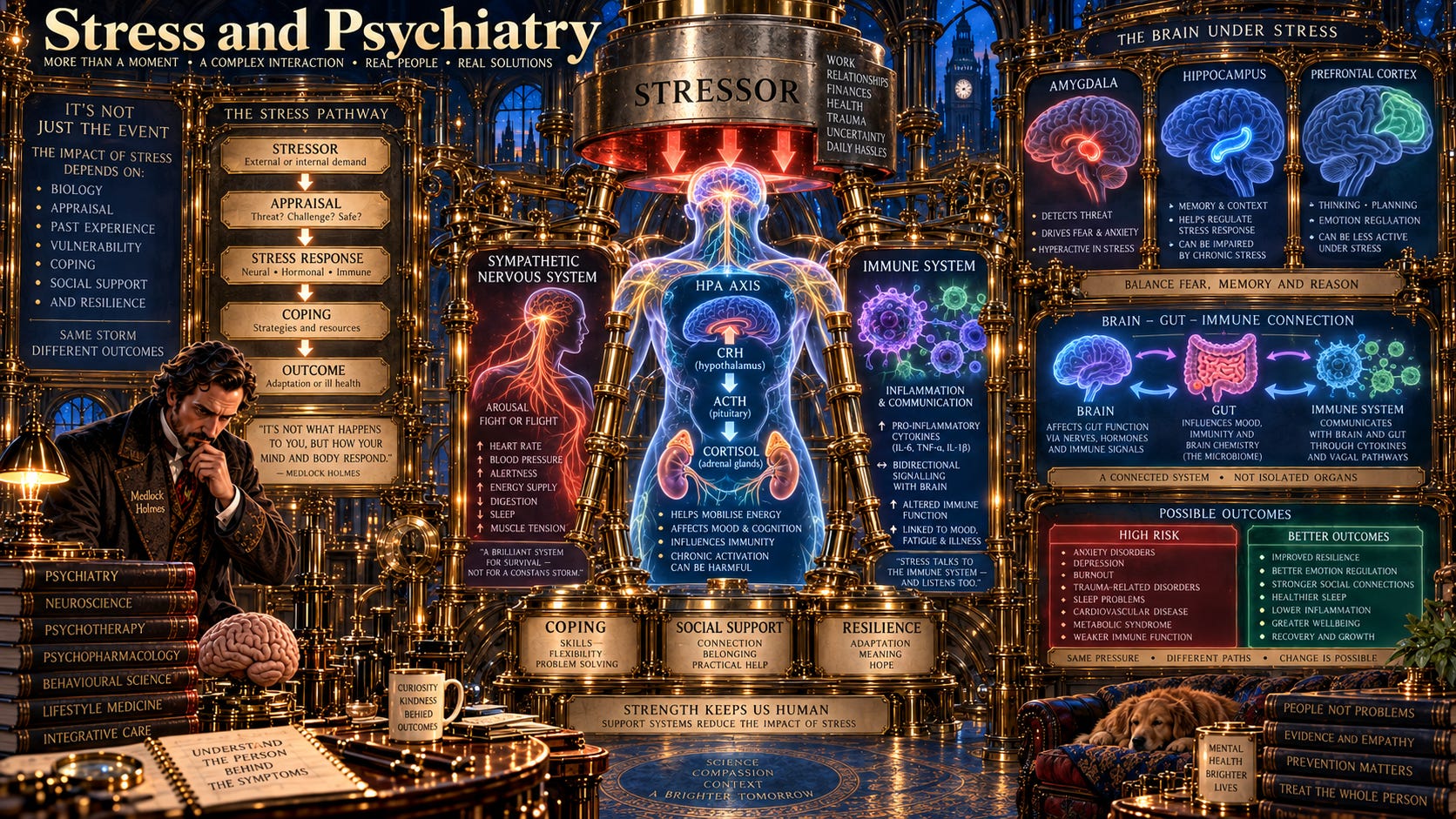
PSYCH 151: Stress and Psychiatry
and resilience.Medlock Holmes enters The Stress Laboratory, where an enormous brass apparatus is being subjected to pressure.At first, the mystery appears straightforward: apply enough force and eventually something breaks.But Holmes quickly discovers that human beings do not behave like identical pieces of metal.Two people can encounter the same loss, illness, humiliation or threat and follow com
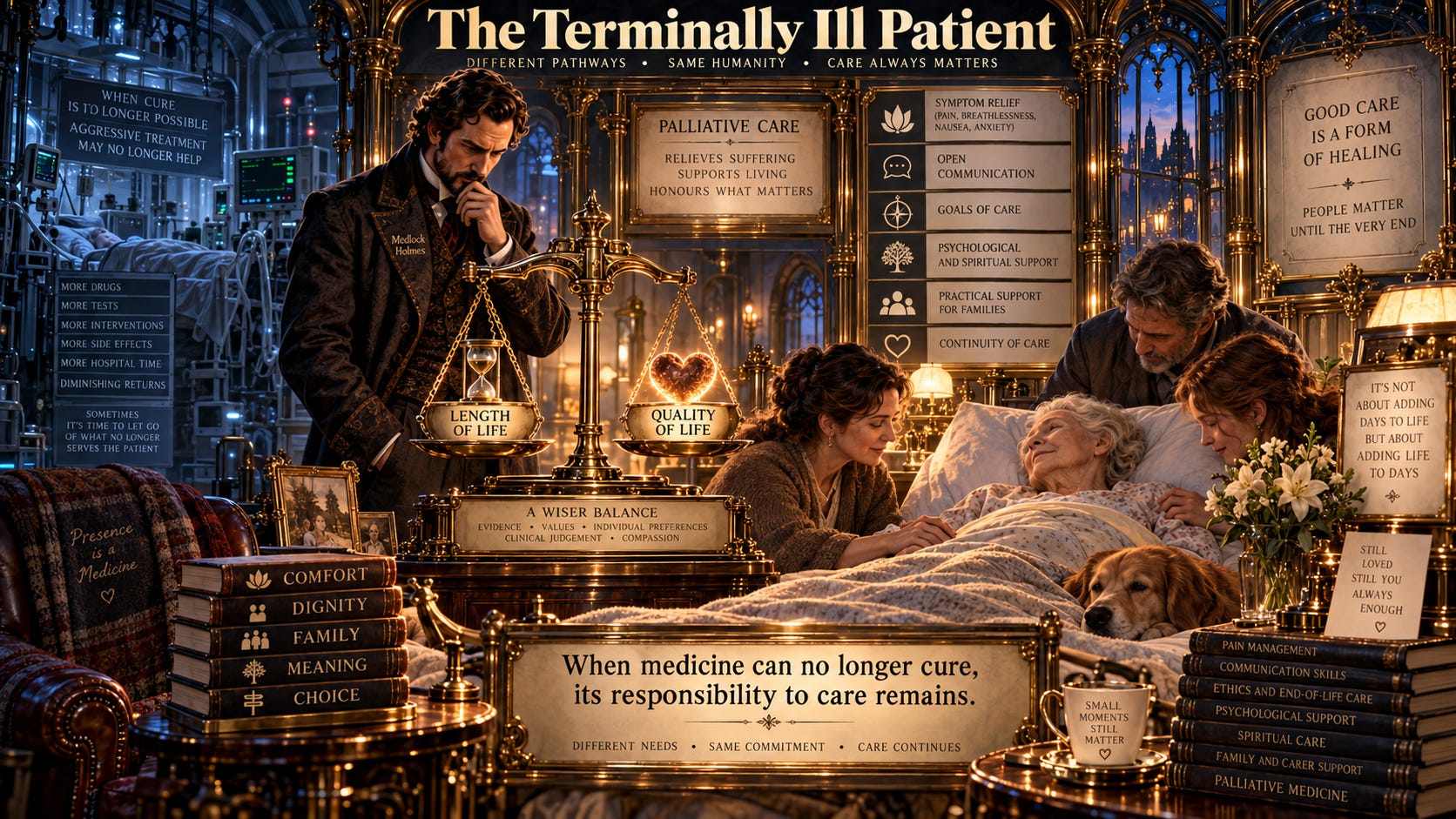
PSYCH 150: The Terminally Ill Patient
Medlock Holmes enters The Last Ward, a quiet wing of the hospital where medicine appears to be running out of doors.Behind the patients lie operating theatres, chemotherapy suites, dialysis machines and intensive-care units. Ahead lies a doorway that medicine cannot ultimately prevent anyone from reaching.But Holmes immediately notices something important.The doctors have not disappeared.Neither h
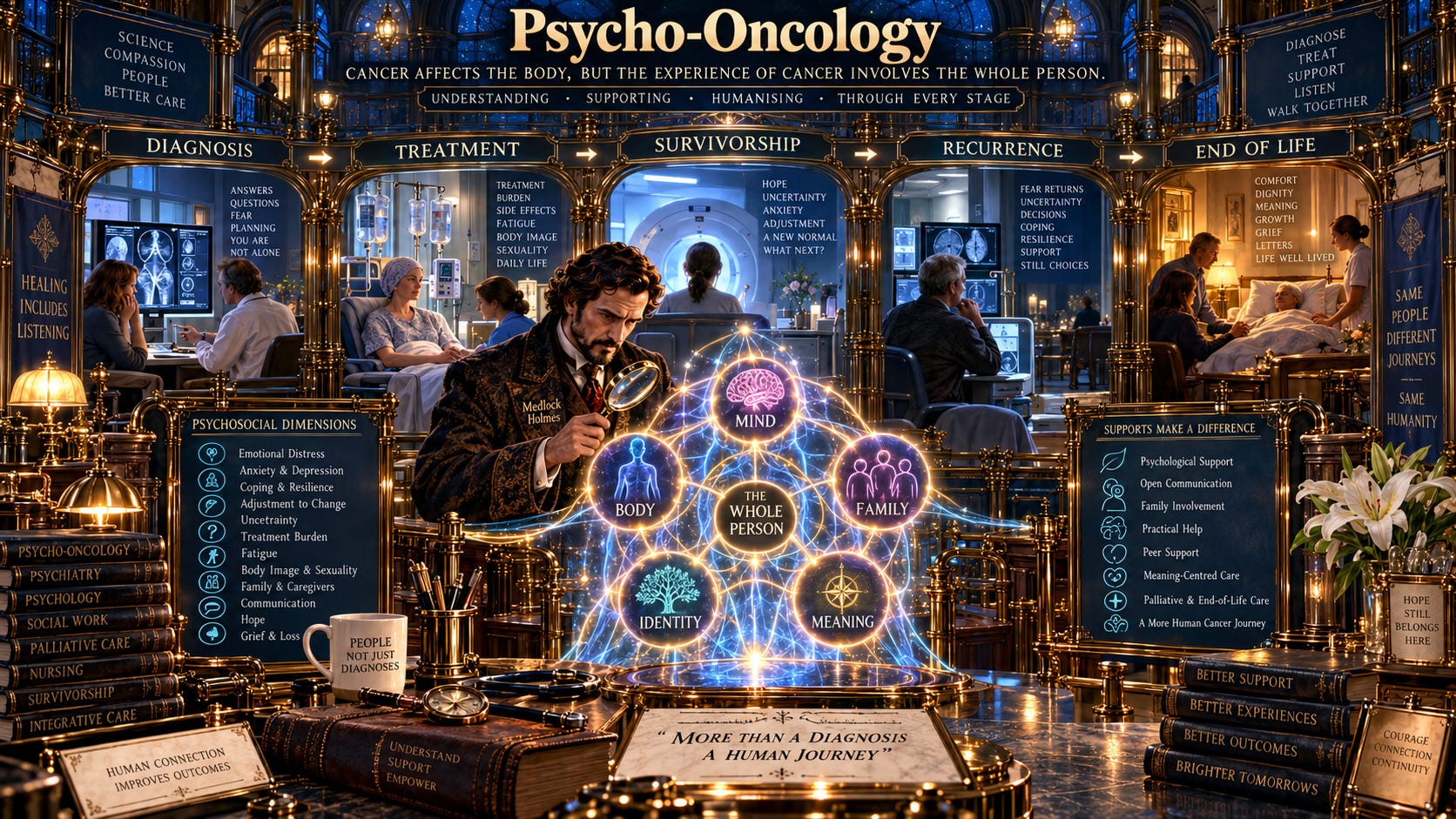
PSYCH 149: Psycho-Oncology
and the end of life.Medlock Holmes enters The House of Cancer, expecting to investigate a disease of abnormal cells.But he quickly discovers that cancer never occupies only one room.In the laboratory, cells divide uncontrollably. In the adjoining rooms, entirely different processes are unfolding: a newly diagnosed patient sits stunned after hearing the word cancer; another cannot sleep before a su
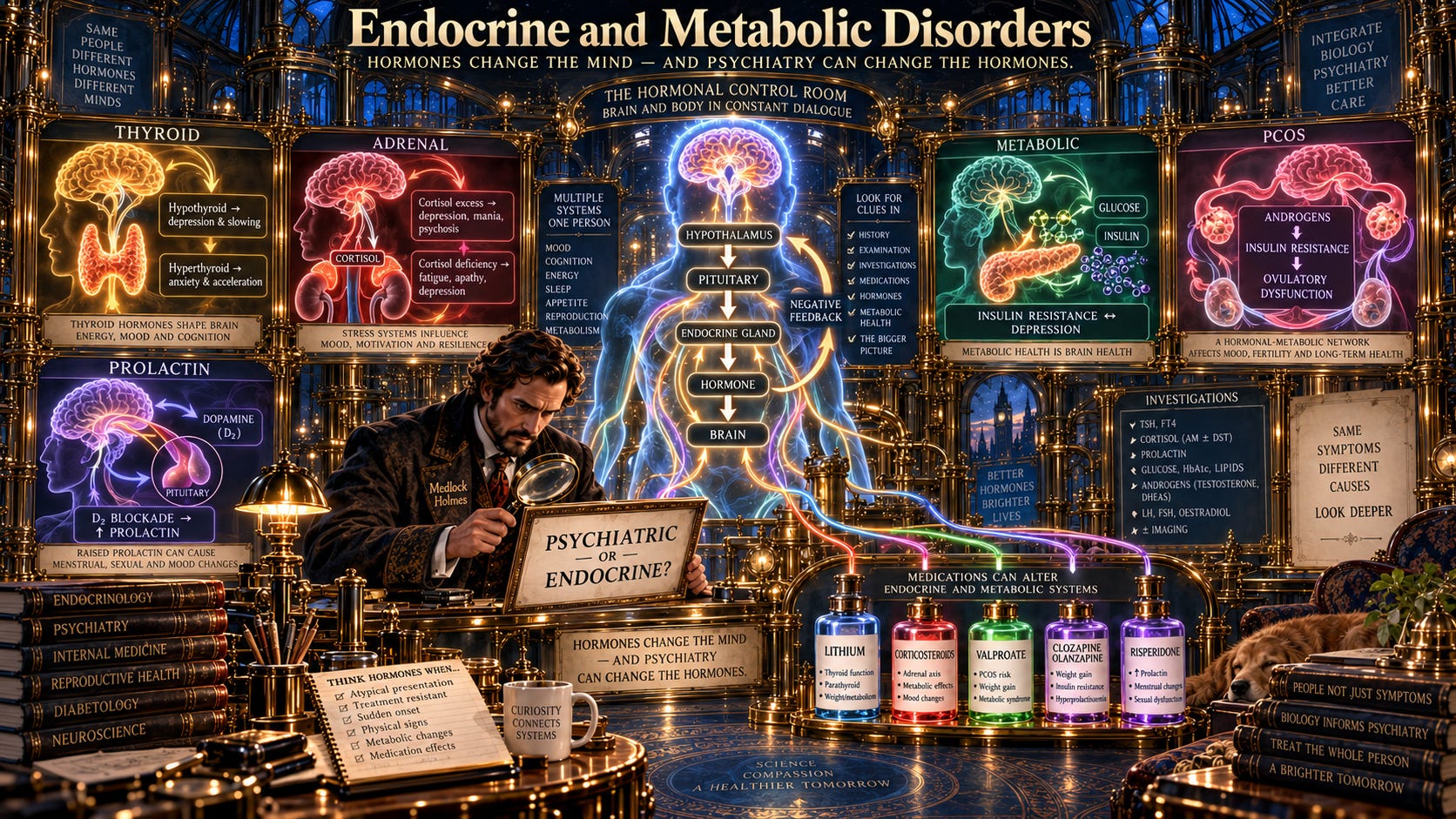
PSYCH 148: Endocrine and Metabolic Disorders
meaning disturbances of thyroid, adrenal, metabolic and reproductive systems can present as depression, anxiety, mania, psychosis or cognitive change.Episode DescriptionMedlock Holmes enters The Hormonal Control Room, a vast Neo-Victorian laboratory where the brain and body communicate through an intricate network of chemical messengers.At its centre stands the hypothalamus, connected to the pitui
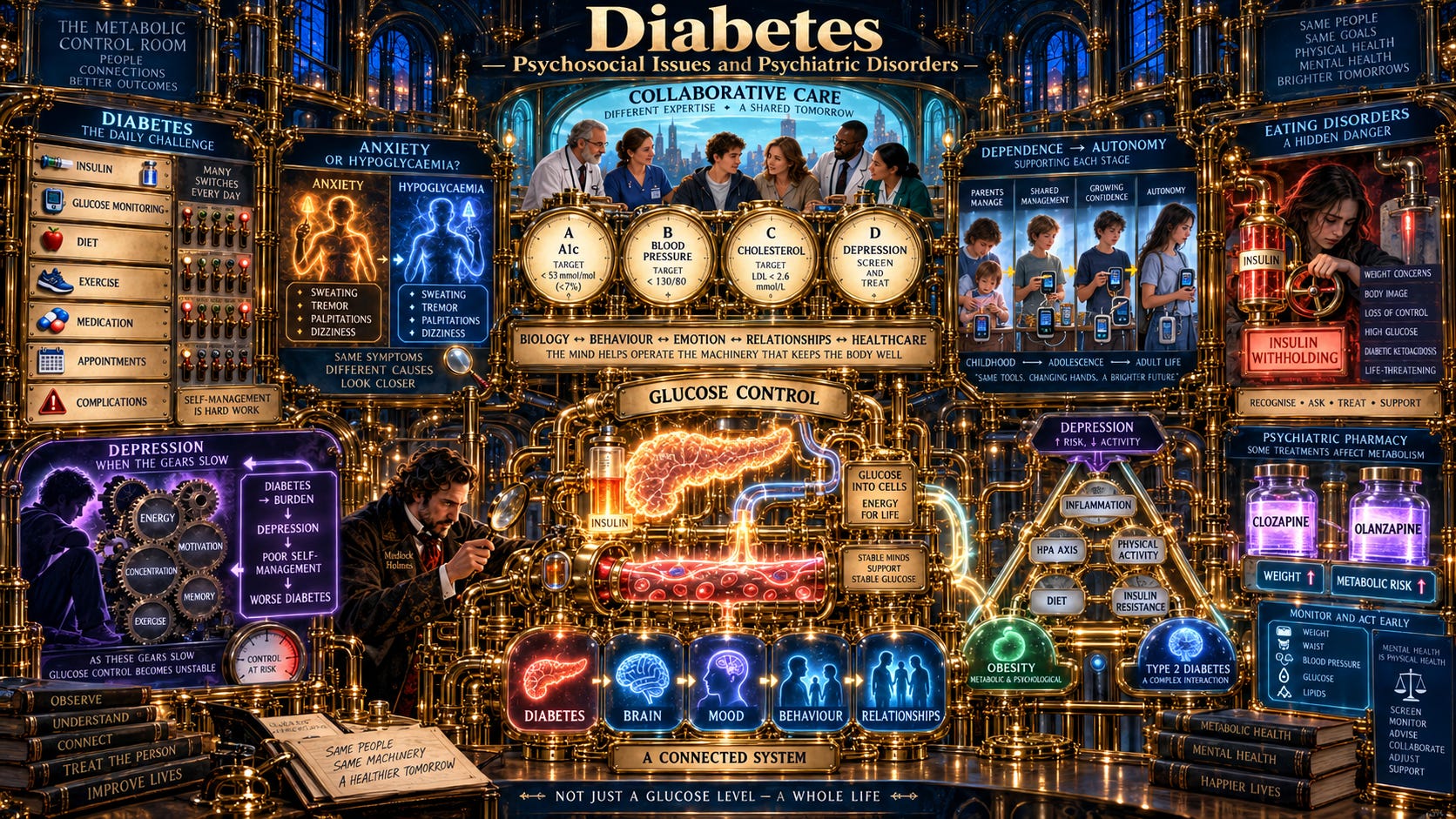
PSYCH 147: Diabetes - Psychosocial Issues and Psychiatric Disorders
making mental health inseparable from metabolic health.Episode DescriptionMedlock Holmes enters The Metabolic Control Room, an immense Neo-Victorian chamber built around a glowing bloodstream. At its centre sits a vast brass dial labelled GLUCOSE, connected to the pancreas, brain, heart, kidneys, eyes and peripheral nerves.At first, the machinery seems straightforward.In type 1 diabetes, autoimmun
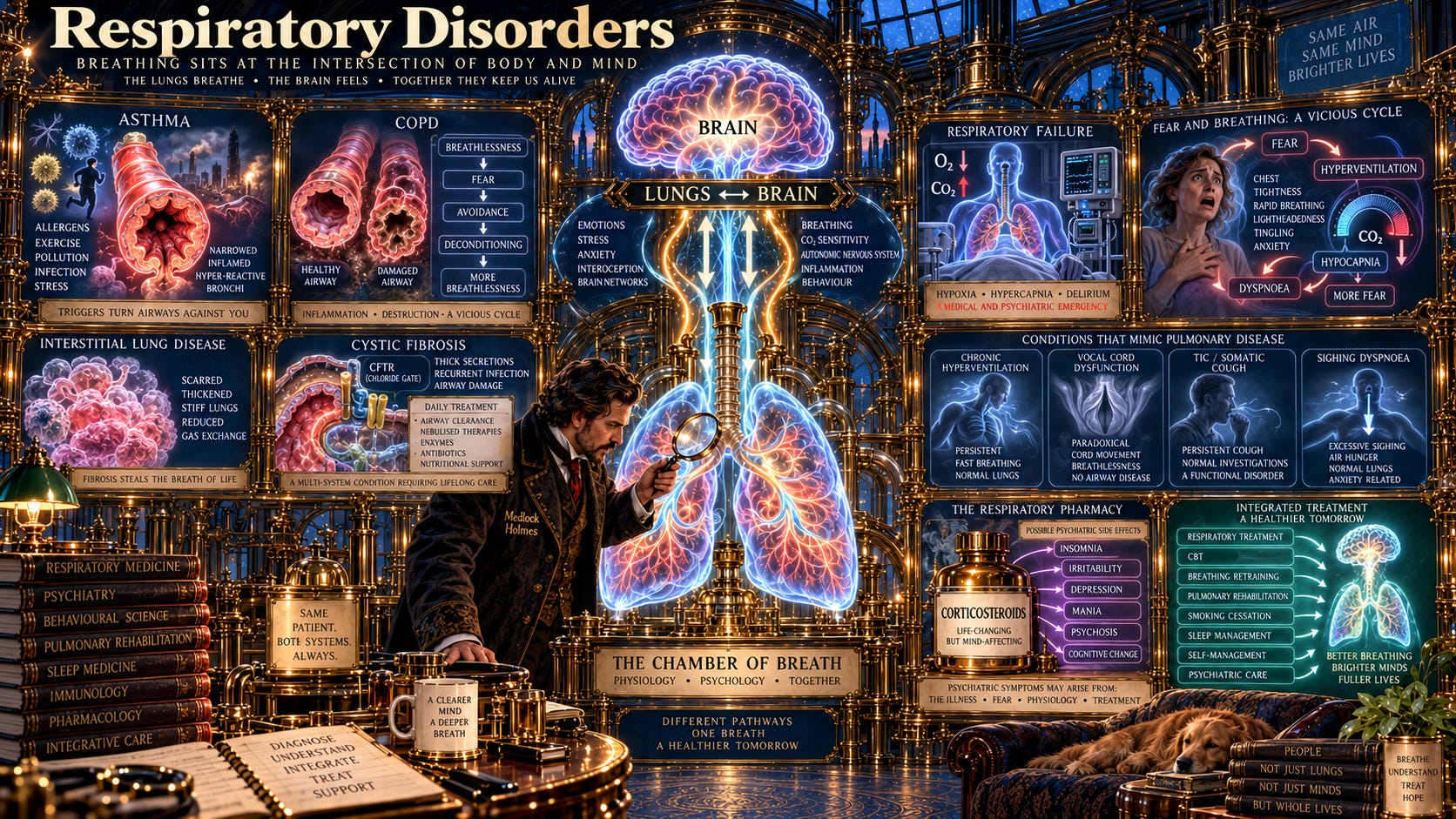
PSYCH 146: Respiratory Disorders
and psychiatric treatment.Episode DescriptionMedlock Holmes enters The Chamber of Breath, an immense Neo-Victorian respiratory laboratory where a pair of mechanical lungs expands and contracts beneath an intricate network connecting the lungs, brain, emotions and behaviour.At first, the mystery appears entirely pulmonary. Asthma narrows reactive airways. COPD progressively restricts airflow. Inter
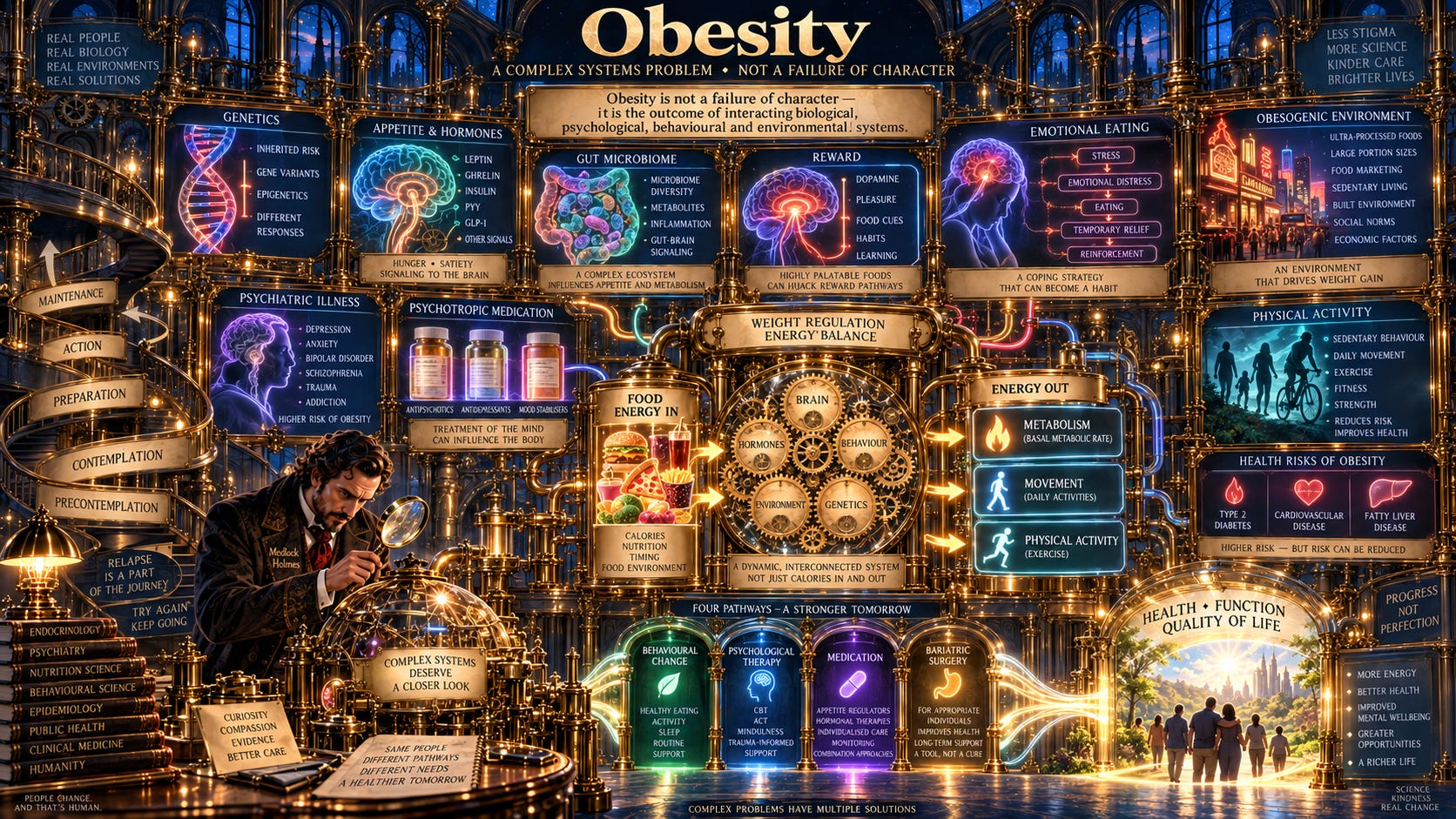
PSYCH 145: Obesity
the development and management of obesity.Medlock Holmes enters The Great Energy Exchange, an immense Neo-Victorian metabolic laboratory where every calorie entering the body passes through a bewildering network of biological, psychological and environmental machinery.At first, the equation appears almost embarrassingly simple:ENERGY IN > ENERGY OUT → WEIGHT GAINBut Holmes quickly discovers that t
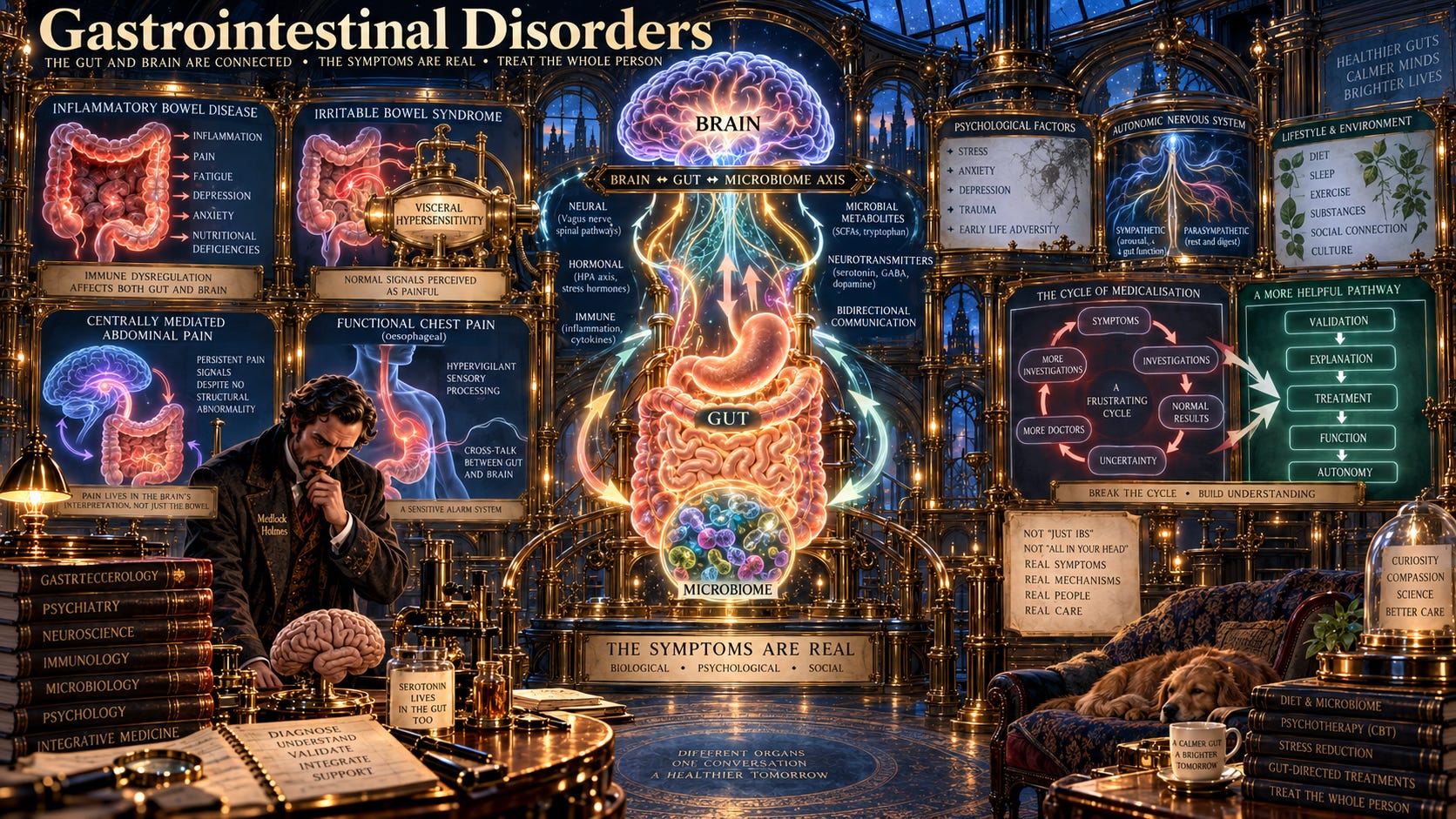
PSYCH 144: Gastrointestinal Disorders
and the extraordinary bidirectional conversation of the brain–gut–microbiome axis.Medlock Holmes enters The Great Gut–Brain Exchange, an immense Neo-Victorian communication network in which the brain and gastrointestinal tract are joined by constantly moving signals. Messages travel downward through the autonomic nervous system, HPA axis and neuroendocrine pathways, while sensory, immune, hormonal
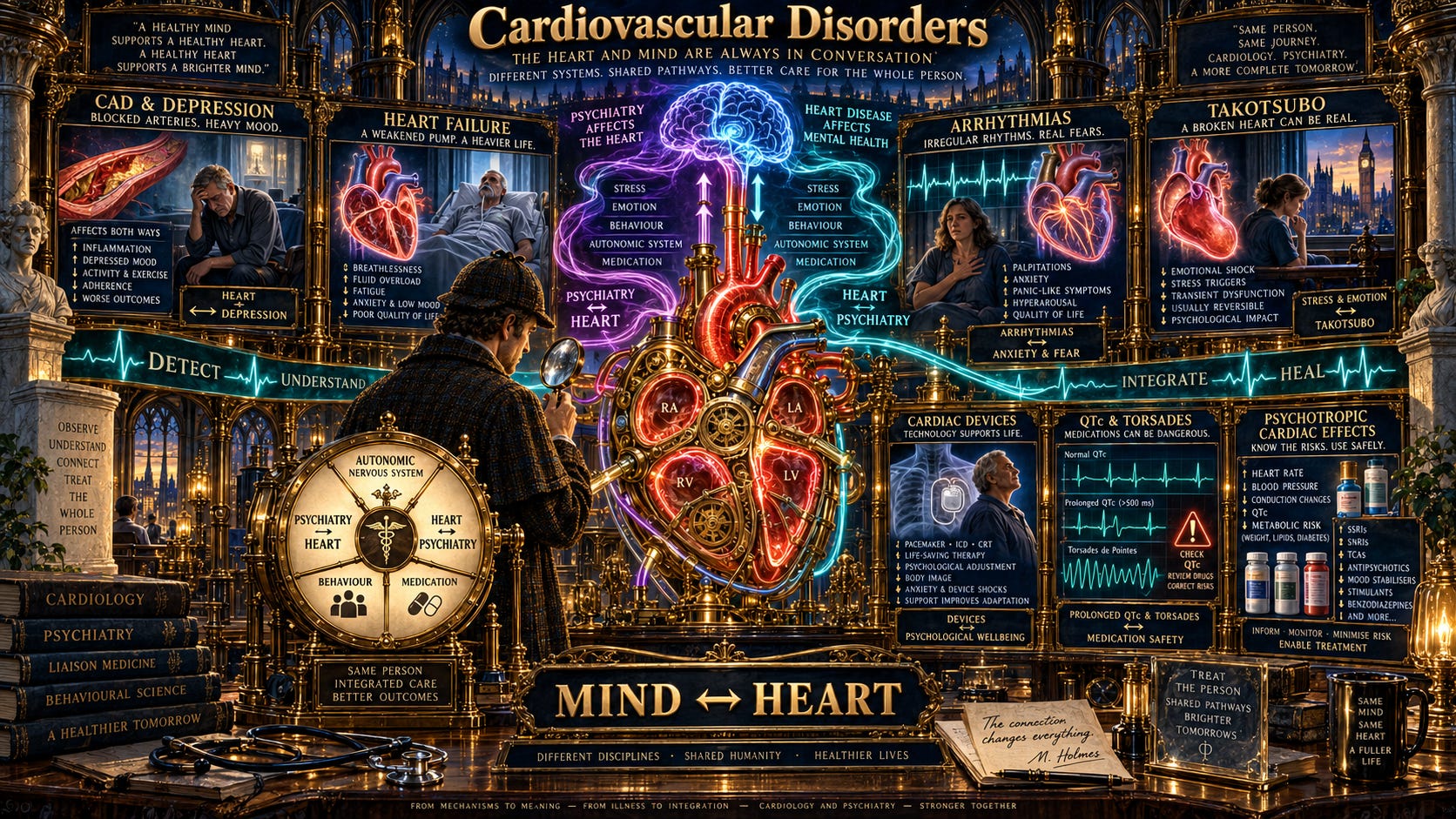
PSYCH 143: Cardiovascular Disorders
Medlock Holmes enters The Engine Room of the Heart, where an enormous mechanical heart is connected to the brain by networks carrying stress, emotion, behaviour, autonomic signals and medication effects.The relationship is strikingly bidirectional. Cardiovascular disease can produce anxiety, depression, cognitive disturbance and trauma-related symptoms, while psychiatric disorders and psychologica
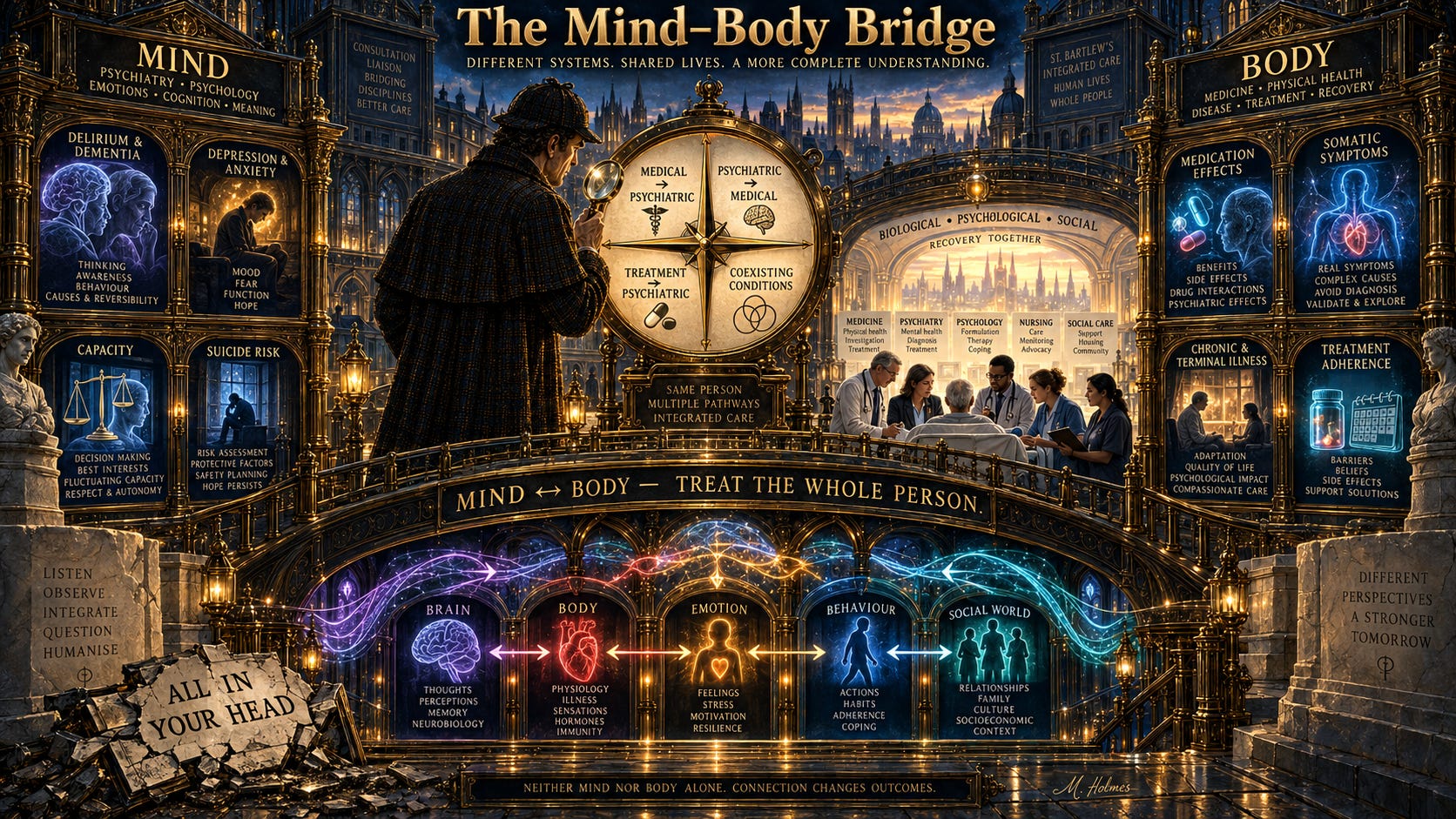
PSYCH 142: Consultation-Liaison Psychiatry and Psychosomatic Medicine
Medlock Holmes enters The Hospital of Two Wings.For generations, one wing has been labelled BODY and the other MIND. Patients are routinely carried from one to the other, as though every symptom must belong exclusively to one side.Holmes immediately notices the flaw.A bridge connects them.Consultation-liaison psychiatry operates on this bridge: the part of psychiatry concerned with psychiatric pro
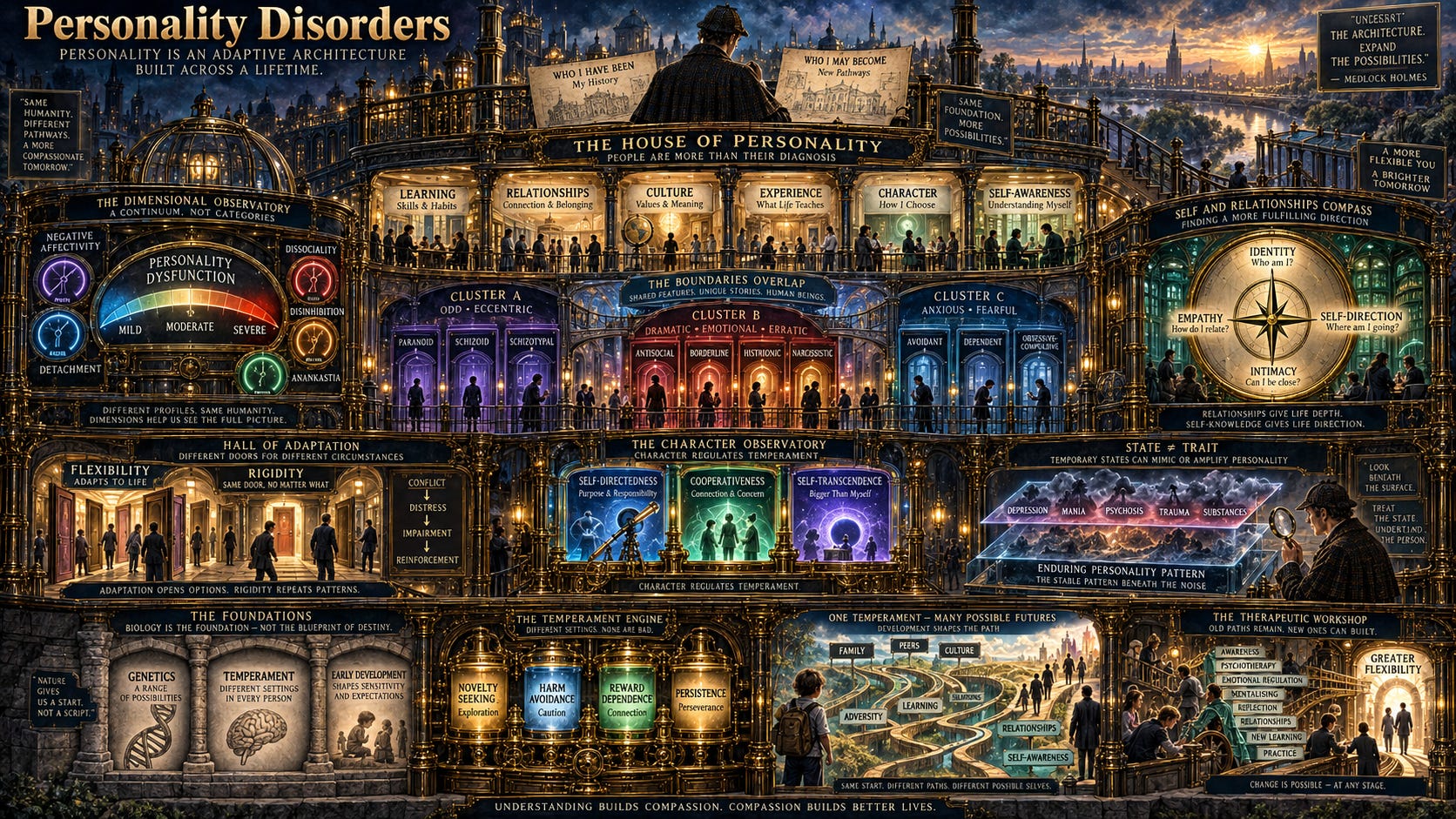
PSYCH 141: Personality Disorders
Personality disorder emerges not because someone has a distinctive personality, but when enduring patterns become sufficiently inflexible and maladaptive to repeatedly disrupt the self, relationships and functioning.Medlock Holmes enters The House of Personality, an extraordinary mansion that has been under construction since childhood.Its foundations contain inherited temperament. Its rooms have
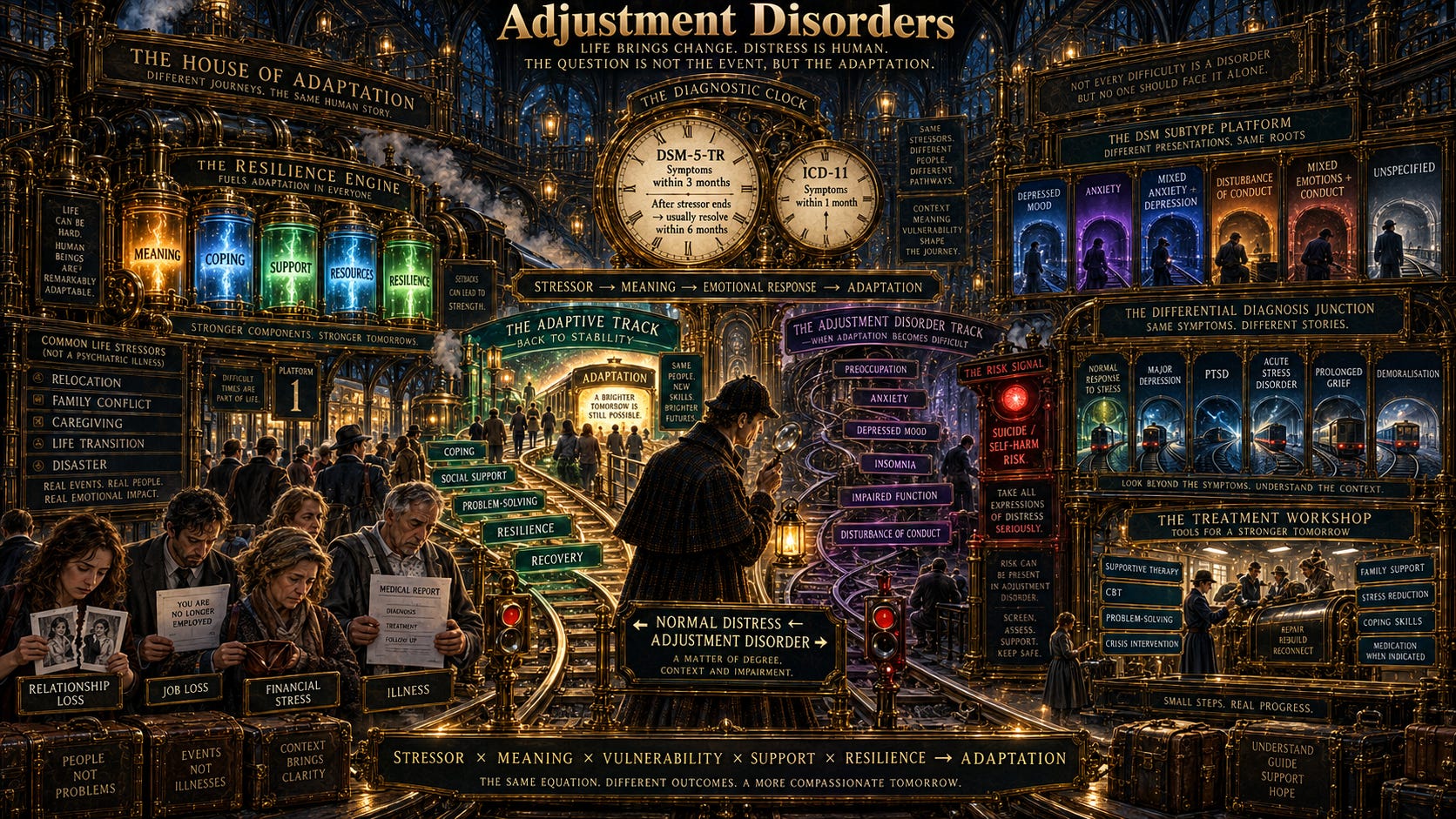
PSYCH 140: Adjustment Disorders
Medlock Holmes enters The House of Adaptation, where people arrive carrying the weight of events that have changed their lives: relationship breakdown, financial hardship, illness, unemployment, conflict, relocation, bereavement and unexpected transitions.But Holmes immediately encounters psychiatry’s central difficulty with adjustment disorder:“When does distress become disorder?”Adjustment disor
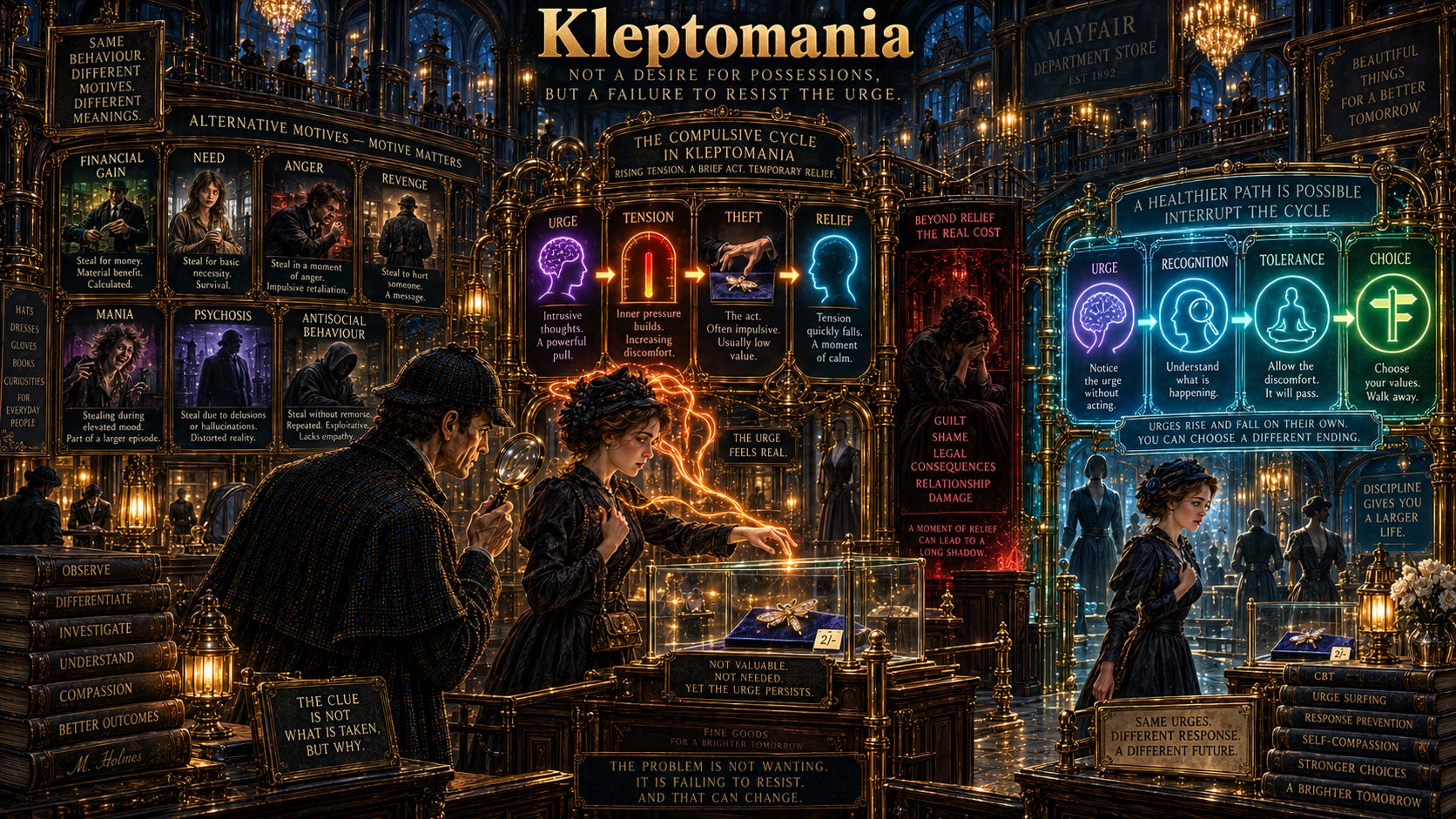
PSYCH 139: Kleptomania
Medlock Holmes enters a vast Neo-Victorian department store where an unusual investigation is underway.An object has been stolen.But the person who took it did not need it. The object had little personal importance. They could easily have afforded it. They may not even use it afterwards - sometimes the stolen objects are hidden, hoarded, given away or even secretly returned.So Holmes asks the ques
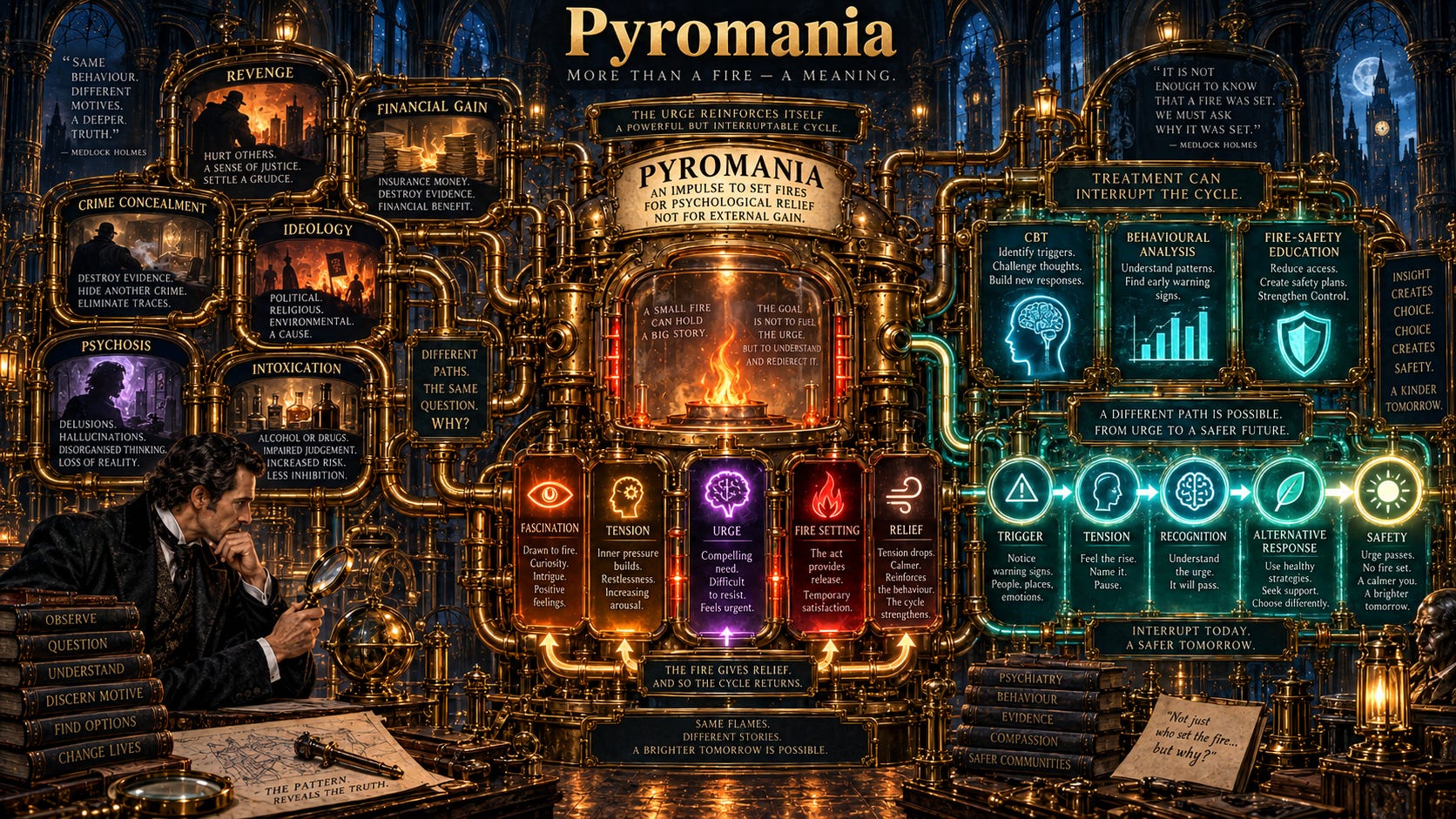
PSYCH 138: Pyromania
and subsequent pleasure or relief.Medlock Holmes enters a vast Neo-Victorian fire investigation chamber where one question dominates the room:WHY WAS THE FIRE SET?Pyromania is not simply fire setting, and most people who deliberately start fires do not have pyromania. The diagnosis requires repeated, deliberate and purposeful fire setting accompanied by increasing tension or emotional arousal befo
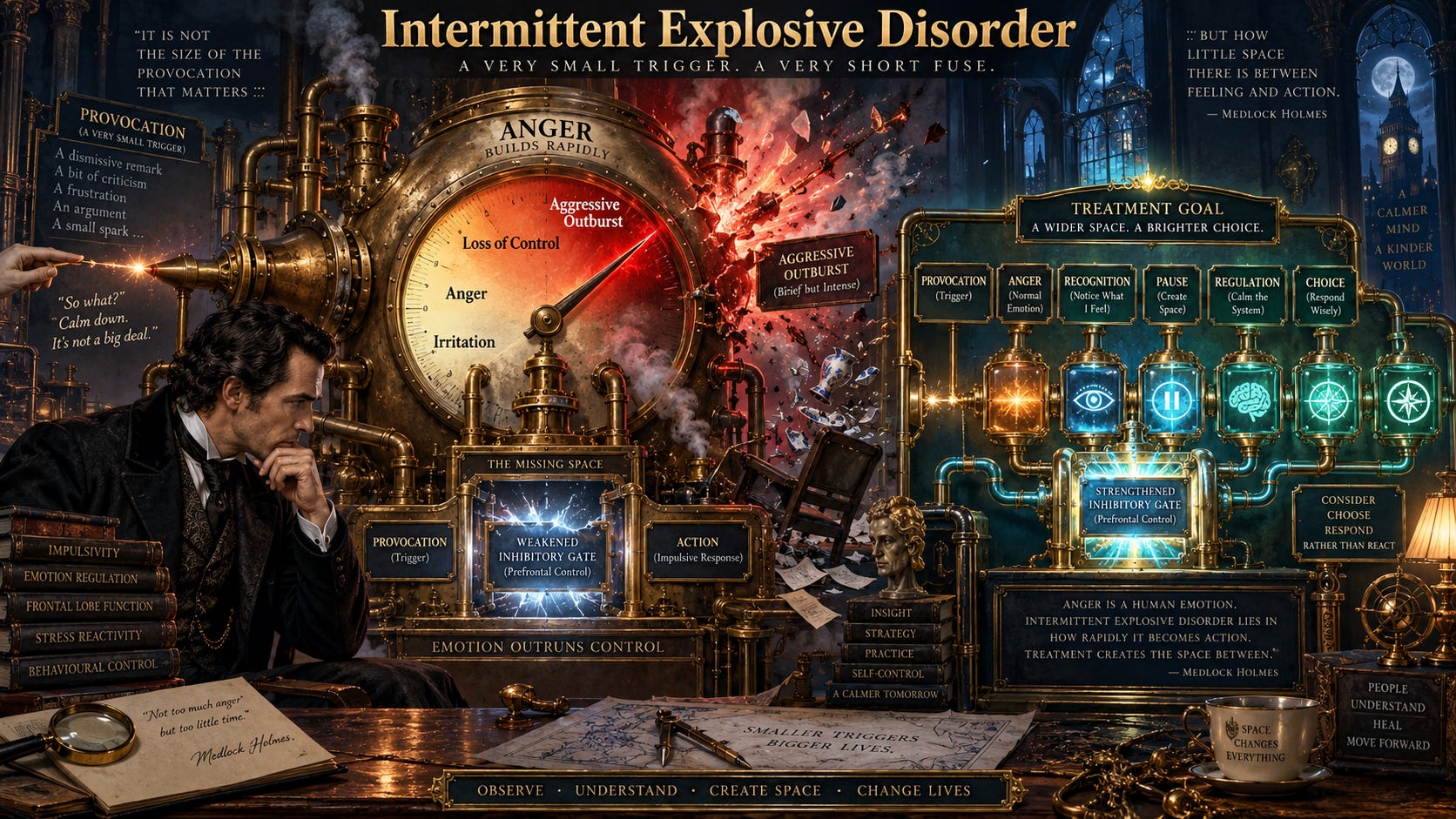
PSYCH 137: Intermittent Explosive Disorder
Medlock Holmes enters an immense Neo-Victorian institution known as The Hall of Impulsive Aggression.At first, the building seems calm.Then a small bell rings.Someone makes a dismissive remark.A door slams.A criticism is heard.A minor disagreement begins.Within seconds, an enormous brass pressure chamber erupts.The explosion is dramatic, but brief.Then silence.The whole event has lasted less than
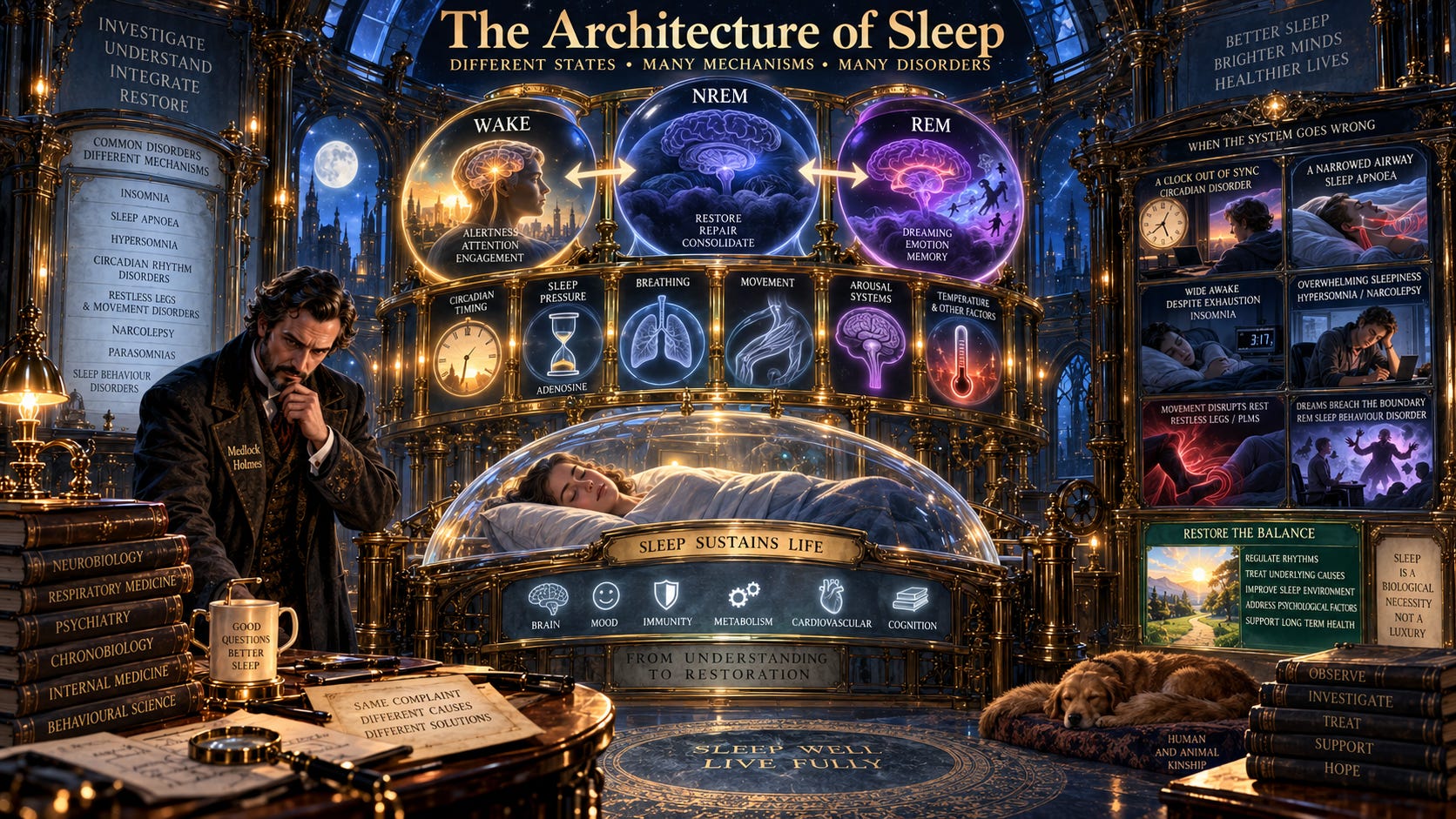
PSYCH 136: Sleep Disorders
Sleep disorders arise when the mechanisms controlling sleep quantity, timing, breathing, movement, arousal or dream-state boundaries become disrupted - and the consequences can range from chronic distress to accidents, cardiovascular disease and major functional impairment.Medlock Holmes enters an immense Neo-Victorian institution called The Grand Observatory of Sleep and Wakefulness.At first glan
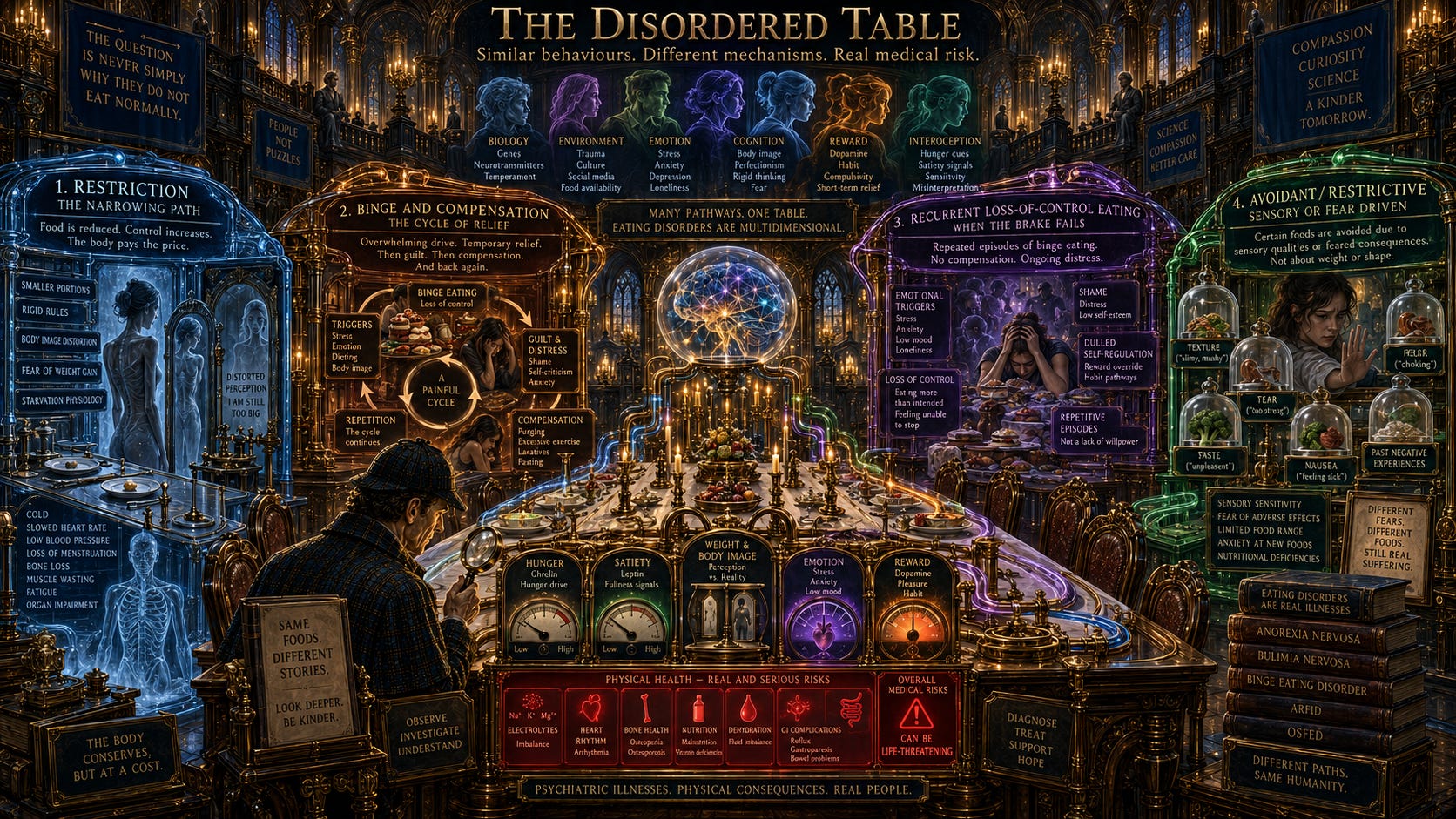
PSYCH 135: Feeding and Eating Disorders
health become entangled - sometimes producing profound malnutrition, dangerous compensatory behaviours, loss of control over eating, nutritional deficiency, medical instability and substantial psychosocial impairment.Medlock Holmes enters an immense Neo-Victorian institution called The House of Eating, Weight and Regulation.At first, the building appears deceptively ordinary.At its centre is a vas
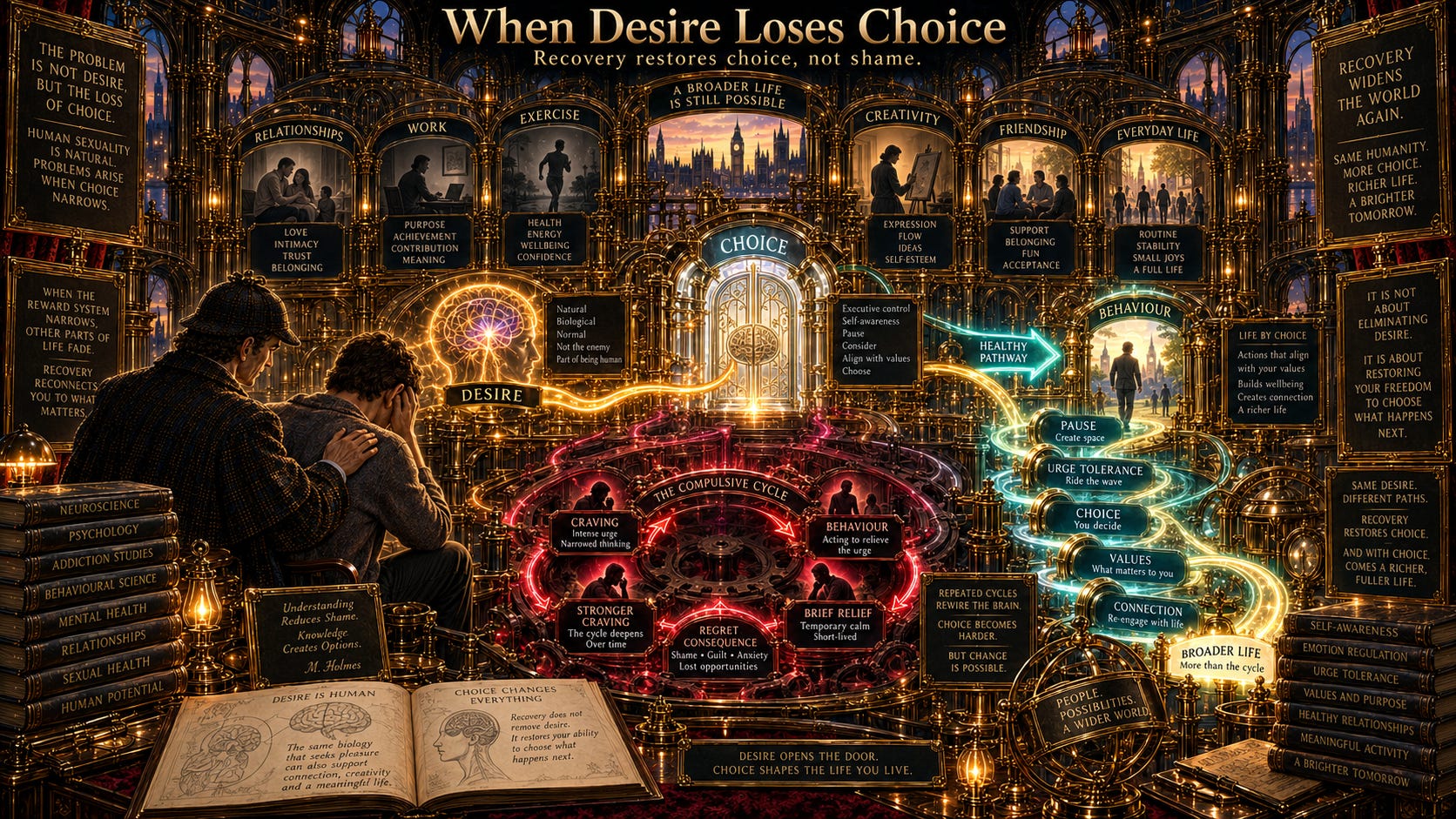
PSYCH 134: Sexual Addiction
The central clinical question is not “How much sex is too much?” but “Has sexual behaviour become the person's primary way of regulating distress, reward and self-experience?”Medlock Holmes enters an immense Neo-Victorian institution called The House of Driven Behaviour.At first, nothing in the building looks inherently pathological.There are rooms devoted to:sexual fantasymasturbationromantic att
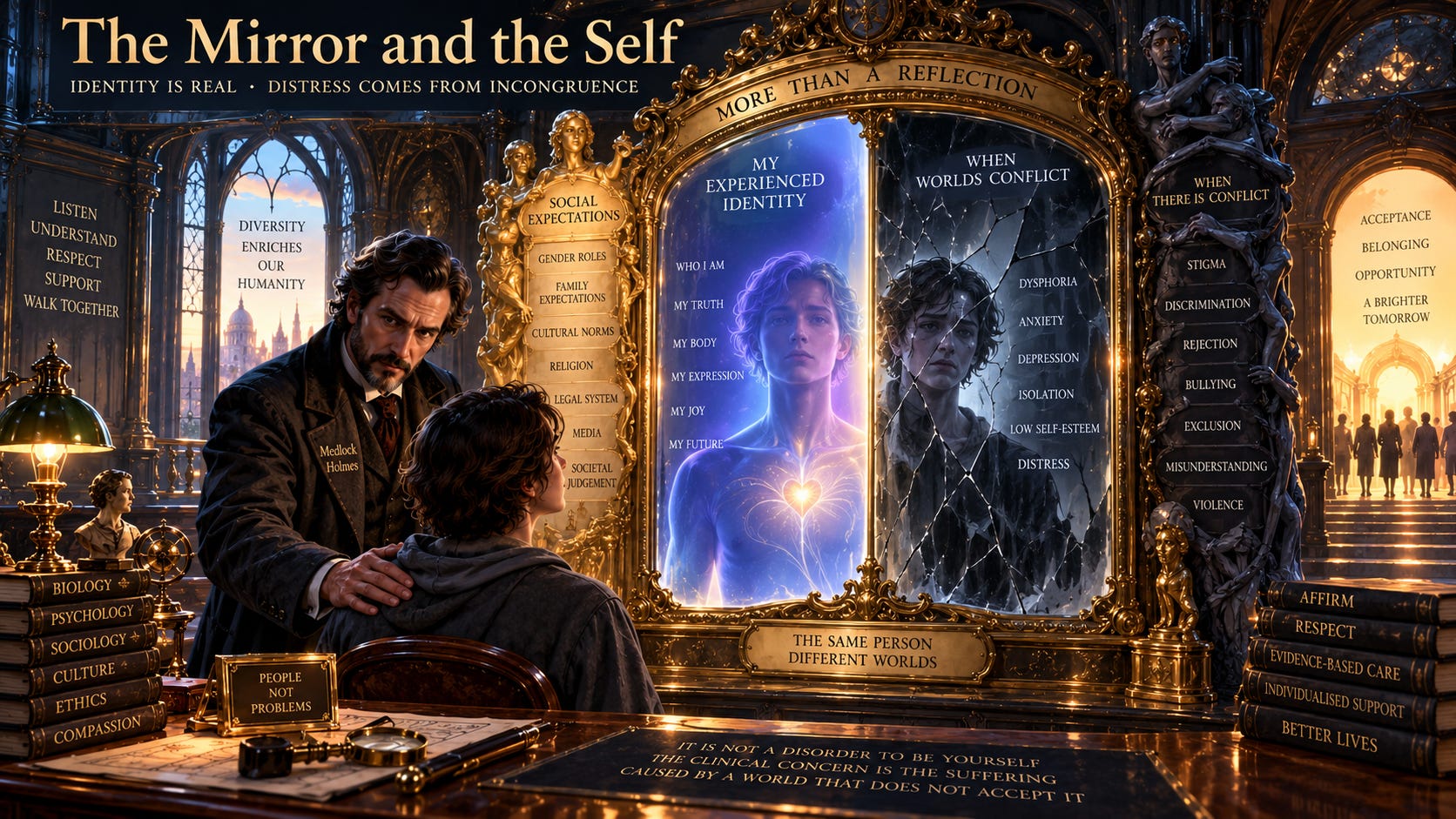
PSYCH 133: Gender Identity, Gender Diversity, and Gender Dysphoria/Incongruence
Medlock Holmes enters an immense Neo-Victorian institution called The Grand Observatory of Gender.At its centre stands a transparent human figure surrounded by several rotating brass rings.One is labelled:SEX CHARACTERISTICSAnother:GENDER IDENTITYAnother:GENDER EXPRESSIONAnother:SEXUAL ORIENTATIONAnother:SOCIAL ROLEThe rings frequently align.Sometimes they do not.Holmes immediately discovers the c
PSYCH 132: Paraphilic Disorders
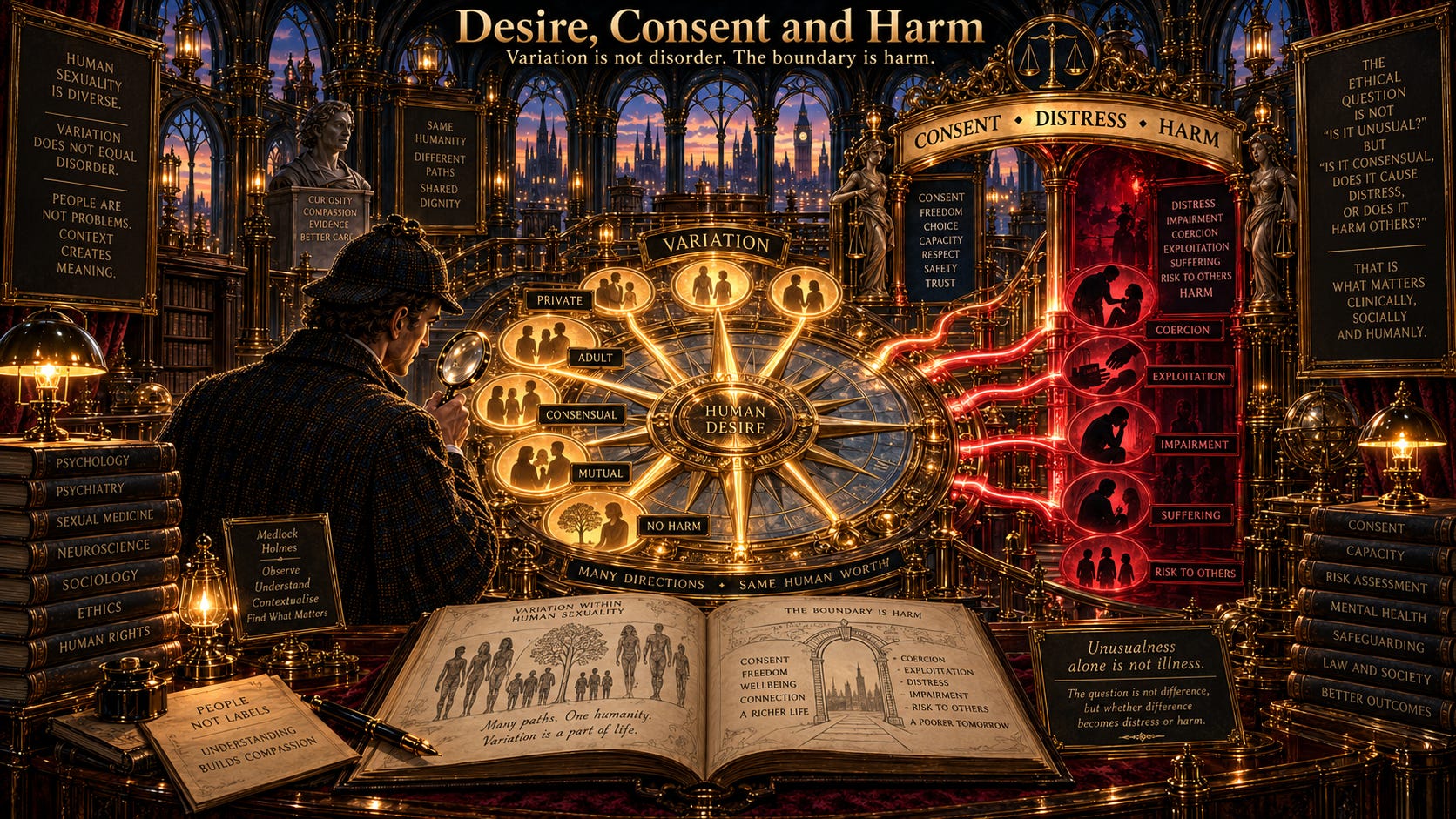
Medlock Holmes enters an immense Neo-Victorian institution called The Tribunal of Sexual Interest, Consent and Harm.At its centre stands a large brass balance.On one side:UNUSUAL SEXUAL INTERESTOn the other:DISTRESS • IMPAIRMENT • HARM • NONCONSENTHolmes quickly discovers the central distinction in modern psychiatric classification:A PARAPHILIA IS NOT AUTOMATICALLY A PARAPHILIC DISORDER.DSM-5 defi
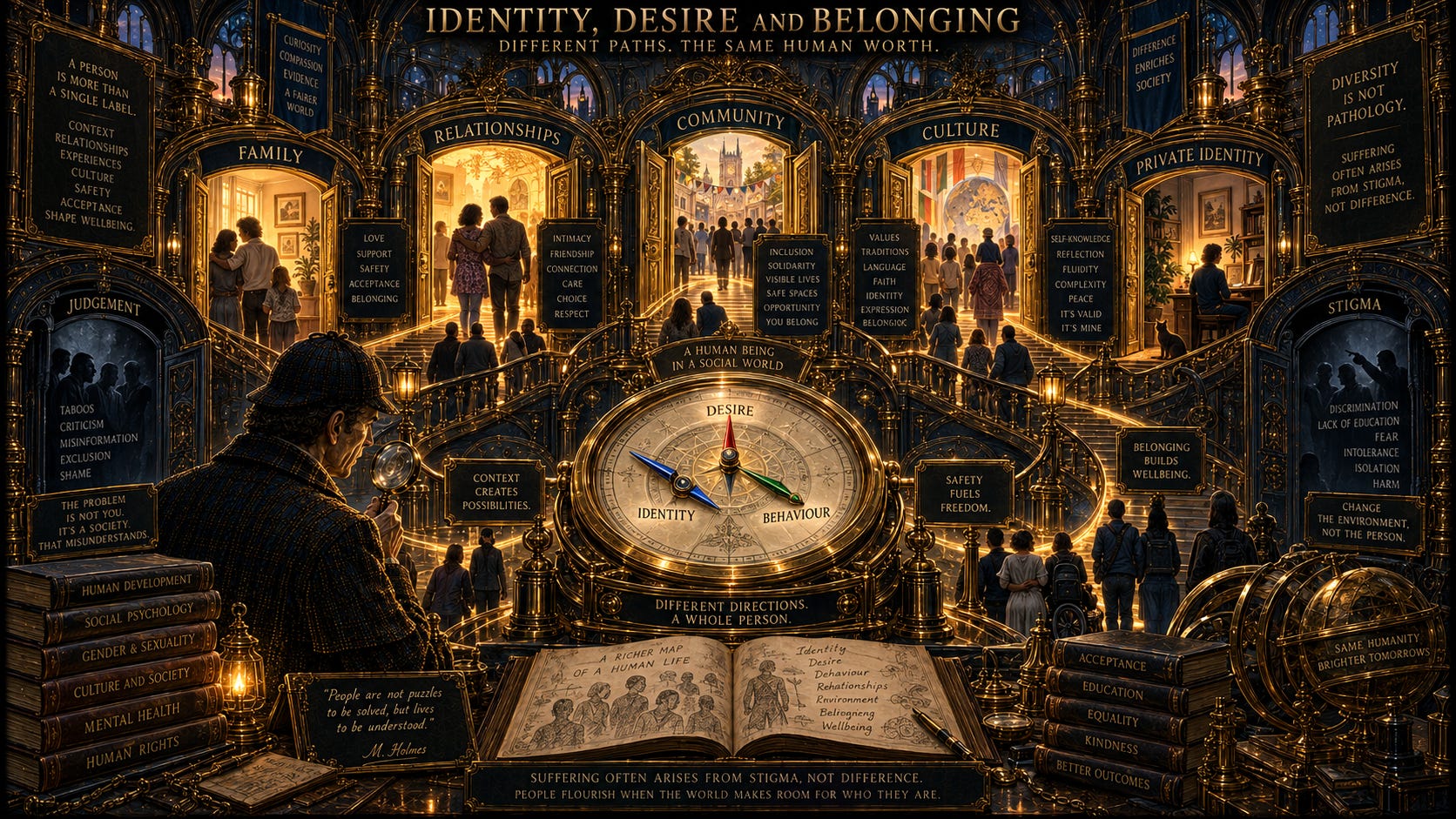
PSYCH 131: Homosexuality, Gay and Lesbian Identities, and Homosexual Behaviour
Medlock Holmes enters an immense Neo-Victorian institution called The Hall of Sexual Identity and Social Meaning.At its centre is a large brass compass with three separate needles:DESIRE • BEHAVIOUR • IDENTITYHolmes notices immediately that the needles do not always point in the same direction.A person may experience same-sex attraction without acting on it. Another may have same-sex relationships
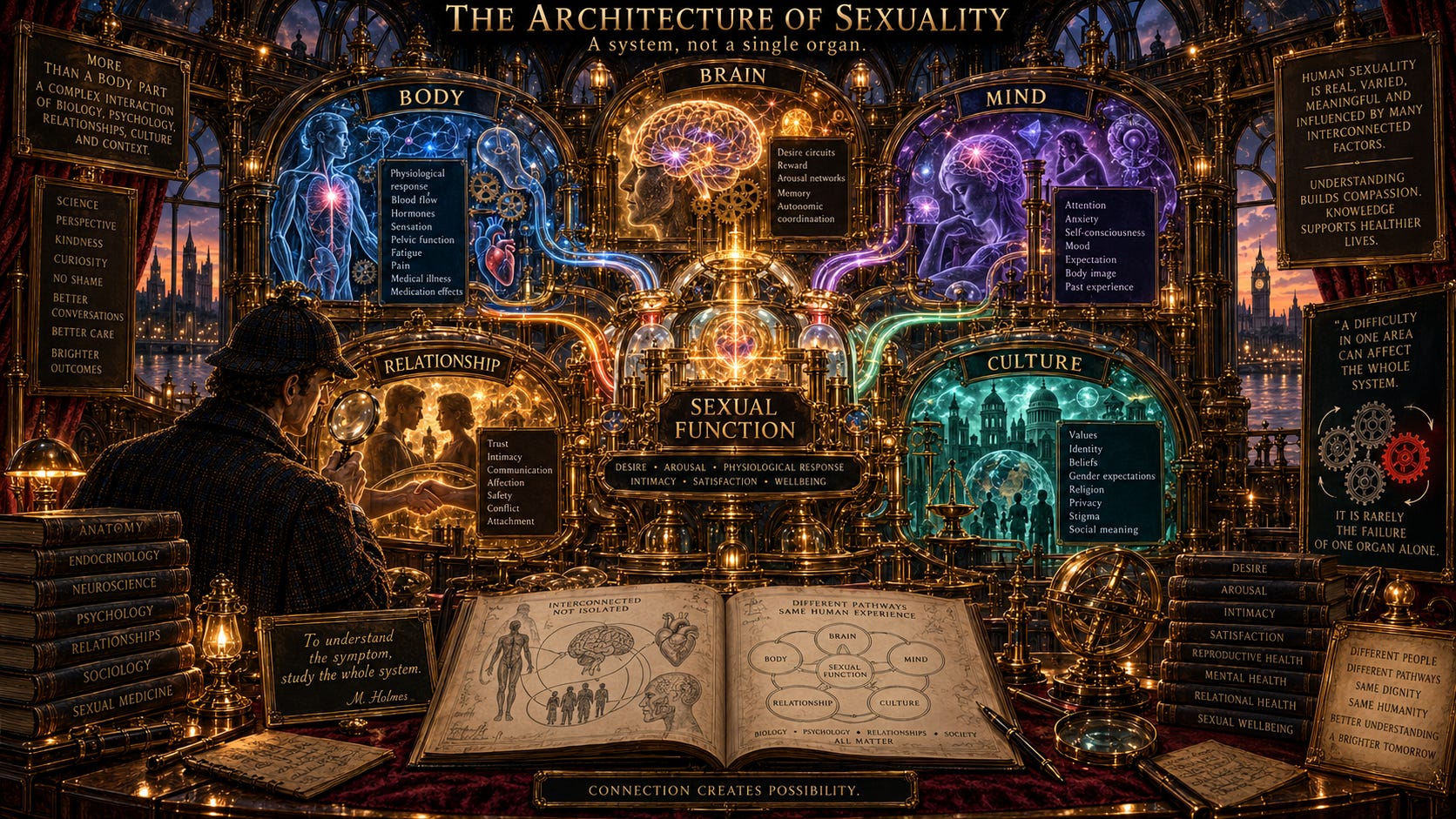
PSYCH 130: Normal Human Sexuality and Sexual Dysfunctions
Medlock Holmes enters an immense Neo-Victorian institution called The Grand Observatory of Human Sexuality.It is part anatomy theatre, part neuroscience laboratory, part relationship clinic and part cultural museum.At its centre stands an enormous brass instrument labelled:SEXUAL FUNCTIONSeven interlocking systems surround it:BODY • BRAIN • HORMONES • DESIRE • RELATIONSHIP • LEARNING • CULTUREHolm
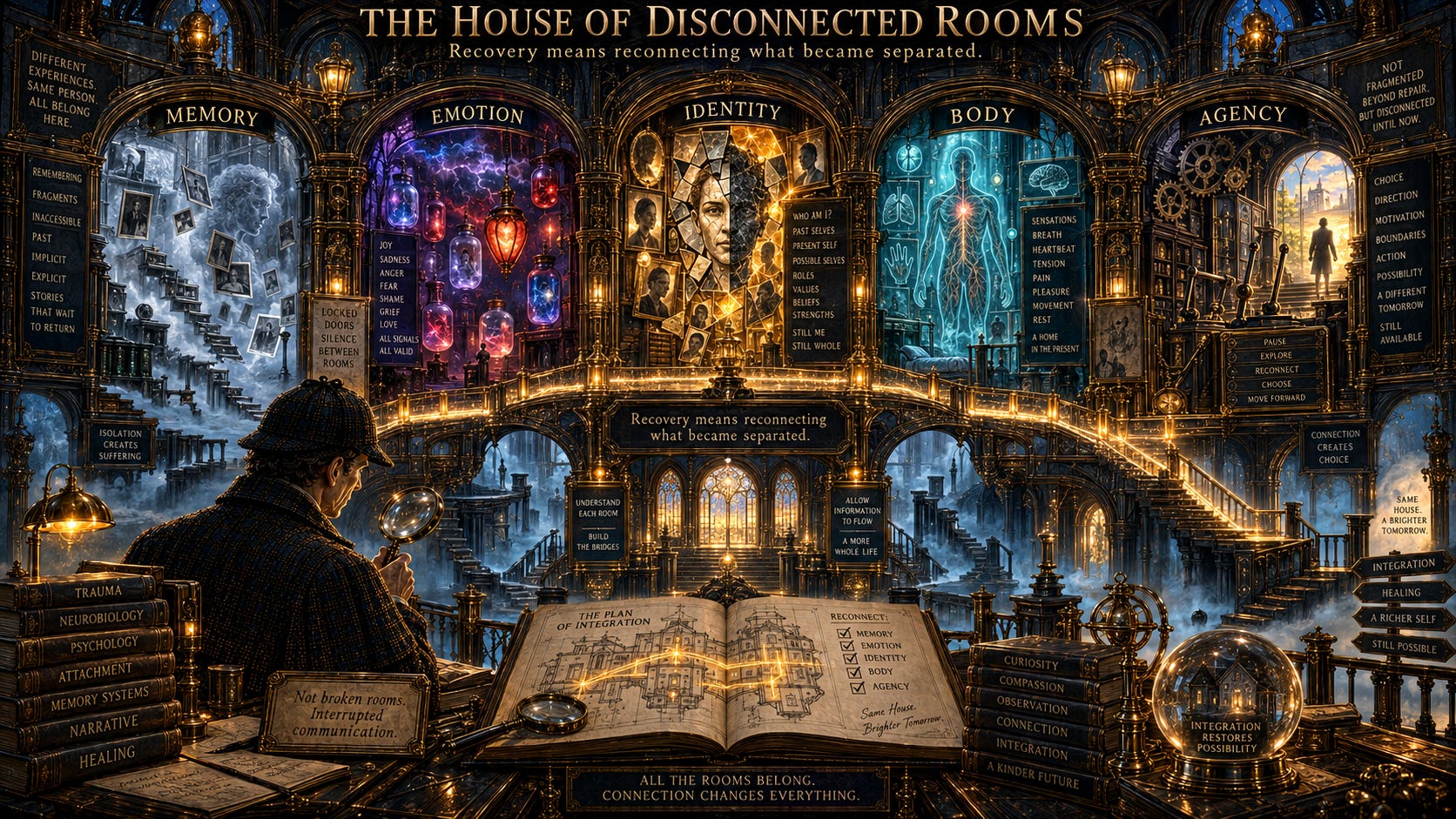
PSYCH 129: Dissociative Disorders
Medlock Holmes enters an extraordinary Neo-Victorian building called The House of Disconnected Rooms.From outside, it appears to be one house. Inside, however, corridors terminate unexpectedly, doors open into rooms that seem unaware of one another, clocks show different times, mirrors reflect unfamiliar faces, and sections of the archive are inaccessible from the main library.Nothing has disappea
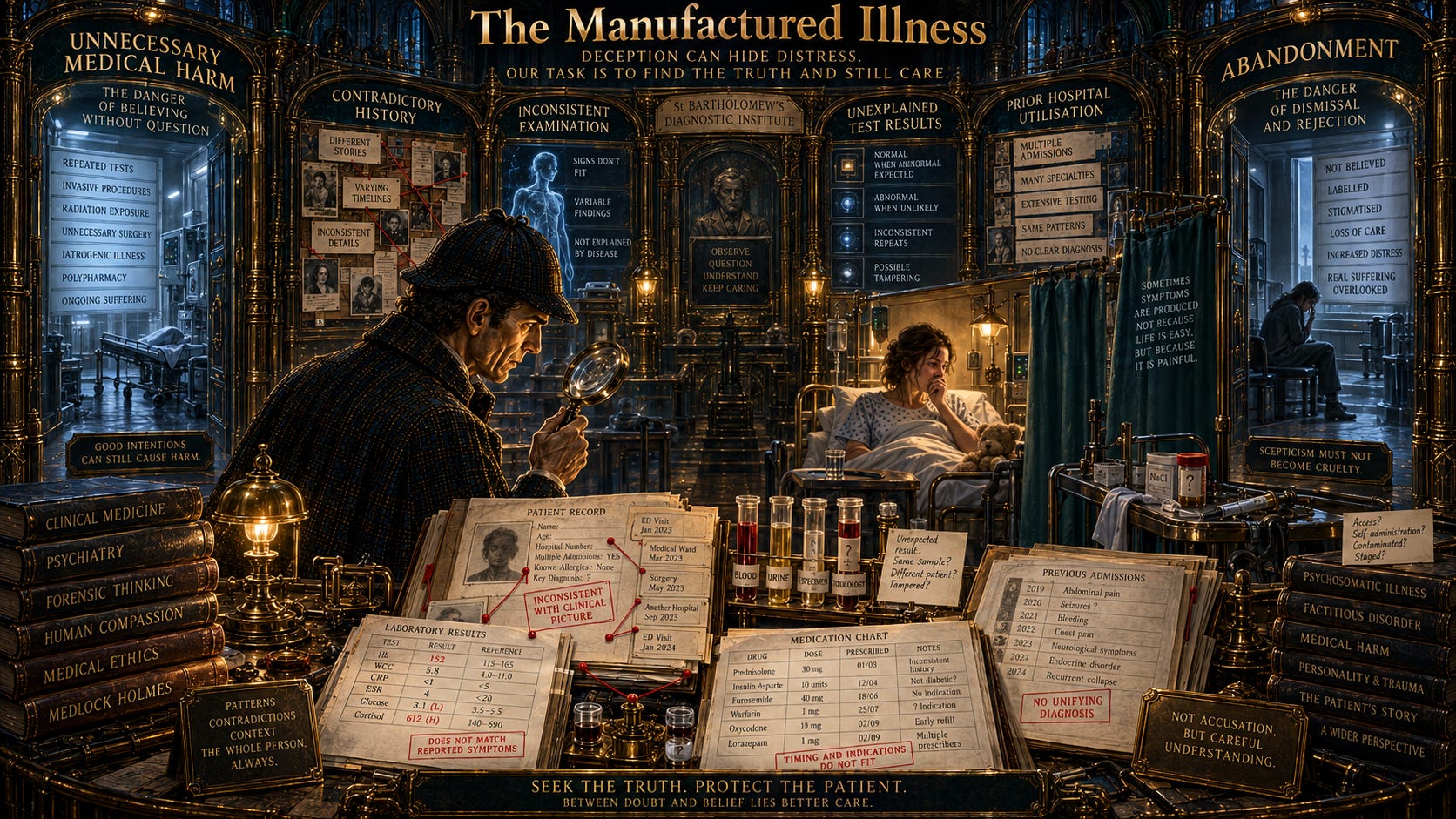
PSYCH 128: Factitious Disorder
At first, the cases look extraordinary.A patient presents with recurrent sepsis caused by unusual organisms. Another has persistent wounds that never heal. Another reports repeated seizures that vanish under observation. One produces dramatic laboratory abnormalities. Another travels from hospital to hospital under changing identities. In a paediatric ward, a child appears inexplicably ill wheneve
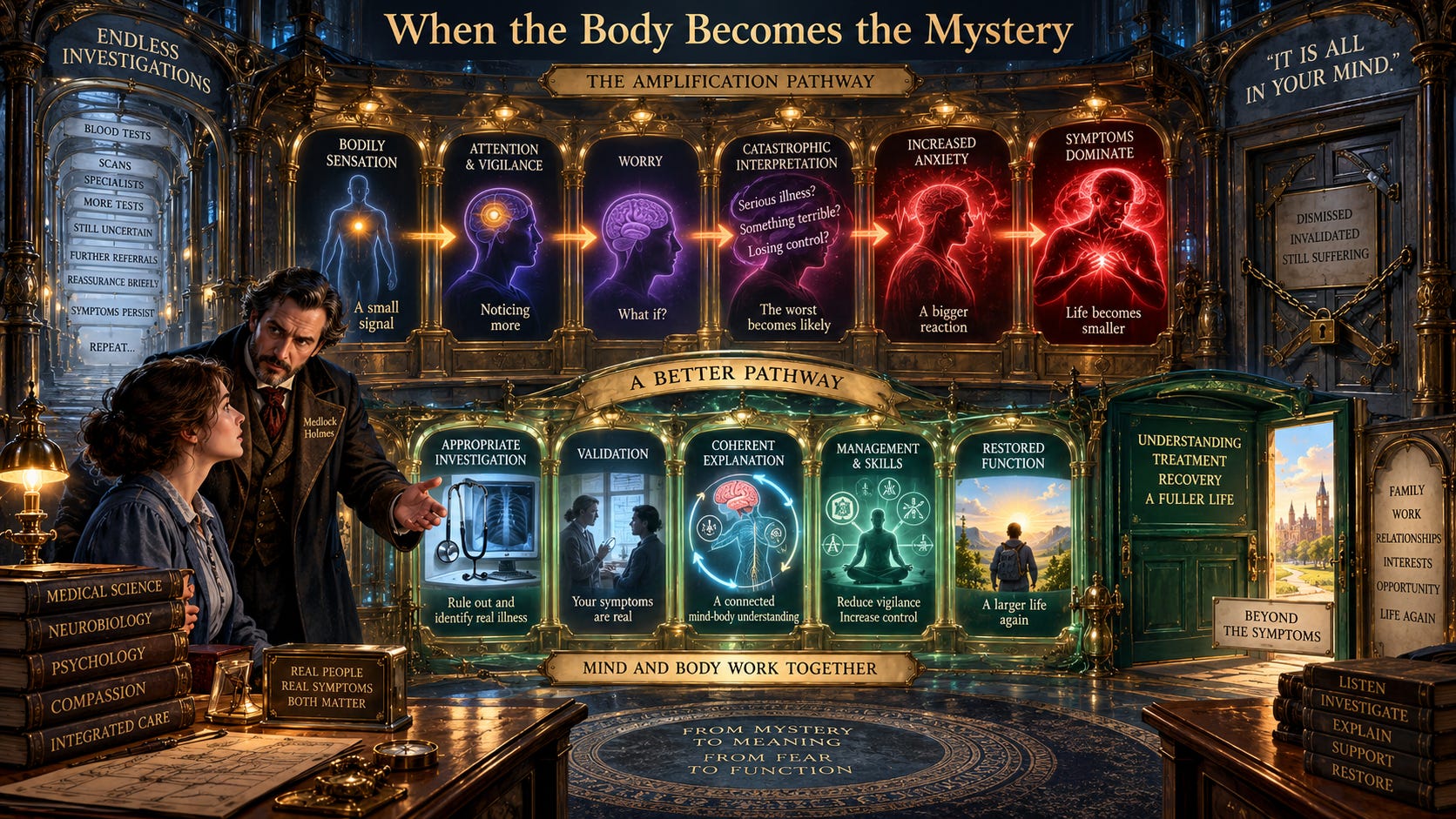
PSYCH 127: Somatic Symptom and Related Disorders
Medlock Holmes enters an immense Neo-Victorian medical complex called The House of Bodily Signals.Every corridor is crowded.One patient reports abdominal pain. Another dizziness. Another weakness. Another chest discomfort. Another is convinced that a subtle bodily sensation means serious disease. One patient has undergone scan after scan without reassurance. Another has genuine physical illness bu
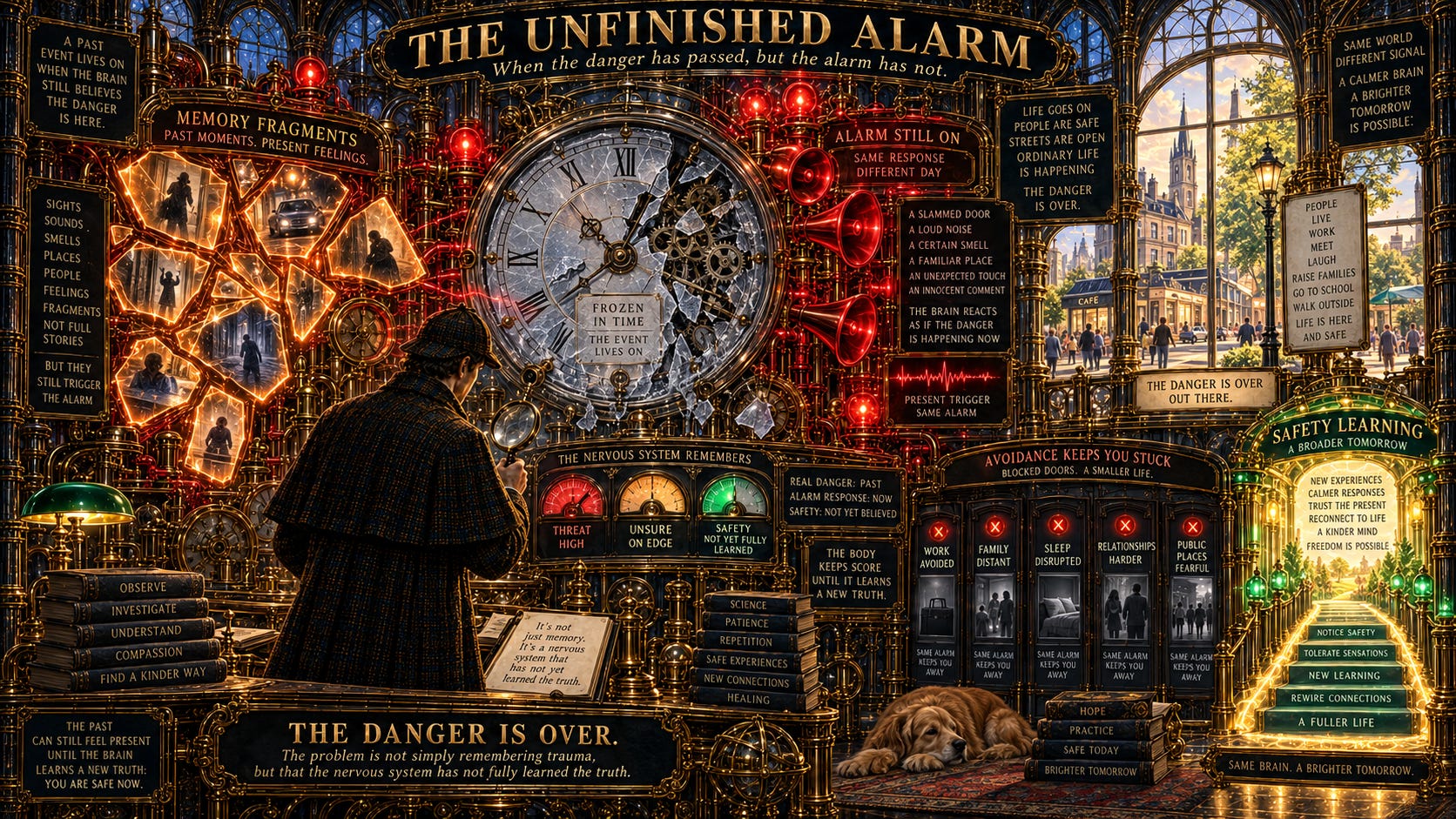
PSYCH 126: Post-Traumatic Stress Disorder
Medlock Holmes enters an immense Neo-Victorian institution called The Citadel of the Unfinished Alarm.At the centre is a vast clock frozen at the moment of trauma.Outside the citadel, the danger has passed.Inside, however, bells continue to ring.A veteran ducks at the sound of a car backfiring. A survivor avoids a street that resembles the place of an assault. Another wakes from the same nightmare
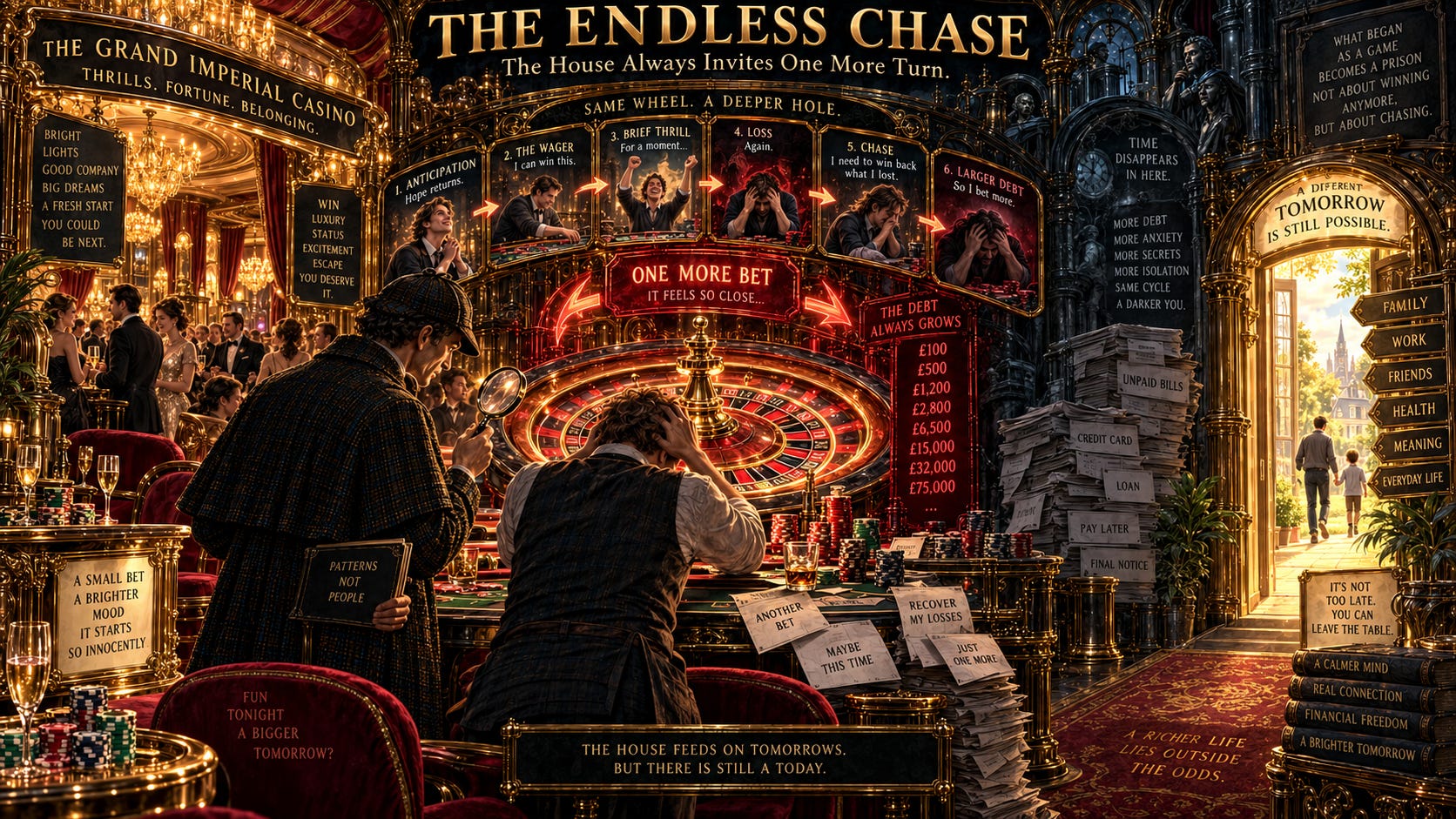
PSYCH 125: Gambling Disorder
Medlock Holmes enters an immense Neo-Victorian casino called The House of the Endless Chase.At first, the place appears glamorous.Roulette wheels turn beneath chandeliers. Cards slide across green felt. Slot machines sing. Sports odds flicker across brass boards. Online betting screens glow in distant alcoves.But Holmes notices something that ordinary gamblers do not.Almost every corridor leads ba
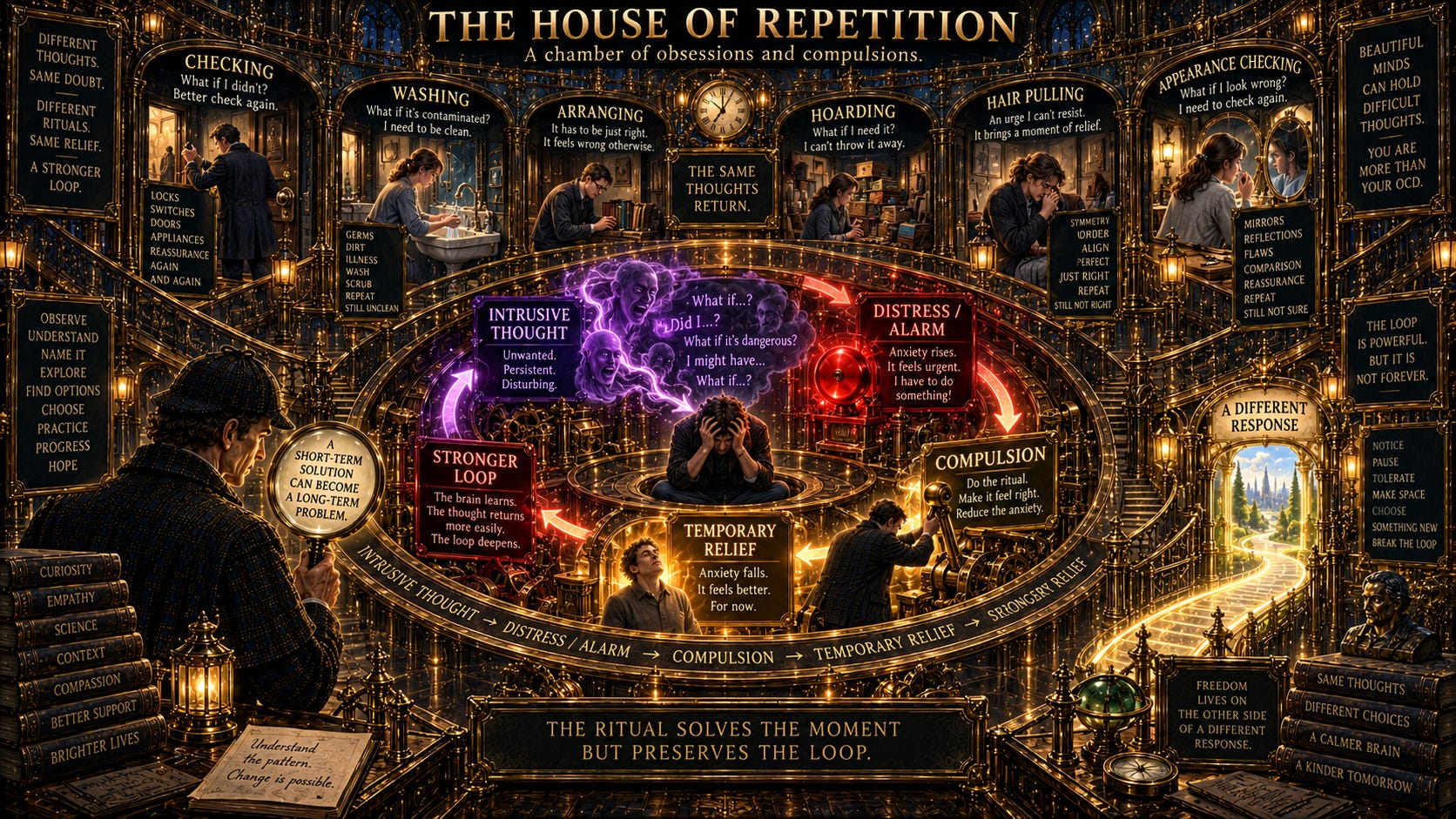
PSYCH 124: Obsessive-Compulsive and Related Disorders
Medlock Holmes leaves the Grand Dispensary of Anxiety and enters an entirely different institution: The Grand House of Repetition.At first, everything appears orderly. Doors are locked. Hands are washed. Objects are aligned. Possessions are carefully preserved.Then Holmes notices something unsettling.The same actions are happening again.And again.And again.A man checks a locked door for the twenti
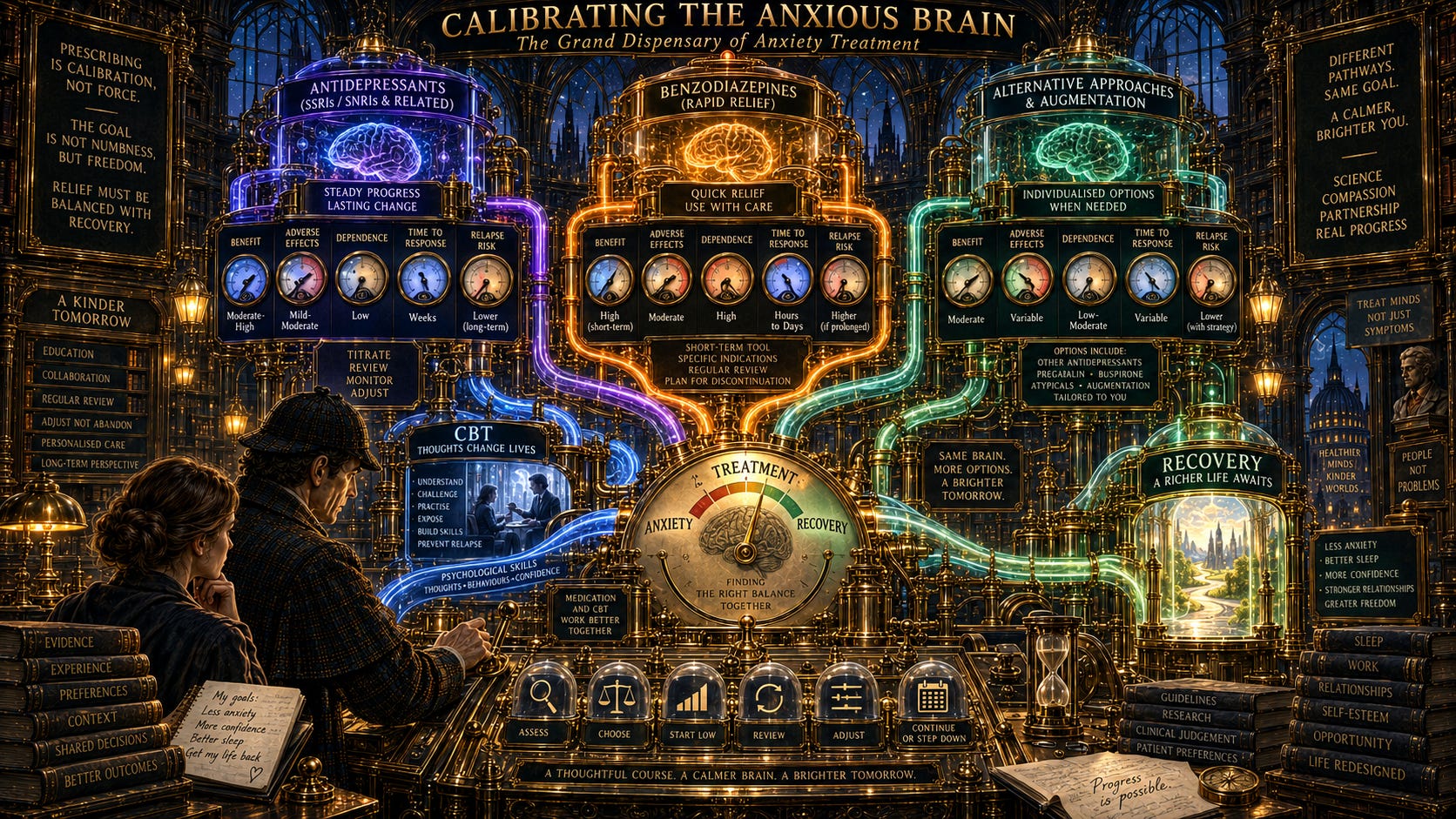
PSYCH 123: Anxiety Disorders - Somatic Therapies
Medlock Holmes enters an immense Neo-Victorian treatment complex called The Grand Pharmacological Dispensary of Anxiety.Rows of treatment pathways stretch before him.Some contain SSRIs and SNRIs.Others hold benzodiazepines, pregabalin, buspirone, beta-blockers, older antidepressants, antipsychotics, neurostimulation devices, and emerging experimental therapies.But Holmes immediately notices that t
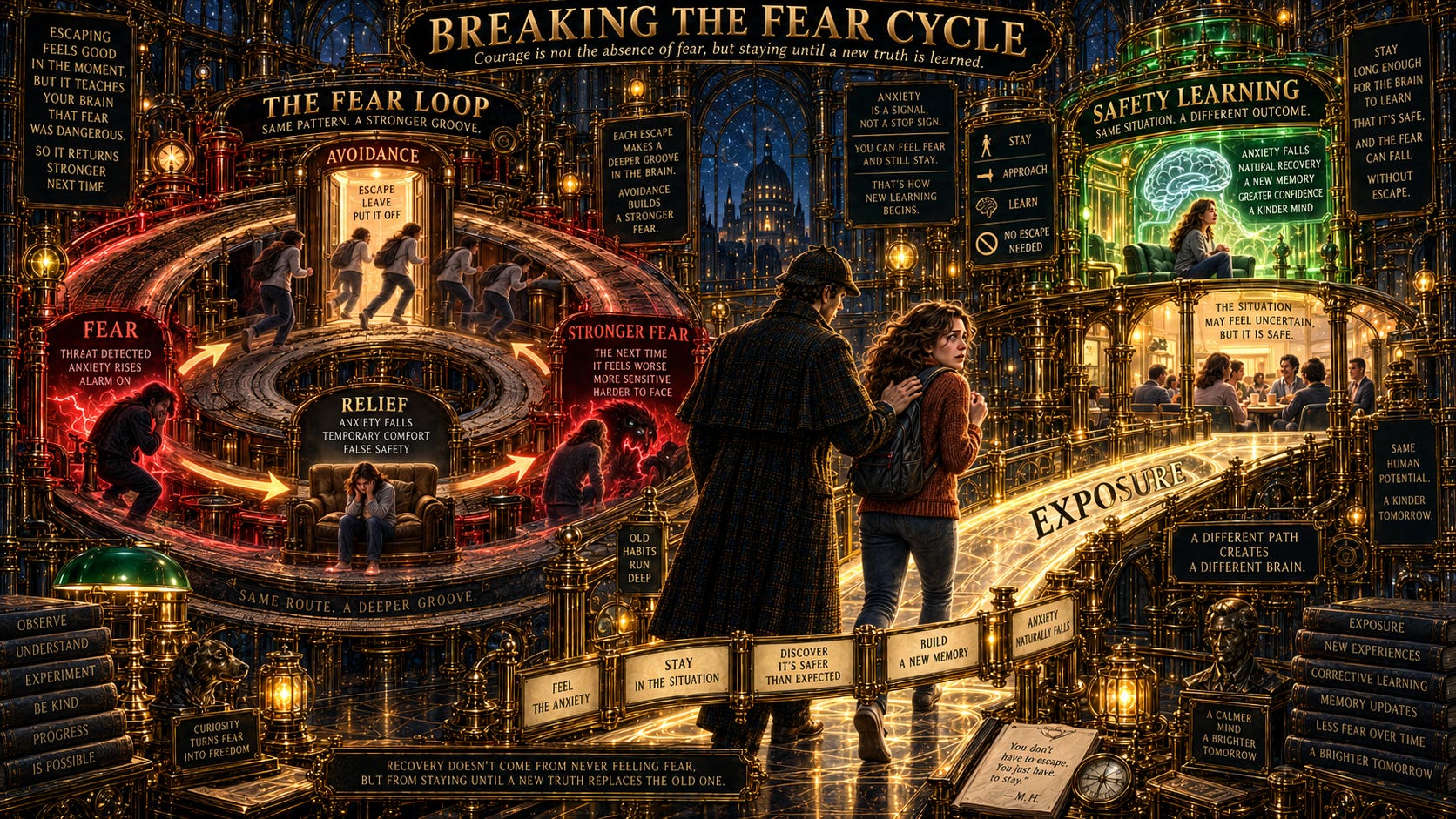
PSYCH 122: Anxiety Disorders - Cognitive-Behavioural Therapy
Medlock Holmes enters an immense Victorian experimental laboratory called The Institute of Fear and Learning.Around him, patients are trapped within apparently different mysteries.One avoids dogs. Another fears crowded trains because a panic attack might occur. Another rehearses every sentence before speaking, terrified of humiliation. Another spends hours worrying about disasters that may never h
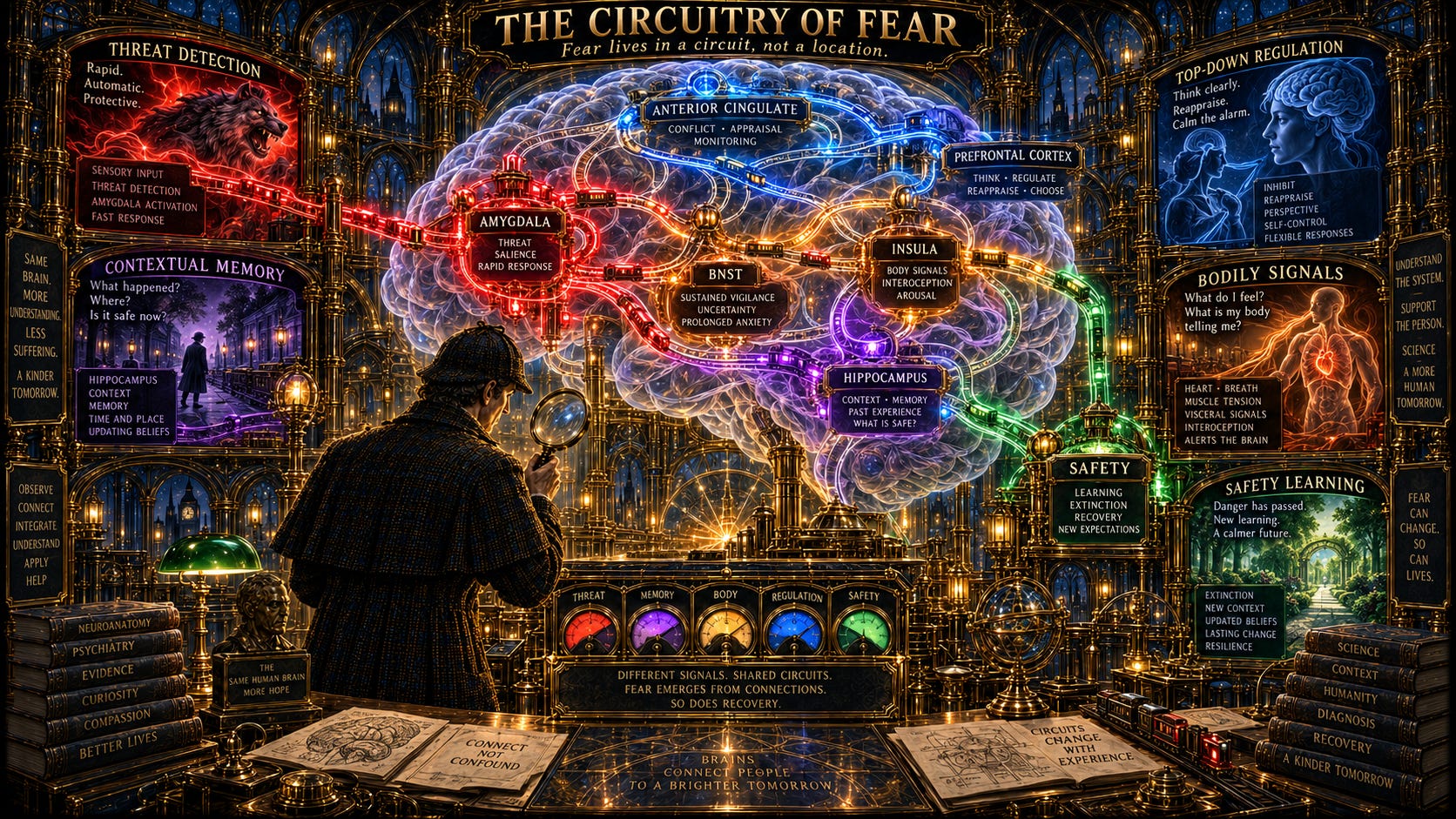
PSYCH 121: Anxiety Disorders - Neuroimaging and Neuroanatomical Circuits
Medlock Holmes enters the Grand Neuroanatomical Theatre of Fear.At the centre hangs an enormous transparent brain.The amygdala glows brightly.But Holmes does not stop there.Around it are the hippocampus.The medial and orbital prefrontal cortex.The anterior cingulate cortex.The insula.The thalamus.The hypothalamus.The bed nucleus of the stria terminalis.The periaqueductal grey.The locus coeruleus.S
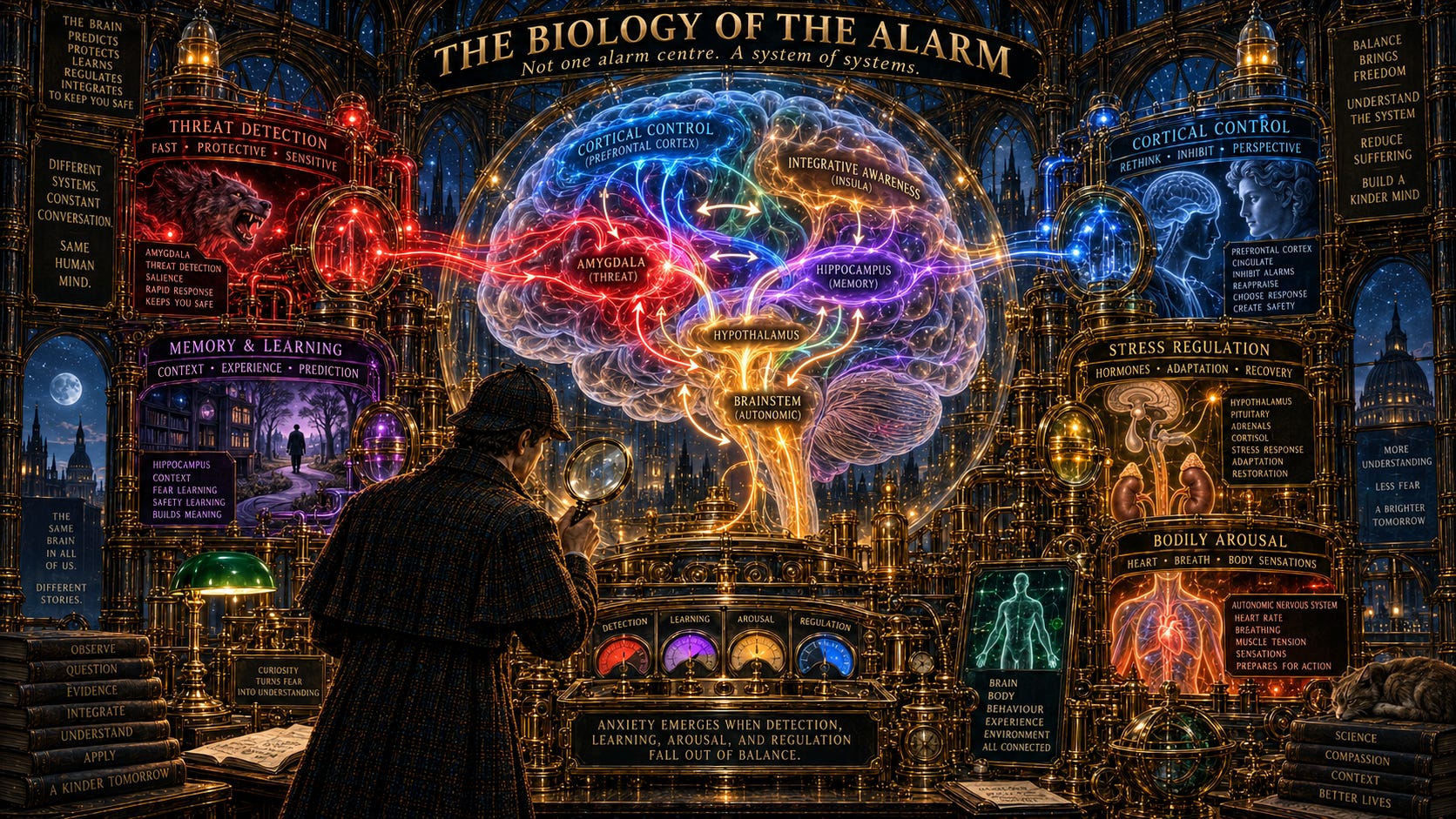
PSYCH 120: Anxiety Disorders - Neurobiology and Neuroscience
Medlock Holmes enters the Neurobiological Citadel of Fear.At its centre stands an enormous transparent brain.It is not silent.Signals move constantly between the amygdala, hippocampus, prefrontal cortex, thalamus, hypothalamus, locus coeruleus, and brainstem.Some pathways detect threat.Others generate autonomic responses.Others encode memories.Others decide whether a stimulus is dangerous.Others d

PSYCH 119: Anxiety Disorders - Epidemiology
Medlock Holmes enters the Global Atlas of Anxiety.At the centre floats an enormous illuminated globe.Every continent is marked.Every age group is represented.And across the map, the same message appears:Anxiety disorders are everywhere.Epidemiology asks more than how many people are affected.It asks:Who develops anxiety?When does it begin?Which disorders persist?What travels with them?Which people
PSYCH 118: Anxiety Disorders - Clinical Features
Medlock Holmes enters the Grand Gallery of Anxious Minds.At the entrance, every patient appears to have the same complaint:“I am anxious.”But Holmes knows that this is only the beginning of the investigation.Anxiety is found across psychiatry.The diagnosis depends not simply on the presence of fear, but on what is feared, when it occurs, what the person predicts will happen, and what they do to pr
PSYCH 117: Anxiety Disorders - Introduction and Overview
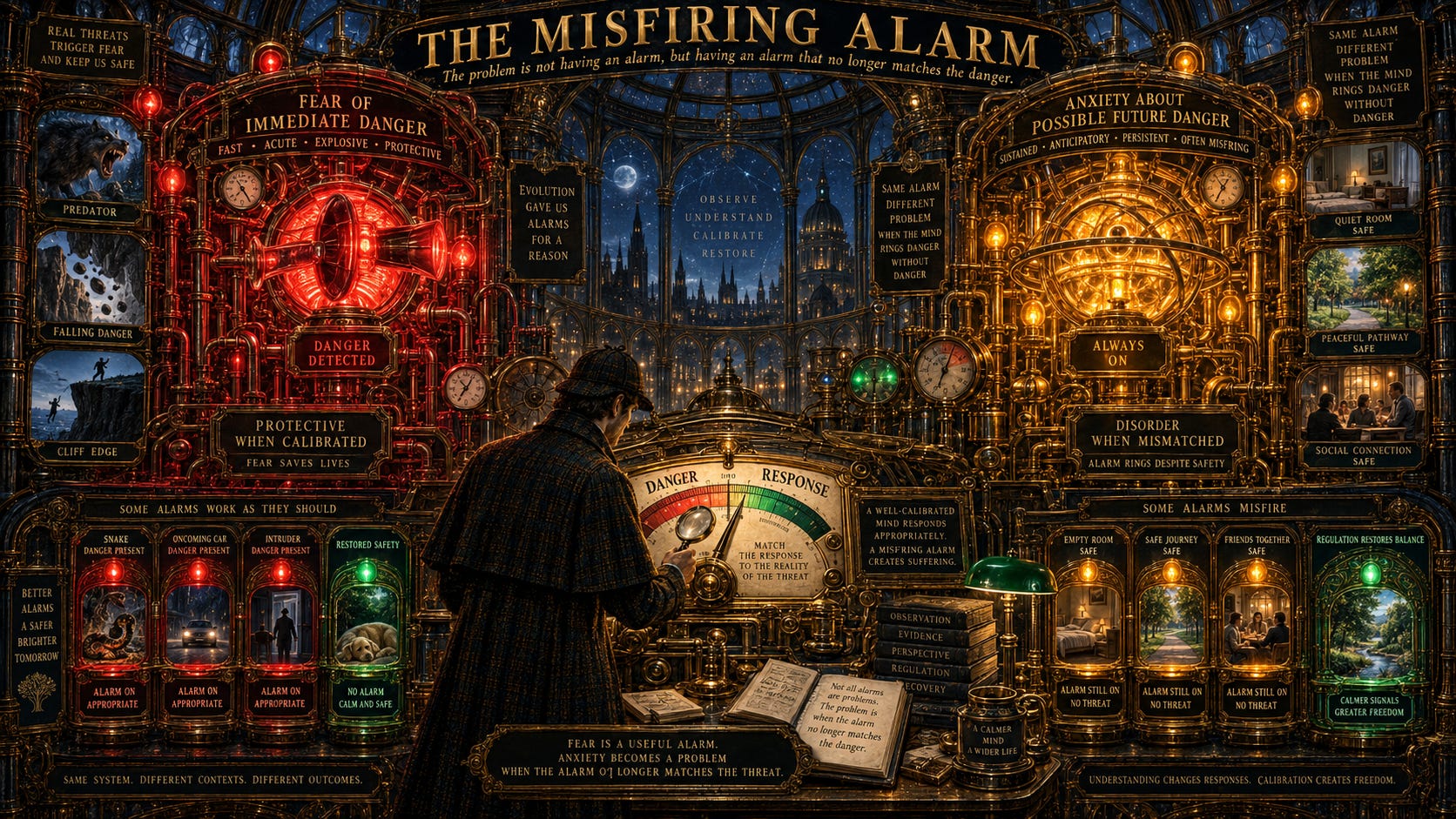
Medlock Holmes enters the Grand Observatory of Fear and Anxiety.At the centre stand two enormous warning systems.One is labelled:FEARThe other:ANXIETYAt first they appear identical.Both activate the body.Both sharpen attention.Both pull behaviour towards avoidance.Both exist to protect the organism from harm.But Holmes quickly sees the difference.Fear is immediate.A threat is here.A predator appea
PSYCH 116: Mood Disorders - Neurobiology
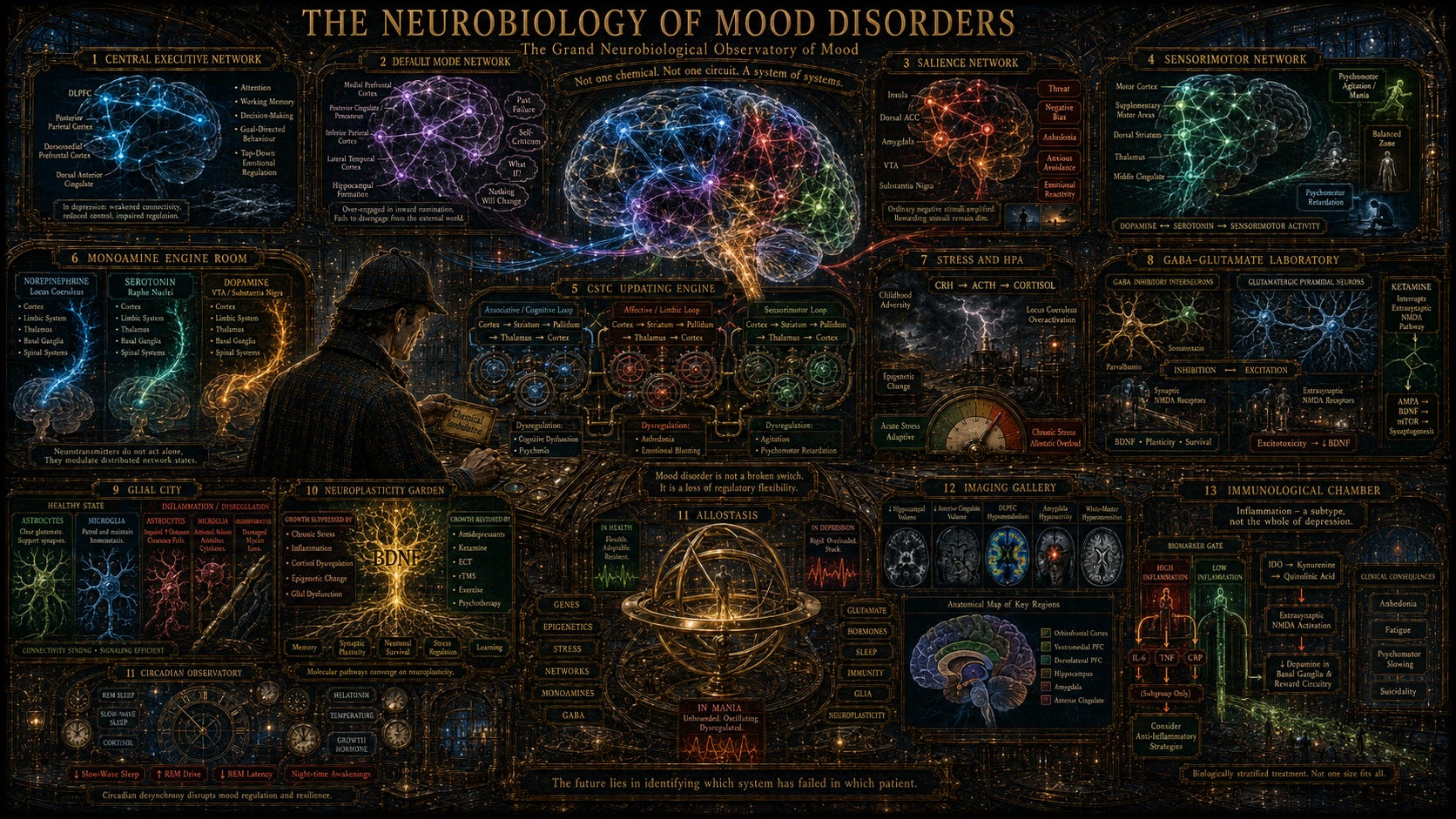
Medlock Holmes enters the Grand Neurobiological Observatory of Mood.At its centre is not one brain map, but an enormous interconnected city of systems.One district controls attention and executive function.Another processes salience and threat.Another turns inward towards memory, self-reflection, and rumination.Another regulates movement.Another tracks reward and motivation.Above them all, stress
PSYCH 114: Mood Disorders - Pharmacologic Treatment of Depression and Bipolar Disorders
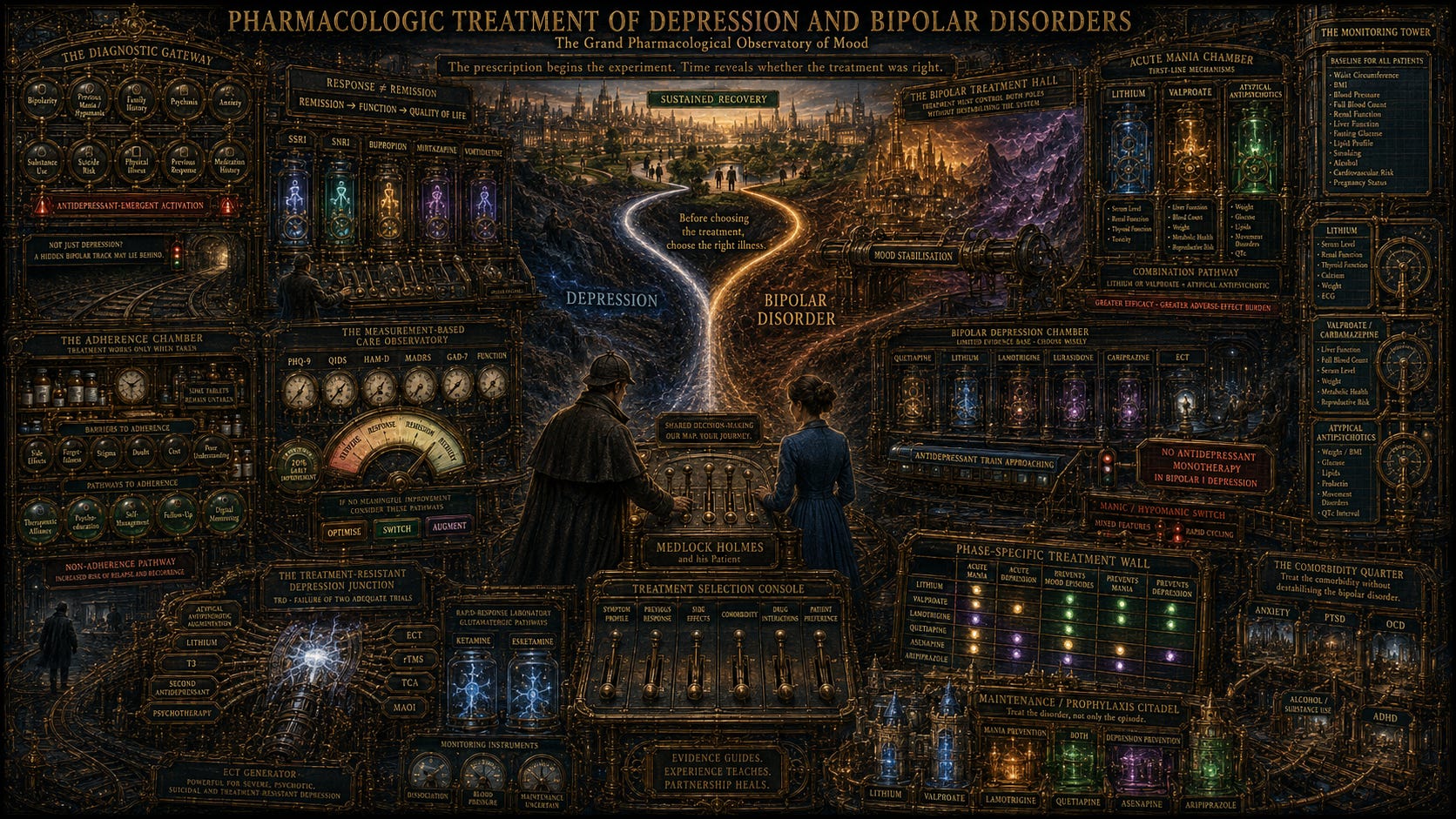
Medlock Holmes enters the Grand Pharmacological Observatory of Mood.At its centre stands an enormous control table.Two major pathways emerge from it.One is labelled:MAJOR DEPRESSIVE DISORDERThe other:BIPOLAR DISORDERAt first, the pathways appear similar.Both contain depression.Both contain impaired function.Both may involve suicidality, anxiety, sleep disturbance, and psychotic features.But Holmes
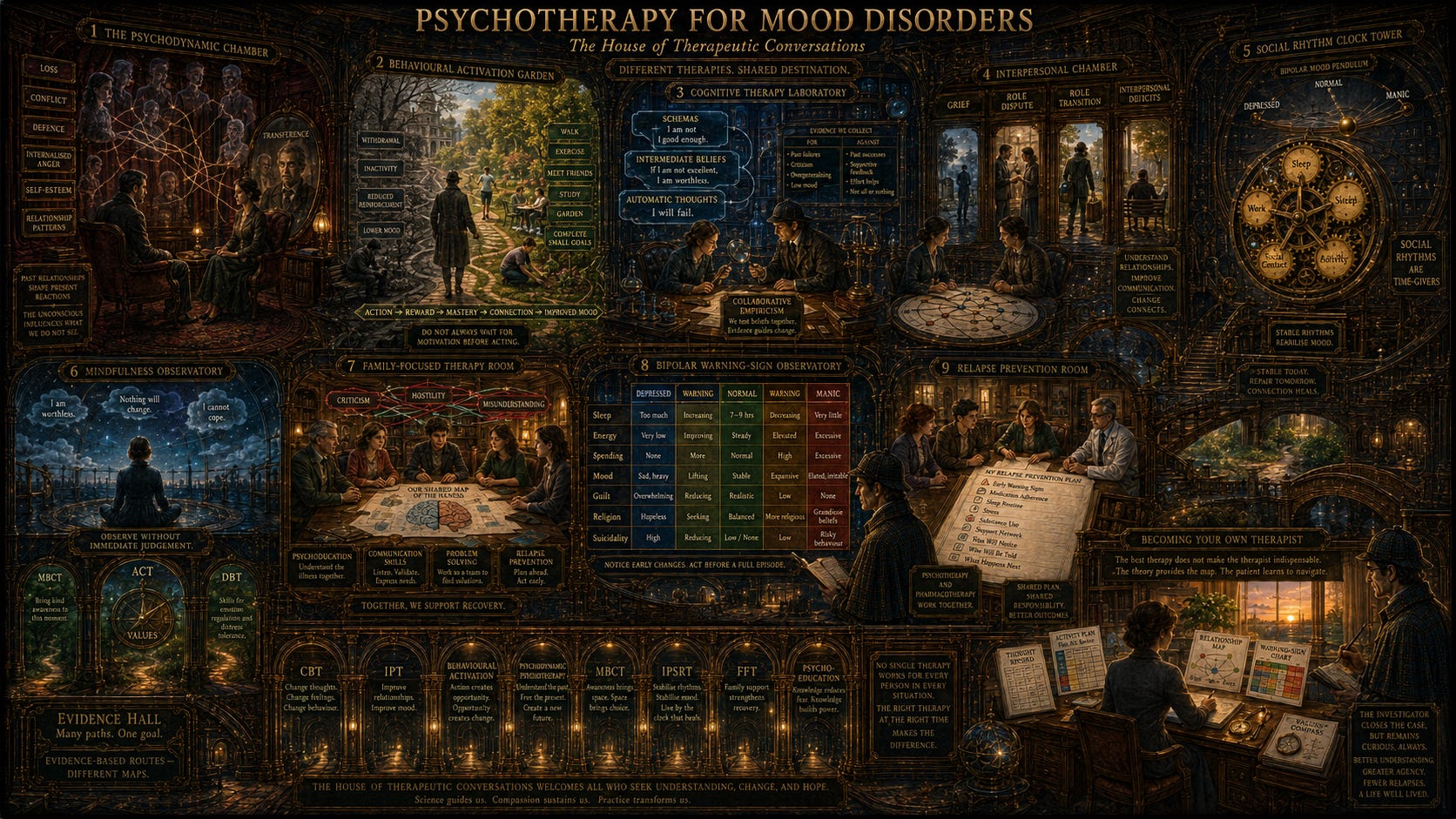
PSYCH 115: Mood Disorders - Psychotherapy
Medlock Holmes enters the House of Therapeutic Conversations.Unlike the pharmacological observatory, there are no bottles, serum levels, or receptor maps here.Instead, there are rooms.Each room represents a different way of understanding and changing mood disorder.One contains memories, conflicts, and unresolved relationships.Another contains automatic thoughts and deeply held beliefs.Another cont
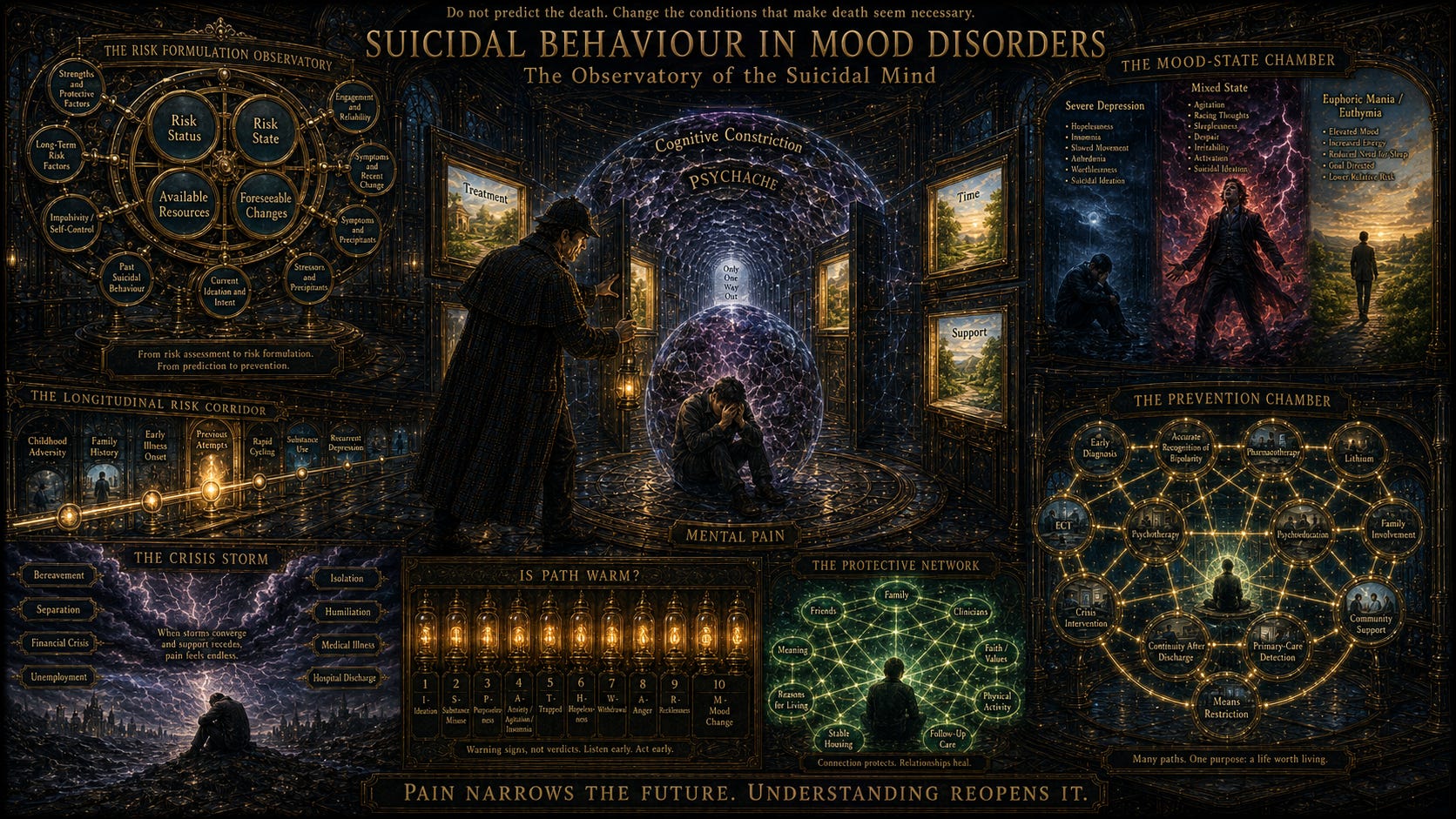
PSYCH 113: Mood Disorders - Suicidal Behaviou
Medlock Holmes enters the Observatory of the Suicidal Mind.At first, the room appears to contain a familiar psychiatric chart:Depression → Suicide RiskHolmes immediately rejects it.The relationship is far more complex.Mood disorders are among the strongest contributors to suicidal behaviour, but most people with depression do not die by suicide, and suicidal crises can occur outside formal diagnos
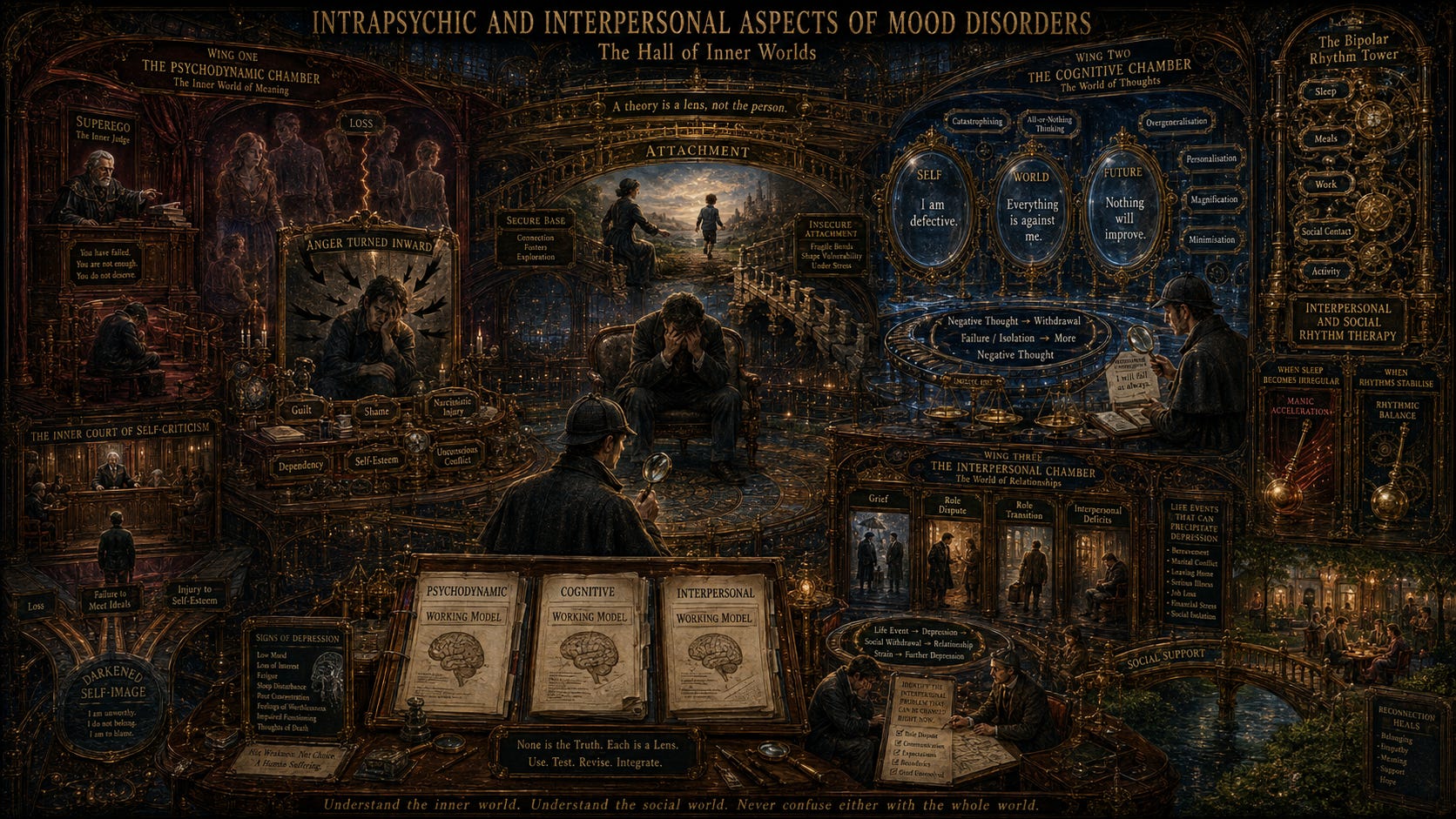
PSYCH 112: Mood Disorders - Intrapsychic and Interpersonal Aspects
Medlock Holmes enters the Hall of Inner Worlds, where three different investigative rooms attempt to explain the same depressed patient.The first is the Psychodynamic Chamber.Here, the focus is on what lies beneath conscious experience: loss, unconscious conflict, guilt, anger turned inward, injured self-esteem, and the enduring influence of early relationships.Freud’s classic account of melanchol
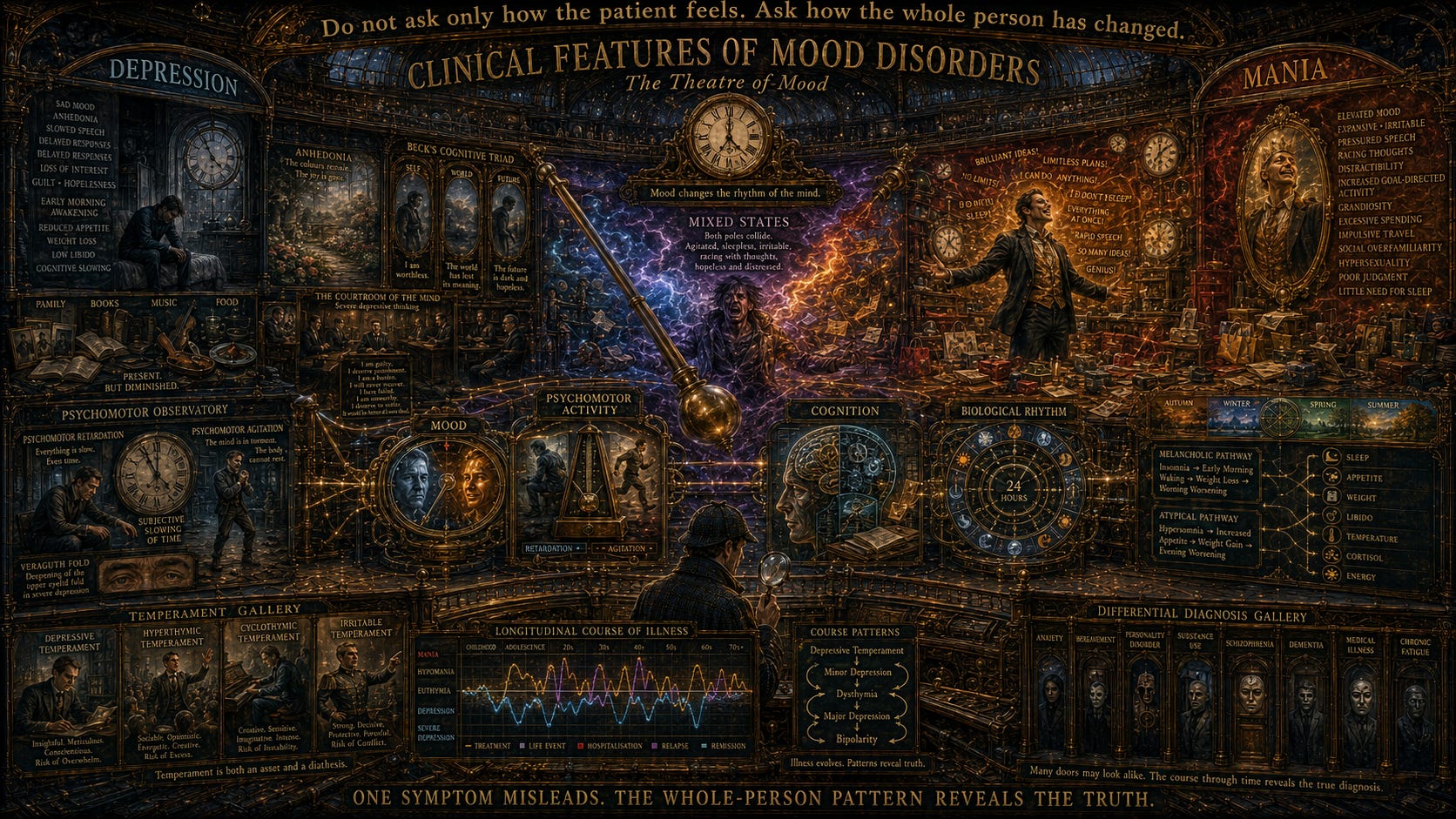
PSYCH 111: Mood Disorders - Clinical Features
Medlock Holmes enters the Theatre of Mood.At first, the stage appears simple.One side is darkened by depression.The other glows with mania.But as the lights rise, Holmes realises that mood is only one part of the performance.Behind every emotional state lies an entire orchestra of change.Movement slows or accelerates.Sleep contracts or expands.Appetite disappears or increases.Thought becomes const
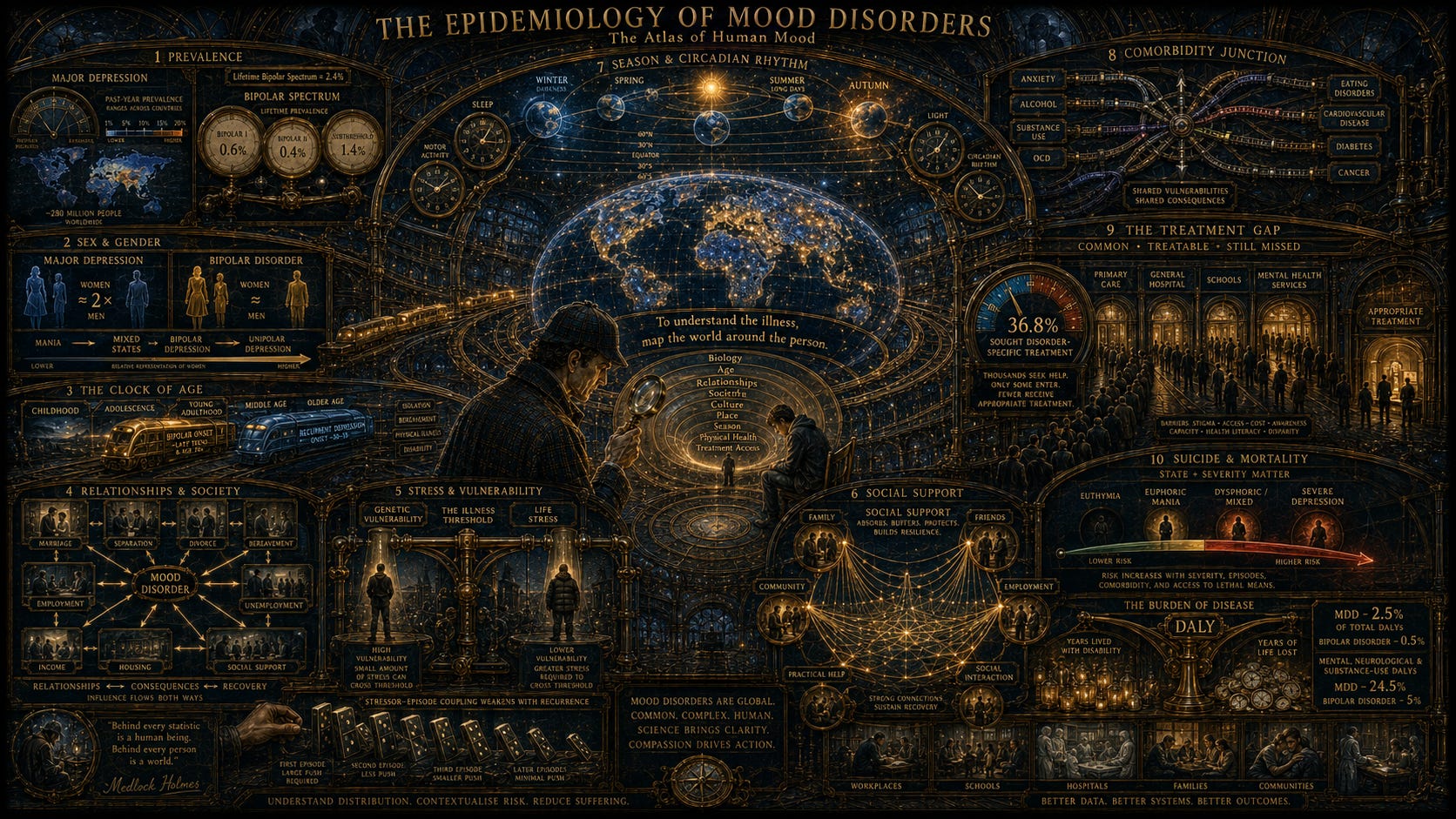
PSYCH 110: Mood Disorders - Epidemiology
Medlock Holmes enters the Atlas of Human Mood.It is an extraordinary observatory.Suspended at its centre is an enormous illuminated globe. Across every continent, thousands of small lights pulse between blue and gold.Blue represents depression.Gold represents mania and hypomania.But the lights are not distributed randomly.Holmes notices patterns.They cluster differently according to sex.Age.Social
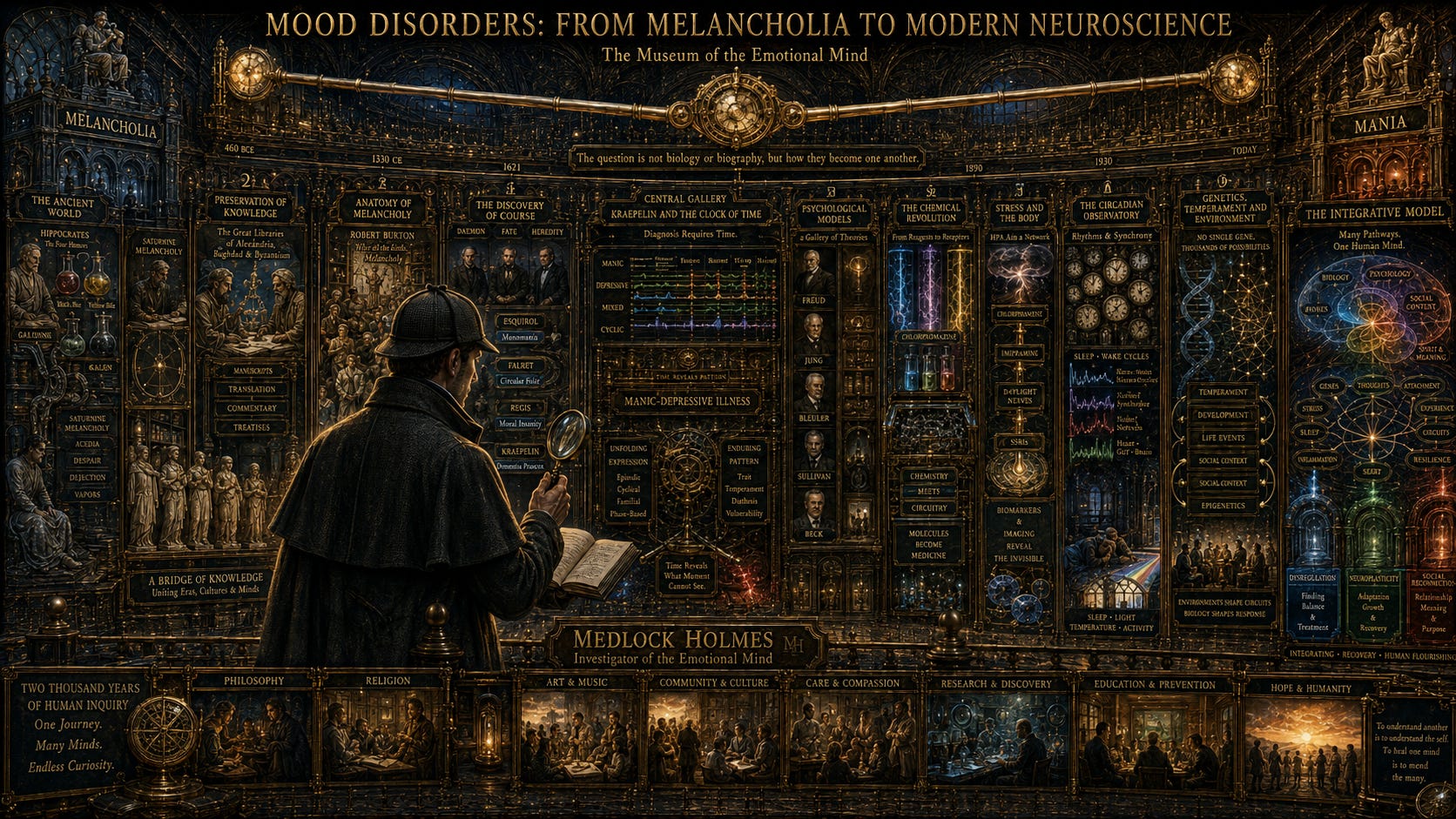
PSYCH 109: Mood Disorders - Historical Introduction and Conceptual Overview
Medlock Holmes enters the Great Museum of the Emotional Mind.It is unlike any museum he has visited before.Instead of paintings, its galleries contain theories.Instead of fossils, there are abandoned explanations of human suffering.And running through the centre of the building is an enormous pendulum.At one extreme is engraved:MELANCHOLIAAt the other:MANIAThe pendulum has been swinging for more t
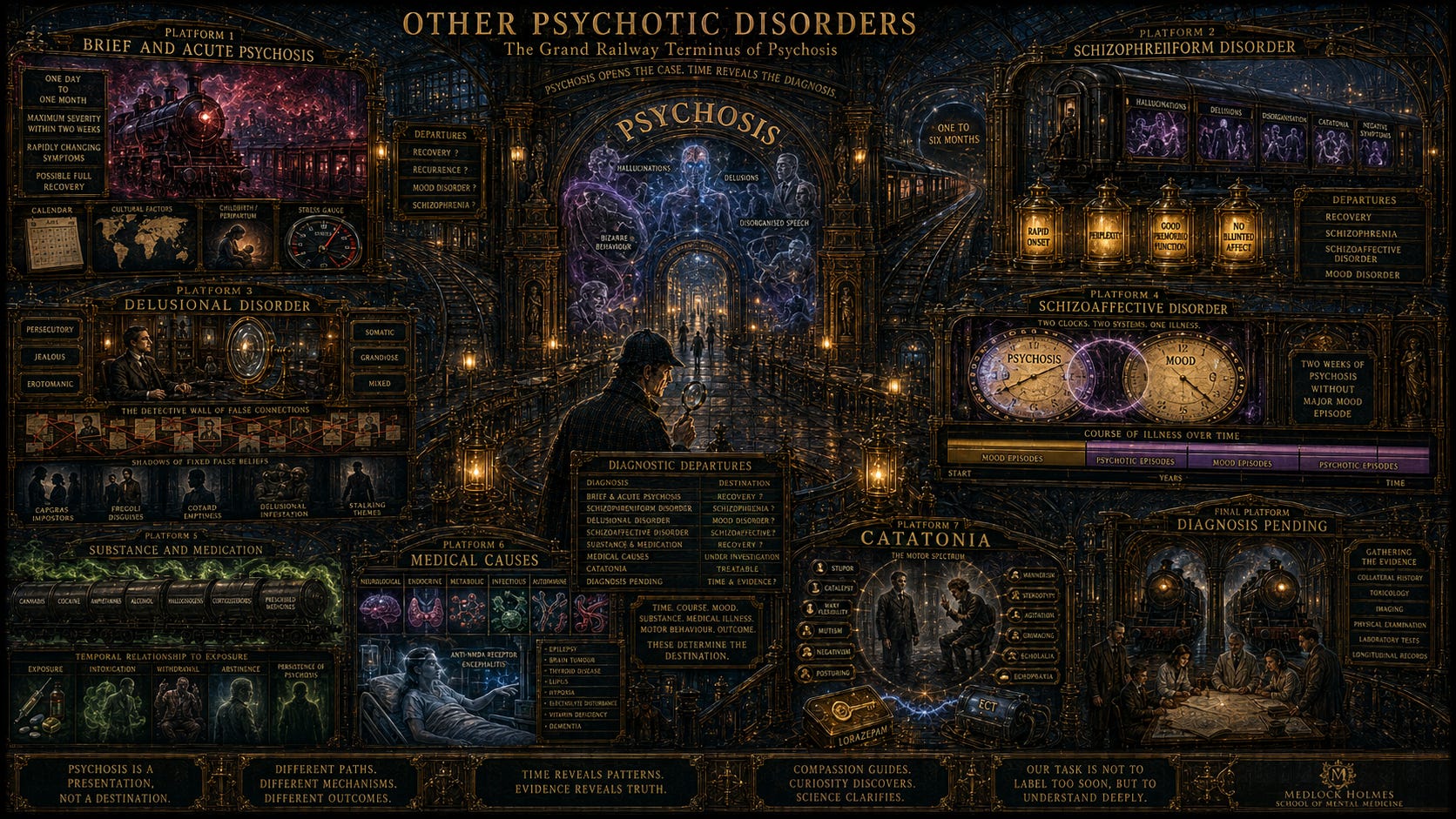
PSYCH 108: Other Psychotic Disorders
Medlock Holmes enters the Grand Railway Terminus of Psychosis.Every platform begins in the same central hall.A patient may arrive with hallucinations.Another with delusions.Another with disorganised speech, bizarre behaviour, perplexity, agitation, or catatonic stillness.At first glance, all appear to be travelling towards the same destination.But the departures board tells a different story.Some
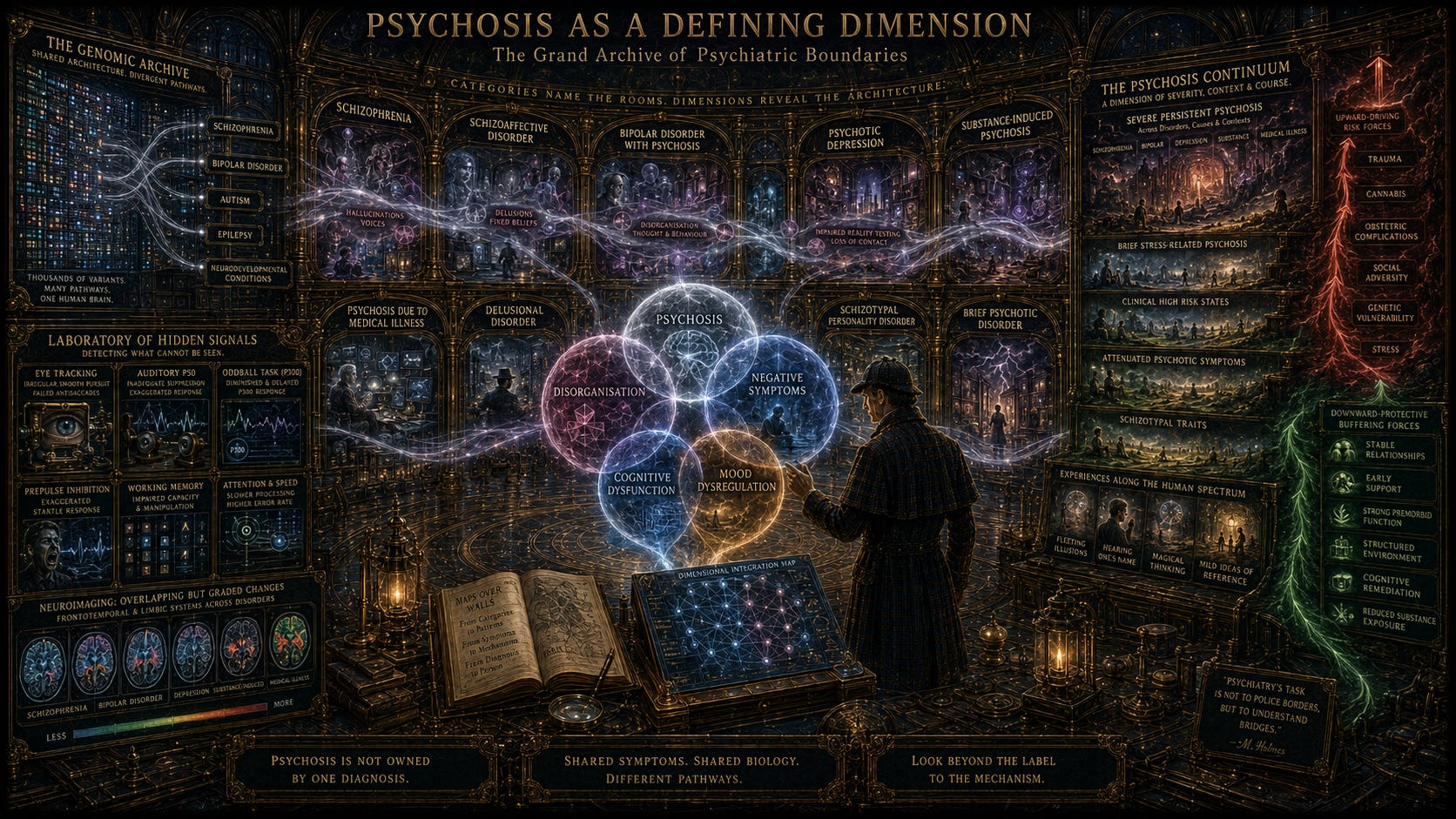
PSYCH 107: Psychosis as a Defining Dimension in Schizophrenia
Medlock Holmes enters the Grand Archive of Psychiatric Boundaries.The building is divided into rigid rooms.One is labelled Schizophrenia.Another Bipolar Disorder.Another Psychotic Depression.Beyond them lie chambers for substance-induced psychosis, psychosis caused by medical illness, delusional disorder, schizotypal personality disorder, and brief psychotic states.Each room appears separate.Yet f
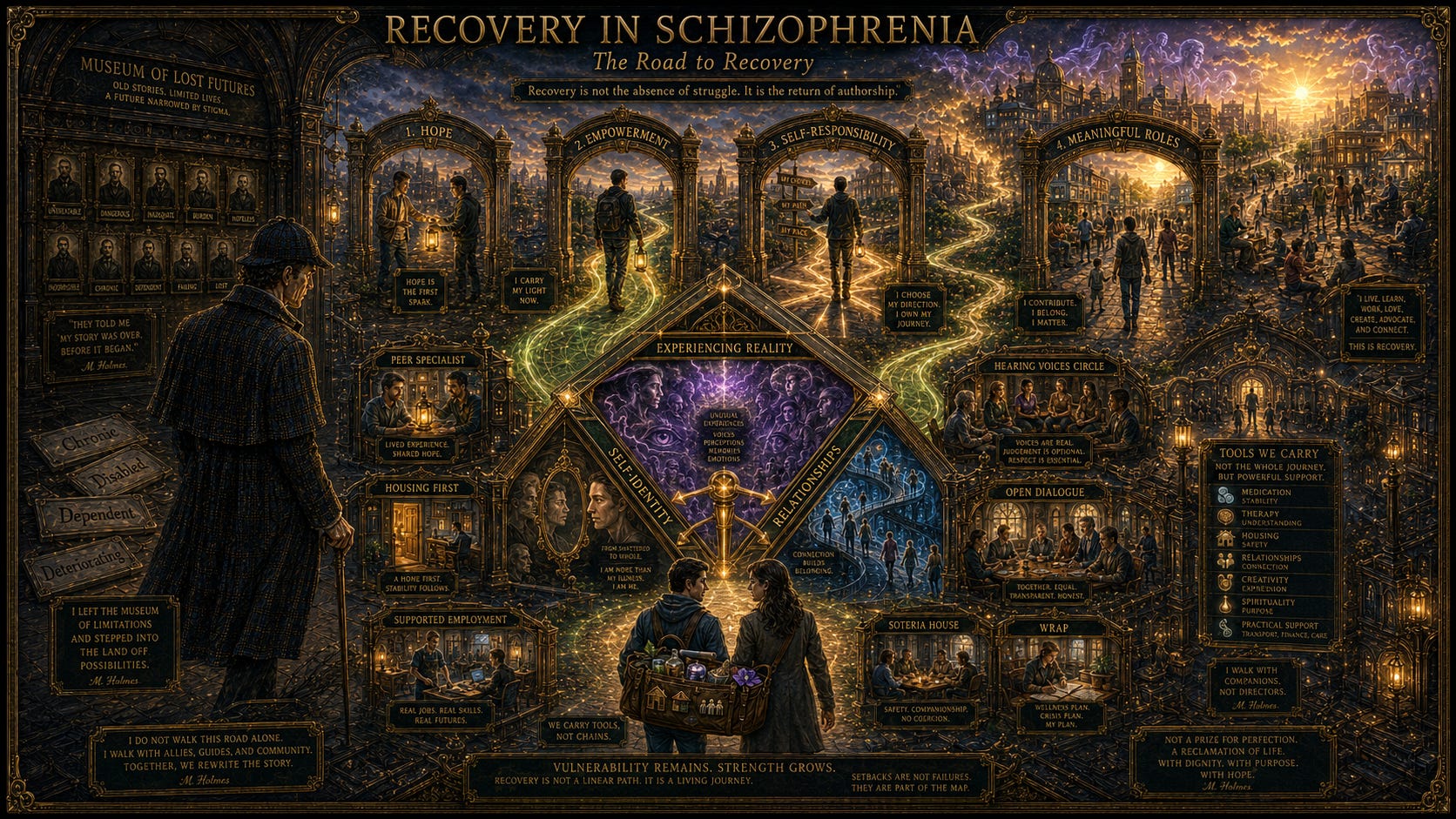
PSYCH 106: Recovery in Schizophrenia
Medlock Holmes enters the Museum of Lost Futures.The walls are lined with portraits of people diagnosed with schizophrenia. Beneath each portrait is the same inscription:Chronic. Disabled. Dependent.The museum presents these outcomes as inevitable.Holmes is immediately suspicious.He opens the historical ledgers and discovers that long-term studies tell a different story. Many people diagnosed with
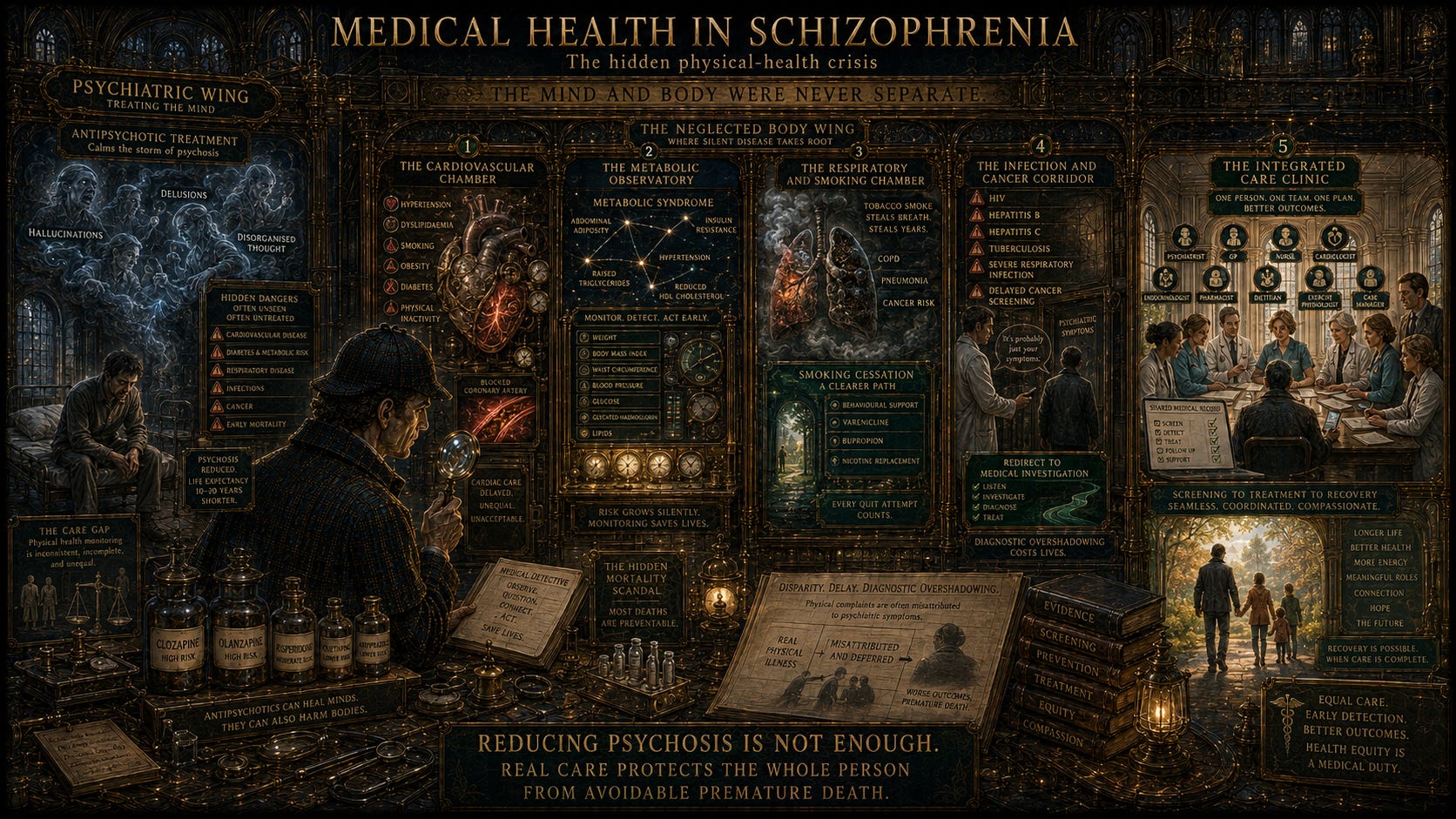
PSYCH 105: Medical Health in Schizophrenia
Medlock Holmes is called to investigate a disturbing pattern.The records appear unrelated.A man with schizophrenia dies from a myocardial infarction in his fifties.A woman develops diabetes that remains undetected for years.Another patient is repeatedly treated for anxiety while an underlying respiratory illness worsens.Someone else survives psychosis but dies from a preventable infection.Holmes s
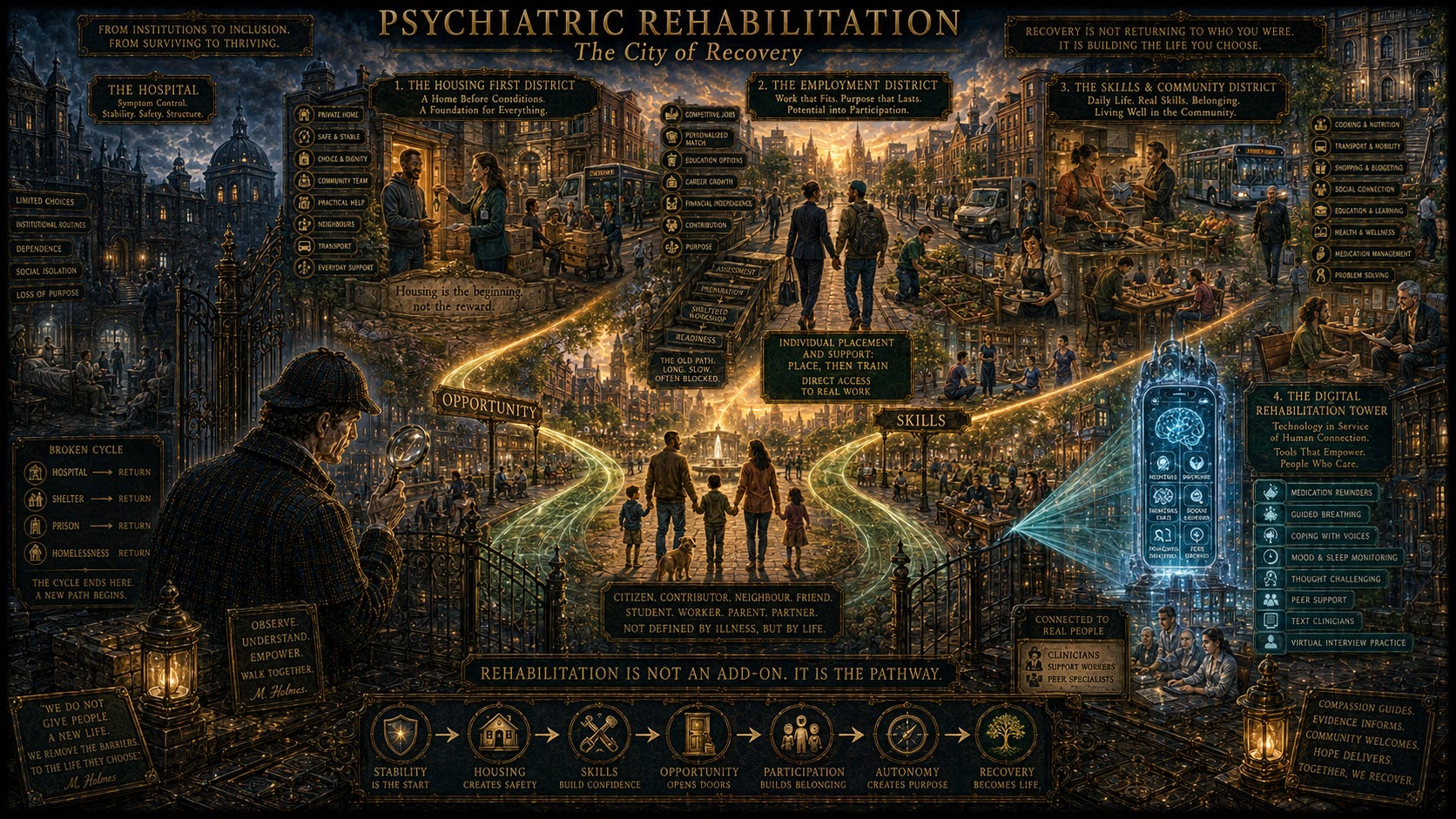
PSYCH 104: Psychiatric Rehabilitation in Schizophrenia
Medlock Holmes enters a psychiatric hospital expecting to find the next mystery inside the consulting room.Instead, the patient is waiting at the front gate.His hallucinations have improved.His delusions are less intense.His medication is stable.Yet he has nowhere secure to live, no employment, few relationships, and no meaningful reason to wake each morning.The treatment has reduced the illness.I
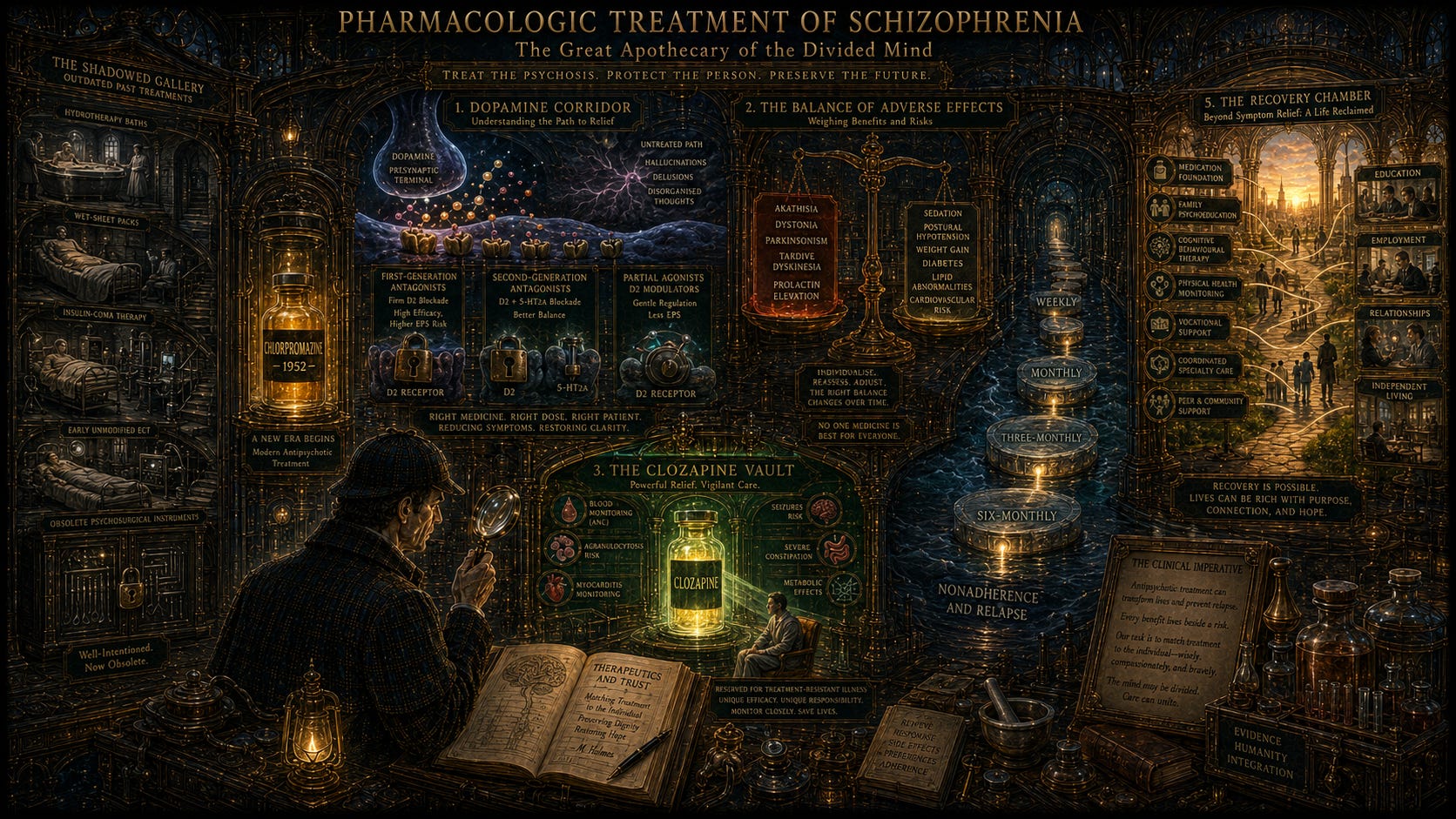
PSYCH 103: Pharmacologic Treatment of Schizophrenia
Medlock Holmes enters the Great Apothecary of the Divided Mind.The chamber is vast.Along one wall stand the abandoned instruments of psychiatric history: wet-sheet packs, insulin syringes, barbiturate sleep chambers, convulsive machines, and the cold steel apparatus of prefrontal lobotomy.Each represents an era in which clinicians tried to calm psychosis without understanding how to treat it.Then
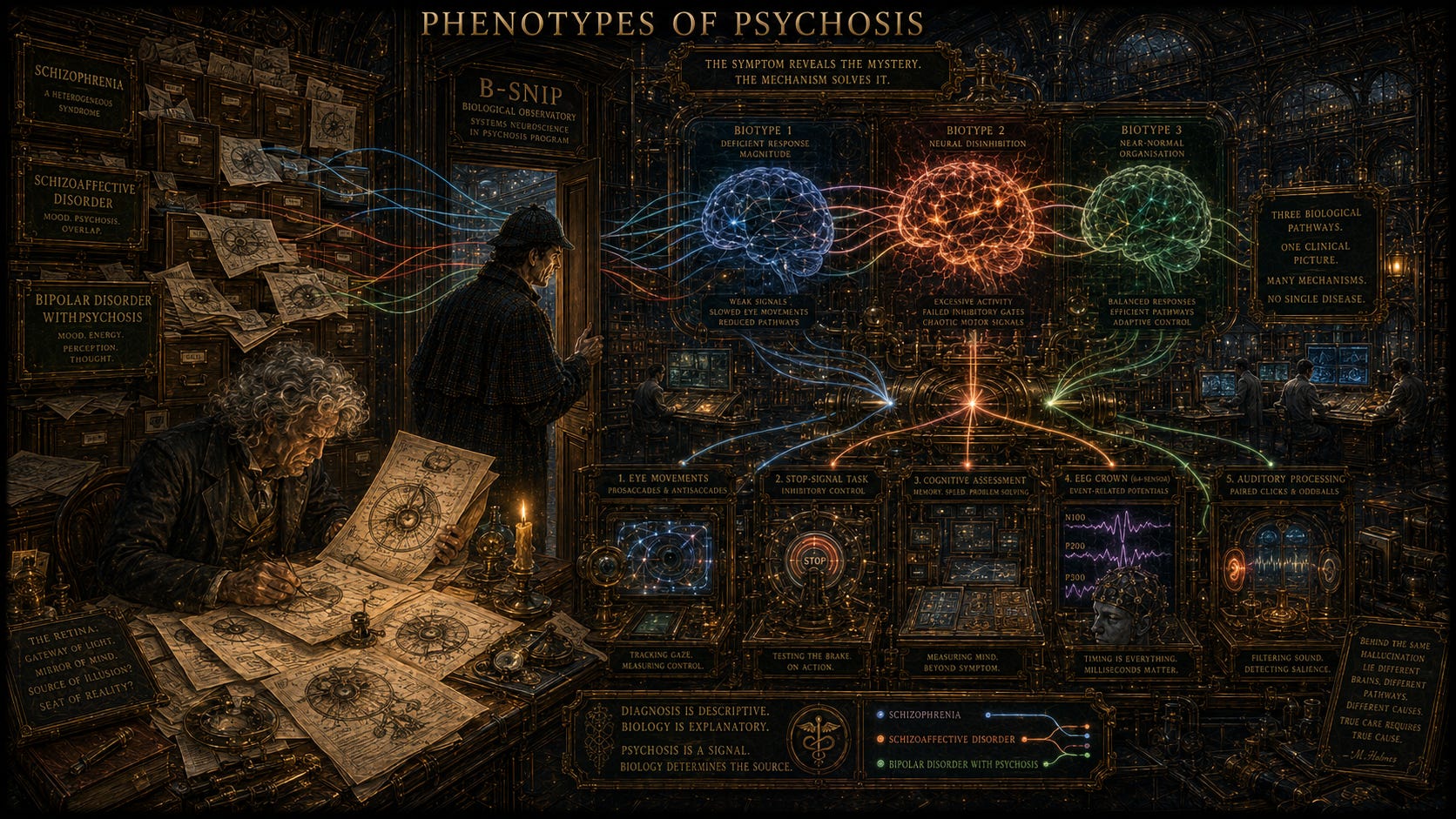
PSYCH 102: Phenotypes of Psychosis
Medlock Holmes is summoned to a locked psychiatric ward to meet an extraordinary patient.The man was once a distinguished professor of anatomy: intellectually formidable, artistically gifted, and professionally successful. Long after the age at which schizophrenia usually appears, he developed relentless visual hallucinations and an elaborate belief that the source of psychosis lay within the huma
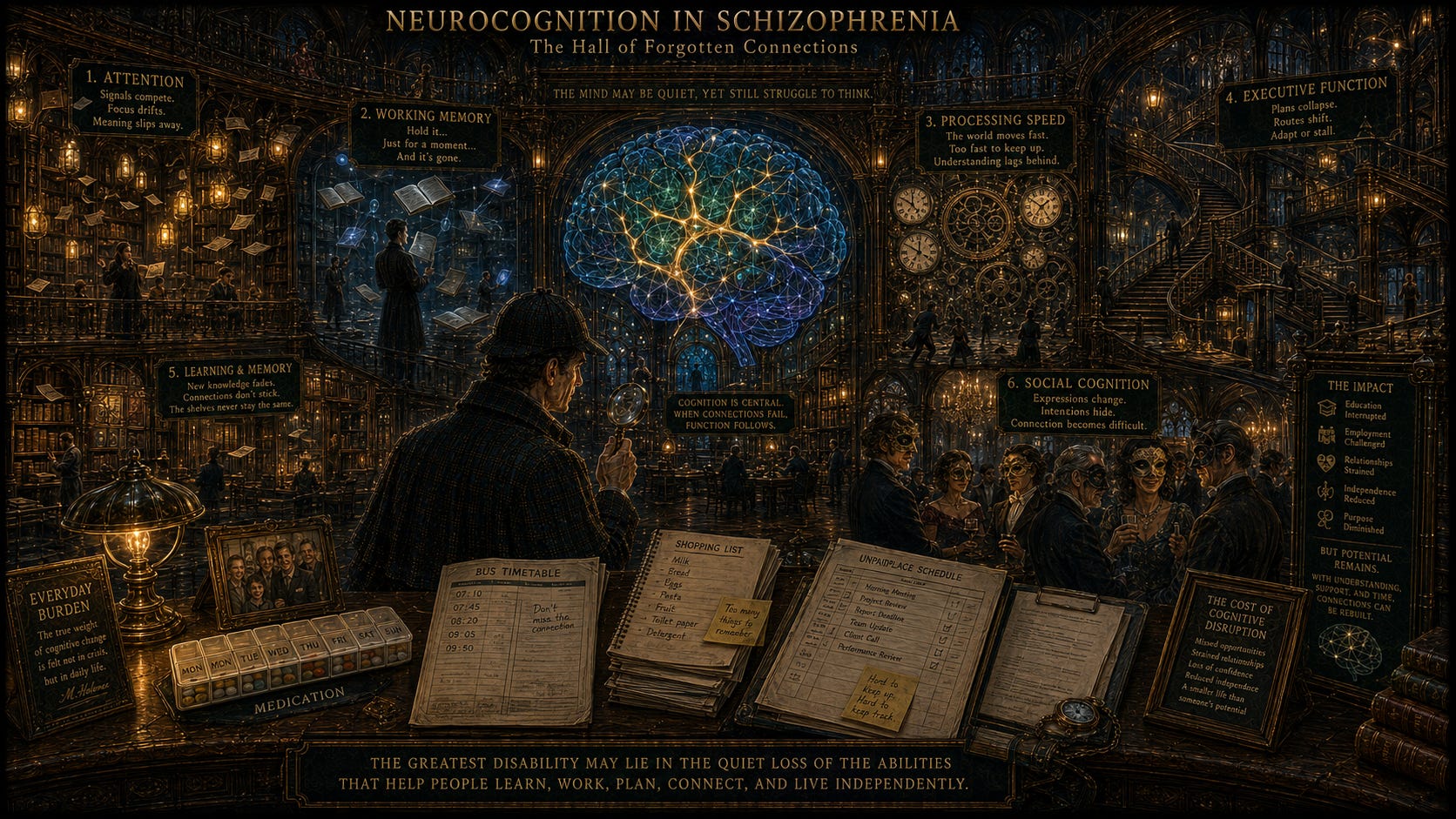
PSYCH 101: Neurocognition in Schizophrenia
Medlock Holmes arrives at what appears to be the simplest of all investigations.A patient is sitting quietly in an elegant Victorian library.No voices.No delusions.No obvious distress.To every casual observer, the illness seems well controlled.Yet something is wrong.The patient repeatedly loses track of conversations.Simple instructions must be repeated.Bills remain unpaid.Appointments are forgott
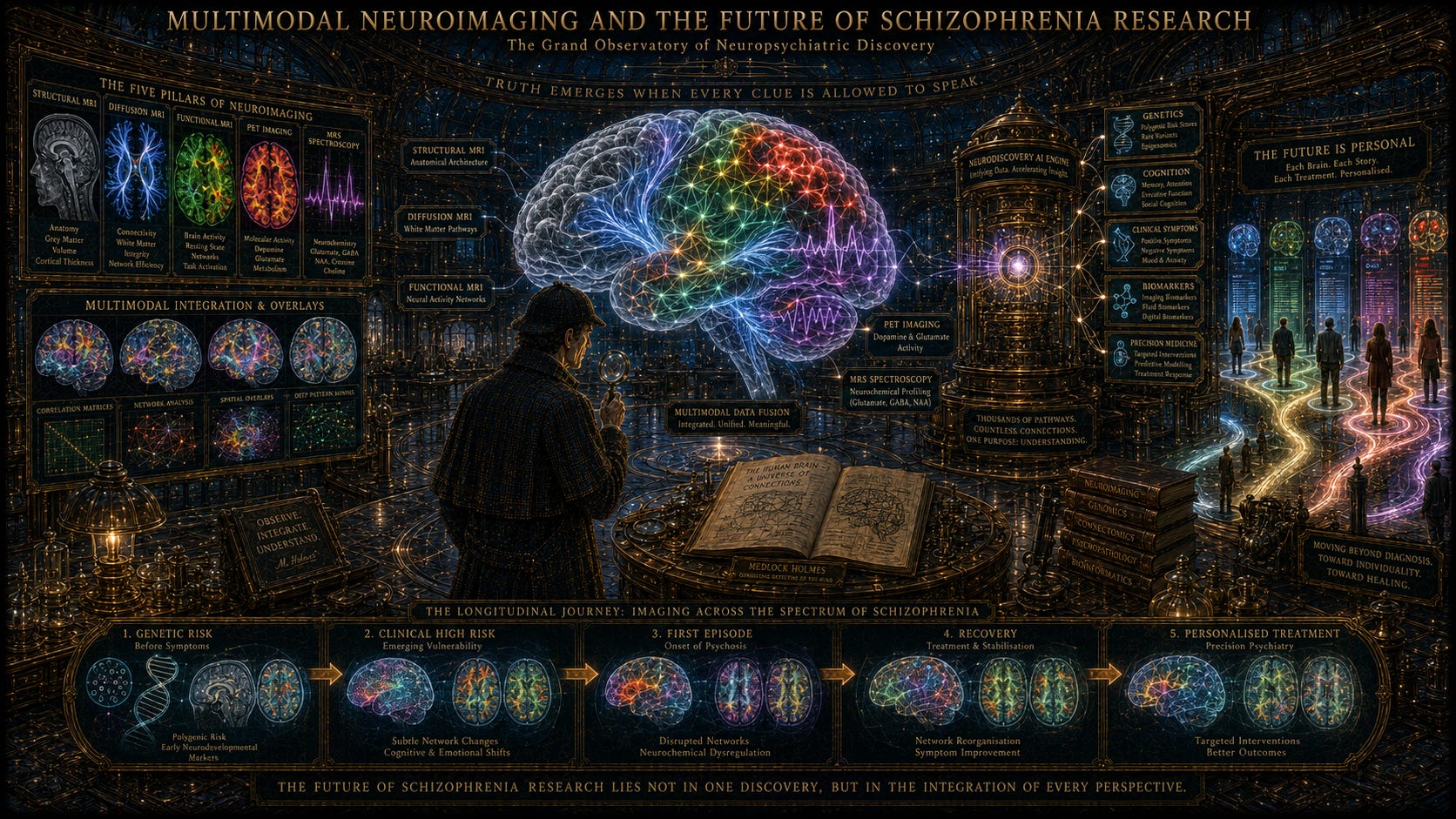
PSYCH 100: Multimodal Neuroimaging and the Future of Schizophrenia Research
Medlock Holmes stands before the final chamber of the Neuroimaging Institute.Around him are the tools he has mastered throughout his investigation.MRI reveals the brain’s architecture.Diffusion imaging maps its white matter highways.PET uncovers its chemistry.Magnetic resonance spectroscopy measures its metabolites.Functional MRI watches neural networks come alive.Each technique has solved part of
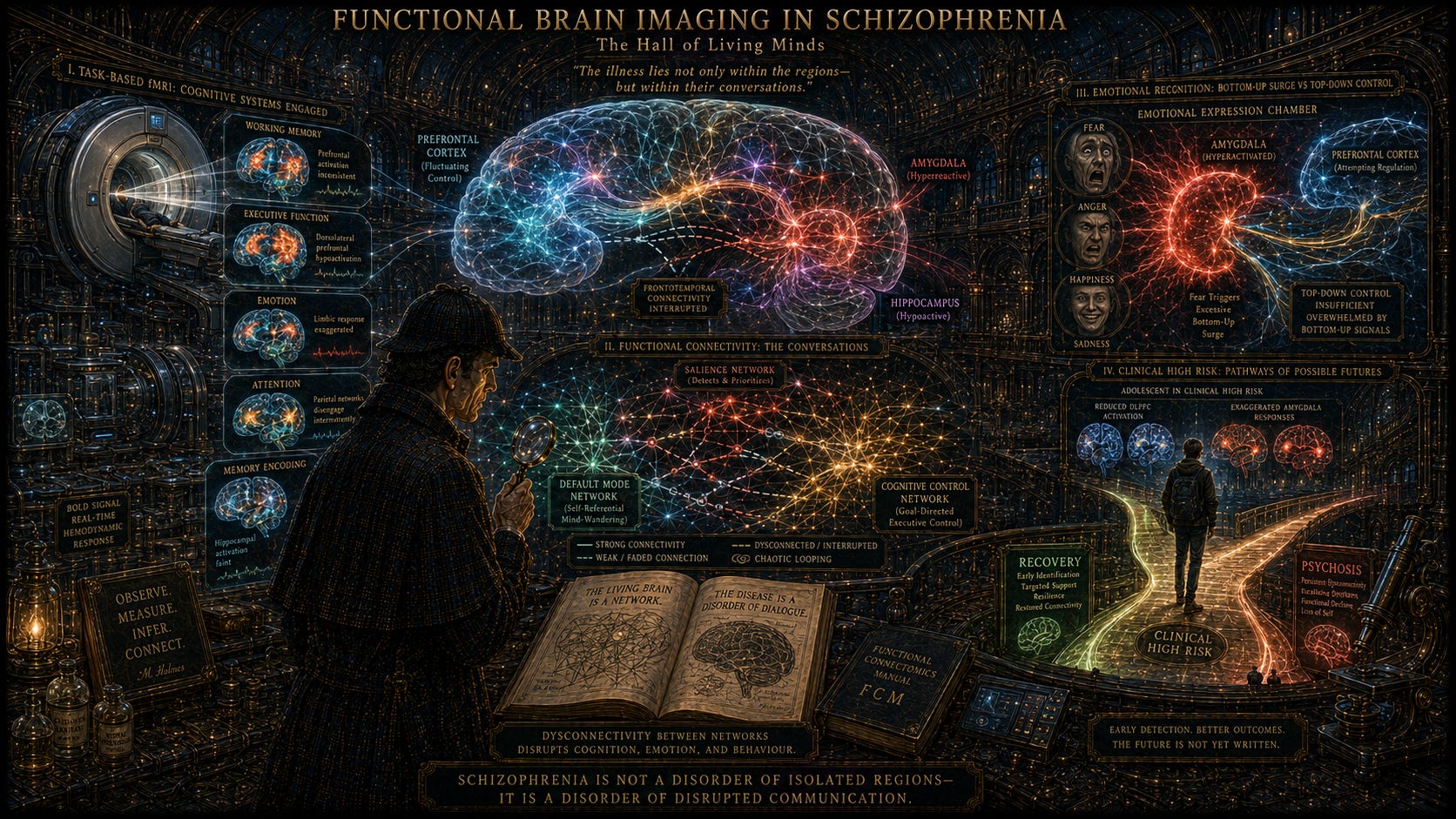
PSYCH 099: Functional Brain Imaging in Schizophrenia
Medlock Holmes enters the Hall of Living Minds.Unlike the museum of structural imaging, nothing here is still. Every wall pulses with colour as thoughts ignite across the cortex. Memory glows, emotion flickers, attention surges, and language races through intricate neural pathways. Holmes is no longer examining anatomy-he is watching the brain at work.His first instrument is functional magnetic re
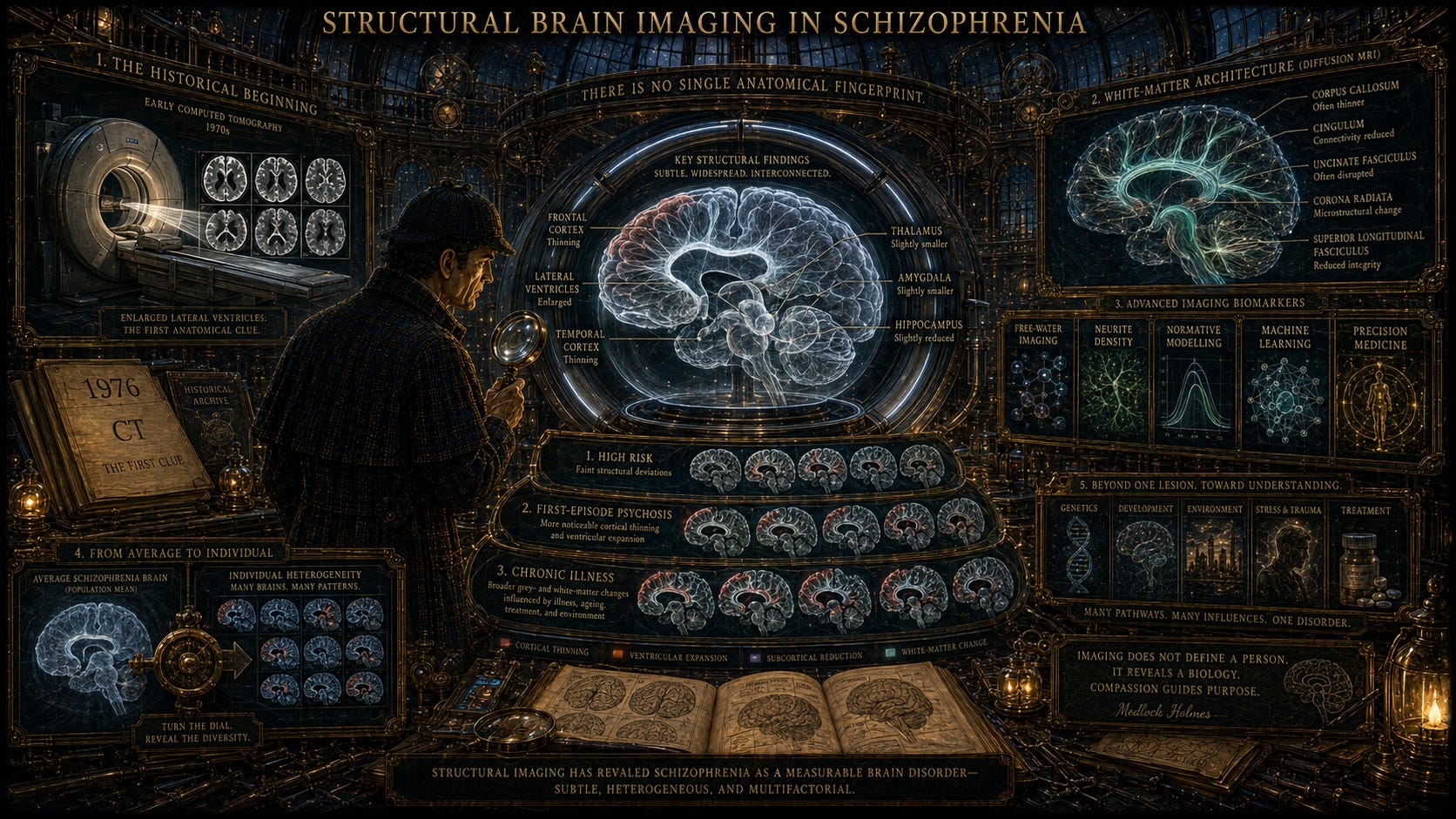
PSYCH 098: Structural Brain Imaging in Schizophrenia
Medlock Holmes enters a vast radiological observatory where the human brain can be examined without ever being opened.The earliest instruments are crude. Old computed tomography images reveal enlarged ventricles-dark chambers within the brain that seem wider in people with schizophrenia. The finding is important, but it is not specific enough to solve the case.Then the observatory changes.Magnetic
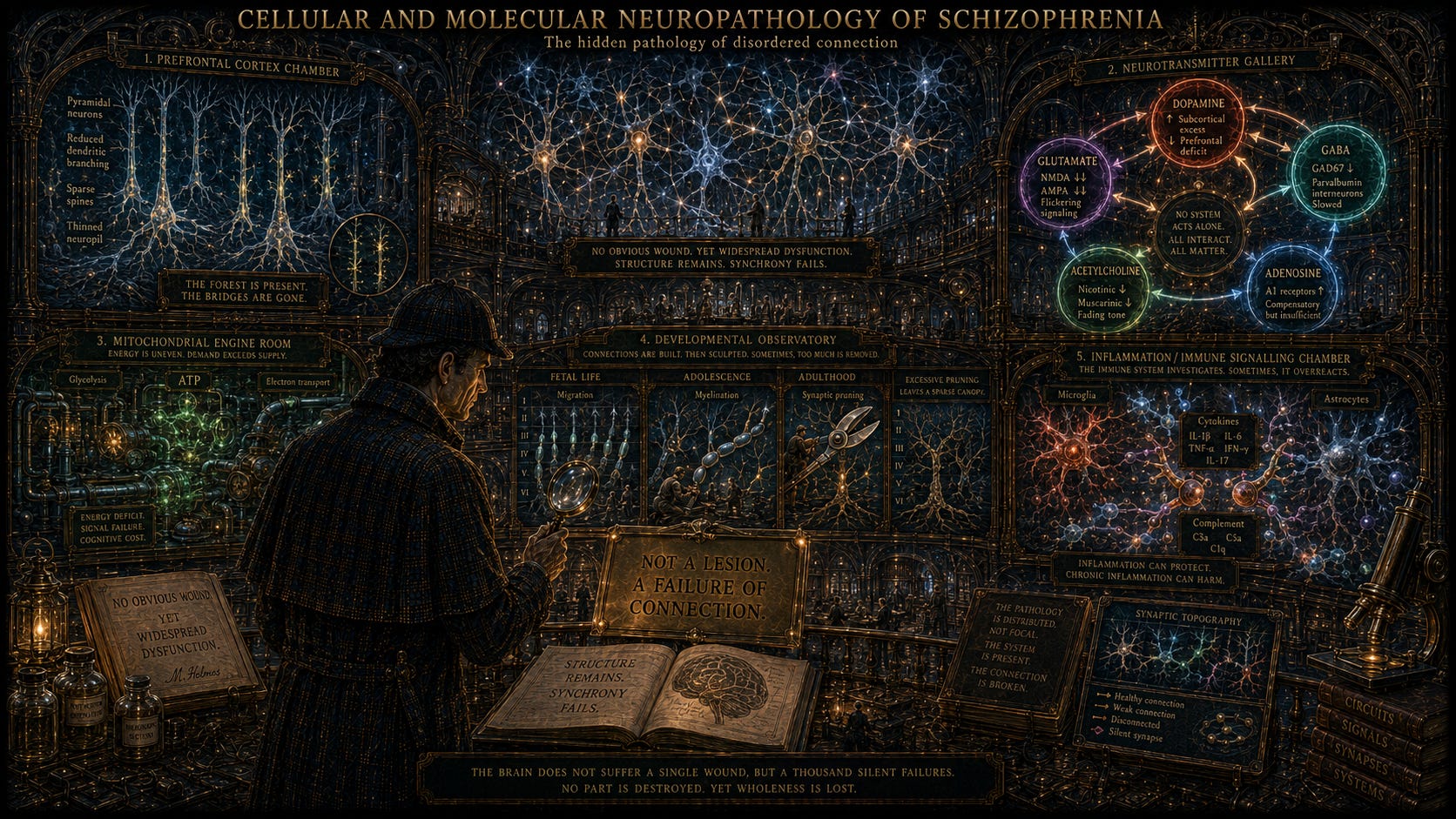
PSYCH 097: Cellular and Molecular Neuropathology of Schizophrenia
Medlock Holmes enters a laboratory containing a brain that appears, at first glance, entirely normal.There is no tumour.No haemorrhage.No obvious area of destruction.Nothing resembling the unmistakable lesions seen in many neurological diseases.Yet Holmes knows that normal appearance does not mean normal function.He begins his investigation at the microscopic level.Within the prefrontal cortex, th
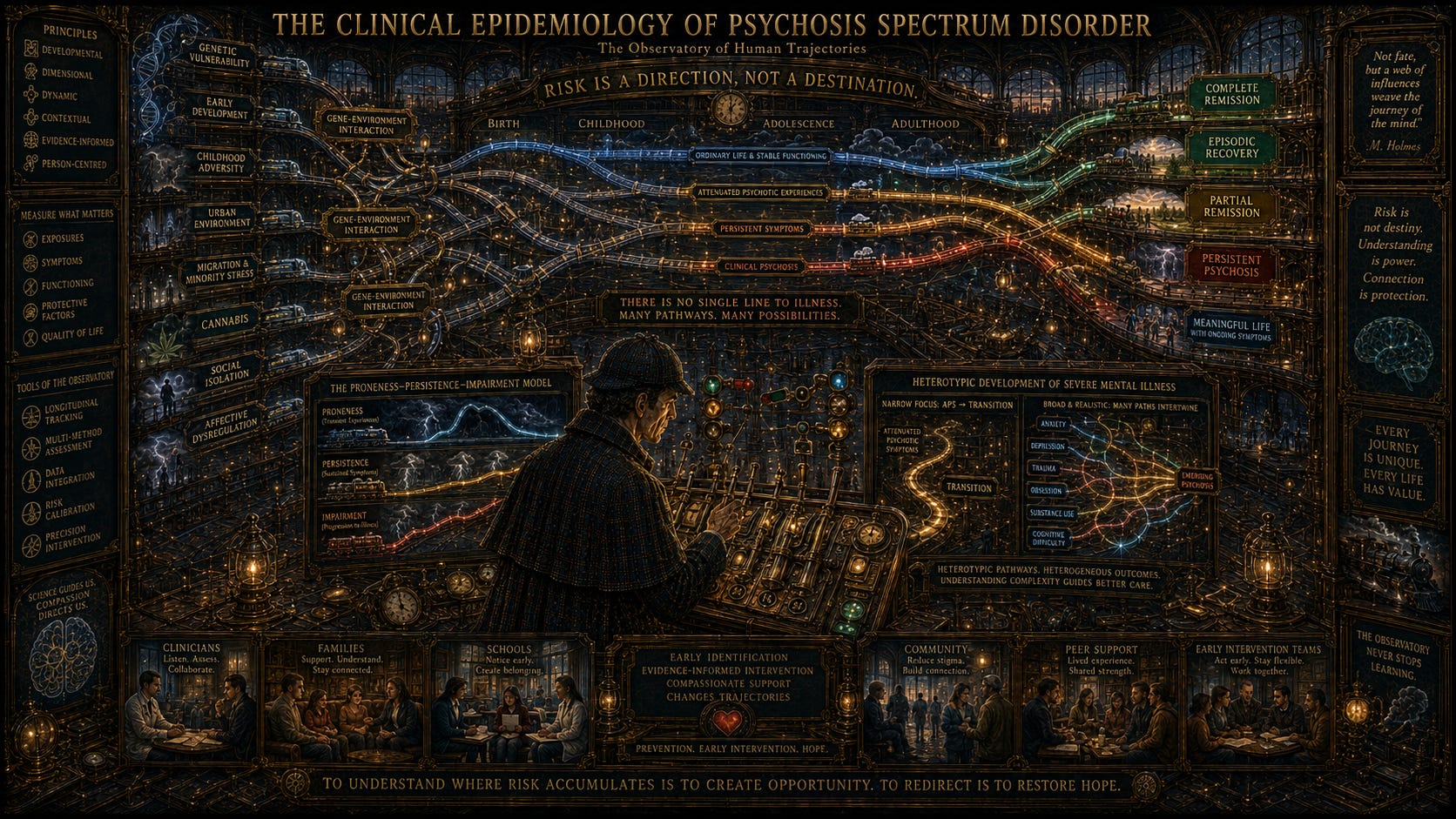
PSYCH 096: The Clinical Epidemiology of Psychosis Spectrum Disorder
Medlock Holmes enters a vast railway control room where thousands of human journeys are represented by illuminated tracks.Some routes remain smooth throughout life.Others begin with subtle diversions: delayed development, social isolation, anxiety, depression, trauma, or unusual perceptual experiences. Most of these tracks eventually return to the main line. A smaller number continue towards persi
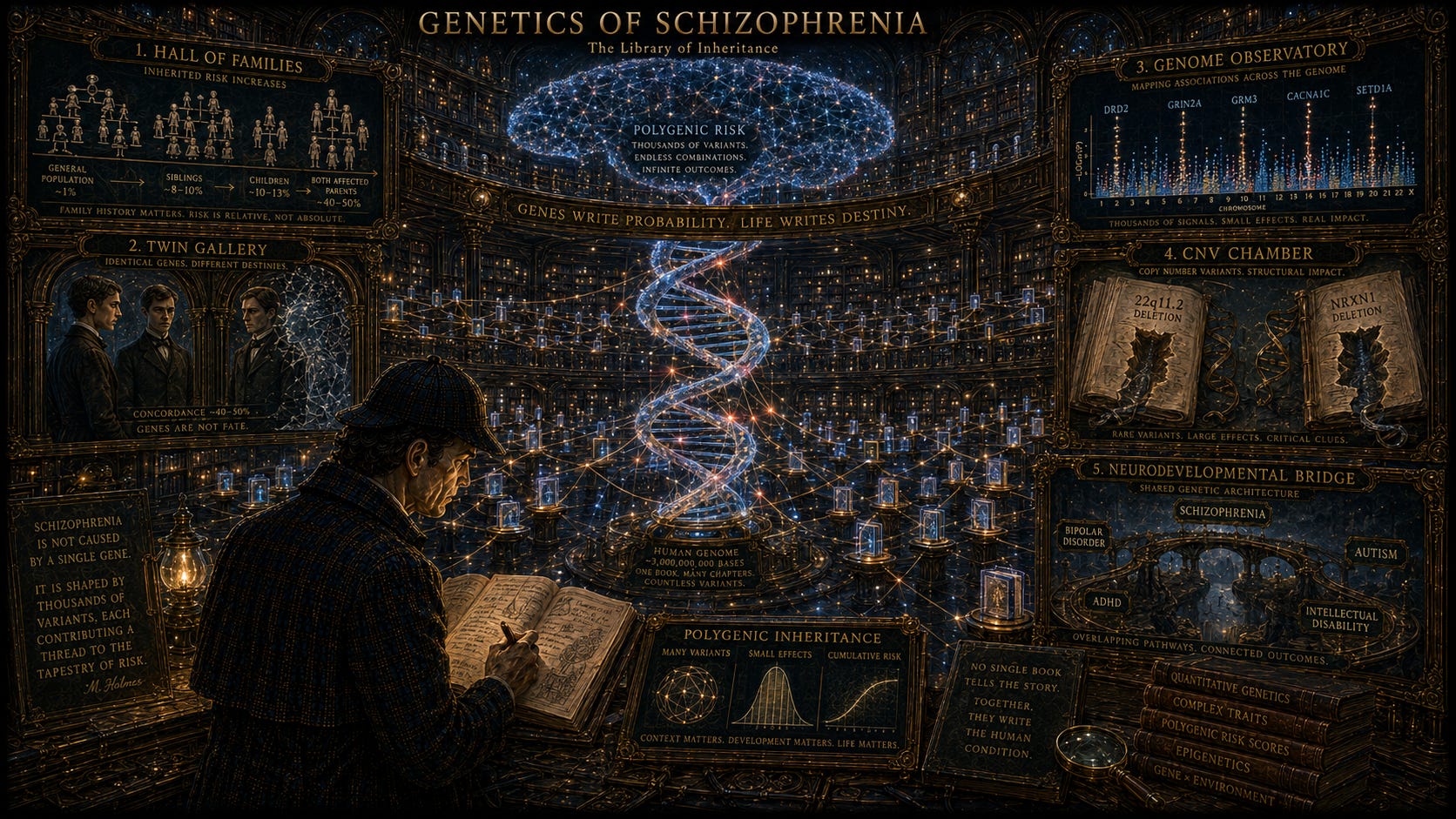
PSYCH 095: Genetics of Schizophrenia
Medlock Holmes enters perhaps the most intricate room in the entire Psychiatric Archive.Above the doorway is engraved:“The Library of Inheritance.”Thousands of leather-bound books stretch from floor to ceiling.Each volume represents a human genome.Holmes expects to find a single book labelled The Schizophrenia Gene.Instead, he finds nothing of the sort.The librarian smiles.“You are looking for one
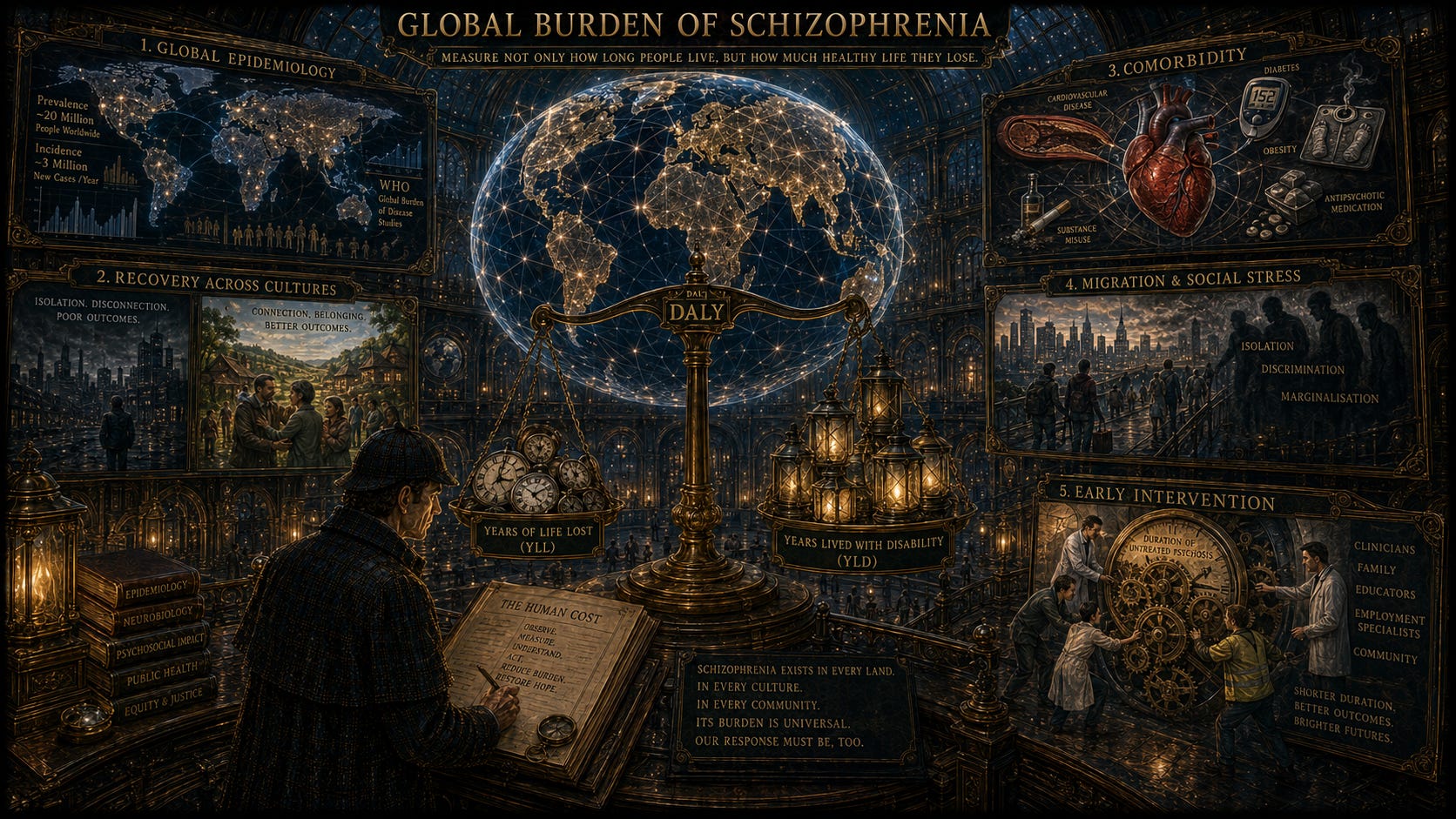
PSYCH 094: Global Burden of Schizophrenia
Medlock Holmes arrives at the Hall of Human Burden.Unlike previous investigations, this hall contains no microscopes, MRI scanners, or genetic maps.Instead, the walls are covered with clocks.Some clocks have stopped too early.Others continue to tick, but their hands barely move, representing lives lived with profound disability rather than early death.Holmes quickly realises that measuring illness
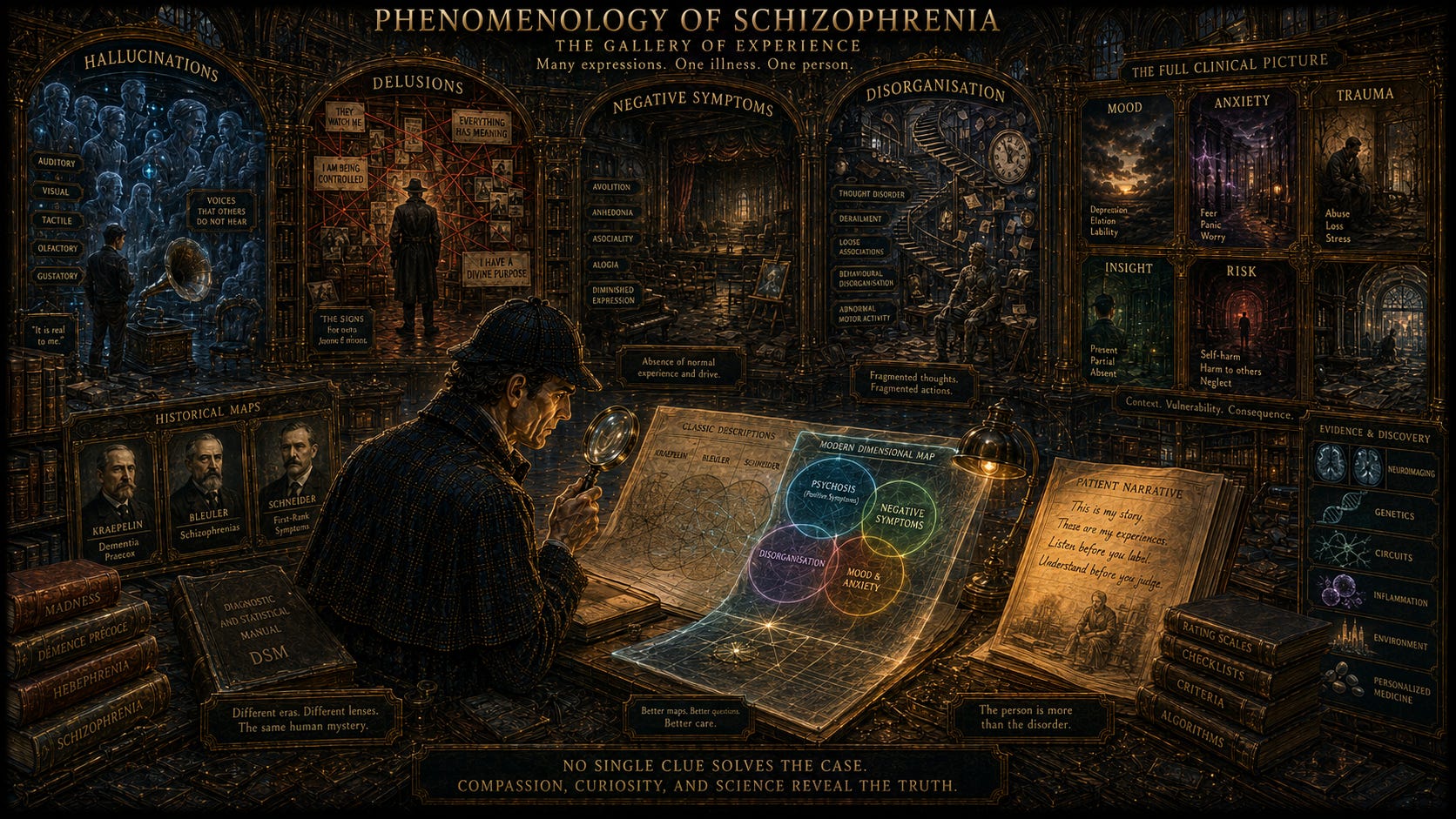
PSYCH 093: Phenomenology of Schizophrenia
Medlock Holmes enters an enormous archive filled with thousands of witness statements.Some describe voices no one else can hear.Others speak of thoughts being inserted, removed, or broadcast beyond the boundaries of the mind.Some accounts are crowded with elaborate conspiracies. Others contain only a few sparse words, long silences, diminished expression, and a life gradually emptied of purpose.Ev
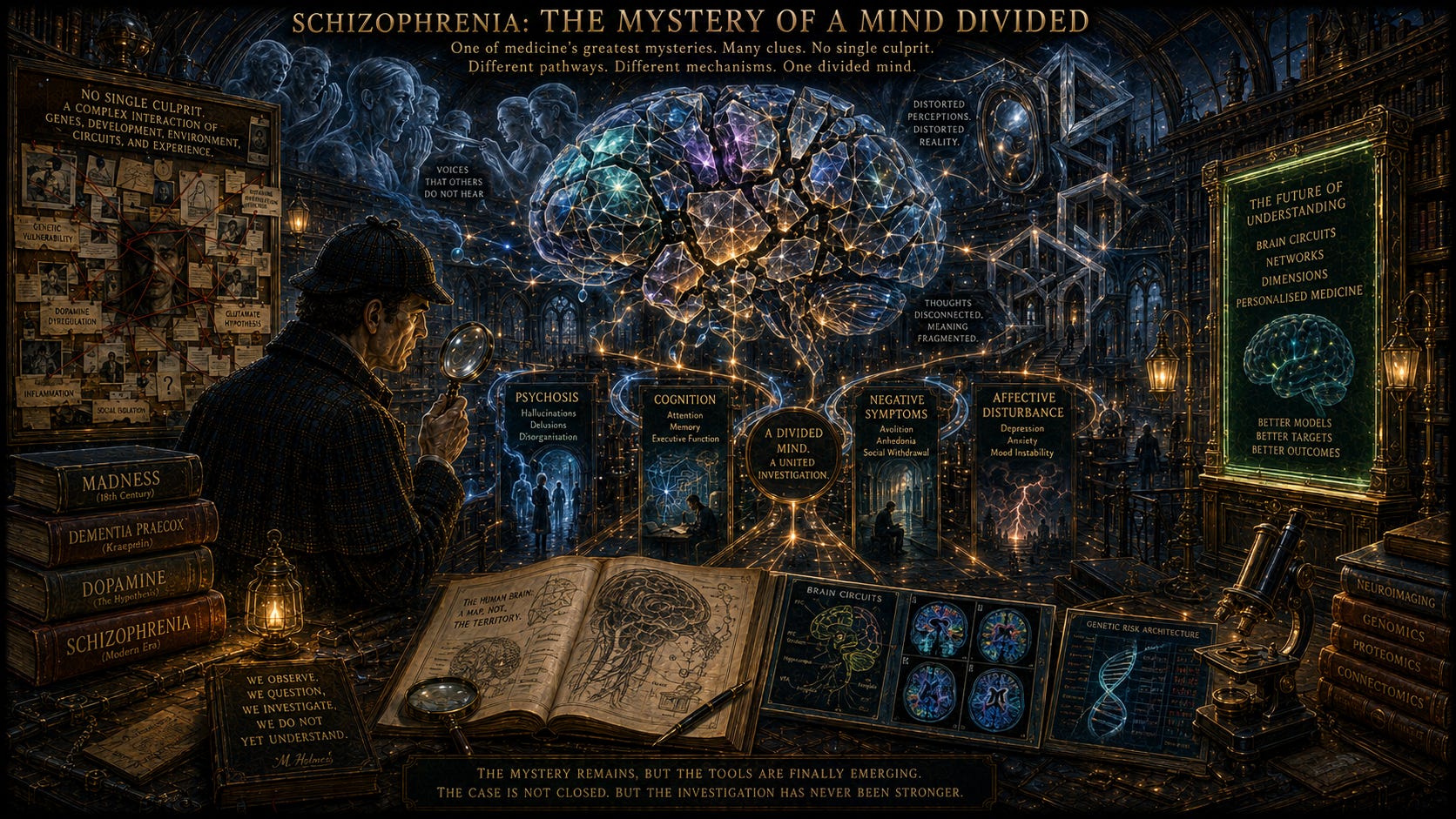
PSYCH 092: Schizophrenia
Schizophrenia is one of the most misunderstood disorders in medicine. It is not simply a condition of hallucinations and delusions; it is a disorder that disrupts perception, cognition, motivation, emotion, and the ability to connect with the world. For centuries it was viewed as madness, then as degeneration, later as a dopamine disorder, and now increasingly as a disorder of brain circuits, neur
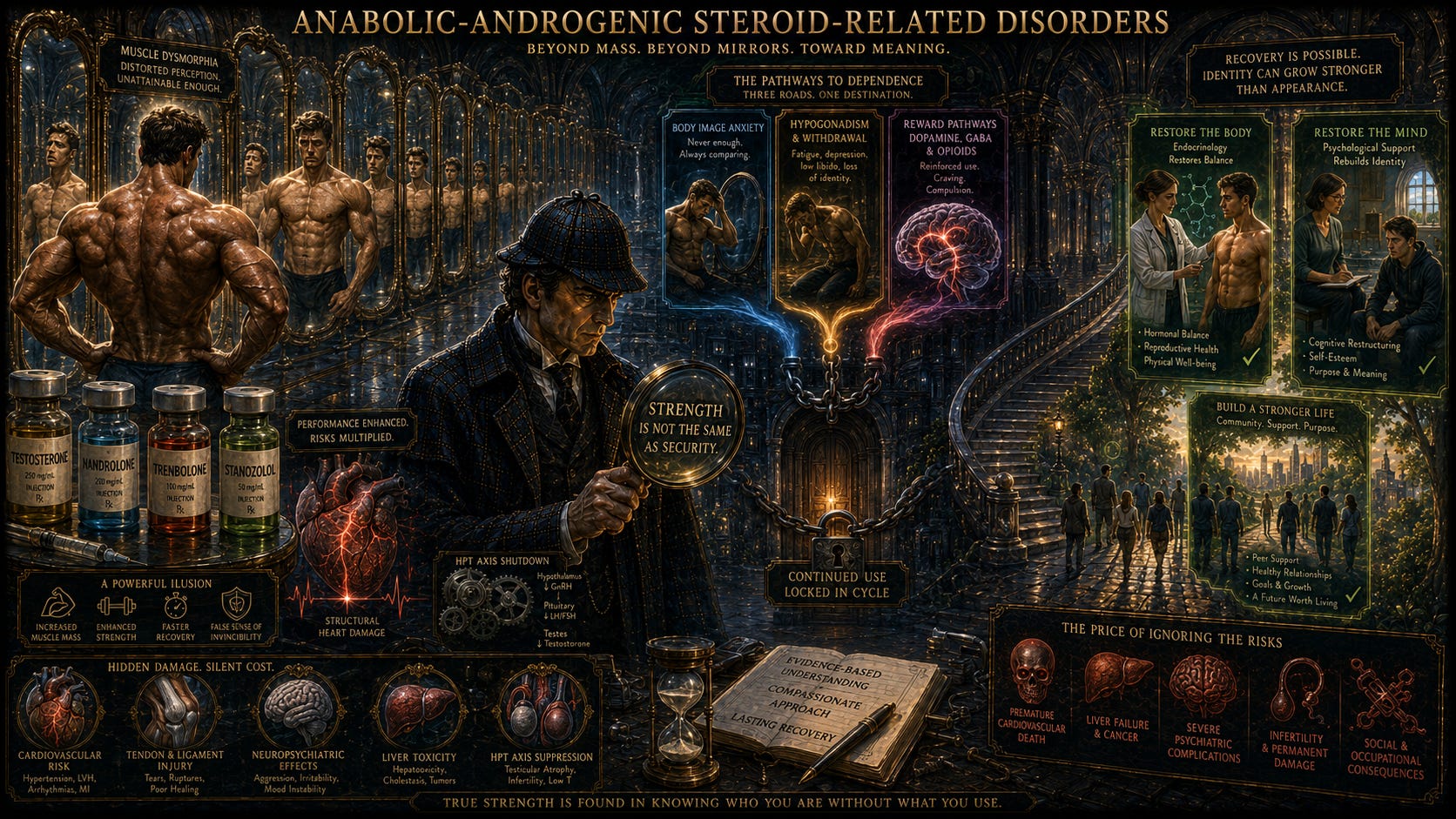
PSYCH 091: Anabolic-Androgenic Steroid-Related Disorders
A famous bodybuilder walks into Medlock Holmes’ consulting room.He is physically magnificent.Broad shoulders. Sculpted chest. Powerful arms.Yet Holmes notices something else.The man cannot stop looking at his reflection.Every polished surface becomes another mirror.Every missed gym session feels catastrophic.Every slight reduction in muscle size feels like losing part of himself.Holmes quickly rea
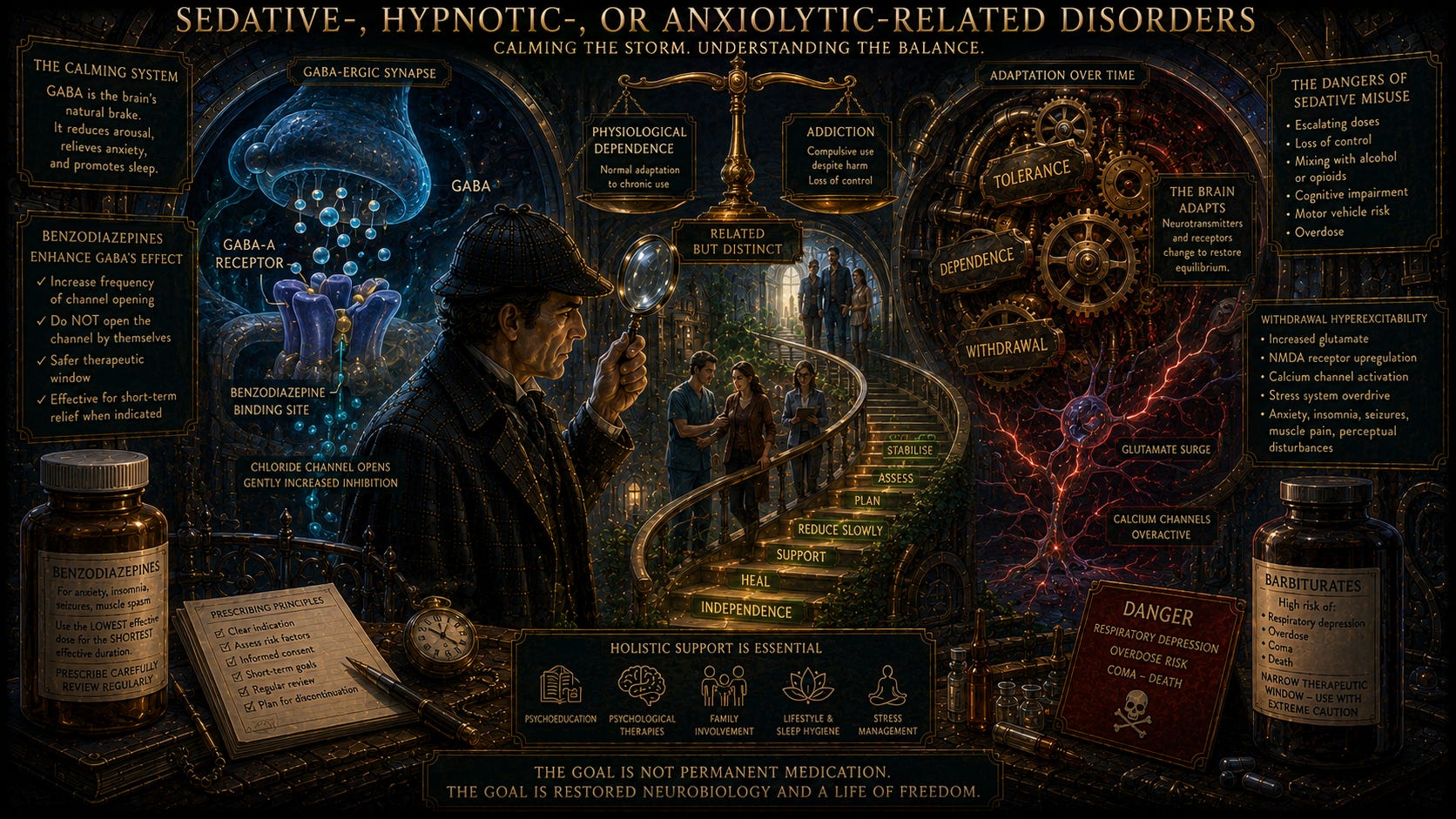
PSYCH 090: Sedative-, Hypnotic-, or Anxiolytic-Related Disorders
Medlock Holmes is summoned to investigate a peculiar paradox.The patients arriving at his clinic are not chasing euphoria. Many have never bought drugs illegally. They are teachers, nurses, executives, retirees, and people living with chronic anxiety or insomnia. They followed medical advice. They took their medication exactly as prescribed.Yet months-or years-later, many discover something unsett
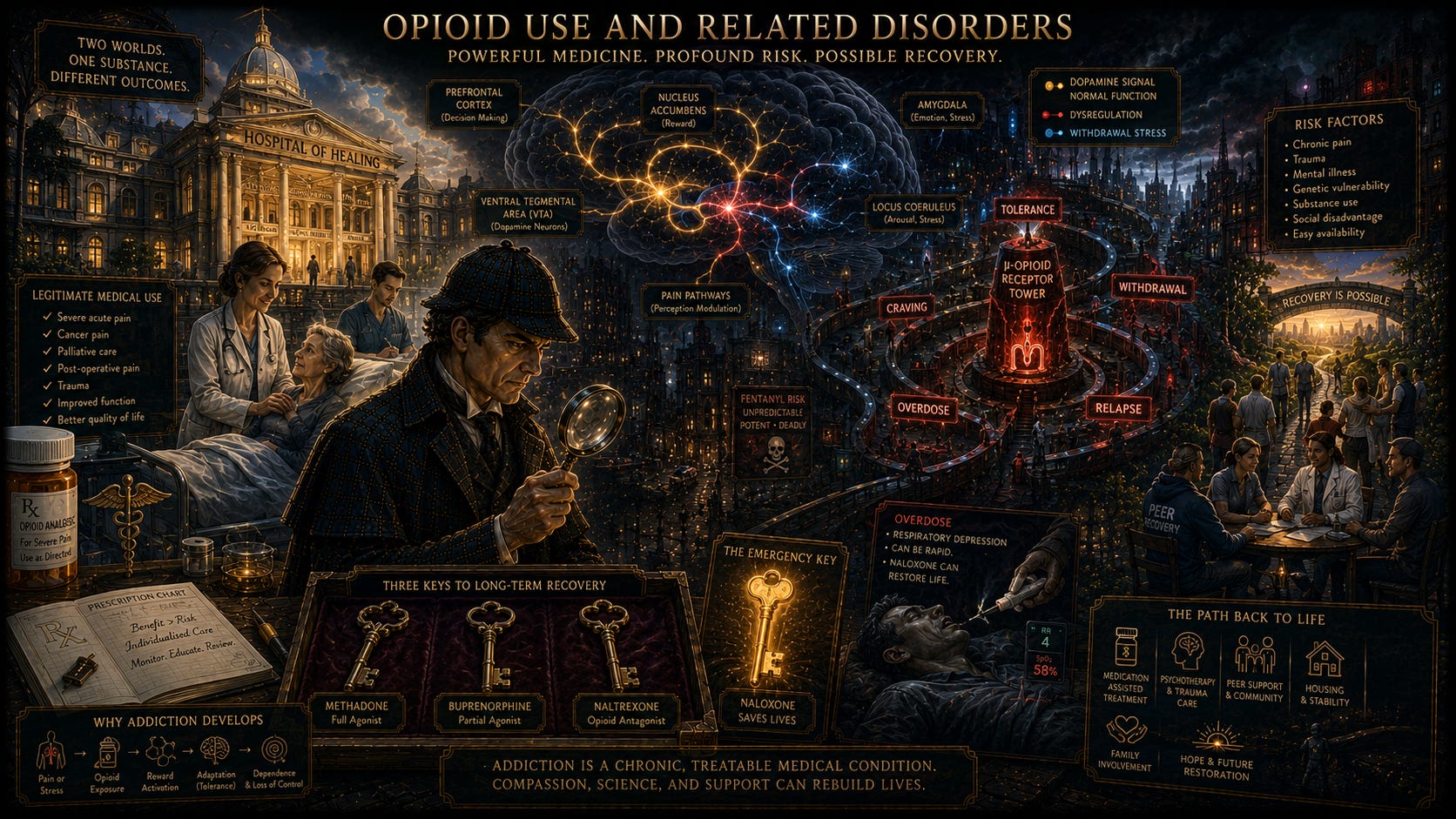
PSYCH 089: Opioid Use and Related Disorders: From Neuroscience to Treatment
Medlock Holmes enters a city built around a remarkable hospital.Within its walls, suffering is eased. Pain is softened. Patients who could not move begin to breathe, walk, sleep, and recover. The medicines used here are powerful, ancient, and deeply valuable.Yet beyond the hospital gates, Holmes finds another city forming in the shadows.At first, the same medicines offer warmth, relief, and escape
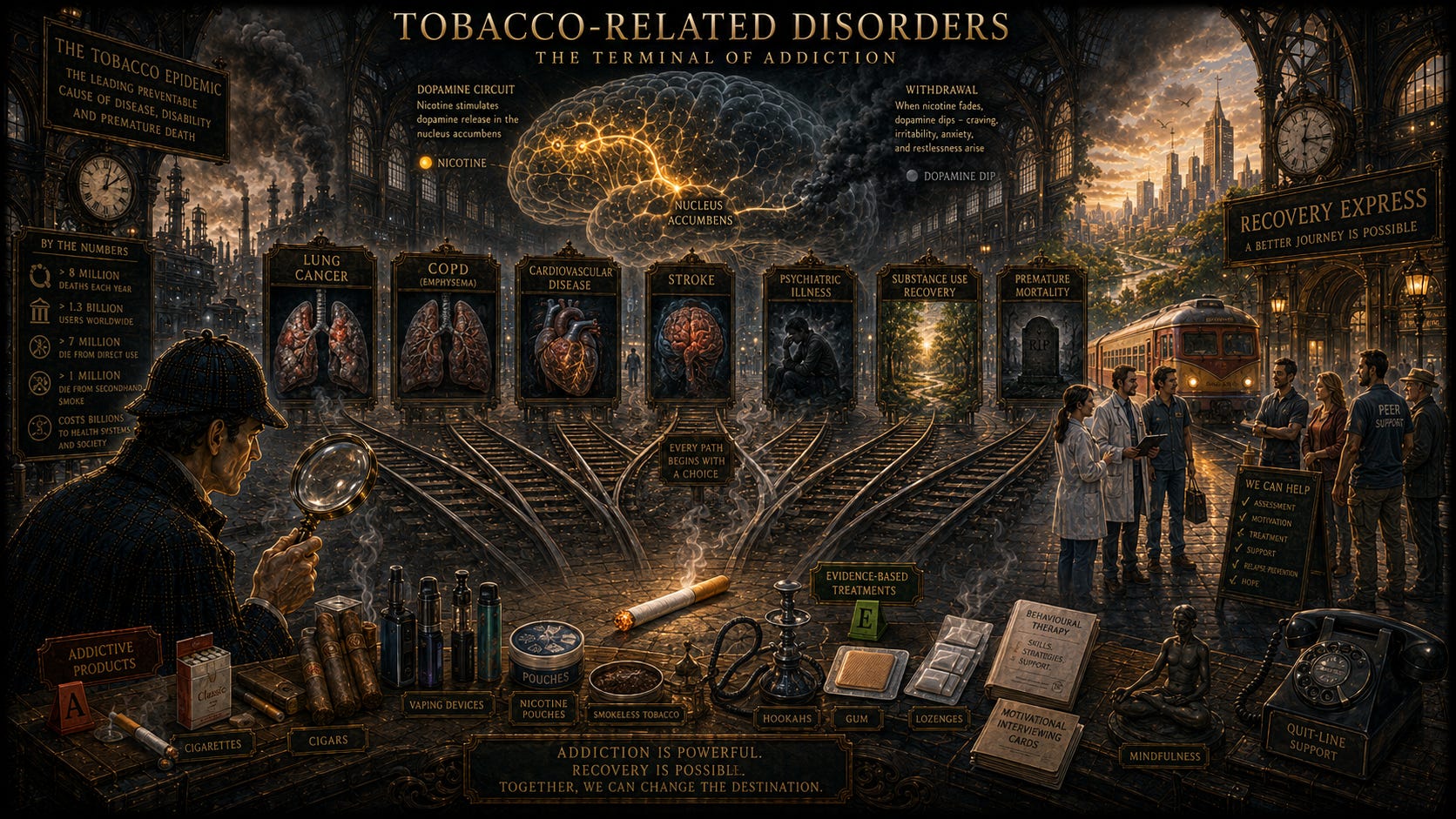
PSYCH 088: Tobacco-Related Disorders
Medlock Holmes is summoned to investigate the greatest unsolved epidemic in modern psychiatry.Unlike the previous cases, there is no mystery about what causes the deaths.The evidence has been overwhelming for decades.Yet millions continue to use the substance.The mystery is not what tobacco does.The mystery is why humanity continues to smoke despite knowing the truth.Holmes begins where every psyc
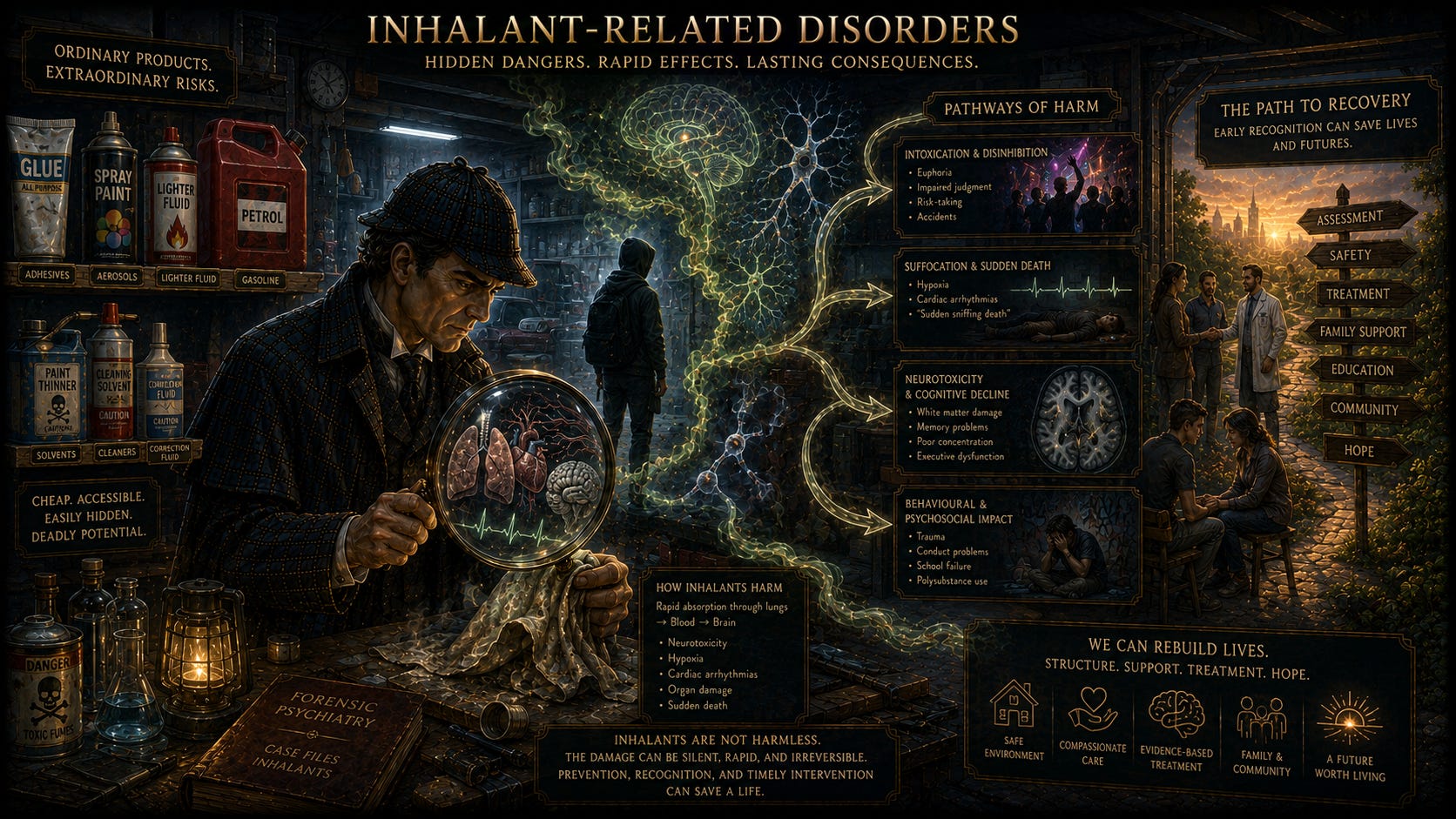
PSYCH 087: Inhalant-Related Disorders
Medlock Holmes is called to investigate a troubling mystery among the youngest citizens of the city.There is no dealer on the street corner.No hidden laboratory.No expensive supply chain.Instead, the clues are ordinary household objects: glue, paint thinner, spray cans, lighter fluid, petrol, correction fluid, cleaning products, and aerosol dusters.At first, the city dismisses the danger.These are
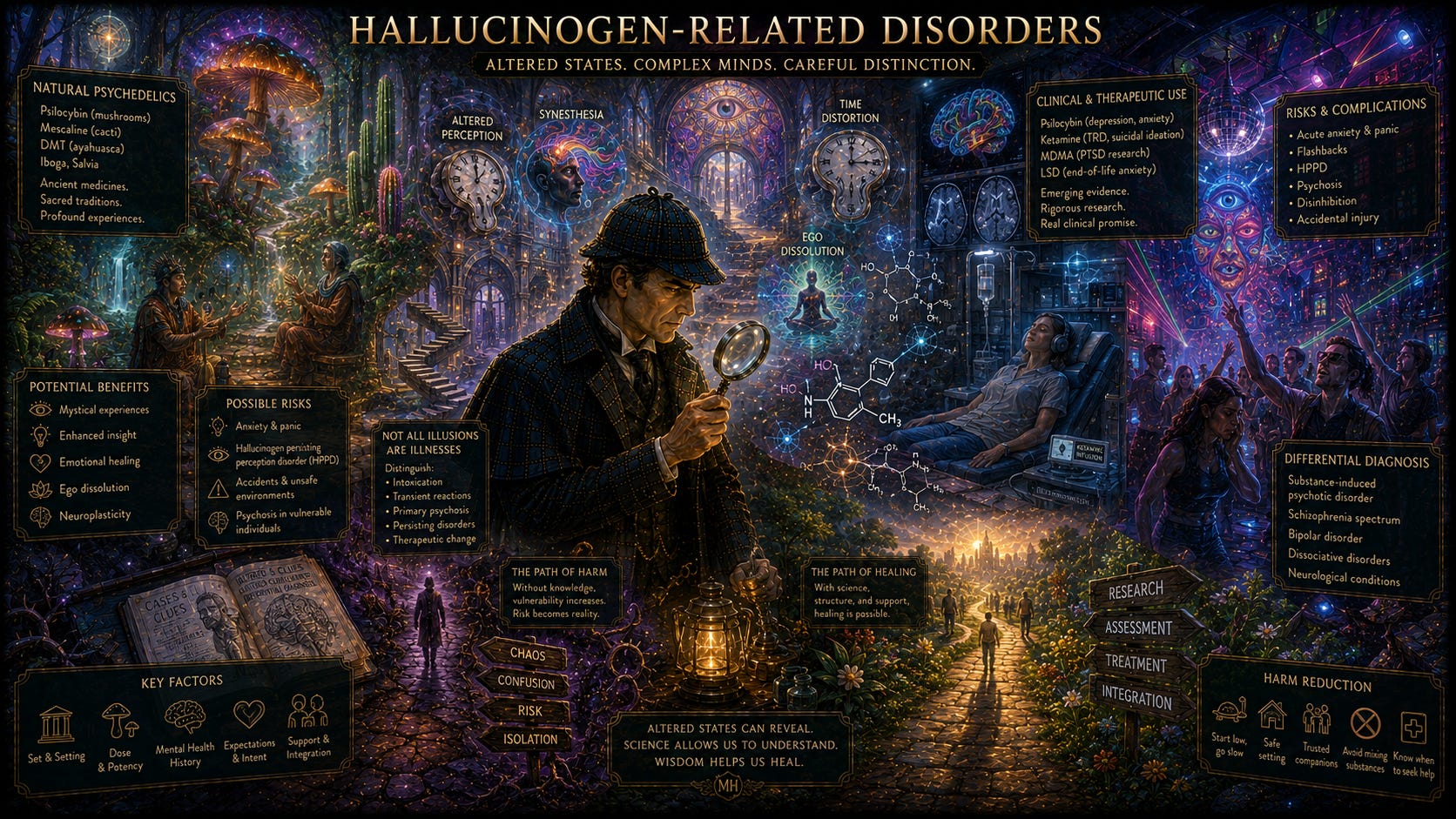
PSYCH 086: Hallucinogen-Related Disorders
Medlock Holmes is called to investigate a series of extraordinary reports.One witness describes colours that seem alive. Another believes time has stopped. A third feels completely detached from their own body, while another speaks of overwhelming love, profound spiritual insight, or terrifying paranoia. Some recover within hours, while others continue to experience disturbing visual phenomena mon
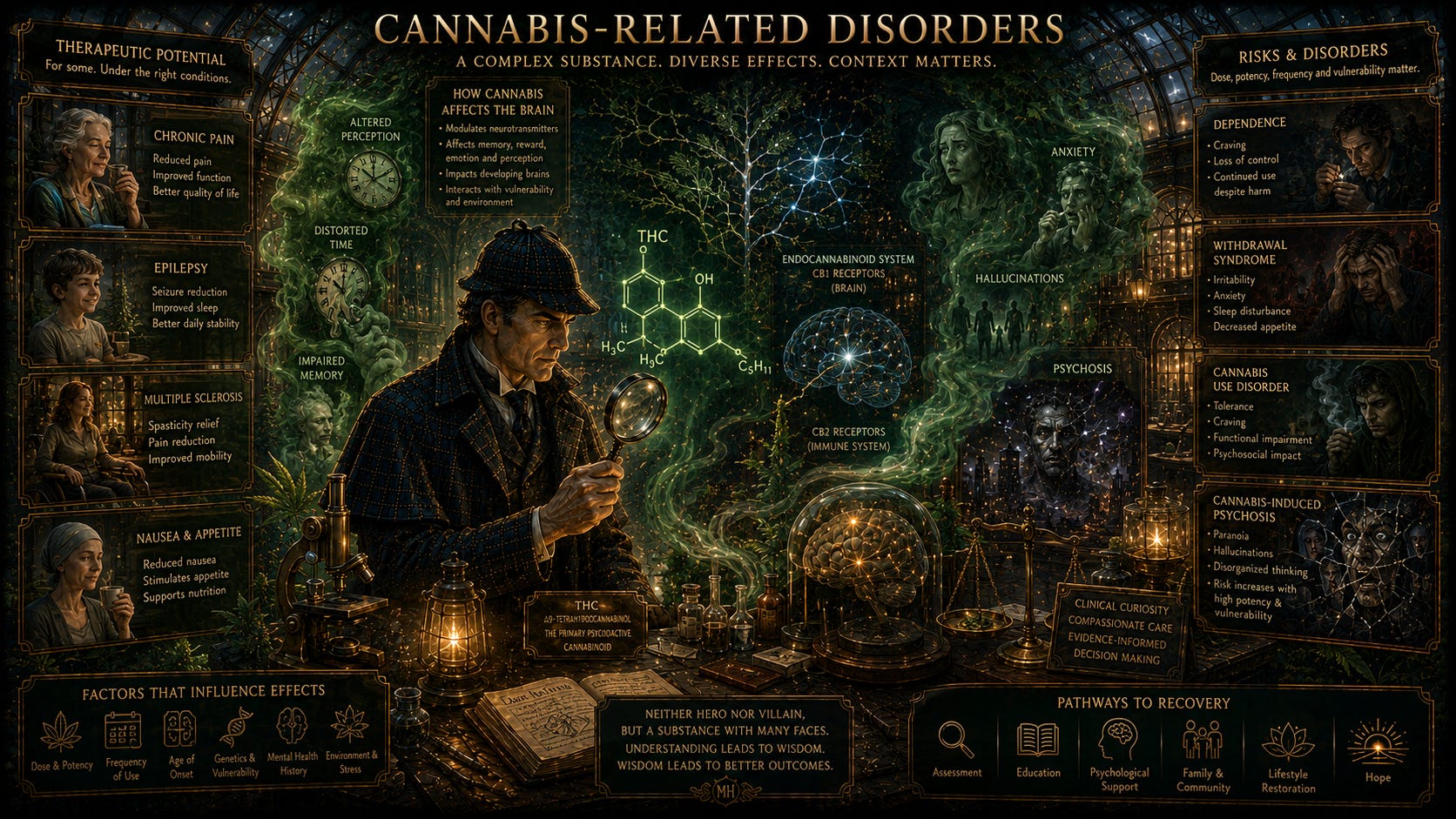
PSYCH 085: Cannabis-Related Disorders
Cannabis is often viewed as harmless, natural, or even medicinal, yet its relationship with mental health is far more complex. In this episode, Medlock Holmes investigates how THC alters brain function, why some people develop dependence while others do not, and the growing evidence linking cannabis with anxiety, psychosis, cognitive impairment, and withdrawal. As cannabis becomes increasingly pot
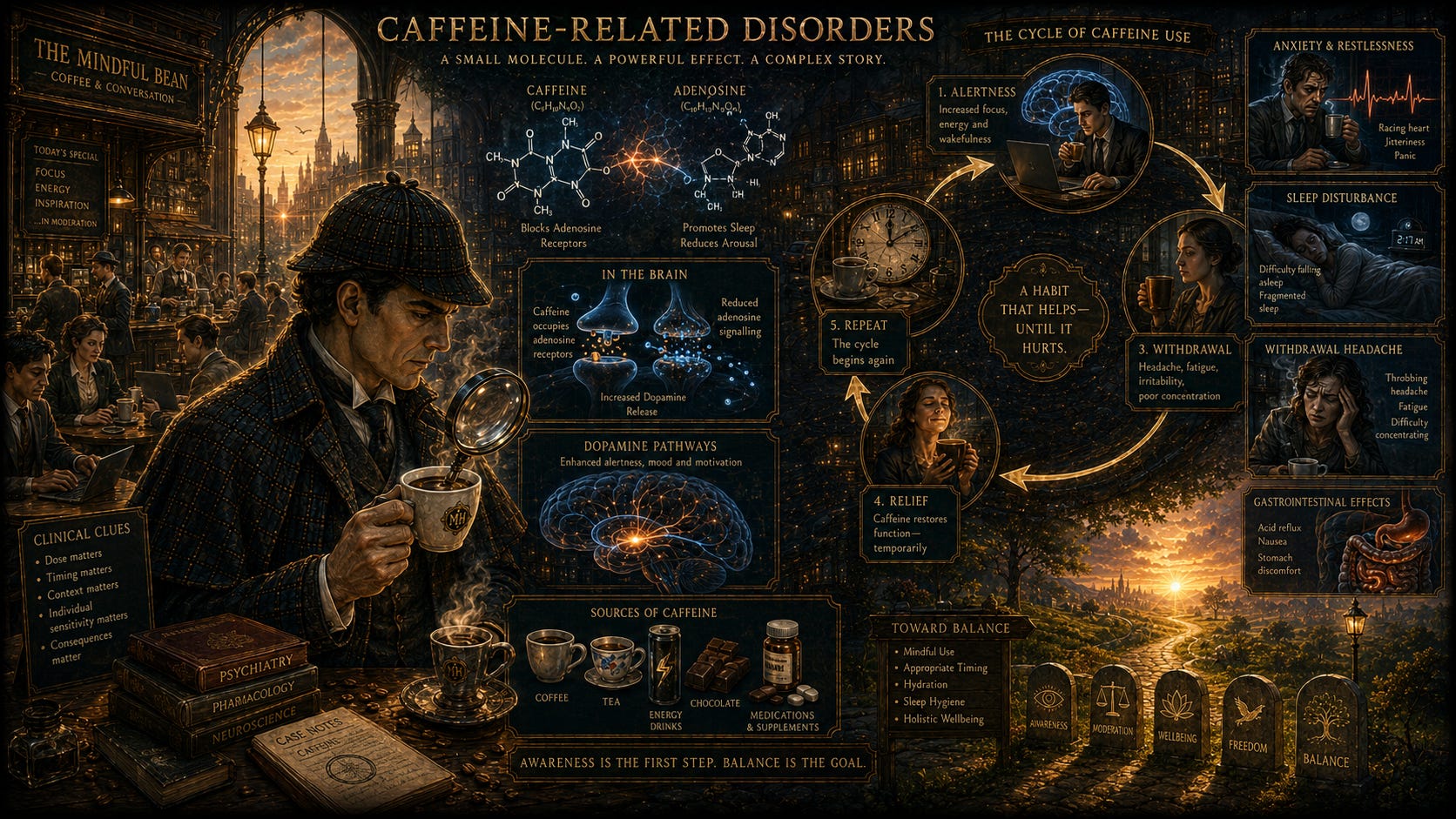
PSYCH 084: Caffeine-Related Disorders
Every morning, before the city truly awakens, Medlock Holmes notices a remarkable ritual.Office lights flicker on.Coffee machines begin to hiss.Kettles whistle.Students cradle steaming mugs.Doctors begin ward rounds with takeaway cups in hand.Parents finally feel awake after the first sip.Unlike the illicit drugs Holmes has investigated before, no one hides this substance.It is celebrated.Shared.O
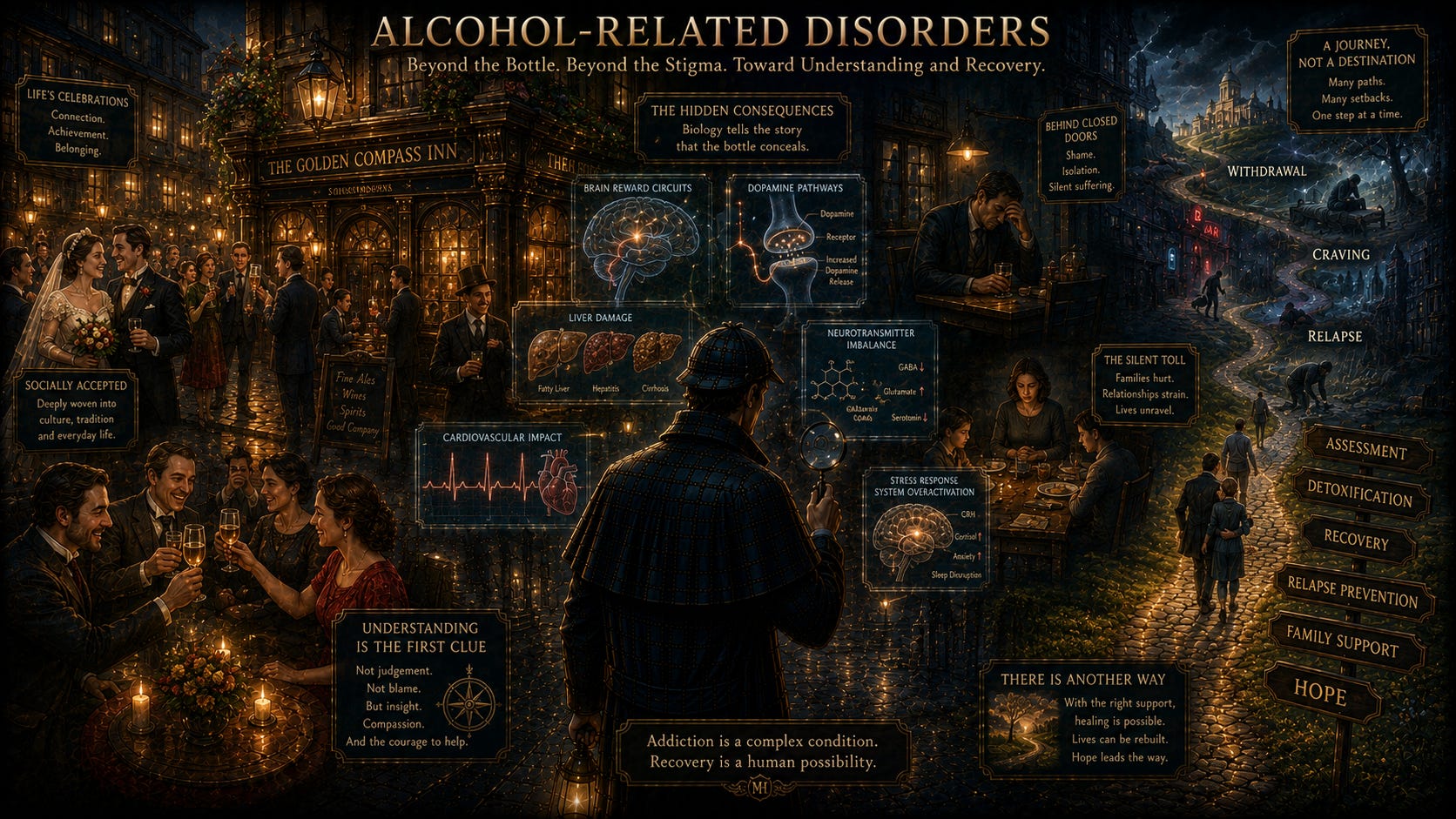
PSYCH 082: Alcohol-Related Disorders
Medlock Holmes is invited to investigate a city where one establishment appears to be at the centre of almost every celebration.People gather there after work.Families celebrate milestones there.Business deals are made there.Victories are toasted there.At first glance, the tavern seems woven naturally into the life of the city.Yet Holmes begins noticing a different pattern.The same people keep ret
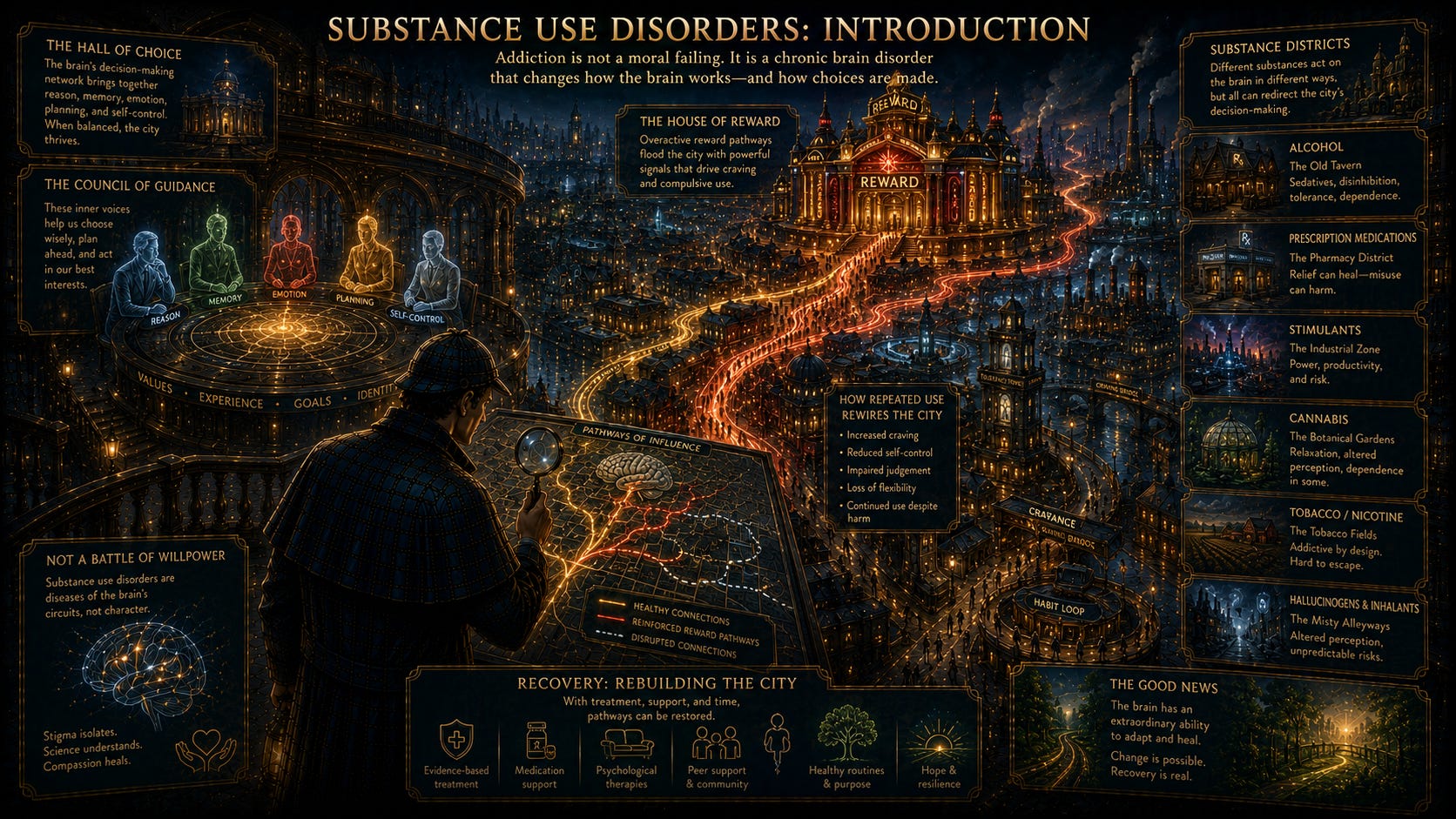
PSYCH 081: Substance Use Disorders: Introduction
Imagine Medlock Holmes arriving in a magnificent city renowned for one remarkable feature.Every citizen possesses complete freedom.Every street offers choices.Every marketplace presents opportunities.Every day, thousands of decisions are made.Which road to follow.Which people to trust.Which risks to take.Which pleasures to pursue.At the centre of the city stands the Hall of Choice.Inside, an intri
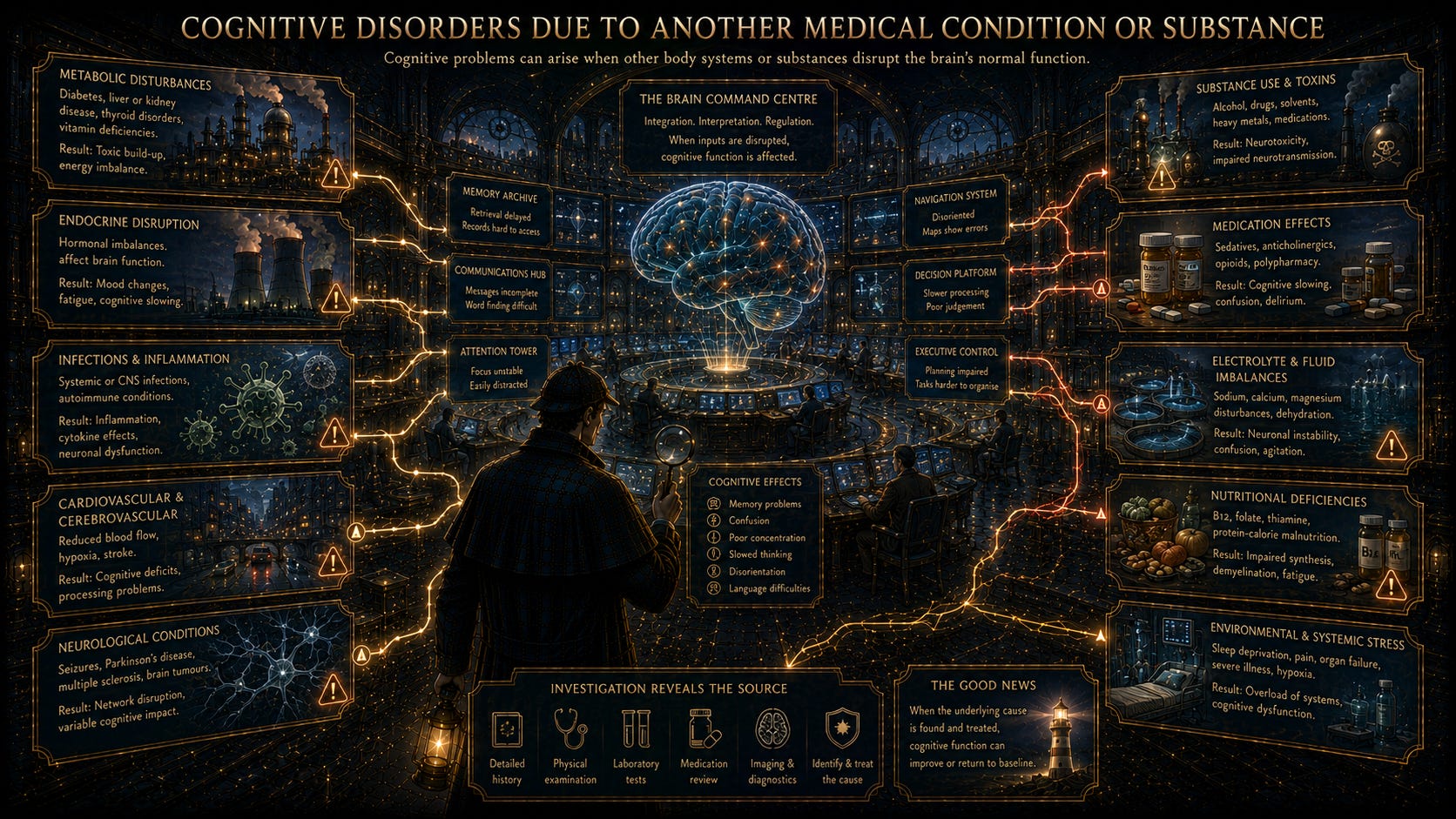
PSYCH 080: Cognitive Disorders Due to Another Medical Condition or Substance
Imagine Medlock Holmes arriving at a grand command centre responsible for coordinating an entire city.The command centre appears sophisticated and highly organised. It manages communication, planning, navigation, memory, and decision-making for every district.One day, however, the operators begin making mistakes.Messages are delayed.Instructions become confused.Important information is misplaced.D
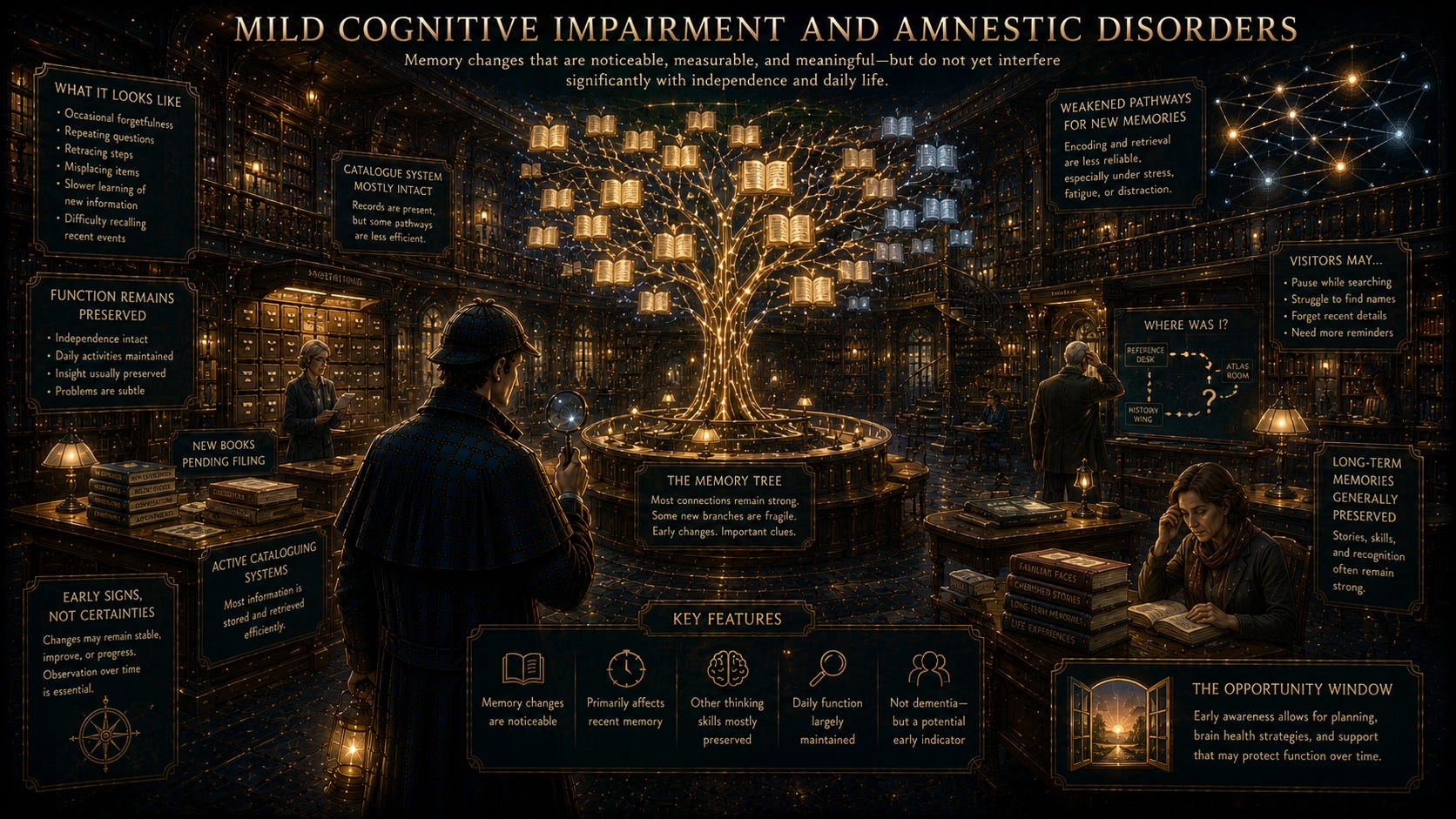
PSYCH 079: Mild Cognitive Impairment and Amnestic Disorders
Imagine Medlock Holmes returning once more to the great library of the mind.Unlike the previous chapter, the library is still functioning remarkably well.The catalogue remains largely intact.Visitors can still find most of the books they need.The librarians continue their work.The building remains operational.Yet Holmes notices subtle signs that something has changed.A librarian takes longer to lo
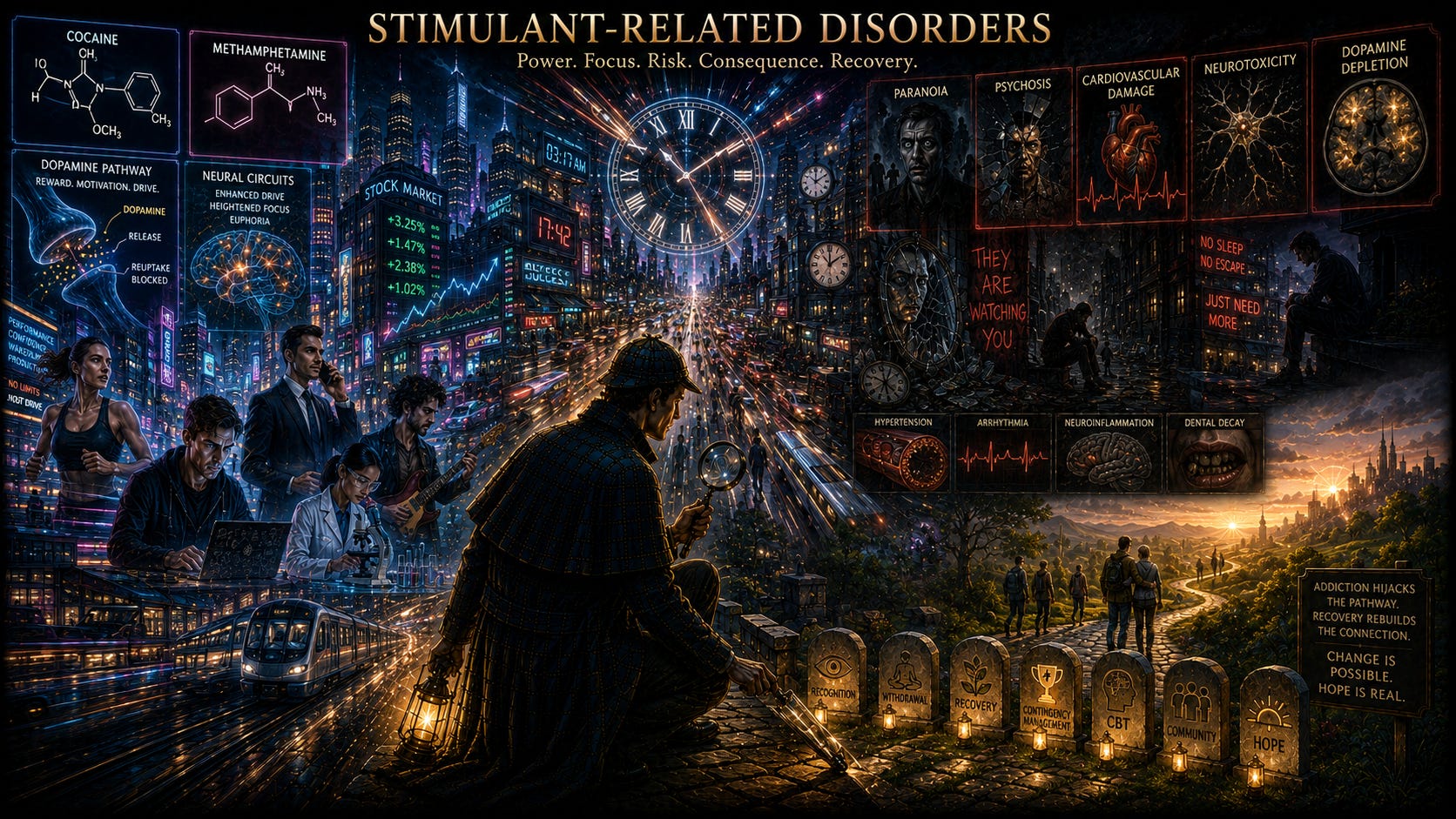
PSYCH 083: Stimulant-Related Disorders
Medlock Holmes is summoned to investigate a city that never seems to sleep.The streets remain alive long after midnight.Factories work around the clock.Students study without rest.Traders chase impossible fortunes.Artists paint through the night.Everyone appears driven by an invisible force that promises endless energy, relentless focus, and extraordinary productivity.Yet Holmes quickly notices an
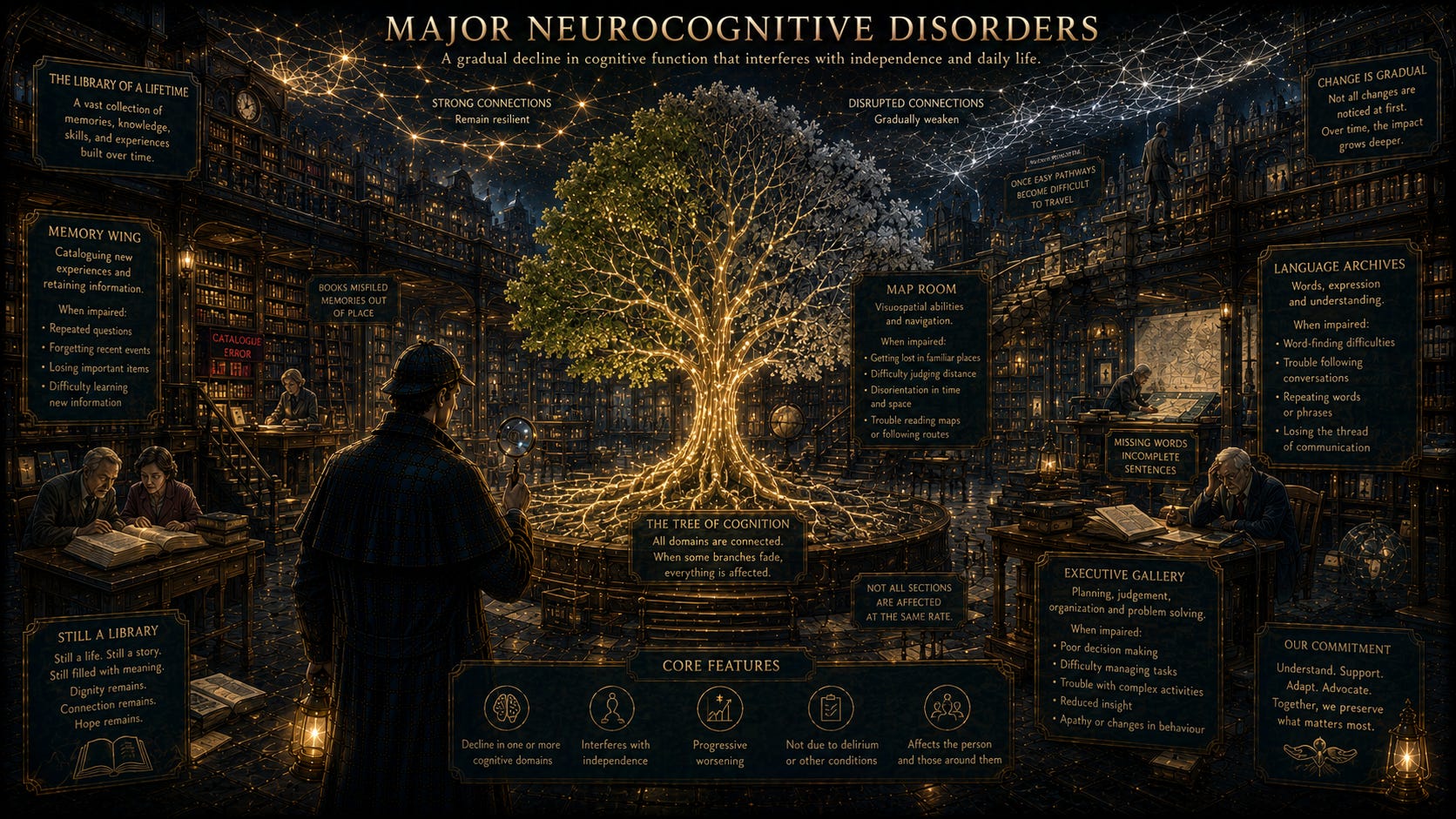
PSYCH 078: Major Neurocognitive Disorders
Imagine Medlock Holmes returning to the great library introduced in the previous chapter.At first glance, the library still stands.Its walls remain intact.The shelves are still filled with books.The familiar corridors continue to stretch into the distance.Yet something profound has changed.The librarians who once maintained the archives can no longer keep pace with the demands of the system.Catalo
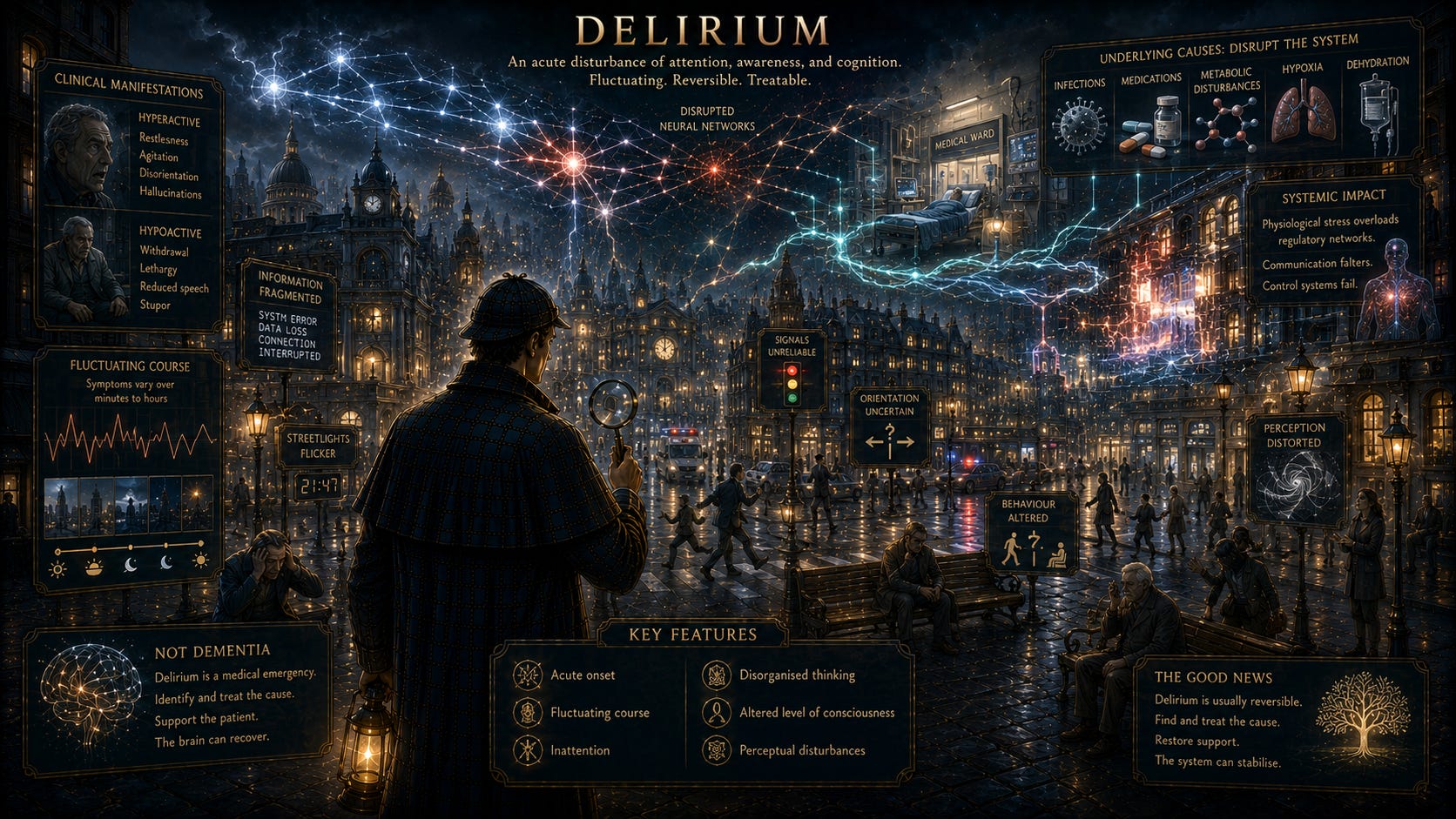
PSYCH 077: Delirium
Imagine Medlock Holmes arriving in a bustling city that normally functions with remarkable precision.Traffic flows smoothly.Messages are delivered accurately.Citizens recognise one another.Markets open on time.The entire system depends upon a continuous and reliable supply of energy.One morning, however, something changes.The city’s power grid begins to fluctuate.Lights flicker unpredictably.Commu
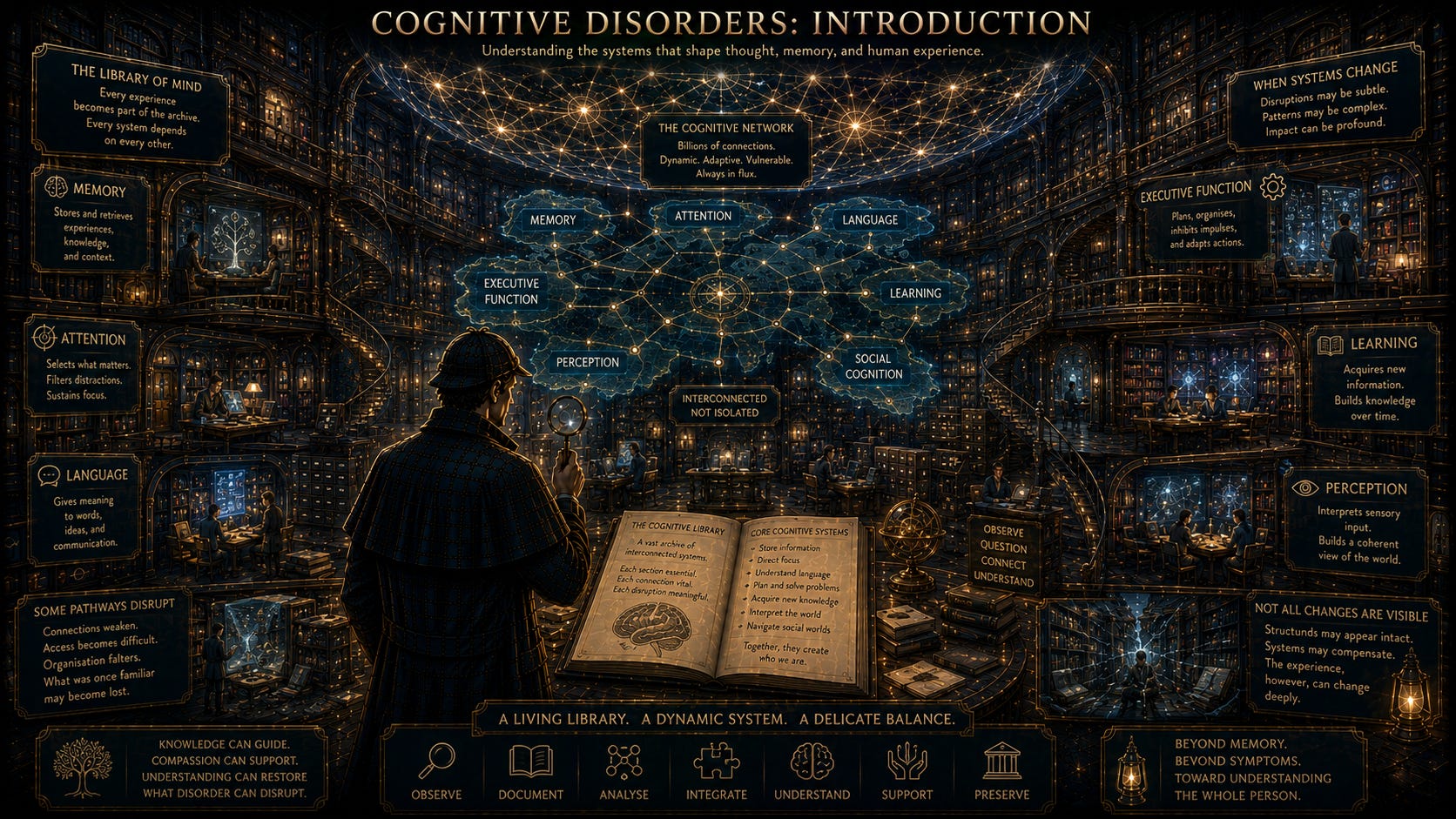
PSYCH 076: Cognitive Disorders: Introduction
Imagine Medlock Holmes entering the largest library he has ever encountered.Endless shelves stretch beyond the horizon. Countless volumes contain memories, skills, language, relationships, emotions, and the accumulated experiences of an entire lifetime.At first glance, the library appears orderly and functional.Yet Holmes soon notices subtle signs that something is changing.A book returned to the
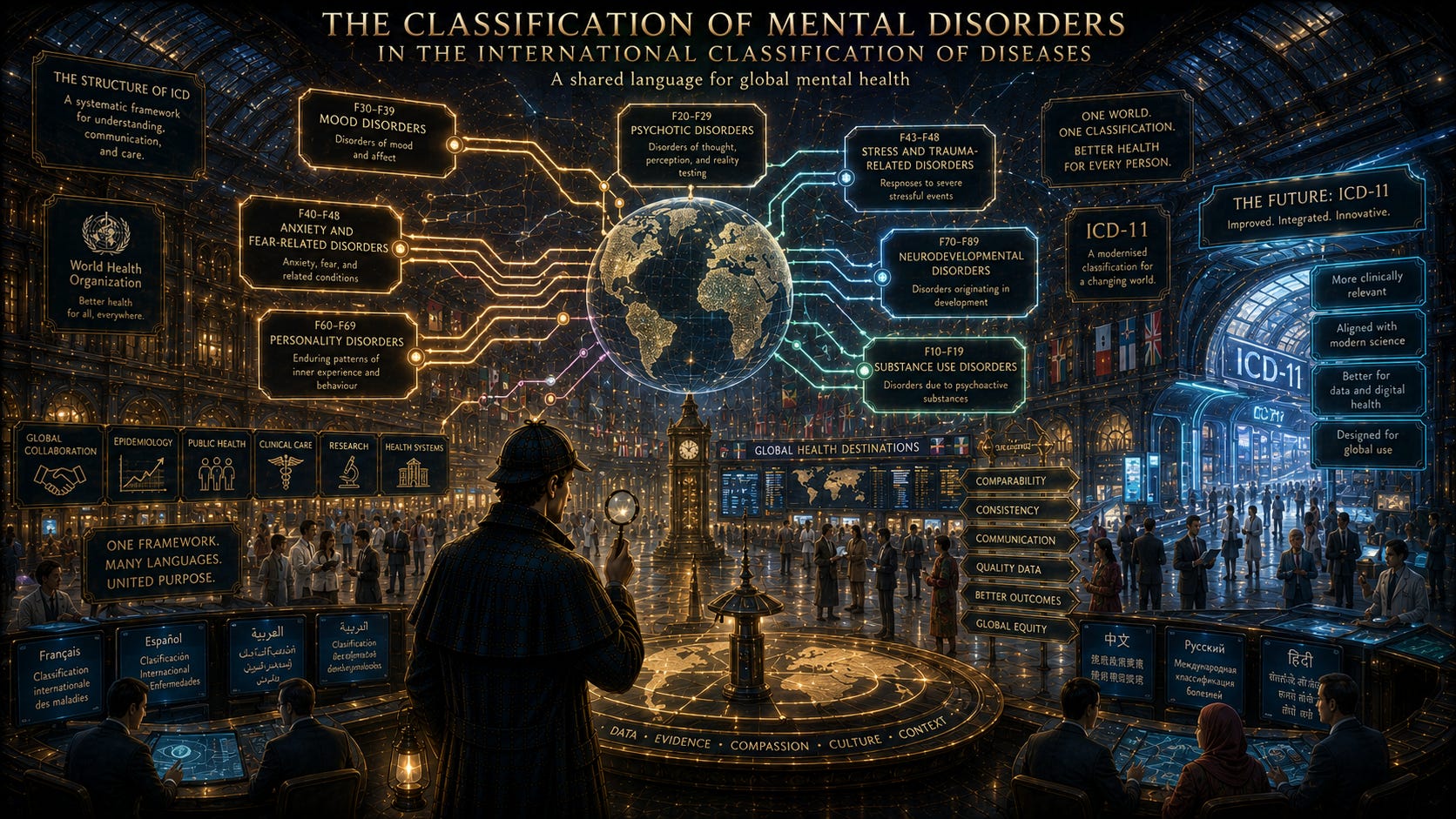
PSYCH 075: The Classification of Mental Disorders in the International Classification of Diseases
Imagine Medlock Holmes arriving at an immense international railway terminal.Thousands of travellers move through the station every hour. They come from different nations, cultures, languages, and healthcare systems. Yet somehow they all manage to navigate using a single set of signs, symbols, and destinations.Holmes quickly realises that this station represents the global healthcare system.The si
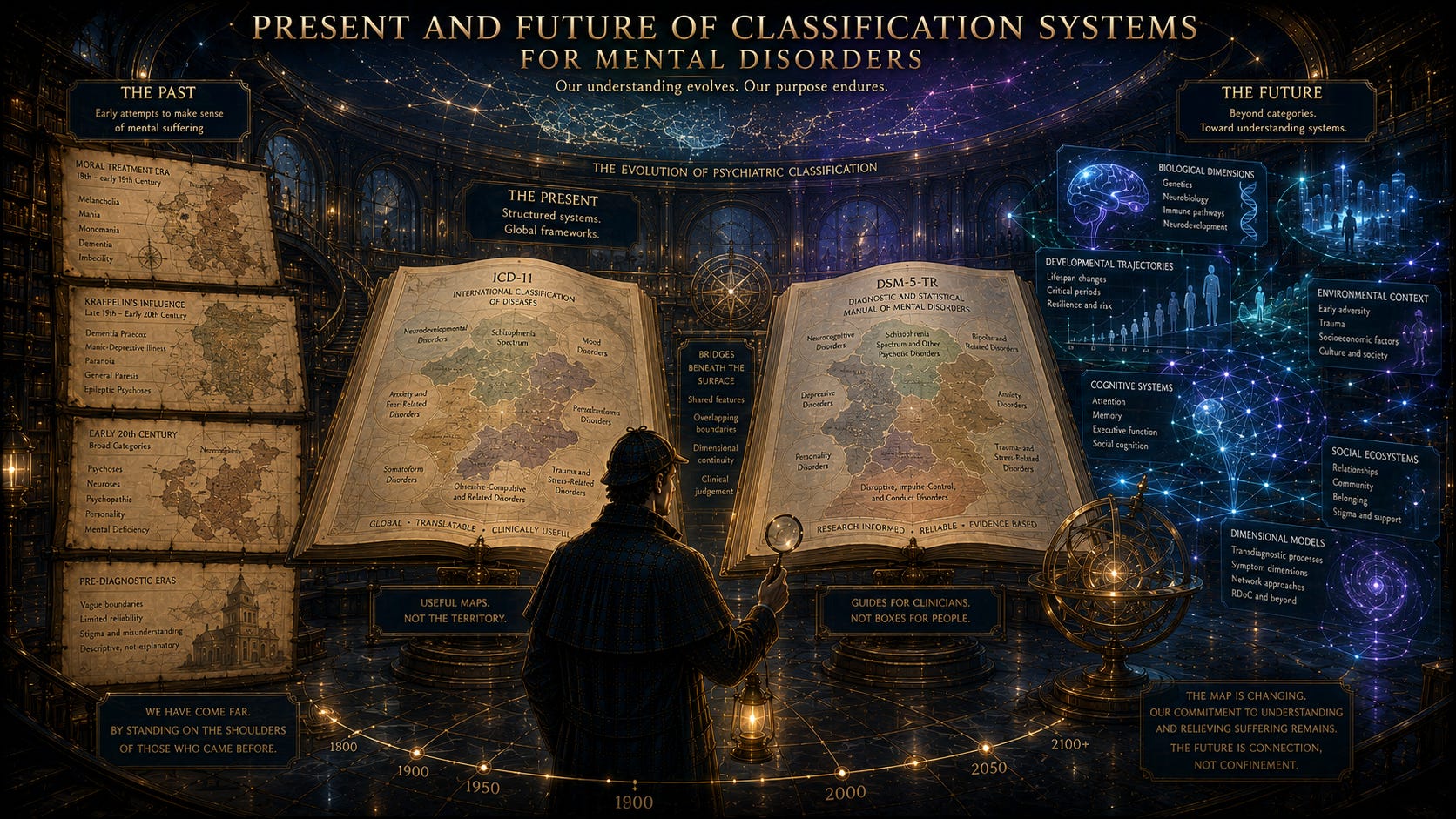
PSYCH 074: Present and Future of Classification Systems for Mental Disorders
Imagine Medlock Holmes standing within a vast cartography chamber.Spread before him are enormous maps of the mind created across different eras. Some are centuries old, hand-drawn and incomplete. Others are modern, precise, and densely detailed. Each attempts to answer the same question:How should we classify mental disorders?As Holmes examines the maps, he notices that none perfectly match the te
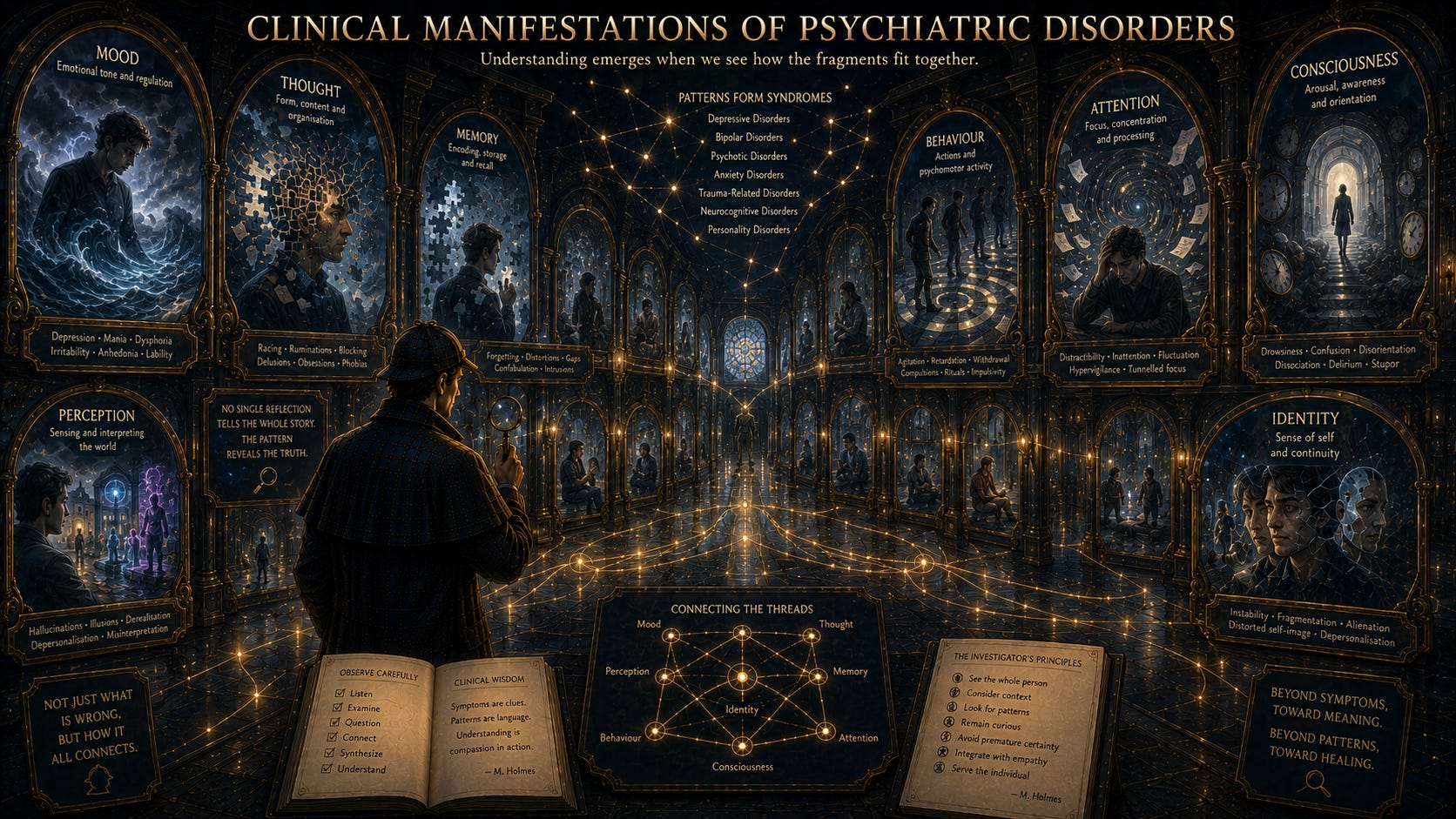
PSYCH 073: Clinical Manifestations of Psychiatric Disorders
Imagine Medlock Holmes entering a vast hall of mirrors.Each mirror reflects a different aspect of human experience: mood, thought, perception, memory, behaviour, identity, motivation, and consciousness. Most reflections remain coherent and integrated. Yet in some mirrors, subtle distortions begin to appear. A thought becomes fixed. An emotion becomes overwhelming. A perception no longer matches re
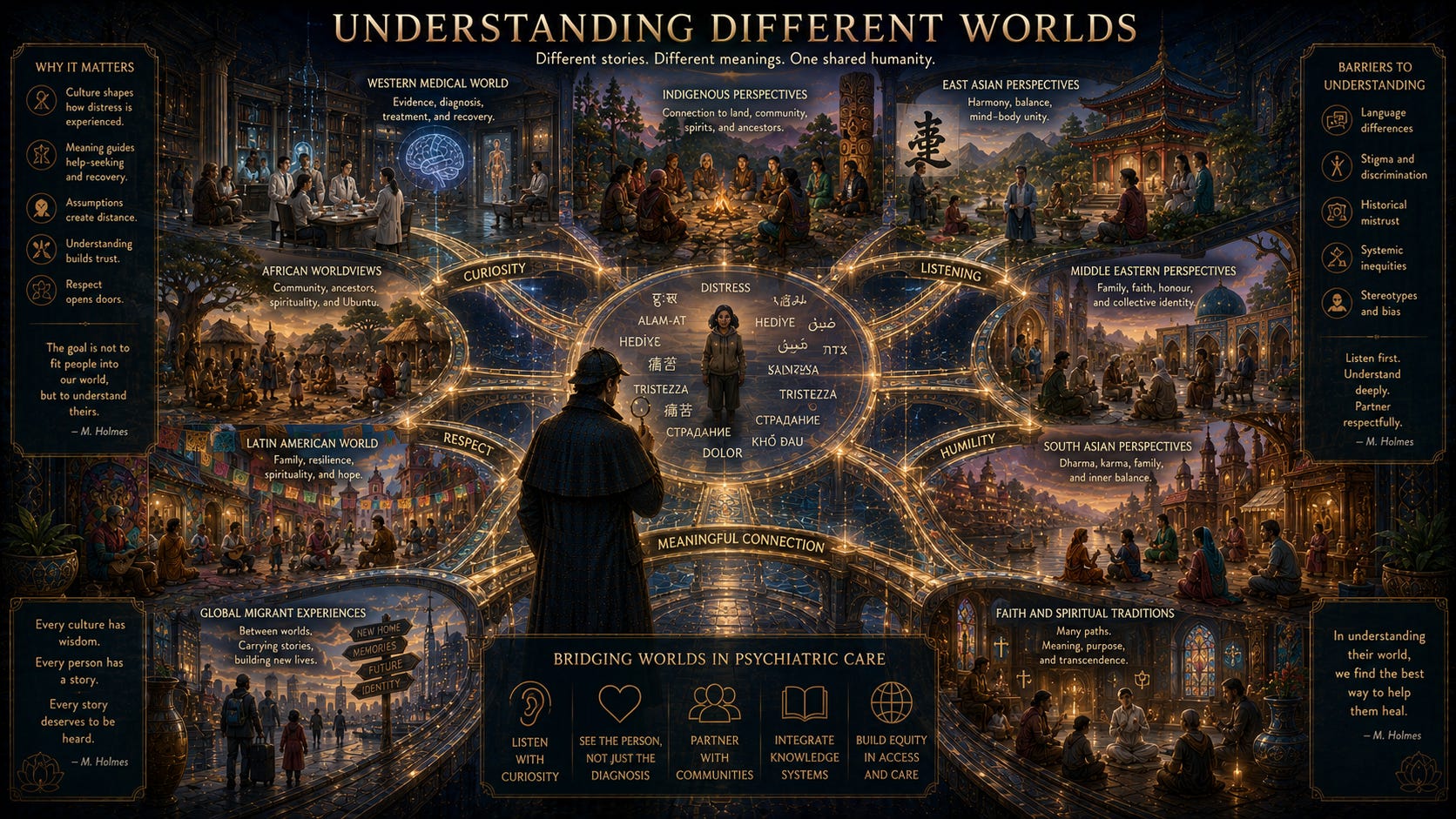
PSYCH 071: Cultural Competency in the Organisation and Delivery of Psychiatric Care
This chapter explores cultural competency as a foundational component of modern psychiatric practice. Mental health care does not occur in a cultural vacuum. Every patient, clinician, organisation, and healthcare system operates within networks of beliefs, values, traditions, identities, languages, and social experiences that influence how distress is understood and treated.Cultural competency ext
Recommended

Fantasy Flex

زن بودن

Medicine with Meaning

Yours Truly Johnny Dollar Collection

Take Back Your Health®

CBS Radio Mystery Theater | Old Time Radio

Solved Murders - True Crime Stories

紐約鳥|New York Aperture
The Swerve Podcast: Obscure Topics | Conspiracy Theories

The Bread and Banter Podcast

The Church of What's Happening Now: The New Testament

Busted Open
