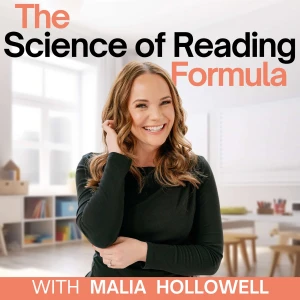
The Science of Reading Formula
The Science of Reading Formula is a podcast hosted by Malia Hollowell, a National Board Certified Teacher and founder of Playdough to Plato. It offers practical, science-backed strategies for teaching reading, aiming to simplify instruction and reduce teacher burnout. Each episode covers topics like differentiated instruction, time-saving planning tips, and evidence-based practices to boost student success. The podcast provides encouragement and actionable ideas for educators seeking a better work-life balance.
Episodes
Structured Literacy Strategies That Actually Help with Dr. Lousie Spear-Swerling
Helping struggling readers can feel frustrating, but it doesn’t have to be a mystery. In this episode of The Science of Reading Formula Podcast, author and expert Louise Spear-Swerling breaks down the structured literacy strategies that actually move the needle for PreK–2 students. From spotting instructional mismatches to giving more effective feedback, this episode is packed with teacher-tested,
Teaching Writing is Essential to Reading Success with Dr. Steve Graham
What if the secret to stronger readers isn’t more reading instruction—but better writing instruction?In this episode, literacy expert Dr. Steve Graham reveals why writing is often the missing piece in early reading success—and how you can use it to supercharge your phonics, fluency, and comprehension instruction.We’re talking research-backed strategies you can actually use in your PreK–2 classroom
Simple Moves That Supercharge Vocabulary Instruction with Blythe Anderson
What if teaching vocabulary didn’t mean adding more to your plate—but simply rethinking the words you already use? In this episode, Dr. Blythe Anderson shares simple talk moves that make a big impact. From classroom job titles to science experiments, you’ll learn how to turn everyday moments into powerful vocabulary instruction.In this episode, we'll talk about:Why word lists aren’t enough—an
Why Good Readers Still Struggle with Spelling & How to Fix It with Joanne Rudling
What if everything you’ve believed about spelling is only half the story?In this episode, spelling expert Joanne Rudling reveals why even your strongest readers still misspell words like said, bottle, and shopping—and why the fix has nothing to do with more phonics worksheets.Get ready for a conversation that will change the way you teach spelling forever.In this episode, we'll talk about:The
My Child Couldn't Read and No One Noticed with Missy Purcell
Missy Purcell was a teacher. Her son went to a “good” school. But in third grade, she realized something no one else had: he couldn’t read.In this powerful conversation, Missy shares the story that shocked her district—and later, the country—when she told it on Emily Hanford’s Sold a Story. What happens when a bright, well-behaved child falls through the cracks of a balanced literacy system? And w
The Surprising Science Behind Play-Based Learning with Kristen Day
Is play just for fun—or is it doing something deeper? In this episode, I sit down with Kristen Day, founder of Butterfly Hill Nature Preschool and a fierce advocate for honoring how young children actually learn. We dig into the real science behind play-based learning—what it does for the brain, how it shapes behavior, and why removing it from early childhood classrooms may be doing more harm than
Stop Teaching Vocabulary the Wrong Way - Try This Instead with Natalie Wexler
Still asking your students to guess word meanings from context? It’s time for a change. In this episode, Natalie Wexler breaks down the science of how vocabulary really works—and why it’s the key to unlocking reading comprehension.You’ll learn how to move beyond surface-level word lists and start building deep, long-term word knowledge using techniques grounded in cognitive science.In this episode
Why Kids Act Out and What Their Nervous System is Trying to Tell You with Kim Barthel
Why do some kids act out, melt down, or shut down—no matter how consistent or calm we are? In this powerful episode, I’m joined by internationally respected occupational therapist Kim Barthel, who helps us unpack the neuroscience of behavior. We talk about how trauma affects student behavior, what’s really happening when kids dysregulate, and why traditional behavior plans often miss the mark for
The Surprising Way Your Voice Can Calm a Dysregulated Classroom with Tracy Goodwin
What if your voice was the key to calming chaos in your classroom? In this episode, voice expert Tracy Goodwin shares how tone, pace, and presence can either soothe or activate a child’s nervous system—especially those who are dysregulated.You’ll learn simple shifts you can make to use your voice as a powerful tool for connection, co-regulation, and classroom calm.In this episode, we'll talk
"I Couldn't Keep Reteaching... so I Tried Something Different" with Rose Crystal
What if your students could finally retain what you teach—and you could stop second-guessing every phonics lesson?In this episode, veteran first grade teacher Rose shares how she went from overwhelmed and unsure… to confident and clear—thanks to her first step inside The Science of Reading Formula: our four-week bootcamp called The Reading Roadmap.If you’re tired of piecing together your reading i
How School Leaders Quietly Shape (or Sabotage) Reading Success with Dr. Terrie Noland
What if leadership is the reason your reading scores aren’t moving? You’ve trained your teachers. You’ve rolled out new curriculum. But something still isn’t working. In this episode, Terrie Noland reveals how leadership—yes, even well-meaning leadership—can quietly block or boost reading success. It’s not about blame. It’s about getting real.In this episode, we'll talk about:Why literacy lea
Is Your Curriculum Aligned with the Science of Reading? with Kari Kurto
You’re told to teach with fidelity—but what if the curriculum itself isn’t aligned with the science of reading? In this episode, Kari Kurto from The Reading League breaks down how to evaluate your materials, spot red flags, and use the Curriculum Navigation Reports and Compass tools to make better instructional decisions—without starting from scratch.In this episode, we'll talk about:How to t
Behavior Management Strategies That Save Your Sanity with Allie Szczecinski
Ever feel like one more behavior outburst might push you over the edge? You’re not alone. In this episode, we’re breaking down practical, real-life strategies that help K–2 teachers handle challenging behaviors without shame, power struggles, or burnout. If behavior’s been the hardest part of your day—you’re going to feel seen and supported here.In this episode, we'll talk about:Why behavior
You Can't Teach Every Vocabulary Word, So Teach This Instead with Dr. Trina Spencer
Teaching kids to decode words is essential, but what happens when they can read the words and still don’t understand what they’re reading? In this episode, we dive deep into the often overlooked role of academic language in reading comprehension. Language expert Trina Spencer joins us to explain why strong language skills are the true foundation of literacy and what teachers can start doing right
Literacy is a Human Right with Dr. Tanji Reed Marshall
What if reading isn’t just a skill we teach—but a right we protect?In this episode, I’m joined by Dr. Tanji Reed Marshall, a powerful voice in education who invites us to rethink what it really means to teach every child how to read. We go beyond the buzzwords and into the heart of why literacy matters—not just for achievement, but for identity, dignity, and opportunity.This conversation will chal
What No One Tells PreK-2 Teachers About Teaching Writing... Until Now with Joan Sedita
You’ve heard all about the science of reading—but what about the science of writing? Most K–2 teachers are handed phonics programs with zero guidance on how to actually teach writing. That changes today.In this episode, Joan Sedita pulls back the curtain on what your teacher prep program never taught you. She introduces her powerful Writing Rope framework, shares why oral language matters more tha
7 Mighty Moves That Transform Reading Instruction with Lindsay Kemeny
What happens when a veteran teacher discovers that her reading instruction isn’t working—not even for her own son?In this episode, Lindsay Kemeny, author of 7 Mighty Moves, shares the pivotal moment that changed everything and walks us through the practical shifts she made to align her classroom with the science of reading.In this episode, we'll talk about:The 7 Mighty Moves and how to apply
She Built an MTSS System That Actually Works—Here's How with Joan Schumann
What if your MTSS system actually worked—and didn’t leave teachers or students overwhelmed?In this episode, Dr. Joan Schumann shares the exact strategies she used to build a Multi-Tiered System of Support that’s practical, sustainable, and truly effective. Whether you're a classroom teacher, coach, or school leader, this conversation will help you rethink how you use data, strengthen Tier 1,
Why Students Can Sound Out Words but Not Read Them with Beth Gaskill
Some students can sound out every letter in a word… but still not read it. In this episode, literacy interventionist Beth Gaskill helps us unpack why that happens and what to do about it. We’re talking about the “fuzzy middle” between phonemic awareness and fluent reading, and why simple, consistent, multisensory routines can make all the difference.In this episode, we'll talk about:Why some
The Tier 2 Formula You've Been Missing with Linsey Jones
What if Tier 2 didn’t feel like a last-ditch effort—but your most powerful tool for early reading success? In this episode, I sit down with Linsey, a school-based SLP who built a Tier 2 intervention program that’s catching struggling readers before they fall behind. Short, targeted, and backed by real results—you’re going to want to hear how she’s doing it.In this episode, we'll talk about:Wh
What to Do When Kids Can Read but Don't Understand with Dr. Tim Shanahan
You know the type—students who can read every word but still have no idea what they just read. In this episode, literacy expert Dr. Tim Shanahan breaks down why this happens and what you can do about it. Get ready for myth-busting moments and practical tools you can use in your classroom tomorrow.In this episode, we'll talk about:Why kids who read fluently may still struggle to comprehend.The
Why Does "Two" Have a Silent W? (And Other Phonestheme Tricks You'll Love Teaching)
Have you ever wondered why there is a silent W in the word two? In this episode, we explore a surprisingly powerful concept that helps students unlock word meaning just by noticing how a word is spelled. It is called a phonestheme, and once you understand it, you will start seeing these hidden clues everywhere.We look at how sound clusters like TW, GL, and SN give hints about a word’s meaning and
A Simpler Way to Teach Multisyllabic Words with Devin Kerns
Teaching students how to read longer words shouldn’t feel like a lesson in rule-breaker management. In this episode, I’m joined by Dr. Devin Kearns, a leading researcher in early literacy, who shares a simpler, more flexible way to teach multisyllabic word reading—without relying on confusing syllable rules that don’t always work. If you’ve ever watched your students freeze at the sight of a longe
How to Teach Phonological Awareness Through Play with Beck Goodman
Can kids really build phonological awareness by pretending to sell you a $1 million cup of ice cream? According to literacy expert Beck Goodman… yes! In this episode, we’re unpacking how to teach phonological awareness through play—with fun, simple strategies that actually work.In this episode, we'll talk about:The spectrum of play-based learning—and where structured lessons fit in.Easy phono
Turn Your Living Room Into a Thriving Preschool with Joy Anderson
Burned out by the system but still love teaching? You don’t have to choose between your passion and your peace. In this episode, you’ll hear how Joy Anderson went from stay-at-home mom with no income to thriving preschool founder—and how you can turn your own living room into a flexible, fulfilling preschool too.In this episode, we'll talk about:The moment Joy realized she had to create a new
How to Know if Your Reading Instruction is Actually Working
How do you really know if what you’re teaching in reading is actually helping kids grow?If you’ve ever finished a lesson wondering, “Is this even working?” — this episode is for you. We're diving into how to use student data to take the guesswork out of reading instruction and make sure every moment you teach counts.In this episode, we'll talk about:The 3 types of assessments that show y
What to Say to Parents After a Dyslexia Diagnosis with Rebecca Bush
When a family receives a new dyslexia diagnosis, emotions run high—and teachers are often the first person they turn to for answers. But what should you say? In this episode, dyslexia therapist Rebecca Bush gives teachers practical guidance on how to talk to families with clarity, empathy, and confidence.In this episode, we'll talk about:What to say (and what not to say) after a dyslexia diag
What if Irregular Words Aren't Irregular? Introducing Structured Word Inquiry for Elementary Teachers with Peter Bowers
What if the word “does” isn’t irregular at all?Most teachers were taught to memorize tricky words like does, there, or really—but today’s guest says that’s exactly the problem. In this episode, Dr. Peter Bowers introduces us to Structured Word Inquiry (SWI)—a powerful, meaning-based approach to spelling that helps students (and teachers!) understand how English truly works.If you've ever wond
The Hidden Skill Struggling Readers Need but Aren't Getting with Dr. David Kilpatrick
Why do some students decode perfectly but never seem to retain the words? In this episode, we sit down with Dr. David Kilpatrick to uncover the most misunderstood skill in reading instruction—and why phonics alone isn’t enough.In this episode, we'll talk about:The hidden skill struggling readers must master to build fluency.Why phonemic awareness can’t be replaced by phonics.The difference be
How One Man Discovered He Was Dyslexic in Prison and Transformed His Life Through Reading with Ameer Baraka
He was called stupid. Beaten for not being able to read. And it wasn’t until prison that Ameer Baraka learned the truth—he was dyslexic.In this gripping episode, Ameer shares how a compassionate teacher, a late diagnosis, and sheer determination transformed his life—from a struggling student to a scriptwriter for Tyler Perry.If you teach reading, this is the kind of story that will stay with you.I
"I Couldn't Keep Reteaching... so I Tried Something Different" with Rose Crystal
What if your students could finally retain what you teach—and you could stop second-guessing every phonics lesson?In this episode, veteran first grade teacher Rose shares how she went from overwhelmed and unsure… to confident and clear—thanks to her first step inside The Science of Reading Formula: our four-week bootcamp called The Reading Roadmap.If you’re tired of piecing together your reading i
How to Convince Your Admin to Support the Science of Reading
You know the science of reading works—you’ve seen the difference in your classroom. But what happens when your administrator isn’t on board, or doesn’t fully understand why this shift matters?In this episode, we’ll walk through how to have these conversations with confidence and care. You’ll learn how to share your classroom data, connect it to the bigger picture, and offer solutions that make it
Fan Favorite- The Best Order to Teach Phonics Skills
Teaching phonics can feel overwhelming, but having a clear, step-by-step sequence makes all the difference! In this episode, we’ll break down the best order to teach phonics skills, so your students build strong reading foundations with confidence. Whether you're a seasoned educator or new to the science of reading, this progression will help you support every learner at their own pace.In thi
Fan Favorite- The Ultimate Reading Recipe
Struggling readers aren’t a mystery—there’s a clear formula for reading success! In this episode, we’re breaking down the Simple View of Reading—a powerful, research-backed framework that explains how decoding and comprehension work together to build strong readers. You’ll learn why some students struggle, how to pinpoint the root cause, and actionable strategies to support them. Whether your stud
Fan Favorite- Decoding Dyslexia: Tips, Tricks, and Strategies That Work
Supporting students with dyslexia doesn’t have to feel overwhelming! In this episode, we’re sharing science-backed dyslexia support strategies to help struggling readers build confidence and fluency. Learn how to use multisensory instruction, structured phonics, and effective accommodations to create a dyslexia-friendly learning environment.*Note: Since this episode first aired, The International
Fan Favorite- Stop Drilling Sight Word Flashcards! (Do This Instead)
Are your students still struggling with sight words even after hours of drilling flashcards? You're not alone—and there’s a better way. In this episode, we're diving into research-backed strategies that actually help K-2 students retain high-frequency words without relying on visual memory.In this episode, we’ll talk about:Why traditional sight word flashcard drills don’t work.The 3-step
Fan Favorite: Help! My Students Can't Blend Letter Sounds to Read Words
Struggling to help your students blend letter sounds into words? You’re not alone! Many early readers know their letter sounds but face challenges when it comes to smoothly blending them into recognizable words. The good news? Blending is a skill that can be developed with the right strategies and activities.In this episode, we break down simple, research-backed phonemic awareness techniques that
Is AI Developmentally Appropriate for Pre K to 2nd Grade with Vicki Davis
Is AI really safe—or even useful—for our youngest learners? In this episode, veteran educator Vicki Davis unpacks what developmentally appropriate AI use looks like in PreK–2 classrooms. You’ll hear practical ways to integrate technology without sacrificing connection, creativity, or literacy.In this episode, we'll talk about:Whether AI supports or harms early childhood development.Creative w
The Truth About the Top 5 Literacy Curriculums
Not all literacy programs are created equal—and some of the most popular ones may actually be holding your students back.In this episode, we’re uncovering the truth about the top 5 literacy curriculums used in schools today. You’ll learn which ones align with the science of reading, which ones don’t, and what to do if your school’s core program is missing critical pieces.This isn’t about shaming t
Dyslexia Myths Debunked: What Every Teacher Needs to Know with Melanie Brethour
So many of us grew up believing myths about dyslexia—like thinking it meant kids saw letters backwards, or that they would eventually “catch up” if we just gave them time. But those myths don’t just confuse teachers… they keep students from getting the support they desperately need.In this episode, I sit down with resource teacher and dyslexia advocate Melanie Brethour to unpack the most common dy
What to Say When Parents Tell You "I Didn't Learn to Read Like This"
What do you say when a parent questions your reading instruction with, “This isn’t how I learned to read”? In this episode, we’re giving you clear, confident responses that help build trust and explain the science of reading—without getting lost in the research.In this episode, we'll talk about:What parents really mean when they say, “I didn’t learn to read like this”.How to use a math analog
Skip the Worksheets! Here's How to Really Teach Handwriting with Kelli Fetter
Teaching handwriting in early grades can feel frustrating—especially when kids struggle to form letters, and the pressure to move fast is real. In this episode, Malia chats with pediatric occupational therapist Kelli Fetter to uncover what actually works. From Play-Doh to pencil grips, you’ll walk away with brain-based strategies that make handwriting instruction developmentally appropriate and fu
The Phonics Staircase: What It Is and How to Use It
Struggling to figure out what phonics skill to teach next? What if there was a simple, visual roadmap that showed you exactly where your students are—and where they need to go? In this episode, we're breaking down The Phonics Staircase, a powerful, step-by-step framework that will change how you think about phonics instruction forever.In this episode, we'll talk about:The exact order to
What the Most Impactful Teachers Do Differently with Rebecca Knighton
What if the key to student success isn’t just in your curriculum—but in how you see your students? In this episode, we sit down with Dr. Rebecca Knighton, author of Flip the Script: Breaking Down Barriers, Building Relationships, and Engaging Secondary Students to explore how the most impactful teachers build deep connections with students who are often the hardest to reach. If you’ve ever felt st
If You're Nervous About the Science of Reading... Start Here!
Feeling overwhelmed by all the science of reading lingo? You’re not alone. In this episode, we’re breaking it down in a way that feels clear, relatable, and reassuring—especially if you're just getting started.In this episode, we'll talk about:Why it’s totally normal to feel nervous about shifting to science-based reading instruction.The biggest myth that holds teachers back from making
How Early Literacy Prevents the School to Prison Pipeline with Hilderbrand Pelzer III
What if the behavior issues in your classroom weren’t about defiance—but about reading? In this powerful episode, we talk with Hildebrand Pelzer III, a former prison principal turned education advocate, about how early literacy is the key to preventing the school to prison pipeline. This is a conversation every teacher and school leader needs to hear.In this episode, we'll talk about:Why read
Is the Science of Reading Just Another Early Literacy Trend?
Feeling whiplash from decades of shifting reading strategies? You’re not alone. In this episode, we unpack the real story behind the science of reading—and why it’s not just another trend. If you’ve been burned by balanced literacy, whole language, or three-cueing, this conversation is your turning point.In this episode, we'll talk about:Why the science of reading isn’t a passing fad—but a 50
The Hidden Struggles of Neurodivergent Students— And What Teachers Can Do About It with Dr. Emily King
Get ready for an eye-opening conversation that might just change the way you see your classroom. In this episode, Dr. Emily King—student psychologist and neurodivergent expert—shares practical, shame-free strategies to help PreK–2 teachers support students struggling with executive functioning, emotional regulation, and mental health needs.In this episode, we'll talk about:How to tell the dif
The Top Five Things Phonics Programs Get Wrong
If you’ve ever followed your phonics program to the letter and still thought, “What am I missing?” — this episode is for you. The truth? Even the best programs make mistakes that leave students stuck.We’re pulling back the curtain on the top 5 things phonics programs get wrong—and how to fix them with practical, science-backed strategies you can use right away.In this episode, we'll talk abou
Using MTSS to Prevent Reading Failure with Dr. Stephanie Stollar and Dr. Sarah Brown
MTSS often gets written off as just another intervention checklist—but what if it’s actually your strongest tool for preventing reading failure?In this episode, I’m joined by MTSS experts Dr. Sarah Brown and Dr. Stephanie Stollar to break down what MTSS really is, clear up the biggest myths, and show you how this framework can support your Tier 1 instruction, simplify your decisions, and help more
Helping Struggling Readers Build Confidence (And Avoid Shutdown)
If you’ve ever had a student say “I can’t read” with tears in their eyes, this episode is for you. Today we’re exploring why reading shutdown happens—and what you can do to rebuild confidence and spark success in your most discouraged learners.In this episode, we'll talk about:The emotional root behind student shutdown (it’s not laziness).Why celebrating effort beats chasing perfection.How to
Orthographic Mapping Made Simple with Molly Ness
Teaching spelling shouldn’t feel like a guessing game. In this episode, Dr. Molly Ness breaks down orthographic mapping—the science-backed process that helps students permanently store words in memory.Whether you’re new to the term or ready to ditch ineffective sight word drills, you’ll walk away with real strategies you can start using tomorrow.In this episode, we'll talk about:What orthogra
How to Build Comprehension Before Students Can Decode
Some students can’t read “cat” yet—but can explain the moral of a story better than anyone. So how do we support comprehension before decoding clicks? In this episode, we’re exploring how to nurture deep thinking while building foundational reading skills.In this episode, we'll talk about:Why decoding and comprehension must grow side-by-side.How to use read alouds and class discussions to bui
When Phonics Isn't Enough with Michelle Sullivan
Ever feel like phonics just isn’t enough to help your students tackle bigger words? You’re not imagining it. In this episode, we’re joined by literacy coach Michelle Sullivan to explore why morphology—yes, even in K–2—is the missing link in your literacy block. She shares easy-to-implement strategies that help kids understand how words work—without overwhelming them (or you). If you’re ready to ma
Teaching a Class with 4+ Reading Levels? Here's How to Make It Work
If your classroom feels like a jigsaw puzzle of reading needs, this episode is for you. We’re diving into the ACEd method—a simple, step-by-step way to manage mixed reading levels without prepping 25 separate lessons.In this episode, we'll talk about:The #1 reason teachers feel overwhelmed by reading instruction.How to assess students efficiently and meaningfully.Why grouping by skill (not gr
Making the Shift from Balanced Literacy to the Science of Reading with Meghan Hein
What does it really look like to move from balanced literacy to the science of reading? In this episode, veteran teacher Meghan Hein shares her honest, four-year journey—complete with mindset shifts, classroom trials, and practical wins.Whether you're just starting or deep in the transition, this episode will leave you feeling seen, supported, and ready to take your next small step.In this ep
Phonics Without Tears: Science of Reading Phonics Routine
Planning phonics lessons shouldn't leave you stressed and scrambling. In this episode, we're sharing a simple, science-backed routine that takes the guesswork out of teaching phonics—so your lessons practically plan themselves.In this episode, we’ll talk about...My Thanksgiving-themed phonics mistake you don’t want to repeat.The 4-step routine that works with any skill.How to help studen
Game-Changing ADHD Strategies For Primary Teachers with Cheryl Agrawal
What if the student who "won’t sit still" or "never starts their work" isn’t trying to misbehave—but is quietly asking for support? In this episode, veteran educator Cheryl Agrawal helps us rethink ADHD in the primary classroom. You’ll walk away with fresh insights and game-changing strategies that make your school days smoother—for you and your students.In this episode, we’ll
When to Move on to the Next Phonics Skill
Moving too fast in phonics instruction can lead to shaky reading foundations—but how do you know when students are truly ready to progress? In this episode, we’ll show you exactly what to look for so you can successfully move forward with confidence.In this episode, we’ll talk about:Why checking a box on a scope and sequence isn’t enough.The “Three A’s” every student must show before moving on.Wha
How to Teach Morphology in Early Elementary Without Overwhelming Your Students with Sarah Paul
What if the key to better decoding, spelling, and vocabulary was hidden in the very structure of words? In this episode, we're diving deep into how morphology can transform literacy instruction—starting as early as PreK. Our guest, Sarah from Snippets by Sarah, shares how she helps students understand meaningful word parts and why it's never too early to start.In this episode, we'll
How to Pass National Board Certification the First Time
Earning National Board Certification can feel overwhelming—but what if you could pass on your first try? In this episode, Malia shares the exact strategies she used to do just that, along with the hard lessons she learned along the way.In this episode, we’ll talk about:The #1 mistake teachers make when submitting student work samples.Why choosing “outlier” students is key to showcasing your impact
Early Signs of Dyslexia in Preschool and Kindergarten with Lori Josephson
In this powerful conversation, veteran educator Lori Josephson breaks down what dyslexia really is—and how you can spot the early signs in your preschool and kindergarten students. If you’ve ever had a gut feeling that something was “off” with a student’s reading but didn’t know what to look for or how to help, this episode is your guide.In this episode, we'll talk about:The most common myths
What's Better: Decodable Books or Leveled Readers?
For decades, schools have relied on leveled readers to teach kids how to read—but what if they’ve been setting students up to guess instead of actually read? In this episode, I’m breaking down the difference between leveled readers and decodable books, and why one approach is backed by science while the other reinforces bad reading habits.We’ll explore what makes decodable books so powerful, how t
Season One Wrap Up
Season 1 of The Science of Reading Formula podcast was all about giving K-2 teachers practical, no-fluff strategies grounded in research. Whether it was demystifying phonics instruction, navigating structured literacy, or choosing the right decodable texts, each episode tackled real classroom struggles with clarity and compassion. From veteran teachers rethinking old routines to new educators buil
Science of Reading Strategies for Teaching Sight Words in Kindergarten
If you’ve ever felt pressured to introduce sight words early but weren’t sure how to do it in a way that actually supports reading development, you’re not alone! In this episode, I’m breaking down when and how to introduce high-frequency words the right way—using research-backed strategies that align with the science of reading.We’ll explore why traditional sight word memorization sets students up
Effective Classroom Strategies for Supporting Students with Dysgraphia with Natasha Gray
Have you ever had a student who avoids writing, struggles to stay on the lines, or complains about hand pain when trying to get their thoughts on paper? They may be dealing with dysgraphia—a commonly misunderstood learning disability that affects written expression.In this episode, I sit down with educational diagnostician Natasha Gray to break down what dysgraphia really is, how it differs from d
Teachers, Turn Your Skills Into Cash!
Let’s be real—teaching is incredibly rewarding, but it doesn’t always cover the bills. If you’ve ever thought about launching a tutoring side hustle but didn’t know where to start, this episode is for you! I’m walking you through how to set up a tutoring business that fits your life, fuels your passion, and brings in extra income—without burning you out.Whether you're looking to make $500 a m
Differentiation Strategies for Gifted Students in Elementary School with Melita Haines
When we think about differentiation, we often focus on supporting struggling readers—but what about the students who need more challenge? If you’ve ever had a student who finishes their work in record time or seems disengaged despite their advanced abilities, this episode is for you!I’m joined by gifted education expert Melita Haines to break down what giftedness really looks like (hint: it’s not
Effective Tier 1, 2, and 3 Reading Interventions for Elementary Teachers
Have you ever wondered why some students seem to pick up reading effortlessly while others struggle—even when you’re teaching the exact same lesson? It’s a lot like learning to ride a bike! Some kids take off immediately, while others need training wheels (and some need one-on-one coaching). That’s where Tier 1, Tier 2, and Tier 3 instruction come in.In this episode, I break down what each tier of
Common Phonics Teaching Mistakes and How to Avoid Them
If teaching phonics sometimes feels overwhelming, you’re not alone! With so much conflicting advice out there, it’s easy to fall into common teaching traps that actually slow down student progress. But the good news? Once you know better, you can do better—and I’m here to help!In this episode, I’m breaking down the four biggest phonics mistakes I see teachers make and, more importantly, how to fix
Culturally Responsive Teaching Strategies with Dr. Jarri Goodman
How can we create a truly inclusive, equitable classroom where every student feels seen, valued, and supported? In this episode, I sit down with Dr. Jarri Goodman, an educator, faculty coach, and advocate for equity in education, to explore the real barriers students of color face—and the powerful role teachers play in breaking them down.We discuss how to move beyond surface-level representation,
Science-Backed Strategies for Struggling Readers
Have you ever felt like teaching reading is an uphill battle—no matter how hard you try, some students just don’t seem to get it? You’re not alone! In this episode, I break down the three essential elements that every successful reading teacher needs to master.Using a surprising analogy from the reality show Alone, I’ll show you why the most effective teachers don’t just know what works—they take
The #1 Predictor of Reading Success (And How to Teach It!)
If you’ve ever had a student struggle to sound out words or blend sounds together, chances are they need more support with phonemic awareness. Research shows that phonemic awareness is the strongest predictor of future reading success—yet many teachers receive little formal training on how to teach it effectively.In this episode, I break down exactly what phonemic awareness is, how it differs from
7 Surprising Jobs of Silent E (That Most Teachers Don't Know)
Have you ever told your students that the word have is a rule breaker because the silent E doesn’t make the A say its name? I used to think that too—until I learned the real reasons silent E exists. Spoiler alert: have isn’t a rule breaker at all!In this episode, I’m breaking down the seven jobs of silent E—why it’s not just there to make vowels long, and how understanding its purpose can transfor
Understanding Autism with Heather Cacioppo
Have you ever had a student with autism in your classroom and felt unsure of how to best support them? You’re not alone! In this episode, I sit down with special education teacher Heather Cacioppo to break down simple, evidence-based strategies to create an inclusive and supportive learning environment for students with autism.We explore common misconceptions, how to recognize early signs, and wha
Stop the Spelling Struggle! The Smarter Way to Teach Words
Have you ever given your students a list of spelling words, drilled them all week, and still watched them struggle on Friday’s test? If so, you’re not alone! In this episode, I’m breaking down the biggest myths about spelling instruction—and sharing research-backed strategies that actually help students retain spelling patterns for the long haul.We’ll dive into how spelling and phonics go hand in
Snack Smarter, Teach Better with Kate Lyman
Ever feel like you're running on caffeine and fumes just to make it through the school day? You're not alone! In this episode, I sit down with nutrition educator and coach Kate Lyman to talk about how small, strategic nutrition shifts can boost energy, improve focus, and help prevent teacher burnout.We break down the science behind brain fuel and simple, no-stress ways to eat better—even
How to Support Early Literacy Through Speech and Language Development with Rita Shamoun
Have you ever had a student who struggles to pronounce words clearly—or one who seems to have trouble following directions or understanding new vocabulary? You might be seeing early signs of speech and language difficulties, which can directly impact reading success.In this episode, I sit down with pediatric speech pathologist Rita Shamoun to explore the critical connection between oral language d
Multisensory Phonics Activities That Work
Teaching phonics doesn’t have to feel like reinventing the wheel! In this episode, I'm sharing my favorite multisensory strategies to engage every learner. Whether you’re a new teacher looking to make phonics fun or a veteran searching for fresh ideas, this episode will give you practical tips to elevate your instruction. Learn how multisensory techniques activate multiple parts of the brain,
What You Didn't Know About Hearing Loss and Learning with Deanna Barlow
Have you ever had a student who was hard of hearing and felt unsure about how to meet their needs? You’re not alone! In this episode, I sit down with Deanna Barlow, an itinerant teacher of the deaf and hard of hearing, to explore practical, research-backed strategies for making literacy instruction more accessible.We dive into how hearing loss impacts phonemic awareness, language development, and
Recommended
Medicine with Meaning

Yours Truly Johnny Dollar Collection

Take Back Your Health®
CBS Radio Mystery Theater | Old Time Radio
Solved Murders - True Crime Stories

紐約鳥|New York Aperture
The Swerve Podcast: Obscure Topics | Conspiracy Theories

The Bread and Banter Podcast

The Church of What's Happening Now: The New Testament
Busted Open

Deadline: White House

Panda Show - Picante
