
BE Inglés - Escucha y Aprende
Soy Will, English Coach. Lo que empezó como recursos para mis clientes… terminó siendo esto: un podcast que ayuda a latinos pro a sonar claros, seguros y naturales en inglés. Cada episodio nace de lo que vemos en sesiones reales: errores comunes, dudas frecuentes y frases que sí funcionan. Vocabulario útil, pronunciación clara, gramática sin trauma. Coaching real, sin drama. Descubre más y agenda tu clase en www.beingles.ca
Episodes

Coaching Moments - Show the Evidence
Calling a result “good,” “strong,” or “successful” tells your listener what you think. What supports that conclusion?In this Coaching Moment, practise Claim → Evidence → Implication: state your result, give concrete evidence, and explain why it matters. Follow a simple example showing how faster processing creates more time for client follow-up, then try the structure in your next work update.Supp

Coaching Moments - Lead With the Headline
Someone asks a straightforward question, but you begin with the background. Your listener hears the story—and keeps waiting for your answer.In this Coaching Moments episode, a newspaper mnemonic helps you practise Headline → Detail: give the main answer first, then add the context needed to explain it. Hear the difference between two versions of the same update, and try the approach in your next w

Coaching Moments - Name the Deciding Factor
One proposal costs less. The other can be ready sooner. Both have merit—and someone wants your recommendation.In this episode of Coaching Moments, learn a practical framework for explaining your choice in English: Both options → Priority → Choice.We explore how “The deciding factor is…” introduces what matters most, and how “Given that priority, I’d recommend…” connects your reasoning to your reco

Coaching Moments - A Decision Needs an Owner
Everyone agrees, but the next step is still unclear. How can you speak up in English when assigning the work isn’t your role? Today’s Coaching Moments explores that awkward meeting moment and helps you find the words to move the conversation towards a clear commitment.Check out my new subscription feature where you can view video versions of your favourite podcast episodes.

Coaching Moments - Time Will Organize You
“How’s the work coming along?” You have the facts ready, but explaining them clearly doesn’t always come easily. Your listener may end up piecing the story together while you’re still talking.In this Coaching Moment, we explore a simple way to organise your update so colleagues can follow your message with less effort. A practical tool to try in your next meeting or conversation at work.Subscripti

Coaching Moments - Keep the Goal in View
A problem can take over a meeting before anyone notices. You explain what’s going wrong, but your colleagues are still waiting to hear where the project goes from here.Today’s Coaching Moments explores how to communicate more clearly in English when work gets stuck and your team needs a way forward.Subscriptions are now available. Subscribe to watch videos of your favourite audio series.

Coaching Moments - Don't Stop at the Facts
A work update can be accurate and still leave your colleagues with questions. In this Coaching Moment, we look at how to help your listeners understand the result you’re sharing and where the conversation goes next.This episode is available in audio and video on Spotify. Subscriptions have also launched: subscribe to watch video versions of your favourite audio series.
Coaching Moments - From Problem to Solution
Subscriptions just launched! Subscribe to watch video versions of your favourite Podcast Series.In this episode, a colleague suggests changing a weekly meeting. You see the benefit, but also something the plan may miss. How can you offer another perspective and keep the conversation moving? Listen for a practical workplace example.

Coaching Moments - Build on Their Point
Subscriptions just launched! Subscribe to watch video versions of your favourite audio series.In this episode, a colleague suggests changing a weekly meeting. You see the benefit, but also something the plan may miss. How can you offer another perspective and keep the conversation moving? Listen for a practical workplace example.

Coaching Moments - Risk, Meet Response
Subscriptions are here! Subscribe to watch video versions of your favourite audio series.You notice a potential problem with a plan at work and speak up. But what happens after you’ve raised the concern? In this Coaching Moment, we look at how to help your colleagues move the conversation forward.Make your English work for you!

Coaching Moments - Construct Your Point
Subscriptions just launched! Subscribe to watch video versions of your favourite podcast series.When a colleague asks “Why?”, you may know exactly what you mean but struggle to explain it in the moment. In this Coaching Moment, we look at how to make your thinking easier for someone else to follow, so your expertise comes through.

Coaching Moments - Two Parts Are Easier to Follow
Subscriptions Just Launched - sign up to watch video versions of your favourite podcast episodes!Your director asks about an unhappy team and a client waiting for an order. You know what’s happening, but several details compete for your attention as you answer. In this Coaching Moment, we look at that familiar workplace pressure and how I help clients practise questions drawn from their own work.M

Coaching Moments - Give Each Side a Signpost
A balanced workplace answer can become surprisingly difficult to follow. You understand the benefits, the drawbacks and the decision—but does your listener? This Coaching Moment explores how to make competing considerations sound organized, confident and purposeful, especially when you need to reach a clear conclusion.

Coaching Moments - Count It Before You Say It
When a workplace question brings several ideas to mind, a strong answer can quickly become difficult to follow. In this Coaching Moment, discover a simple way to make multi-part responses feel clearer and more confident—especially when you have to answer without much preparation.

Coaching Moments - Too Much on Your Mind
You know your operation inside out. But an unexpected question in English leaves several details competing for attention. Add translation and self-correction, and even a familiar answer can feel difficult to deliver.In “Too Much on Your Mind,” Coaching Moments explores that pressure through a situation many hotel managers—and other busy professionals—will recognise.

Coaching Moments - End With the Ask
You explain a workplace problem in English. Your colleague understands the situation. Yet the conversation ends with a puzzled look, and nothing moves forward.When you’ve worked hard to express yourself, that can be frustrating. Was it your English, or was something else missing?This episode of Coaching Moments explores a familiar communication snag and how I help experienced professionals practis

Coaching Moments - The Pause Has a Job
Difficult questions can make even experienced professionals struggle to explain what they know, especially in English. You might recognise the feeling from listening to someone else search for their answer, then finding yourself doing exactly the same thing.This Coaching Moments episode looks at that familiar pressure from both sides of the conversation, with a practical idea to help you respond m

Coaching Moments - Curiosity Builds the Bridge
Starting small talk is often easier than keeping it moving. Someone answers your opening question, and suddenly you are searching for a new topic, an interesting story or anything that will prevent the conversation from fading out.In this Coaching Moment, discover a simple way to move beyond that awkward pause and help the conversation develop more naturally. Take some of the pressure off yourself

Coaching Moments - Say It Again, Better
Sometimes you hear your explanation becoming less clear while you’re still speaking. The details begin to pile up, your sentence keeps growing, and the main point starts to disappear. In this episode, learn how to recover calmly, refocus your message and continue with confidence.

Coaching Moments - Put Your Update on Track
You know the details of a project—but when someone asks for a quick update, your ideas may not arrive in the clearest order. In this Coaching Moment, discover a simple way to organize your answer so your listener can follow you and you can respond with greater clarity and confidence.

Coaching Moments - What Are You Writing "For"?
How do you describe the time a task requires in natural English? In this Coaching Moment, a busy manager tells a curious clock how long it takes him to write two paragraphs. Their short exchange gives you a simple, memorable way to connect an amount of time with the task behind it—and explain the effort your work requires more naturally.

Coaching Moments - Prefer Needs a Companion
One small missing companion can make a sentence about preferences sound incomplete. In this episode of Coaching Moments, discover what prefer needs when another verb follows—and meet the little characters who make the pattern easier to remember in professional English.

Coaching Moments - One Folder. One Verb.
When many facts and details come together as information, English makes one small but important grammatical choice. In this Coaching Moment, Will gives you a simple folder image to help you remember it.

Coaching Moments - Clear Doesn't Need "More"
Should you say “more clear” or “clearer”? In this Coaching Moment, learn why short adjectives such as clear, fast, small, and strong normally add -er when making comparisons. A simple mnemonic will help you remember when clear can carry its own ending and when longer adjectives really do need more. Because at work, clearer messages are easier to understand, easier to act on, and harder to misinter

Coaching Moments - Listen Always Brings "To"
“You should listen more the team.” The message is clear, but one little word is missing: “to.”In today’s Coaching Moment, learn when “listen” needs “to” and how to remember the connection with a tiny companion. We’ll practise examples about colleagues, feedback, and podcasts, then finish with a sentence for you to complete.A small grammar adjustment to help your English sound more natural at work

Coaching Moments - Feedback by the piece
“I have one feedback for you.” The meaning is clear, but the phrasing needs a small adjustment.In this episode of Coaching Moments, we explore why “feedback” is uncountable and when to use “some feedback” or “one piece of feedback.” A simple bread analogy helps you remember the pattern and use it naturally in workplace conversations, whether you’re sharing a suggestion, discussing performance, or

Coaching Moments - All aboard the "with" train!
“Could you share me the file?” The request is understandable, but in natural English, the parts of the sentence need to travel in a different order.In this Coaching Moment, we turn the sentence into a train: “share” is the engine, “the file” is the cargo, “with” is the coupling and “me” rides at the end. Learn the pattern share something with someone, see how it differs from “send me the file” and

Coaching Moments - No Duplicate Hire
“The manager, he approved the proposal.” The meaning is clear, but in standard professional English, the sentence gives the same job to two subjects.In this Coaching Moment, learn how to choose either the noun or the pronoun and streamline the sentence to “The manager approved the proposal” or “He approved the proposal.” It is a small change that makes your English sound cleaner, more natural and

Coaching Moments - Disagree, Don't Dismiss
How can you disagree clearly in English without making the other person feel dismissed? In this Coaching Moment, Will explains why “No, that’s not correct” can stop a discussion, even though the English is grammatically correct. Learn a more constructive alternative that expresses a different view, invites the other person to explain their thinking and keeps an important professional conversation

Coaching Moments - Don't Discount Your Point
“This is probably not important, but…” may sound polite and cautious, but it can reduce the value of your idea before anyone has heard it.In this Coaching Moment, discover how “One thing to consider is…” gives your point a fair hearing without sounding overly assertive. It is a small language adjustment that helps your expertise come through with greater clarity and confidence.

Let it Land - Coaching Moments
A recommendation may be perfectly clear, but rising intonation can make it sound as though you are asking for reassurance. In this Coaching Moment, discover how a calm, measured finish can help your recommendation land and allow your expertise to be heard.

Coaching Moments - "To" Wasn't invited
“Suggest to delay” may sound logical, but “suggest” follows a different grammatical route. Learn its two natural patterns, “suggest delaying” and “suggest that we delay,” and use a simple airport mnemonic to remember which words can check in after “suggest.”

Coaching Moments - The Proposal Lost in the Hedges
Trying to sound diplomatic at work can sometimes weaken a perfectly reasonable proposal. When “I think,” “maybe,” “could” and “possibly” all appear in one sentence, your listener may struggle to tell whether you are making a recommendation or distancing yourself from the idea.In this Coaching Moment, discover how one carefully chosen hedge can keep your proposal polite while making it clearer and

Coaching Moments - When Two Questions Collide
How do indirect questions work in English? Learn why “Can you tell me when does the meeting start?” becomes “Can you tell me when the meeting starts?” This Coaching Moments episode explores English question word order, polite requests for information, and a memorable grammar mnemonic for clearer Business English communication.

Coaching Moments - The Next Verb Travels Light
Why do we say “I didn’t understand,” not “I didn’t understood”? Because “did” already carries the sentence into the past. In this Coaching Moment, learn a simple backpack mnemonic that makes the base-verb pattern easier to retrieve and reuse.
Coaching Moments - When “Of” Longed to Be “On”
Coaching Moments is a short Business English coaching series for experienced non-native English-speaking professionals who want greater clarity, confidence, and influence at work. Each episode begins with a familiar communication pattern. Will listens closely, identifies what is shaping it, and offers a practical, memorable tool you can use again. Because being heard at work begins with being list
Business English Decoded, "It's not ideal..."
“Not ideal” at work can signal anything from a manageable inconvenience to a serious problem hidden behind professional understatement.In this episode of Business English, Decoded, learn how to judge the phrase through context and tone, then ask focused questions that clarify the severity, urgency, and action expected from you.
Business English Decoded, "I hope this helps."
“I hope this helps” at work can be sincere, but it can also signal that the explanation is over and you’re expected to take it from here.What happens when you understand the explanation but still don’t know exactly what the task requires? In this episode of Business English, Decoded, learn how to identify the missing detail and ask a focused follow-up question without sounding lost or confrontatio
Business English Decoded, "Thanks in advance!"
“Thanks in advance” sounds polite, but at work it can sometimes carry an extra message: I’m assuming you’re going to do this.In this episode of Business English, Decoded, learn how context changes the meaning of this common phrase and how to respond clearly without getting distracted by the tone.
Business English Decoded, "Going forward ..."
What does “going forward” mean at work? It can introduce a simple future plan, but after a mistake or problem, it may also signal a polite correction: this is what I expect you to do differently next time.Learn how to read the context and respond without becoming unnecessarily defensive.
Business English Decoded, "Interesting ..."
What does “interesting” mean at work? Sometimes it signals genuine curiosity or approval. Sometimes it suggests hesitation. And sometimes, you simply do not have enough information to know.In this Business English, Decoded episode, we look at why ambiguous workplace language can trigger overthinking, how to avoid turning uncertainty into criticism, and one simple way to ask for clearer feedback.
Business English Decoded, "I'll leave that with you ..."
What does “I’ll leave that with you” mean at work?In this episode of Business English, Decoded, we look at how this polite phrase can signal genuine autonomy or quietly transfer responsibility.Learn what to listen for in the context, how to tell whether you’ve been given freedom or ownership, and how to clarify the handoff when the expectation isn’t clear.
Business English Decoded, "With all due respect ..."
What does “with all due respect” mean at work?Literally, it signals respect before disagreement. In practice, it can also be a warning that a more direct challenge is coming.In this Business English, Decoded episode, we look at what the phrase may really communicate in a meeting, why context matters, and how to respond calmly without escalating the tension.Make your English work for you!
Business English Decoded "As a reminder ..."
What does “as a reminder” mean at work?Sometimes it’s exactly what it sounds like: a helpful reminder. But depending on the context, it can also signal: we’ve already discussed this, and you still haven’t done it.In this Business English, Decoded episode, I look at how tone and context change the meaning of this common workplace phrase, and how to respond professionally without getting pulled into
Business English Decoded, "Just following up ..."
“Just following up…” 🙃It sounds like a perfectly polite way to check on the status of something.And sometimes it is.But in the right context, it can also mean: “You haven’t answered me.”In this episode of Business English, Decoded, we look at the subtext behind this very common workplace phrase and how to respond without turning the email thread into a very polite fight.Make your English work for
Business English Decoded, "PER MY LAST EMAIL."
“Per my last email…”It looks like straightforward business English, but this phrase has become a workplace meme for a reason. Sometimes it is simply a helpful reminder. Other times, it quietly means, “I already answered this.”In this episode of Business English, Decoded, we look at how context changes the meaning of the phrase, how to recognise the subtext, and how to respond professionally withou
Business English Decoded, "For future reference ..."
“For future reference” can be useful guidance, but it can also carry a quiet message: an expectation was missed. Learn how context and tone change the meaning, and how to respond professionally without becoming defensive.
Business English Decoded, "I don't disagree ..."
“I don’t disagree” can sound reassuring, but it does not always mean full agreement. In this episode of Business English, Decoded, we look at how the phrase can signal partial support, caution or lingering reservations, why context matters, and how to respond when you need to understand where someone really stands.
Business English, Decoded: "That's one way to look at it."
In this episode of Business English, Decoded, explore what “That’s one way to look at it” can really mean at work. Learn how the phrase may signal neutral acknowledgement, polite disagreement or distance, and how context can help you respond with confidence in professional conversations.
Business English, Decoded “NOTED”: RUDE OR NEUTRAL?
What does “Noted” really mean at work? Sometimes it is simply a neutral acknowledgement. In other situations, it can feel cold, final or even irritated. This episode of Business English, Decoded looks at how context, relationship and what happens next can help you interpret the message and decide whether a response is needed.
Business English Decoded, "Let's take this offline."
What does “Let’s take this offline” mean at work? Discover why professionals use this expression in meetings, what tone and context can reveal, and how to respond while ensuring the conversation continues productively.
Business English Decoded, "Of course."
What does “of course” really mean at work? Explore how tone and context can make it sound warm, reassuring or occasionally dismissive, and learn how to respond naturally and confidently.

Leadership English: Bring Meetings Back on Track
Learn a diplomatic English phrase for acknowledging a tangent, refocusing the discussion, and bringing a workplace conversation back to the decision that needs to be made.

Ask Your Team for Advice in English
Strong leaders know how to invite the expertise already in the room. Learn a practical way to ask your team for advice in English while remaining confident, collaborative, and responsible for the final decision.

What good leaders say in English
Supportive leadership language helps professionals build trust, encourage honest communication, and lead more effectively in English. Discover how small changes in language can keep expectations clear while making conversations feel safer and more constructive.
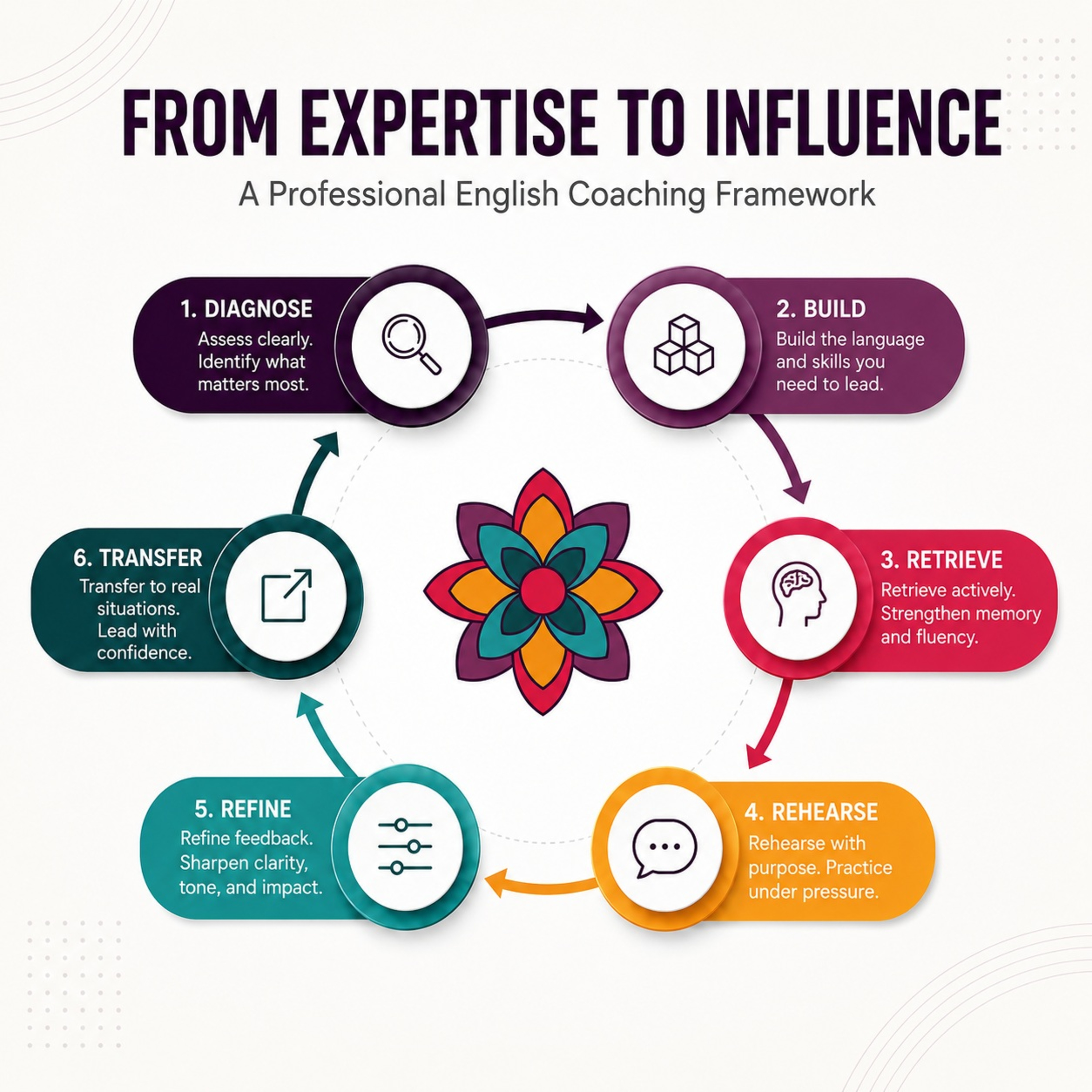
Stage 5: Transfer to Real-World Communication
The final stage of the Expertise-to-Influence Framework is Transfer: taking developing communication skills beyond the coaching session and using them independently in real professional situations. The goal is to respond, adapt and continue growing through experience.
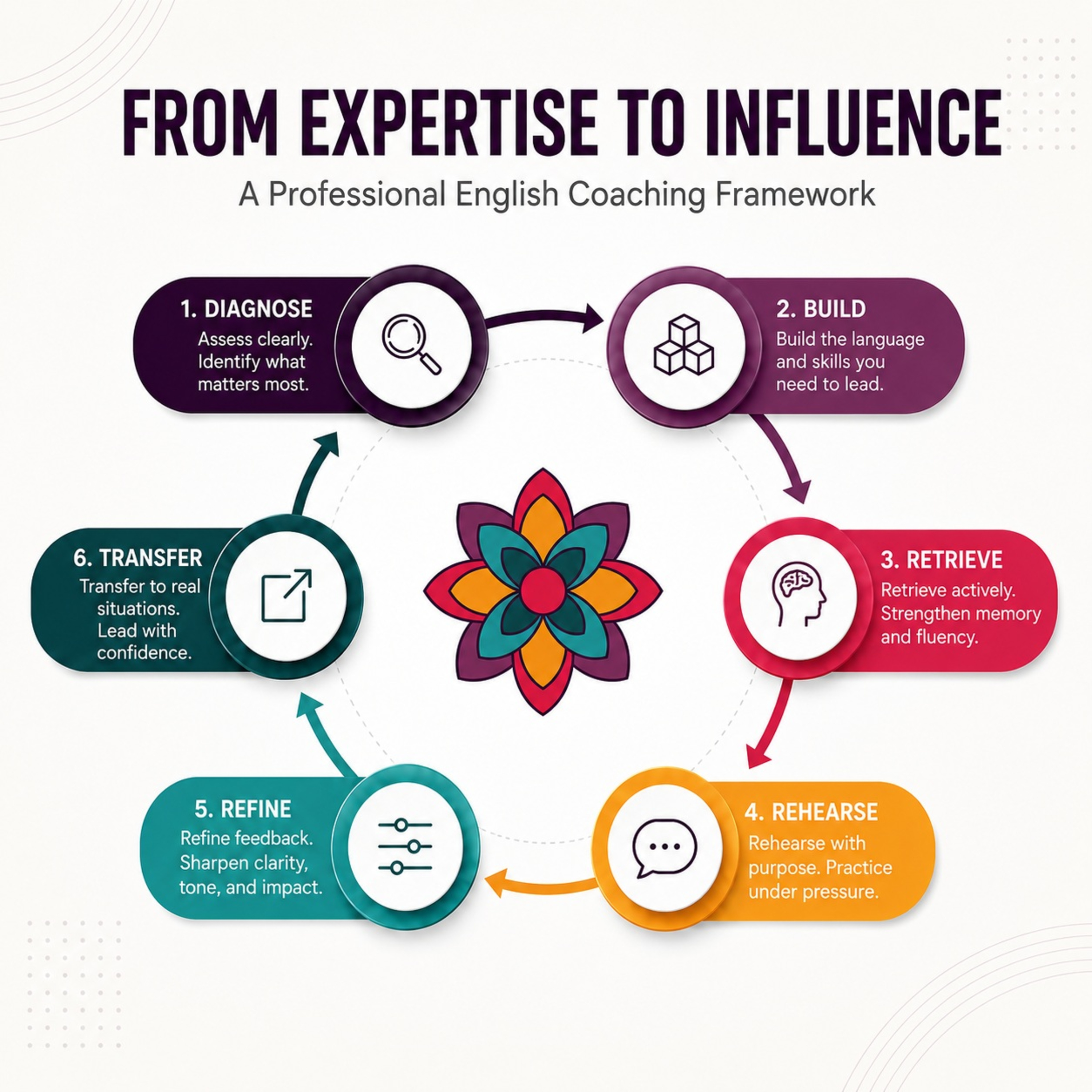
Stage 4: Rehearse Your Professional English
Stage 4 of the Expertise-to-Influence Framework focuses on rehearsal: practising realistic workplace situations so you can adapt your English when conversations, meetings and presentations do not go exactly as planned.Make your English work for you!
Stage 3: Retrieve Your English Faster
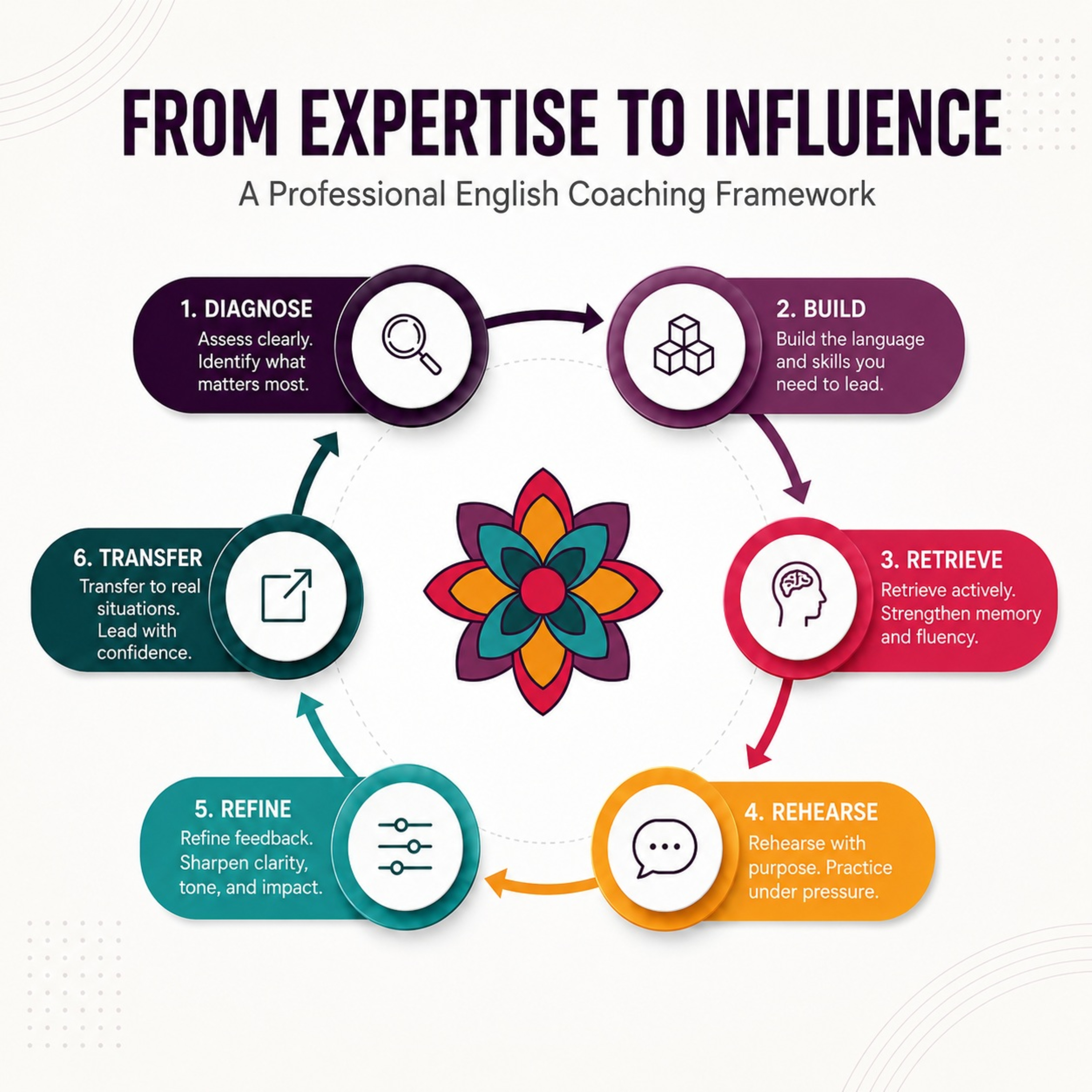
Stage 3 of the Expertise-to-Influence Framework focuses on retrieval: making useful professional English easier to access when you need it.In coaching, we practise recalling and adapting language in realistic workplace situations so that your English is more available when conversations move quickly and your expertise needs to come through.
Stage 2: Build | The Expertise-to-Influence Framework
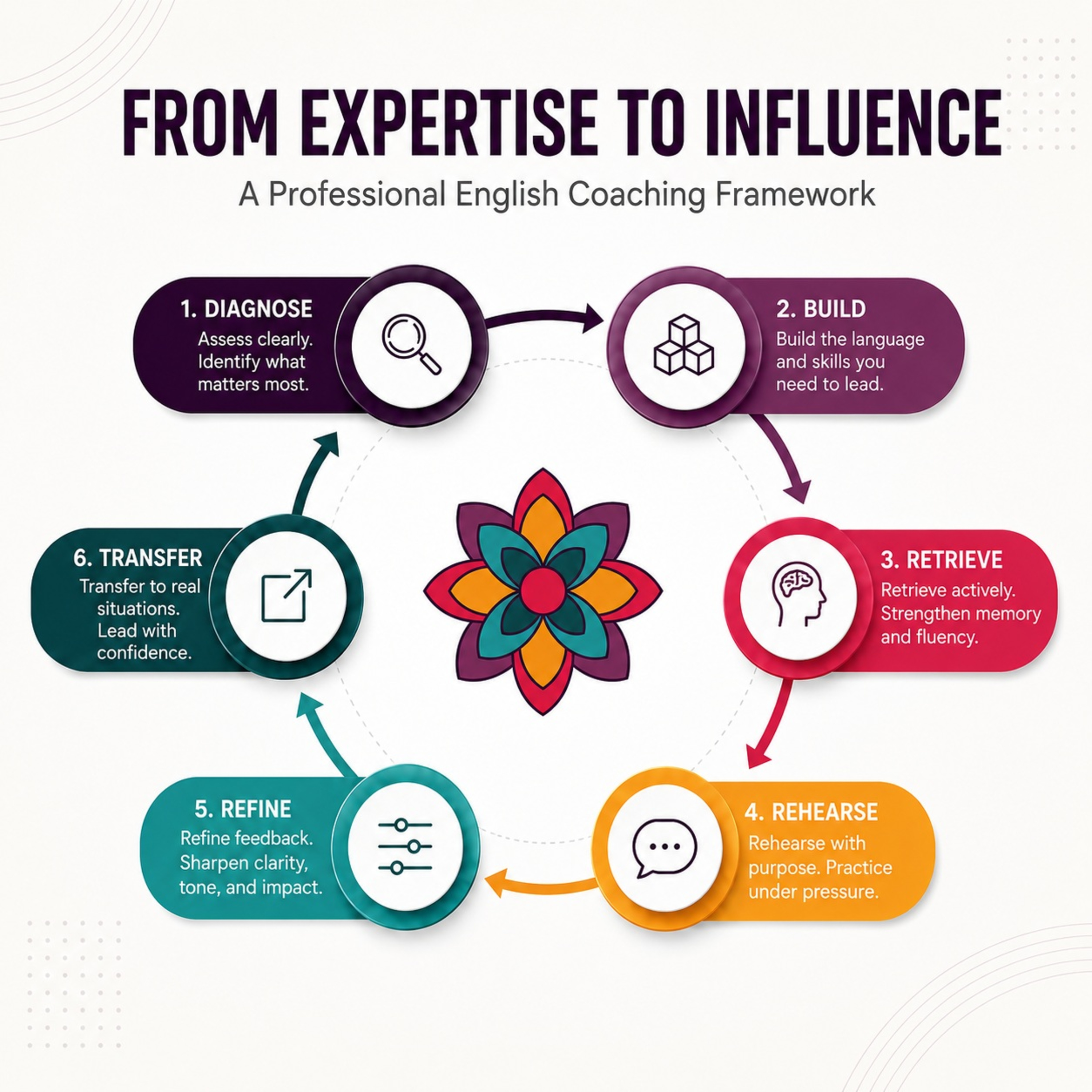
Stage 2 of the Expertise-to-Influence Framework focuses on building the language, structures, and flexibility you need to communicate effectively in real workplace situations.
Stage 1: Diagnose | The Expertise-to-Influence Framework
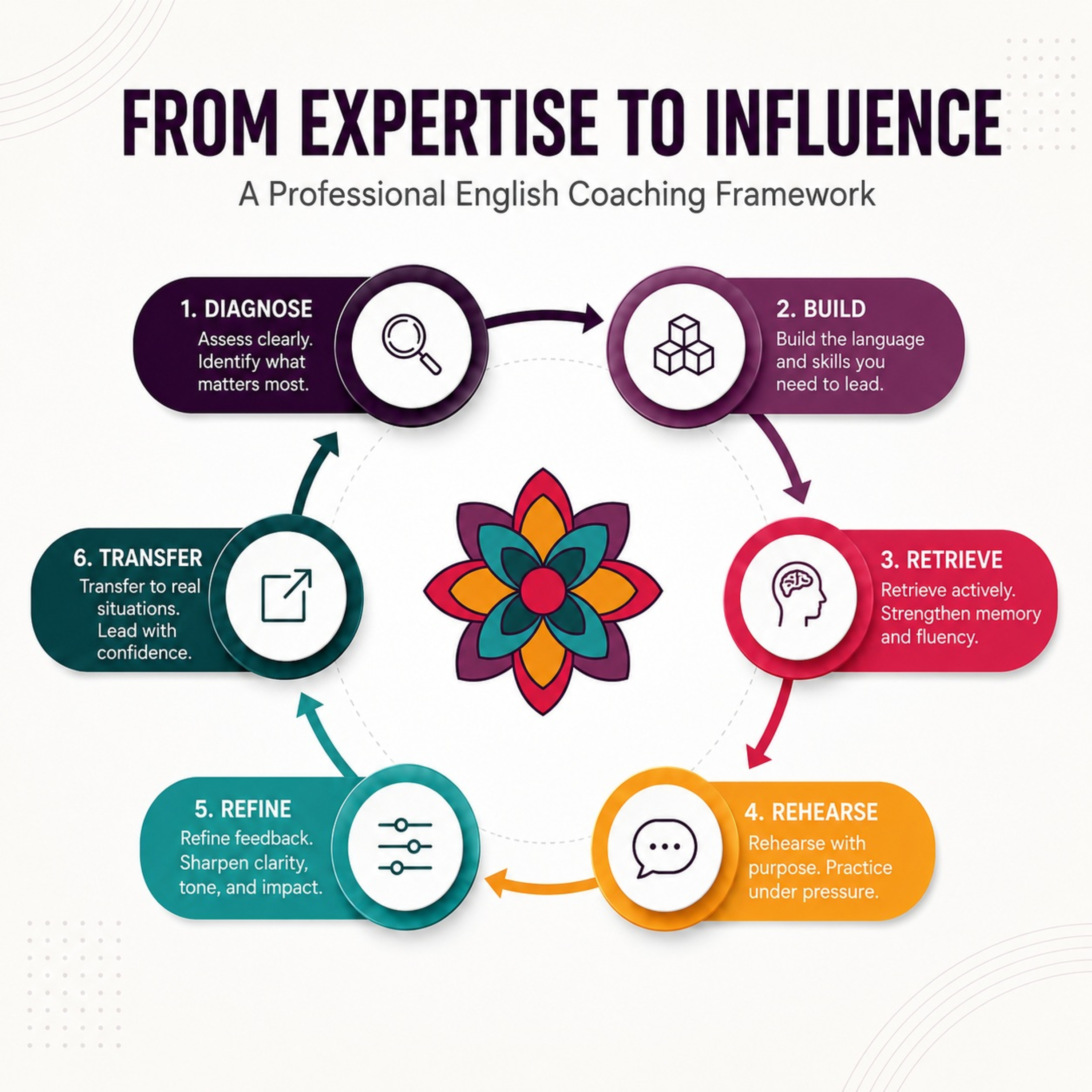
https://www.beingles.ca/post/stage-1-diagnose-where-your-english-breaks-down-the-expertise-to-influence-framework
From Expertise to Influence
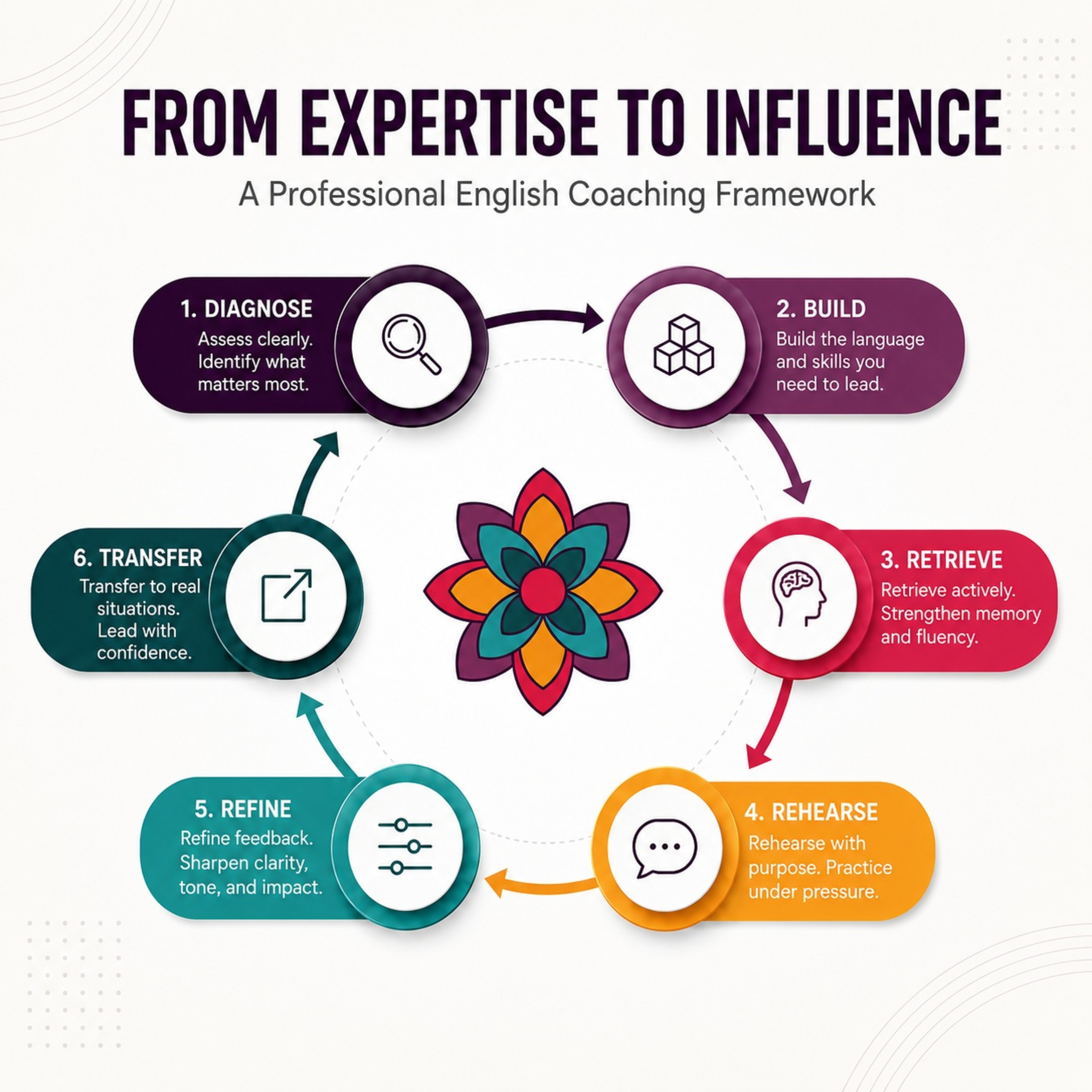
Your expertise is already there. The Expertise-to-Influence Framework is a structured Professional English coaching process that helps you develop, practise, and apply the language you need when it matters at work.Read the full article through the link in the first comment.

Leadership English - How to say "I don't know."
Strong leaders do not need to pretend they know everything. They need language that communicates honesty, sound judgement, and follow-through.In this short, learn two natural English phrases for responding when you do not have an immediate answer, without losing confidence or authority.These expressions help you acknowledge uncertainty, take ownership, and keep the conversation moving.I help exper

Leadership English - Setting Clear Expectations
Strong leaders create accountability by making expectations clear from the beginning. In this short Leadership English lesson, learn two professional phrases for setting deadlines and clarifying responsibilities without sounding controlling. Build greater confidence using English to lead with clarity, trust, and respect.

Episode 5 – Strong English. Soft Endings. Fix That.
In this episode of English for Leaders who Speak Up, we focus on one of the most overlooked leadership skills in English: closing.Many professionals negotiate well. They ask smart questions, explore options, and contribute thoughtfully. But when it’s time to bring the conversation to a clear decision, they hesitate. Not because their English is weak, but because closing requires authority. It requ

Episode 4 – The Hidden Cost of Over-Preparing in English
Over-preparing in English feels like the responsible thing to do. It feels professional. It feels safe.But what if all that preparation is quietly limiting how you show up as a leader?In this episode of English for Leaders who Speak Up, we talk about the hidden cost of over-preparing. Not from a language perspective, but from a leadership one. Because when you only feel ready once everything is wr

Episode 3 - When Speaking Up Means Disagreeing
In this episode of English for Leaders Who Speak Up, we talk about one of the most uncomfortable moments in professional English: interrupting and disagreeing.Not because you don’t know what to say.But because you care how it will land.Many strong professionals stay quiet or soften their message when they disagree. They don’t want to sound rude. They don’t want to create tension. They don’t want t

Episode 2 -When Your English Explains … But Doesn’t Persuade
In this episode of English for Leaders Who Speak Up, we explore one of the most subtle shifts in professional communication: the difference between explaining and convincing.Many professionals explain their ideas clearly in English. Their logic is solid. Their language is correct. Their message is understood. And yet, they sometimes leave meetings feeling that nothing really moved forward. People

Episode 1 - Leadership Starts When You Speak
In this first episode of English for Leaders Who Speak Up, we explore why so many professionals feel confident writing in English but hesitate when it comes to speaking. If your emails are clear and polished, yet your voice feels smaller in meetings or calls, this episode will help you understand why. You’ll learn how choosing email over conversation slowly limits your influence, and how real lead

When English Matters at Work – Episode 3: Listening in English - Asking for Clarification with Confidence
Asking for clarification in English doesn’t mean you’re unsure.In fact, avoiding clarification is often what creates the biggest risks at work.In this episode of When English Matters at Work, we look at how professionals listen actively in English — and how they ask for clarity without losing credibility, authority, or momentum.You’ll learn:Why pretending to understand is more damaging than asking

When English Matters at Work – Episode 2: Leadership English - How Language Signals Authority
Leadership English isn’t about sounding confident.It’s about how your language signals authority in real work moments.In this episode of When English Matters at Work, we look at how small language choices quietly shape how others perceive your leadership — especially in meetings, decisions, and moments of uncertainty.You’ll learn:How commitment (not confidence) shows authorityHow leaders frame con

When English Matters at Work – Episode 1: Storytelling for Leaders
When English Matters at Work – Episode 1: Storytelling for LeadersThis episode is for profesionales que ya usan inglés en su trabajo — pero que no siempre se sienten tomados en serio cuando necesitan hablar durante más tiempo.The problem is rarely vocabulary.El problema casi nunca es el nivel.It’s structure.When professionals struggle with “storytelling” in English, they’re usually not talking abo

Using English at Work — Una reflexión para 2026
Este mensaje marca el inicio de un nuevo año y una oportunidad para mirar con más claridad cómo el inglés apoya —o limita— tu comunicación profesional.Para muchos profesionales, el reto no es el nivel, sino el uso del idioma en situaciones reales de trabajo.Si quieres profundizar, he preparado una guided self-reflection breve y práctica.Está pensada para ayudarte a identificar patrones, fricciones

Episodio 9 — Cómo sonar más amable en inglés con frases cálidas
¿Quieres sonar más amable y cercana en inglés sin perder profesionalismo? En este episodio de Inglés Real, Confianza Real descubrirás tres frases cálidas que elevan tu comunicación al instante y te ayudan a conectar mejor en el trabajo, especialmente en reuniones, correos y conversaciones rápidas con colegas o clientes.Aprenderás cómo usar expresiones simples pero poderosas para transmitir clarida

Episode 8 — Cómo sonar más profesional al terminar tus ideas en inglés
¿Alguna vez sientes que tus ideas en inglés se quedan “flojas” al final? Terminar bien una frase es una de las claves para sonar más profesional, más seguro y más claro en cualquier conversación laboral. En este episodio de Inglés Real, Confianza Real, aprenderás tres frases prácticas que te ayudan a cerrar tus ideas con intención y sin divagar.Descubrirás cómo usar expresiones como “That’s the ma

Episode 7 — Palabras que dan claridad inmediata (actually, basically, totally, definitely)
¿Te disculpas demasiado en inglés? No estás solo. En este episodio de Inglés Real, Confianza Real aprenderás cómo sonar más amable y profesional sin caer en el “sorry” constante. Descubre frases prácticas, un tono más seguro y estrategias que usarás de inmediato en tus correos y reuniones.Si quieres avanzar con claridad, confianza y acompañamiento personalizado, puedes agendar tu llamada de estrat

Episode 6 — Cómo sonar amable pero firme en correos y reuniones
How do you sound polite and firm in English—especially in emails and meetings?In this episode de Inglés Real, Confianza Real, te enseño tres frases que te ayudan a comunicar límites, expectativas y dirección sin perder tu tono amable.Aprenderás cómo aclarar información, alinear a tu equipo y guiar una conversación con seguridad… sin sentirte brusca ni insegura. Perfecto para profesionales que nece

Episode 5 — Pronunciación práctica para hispanohablantes - TH + ING
La claridad en inglés no siempre depende del vocabulario: muchas veces depende de cómo suenas.En este episodio de Inglés Real, Confianza Real, trabajamos dos sonidos que marcan una gran diferencia para hispanohablantes: TH y ING.Aprenderás una técnica sencilla para producir ambos sonidos de forma natural, sin tensión y sin sonar forzado. Practicaremos juntos palabras y frases reales que usarás en

Episode 4 — Cómo usar pausas para sonar más claro en inglés
Hablar inglés con claridad no depende solo de las palabras: también depende del ritmo. En este episodio de Inglés Real, Confianza Real, descubrirás cómo usar pausas estratégicas para sonar más seguro, más claro y más profesional en cualquier reunión o presentación.Aprenderás por qué las pausas dan autoridad, cómo ayudan a organizar tus ideas y qué estructuras puedes aplicar hoy mismo para comunica

Episode 3 — Cómo sonar natural cuando no entendiste algo
No entender algo en inglés no te hace ver poco profesional. Le pasa a todo el mundo — incluso a líderes con años de experiencia. Lo que realmente importa es cómo recuperas el hilo con naturalidad y seguridad.En este episodio aprenderás dos frases simples y efectivas para manejar esos momentos sin disculparte, sin sonar confundido y sin detener la conversación. Frases como “I didn’t catch that. Cou

Episode 2 — Cómo pedir aclaraciones sin sentirte inseguro
Pedir aclaraciones en inglés no es una debilidad; es una señal de profesionalismo, precisión y liderazgo. En este breve episodio aprenderás dos frases claras y naturales que te permiten pedir claridad sin sonar inseguro, sin disculparte de más y sin perder autoridad.Te muestro cómo usar estructuras como “Could you clarify what you mean by…?” y “Just to make sure I understand…” para confirmar infor
Recommended

The Bread and Banter Podcast

The Church of What's Happening Now: The New Testament

Busted Open

Deadline: White House

Crickets Corner

History of the Earthquake and Fire in San Francisco

Fox news

K-Drama Obsessed Mamas | Beyond “Just One More Episode!”

True Crime Classics

The Healer Revolution

Becoming: HER with Nikki Spoelstra

Booked, Blonde & Busy w/ Olivia Ponton
