The AI Policy Podcast
Join CSIS’s Aalok Mehta, Director of the Wadhwani AI Center, on a deep dive into the world of AI policy. Every two weeks, tune in for insightful discussions covering AI regulation, economic impacts, national security, geopolitics, and more. CSIS is a bipartisan think tank in Washington, D.C.
Episodes
Unpacking the Data Center Backlash with Jasmine Sun
AI data centers have become a flashpoint for policymakers across the country in the leadup to midterm elections, with polls showing that seven in 10 Americans oppose new data center construction in their local area. In this episode of the AI Policy Podcast, Wadhwani AI Center director Aalok Mehta sits down with writer Jasmine Sun for a conversation about the AI data center backlash. They unpack wh
OpenAI Agents Hack Australian Government and Trump Rejects Global Governance at UNGA
This week, Aalok and Nicole discuss new reports of rogue AI agents on the open internet – including the first known case of an agent hacking a government system – and the lackluster outcome of last week's highly anticipated U.S.-China summit. Plus, the Trump Administration and frontier lab CEOs present contrasting visions for AI governance at the UN General Assembly, and states continue to pass ne
How AI Startups are Navigating Regulation with Maryam Mujica and Munjal Shah
This week, Aalok is joined by Maryam Mujica, president of the General Catalyst Institute, and Munjal Shah, co-founder and CEO of generative AI startup Hippocratic AI, for a discussion on how generative AI startups are thinking about AI regulation.
Guests:
Maryam Mujica, President, General Catalyst Institute
Munjal Shah, co-founder and CEO, Hippocratic AI
Timestamps:
About the Genera
AI Safety Goes Mainstream
An Anthropic researcher's viral resignation post last week set off a maelstrom of fear around extreme AI risks. Aalok and Nicole discuss the resulting vibe shift and how frontier labs are responding. They also unpack OpenAI solving one of the most difficult open problems in mathematics and reports of more rogue agent activity on the open internet.
Timestamps:
OpenAI solves Milleniu
Decoding State-Level Regulation with Jason Elliott
This week, Aalok is joined by Jason Elliott, the former Deputy Chief of Staff to California Governor Gavin Newsom, for a conversation about regulating AI at the state level.
Guests:
Jason Elliott, President, Versus Solutions
Timestamps:
Jason's bio (0:16)
Legislating at the state vs. federal level (2:21)
Revisiting SB-1047 (5:58)
SB-53 (13:43)
States as "laboratories of dem
METR Investigates OpenAI-Hugging Face Incident and California Legislature Advances IVO Framework
This week, we unpack findings from METR's six-day investigation of the OpenAI-Hugging Face cyber incident. We also discuss an IVO bill passed by the California Legislature, Bill Gates' take on the current moment in AI, and a federal judge striking down Anthropic's supply chain risk designation.
Additional Reading: SB-813 bill text: https://leginfo.legislature.ca.gov/faces/billNavClient.xht
Responding to AI Agent Containment Failures with CSET's Helen Toner, LawAI's Mackenzie Arnold & CSIS's Matt Pearl
This episode cross-posts a panel from the event "AI Agent Containment Failures: Technical Realities and Policy Responses," co-hosted by the Wadhwani AI Center and the Institute for Law and AI on August 24.
Check out the full event recording: https://www.csis.org/events/ai-agent-containment-failures-technical-realities-and-policy-responses
Guests:
Helen Toner, Executive Director, C
OpenAI Pauses RL Training and Anthropic Adds Watermarks to AI-Generated Text
This week, we cover updates from the ongoing cyber saga, including OpenAI's two-week pause on RL training and the cyber capabilities of Z.ai's latest model GLM-5.3. We also unpack Anthropic's move to add watermarks to text generated by Claude in compliance with the EU AI Act.
Timestamps:
Mark Zuckerberg's essay on AI (00:20)
OpenAI pauses RL training (5:56)
Cyber capabilities of GLM-5.3 (15:
Planning for the AI-Powered Economy with Windfall's Adrian Brown
In this episode, we're joined by Adrian Brown, founder and CEO of Windfall Trust, for a conversation about the economic impacts of AI.
Why the economic focus (00:58)
Capturing AI's impact in macro statistics (5:03)
Planning under uncertainty (9:44)
What's driving the AI backlash (17:27)
A new social contract for the AI era (20:31)
Are governments taking AI seriously enough? (31:21)
The AI Policy Podcast Trailer
Join CSIS’s Aalok Mehta, Director of the Wadhwani AI Center, on a deep dive into the world of AI policy. Every two weeks, tune in for insightful discussions covering AI regulation, economic impacts, national security, geopolitics, and more. CSIS is a bipartisan think tank in Washington, D.C.
Three More AI Hacking Incidents, and a Push to 'Pace the Frontier'
In this episode, we touch on Texas' new verification and audit requirement for data center developers seeking connection to the state's grid (1:11) before unpacking Anthropic's disclosure of three incidents in which its models hacked into another company during internal cyber evaluations (11:02). We discuss how these incidents—in addition to a previously disclosed incident at OpenAI—are drivi
A Deep Dive Into IVOs with Fathom's Bri Treece
In this episode, we're joined by Fathom co-founder and President Bri Treece for a conversation about third-party solutions to AI governance. Bri makes the case for Independent Verification Organizations, or IVOs, as the ideal AI governance model (5:32) and explains what historical analogies have to teach us about regulating AI (10:39). We also discuss the role IVOs can play in assuaging the public
Japan's Take on AI Sovereignty with Hiroki Habuka
In this episode, we're joined by Hiroki Habuka for a conversation about Japan's approach to AI sovereignty. We discuss how the Japanese government defines sovereign AI (1:08) and how that definition shifted following the Trump Administration's move to block foreign access to Anthropic's Fable in June (7:58). We also cover Japan's AI Promotion Act (13:52) and the country's take on copyright and AI
OpenAI Models Hack Hugging Face, Kimi K3's "DeepSeek Moment," and New York's Data Center Moratorium
In this episode, we discuss reports that OpenAI models escaped a sandboxed evaluation and breached Hugging Face's infrastructure (00:33). We then turn to Moonshot AI's Kimi K3, which has prompted talk of a second "DeepSeek moment," along with the distillation and export-control questions surrounding it (8:31). Finally, we cover New York Governor Kathy Hochul's executive order pausing data center p
Canada's Approach to AI Sovereignty with Sean Mullin
In this episode, we're joined by Sean Mullin for a conversation on Canadian AI sovereignty. We discuss implications of the Trump Administration restricting foreign nationals' access to Fable (1:33); highlights from Canada's June 2026 National AI Strategy (13:05); the country's approach to AI regulation, including its AI and Data Act and (27:38); and more.
Sean is a senior fellow at the Munk Schoo
Illinois Mandates Third-Party Audits of Frontier Labs and Trump Lifts Export Controls on Anthropic's Fable
In this episode, we discuss the AI Safety Measures Act, or SB 315, Illinois' new frontier AI bill that mandates third-party audits for frontier AI labs (:51). We also cover the Trump administration's decision to lift export controls on Anthropic's Fable and Mythos models (7:34), Anthropic's claim that Alibaba extracted capabilities from Claude in a large-scale distillation attack (17:46), and Open
Advancing AI Readiness with SeedAI's Austin Carson and Joshua New
In this episode, we're joined by Austin Carson and Joshua New of SeedAI, a nonprofit focused on building AI readiness in the United States. We discuss their backgrounds (00:56), SeedAI's mission and projects (10:28), opportunities and risks from using AI to advance scientific discovery (14:15), and more.
White House Imposes Export Controls on Anthropic's Fable and Tech CEOs Join Heads of State at G7 Summit
In this episode, we're joined by Kate Koren, deputy director of the Economics Program and Scholl Chair at CSIS, to discuss the Trump administration's recent move to impose export controls on Anthropic's Fable 5 and Mythos 5 models. We walk through the events leading up to the administration's decision (:47) and explore what authorities the Commerce Department has to restrict access to AI models (6
Trump Signs Mythos-Inspired Executive Order After Delay and Reps. Obernolte and Trahan Release Draft Federal Framework for AI
In this episode, we unpack the Mythos-inspired executive order "Promoting Advanced Artificial Intelligence Innovation and Security," which the Trump administration issued on June 2 after an initial delay (2:10). We also cover the draft federal AI framework released by Reps. Jay Obernolte and Lori Trahan (14:53) and recent proposals for the U.S. government to acquire shares of American AI companies
Bridging the Public-Private Tech Talent Divide with Arun Gupta
In this episode of the AI Policy Podcast, Wadhwani AI Center Director Aalok Mehta is joined by Arun Gupta, CEO of NobleReach Foundation and experienced venture capitalist, for a discussion on bridging the technology talent gap between the private and public sectors. They will cover the mission and accomplishments of NobleReach, the newly launched US Tech Force and its implications for AI adoption
Pope Leo Weighs in on AI and Trump Postpones Mythos-Inspired Executive Order
In this episode, Aalok Mehta makes his first appearance as the new host of the AI Policy Podcast. We briefly discuss what listeners can expect in this new chapter of the podcast before diving into Pope Leo XIV's recent encyclical on AI (1:45). We also cover President Trump's postponed executive order on AI and cybersecurity, including what the EO likely contained and why its signing ceremony was u
The Next Chapter of the AI Policy Podcast
In this episode, founding host Gregory C. Allen announces his departure from CSIS and introduces Aalok Mehta, Director of the Wadhwani AI Center, as the new host of the AI Policy Podcast.
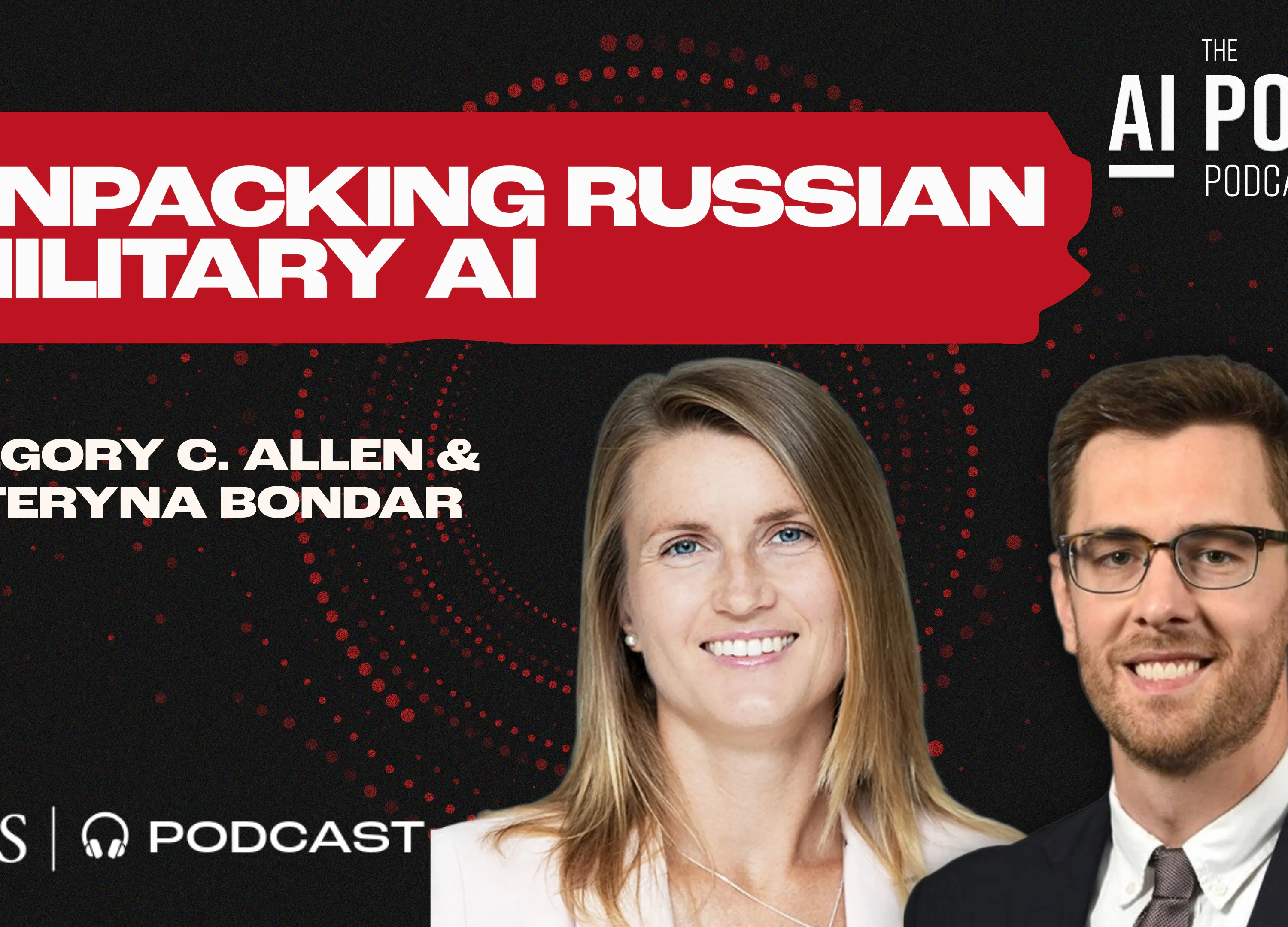
Unpacking Russian Military AI with Kateryna Bondar
In this episode, we are joined by Wadhwani AI Center fellow Kateryna Bondar to discuss her recent reports on Russia's military AI, "How Russia Is Building a Sovereign Drone Ecosystem for AI-Driven Autonomy" and "How Russia Is Reshaping Command and Control for AI-Enabled Warfare."
We cover Kateryna's background (1:07) before doing a deep dive into the role technological innovation has played in t
Inside Project Maven and AI-Powered Warfare with Katrina Manson
In this special episode, we sit down with Katrina Manson, author of Project Maven: A Marine Colonel, His Team, and the Dawn of AI Warfare. We explore what drew Katrina to this story (2:31), trace the turbulent history of Project Maven and the obstacles it has overcome (8:03), examine how the U.S. leveraged Maven to support Ukraine against Russia (31:32), and discuss Katrina's latest reporting on M
Trump's National AI Framework and Super Micro's Chip Smuggling Indictment
In this episode, we unpack President Trump's new national framework for AI legislation (11:15), including reactions from experts and policymakers (39:44). We also discuss the indictment of a Super Micro co-founder for smuggling Nvidia chips into China (42:59) and Nvidia receiving permission to sell H200 chips to China (57:04).
Anthropic Goes to Court While Claude Goes to War in Iran
In this episode, we provide a detailed update on the Anthropic-Pentagon clash, including the Trump Administration's decision to label Anthropic "a supply chain risk" (4:17), the lawsuits Anthropic has filed in response (11:45), and what these lawsuits and recent reporting reveal about how Claude has been used in the war in Iran (43:20).
A Crash Course on AI Standards with Google DeepMind's Owen Larter
In this episode, we're joined by Owen Larter, Head of Frontier Policy and Public Affairs at Google DeepMind, to explore the often-overlooked world of AI standards and the role they play in shaping how AI is developed and governed. We discuss what standards are and why they matter for technological progress (2:53), how standards are developed and the key organizations involved (16:05), the relation
Andreessen Horowitz's Jai Ramaswamy, Matt Perault: AI Regulation & Innovation
In this episode of the AI Policy Podcast, Wadhwani AI Center senior adviser Gregory C. Allen is joined by Andreessen Horowitz Chief Legal and Policy Officer Jai Ramaswamy and head of AI policy Matt Perault for a discussion on a16z's AI policy agenda. They will cover a16z's entrance into politics, their position on state and federal AI regulation, and how to ensure AI benefits society.
Jai Rama
Inside Anthropic's Standoff with the Pentagon and What It Means for Military AI
In this episode, we break down the escalating Anthropic-Pentagon clash, including the best arguments for either side, Defense Secretary Pete Hegseth's ultimatum, and the potential consequences of designating Anthropic as a "supply chain risk" or invoking the Defense Production Act (00:34). We then discuss several recent stories that are sparking discourse about the economic impacts of AI (28:58) a
Live from New Delhi: Our Takeaways from the India AI Impact Summit
This special episode was recorded in India on the last day of the India AI Impact Summit. We discuss the highlights of our experience at the Summit (00:25), whether India accomplished its goals for the event (10:25), major AI investments announced (16:01), and key messages from speeches by AI CEOs (19:45) and government officials (28:35).
Inside The Second International AI Safety Report with Writers Stephen Clare and Stephen Casper
The second International AI Safety Report, released on February 3, brings together insights from over 100 AI experts across 30 countries to assess the current state of frontier AI systems. The report examines advanced models' capabilities, the risks they pose, and the technical and governance measures needed to ensure their safe development and deployment.
In this episode of the AI Policy Podcas
Jennifer Pahlka on Reforming Government for the AI Era
In this special episode recorded at Fathom’s 2026 Ashby Workshops, Greg sits down with Jennifer Pahlka, founder of Code for America and author of Recoding America: Why Government Is Failing in the Digital Age and How We Can Do Better. Jennifer walks us through her career journey, from filing paperwork at a child welfare agency to helping pioneer the U.S. Digital Services in the Obama administratio
The Indian and French Ambassadors to the US on Global AI Summits
This episode cross-posts a fireside chat with the Ambassadors of India and France to the United States, Amb. Vinay Kwatra and Amb. Laurent Bili. The discussion was recorded at the Wadhwani AI Center’s January 30 conference, “Exploring Global AI Policy Priorities Ahead of the India AI Impact Summit.” A full recording of the conference, including additional panels and speakers, can be found here.
The Future of Nvidia’s H200 in China and the Pentagon's New AI Strategy
In this episode, we discuss and evaluate the BIS' new export policy for Nvidia's H200 chips (00:31) before turning to Beijing's decision to block H200 imports (20:18). We then unpack the Pentagon's recently published AI Strategy, including the shift it represents in DOW's approach to AI integration (29:17).
Read the CNAS commentary "Unpacking the H200 Export Policy" here.
xAI's Latest Controversy and New York's New AI Safety Bill
In this episode, we examine Grok’s public posting of child sexual abuse material and non-consensual intimate imagery (00:27), the legal consequences xAI may face (12:41), and the international policy community's response (19:05). We then unpack New York’s RAISE Act, including the politics leading up to Gov. Hochul’s signature (22:51) and the final outcome of negotiations (28:16).
China's EUV Manhattan Project and Export Control Mythbusting with Chris McGuire
In this episode, we're joined by Chris McGuire for a conversation about AI and semiconductor export controls. We begin by discussing Chris' career path into AI and national security (1:55), then turn to his views on recent developments, including reports about a Chinese EUV prototype (11:07). We spend the rest of the episode rating common arguments against AI export controls as fact, fiction, or s
Previewing India's AI Impact Summit with MeitY Secretary S. Krishnan
Since 2023, a series of global AI summits has brought together world leaders to advance international dialogue and cooperation on artificial intelligence. Building on this momentum, Prime Minister Narendra Modi announced the India AI Impact Summit, which will take place in New Delhi in February 2026. As the first summit in the series to be hosted in a Global South country, the AI Impact Summit aim
Trump Signs EO Targeting State AI Laws While Meta Showcases Risks of Weak Tech Regulation
In this episode, we unpack President Trump’s new executive order targeting state AI laws, including how the final version compares to an earlier draft (1:26), and the legal and political challenges it is likely to face (14:46). We then discuss recent Reuters reporting on Meta’s reliance on scam-driven ad revenue (22:12) and what the social media experience suggests about the risks of failing to re
White House Greenlights H200 Exports, DOE Unveils Genesis Mission, and Insurers Move to Limit AI Coverage
In this episode, we break down the White House’s decision to let Nvidia’s H200 chips be exported to China and Greg’s case against the move (00:33). We then discuss Trump’s planned “One Rule” executive order to preempt state AI laws (18:59), examine the NDAA's proposed AI Futures Steering Committee (23:09), and analyze the Genesis Mission executive order (26:07), comparing its ambitions and funding
Trump’s Draft AI Preemption Order, EU AI Act Delays, and Anthropic's Cyberattack Report
In this episode, we start by discussing Greg's trip to India and the upcoming India AI Impact Summit in February 2026 (00:29). We then unpack the Trump Administration’s draft executive order to preempt state AI laws (07:46) and break down the European Commission’s new “digital omnibus” package, including proposed adjustments to the AI Act and broader regulatory simplification efforts (17:51). Fina
What Selling Nvidia's Blackwell Chips to China Would Mean for the AI Race
In this episode, Georgia Adamson and Saif Khan from the Institute for Progress join Greg to unpack their October 25 paper, "Should the US Sell Blackwell Chips to China?" They discuss the geopolitical context of the paper (3:26), how the rumored B30A would compare to other advanced AI chips (11:37), and the potential consequences if the US were to permit B30A exports to China (32:00).
Their paper
How to Build a Career in AI Policy
One of the most common questions we get from listeners is how to build a successful career in AI policy—so we dedicated an entire episode to answering it. We cover the most formative experiences from Greg's career journey (3:30), general principles for professional success (45:09), and actionable tips specific to breaking into the AI policy space (1:11:52).
Sora 2 and the Deepfake Boom
In this episode, we cover OpenAI’s latest video-generation model Sora 2 (1:02), concrete harms and potential risks from deepfakes (5:18), the underlying technology and its history (27:03), and how policy can mitigate harms (36:31).
Congressman Jay Obernolte on the Future of U.S. AI Regulation
In this episode, we are joined by Rep. Jay Obernolte, one of Congress’s leading voices on AI policy. We discuss his path from developing video games to serving in Congress (00:49), the work of the bipartisan House Task Force on AI and its final report (9:39), competing approaches to designing AI regulation in Congress (16:38), and prospects for federal preemption of state AI legislation (40:32).
The Impact of AI on Labor with Harry Holzer
In this episode, we are joined by economist Harry Holzer to discuss how AI is set to transform labor. Holzer was Chief Economist at the U.S. Department of Labor during the Clinton administration and is currently a Professor of Public Policy at Georgetown University. We break down the fundamentals of the labor market (4:00) and the current and future impact of AI automation (10:30). Holzer also rea
What California's SB 53 Means for AI Safety
In this episode, we dive into California's new AI transparency law, SB 53. We explore the bill's history (00:30), contrast it with the more controversial SB 1047 (6:43), break down the specific disclosure requirements for AI labs of different scales (13:38), and discuss how industry stakeholders and policy experts have responded to the legislation (29:47).
The Energy Cost of AI with Joseph Majkut
In this episode, we're joined by Joseph Majkut, Director of CSIS' Energy Security and Climate Change Program, to take an in-depth look at energy's role in AI. We explore the current state of the U.S. electrical grid (11:34), bottlenecks in the AI data center buildout (43:45), how U.S. energy efforts compare internationally (1:16:06), and more.
Joseph has co-authored three reports on AI and energy
Is China Done with Nvidia’s AI Chips?
In this episode, we discuss how today’s massive AI infrastructure investments compare to the Manhattan Project (00:33), China’s reported ban on Nvidia chips and its implications for export control policy (13:41), Anthropic’s $1.5 billion copyright settlement with authors (33:49), and recent multibillion-dollar AI investments by Nvidia and ASML (44:42).
Why is China's AI Sector Booming?
In this episode, we discuss China's focus on AI adoption (00:58), the underlying factors driving investor enthusiasm (14:51), and the national security implications of China's booming AI industry (31:47).
Unpacking the EU AI Act Code of Practice with Marietje Schaake
In this episode, we are joined by Marietje Schaake, former Member of the European Parliament, to unpack the EU AI Act Code of Practice. Schaake served as Chair of the Working Group on Internal Risk Management and Governance of General-Purpose AI Providers for the Code of Practice, with a focus on AI model safety and security. We discuss the development and drafting of the EU AI Act and Code of Pra
U.S. Takes 10% Stake in Intel and Nvidia Halts H20 Production for China
In this episode, we unpack the Trump administration’s $8.9 billion deal to acquire a 9.9% stake in Intel, examining the underlying logic, financial terms, and political reactions from across the spectrum (00:33). We then cover Nvidia’s sudden halt in H20 chip production for China, its plans for a Blackwell alternative, and what Beijing’s self-sufficiency push means for the AI race (28:18).
Trump's AI Chip Licensing Deal, AI Spending Bubble Concerns, & New Advances for Gov't AI Adoption
In this episode, we'll break down the Trump administration’s new licensing agreement with Nvidia and AMD for semiconductor exports and what this development means for U.S. national security (00:35), explore concerns about an AI-driven economic bubble (22:17), and unpack recent advancements for the federal government's adoption AI after the U.S. General Services Administration approved OpenAI, Anth
H20 Export Dispute and Industry Responses to the EU AI Code of Practice
In this episode, we cover the renewed debate over U.S. approval of Nvidia’s H20 chip exports to China, from political pushback in Washington to reactions in Beijing (00:30). We also examine how the AI industry is responding to the EU AI Code of Practice and the reasons some companies are choosing not to sign (44:53).
Read Gregory C. Allen's report on DeepSeek here.
Watch or listen to our event
Unpacking the White House AI Action Plan with OSTP Director Michael Kratsios
On July 30, the CSIS Wadhwani AI Center hosted Michael Kratsios, Director of the White House Office of Science and Technology Policy for a discussion breaking down the recently released AI Action Plan and discuss the Trump administration’s vision for U.S. AI leadership and innovation amid strategic competition with China.
As the thirteenth Director of the White House OSTP, Mr. Kratsios oversees
In Memoriam: Andrew Schwartz, Our Friend and Colleague
In this special episode, we honor the life of Andrew Schwartz, Chief Communications Officer at CSIS and beloved co-host of this podcast. Andrew was a mentor, a friend, and a tireless champion of the CSIS Wadhwani AI Center’s work. His humor, personal stories, and passion shaped this show and left a lasting impact on all of us. Our team, our community, and CSIS will miss him deeply.
China's AI Industrial Policy with Kyle Chan
In this episode, we are joined by Kyle Chan, postdoctoral researcher at Princeton’s Sociology Department and adjunct researcher at the RAND Corporation, to explore China's approach to AI industrial policy. We discuss the fundamentals of industrial policy and how it operates in China's digital technology sector (4:15), the evolution of China's AI industrial policy toolkit and its impact on companie
Senate Strikes AI Law Moratorium, Courts Rule on Copyright Cases, and Congress Talks AGI
In this episode, we cover the Senate's vote to remove the moratorium on
state AI laws from the reconciliation bill (00:38), the latest AI copyright
court rulings involving Meta and Anthropic (7:38), key takeaways from the House Select Committee on China's AI hearing (20:55), and the latest developments surrounding DeepSeek, including export control impacts and military ties (27:45).
AI, Cybersecurity, and Securing Model Weights with Miles Brundage and Chris Rohlf
In this episode, we’re joined by Miles Brundage, independent AI policy researcher and former Head of Policy Research at OpenAI, and Chris Rohlf, Security Engineer at Meta and cybersecurity expert. We cover the fundamentals of cybersecurity today (9:20), whether AI is tipping the offense-defense balance (21:00), the critical challenge of securing AI model weights (34:55), the debate over “AI securi
AI Safety Institute Rebrand, Congressional Hearing on Export Controls, and Meta's New Superintelligence Lab
In this episode, we discuss the U.S. AI Safety Institute's rebrand to the Center for AI Standards and Innovation (00:37), BIS Undersecretary Jeffrey Kessler's testimony on semiconductor export controls (10:36), and Meta's new AI superintelligence lab and accompanying $15 billion investment in Scale AI (22:26).
Shield AI’s Ryan Tseng on Building an Autonomous Future for the DOD
On June 9, 2025, the CSIS Wadhwani AI Center hosted Ryan Tseng, Co-Founder and President of Shield AI, a company building AI-powered software to enable autonomous capabilities for defense and national security.
Mr. Tseng leads strategic partnerships with defense and policy leaders across the United States and internationally. Under his leadership, Shield AI secured major contracts with the U
AI in the “Big Beautiful Bill” and Safety Concerns About Anthropic’s Newest Model
In this episode, we discuss House Republicans’ proposed moratorium on state and local AI laws (00:57), break down AI-related appropriations across the executive branch (18:54), and unpack the safety issues and safeguards of Anthropic's newest model, Claude Opus 4 (26:51).
Correction: In this episode, a quote was incorrectly attributed directly to Rep. Laurel Lee (R-Fla.). The statement—“Should
China's AI Industrial Policy, New Controls on Huawei's Ascend Chips, and President Trump's Middle East Trip
In this episode, we discuss Princeton researcher Kyle Chan's op-ed in the New York Times on China's industrial policy for AI and advanced technologies (0:35), what the Bureau of Industry and Security's new controls on Huawei's Ascend chips mean for China's AI ecosystem (10:09), and our biggest takeaways from President Trump's visit to the Middle East (19:07).
The AI Diffusion Rule is Rescinded, AI Executives Testify Before Congress, & AI Adoption in the IRS
In this episode, we discuss the Trump administration’s decision to rescind the AI Diffusion Framework (1:34), the message of top AI executives in their recent Senate testimony (20:03), what AI adoption could mean for the IRS (35:15), the U.S. Copyright Office’s latest report on generative AI training (44:44), and what AI policy might look like in the new papacy (49:24).
Fiscal Year 2026 Budget Request, AI Diffusion Framework Update, and the Politburo's Study Session on AI
In this episode, we discuss what the Trump administration's Fiscal Year 2026 budget request means for federal AI spending, what might happen to the AI Diffusion Framework before its May 15 implementation deadline, and what the Chinese Communist Party Politburo's Study Session on AI indicates about China's AI ambitions.
Scale AI’s Alexandr Wang on Securing U.S. AI Leadership
On May 1, 2025, the CSIS Wadhwani AI Center hosted Alexandr Wang, Founder and CEO of Scale AI, a company accelerating AI development by delivering expert-level data and technology solutions to leading AI labs, multinational enterprises, and governments. He shared his insights on key issues shaping the future of AI policy, such as U.S.-China AI competition, international AI governance, and the new
Michael Kratsios’s Vision for U.S. Tech Leadership, H20 Export Controls, and Huawei’s Ascend 920
In this episode, we discuss OSTP Director Michael Kratsios’s recent speech on US technology policy at the Endless Frontiers Retreat (0:19), the Trump administration’s decision to control the Nvidia H20 chip (10:48), and what Huawei’s announcement of the Ascend 920 chip means for U.S.-China AI competition (18:24).
A New Vision for Advancing AI Governance with Andrew Freedman
In this episode of the AI Policy Podcast, Wadhwani AI Center Director Gregory C. Allen is joined by Andrew Freedman, Chief Strategic Officer at Fathom, an organization whose mission is to find, build, and scale the solutions needed to help society transition to a world with AI. They will discuss the origins and purpose of Fathom, key initiatives shaping AI policy around the country such as Califor
Tariffs, Nvidia’s H20 Export Control Exemption, and OMB’s New AI Guidance
In this episode, we discuss what the Trump administration’s tariffs mean for the US AI ecosystem (2:42), reporting that Nvidia’s H20s will be exempt from export controls (8:58), the latest AI guidance from the White House Office of Management and Budget (OMB) (12:48), and the EU’s AI Continent Action Plan (17:07).
Mapping Chinese AI Regulation with Matt Sheehan
In this episode, we are joined by Matt Sheehan, fellow at the Carnegie Endowment for International Peace. We discuss the evolution of China's AI policymaking process over the past decade (6:45), the key institutions shaping Chinese AI policy today (44:30), and the changing nature of China's attitude to AI safety (50:55).
AI Action Plan RFI, California's AI Policy Working Group Report, and Why Programming Jobs Are Disappearing
In this episode, we discuss AI companies' responses to the White House AI Action Plan Request For Information (RFI) related to key areas like export controls and AI governance (00:51), the release of the Joint California Policy Working Group on AI Frontier Models draft report (24:45), and how AI might be affecting the computer programming job market (40:10).
The State and Local AI Regulation Landscape with Dean Ball
In this episode of the AI Policy Podcast, Wadhwani AI Center Director Gregory C. Allen is joined by Dean Ball, Research Fellow in the Artificial Intelligence & Progress Project at George Mason University’s Mercatus Center. They will discuss how state and local governments are approaching AI regulation, what factors are shaping these efforts, where state and local efforts intersect, and how a fract
Deepseek Report, Manus AI, and the DOD’s New Acquisition Approach
In this episode, we discuss the Wadhwani AI Center’s latest publication on the implications of DeepSeek for the future of export controls (0:40), Chinese company Manus AI (9:05), what Secretary Hegseth’s memo means for the DOD AI ecosystem (15:27), and xAI’s acquisition of 1 million square feet for its new data center in Memphis (21:28).
The UAE's AI Ambitions
In this special episode, we are joined by Georgia Adamson, Research Associate at the CSIS Wadhwani AI Center, Lennart Heim, Associate Information Scientist at RAND, and Sam Winter-Levy, Fellow for Technology and International Affairs at the Carnegie Endowment for International Peace. We outline the biggest takeaways from our recent report about the UAE's role in the global AI race (2:34), the deta
Grok 3, DOGE, and Xi Jinping's Meeting with DeepSeek
In our first video episode, we discuss xAI's release of the Grok 3 family of models, the Department of Government Efficiency's (DOGE) impact on the federal AI workforce, Xi Jinping's meeting with major Chinese AI company executives, and what the Evo-2 model could mean for the future of biology.
Unpacking the AI Action Summit
In this special episode, Greg breaks down his biggest takeaways from the Paris AI Action Summit. He discusses France’s goals for the summit (5:05), Vice President JD Vance’s speech about the US vision for AI (12:16), the EU’s approach to the convening (17:13), why the US and UK did not sign the summit declaration (20:50), and the rebranded UK AI Security Institute (23:20).
DeepSeek Deep Dive
In this crossover episode with Truth of the Matter, we discuss the origins of Chinese AI Company DeepSeek (0:55), the release of its DeepSeek R1 model and what it means for the future of U.S.- China AI competition (3:05), why it prompted such a massive reaction by U.S. policymakers and the U.S. stock market (14:04), and the Trump administration's response (24:03)
Week 1 of the Trump administration, AGI timelines, and DeepSeek
In this episode, we break down President Trump's repeal of the the Biden administration's Executive Order (EO) on AI (1:00), the release of the America First Trade Policy memorandum (9:52), and the Trump administration's own AI EO (15:02). We are then joined by Lennart Heim, Senior Information Scientist at the RAND Corporation to discuss the Stargate announcement (20:40), how AI company CEOs are t
Executive Order on AI and Energy Infrastructure - Emergency Podcast 2.0
In this special episode of the AI Policy Podcast, Andrew, Greg, and CSIS Energy Security and Climate Change Program Director Joseph Majkut discuss the Biden administration's Executive Order on Advancing United States Leadership in Artificial Intelligence Infrastructure. They consider the motivation for this measure and its primary goals (1:07), its reception among AI and hyperscaler companies (12:
AI Diffusion Framework - Emergency Podcast
In this pressing episode, we break down the release of the Biden administration's Framework for Artificial Intelligence Diffusion. We discuss the rationale for this latest control (0:52), and its reception among major AI and semiconductor firms (8:14), U.S. allies (17:15), and the incoming administration (19:48).
Export Control Update, White House AI Czar, OpenAI-Anduril Team-up, and China’s Loyal Wingman
In this episode, we discuss the December 2nd semiconductor export control update (0:45), the Trump administration’s appointment of David Sacks as the White House AI czar (5:35), the OpenAI and Anduril partnership and its implication for national security (9:31), and the latest from China’s autonomous fighter aircraft program (16:39).
Recommended

Fantasy Flex

زن بودن

Medicine with Meaning

Yours Truly Johnny Dollar Collection

Take Back Your Health®

CBS Radio Mystery Theater | Old Time Radio

Solved Murders - True Crime Stories

紐約鳥|New York Aperture
The Swerve Podcast: Obscure Topics | Conspiracy Theories

The Bread and Banter Podcast

The Church of What's Happening Now: The New Testament
Busted Open
