HomePodcastsGreat Zimbabwe: The Lost African Kingdom of Stone — Fexingo History
Great Zimbabwe: The Lost African Kingdom of Stone — Fexingo History
Fexingo89 EpisodesOct 13, 2026
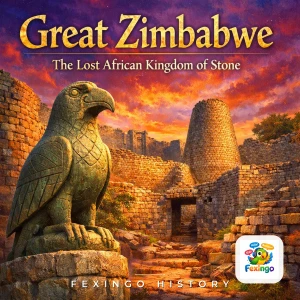
Perched on a windswept plateau in southern Africa, Great Zimbabwe stands as the continent's most monumental pre-colonial stone city — a testament to the ingenuity of the Shona civilization that built it between the 11th and 15th centuries. This show, hosted by Lucas and Luna, delves into the rise of the Kingdom of Zimbabwe, from its origins as a modest ironworking settlement to its zenith as a trading power whose gold and ivory reached as far as China and Persia. We explore the architectural marvel of the Great Enclosure, with its dry-stone walls rising 11 meters high, and the enigmatic soapstone birds that have become the nation's emblem. We confront the colonial erasure of African civilization: how Portuguese explorers and later Cecil Rhodes' British South Africa Company dismissed Great Zimbabwe as the work of Phoenicians or Arabs, a racist fiction that persisted into the 20th century. Through archaeology, oral traditions, and recent DNA studies, we piece together the kingdom's court life, its control of Indian Ocean trade routes through Sofala, and its eventual decline due to environmental pressure and shifting trade networks.
Episodes
Great Zimbabwe's Soapstone Birds: Sacred Art or Trade Tokens?Oct 13, 20267:26For decades, the soapstone birds of Great Zimbabwe were dismissed by early European explorers as mere curiosities or African craft imitations, with no place in a grand civilization. This episode uncovers the truth behind these fourteen iconic figures carved from local stone between the 11th and 15th centuries. We explore how these objects functioned as potent symbols of spiritual authority, connec
The Great Enclosure’s Acoustic SecretsOct 12, 20267:34For decades, visitors to Great Zimbabwe stood in the shadow of the Great Enclosure and assumed the curved walls were merely structural feats of dry-stone masonry. But recent acoustic studies suggest these architects designed the space for sound as much as shelter. In this episode, we explore how the specific curvature of the granite blocks, combined with the hard-packed earth floors, created a nat
Great Zimbabwe's Gold Monopoly and Indian Ocean TradeOct 10, 20265:57While previous episodes explored the architectural genius of the vavaki and the spiritual weight of the mhondoro, this episode uncovers the economic engine that built these stone walls: the gold trade. We trace how the rulers of Great Zimbabwe maintained a tight monopoly on the region’s gold, channeling it through the port of Sofala to Swahili merchants who then connected with markets as far away
Great Zimbabwe's Daily Life and Social HierarchyOct 9, 20269:58We’ve spent many episodes discussing the monumental stone walls, the political intrigue of the Mwene Mutapa, and the vast trade networks that connected Great Zimbabwe to the Swahili Coast. But what did it actually feel like to live inside those enclosures? In this episode, we step away from kings and conquests to examine the daily rhythms of ordinary life in the thirteenth and fourteenth centuries
The Architects of Great Zimbabwe's Stone WallsOct 8, 20268:44We step away from the gold mines and royal succession dramas to examine the invisible hands that built Great Zimbabwe. This episode explores the vavaki, the guild of stonemasons who mastered dry-stone construction without mortar. Lucas traces their technical evolution from the sloping walls of Mapungubwe to the intricate chevron patterns of the Great Enclosure. Luna asks about the daily reality of
Great Zimbabwe's Hidden Water SystemsOct 7, 20266:58While earlier episodes have explored the political intrigue, gold trade, and sacred rituals of Great Zimbabwe, this episode turns its gaze to the invisible infrastructure that made the city possible. We examine how the Shona engineers managed water in a semi-arid region, focusing on the sophisticated drainage channels, cisterns, and rainwater harvesting techniques visible today. Lucas walks us thr
The Great Enclosure's Acoustic SecretsOct 6, 20265:44Great Zimbabwe’s Great Enclosure is more than a architectural marvel; it was an acoustic instrument. This episode explores how the stone walls were engineered to amplify and direct sound, creating a soundscape of power that shaped political life in the fourteenth century. We examine the specific geometry of the conical tower and the curved walls, which acted as natural amplifiers for the Mwene Mut
Great Zimbabwe's Diplomatic Letters to the WorldOct 5, 20267:44For centuries, European maps erased Great Zimbabwe from existence, labeling it a 'myth' or the work of Phoenicians and Queen Sheba. This episode uncovers how indigenous Shona historians preserved the true lineage of the Mwene Mutapa through oral epic poetry known as dzimbahwe. We explore the pivotal moment in the late 19th century when explorer Carl Mauch stumbled upon the ruins, sparking a coloni
Great Zimbabwe's Maritime Silk RoadOct 4, 202611:10We usually think of Great Zimbabwe as a landlocked stone fortress, but its true power lay in its connection to the Indian Ocean. This episode explores how Shona merchants navigated the treacherous waters of Sofala to trade gold and ivory for Chinese porcelain, Indian cotton, and Persian glass beads. We trace the route from the Limpopo River to the Swahili coast, examining the archaeological eviden
Great Zimbabwe's Diplomatic Letters to the WorldOct 3, 20266:17Long before modern borders were drawn, the rulers of Great Zimbabwe sent formal letters across the Indian Ocean, establishing diplomatic ties with distant powers. This episode explores the correspondence between the Mwene Mutapa and foreign merchants, revealing a sophisticated state apparatus that managed trade and politics through written communication. We examine how these documents traveled fro
Great Zimbabwe's Royal Succession Crisis: The Battle for PowerOct 2, 20268:41In this episode, we explore the violent political fractures that eventually led to Great Zimbabwe’s decline. While previous episodes covered trade and architecture, we focus on the internal power struggles between rival royal houses. We examine the role of the mhondoro ancestral spirits in legitimizing rule and how succession disputes escalated into open conflict. Lucas walks us through the shifti
Great Zimbabwe's Lost Water ManagementOct 1, 20267:38While earlier episodes have explored Great Zimbabwe’s gold trade, soapstone carvings, and political succession crises, this episode turns to the invisible infrastructure that made the city possible: its sophisticated hydraulic engineering. We examine how the Shona architects of the Hill Complex and Great Enclosure managed water in a semi-arid region with no perennial rivers. Lucas and Luna discuss
Great Zimbabwe's Silent Collapse: Drought and DisplacementSep 30, 20266:23While previous episodes have explored Great Zimbabwe’s architectural genius, gold trade, and political intrigue, this episode investigates the environmental catastrophe that ultimately forced its abandonment. We examine the paleoclimatological evidence pointing to a severe megadrought in the thirteenth century, analyzing how shifting rainfall patterns strained the region’s agricultural systems. Lu
Great Zimbabwe's Forgotten Slave Trade NetworksSep 29, 20269:20While earlier episodes explored the stone walls, gold mines, and architectural guilds of Great Zimbabwe, this episode shifts focus to the human cost of its prosperity: the trans-Saharan and Indian Ocean slave trade. We trace how the Kingdom of Zimbabwe became a crucial hub in the medieval African slave market, supplying labor and captives to distant empires. Lucas and Luna examine the role of the
Great Zimbabwe's Royal Succession CrisisSep 28, 20265:22In this episode, we trace the fragile political architecture of the Mwene Mutapa state as it navigated the turbulent decades following Great Zimbabwe’s decline. We explore how royal succession was not merely a family matter but a complex ritual involving the mhondoro ancestral spirits and the vavaki architect guilds. Lucas walks us through the specific tensions between the Hill Complex elites and
Great Zimbabwe's Missing MonarchsSep 27, 202610:28For centuries, the towering stone walls of Great Zimbabwe stood as a testament to the power and sophistication of the Shona people, yet the specific names of the rulers who built them were largely erased from the historical record. In this episode, we explore how early European explorers like Richard Francis Burton and Carl Mauch dismissed the site as the biblical Ophir or Solomon’s Mines, refusin
Great Zimbabwe's Royal Succession CrisisSep 26, 20268:53The collapse of Great Zimbabwe wasn't just a failure of agriculture or trade; it was a catastrophic political fracture. In this episode, we examine the contested succession of the late 15th century, where the death of a powerful Mambo triggered a civil war that split the kingdom. We look at how rival factions vied for control of the sacred Hill Complex and the lucrative gold mines, leading to the
The Stone Carvers: Great Zimbabwe's Lost GuildsSep 25, 202613:12We often marvel at the sheer scale of Great Zimbabwe’s dry-stone walls, but we rarely consider the hands that built them. In this episode, we shift our focus from kings and trade routes to the artisans themselves—the vavaki, the master guild of stonemasons who turned soapstone into sacred geometry. We explore how these craftsmen operated not as laborers, but as a specialized elite with their own l
Great Zimbabwe's Royal Succession CrisisSep 24, 20266:46Episode 246 explores the volatile political landscape of Great Zimbabwe during the late fifteenth century, focusing on the internal power struggles that followed the death of a prominent Mambo. Rather than external invasion or environmental collapse, this episode examines how the complex web of vavaki guilds and clan leadership turned succession into a civil conflict. We look at the role of the mh
Great Zimbabwe's Royal Succession CrisisSep 23, 20267:27In Episode 245, Lucas and Luna explore the political fracture that followed the death of the Mambo in the early 15th century. While previous episodes covered trade, architecture, and decline, this episode focuses on the internal power struggle between the Hill Complex elites and the Valley Enclosure merchants. We examine how the rivalry over the mwene mutapa title split the kingdom, leading to the
Great Zimbabwe's Iron Empire and Trade NetworksSep 22, 20266:07We often think of Great Zimbabwe as a center of gold and ivory, but its true industrial might lay in iron. This episode explores the vaShona smiths who powered the region’s economy through advanced metallurgy. We look at how the vavaki guilds managed production from the Mashonaland highlands to the coast at Sofala. The narrative traces the journey of iron ingots along trade routes that connected i
Great Zimbabwe's Soapstone Birds: Sacred SymbolsSep 21, 20265:42We explore the mysterious soapstone birds of Great Zimbabwe, those iconic carved figures that have come to define the site’s image. But what were they really? Were they perches for royal ancestors, symbols of power, or something else entirely? Lucas and Luna dig into the archaeology of these artifacts, examining their placement in the Great Enclosure and the Valley Enclosures. We discuss the debat
The Royal Baths and Ritual Cleansing at Great ZimbabweSep 20, 20267:19While earlier episodes explored the architectural genius of the vavaki guilds and the economic power of gold trade, this episode turns to a more intimate dimension of life within the Hill Complex: the royal bathing rituals. We examine how water was not merely a utility but a sacred medium for political legitimacy and spiritual purification. Lucas traces the engineering feats required to channel cl
Great Zimbabwe's Ancient Gold MinesSep 19, 20266:48While earlier episodes explored the trade routes and architectural marvels of Great Zimbabwe, this episode turns its gaze underground to the source of the kingdom’s wealth: the gold mines themselves. We trace the journey of gold dust from the deep veins of the Mashonaland highlands to the hands of merchants on the Swahili coast. Lucas and Luna examine how the vaShona people extracted gold without
Great Zimbabwe's Gold and the Portuguese Silver CrisisSep 18, 20268:35In Episode 240, Lucas and Luna explore the economic engine that built Great Zimbabwe: the gold trade. While previous episodes covered stone architecture and political sieges, this episode focuses on the monetary mechanics of the Indian Ocean rim. We trace how gold dust from the interior flowed through Sofala to Kilwa, creating a unique currency system based on weight rather than minted coins. Luca
The Shona Stone: Great Zimbabwe's Lost ArchitectsSep 17, 20267:00For centuries, European explorers insisted that the magnificent stone ruins of Great Zimbabwe could not have been built by Africans, attributing them to Phoenicians, Arabs, or even the Queen of Sheba. This episode dismantles that colonial myth by focusing on the vavaki, the Shona guild of master builders who designed and constructed the complex without mortar. We explore how these artisans used pr
Great Zimbabwe's Iron Smelting and Industrial PowerSep 16, 20267:30For anyone coming with us through these conversations about Southern Africa, we’ve explored the stone walls, the trade routes, and the political intrigues of Great Zimbabwe. But the city’s true engine was its industrial might. In this episode, Lucas and Luna examine the massive iron smelting operations that powered the state. We look at how the vavaki guilds organized hundreds of smiths to produce
Great Zimbabwe's Hidden Underground GranariesSep 15, 20268:12In Episode 237, Lucas and Luna explore the sophisticated underground storage systems of Great Zimbabwe that sustained its elite during periods of drought. While previous episodes covered trade, architecture, and decline, this episode focuses on the mfisi—secret granaries built by the vavaki guilds to preserve grain surpluses. We examine how these stone-lined pits, located beneath the Valley Enclos
The Malaria Crisis That Ended Great ZimbabweSep 14, 20265:15For centuries, the stone walls of Great Zimbabwe stood as a testament to Shona power and trade. But by the late fifteenth century, the city was abandoned. Recent research suggests a silent killer played a major role: Plasmodium falciparum malaria. In this episode, we explore how mosquito-borne disease devastated the population, disrupted grain stores, and forced the elite to migrate to Khami. We l
Great Zimbabwe's Forgotten Architects: The Vavaki GuildsSep 13, 20266:19While the stone walls of Great Zimbabwe have long been celebrated, the social machinery that built them remains a mystery to many. This episode shifts focus from the architecture itself to the people who crafted it: the vavaki, the elite guild of master builders and stonemasons in Shona society. We explore how these artisans were not just laborers but revered experts holding significant political
Great Zimbabwe's Lost Glass TradeSep 12, 202611:17For over a century, archaeologists puzzled over the presence of Chinese porcelain and Persian glass at Great Zimbabwe. This episode explores how these distant materials arrived in Southern Africa long before European contact, revealing a sophisticated network of Indian Ocean commerce. We trace the journey of celadon ware from Jingdezhen kilns to the shores of Sofala, and examine how Shona elites u
Great Zimbabwe's Secret Grain SilosSep 11, 20267:44While earlier episodes explored the grandeur of stone architecture and the political power of the Mwene Mutapa, we rarely ask how a city of thousands survived the dry winters. This episode investigates the hydraulic engineering and agricultural resilience that kept Great Zimbabwe fed. We examine the sophisticated rainwater harvesting systems designed by the vavaki guilds, the strategic placement o
Great Zimbabwe's Malaria and the Silent DeclineSep 10, 20269:16For decades, historians pointed to drought, political fragmentation, or European invasion as the reasons Great Zimbabwe was abandoned. But recent paleoclimatology and archaeological evidence suggest a quieter, more insidious killer: malaria. In this episode, Lucas and Luna explore how the very geography that made Great Zimbabwe a thriving trade hub also created a perfect breeding ground for Plasmo
Great Zimbabwe's Water Engineering SecretsSep 9, 20266:10While earlier episodes explored the stone walls and trade routes of Great Zimbabwe, we rarely discussed how its inhabitants managed one of the most critical resources for any ancient city: water. In this episode, Lucas and Luna investigate the sophisticated hydraulic engineering that sustained a population of up to 18,000 people in a region prone to seasonal droughts. We look at the specific drain
The Shona Resistance: How Great Zimbabwe Defeated PortugalSep 8, 20268:54While most histories focus on the trade wealth or architectural marvels of Great Zimbabwe, this episode explores its military resilience against European colonization. In 1693, Portuguese captain Antonio de Brito launched a surprise attack on the capital, expecting an easy conquest fueled by earlier diplomatic tricks and local alliances. Instead, he walked into a meticulously prepared defense orch
Great Zimbabwe's Silk Road to the Indian OceanSep 7, 20266:23While we’ve explored the stone walls and gold mines of Great Zimbabwe, this episode uncovers the textile empire that powered its economy. Lucas and Luna trace the journey of dhaka cloth from local looms to the Swahili coast and beyond, revealing how this striped cotton fabric became a currency of trust across the Indian Ocean trade network. We examine the vavaki guilds who mastered the craft, the
Great Zimbabwe's Decline: Drought, Disease, and DisplacementSep 6, 20267:13For over four centuries, Great Zimbabwe was the thriving heart of a vast trading empire, but by the early 15th century, its massive stone walls began to fall silent. In this episode, we explore the complex web of environmental and social factors that led to the city's abandonment. We look at paleoclimatological evidence pointing to severe droughts in the region, which would have devastated the cat
Great Zimbabwe's Water Management and Urban PlanningSep 5, 20267:31We step away from the stone walls and ivory trade to explore how Great Zimbabwe sustained a population of up to twenty thousand people in a semi-arid landscape. This episode examines the sophisticated hydraulic engineering, including rainwater harvesting systems, cisterns, and drainage channels that prevented flooding and ensured a steady water supply. Lucas and Luna discuss the archaeological evi
Great Zimbabwe's Forgotten Architects: The Vavaki GuildsSep 4, 20269:25We usually talk about the kings, the gold, and the trade routes that made Great Zimbabwe wealthy, but we rarely ask who actually built it. In this episode, Lucas and Luna peel back the layers of stone to reveal the vavaki, the specialized guilds of builders who turned soapstone and granite into the towering enclosures we see today. We explore the strict hierarchy of these artisans, from the unskil
Great Zimbabwe's Elite Women and the Power of BeerSep 3, 20268:18While much has been written about kings, trade routes, and stone walls, this episode turns its gaze to the women who held Great Zimbabwe together. We explore how elite Shona women controlled the production and distribution of beer, a substance that was far more than a casual drink. In a society where social bonds were sealed over shared cups, female brewers held immense political leverage. Lucas w
The Siege of Great Zimbabwe: Antonio de Brito's Failed AttackSep 2, 202610:56In 1569, Portuguese captain Antonio de Brito marched on Great Zimbabwe with a small force of musketeers and African allies, expecting an easy plunder of gold. Instead, he walked into a meticulously prepared trap set by the Munhumutapa state, resulting in the total annihilation of his expedition. This episode explores the military strategy behind the defense of the stone city, the role of local all
The Portuguese Siege of Great ZimbabweSep 1, 202612:46In 1571, the Portuguese Empire launched a desperate military expedition to seize control of the gold trade routes radiating from Great Zimbabwe. Led by Antonio de Brito, this campaign represented the first major armed conflict between European colonial forces and the powerful Munhumutapa state in Southern Africa. This episode explores the strategic failures of the Portuguese siege, the resilience
The Rafing Spider: A Lost Zimbabwe CraftAug 31, 20268:06In episode 222 of Great Zimbabwe, Lucas and Luna explore the intricate craft of basket weaving at Great Zimbabwe — the materials, the techniques, and the social roles of the weavers. They discuss the significance of the rafing palm, the patterns that echoed the stone walls, and how these baskets were traded along the same routes as gold and ivory. The episode also touches on the gendered division
Great Zimbabwe's Swahili Coast Trade ConnectionsAug 30, 20268:53In this episode, Lucas and Luna explore the deep economic and cultural ties between Great Zimbabwe and the Swahili coast trading cities. They trace the flow of gold, ivory, and textiles along the networks that linked the inland kingdom to the Indian Ocean world. The conversation examines the role of Swahili intermediaries, the goods exchanged, and how this trade shaped power and society at Great Z
Great Zimbabwe's Soapstone Birds: More Than SymbolsAug 29, 20268:19In this episode of Fexingo History, Lucas and Luna explore the deeper meanings behind Great Zimbabwe's iconic soapstone birds. Beyond the familiar bateleur eagle, they uncover how these carvings embodied royal power, spiritual authority, and the connection between the living and the ancestors. From the hilltop where they perched to the rituals that gave them life, discover the layers of symbolism
The Lost Gold Pendants of Great Zimbabwe's EliteAug 28, 20268:33In this episode, Lucas and Luna explore the exquisite gold pendants and ornaments crafted by the elite of Great Zimbabwe. They trace the journey of gold from the Domboshava mines to the skilled hands of the vavaki, the master builders who also shaped soapstone birds. The conversation reveals how these pendants were more than mere decoration—they were symbols of spiritual authority, tied to the Mwa
The Echoing Stone: Sound and Ceremony at Great ZimbabweAug 27, 20265:58In this episode, Lucas and Luna explore the acoustic world of Great Zimbabwe, asking how sound shaped ritual, power, and daily life within the stone city. They discuss the natural amphitheatre of the Valley Enclosure, the possible use of the Hill Complex for auditory ceremonies, the role of drums and mbira in connecting with Mwari and ancestors, and the acoustics of the Conical Tower and Great Enc
The Lost Gold of Great Zimbabwe: Mines, Trade, and PowerAug 26, 202610:48Gold built Great Zimbabwe. But the story is more complex than treasure hunting. This episode traces the gold trade from the ancient mines of the Zimbabwe Plateau to the Swahili coast and the Indian Ocean world. We look at how gold flowed through the hands of miners, middlemen, and kings, and how it shaped Great Zimbabwe's rise and fall. We meet the people who actually mined gold — the women and me
The Walls That Talked: Decoding Great Zimbabwe's Stone ArchitectureAug 25, 20267:03In episode 216 of Great Zimbabwe: The Lost African Kingdom of Stone, Lucas and Luna explore the engineering and symbolism behind the iconic stone walls of Great Zimbabwe. Built between the 11th and 15th centuries without mortar, these massive granite structures—the Hill Complex, the Great Enclosure, and the Valley Ruins—have puzzled visitors for centuries. Lucas explains the dry-stone technique ca
The Conical Tower of Great Zimbabwe: A Symbol of PowerAug 24, 202610:29In this episode of Fexingo History, Lucas and Luna explore the mysteries of the Conical Tower, the most iconic structure within the Great Enclosure of Great Zimbabwe. Built entirely of granite blocks without mortar, this 30-foot tower has puzzled archaeologists for over a century. Was it a granary, a phallic symbol, a representation of the king's power, or a sacred link to the ancestors? The hosts
Great Zimbabwe's Ivory Trade: A Tusks, Ivory, and PowerAug 23, 20268:42In this episode, Lucas and Luna trace the ivory trade that flowed through Great Zimbabwe from the 11th to 15th centuries, following tusks from the savanna to the Swahili coast and across the Indian Ocean. They explore how elephants were hunted with poisoned arrows and pit traps, how ivory was carved into bracelets and ceremonial objects in the Hill Complex, and how the trade enriched the ruling el
The Lost Legacy of Great Zimbabwe's Stone BirdsAug 22, 20267:40In this episode, we revisit the iconic soapstone birds of Great Zimbabwe and uncover the latest discoveries that are rewriting their story. From the famed Zimbabwe bird to the sacred bateleur eagle, we explore how these carvings functioned as royal totems, intermediaries to the Mwari oracle, and symbols of cosmic power. Join us as we examine new archaeological findings from the Hill Complex and Gr
Great Zimbabwe's Daily Life: Markets, Homes, and HustleAug 21, 202611:50We've covered the kings, the gold, and the stone walls, but what was it actually like to live in Great Zimbabwe at its height? In this episode, Lucas and Luna step inside the city's bustling markets, cramped courtyards, and smoky kitchens. They trace a day in the life of a potter, a herder, and a trader hauling salt from the coast. Along the way, they uncover the ingenious ways ordinary people rec
Great Zimbabwe's Soapstone Birds: Symbols of PowerAug 20, 20265:57In this episode, Lucas and Luna revisit the iconic soapstone birds of Great Zimbabwe, but with a fresh lens: not as artwork, but as living symbols of royal authority, spiritual mediation, and political legitimacy. They trace the birds' origins in the 13th century, their placement on the Hill Complex and Great Enclosure, and their role in coronation rituals. The conversation touches on the birds' c
The Iron Age of Great Zimbabwe: Forging PowerAug 19, 20268:12In this episode of Fexingo History, Lucas and Luna turn from stone and gold to the fires of the forge. Great Zimbabwe's wealth wasn't just in cattle and gold — it was built on iron. From the raw bloomery furnaces to the skilled smiths who shaped hoes, spears, and the iconic Zimbabwe birds, iron was the quiet engine of the kingdom's power. We trace the iron trade that moved along the same routes as
The Lost Cattle of Great Zimbabwe: Bones, Blood, and PowerAug 18, 20267:32In this episode, Lucas and Luna dig into the archaeology of cattle at Great Zimbabwe, moving beyond the romantic images of stone walls to the bones, blood, and social power that shaped the kingdom. They explore how cattle were not just wealth but the very currency of politics, marriage, and spiritual authority. Through the work of scholars like Peter Garlake and the analysis of faunal remains, the
The Sacred Landscape of Great Zimbabwe's Surrounding HillsAug 17, 20267:13In this episode, Lucas and Luna step beyond the stone walls of Great Zimbabwe to explore the sacred landscape that surrounded the ancient city. Drawing on evidence from archaeology, oral tradition, and Shona cosmology, they trace how the hills, caves, and rock art around the site shaped ritual practice and royal power. They discuss the role of the Matopo Hills as a spiritual center, the significan
The Munhumutapa Succession Crisis: A Royal Family DividedAug 16, 20269:34In the early 1500s, the Munhumutapa Empire — heir to Great Zimbabwe's legacy — was torn apart by a succession crisis that reshaped southern Africa. When Mutota's descendants fought for the throne, Portuguese traders saw an opening, and the empire's fate hung on the ambitions of a prince named Chikuyo. This episode follows the coup of 1490, the rise of a usurper, and the brutal war that followed. W
The Domboshava Torque: Gold, Power, and a Lost NecklaceAug 15, 20269:30In this episode, Lucas and Luna dig into the story of the Domboshava Torque, a massive gold neck-ring unearthed near Great Zimbabwe in the early twentieth century. They trace its likely origins to the Munhumutapa court, its possible connection to the spirit mediums of the Mwari cult, and the violent trade that brought gold to Sofala. They also explore the torque's afterlife — how it was melted dow
The Water Systems of Great ZimbabweAug 14, 20266:03Great Zimbabwe was more than stone walls and gold. Beneath its famous ruins lay an ingenious network of aqueducts, dams, and cisterns that sustained a city of thousands in a semi-arid landscape. In this episode, Lucas and Luna explore the unseen engineering of Great Zimbabwe's water systems: the seasonal Mutirikwe River, the stone-lined channels that carried water across the plateau, the terraced
The Lost Cattle Roads of Great ZimbabweAug 13, 20266:10Great Zimbabwe was built on cattle. In this episode, Lucas and Luna follow the hidden hoof-worn arteries that connected the stone city to the wider world: the cattle roads that carried Nguni herds to the Indian Ocean coast and back. We trace how cattle shaped social hierarchies, fueled the gold trade, and became the measure of a king's power. Along the way, we meet the Mambo who taxed every hoof,
The Sacred Cattle of Great Zimbabwe: Wealth, Status, and PowerAug 12, 20267:54In this episode of Great Zimbabwe: The Lost African Kingdom of Stone, hosts Lucas and Luna explore the crucial role of cattle in the rise and fall of this medieval African kingdom. As the civilization grew from a small settlement to a powerful state, cattle represented not just wealth but social status, political power, and spiritual significance. Lucas and Luna discuss the Shona concept of 'dzimb
The Rise and Fall of the Munhumutapa EmpireAug 11, 20264:35In Episode 202, Lucas and Luna follow the trail from Great Zimbabwe's decline to the rise of the Munhumutapa Empire, a Shona kingdom that dominated southern Africa from the 15th to the 17th centuries. They trace the reign of Nyatsimba Mutota, the founding ruler who left the stone city to seek new salt and elephant herds, and his successor Matope, whose military campaigns expanded the empire to its
Great Zimbabwe's Final Exodus: The Great Dyke MigrationAug 10, 20268:53In this episode of Fexingo History, Lucas and Luna trace the final chapter of Great Zimbabwe's story: not a sudden collapse, but a slow unraveling that sent its people north to found the Mutapa state. They follow the evidence of drought, soil exhaustion, and shifting trade routes that pushed the Shona off the Zimbabwe Plateau. Along the way, they meet oral traditions of Mambos and spirit mediums,
The Fall of Great Zimbabwe: A King's Last StandAug 9, 20266:11In this two-hundredth episode, Lucas and Luna revisit the twilight of Great Zimbabwe. They trace the final years of the kingdom through the reign of its last great mambo, the shifting trade winds that turned the Indian Ocean routes away, and the slow environmental unraveling that made the stone city untenable. They examine the role of the Rozvi, the rise of Torwa and Khami, and the fate of the Zim
The Rise of Great Zimbabwe: From Cattle to StoneAug 8, 20266:54In this episode, Lucas and Luna trace the origins of Great Zimbabwe, the medieval city that rose from cattle wealth and gold trade to become the largest stone structure in sub-Saharan Africa. They explore how the ancestors of the Shona people built the Hill Complex using granite blocks without mortar, and how the city's prosperity attracted traders from as far as China. The conversation also exami
The Soapstone Birds of Great Zimbabwe: A Lost Art RevealedAug 7, 20268:16In this episode, Lucas and Luna explore the craftsmanship and meaning behind the soapstone birds of Great Zimbabwe, the famous carved stone relics that have become national symbols of Zimbabwe. They discuss the physical attributes of the birds, the techniques used by ancient Shona artisans to carve and polish the soapstone, and the ongoing debate over what these birds represented — royal emblems,
Great Zimbabwe's Mud Walls: The Dhaka That Built an EmpireAug 6, 20268:53Long before the famous stone walls of Great Zimbabwe rose, a humbler material carried the kingdom: dhaka, the packed-earth mortar that bound granite blocks and shaped the city's everyday life. In this episode, Lucas and Luna explore how the vavaki — the builders of Great Zimbabwe — mixed local soils with termite mounds and dung to create a building technique that managed water, supported towering
The Gold of Great Zimbabwe: Mining, Trade, and PowerAug 5, 20268:25In this episode of Fexingo History, Lucas and Luna dig into the gold that made Great Zimbabwe wealthy and powerful. From the ancient mines of the Zimbabwe Plateau to the bustling Swahili port of Sofala, they trace the journey of a single ounce of gold — who mined it, who traded it, and who kept the profits. Along the way, they debunk the myth that outsiders built the city, uncover the role of the
The Great Zimbabwe Bird: A Sacred Totem's Journey Through TimeAug 4, 20267:52In this episode, Lucas and Luna trace the story of the soapstone Zimbabwe bird, from its origins as a sacred totem of the Shona people to its transformation into a national symbol of modern Zimbabwe. They explore the bird's likely meaning as a link between the earthly and spiritual realms, the craftsmanship behind the eight carved birds discovered at Great Zimbabwe, and the controversial removal o
Great Zimbabwe's Hidden Waterways: Aqueducts and CisternsAug 3, 20266:11In this episode, Lucas and Luna explore the engineering marvels that sustained Great Zimbabwe: its aqueducts, cisterns, and water management systems. They discuss how the city's inhabitants, the vaShona, channeled water from the Tugwi River, built stone-lined channels and underground reservoirs, and used dhaka (clay plaster) to line cisterns. The conversation touches on the broader context of wate
Great Zimbabwe's Trade: Gold, Ivory, and the Indian OceanAug 2, 20266:01In this episode, Lucas and Luna explore the economic engine of Great Zimbabwe, focusing on its trade networks with the Swahili coast and the Indian Ocean world during the 13th and 14th centuries. They discuss key trading partners like Sofala and Kilwa, the commodities of gold, ivory, and copper, and the cultural artifacts such as Chinese porcelain and cowrie shells that reveal the reach of these c
The Rise and Fall of Great Zimbabwe's KingsAug 1, 20269:09In this episode, Lucas and Luna explore the often-overlooked political history of Great Zimbabwe, focusing on the reigns of its kings and the factors that led to the city's decline in the 15th century. They discuss the role of the Mambo as both political and spiritual leader, the importance of the Zimbabwe bird as a symbol of royal authority, and the economic pressures that combined with environme
The Mbira Council of Song at Great ZimbabweJul 31, 20267:23In this episode of Great Zimbabwe: The Lost African Kingdom of Stone, we explore the Mbira Council of Song—an elite group of master musicians whose sacred mbira performances were central to the kingdom's spiritual and political life. Drawing on oral traditions and archaeological evidence, Lucas and Luna discuss how the council's music invoked the Mwari oracle at Njelele, shaped decisions of the Ro
Great Zimbabwe's Spirit Mediums: Svikiro and MhondoroJul 30, 20267:15In this episode, Lucas and Luna explore the spiritual heart of Great Zimbabwe: the svikiro (spirit mediums) who channeled the mhondoro—the lion spirits of ancestral rulers. These intermediaries shaped political decisions, from the Rozvi military campaigns to the selection of kings. We delve into the training of a svikiro, the role of the Mwari oracle at Matopo Hills, and the legacy of the famous m
Great Zimbabwe's Great Enclosure: Temple or Palace MysteryJul 30, 20267:07In this episode of Fexingo History, Lucas and Luna dive into the heart of Great Zimbabwe—the massive Great Enclosure and its enigmatic Conical Tower. Standing 11 meters high with walls of precision-stacked granite, this structure has puzzled archaeologists for over a century. Was it a king's palace, a religious temple, a grain silo, or something else? We explore the clues: the chevron patterns, th
The Hill Complex: Great Zimbabwe's Spiritual SanctuaryJul 29, 20266:54In this episode of Fexingo History, Lucas and Luna explore the Hill Complex of Great Zimbabwe—the oldest and most sacred part of the ancient stone city. They discuss its construction on a natural granite outcrop, the purpose of its winding passages and high enclosures, and the religious rituals that took place there. The role of the mhondoro spirit mediums and the Mwari cult is examined, along wit
Great Zimbabwe's Iron Age Roots: Gokomere and Leopard's KopjeJul 29, 20267:54We've spent many episodes on the Rozvi and the later stone city, but where did Great Zimbabwe really begin? In this episode, Lucas and Luna go back over a thousand years to the early Iron Age peoples who first settled the Zimbabwe Plateau. We explore the Gokomere culture (4th–8th centuries) with their distinctive stamped pottery and cattle herding, and the Leopard's Kopje culture (9th–13th centuri
Great Zimbabwe's Stone Walls: Engineering Without MortarJul 28, 20267:54Step into the architectural wonder of Great Zimbabwe, where builders raised massive granite walls without a drop of mortar. This episode unpacks the dry stone masonry techniques that made the Hill Complex, Great Enclosure, and Conical Tower possible—from quarrying with fire and water to the herringbone patterns that still stand after 700 years. Discover how the vavaki (builders) organized labor, t
The Zimbabwe Bird: From Ancient Totem to Modern National SymbolJul 28, 20263:48In the final episode of our Great Zimbabwe arc, we trace the journey of the iconic soapstone Zimbabwe bird from its origins as a spiritual totem in the medieval Shona kingdom to its transformation into a powerful symbol of resistance and national identity in modern Zimbabwe. Lucas and Luna explore how the bird was taken by colonial agents, reclaimed by liberation movements, and enshrined on the na