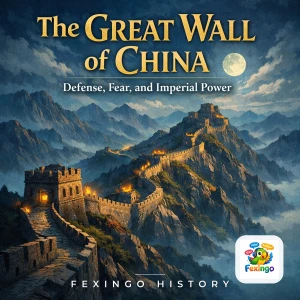
The Great Wall of China: Defense, Fear, and Imperial Power — Fexingo History
For over two thousand years, the Great Wall of China has stood as the world's most monumental defensive structure, but its story is far more complex than a simple barrier against northern invaders. In this series, Lucas and Luna unravel the wall's layered history, from the early rammed-earth fortifications of the Warring States period to the massive stone and brick expansions under the Ming dynasty. They explore the wall not just as a military fortification but as a symbol of imperial power, fear, and control—a tool for regulating trade, migration, and cultural exchange along the Silk Road. Episodes delve into the strategic visions of Qin Shi Huang and the Ming emperors, and examine the human cost of building and garrisoning the wall.
Episodes

The Great Wall's Unseen Laborers: Migrant Soldiers
While previous episodes have explored the Ming Dynasty’s military reforms and the tragic lives of forced corvée laborers, this episode shifts focus to the tuntian system—the agricultural colonies that sustained the wall. We examine how soldiers were transformed into farmers to create a self-sustaining frontier economy. Lucas traces the evolution from Hongwu Emperor’s initial mandates to the comple
The Great Wall's Secret: Why China Built It Twice
While most people picture the Ming Dynasty's brick-and-stone fortifications, the Great Wall of China is actually a palimpsest of defenses built over two millennia. In this episode, Lucas and Luna peel back the layers to reveal that the wall we know today is just the final chapter in a story that began with the Warring States period. We explore how early Chinese states like Zhao and Yan constructed
The Wall's Economic Engine: Silk and Salt Trade
While the Great Wall is famous for its military defenses, it functioned equally as a sophisticated economic regulator. This episode explores how the Ming Dynasty used the wall to control the lucrative Silk Road trade routes and manage the salt monopoly in the north. We examine the complex relationship between Chinese merchants and Mongol traders at border markets like Datong and Taiyuan, where the
The Great Wall's Forgotten Soldiers: Tuntian and Frontier Life
We often picture the Great Wall as a static line of stone, but for centuries it was a living, breathing frontier ecosystem driven by the tuntian system. In this episode, we explore how the Ming Dynasty didn't just build walls; they populated them with soldier-farmers who turned barren borderlands into sustainable agricultural zones. We meet figures like Li Chengliang and follow the logistical mira
Genghis Khan's Mongol Horsemen and the Wall
This episode explores the military terror that forced China to build its most famous stone fortifications. We examine how Genghis Khan’s cavalry tactics shattered previous defenses, leading to the Jin Dynasty’s desperate construction of the 'Iron Wall'. Lucas details the specific engineering of beacon towers and garrison towns designed to counter nomadic speed, while Luna probes the psychological
The Ming Wall's Broken Watch: Signal Failure
We have spent many episodes talking about the stone and mortar of the Great Wall, but this episode turns its attention to the invisible nervous system that kept it alive. When Oirat forces breached the border in 1449, the beacon towers failed not because of bad engineering, but because of a broken chain of command and terrified officials. We trace the collapse of the feng huo tai signal network du
The Great Wall's Lost Villages: Life Behind the Stone
We’ve spent dozens of episodes examining the Ming Dynasty’s military reforms, the architecture of fear, and the tragic Tumu Crisis. But we haven’t looked closely at the people who actually lived in the shadow of these fortifications. In this episode, Lucas and Luna explore the hidden world of the border garrisons—the tuntian agricultural colonies and the taosi military villages that sustained the
The Ming Wall’s Hidden Villages: Life Behind the Stone
For decades, history has treated the Great Wall of China as a static monument to imperial fear and military engineering. But beneath the stone battlements and beacon towers lived thousands of people who never saw an enemy soldier. This episode explores the hidden world of the border garrison villages that sprang up along the Ming defenses. We look at how soldiers, farmers, merchants, and families
The Ming Wall's Hidden Villages: Life Behind the Stone
We often think of the Great Wall as a military barrier, but Episode 254 reveals it as a thriving economic and social ecosystem. We explore the taosi garrison villages that sprang up along the Liao River and Shanxi borders, where soldiers, farmers, and merchants lived in complex interdependence. Through the lens of Li Chengliang’s Liaodong defense strategy and the Wei-Suo system, we uncover how the
The Great Wall's Diplomatic Blindspot: Altan Khan
For decades, the Ming Dynasty viewed the Mongols as barbarians to be kept out, but by the late sixteenth century, that policy had collapsed under its own weight. In this episode, we explore how the Jiajing Emperor’s refusal to negotiate with Altan Khan led to a devastating breach of Beijing’s outer defenses in 1550. We look at the human cost of this diplomatic failure, the eventual peace treaty th
Ming Dynasty's Forgotten Wall: The Liao River Defense
While most people picture the Great Wall snaking across northern mountains, a critical defensive line ran along the Liao River in Liaodong, protecting the Ming heartland from Manchurian incursions. This episode explores the strategic importance of the Liaodong defense system, focusing on the pivotal Battle of Sarhu in 1619 and the collapse of Ming military power in the northeast. We examine how th
The Wall's Hidden Villages: Life Behind the Stone
We often picture the Great Wall as a stark line of defense against the Mongols, but behind those ramparts lay a complex society of farmers, soldiers, and merchants. In this episode, we explore the taosi and qianqi communities that formed along the Ming borderlands. These were not just military garrisons but thriving agricultural colonies established through the tuntian system, where soldiers farme
The Great Wall's Hidden Villages
Most people picture the Great Wall as a solitary line of stone and watchtowers stretching across the mountains, but beneath that iconic silhouette lies a vast, invisible infrastructure of human life. In this episode, we peel back the military history to reveal the *taosi*—the fortified border villages that sustained the Ming Dynasty’s northern defense for centuries. We explore how these communitie
The Great Wall's Broken Watch: Signal Failure
We often imagine the Great Wall of China as an impenetrable barrier, a stone spine meant to keep out nomadic raiders. But in this episode, we explore the terrifying reality of what happened when that wall failed. We look at the Tumu Crisis of 1449, where the Ming Emperor Zhengtong was captured by the Oirat leader Esen Taishi, exposing the fatal flaws in the empire’s defense systems. Lucas and Luna
The Great Wall's Silent Victims: Forced Labor and Mortality
While previous episodes explored the Ming Dynasty’s military reforms, signal towers, and diplomatic failures, this episode turns its gaze downward to the human cost of imperial ambition. We examine the grim reality behind the stones: the conscription systems, the brutal conditions of the Tuntian colonies, and the staggering mortality rates among corvée laborers. Lucas and Luna discuss how the Wall
Ming Dynasty's Secret Weapon: The Thunder Crash Bomb
While the Great Wall stands as a monument to stone and earth, its defenders relied on a terrifying innovation to hold the line against Mongol cavalry: the thunder crash bomb. This episode explores the Ming Dynasty’s rapid advancement in gunpowder warfare during the 14th and 15th centuries, moving beyond simple fire arrows to heavy explosive devices designed to shatter both armor and morale. We exa
Ming Dynasty Military Reforms and Qi Jiguang
We often think of the Great Wall as a static line of stone, but its true strength lay in the human systems that guarded it. This episode explores the military reforms of the mid-Ming Dynasty, focusing on General Qi Jiguang and his revolutionary approach to border defense. We look beyond the bricks to examine the Wei-Suo system's decay, the creation of the Mandarin Duck Formation, and how Qi Jiguan
The Wall's Broken Watch: Ming Signal Failure
For decades, historians treated the Great Wall as an impenetrable barrier, but the reality was far more fragile. In this episode, we examine the critical failure of the Ming Dynasty’s beacon tower system during the Tumu Crisis of 1449. When Esen Taishi led a massive Oirat Mongol raid deep into Chinese territory, the signal network designed to warn the capital collapsed almost instantly. We explore
The Great Wall's Broken Watch: Ming Signal Failure
We explore the tragic mechanics of the Tumu Crisis in 1449, where a bureaucratic breakdown at the beacon towers led to the capture of Emperor Zhengtong. This episode examines how the feng huo tai signal system, designed for speed and clarity, became a liability when political corruption and fear of punishment paralyzed local commanders. We look at Esen Taishi’s rapid advance, the failure of Qi Jig
The Wall's Ghost Armies: Ming Military Reforms
While previous episodes have explored the labor, logistics, and diplomatic failures behind the Great Wall of China, Episode 243 turns to the human engine that kept these fortifications operational during the mid-Ming Dynasty. We examine the evolution of the Wei-Suo military household system, a rigid hereditary structure designed to create self-sufficient border garrisons. Lucas traces how this sys
The Great Wall's Lost Emperors: Siege, Capture, and Shame
Most people know the Great Wall as a static monument of stone, but Episode 242 reveals it as a stage for imperial desperation and humiliation. We focus on the Tumu Crisis of 1449, where the Zhengtong Emperor led his army into a trap set by Esen Taishi of the Oirat Mongols. This episode explores how a massive military force was decimated not by siege engines, but by superior nomadic mobility and br
The Great Wall's Unseen Architects: The People Behind the Stone
While the Great Wall is often viewed as a static monument to imperial power, its construction and maintenance relied on a complex, often overlooked social fabric. In this episode, we explore the lives of the artisans, engineers, and local communities who built and sustained these defenses from the Qin through the Ming dynasties. We examine how techniques like sticky rice mortar transformed militar
The Great Wall's Diplomatic Blindspot
We often think of the Great Wall as a static line of stone and brick, but for the Ming Dynasty, it was also a complex diplomatic instrument. In this episode, Lucas and Luna explore how the Wall served as more than just a physical barrier against Mongol raids—it was a stage for negotiation, tribute, and imperial projection. We focus on the Jiajing Emperor’s disastrous decision to close the border m
Ming Border Forts: Architecture of Fear and Power
While earlier episodes explored the labor, logistics, and signal systems of the Great Wall, this episode examines the architectural psychology behind the Ming Dynasty's border defenses. Lucas and Luna discuss how the physical design of the watchtowers and battlements was engineered to project imperial power and induce psychological submission in northern nomadic tribes. We look at specific structu
Qi Jiguang’s Revolutionary Battle Formations
In this episode of Fexingo History, we step away from the physical bricks of the Great Wall to examine the tactical genius that made them effective. We focus on Qi Jiguang, the Ming Dynasty general who transformed Chinese military doctrine in the late sixteenth century. Lucas and Luna explore how Qi responded to the devastating Tumu Crisis and subsequent Oirat raids by creating the 'Mandarin Duck
The Great Wall's Forgotten Battle: Tumu Crisis
In this episode of The Great Wall of China, we pivot from the stones and mortar to the moment the wall nearly failed its masters. While previous episodes have covered Qi Jiguang’s reforms and the intricate signal tower networks, we explore the catastrophic Tumu Crisis of 1449. We look at how Emperor Zhengtong ignored his generals, rode out to face the Oirat Mongols led by Esen Taishi, and ended up
The Wall That Wasn't: Han Dynasty Defense Lines
We usually think of the Great Wall as a continuous Ming dynasty brick barrier, but the reality of Chinese border defense stretches back much further. In this episode, we explore the Han Dynasty's intricate network of beacon towers and rammed earth walls that stretched from Yumen Guan into the Tarim Basin. We examine how Emperor Wu used these structures not just for military defense against the Xio
The Great Wall's Secret Spies: Ming Intelligence Networks
While the bricks of the Great Wall are famous, the intelligence network behind them was the empire’s true shield. This episode explores the Jinyiwei and their civilian counterparts, the ganhuo, who operated in the shadows of the northern borderlands during the Ming Dynasty. We look at how Wang Daoren, a notorious spy master, managed a web of informants stretching from the Yumen Guan to the Liaodon
The Great Wall's Forgotten Sentries: Ming Border Life
While we have explored the engineering of the wall and the grand strategies of emperors like Jiajing and Wanli, Episode 234 steps down from the ramparts to examine the human reality of the Ming border garrisons. We focus on the daily existence of the ordinary soldiers stationed at outposts like Gubeikou and the Jiayuguan corridor, far from the court intrigues of Beijing. Lucas and Luna discuss the
The Great Wall's Lost Watchtowers: Fire, Smoke, and Signal
Most people imagine the Great Wall as a static barrier of stone, but for centuries it was a dynamic communication network. In this episode, we uncover the sophisticated signaling system used by Ming dynasty guards to transmit military intelligence across thousands of miles. We explore the use of feng huo tai (beacon towers) and lang yan (smoke signals), detailing how specific combinations of fire
The Great Wall's Secret Spies: Ming Intelligence Networks
We have spent many episodes tracing the physical stones and brickwork of the Great Wall, but we rarely discuss the invisible architecture that held it together. This episode explores the sophisticated intelligence apparatus of the Ming Dynasty, specifically the role of the Jinyiwei and the civilian informants known as ganhuo who operated along the northern frontier. While Qi Jiguang reformed milit
The Wall's Broken Watch: Ming Signal Failure
We often imagine the Great Wall as an impenetrable barrier, but for the Ming Dynasty soldiers stationed on its ridges, it was a fragile network of eyes and ears that frequently failed. In this episode, we explore the intricate system of beacon towers, known as feng huo tai, and the desperate codes used to signal danger. We look at how smoke by day and fire by night were supposed to convey precise
The Great Wall's Secret Signal Towers
We often picture the Great Wall as a static barrier, but for centuries it functioned as a high-speed communication network. In this episode, we explore the sophisticated beacon system of the Ming Dynasty, known as feng huo tai and lang yan. Lucas and Luna trace how smoke signals by day and fire by night could transmit complex military information across hundreds of kilometers in hours, turning the
The Great Wall's Hidden Bureaucracy: Logistics and Labor
While previous episodes have explored the martial drama of border crises, the legendary generals like Qi Jiguang, and the emotional weight of the Meng Jiangnu legend, we rarely examine the quiet machinery that kept the wall standing. This episode investigates the Ming dynasty’s logistical bureaucracy, focusing on the Tuntian military farming system and the Taipusi horse pastures that sustained fro
The Great Wall's Diplomatic Failures and Border Markets
We often imagine the Great Wall as an impenetrable barrier, but its true history is written in broken treaties, smuggled silk, and the desperate diplomacy of border markets. In this episode, we explore the Ming Dynasty's fraught relationship with the Mongols, focusing on the failed tribute system and the tragic Tumu Crisis of 1449. We look at how the Zhengtong Emperor’s personal ambition led to hi
The Great Wall's Silk Road: Trade, Spies, and Smugglers
While previous episodes have explored the Wall’s military architecture and defense against Mongol incursions, this episode examines its role as a porous economic boundary. We look at how the Ming Dynasty managed trade along the Gansu Corridor through official tribute markets and illicit smuggling routes. The narrative focuses on the complex relationship between the frontier garrisons and Central A
The Great Wall's Hidden Villages and Daily Life
We often imagine the Great Wall as a static line of stone, but for centuries it was a living, breathing community. This episode explores the daily existence of the soldiers, their families, and the merchants who inhabited the garrison towns along the frontier. We look at how the Ming Dynasty’s tuntian military farming system transformed barren borderlands into self-sustaining agricultural hubs. Th
The Great Wall's Silent Guardians: The Legend of Meng Jiangnu
We often think of the Great Wall as a monument to imperial engineering, but for centuries, it has also been a monument to grief. In this episode, Lucas and Luna explore the enduring legend of Meng Jiangnu, the woman whose weeping brought down a section of the wall. We trace her origins back to the Spring and Autumn period with the story of Fan Xiliang, through the Qin Dynasty’s brutal conscription
The Great Wall's Hidden Labor: Conscripts, Criminals, and Craftsmen
While earlier episodes explored the bureaucracy, funding, and military strategy behind the Great Wall, this episode turns the camera toward the human cost of its construction. We examine the complex system of labor conscription that stretched from the Qin Dynasty through the Ming, focusing on the diverse populations forced to build these fortifications. Lucas details how convicts known as chengzu
The Great Wall's Secret Weapon: Horse Pastures
We’ve spent months dissecting the bricks, the bureaucracy, and the beacon fires of the Ming Dynasty’s northern frontier. But the wall itself was only half the story. The other half was the horse. For centuries, the Chinese empire has been defined by its struggle to control the steppe, and for every soldier on the wall, there needed to be a cavalryman in the saddle. In this episode, we explore the
The Great Wall's Secret: How Soldiers Survived the Cold
We often picture the Great Wall as a static barrier of stone, but for the Ming dynasty soldiers stationed along its length, it was also a complex logistical machine designed to keep them alive. In this episode, Lucas and Luna explore the daily survival strategies of the frontier garrisons, focusing on the specific dietary habits that prevented scurvy and the architectural innovations that provided
The Great Wall's Secret Weapon: The Horse Pastures
In this episode of Fexingo History, Lucas and Luna explore the Great Wall's hidden foundation: the imperial horse pastures that supplied the Ming cavalry. From the famed Taipusi (太仆寺) stud farms in the northwest to the little-known Liaodong pastures, they uncover how the Ming state managed grazing lands, bred warhorses, and dealt with horse theft and pasture encroachment. Along the way, they meet
The Great Wall's Last Masons: Who Built It?
When we picture the Great Wall, we see stone and brick, but behind every crenellation and watchtower are the hands of millions of laborers. In this episode, Lucas and Luna dig into the human story of the Wall's construction — from Qin Shi Huang's convicts and conscripts to the Ming dynasty's professional armies and the 'tuntian' farming soldiers who grew their own food while building fortification
The Great Wall's Jade Gate: Han Outpost or Trade Hub?
Before the Ming, before the rammed earth and brick we picture, the Han dynasty pushed a fragile line of watchtowers and forts deep into the Gobi. At its heart sat a small gate with an outsized reputation: Yumen Guan, the Jade Gate. This episode follows the archaeologists and historians who have traced its shifting location, its role in the Silk Road trade, and the soldiers who manned its lonely po
The Great Wall's Canal Network: Water Routes and Military Supply
When we think of the Great Wall, we imagine stone and rammed earth stretching across ridges. But the wall's real strength came from the water that fed it. In this episode, Lucas and Luna trace the canal network that moved grain, weapons, and soldiers to the frontier — from the Yuan dynasty's Grand Canal expansion to the Ming's Hai River and Huai River systems. They explore how the Hongwu Emperor's
The Great Wall's Greatest General: Qi Jiguang's Reforms
In this episode, Lucas and Luna dig into the career of Qi Jiguang, the Ming dynasty general who turned a demoralized frontier army into a fighting force that repelled Mongol raids and later defended Beijing itself. They cover his family background in Shandong, his early victories against pirates on the southeast coast, the formation of the 'Qi family army' with its distinctive mandarin duck format
The Great Wall's Last Frontier: The Gansu Corridor's Great Wall
In 1539, the Ming dynasty ordered the construction of the westernmost section of the Great Wall, a 700-kilometer earth-and-stone barrier stretching from Jiayuguan to the edge of the Gobi. This episode follows the wall's forgotten builders and the soldiers who manned it, from the fortress at Jiayuguan — known as the 'First and Greatest Pass Under Heaven' — to the watchtowers in the Qilian Mountains
The Great Wall's Mongol Invasions: The 1550 Beijing Crisis
In 1550, the Great Wall failed spectacularly. Altan Khan, the Mongol leader who had grown rich on tribute but tired of Ming rejection, breached the wall at Gubeikou and rode all the way to the gates of Beijing. For three days, his cavalry burned the suburbs while the Ming court, paralyzed by corruption and factionalism, did nothing. This episode tells the story of that crisis: the defense collapse
The Great Wall's Unbuilt West: Ming Fear of the Oirats
In this episode of Fexingo History, Lucas and Luna explore why the Ming dynasty, despite building the Great Wall across northern China, never extended it to the far west. The focus is on the Gansu Corridor and the strategic decision to fortify Jiayuguan, the 'last pass under heaven,' instead of building a continuous wall. They discuss the Oirat Mongol threat, the Zhenfan system of military farms,
The Great Wall's Forgotten Frontier: The Gansu Corridor
In this episode, Lucas and Luna travel west to the Gansu Corridor, the long thin strip of land that linked China to Central Asia for millennia. They explore how Ming dynasty officials managed this vulnerable frontier beyond the famous wall, from the fortified garrisons at Jiayuguan and Yumenguan to the military farms that fed the soldiers. Lucas reveals the role of the Qilian Mountains' snowmelt i
The Great Wall's Forgotten Enemy: The Tumu Fortress
In 1449, the Ming dynasty suffered one of its greatest military disasters not at the Wall, but at a small fortress called Tumu, deep in Mongol territory. The Tumu Crisis, as it came to be known, saw the Zhengtong Emperor captured by the Oirat leader Esen Taishi, and it nearly toppled the dynasty. In this episode, Lucas and Luna explore the events leading up to the crisis, the role of the eunuch Wa
The Great Wall's Last Stand: Shanhaiguan 1644
In this episode, Lucas and Luna revisit the Great Wall's most dramatic moment: the fall of Shanhaiguan in 1644. As Ming forces crumble under Li Zicheng's rebel army, General Wu Sangui faces an impossible choice—surrender to the rebels or ally with the Manchu invaders. Lucas traces Wu's dilemma, the failed negotiations, and the battle that opened the gates to the Qing dynasty. Along the way, he exp
The Great Wall's Ghost Army: Ming Deserters
In this episode, Lucas and Luna explore the shadowy world of Ming deserters who abandoned the Great Wall garrisons. From the arsonist who burned a strategic tower to the soldier who simply walked away with his bow, these disappearances reveal the human cracks in the empire's stone facade. Lucas explains how underpaid, overworked soldiers turned to banditry or joined the enemy, and how the Ming cou
The Great Wall's Night Watch: Lanterns and Sentries
When the sun set on the Ming frontier, the Great Wall didn't go dark. In this episode, Lucas and Luna explore the overlooked world of night watch on the wall — the lantern signals, the patrol routines, the passwords, and the men who stared into the dark for hours. They trace the system from the early Ming beacon towers to the sophisticated night signals of Qi Jiguang's era, revealing how the Wall
The Great Wall's Beacon Towers: A Signaling Network
In this episode, Lucas and Luna explore the Great Wall's beacon tower system, the feng huo tai, a network of signal towers that used smoke by day and fire by night to relay warnings across thousands of miles. They discuss how the towers worked, the wolf dung smoke that gave lang yan its name, and the relay speed that could carry an alarm from the frontier to Beijing in hours. The episode examines
The Great Wall's Last Great Builder: Xu Da's Legacy
In this episode, Lucas and Luna explore the overlooked role of Xu Da, the Ming dynasty's greatest general, in the construction of the Great Wall. While later figures like Qi Jiguang and Yang Yiqing get credit for the wall we see today, it was Xu Da who laid the foundation in the 1370s, building the first Ming sections in the north and establishing the Nine Garrisons system. We trace his campaigns
The Great Wall's Unsung Hero: The Han Dynasty's Jade Gate
In this episode, Lucas and Luna step beyond the familiar Ming-era fortifications to explore the Han dynasty's Jade Gate Pass, or Yumen guan — the westernmost outpost of the Chinese empire for over four centuries. Built around 121 BC under Emperor Wu, this small frontier station guarded the Silk Road, controlled the flow of jade, silk, and horses, and witnessed the rise and fall of dynasties. Lucas
The Great Wall's Ming Money Trail: Funding the Frontier
How did the Ming dynasty pay for the Great Wall? This episode digs into the gritty economics behind the fortifications: salt vouchers, corvée labor, and the ceaseless drain on the imperial treasury. Lucas and Luna trace the flow of silver and grain from the Grand Canal to the dusty frontier posts, and meet the forgotten administrators who juggled budgets while Mongol raids burned the harvest. They
The Great Wall's Paper Wall: Bureaucracy and Border Control
In this episode of Fexingo History, Lucas and Luna explore the unexpected backbone of the Great Wall: the paper trail. Beyond the rammed earth and brick, the Ming dynasty built a vast bureaucratic system to control movement across the frontier. From the hubu, the Ministry of Revenue, to the bianwen, the border passes that functioned like government-issued passports, we see how documents—not just w
The Great Wall's Mongol Trade War: Horse Markets and the 1571 Opening
In this episode of Fexingo History, Lucas and Luna explore the Great Wall not as a barrier but as a gateway for trade. Through the story of Altan Khan's 1550 raid on Beijing and the subsequent 1571 treaty that opened border markets, they uncover how horse markets and tribute missions shaped Ming frontier policy. Lucas introduces the names behind the diplomacy—Wang Chonggu, the Minister of War who
The Great Wall's Hidden Boundary: The Willow Palisade
In this episode, Lucas and Luna explore a lesser-known chapter of the Great Wall's story: the Willow Palisade, a 1,000-kilometer wall of willow trees and ditches built by the Qing dynasty in the 17th century. Unlike the stone and brick fortifications of the Ming, this "green wall" was a porous boundary designed not to keep invaders out, but to control movement—regulating trade, migration, and the
The Great Wall's Mongol Peace: Altan Khan's 1571 Agreement
In 1571, the Ming dynasty and the Mongol leader Altan Khan signed a treaty that ended decades of border warfare and opened the Great Wall to trade. This episode looks at how a frontier crisis became a diplomatic breakthrough, and what it meant for the people living along the wall. We follow the negotiations led by the official Wang Chonggu, the role of the tribute system, and the establishment of
The Great Wall's Paper Shield: Ming Documents and Border Control
In episode 200 of Fexingo History, Lucas and Luna look past the stone and rammed earth to explore the Great Wall as an information barrier—a paper shield of registers, passes, and permits that tried to govern who and what moved across the frontier. They follow the journey of a single merchant caravan from the garrison town of Datong to the Mongol steppe, tracing the documents required at each gate
Rammed Earth, Frozen Mud: How Ming Builders Built
In this episode, Lucas and Luna dig into the gritty, physical craft behind Ming-era Great Wall construction. They walk through the layers of rammed earth, the stone facings, the kiln-fired bricks, and the lime mortar that held it all together — plus the brutal logistics of moving materials across mountain ridges. They look at how builders dealt with permafrost in the northeast, why some sections u
The Great Wall's Spies: Ming Intelligence Beyond the Border
In this episode, Lucas and Luna delve into the shadowy world of Ming dynasty espionage along the Great Wall. They uncover how the Ming court used a mix of scouts, defectors, and merchant networks to gather intelligence on the Mongols and Jurchens. The conversation traces the evolution from the early warning beacon system to the more sophisticated spy networks of the 16th century, highlighting figu
The Great Wall's Secret Weapon: Salt and the Frontier Economy
In this episode, Lucas and Luna explore how salt — the humble mineral that preserves food and flavours everything — became a strategic resource along the Great Wall. From the Han dynasty's salt and iron monopolies to the Ming's salt-for-horse trade and the smuggling networks that undermined the frontier, salt shaped border policy, financed military garrisons, and even triggered rebellions. Learn h
The Great Wall's Unknown Engineer: Zhan Rong and the Signal Towers
In this episode, Lucas and Luna uncover the story of Zhan Rong, a Ming dynasty engineer who transformed the Great Wall's communication network. While most discussions focus on generals and emperors, Zhan Rong's work on the beacon towers—the feng huo tai—was crucial to the Wall's defense. We trace his career from the 1560s, when the threat from Altan Khan and the Tümed Mongols was at its peak, thro
The Great Wall's Hidden Weakness: Defectors and Insider Threats
This episode digs into a facet of Ming frontier history that often gets overshadowed by battles and construction: defection. Lucas and Luna explore how the Great Wall, for all its stone and mortar, was only as strong as the people manning its gates. We look at specific cases — a eunuch selling troop movements, a general who switched sides, and a trade official who turned informant — and ask what m
The Great Wall's Guardian: Yang Yiqing and the 1516 Rebuilding
In 1516, the Ming dynasty faced a crumbling Great Wall — sections in decay, defenses uneven, and Mongol raiders probing the frontier. Enter Yang Yiqing, a minister whose relentless drive to rebuild the Wall's western flank triggered a political storm. This episode follows Yang's inspections, his bloody vision for rammed-earth repair, and the bureaucratic battles that nearly stopped him. Along the
The Great Wall's Last Stand: Ming Defeat at Shanhaiguan
In this episode, Lucas and Luna explore the final chapter of the Great Wall's military significance: the Ming dynasty's desperate defense of Shanhaiguan against the Manchu invasion in 1644. They discuss the political intrigue that led to the fall of the Ming, including the roles of Wu Sangui, Li Zicheng, and the Chongzhen Emperor. The conversation covers the strategic importance of Shanhaiguan, th
The Great Wall's Greatest Failure: The Tumu Crisis
In 1449, the Ming dynasty's Zhengtong Emperor led a massive army north to crush the Oirat Mongols — and walked into a catastrophic trap at Tumu Fort. This episode unpacks the Tumu Crisis, the Ming's worst military disaster, and how a young emperor's overconfidence, a corrupt eunuch's meddling, and a brilliant Oirat leader's deception nearly toppled the dynasty. We look at the battle's aftermath: t
The Great Wall's Unseen Enemy: Climate Change and the Ming Collapse
In this episode of Fexingo History, Lucas and Luna explore how the Great Wall, built to keep out invaders, was ultimately undone by something far more powerful than any army: climate. From the Little Ice Age's brutal winters to devastating droughts that shattered harvests, the wall's garrison system collapsed as farmers abandoned the land. We trace the chilling effect of volcanic eruptions, the ad
The Great Wall's Forgotten Dynasty: Northern Qi's Stone Wall
We usually picture the Great Wall as a Ming achievement, but centuries earlier, the Northern Qi dynasty built the first extensive stone wall in Chinese history. This episode follows Emperor Wenxuan (Gao Yang) as he mobilizes hundreds of thousands of laborers to construct a wall of stone and rammed earth across the northern frontier, defending against the Rouran and later the Gök Türks. We explore
The Great Wall's Hidden Workforce: Corvée and Suffering
We often admire the Great Wall as a marvel of engineering, but behind every brick and rammed-earth section lies a human story of forced labor, exhaustion, and death. In this episode, Lucas and Luna explore the Ming dynasty's corvée system—the conscription of millions of peasants to build and maintain the Wall. Drawing on the Ming shilu, they discuss the harsh conditions, the lack of wages, the hig
Before the Ming: The Great Wall's Qin Origins
Most imagine the Ming stone bastions when picturing the Great Wall, but the first Great Wall was built over a millennium earlier by Qin Shihuang, the First Emperor of China. This episode traces the wall's origins from the Warring States period to the Qin dynasty, focusing on General Meng Tian's ambitious project linking earlier frontier walls. We explore the rammed-earth construction, the brutal l
Qi Jiguang's Engineering Revolution on the Great Wall
In this episode, we dive into the technical and organizational genius of Qi Jiguang, the Ming general who transformed the Great Wall from a patchwork of rammed earth into a standardized, brick-faced defensive system. Stationed at the Jizhou garrison north of Beijing in the 1570s, Qi Jiguang implemented a comprehensive blueprint: enemy towers (di tai) every few hundred meters, beacon towers with pr
Jiayuguan: The Great Wall's Western Fortress at the Edge of the Gobi
At the westernmost end of the Ming Great Wall, the fortress of Jiayuguan guarded the Hexi Corridor against Mongol raids and controlled Silk Road trade. In this episode, we explore Jiayuguan's construction under the Hongwu emperor in 1372, its strategic design—trapezoidal walls, a moat, and a 'last brick' legend—and its role in protecting the frontier. We also discuss the famous Overhanging Great W
The Great Wall's Hidden Network: Ming Beacon Towers and Smoking Signals
In this episode, Lucas and Luna explore the Ming dynasty's sophisticated communication system along the Great Wall: a network of beacon towers (feng huo tai), wolf-smoke signals (lang yan), and the 'weaver's knot' code that allowed messages to travel hundreds of li in a day. They examine how general Qi Jiguang tested and improved this system in 1572, turning the wall into a giant telegraph line. B
Life as a Ming Soldier on the Great Wall
Beyond the stone and mortar of the Great Wall of China lay a vast human infrastructure: the Ming garrison soldiers who manned its watchtowers, farmed its fields, and defended the frontier. This episode of Fexingo History pulls back the curtain on the daily existence of the wei-suo troops—hereditary soldiers who lived in military colonies (tuntian), faced harsh winters, low pay, and constant Mongol
The Great Wall's Eastern Front: Ming vs. the Jurchens
Most assume the Great Wall was built solely against the Mongols. But the Ming faced a second, equally dangerous frontier in the northeast: the Jurchen tribes. This episode explores the Ming's fortified system in Liaodong, from the palisaded garrisons at Kaiyuan and Fushun to the 'loose rein' policy of bribery and trade. We examine the rise of the Jianzhou Jurchens, the devastating raids of the 16t
Recommended

History of the Earthquake and Fire in San Francisco

Fox news

K-Drama Obsessed Mamas | Beyond “Just One More Episode!”

True Crime Classics

The Healer Revolution

Becoming: HER with Nikki Spoelstra

Booked, Blonde & Busy w/ Olivia Ponton

McKinsey on Consumer and Retail

megahired.com

Hard Knocks Podcast

Effective Weight Loss for Moms | High protein, Strength Training, Lose Weight, Meal Planning, Fat Loss, Healthy Habits

The Human-Animal Connection - Pet Life Radio Original
