The Last Best Hope?
Abraham Lincoln called the United States 'the last best hope of Earth.' This podcast examines whether that claim still holds and whether it ever did. Each episode explores a figure, idea, or moment in American political history, considering what it reveals about the country's self-understanding and how America is viewed from abroad. Hosted by Adam Smith, a professor of American political history at Oxford, the show features conversations with scholars and public figures including Hillary Clinton, Annette Gordon-Reed, and Eric Foner.
Episodes
American Political Parties Explained
What is an American political party? Unlike in parliamentary systems, they're not private organisations but quasi-public bodies, with no membership dues and with their candidate selection regulated by public law. And how do we explain the paradox that in an era of intense 'partisan' division, the parties themselves -- as organisations -- are by some measures weaker than ever before? Ad
New Series
As the United States gears up to mid-term elections, which may once again shift the political trajectory of the country, the Last Best Hope? returns for a brand-new season on the 8th of October.“Adam Smith is one of the UK’s foremost historians of America, and communicates his expertise with zest, wit and unforced passion. The Last Best Hope? brings him together with fellow scholars to provide a u
The Battle over the 250th Anniversary
In the bicentennial summer of 1976, the United States staged what was, by some measures, the largest single celebration in the country’s history. Tall ships in New York harbor. Fireworks over the Mall. Specially-minted bicentennial quarters. A made-for-TV reconciliation after Vietnam and Watergate, after the assassinations and the riots and the burnings of the long sixties. The country told itself
Why America Doesn't Love Soccer (Except When It Does)
Is there anything more distinctively American than its sports culture?In a previous episode of this podcast, we discussed the tragic decline and partial revival of American cricket. As the 2026 World Cup kicks off in the US Adam asks why a sport that took over the world has been so marginal for so long in America – and wonders if that’s finally changing.In the nineteenth and early twentieth centu
1776 and the break up of the United States
The rebels who tried to break up the United States in the 1860s thought of themselves as the rightful heirs to the spirit of 1776. The South Carolina Declaration of the Causes of Secession took the Declaration of Independence as its template. Washington’s face appeared on Confederate banknotes and the Confederacy’s Great Seal. Many of the leaders of the Revolution of the 1860s were the literal gra
The idea of America in British politics
For 250 years, the idea of America and the fact of American power have unsettled British politics. Is America of us, or apart from us? Rival or special friend? In the British political imagination, America has provoked envy, resentment, condescension, and neediness. It has also divided us, because America has so often illuminated or distorted our understanding of ourselves. Since the radical Whigs
Why the Declaration of Independence said what it did, Episode 2
To its principal author, Thomas Jefferson, it was “an expression of the American mind”; to the English philosopher Jeremy Bentham, it was "absurd and visionary". The Declaration of Independence, written 250 years ago, is so layered in myth, so foundational to the idea of America as the last best hope of earth, that it is a challenge, now, to put it into its gritty historical context -- a document
Why the Declaration of Independence said what it did, Episode 1
To its principal author, Thomas Jefferson, it was “an expression of the American mind”; to the English philosopher Jeremy Bentham, it was "absurd and visionary". The Declaration of Independence, written 250 years ago, is so layered in myth, so foundational to the idea of America as the last best hope of earth, that it is a challenge, now, to put it into its gritty historical context -- a document
Can federalism save American liberalism?
For much of the twentieth century, progressives in America wanted to expand the Federal Government. They created regulation, bureaucracy, and agencies capable of managing a complex industrial society. And often state governments were the obstacles they had to flatten – that was most obviously true of the movement for racial equality: the Civil Rights Act of 1964 and the Voting Rights Act of 1965 e
Hillary Rodham Clinton on how America can save itself
Hillary Rodham Clinton has been at the centre of American public life for thirty years. She has exercised more power from more senior positions than any other woman in American history. Clinton has just co-edited a new book Inside the Situation Room: The Theory and Practice of Crisis Decision-making. and in this special episode, she discusses with Adam a key case study in that book -- the raid in
Why the Gettysburg Address Matters, Part 2
It is one of the most famous speeches in the English language and one of the most consequential. In this special two-part documentary, we explore Abraham Lincoln’s Gettysburg Address – why he gave it, what it meant, and its impact at the time and ever since. From the rolling fields of Pennsylvania to Parliament Square in London and the dust of Havana, Cuba, Adam Smith follows the path of the Getty
Why the Gettysburg Address Matters, Part 1
It is one of the most famous speeches in the English language and one of the most consequential. In this special two-part documentary, we explore Abraham Lincoln’s Gettysburg Address – why he gave it, what it meant, and its impact at the time and ever since. From the rolling fields of Pennsylvania to Parliament Square in London and the dust of Havana, Cuba, Adam Smith follows the path of the Getty
How Will History Judge Joe Biden?
A year on, what does Trump’s comeback say about Biden’s understanding of the country he led? Was his vision of America already obsolete — a relic of the bipartisan consensus forged in the 1950s when young Joe was coming of age? In this episode, we trace Biden’s life through the long arc of American politics over the last 80 years, examining the forces that shaped him and the decisions that de
The Myth of the Frontier
If America is the last, best hope of earth, one reason is the frontier. The frontier has been imagined as the place—or perhaps the process—through which the American character is forged—rugged individualism, the possibility of acquiring land and wealth, where happiness is pursued. For the historian Frederick Jackson Turner in the 1890s, the frontier was what made Americans different. Democracy was
Trump’s Second Term Foreign Policy in Historical Context
Beneath the chaos of Donald Trump’s second term foreign policy—the bluster, bravado, back-handers and backdowns—is there something else going on? Has the United States reached a turning point in its relationship to the rest of the world?The era in which the United States constructed multilateral alliances to defend western Europe and advance a global free trade agenda appears to be over. Listen to
Journalism and Democracy: Lessons from Walter Lippmann
A hundred years ago, Walter Lippmann, one of the great analysts of democratic life, wrote that the present crisis of western democracy is a crisis in journalism. Press barons, Lippmann feared, were so powerful that government based on the consent of the governed was under threat if unregulated media owners could manufacture consent. If the facts were not being made available to the public, how cou
Election 2024: What just happened?
In this special episode of The Last Best Hope, we bring you a recording of a live event at the Rothermere American Institute in Oxford on Thursday, November 7. Adam Smith and guests discussed why the election turned out the way it did. The panellists are:Jason Casellas ABC News election decision desk. Jason Casellas is an Associate Professor of Political Science at the University of Houston.
The Age of Polarization Election Special Part 4: 2016
The US is in an Age of Polarization. From the 1930s to the 1980s, voter allegiances were more fluid, and presidents sometimes won massive landslides (think Reagan in 1984 or Nixon in 1972). But for the last thirty years, a huge gulf between the parties -- at least rhetorically -- has opened up, and elections have been persistently nail-bitingly close. How did this happen? In this special series, w
God and Trump: Evangelicals and Politics in today's America
When the media talks about the evangelical vote today, what or to whom are they referring? Who are the people who self-identify in this way? Should we understand them as a group defined by their faith, their style of worship, by distinctive theological positions – or has the term evangelical itself become so politicised that in practice it is now most meaningfully understood as shorthand for a gro
The Age of Polarization Election Special Part 3: 2008
AGE OF POLARIZATION ELECTION SPECIAL PART 3: 2008The US is in an Age of Polarization. From the 1930s to the 1980s, voter allegiances were more fluid, and presidents sometimes won massive landslides (think Reagan in 1984 or Nixon in 1972). But for the last thirty years, a huge gulf between the parties -- at least rhetorically -- has opened up, and elections have been persistently nail-bitingly clos
The Age of Polarization Election Special Part 2: 2000
AGE OF POLARIZATION ELECTION SPECIAL (PART 2)The US is in an Age of Polarization. From the 1930s to the 1980s, voter allegiances were more fluid and presidents sometimes won huge landslides (think Reagan in 1984 or Nixon in 1972). But for the last thirty years, a huge gulf between the parties -- at least rhetorically -- has opened up, and elections have been persistently nail-bitingly close. How d
Eugene V. Debs and America as the last, best hope for socialism?
Eugene V. Debs is a reminder of the possibility of a different kind of American politics. Five times the Socialist Party's candidate for president in the first two decades of the twentieth century, Debs argued that the promise of America -- the last best hope of earth -- could be fulfilled only through socialism. Debs lived in an era that, like our own, was characterised by dramatic economic dislo
The Age of Polarization Election Special Part 1: 1992
ELECTION SPECIAL (PART 1)The US is in an Age of Polarization. From the 1930s to the 1980s, voter allegiances were more fluid and presidents sometimes won huge landslides (think Reagan in 1984 or Nixon in 1972). But for the last thirty years, a huge gulf between the parties -- at least rhetorically -- has opened up, and elections have been persistently nail-bitingly close. How did this happen? In t
Dark Money: Can billionaires buy elections in America?
Wealthy Americans have always found ways of spending money on political campaigns in the presumed expectation of a return on their investment. But in 2010, the Supreme Court’s Citizens United decision ruled that legislation that restricted how much money could be spent on influencing elections was unconstitutional, opening up vast new possibilities for wealthy individuals and corporations to suppo
Rigged! Anxiety about election integrity in America
For as long as there have been elections, there have been those who’ve refused to trust them. But anxiety about elections has peaked at particular moments in American history – in the run-up the Civil War, in the late nineteenth century, in the Civil Rights era, and again today. All periods when sections of the population became convinced that the rules were being bent in ways that robbed ordinary
Presidents and the Press
In 1787, the year of the Constitutional Convention, Thomas Jefferson wrote that if he had to choose between “a government without newspapers or newspapers without a government, I should not hesitate a moment to prefer the latter”. Easy for him to say – but in reality, US presidents and the press have always been locked in an embrace fusing mutual respect and mistrust, cosiness and outright conflic
The Black Founders, America and the Claim of Equality
At the heart of the "promise" of the American Revolution and the new republic's claim to be the last, best hope of earth, is the assertion in the Declaration of Independence that "all men are created equal". How did Black Americans react to the Declaration? How did they seek to shape the character of the new Republic? And what was the relationship between the Black struggle for freedom and equalit
Morning Again in America: The 1984 Election forty years on.
Forty years ago, a twinkly-eyed incumbent president ran for re-election despite concerns about his age. He did so by running a campaign steeped in the idea that America was the last, best hope of earth. Ronald Reagan was no Joe Biden, and no one today expects a landslide victory. Yet there are echoes in today's divided politics in the 1984 election, especially within the Democratic Party, which, b
The strange death and curious rebirth of American cricket
Cricket was once the most popular summer game in the United States – the first ever international match was played not, as you might expect between England and one of its colonies, but between Canada and the United States, in 1844. The first overseas England tour was to the US in 1859. The professional players earned the unheard-of sum of 90 pounds – America then, just as now, was an El Dorado of
How have presidential primaries shaped modern US politics?
Presidential primaries – the circus that has traditionally wended its way from Iowa to New Hampshire and beyond every four years -- is one of the most distinctive features of American political life. From the insurgent campaigns of Jimmy Carter in 1976 to Barack Obama in 2008 and even Donald Trump in 2016, primaries have enabled the rise of politicians who could never have succeeded under the old
How are Latino voters changing America?
Today, Mexicans and people from Latin America make up about half of the total immigrant population and Latinos are now the single largest “non-white” block in the electorate – if, that is, they can be considered a coherent “block” at all. In the early years of the twenty-first century one of the axioms of American politics was that the ever-rising share of Latinos in the electorate would deliver D
American Fascism
In 1930s America, fascism was on the march – not just right-wing politicians who might be pejoratively described like that, but actual fascists who embraced the title. And the core claim they made was that fascism was as American as motherhood, apple pie, and George Washington himself. Yet the US eventually entered the war against Naziism because fascism and Americanism were antithetical. To explo
The Destruction of the Tea, 250 Years On.
Two hundred and Fifty years ago, a group of men boarded three ships in Boston harbour and dumped their cargo of East Indian Company tea overboard. It was a dramatic defiance of the royal government in Massachusetts and of ministers in London who had levied a duty on the tea. Within eighteen months, the revolt against taxes imposed by a distant and unresponsive government had spiralled into armed r
The Kennedy Assassination and Conspiracy Culture
Sixty years ago, President John F. Kennedy was shot and killed in Dallas, Texas. It was quickly mythologised as an end-of-innocence moment, the death of "Camelot". It is natural to believe that big events must have big causes. Could such a shattering, shocking event really have been triggered--figuratively as well as literally--by one troubled man? The historians Phil Tinline and Steve Gillon join
What is a “Colorblind Constitution"?
You cannot begin to understand US politics without encountering the 14th Amendment, ratified in 1868 in the wake of the Civil War. On the surface, the Amendment seems straightforward: it guarantees the equal rights of citizens. But does that mean that race cannot be taken into account even in order to help ensure equality? In his concurring opinion in the affirmative action cases this year, J
Is there a Paranoid Style in American Politics?
In 1963, the historian Richard Hofstadter gave a famous lecture at Oxford (later an essay in Harper’s) arguing that a “paranoid style” was a recurrent strain in American politics. Hofstadter cited examples ranging from the Anti-Masons of the 1830s to MCarthyism. Today, pundits often turn to the concept of a “paranoid style” when trying to explain Trumpism. Why has Hofstadter’s idea been so influen
The Geordie South: How Northumbrians shaped Appalachia
Half a million Northumbrians, the proud people of the English-Scottish border region, settled in the Appalachian mountains in the eighteenth century. And they left their mark in the song, speech and maybe even politics. Geordie culture: the often overlooked element in the forging of the American South. Adam talks to Dan Jackson, author of The Northumbrians: Northeast England and its People, and Te
A City on a Hill: The exceptional history of a powerful metaphor
It is one of America’s most powerful founding myths – the pilgrims on an errand into the wilderness to create a new model society– “we shall be like a city upon the hill,” Massachusetts Bay Colony Governor Winthrop was supposed to have said in 1630, “the eyes of the world upon us”. Separated, yet visible – just like the ark, the responsibilities of such a community were awesome, the prospect
Was there a Culture War in nineteenth century America?
The country is deeply polarised. Each party believes the other not just to be wrong on public policy questions but a profound threat to the nation. At stake are the most fundamental of questions about the values that underpin society. The US today? But also the US in the 1850s. Culture Wars are nothing new. In this episode Adam talks to two historians who have broken the mould of how to think abou
Are there lessons for Biden from the Presidency of Lyndon Johnson?
In 1968, an elderly Democrat President, with major legislative achievements behind him, who had served as Vice President to younger, more charismatic man, decided he could not win a second election. What lessons are there for Joe Biden from the troubled, truncated presidency of Lyndon B. Johnson? Adam talks to Kevin Kruse, the eminent Princeton historian, author of many books on postwar US politic
Lincoln's "House Divided" speech and the Coming of the Civil War
The speech that triggered the Civil War? In a speech in the State Capitol building in Springfield, Illinois, in 1858, Abraham Lincoln warned that a "house divided against itself cannot stand" and that the nation, like a house divided, could not remain "half slave and half free" but would have to become all one thing or all the other. The crisis had arrived; the choice was between complete freedom
The Second Amendment, with Saul Cornell
Why is gun control so hard to accomplish in American politics, despite the number of mass shootings now averaging one a week? Adam talks to Saul Cornell, the leading historian of the Second Amendment, about how the Constitution shapes the politics and culture of guns in the United States. Hosted on Acast. See acast.com/privacy for more information.
Gettysburg and the "last best hope"
Why is Gettysburg the Civil War battle that everyone remembers? How did it come to be seen as the “turning point” of the war? Adam goes to the battlefield to find out. Hosted on Acast. See acast.com/privacy for more information.
Polarisation in American History, with James Morone
It is conventional to say that the US is more polarised now than ever before – at least since the Civil War. But intense partisanship has been a feature of American politics since the Revolution. So what is different about polarisation today? And if there is a “cold civil war” in America at the moment, how will it end? Adam talks about this with the political scientist James Morone, one of the shr
Propaganda and the American Dream
Is 'fake news' new? Or have we always lived in a world of 'alternative facts'? Adam talks to John Maxwell Hamilton, who has written a book arguing that government propaganda started not in the age of social media or Donald Trump but with American entry into the First World War in 1917. Also joining Adam at the British Library's Breaking the News exhibition are curator Tamara Tubb and Professor Jo
The Cotton Famine and the "last best hope"
In Manchester on new year’s eve 1862, thousands turned out for a public meeting to congratulate President Abraham Lincoln for issuing the Emancipation Proclamation. What motivated these people to come along on a wet Wednesday night to listen to fiery speeches about a foreign war? Especially since the most obvious impact of the American Civil War on Lancashire was that the supply of raw cotton was
Mormons and the "last best hope"
The Church of Jesus Christ of Latter-Day Saints is simultaneously the most American and the most 'un-American' of projects. Out of the intense religious revival of the 'burned-over district' of New York in the 1820s, "Mormonism" made the astonishing claim that the Risen Christ had literally walked on American soil. They were thus the first truly homegrown American rel
The Dust Bowl and the American Dream
The Dust Bowl: the ecological disaster within the larger disaster of the Great Depression. It’s a story that generations of Americans have come to know through John Steinbeck's classic novel, The Grapes of Wrath and Dorothea Lange's unforgettable photos of migrant families struggling on the road to make a living in Depression-torn California. In this episode, Adam talks to two prize-win
The Battle Hymn of the Republic and the "last best hope"
The Battle Hymn of the Republic is one of the most recognisable songs in the world. Easy to sing, and to march to, its words are stirring and optimistic, and filled with vivid images: trumpets that never call retreat, watch-fires of a hundred circling camps, trampling of the grapes of wrath, loosing of the fateful lightning of the terrible swift sword, burnished rows of steel, lilies in whose beau
Richard Nixon and the fate of American Liberalism
Was Richard Nixon responsible for the rightward turn of the Republican Party, or was he in fact the “the last liberal Republican”? John R. Price, who worked on social policy in Nixon’s White House, has written a book making the case that Nixon has been misunderstood, pointing to plans to reform welfare to introduce something like a universal basic income and expand health insurance. Rick Perlstein

Billy Graham and the "last best hope"
Billy Graham, with his film star good looks and his baritone voice, seemed to be everywhere in postwar America – the confidante of presidents, and the closest the nation came to having a national pastor. At a time when we often think of religion as in decline in the West, Billy Graham embodied a self-confident, even glamorous Christian faith. He sold Jesus as other people sold vacuum cleaners. An
What are "State's Rights"?
Since the founding of the United States, Americans have been arguing about the correct balance of power between the federal government and the governments of the individual states. Many today still invoke the idea of 'states' rights' as they claim that state governments should retain exclusive power over numerous aspects of public policy, from gun control, to same-sex marriage, to h
The role of Government and the last best hope of earth
From the 1980s until quite recently, the mood music of American politics was to “roll back” the public programmes created during Franklin Roosevelt’s New Deal. Now, taxes and spending are rising and the New Deal – maybe in the guise of the “Green New Deal” – is cool again. Maybe government is seen, once again, as the solution to our problems rather than the problem itself. And yet polls show that
The Rise and Fall of Robert E. Lee
The American Civil War did not end ambiguously – it ended in complete military defeat for the South. And yet for a century and a half, it is the losers – the men who took up arms against the United States to defend the cause of human enslavement – were honoured as American heroes. None more so than Robert E. Lee. Now the immense statue of Lee that stood on Monument Avenue in Richmond has been remo
How 9/11 changed America
The shocking attacks of September 11, 2001, were one of those "wake up" moments for the US, raising troubling questions about the nation's place in the world, how it could defend itself and what kind of a country it wanted to be. Looking back with Adam at how 9/11 changed America are Prof Nazita Lajevardi (Michigan State and Oxford), an expert in the experiences of the Muslim Americ
Irish Americans and the "last best hope"
Why does Joe Biden often refer to his mother's Irish ancestry but not his father's English roots? Why does being "Irish" in America have such cachet? In this episode, Adam talks to Professors Kevin Kenny of New York University and David Gleeson from Northumbria University to explore the complex history of Irishness in American culture. From the "wild Irish" of the sou
The "Crisis" of the Middle Class
Has the "American Dream" died? If the "dream" is one of a confident expectation of increasing affluence across generations, then perhaps it has. While politicians in both parties talk about a crisis of the "middle class", young people in America now find it harder to get on the property ladder, to go to College, and even to make ends meet week by week, without falling
Thomas Jefferson and the American Paradox, with Annette Gordon-Reed
What are we to make of the most famous of American Paradoxes: that Thomas Jefferson, who claimed as a "self-evident truth" the principle that "all men are created equal" was a slaveholder? In this episode, Adam discusses this problem with Pullitzer prize-winning historian Annette Gordon-Reed. With the US undergoing one of the most profound racial reckonings for decades, how sh
Is America no longer the "last best hope"? With Nick Bryant
Has America lost its allure to the rest of the world? Has it lost its confidence, its optimism, its sense of openness? In this episode, Adam talks to Nick Bryant, the BBC correspondent in New York and author of When America Stopped Being Great about the changing image of the US between the 1980s and the present. The two discuss whether America still has the capacity to solve its own problems – o
Americans and the British Royal Family
The soap opera of Meghan and Harry, the deploying of Prince Philip in America's culture wars: why does the British royal family exerted so strong an appeal in republican America ? This is not a new phenomenon. Queen Victoria's son, later Edward VII, toured America on the eve of the Civil War and was greeted with adulation. What's going on? Adam talks to Arianne Chernock and Frank
The 1980 Olympic Boycott
In 1980, Jimmy Carter's administration leaned on the US Olympic Committee to boycott the Moscow Games. Today, there are calls for the US to once again boycott the Olympics -- this time in Beijing. What are the lessons of the 1980 boycott? Can sport ever be an effective instrument of foreign policy? And does the US any longer have the credibility as the "leader of the free world" to
Barnum, Jenny Lind and the American Dream
Jenny Lind, the "Swedish Nightingale": a soprano who made strong men weep with the beauty of her voice. In this episode, Adam explores the Nightingale's sensational tour of the US in 1850-52. She was described as the "most famous woman in the world" by her promoter, the never-knowingly-unselling impresario P T Barnum. Her reputation for virtue did much to make theatre and
Black Abolitionists and the idea of America in Victorian Britain
Throughout the Victorian period, Black abolitionists toured the British Isles. In an effort to enlist British support for ending slavery in America--and later to enlist support for black rights--African Americans spoke not just in London or Leeds but in small towns and villages from the north of Scotland to the foot of Snowdonia and beyond. In this episode, Adam talks to Hannah-Rose Murray to ask
The Confederate States of America as the new "last best hope"
After their own successful secession from the British Empire in the War of Independence, Americans cheered on other plucky nations attempting to wrest themselves from the yoke of others. Whether in Latin America, Hungary, Poland, Ireland or Italy, Americans mostly thought that national self-determination was a good thing. So naturally, when they created the Confederacy, Southerners--some of them
What are the lessons of Reconstruction for today? With Eric Foner
In this episode Adam talks to Eric Foner, the pre-eminent historian of the Civil War and Reconstruction, about the resonances of the Reconstruction era in the present day. In the aftermath of the Civil War, the US had to deal with a recalcitrant white population in the South who rejected the legitimacy of the Federal government's attempt to give political rights to Black people and who used
Joe Biden and the "last best hope of earth" (Part 2)
Adam talks to Mitch Robertson and Kate Guy about Joe Biden's inaugural address and the prospects for his administration. Is this a “new page in America’s story” as Joe Biden says? Adam and guests discuss the new president's appeal to his understanding of the "American tradition" and whether it will work. Hosted on Acast. See acast.com/privacy for more information.
Insurrections in American history
When Trump supporters invaded the US Capitol on Jan 6, 2020, in an attempt to prevent the ratification of the election of Joe Biden, the immediate response of many in the American media was that it was "not who we are". But in this episode, Adam talks to Bruce Baker from the University of Newcastle and Grace Mallon from Oxford, who explain that in fact there is a long American tradition
Did the Founders intend to create an elected King?
Why did the framers of the American constitution invest the President with so many of the powers and trapping of a king? Why does he have the power to pardon felons (including his friends), to command the army and to veto legislation? More to the point why did the framers end up creating a Presidency that although elected nevertheless wields more power than did King George III, or any British mona
Uncle Tom's Cabin and the last best hope of earth
Harriet Beecher Stowe's novel Uncle Tom's Cabin was an outsized media event. No one in America in the 1850s could avoid knowing something of its characters and themes. It brought into the homes and hearts of millions of Americans a dramatic and heartrending story about an enslaved family. White people who wanted to avoid thinking about the reality of human enslavement found it harder to
Joe Biden and the "last best hope" (Part 1)
A week after election day in 2020, Joe Biden has won the election with a margin of at least 5 million votes but President Trump hasn't conceded and may never do so. A defeated incumbent, an election that underlined the deep partisan polarisation of the American nation and a President-Elect who appealed in his acceptance speech to the "better angels" of the country -- quoting, once a
Fidel Castro and "the last best hope"
In September 1960 Fidel Castro, leader of the Cuban revolution and hipster lodestar for the countercultural left visited the belly of the beast, New York City, to attend the UN General Assembly. It was a visit that exposed the contradictions and tensions within the United States' efforts to present itself as the last best hope for the free world at the height of the Cold War. Adam talks to Si
Simone de Beauvoir's American Dream
In this special episode, Oxford historian Charlotte Moberly tells the story of how the French intellectual and pioneer of second-wave feminism, Simone de Beauvoir was personally and intellectually transformed by her visit to America in 1947. This is the first of a new occasional series of short podcasts exploring individuals' encounters with America -- both the idea and the reality. In this e
How music shaped politics
We can't imagine a political campaign without music -- whether it's an election rally, a protest movement or a TV ad, music is essential. In this episode, Adam talks to Billy Coleman, author of a recent book about music and politics in the nineteenth century United States and asks him what music brings to politics and what we can learn from it about how politics works. Hosted on Acast.
Did the South Win the Civil War After All? With Heather Cox Richardson
In this episode Adam talks to Heather Cox Richardson about how the values the South fought for -- oligarchy, and racial and gender inequality -- outlived the Confederacy. Heather argues that American history can be understood as a conflict between oligarchs and masses. Adam asks her why that is. How does a "democracy" become an oligarchy? And is the politics of today an echo of the polit
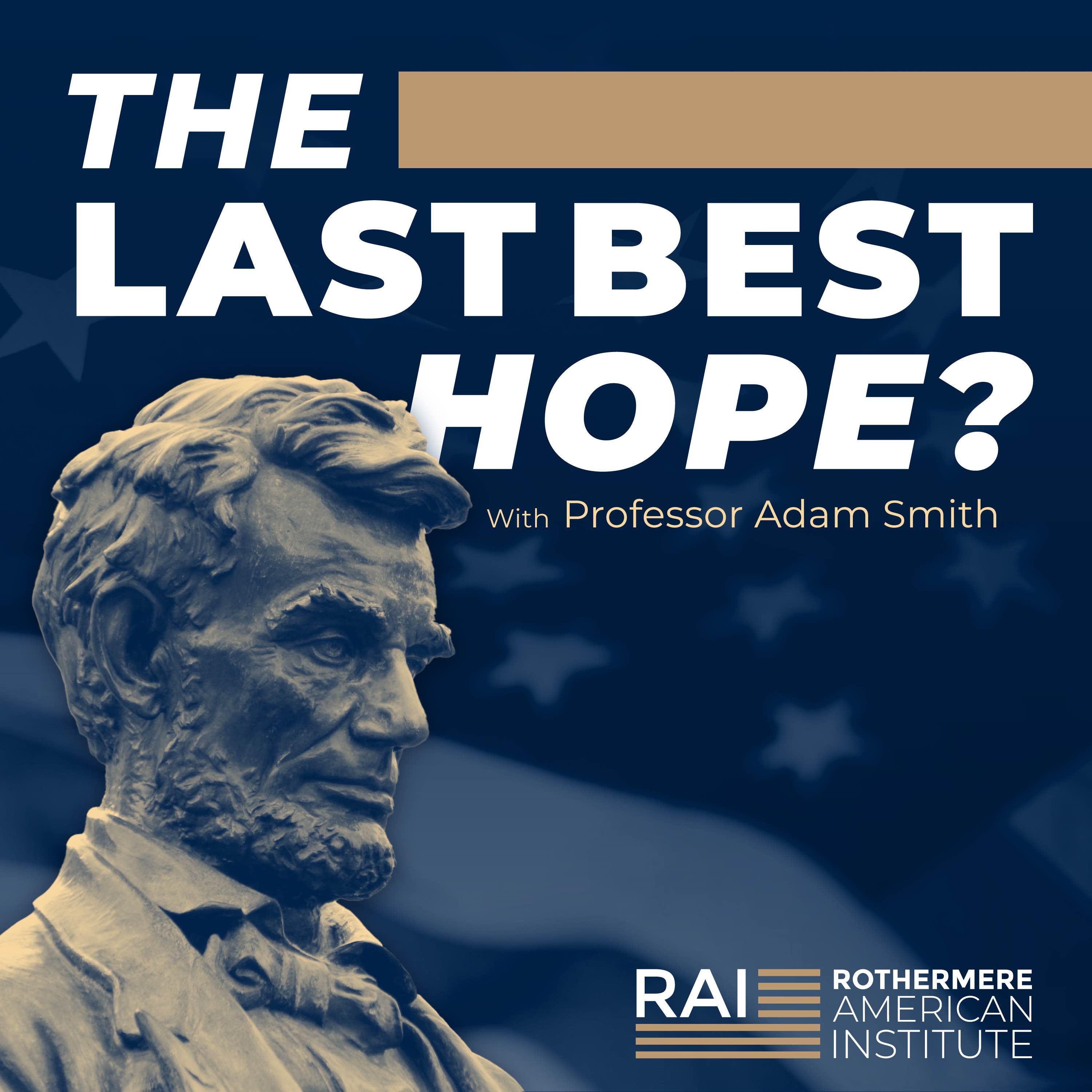
Lincoln and "the Last Best Hope"
"We shall nobly save, or meanly lose, the last best hope of earth" -- Abraham Lincoln's phrase in his message to Congress in December 1862. What did he mean? In this episode, Adam talks to Rachel Shelden of the Richards Civil War Era Center at Penn State. They talked about Lincoln, his opposition to slavery, his vastly more complex view of racial equality... and why he coined that m
What lessons should America learn from the New Deal?
Does America and the world need a new New Deal? If so, what lessons can we learn from how old orthodoxies in economic policy-making were challenged in the interwar period? In this episode, Adam talks to Eric Rauchway about the year 1933, when Franklin D. Roosevelt came into office and immediately set a course that challenged some of the sacred shibboleths of economic policy-making. Hosted on Aca
Reenacting the Revolution
Is a country that’s had a successful revolution doomed to endlessly re-enact it? In this episode, Adam talks to Professor Margaret Weir (Brown University and Oxford) about why anti-lockdown protests take the form they do in America: armed men entering legislatures and the waving of flags with the slogan "Don't Tread on Me". Hosted on Acast. See acast.com/privacy for more informatio
Crisis, what crisis?
What is the difference between a "crisis" and a "not-crisis"? How do crises happen and how have they shaped history? Adam talks to Jay Sexton of the University of Missouri, author of "A Nation Shaped by Crisis: A New American History" who thinks we're now in a crisis that, unlike previous crises, will leave the United States weaker. Hosted on Acast. See acast.co
What is federalism?
Dividing power between the Federal government and the states may have seemed a good idea in theory to the founding fathers but in practice it's led to confusion and conflict. Donald Trump claims that his power is "total". State governors -- and constitutional experts -- beg to differ. In this episode, Adam talks to Grace Mallon of Oxford University, an expert in the reality of Feder
Recommended

زن بودن

Medicine with Meaning
Yours Truly Johnny Dollar Collection

Take Back Your Health®
CBS Radio Mystery Theater | Old Time Radio
Solved Murders - True Crime Stories

紐約鳥|New York Aperture
The Swerve Podcast: Obscure Topics | Conspiracy Theories

The Bread and Banter Podcast
The Church of What's Happening Now: The New Testament
Busted Open

Deadline: White House
