
Astronomy Daily: Space News Updates
Join hosts Anna and Avery for daily Space & Astronomy news, insights, and discoveries. Give us 10 minutes and we'll give you the Universe! For more visit our website and sign up for the free daily newsletter and check out our continually updated newsfeed. Follow us on X, Facebook, YouTube and TikTok.
Episodes
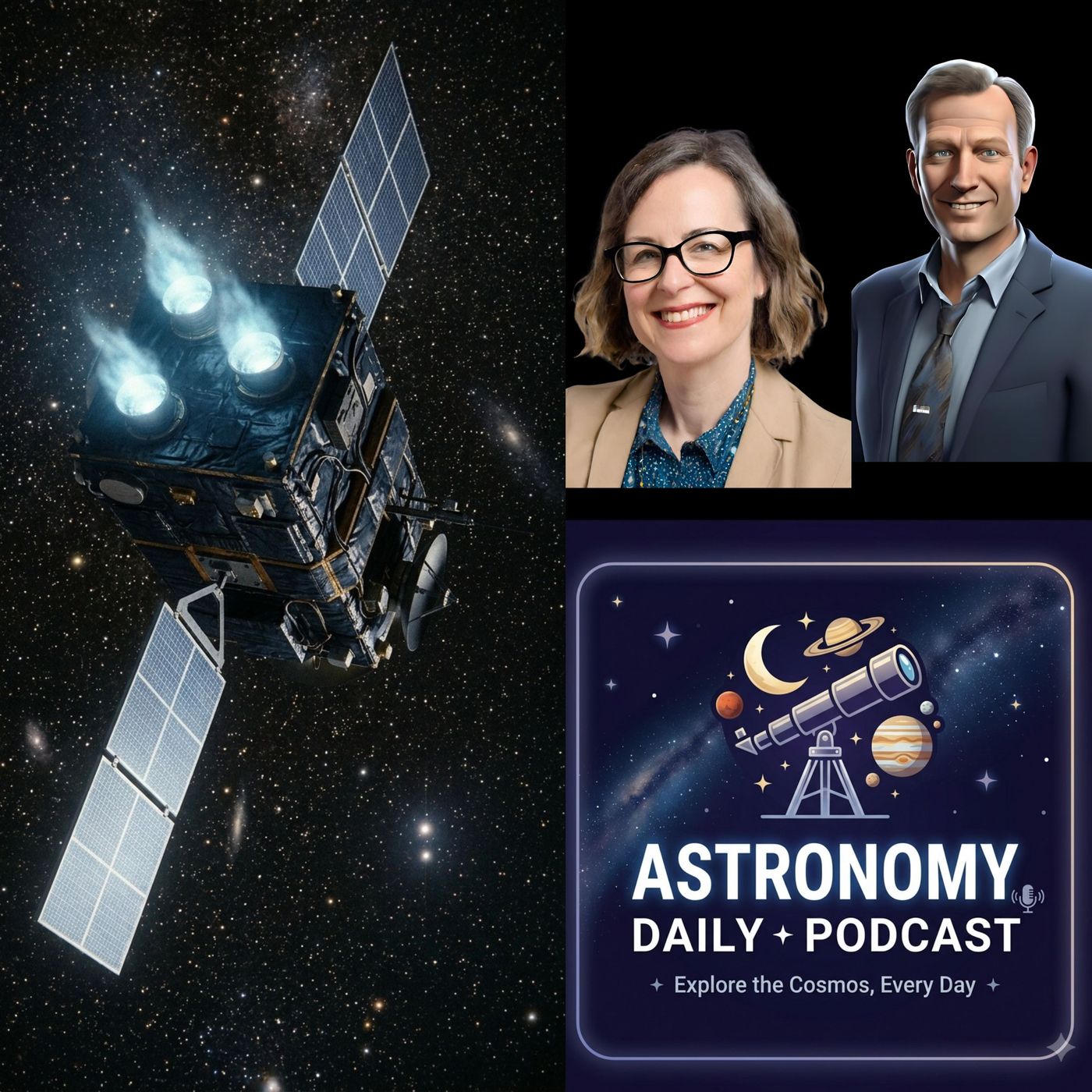
HERA's Grand Maneuver: Braking for Didymos and the Future of Planetary Defence
Show notes Hera Hits the Brakes ESA's Hera spotted its target asteroid for the first time last week and fires its first braking burn on Thursday — 93 minutes of thrust to start stopping at Didymos and Dimorphos, the asteroid pair NASA's DART hit in 2022. Plus: Solar Orbiter traces a solar-wind switchback back to the Sun, Gemini North finds chains of giant knots in the remnant of the supernova of 1
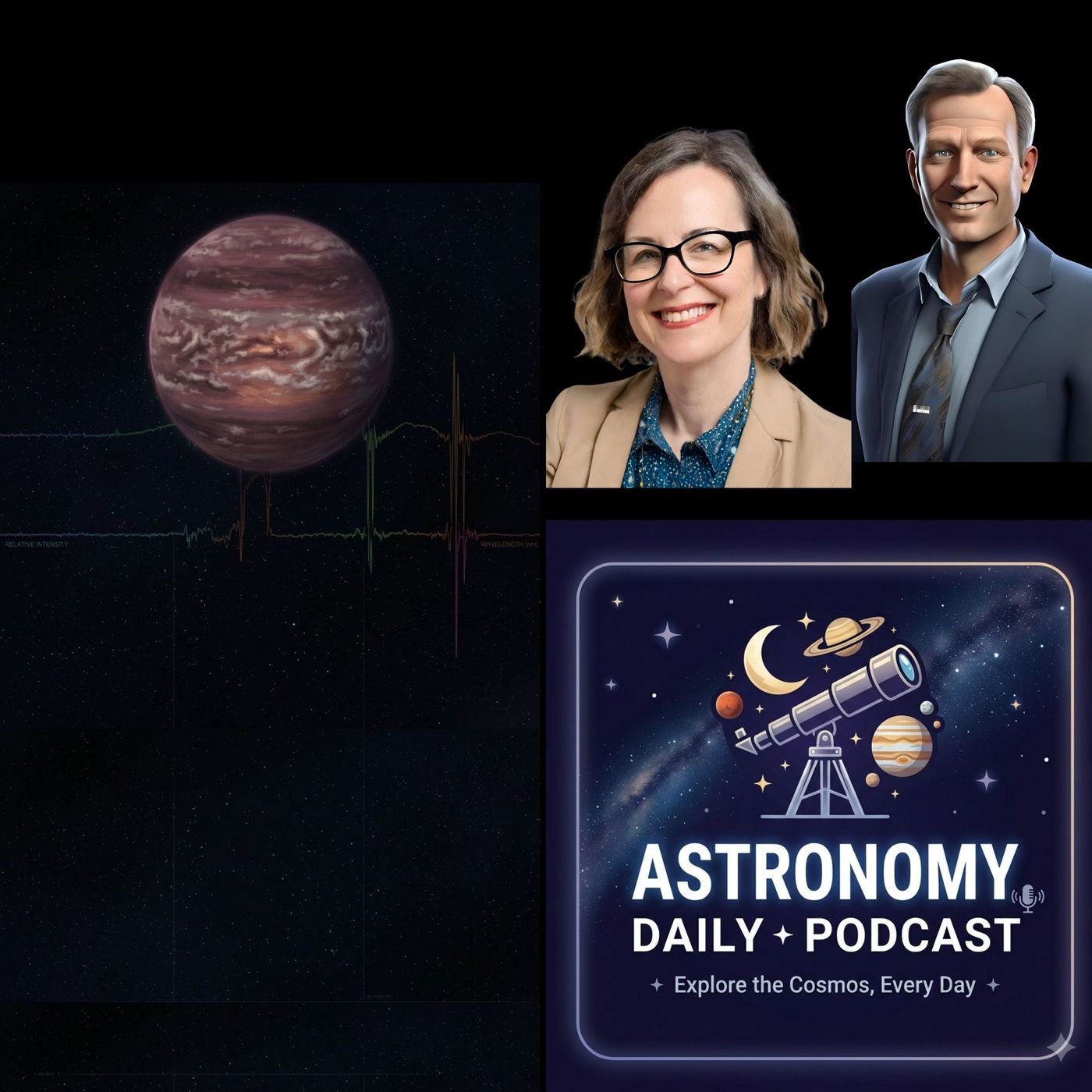
Cloudy with a Chance of Water: The Mysteries of WISE 0855 Unveiled
The coldest brown dwarf we know has weather. JWST watched water clouds thicken and thin on WISE 0855, a sunless world seven and a half light-years away — plus a star slowly eating a brown dwarf, ten minutes of X-rays after a half-second burst, a Soviet satellite breaking up over Western Australia, NASA's lunar cave hunt, and Mercury's best evening show of the year for the south. Stories Weather on

A Nobel in Ice: Unveiling the Secrets of the IceCube Neutrino Observatory
Show notes We're back after a short break! Today: the 2026 Nobel Prize in Physics goes to Francis Halzen for the IceCube Neutrino Observatory — a cubic kilometre of Antarctic ice turned into a telescope. Then a Sydney-led team publishes the most distant fast radio burst yet, from a dwarf galaxy just 3 billion years after the big bang; Hubble's archive yields a possible second-generation planet aro

The Great Water Mystery: Jezero Crater and the Hunt for Mars' Hidden History
Perseverance drove to the edge of an ancient Martian lake expecting a beach and found the inside of a volcano — rock that water has been through at least three separate times. Europe's Jupiter probe comes home on Monday night and crosses Australia in a fully dark sky. Two teams, using two completely different techniques, both find something hiding inside the most famous planetary system we have ev

What Keeps a Galaxy Churning: Andromeda's Supernova Secrets Revealed
Supernovae keep galaxies churning A new study led by Fan Yi Meng from Tsinghua University provides the first comprehensive census of superbubbles in the Andromeda Galaxy, revealing that clustered supernova feedback is sufficient to sustain galactic-scale turbulence. This finding helps to explain why galaxies remain active over billions of years, with turbulence playing a crucial role in regulating

The Unifying Mystery of Black Hole Jets: Stellar and Supermassive Connections
SHOW NOTES Black hole jets follow one universal rule Adelle Goodwin (Curtin University / ICRAR, Forrest Research Foundation Fellow) and Andrew Mummery (Institute for Advanced Study, Princeton) show that supermassive black holes launch their outflows at the same critical accretion rate as stellar-mass black holes — about 2% of the Eddington limit — making accretion-outflow coupling scale-invariant
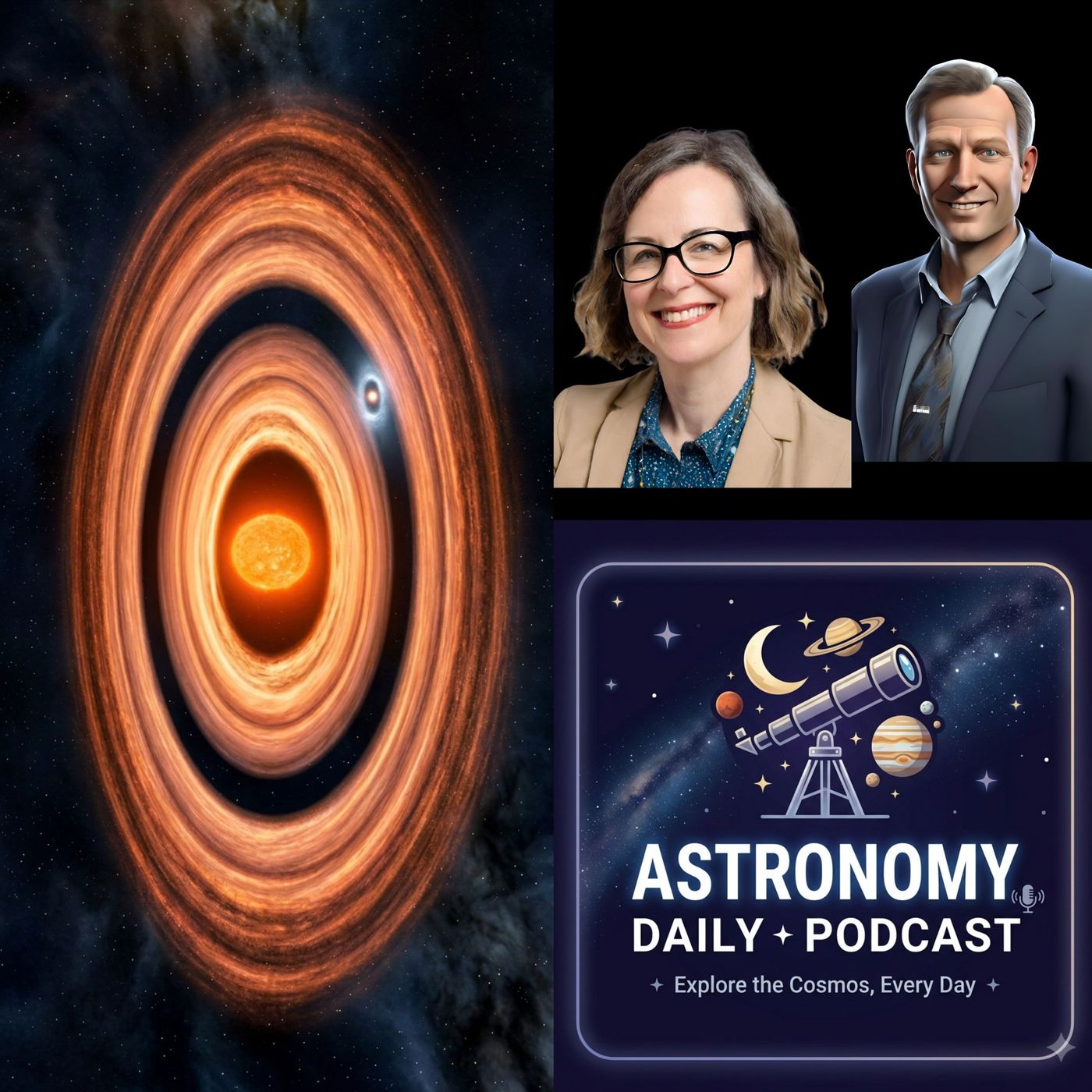
The Youngest Planet Ever Found
Astronomers have confirmed the youngest planet ever found - Elias 2-24 b, less than a million years old, sitting inside a gap it is carving in its own birth disc 450 light-years away. Plus: the Lunar Reconnaissance Orbiter finds a 222-metre crater that was not there in 2024, a 178-year-old space weather record gets corrected by seven years, and Sakurai's Object - a star that came back from the dea

Roman Opens Its Eye
First starlight from Roman, a shorter fuse on the Solar System, weapons in orbit, and a globular cluster hiding behind the dust Roman opens its eye — and finds it has twice as long to look NASA has activated the Nancy Grace Roman Space Telescope's Wide Field Instrument, a 300-megapixel infrared camera built around eighteen detectors, with a field of view at least a hundred times larger than Hubble

The Evolving Enigma of Dark Energy and the Sun's Mysterious Past
An Australian-led team has rebuilt thirty years of supernova observations into one consistent catalogue — and it adds fresh weight to the idea that dark energy is not constant. We also ask whether the young Sun swallowed a super-Earth, find out why a quiet Sun is bad news at thirty-five thousand feet, and watch JWST run the most sensitive exomoon search ever attempted. Plus a Crew-13 update and a

The Planet That Keeps Shrinking plus the Weekend Wrap
Today's episode — The Weekend Wrap, Saturday 12 September 2026: OUR LEAD: A SMALLER MERCURY Mercury has been contracting for four and a half billion years as its huge iron core cools, and it writes the record on its own surface — in long lobe-fronted cliffs called lobate scarps, where one slab of crust has ridden up over another. Add up all that shortening and you get the total contraction. The tr
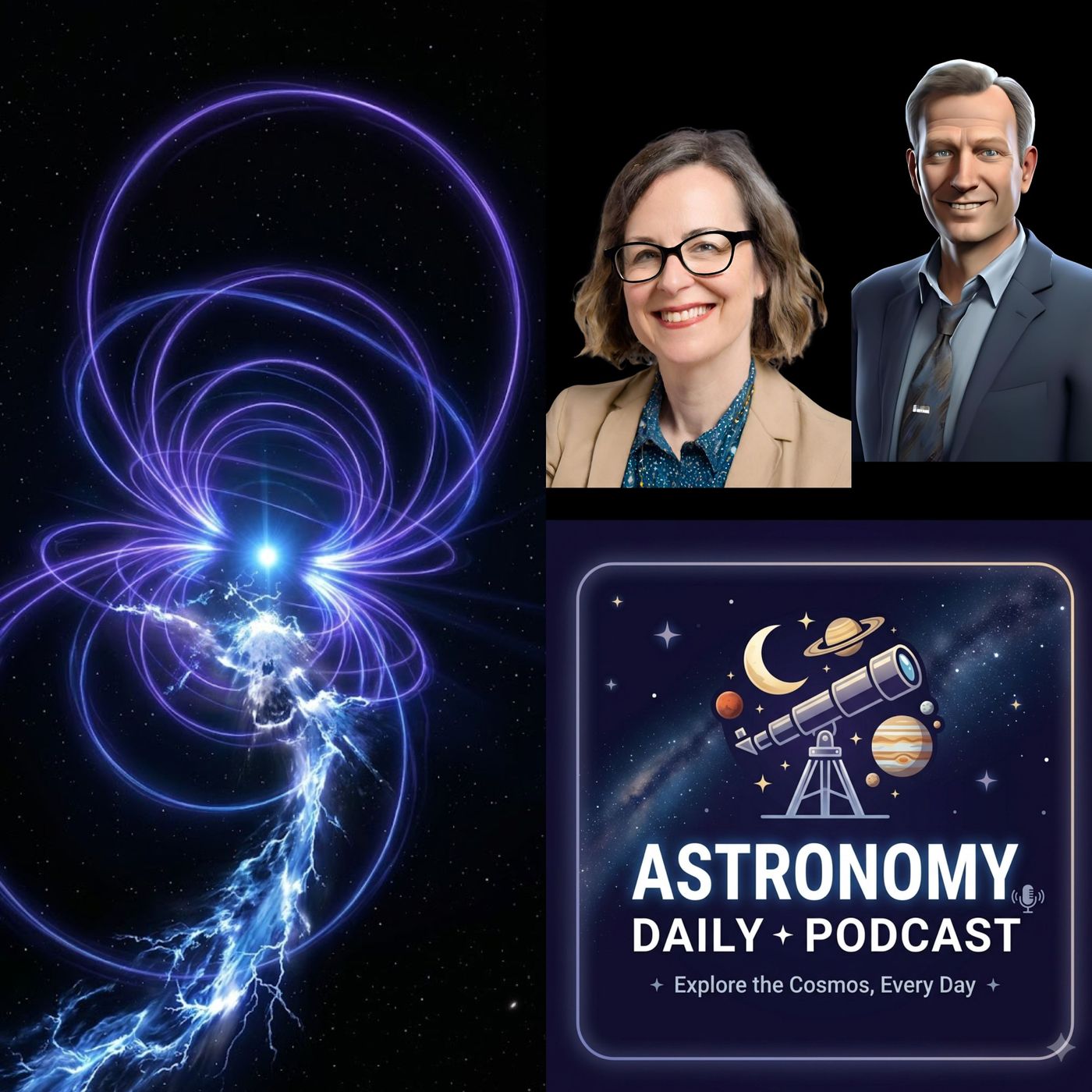
Half the Neutron Stars
Today's episode — S05E191, Friday September 11, 2026: Main story: A population-synthesis study published in Nature Astronomy on 10 September argues that magnetars make up roughly half of all neutron stars, not the one-in-a-hundred implied by the catalogues. Celsa Pardo-Araujo and Nanda Rea (Institute of Space Sciences, ICE-CSIC, Barcelona) with Michele Ronchi (ASTRON) and Vanessa Graber (Royal Hol

A Hundred and Nine Flashes
Today's episode — S05E190, Thursday September 10, 2026: Main story: 109 fast radio bursts have been used to measure how much galactic feedback has smoothed out the matter in the universe. A fast radio burst lasts about a millisecond, and on its way to us it is dispersed — low radio frequencies slowed more than high ones by free electrons along the path, exactly the way a prism separates white ligh
The Smallest Things Remember
Everything beyond Neptune is a leftover. The icy bodies of the Kuiper Belt never got assembled into a planet, and out there — dark, cold and empty enough that things mostly leave each other alone — they are the closest thing we have to the original building blocks of the solar system, still sitting roughly where they were made. The trouble is that everything we know about them, we learned from the

The Moon in Five Hours
For fifty years the story has been that the Moon assembled slowly out of a disc of debris. New simulations from Southwest Research Institute add one thing everybody left out — the strength of rock — and get an intact Moon in about five hours. Plus eight black holes that outgrew their galaxies, two massive stars that fell past each other and got caught, Dragonfly's Titan landing site gets a name, a

Europe Launches From Europe — And Two White Dwarfs Six Minutes Apart
A German rocket lifted off from an Arctic island on Saturday and became the first vehicle ever to reach orbit from Western European soil. Plus: the gaps in stellar streams may not be dark matter after all, two white dwarfs circling every 374 seconds in the far southern sky, peptides that fold in concentrated sulfuric acid, and what Katalyst's LINK is actually doing next to Swift. Both-hemispheres
The Hydrogen Map: How a Radio Telescope Heard Half the Universe
Anna and Avery open the Weekend Wrap with a genuine first: South Africa's MeerKAT has detected the 21-centimetre hydrogen signal from four to five billion light years away using radio data alone — no optical galaxy survey propping it up — proving out the technique the Square Kilometre Array will use to measure dark energy. Then the week in review: Roman's coronagraph wakes up, Starship Flight 14 g

One Flash in the Xenon: The Dark Matter Event Nobody Can Explain
Links & sources Brown University — LZ experiment sees surprising result in search for dark matter — https://www.brown.edu/news/2026-09-01/lz-dark-matter-results US Department of Energy — LZ Sees Surprising Result in Search for Dark Matter — https://www.energy.gov/science/articles/lz-sees-surprising-result-search-dark-matter Imperial College London — Dark matter hunt takes unexpected turn after
BepiColombo Lets Go: Eight Years, Nine Flybys, One Irreversible Moment
Anna and Avery cover BepiColombo's arrival at Mercury beginning today, as the ESA/JAXA mission jettisons the transfer module that has carried it for nearly eight years and nine planetary flybys. Plus: NASA awards Blue Origin a $700 million contract to build a dedicated Mars communications orbiter, Hubble confirms a brand-new ten-sided cloud pattern at Saturn's south pole — first spotted by amateur

There's Something Molten Under Mars's South Pole
Today's episode — S05E183, Wednesday September 2, 2026: Main story: A thermal anomaly beneath Mars's south pole. Writing in Nature on August 27, a team led by Alexander Berne (Caltech PhD '26, now University of Arizona) reports that the interior of Mars's southern hemisphere is 200–400 °C hotter than the northern hemisphere and partially molten. The team used tidal tomography — measuring how much
Catching the Uncatchable: Starship's Boldest Test Yet
Today's episode — S05E182, Tuesday September 1, 2026: Main story: SpaceX cleared Booster 21's static fire at Starbase's Pad 2 on August 30, the last major milestone before Starship Flight 14 — the third flight of the Starship V3 design. Ship 41 had already completed its own static fire campaign at Massey's Test Site. Flight 14 will attempt something no Starship flight has done before: catching the
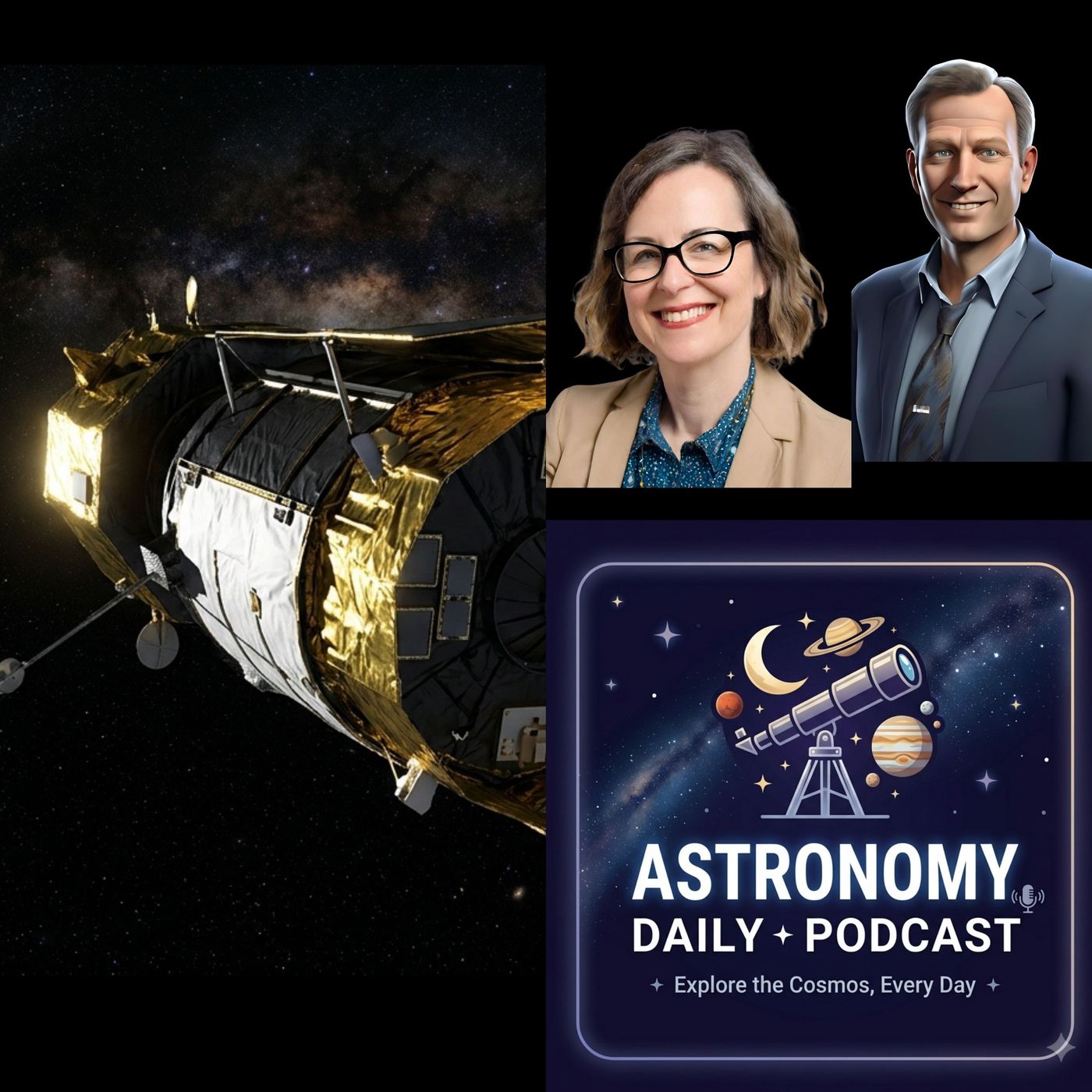
Roman Launches: A Telescope's Countdown Ends
🚀 The Nancy Grace Roman Space Telescope is safely away — Anna and Avery recap Sunday's clean Falcon Heavy launch, what happens next on the road to L2, and a surprise Australian link in the mission. Then: Elon Musk signals the eventual retirement of Falcon 9, two Nobel laureates defend an accelerating universe against a slowing-expansion claim, a single ancient asteroid strike solves two mysteries

The Weekend Wrap, August 29: Roman's Countdown Begins
Today's episode — S05E180, Saturday August 29, 2026, The Weekend Wrap: Main story: The Nancy Grace Roman Space Telescope launches tomorrow, Sunday August 30, with a primary window opening 7:26am EDT (11:26 UTC / 9:26pm AEST Sunday night in Sydney) on a SpaceX Falcon Heavy from LC-39A, Kennedy Space Center; backup window Monday August 31 at 7:22am EDT. Total ascent to spacecraft deployment is about
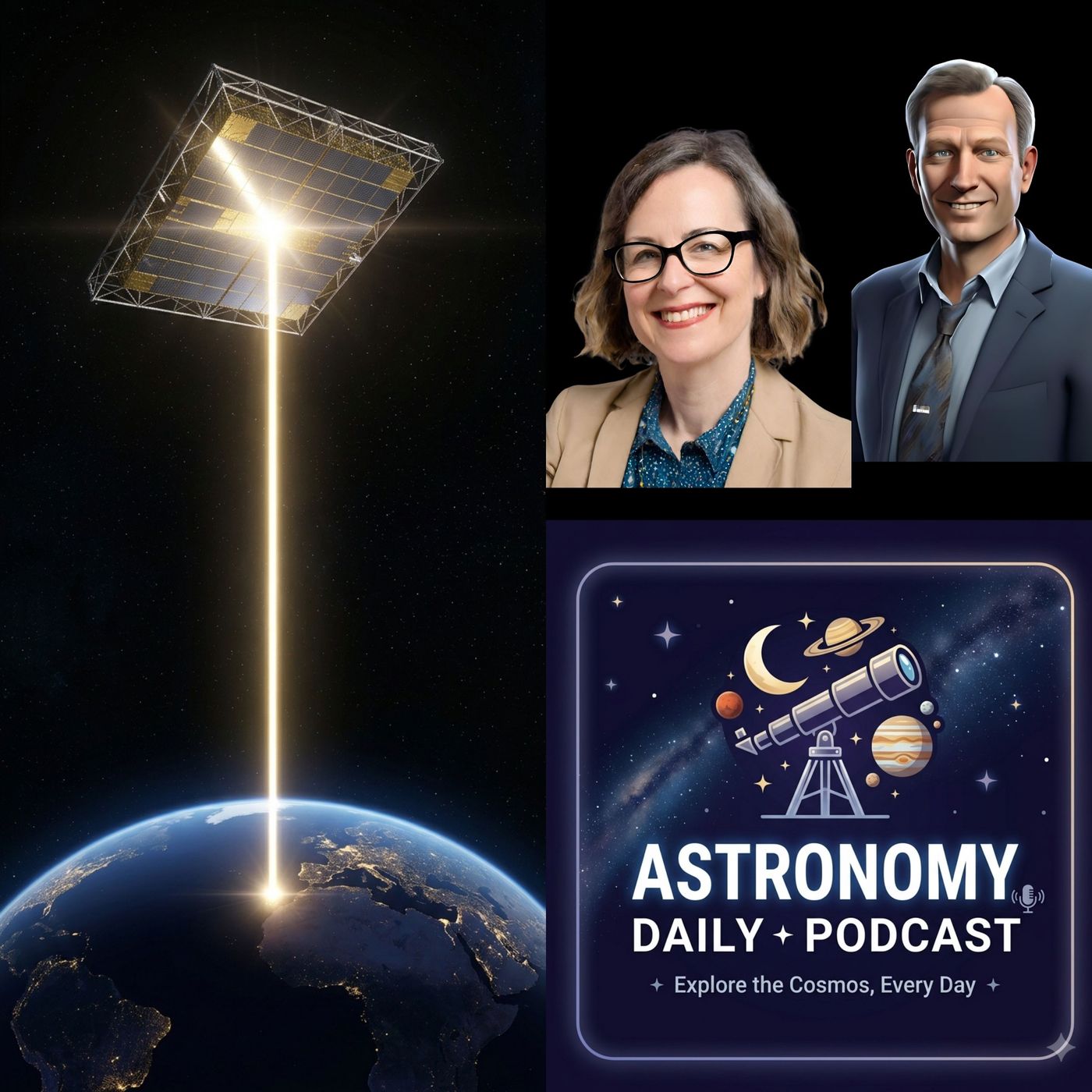
Forty Times Brighter Than the Full Moon: Inside the Space-Mirror Fight
Today's episode — S05E179, Friday August 28, 2026: Feature story: US startup Reflect Orbital has FCC approval for Eärendil-1, a demonstration satellite carrying a 60-foot mirror, the first step toward a planned constellation of 50,000-plus orbital mirrors beaming reflected sunlight to Earth on demand. A new peer-reviewed study (Kocifaj, Bakos and Kundracik, accepted at The Astrophysical Journal

Diamond Rain, Decoded: Twenty Years of Disagreement, Solved
Today's episode — S05E178, Thursday August 27, 2026:Feature story: Physicists at Lawrence Livermore National Laboratory, led by Marius Millot, used the Omega Laser Facility at the University of Rochester to shock-compress diamond samples to about 1 terapascal — roughly three times Earth's core pressure — and temperatures hotter than the Sun's surface, recreating conditions found deep inside Neptun
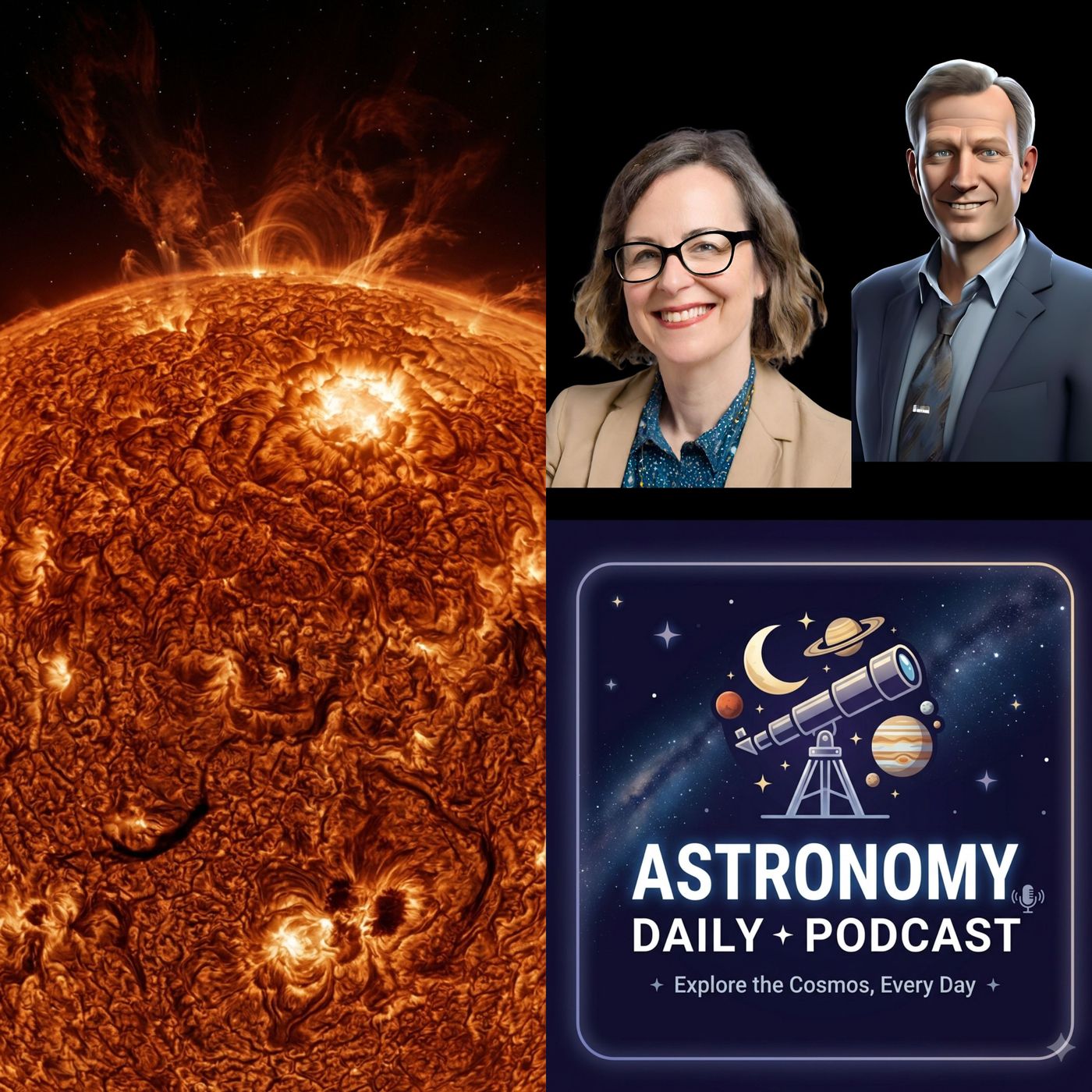
Betelgeuse, Up Close: A Star's Boiling Skin, Revealed
Today's episode — S05E177, Wednesday August 26, 2026:Feature story: Astronomers using the ALMA array in Chile, led by Bill Dent (European Southern Observatory), have released the most detailed picture yet of the actual surface of Betelgeuse, the red supergiant marking Orion's shoulder — a corrugated, irregular surface with bright convective hot spots, some nearly 1,000°F hotter than the surroundin
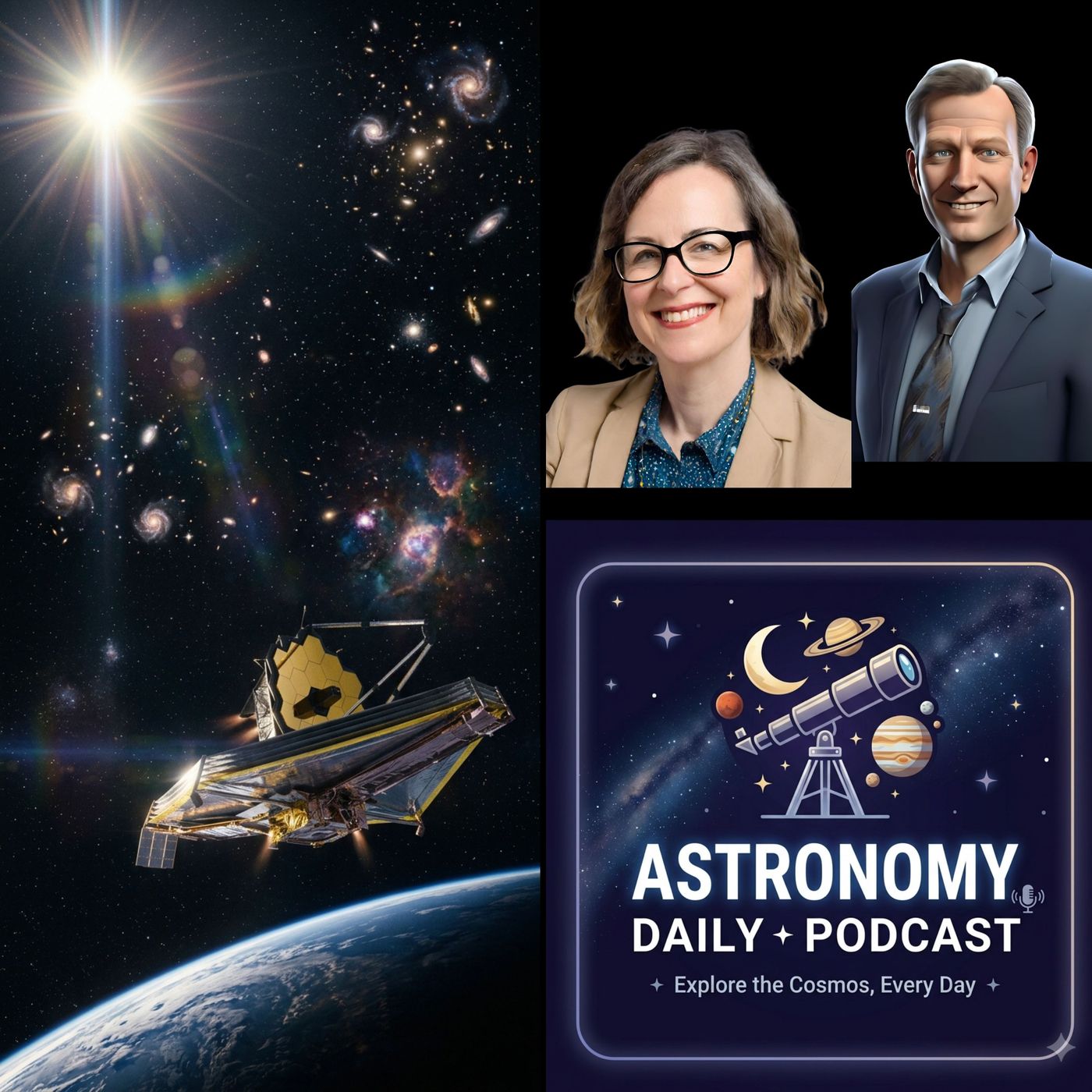
NASA's Roman Space Telescope Is Ready to Fly — Nine Months Early
Today's episode — S05E176, Tuesday August 25, 2026:Feature story: NASA's Roman Space Telescope is fully encapsulated inside its Falcon Heavy fairing and cleared to launch no earlier than 7:26 a.m. ET this Sunday, August 30 — about nine months ahead of its original schedule, a rarity for a NASA flagship mission. Roman is headed to Sun-Earth L2 for a five-year mission mapping dark energy and dark ma
China Delays Its Most Ambitious Moon Mission Ever
Today's episode — S05E175, Monday August 24, 2026:Main story: China delays Chang'e-7's launch by about a month. The Chang'e-7 lunar south pole mission's launch window opened today, August 24, but a tropical system (reported as Tropical Depression/Storm Narra) over the Gulf of Tonkin, alongside a cited safety and reliability review, forced a scrub with no immediate new date. Because the mission's l

China's About to Attempt the Most Ambitious Moon Mission Ever
Anna and Avery cover China's Chang'e-7 mission — a four-vehicle lunar south pole expedition, including a leaping hopper robot, that a Brown University scientist calls the most ambitious robotic Moon mission any nation has ever attempted, with its launch window opening Monday. Then: this week's biggest hardware stories, catching up on Starship's Ship 40 (still marooned off Christmas Island), LandSp

NASA Finds the Crater a SpaceX Rocket Left on the Moon
Anna and Avery cover how NASA, working with South Korea's Danuri orbiter, pinpointed and imaged the exact crater left by a SpaceX Falcon 9 stage that struck the Moon on August 5th. Plus: the private rescue mission for NASA's ailing Swift telescope has officially failed, astronomers may have caught dark matter bending a black hole's jet, and Rocket Lab launches its ninth radar satellite for Japan's

LandSpace Nails It: China's First Private Booster Recovery
Anna and Avery cover LandSpace becoming the first Chinese commercial company to land an orbital-class rocket booster — a big step for the country's private space sector. Plus: astronomers find a "mega-Earth" 23 times more massive than our planet that shouldn't be able to exist, a star weaving impossibly close to our galaxy's supermassive black hole that could reveal its spin within a decade, and n

First Frenchwoman in Space Steps Outside
Anna and Avery cover Sophie Adenot becoming the first French woman ever to conduct a spacewalk — a historic EVA that ran into some antenna trouble along the way. Plus: a trillion-mile river of gas that explains why some planetary systems end up tilted, an honest update on Starship's Ship 40 as it turns out the recovery saga wasn't quite finished, and SpaceX quietly closing in on 11,000 satellites

Starship's Ship 40 Makes It Home
Anna and Avery close out a three-week saga: SpaceX has recovered Starship's Ship 40 from the Indian Ocean after a soft splashdown, a difficult tow, and a moment where recovery odds looked as low as 18%. Plus: a dead star in the Helix Nebula previews our own Sun's five-billion-years-from-now fate, new evidence the Milky Way was built in part by an ancient galactic collision, and China's fast recove

Tiny Robots, Alien Caves: NASA's Plan for Titan
Anna and Avery cover NASA's newly funded concept for spherical, propeller-free "aerobots" that could one day explore the methane-carved cave systems of Saturn's moon Titan. Plus: SpaceX breaks its own launch-turnaround record with two Falcon 9 missions 38 minutes apart, Rocket Lab lands its biggest-ever defense contract to build "Flatellites" for the U.S. Space Force, and a geomagnetic storm arriv

Is Empty Space Really Empty? A 90-Year-Old Mystery Gets Its Answer (S05E168 — The Weekend Wrap)
Today's episode — S05E168, Saturday August 15, 2026, our "Weekend Wrap":**Main story: a magnetar confirms 90-year-old vacuum birefringence prediction.** A team led by Rachael Stewart (George Washington University), using NASA's IXPE spacecraft, found the strongest evidence yet that extreme magnetic fields polarize light passing through empty space — confirming a 1936 prediction by Werner Heisenber

The Black Hole Wrapped in a Star: JWST's Cosmic Dawn Discovery
Anna and Avery break down JWST's discovery of MoM-BH*-1, the earliest known "black hole star" — a black hole shrouded in dense gas, glowing from just 660 million years after the Big Bang, that might explain how supermassive black holes grow so fast. Plus: the Perseid meteor shower's spectacular overnight peak, a new satellite built to watch other satellites in geostationary orbit, and veteran NASA

Two Minutes of Totality: Inside the August 12 Eclipse
Anna and Avery break down yesterday's total solar eclipse — a 182-mile-wide shadow that swept from the Arctic through Greenland and Iceland to northern Spain, giving millions of people up to 2 minutes 18 seconds of totality. Plus: astronomers find three supermassive black holes sharing one distant galaxy (two are about to merge), Virgin Galactic pushes commercial spaceflight back to February 2027,
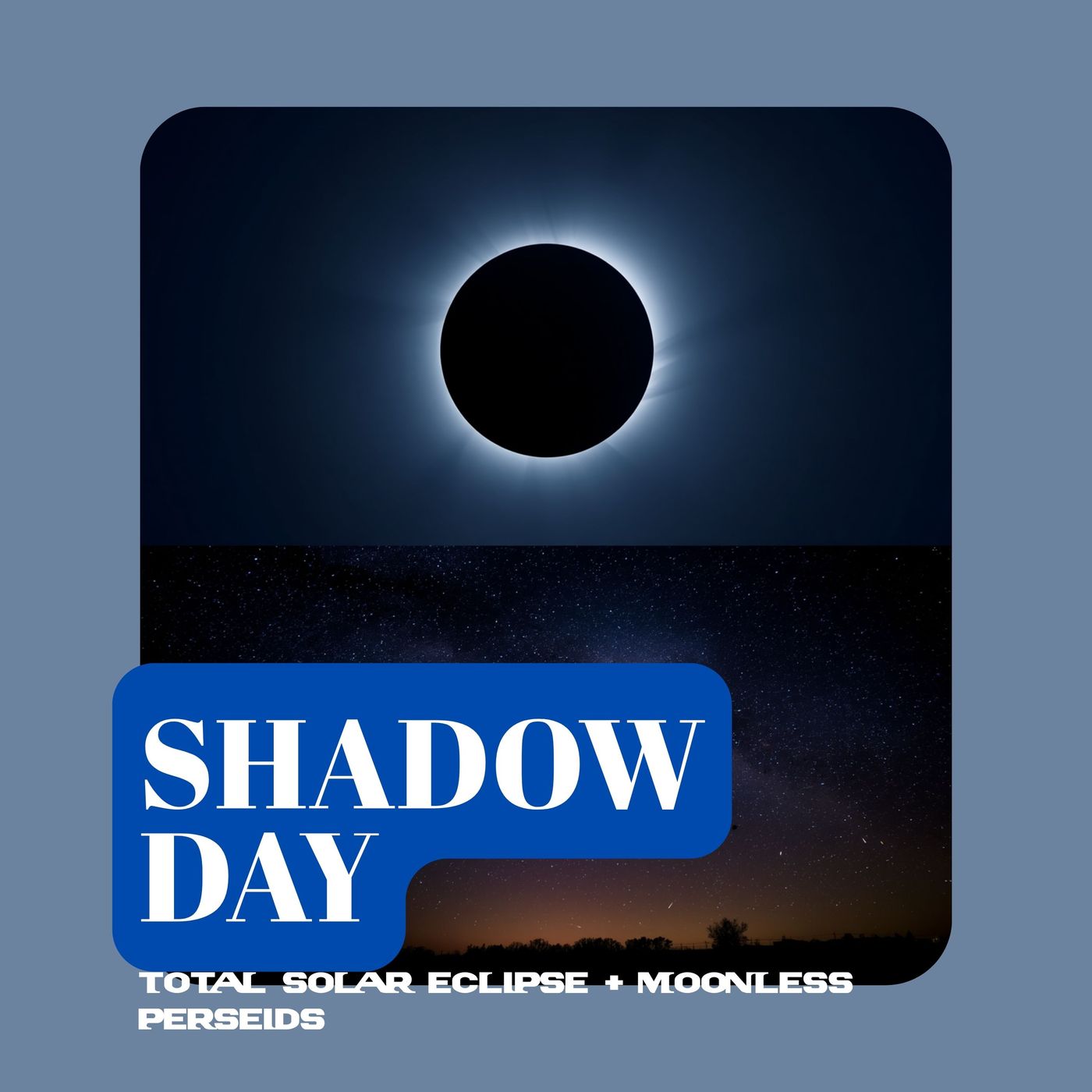
Eclipse 2026: Where, When & How to Watch (Both Hemispheres)
In this episode • Shadow Day: the only total solar eclipse of 2026 crosses Arctic Russia, Greenland, western Iceland and northern Spain today — the first total eclipse over western mainland Europe since 1999 (Spain’s first since 1905, Iceland’s since 1954). Max totality ~2 min 18 s. Reykjavík ~17:48 UT; northern Spain ~18:27–18:33 UT (Sun very low, ~4–10° up). Live via NASA, timeanddate and t
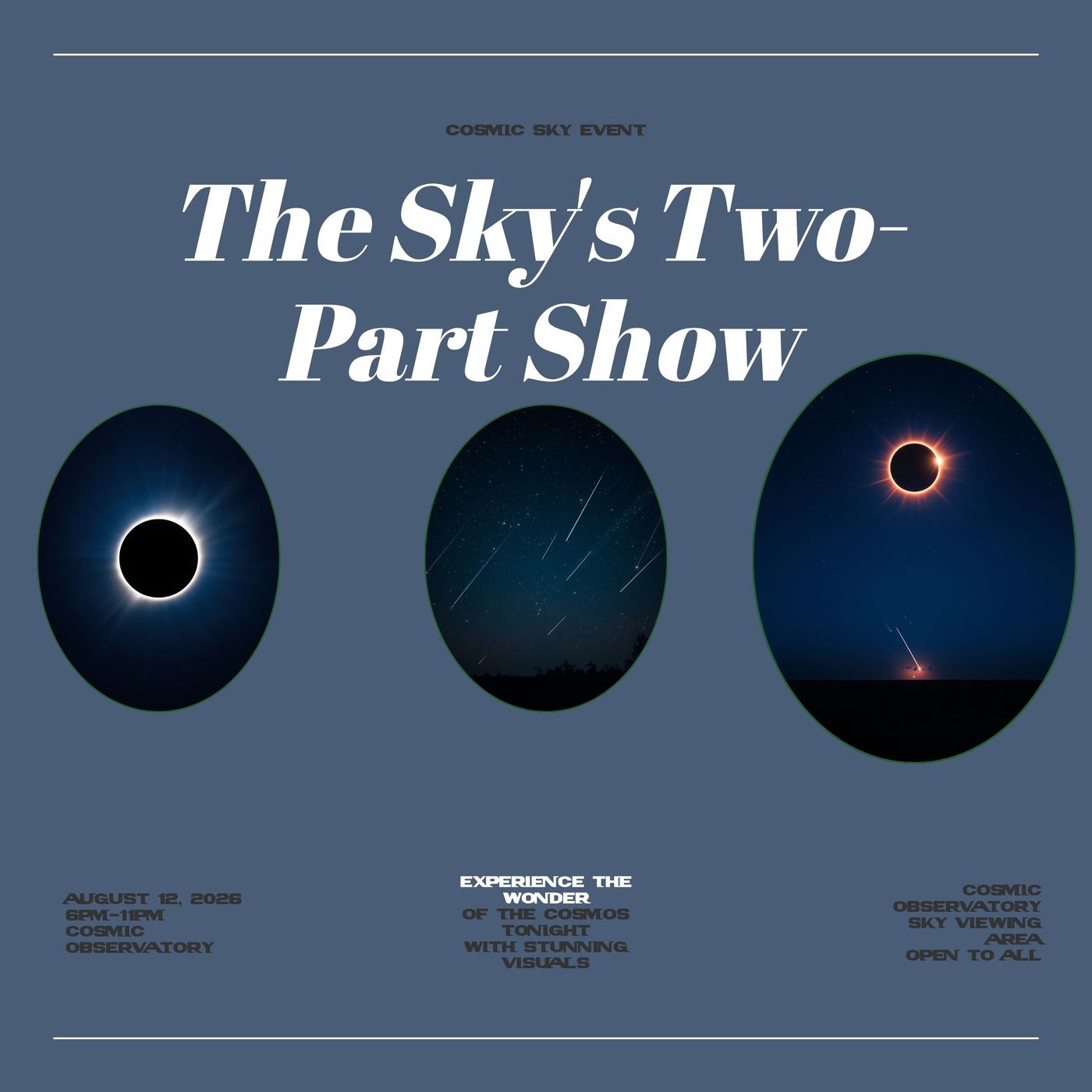
Eclipse Eve: Totality Returns to Europe
Astronomy Daily · S05E164 “Eclipse Eve” · Tuesday 11 August 2026. Sources are primary/agency where possible; aggregator dates were checked against originals. In this episode • LEAD — The 12 August total solar eclipse: the only total eclipse of 2026 and the first over mainland Europe since 1999. Totality arcs from Siberia over the North Pole to eastern Greenland, western Iceland, northern Spain
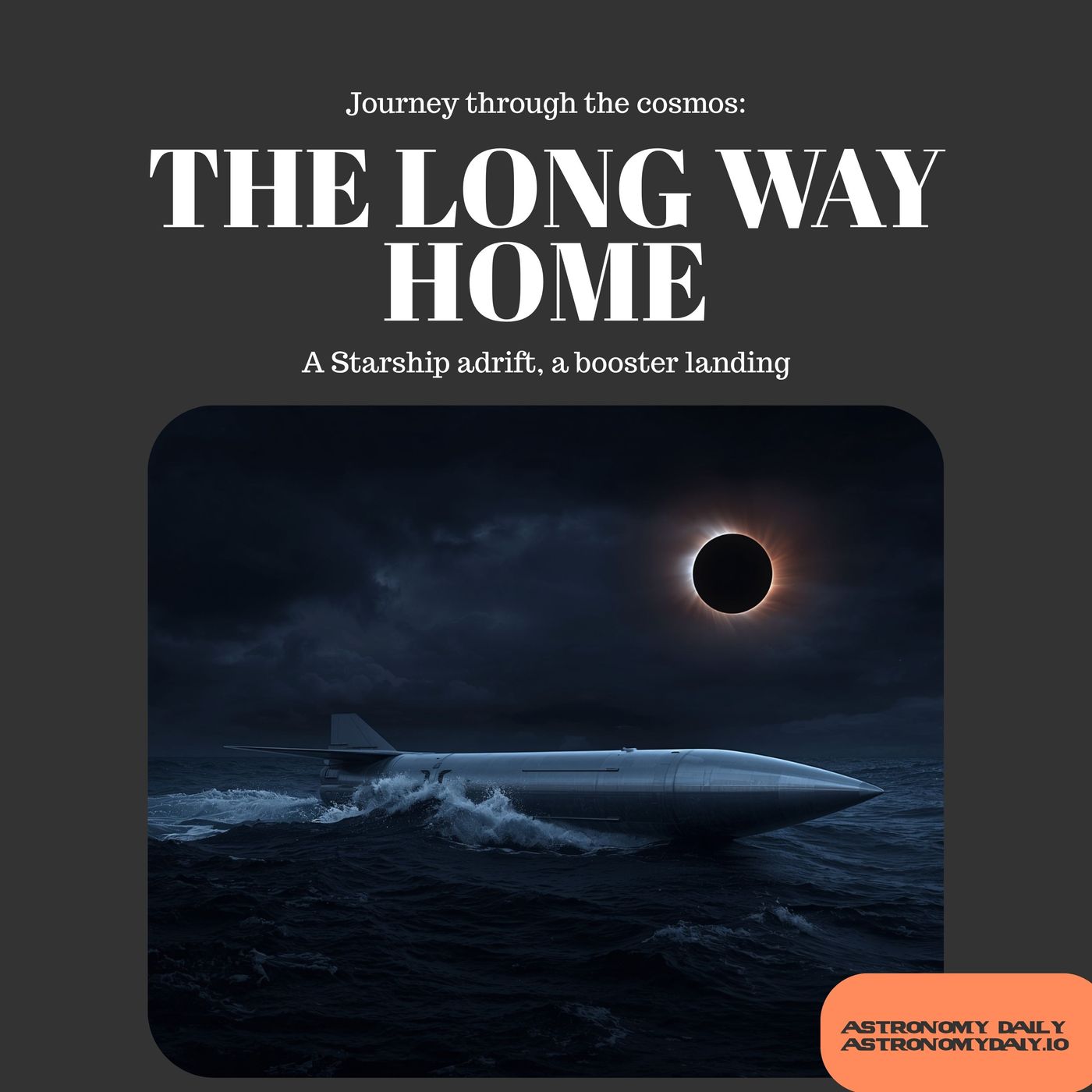
SpaceX Starship Lost at Sea? Plus China’s Landing Attempt & Uranus “Breathing”
Astronomy Daily · S05E163 · “The Long Way Home” · Monday 10 August 2026. Sources verified against primary / institutional outlets. Starship “lost at sea” (Flight 13) • Flight 13 launched 24 July 2026 from Starbase, South Texas; the upper stage (“Ship,” Ship 40, ~52 m) made the softest Starship water landing yet in the Indian Ocean off Western Australia — and, in a program first, survived intact

Whirlpools Found on the Sun’s Surface for the First Time
This weekend on Astronomy Daily: the Inouye Solar Telescope reveals whirlpools on the Sun’s surface for the first time, a Falcon 9 upper stage carves a fresh crater on the Moon, Voyager 2 pulls off a daring "Big Bang" power swap 21 billion kilometres away, and the LINK spacecraft wins its de-spin battle in the race to save NASA’s Swift. Plus your both-hemispheres guide to the 12 August total solar
The Colour of Empty Space
Astronomy Daily · S05E161 · “The Colour of Empty Space” · Friday 7 August 2026. Hosts: Anna & Avery. astronomydaily.io · @AstroDailyPod ① Vacuum birefringence: reading a magnetar ● NASA’s IXPE, with NICER and the Parkes/Murriyang radio telescope (NSW), measured the polarised X-rays of magnetar 1E 1547.0−5408. ● Result: soft X-ray polarisation ~65% at 2 keV, rising to nearly 80% a
A Rocket Just Hit the Moon — And Telescopes Caught It
Astronomy Daily · S05E160 · 6 August 2026. In this episode: a Falcon 9 upper stage confirmed to have struck the Moon; a live ISS spacewalk; supernova SN 2026gzf caught at first light; SpaceX Crew-13 previewed; and a both-hemispheres guide to the 12 August eclipse and Perseids. FALCON 9 LUNAR IMPACT (LEAD) ● Spent upper stage 2025-010D struck near Einstein Crater (~19.4°N, 93.3°W) at ~06:35
Voyager 2’s “Big Bang” Rescue: One More Year in Deep Space
Astronomy Daily S05E159 — Wednesday, 5 August 2026. In this episode: a power-saving “Big Bang” keeps Voyager 2 doing science, direct-to-phone satellites reach orbit, Curiosity finds a vast honeycomb field on its 14th Martian anniversary, and NASA’s Aspera prepares to hunt the universe’s missing gas. ① Voyager 2’s “Big Bang” power save • JPL engineers freed up power by simultaneously switching of

The Crater Makers: Falcon 9 Hits the Moon Tomorrow | Today’s Space News
S05E158 — “The Crater Makers” · Tuesday 4 August 2026. Four stories on cosmic impacts — and a new map of the X-ray sky — plus a both-hemispheres skywatch. ① A dead Falcon 9 is about to crater the Moon ● A spent SpaceX Falcon 9 upper stage (catalogued 2025-010D) is predicted to strike the Moon near Einstein Crater on 5 Aug 2026 at ~06:35 UTC — the second documented uncontrolled rocket impact
The Largest Galaxy in the Universe, Measured at Last
Astronomy Daily · S05E157 · “The Edge of Everything” · Monday 3 August 2026 In this episode • The largest galaxy, measured at last. Ultra-deep imaging of IC 1101 in the Abell 2029 cluster has traced its outer edge for the first time: an edge radius of ~260 kpc, a diameter near 520 kpc (~1.7 million light-years), and ~3.4 trillion solar masses in stars — about 17× the width of the Milky Way. F

The First “Self-Driving” Telescope Goes Stargazing (SkAI )
Astronomy Daily S05E156 — Weekend Space & Astronomy News Wrap. Saturday, 1 August 2026. In this episode • The first “self-driving” telescope — a SkAI deep-learning system (Northwestern / UChicago / Fermilab) schedules and re-plans observations in real time on the Dark Energy Camera at the Blanco 4-m, Cerro Tololo, Chile — matching human schedulers across two runs. • Betelgeuse's companio
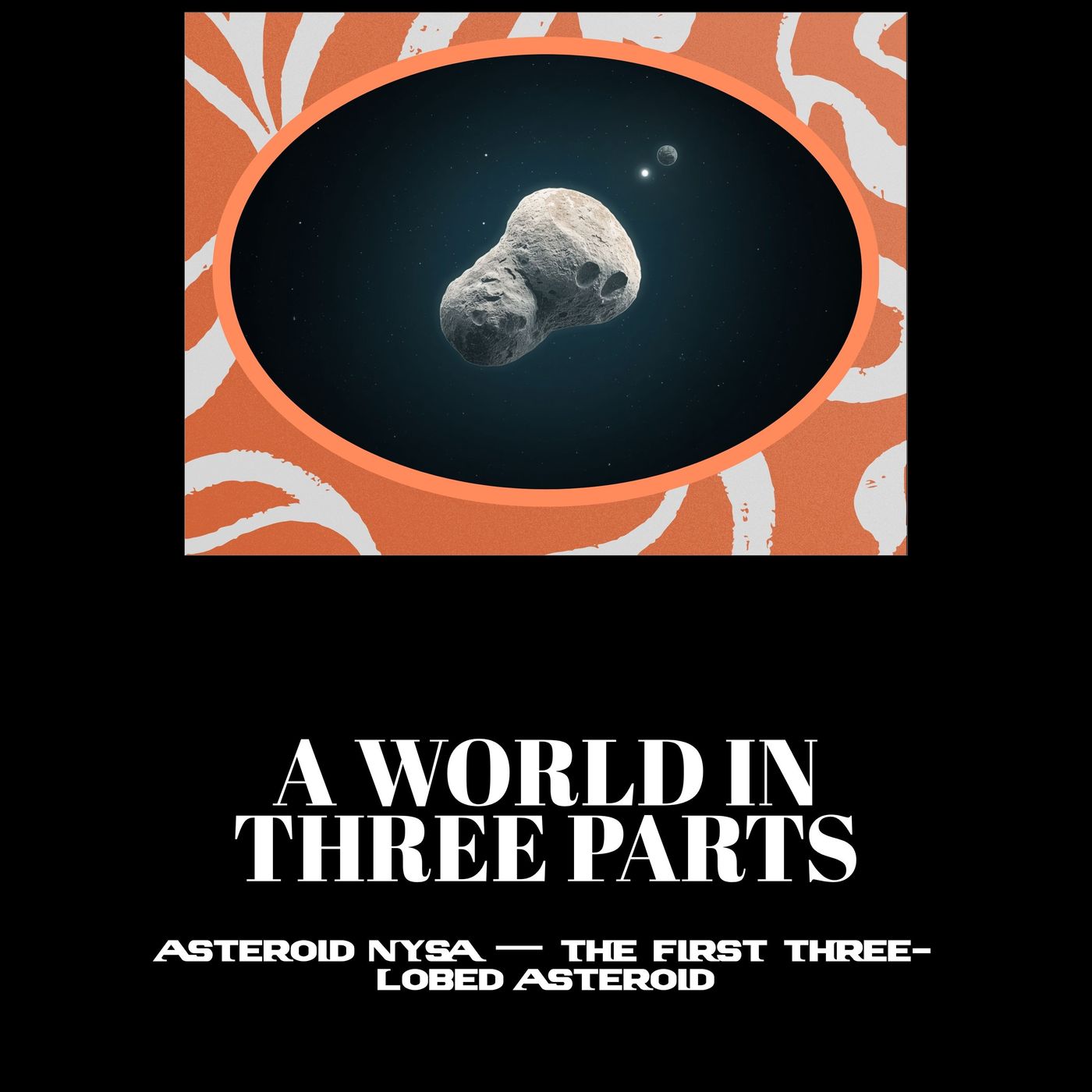
Three of a Kind
S05E155 · Friday 31 July 2026 · Astronomy Daily with Anna & Avery. Four stories and a both-hemispheres skywatch. Australian English. ① Asteroid (44) Nysa — the first three-lobed world, and its hidden moon ● trilobate body — three lobes joined by two narrow necks; a candidate “first” of its kind. ● A new ~1 km moon, S/2026 (44) 1, was found orbiting ≥170 km out — spotted using hig

The Reach of a Giant
Astronomy Daily S05E154 — “The Reach of a Giant.” Thursday, 30 July 2026. Hosted by Anna and Avery. In this episode • A supermassive black hole caught heating and stirring an entire galaxy cluster — turbulence reaching ~300,000 light-years, about 100× more energetic than expected (XRISM / quasar H1821+643). • Why some “clean” white dwarfs are secretly feasting: magnetic fields funnel shredde
Betelgeuse Is Not Alone!
Astronomy Daily · S05E153 · Wednesday 29 July 2026. Four stories from the frontier of space and astronomy, plus a both-hemispheres look at the sky — and news of our brand-new website. In this episode • Betelgeuse is not alone. ESO’s VLT/SPHERE has captured the clearest direct image yet of Betelgeuse B, the long-suspected companion to the famous red supergiant — ending a roughly century-long searc
Reading Io’s Hidden Heat: Juno’s First Subsurface Reading | Today’s Space News
Astronomy Daily S05E152 — “Reading the Heat” · Tuesday 28 July 2026. Hosts Anna & Avery. NASA’s Juno spacecraft has taken the first-ever temperature reading beneath the surface of Io, Jupiter’s volcanic moon — and the technique behind it could reshape how we study icy ocean moons and even volcanoes on Earth. We also look at why JWST’s “Little Red Dots” might be globular clusters being born, th
Pluto's Big Night & a Sharper Look at M87's Black Hole | Today's Space News
Astronomy Daily · S05E151 · “The Faint Little World Has Its Day” · Monday 27 July 2026 · Hosts Anna & Avery. Pluto has its brightest night of the year — so we go deep on the world nobody can agree how to label. Then a crew comes home after 241 days, the galaxy’s most common planet turns out to maybe hide oceans of molten rock, and the first black hole ever photographed gets a sharper, two-colo

Lucky 13 | The Weekend Wrap
Astronomy Daily · S05E150 · “Lucky Thirteen” · Saturday 25 July 2026. Your Weekend Wrap: Starship Flight 13 finally flies and floats, the strongest exomoon candidate yet, a robotic satellite-servicer on its way to GEO, and what the Moon’s far side reveals about Earth — plus a both-hemispheres skywatch. In this episode Chapter Segment 00:00 Cold open & headlines 01:30 LEAD: Starship Flight 13 f

The Moon That Isn't | Today's Space News
Astronomers have confirmed the first moon-like object beyond our solar system — and immediately discovered our vocabulary cannot handle it. A Jupiter-mass world orbits a brown dwarf, which orbits a red dwarf, seventy light-years away. Is it a moon? A planet? Something we have not named yet? Also on today’s show: the Milky Way’s most powerful particle accelerator is confirmed in the direction of Al
Far Side | Today's Space News
Astronomy Daily S05E148 — "Far Side" Thursday 23 July 2026 Starship gets a second shot at Flight 13 — with a schedule caveat worth knowing about. The first far-side lunar samples reveal that Earth has been quietly shielding the side of the Moon that faces us. Astronomers debate whether the lunar far side should be closed to industry. The Milky Way's only helium nova finally steps out from behind t
Space Mechanic | Today's Space News
Astronomy Daily — S05E147: "Space Mechanic" Wednesday 22 July 2026 A spacecraft with robotic arms is on its way to geostationary orbit to keep other satellites alive. A discarded rocket stage is two weeks out from hitting the Moon, and twenty-three astronomers have just asked the world to watch. Plus the first binary star system where both stars exploded, the first complete magnetic map of a galax
Postcards From Mars
Astronomy Daily · S05E146 · “Postcards from Mars” · Tuesday 21 July 2026 NASA’s Psyche probe phones home from its Mars flyby — data and a spellbinding month-long time-lapse — as Europe’s Plato planet-hunter clears its final test. From the Royal Astronomical Society’s National Astronomy Meeting: a CubeSat that could give us hours of solar-storm warning, and a new way to forecast the Sun’s next acti

India Reaches Orbit — Privately — Today's Space News
Astronomy Daily S05E145 — “Arrival” — Monday, 20 July 2026. On the 57th anniversary of Apollo 11, we cover a first-of-its-kind launch, a Mars flyby science haul, a four-billion-year-old Martian record, a habitable-zone world with a likely atmosphere, shrimp feeding in simulated microgravity, and the new science of listening to black holes ring. In This Episode (01:30) India goes private in orbit —
The Sun's Hidden Power, Atmosphere on a Nearby Planet, and Starship's Five-Act Drama
Astronomy Daily — The Weekend Space and Astronomy News Wrap | Saturday 18 July 2026 | S05E144 Anna and Avery wrap the biggest week in space news this year: brand-new research warning that extreme solar storms may hit harder than our models assume, and the delightful news that South African rooibos tea seeds are headed for the International Space Station — plus the four stories that defined the wee

Atmosphere Found on Rocky Exoplanet, Starship Drama Unfolds, and Meteorite Treasure Trove
Astronomy Daily — S05E143 | Friday 17 July 2026 | "A World With Air" Anna and Avery bring you a genuine milestone: the first atmosphere ever detected on a rocky planet in the habitable zone of another star. Plus Starship's last-second launch abort, the New Jersey bedroom meteorite carrying life's ingredients, the earliest galaxy-building ever seen, metallic dunes on Mars, and a Moon–Venus meeting

Hide and Seek - The Faintest Planet Ever Imaged, Pluto's Landslides & Starlink's 355,000 Dodges
Anna and Avery kick off with a decade-long game of cosmic hide-and-seek that has finally ended: Beta Pictoris d, the faintest exoplanet ever directly imaged from Earth, found lurking in more than ten years of archival images — and orbiting a star in the southern constellation Pictor. Then it's the completion of VLASS, the sharpest radio map of the whole sky ever made, arriving just as the Rubin Ob
Starship Set for Launch, First Black Hole Found in Omega Centauri, and X-Rays in Space
Astronomy Daily — S05E141 | Wednesday 15 July 2026 Anna and Avery bring you the biggest space and astronomy news of the day: Starship Flight 13 is cleared for Thursday after the FAA closes its Flight 12 investigation and SpaceX reveals exactly what went wrong; NASA astronaut Anil Menon rides a Soyuz to the ISS on his first flight; astronomers finally find the first of Omega Centauri’s 10,000 "miss
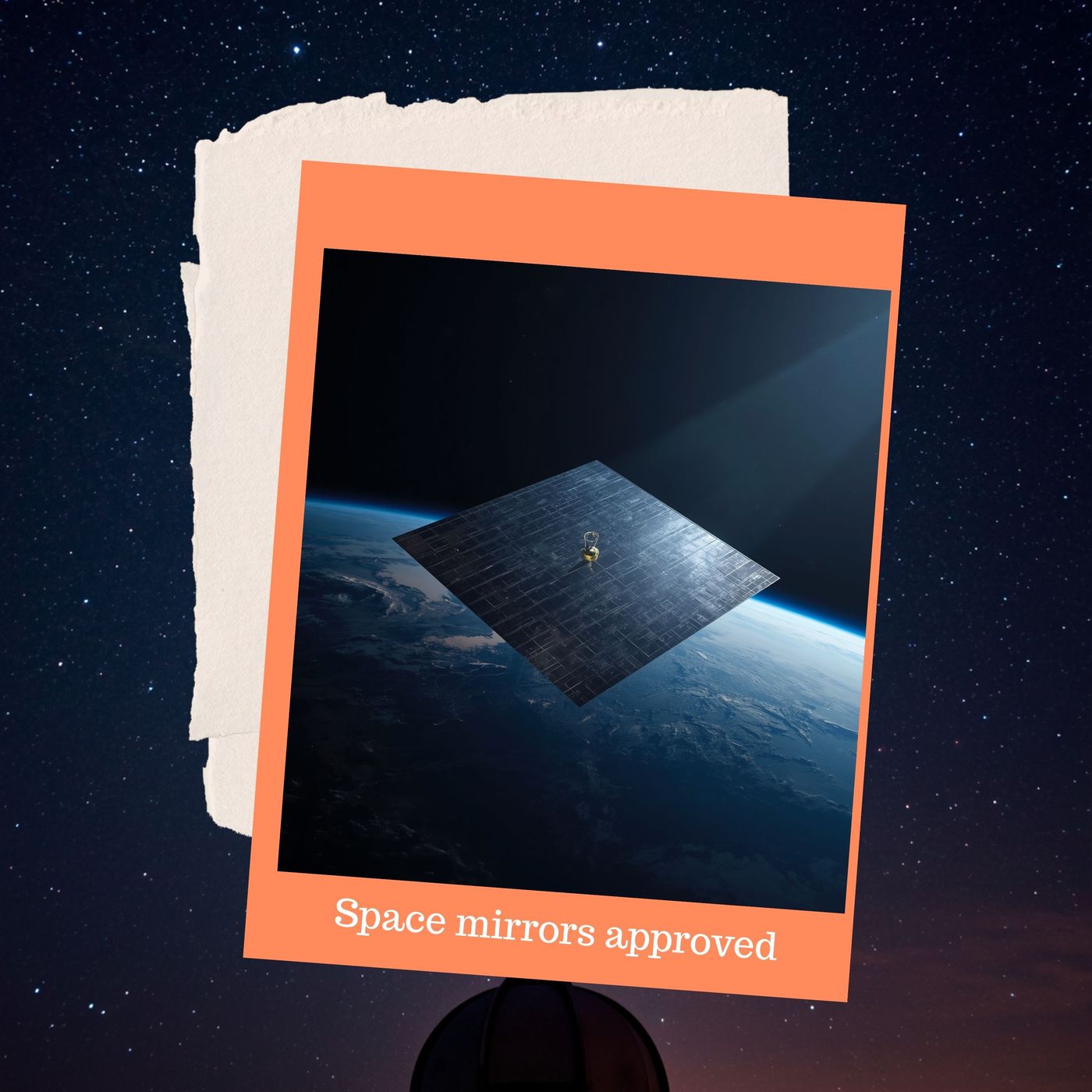
Space Mirrors Spark Controversy, Hidden Space Junk Revealed, and Black Hole Energy Breakthrough
Astronomy Daily — S05E140 | Tuesday 14 July 2026 | Hosts: Anna & Avery Space mirrors are officially cleared for launch — and astronomers are sounding the alarm. In today's episode, Anna and Avery unpack the FCC's approval of Reflect Orbital's Eärendil-1, the first of a proposed constellation of sunlight-reflecting satellites, and what tens of thousands of orbital mirrors could mean for the nig
Starship Set for Flight 13, Japan's Reusable Rocket Breakthrough, and SpaceX's 100,000 Satellite Ambition
Astronomy Daily S05E139 — Monday, 13 July 2026 Starship could fly again as soon as Wednesday — carrying its first-ever real payload. Japan quietly joins the reusable rocket club just a day after China. SpaceX asks regulators for a jaw-dropping 100,000 satellites. Physicists may have heard the accumulated whispers of every star that ever exploded. Isar Aerospace signs a $150 million deal to launc

China's Groundbreaking Rocket Catch, Cosmic Quasars, and Remembering Wally Funk | A Weekend Wrap
Astronomy Daily S05E138 — Weekend Space and Astronomy News Wrap — Saturday, 11 July 2026 China nets a rocket booster from the sea for the first time ever, we remember space pioneer Wally Funk, and we recap the week's four biggest stories: Euclid's 31 ancient quasars, mystery metal spheres on a Queensland beach, JWST's unexplained substance on Titan and Pluto, and New Horizons waking from hiberna
Euclid Finds 31 Ancient Quasars — Plus a "Snowman" Asteroid and Roman Telescope Update
S05E137: Euclid uncovers 31 ancient quasars including the two most distant ever observed, Roman Space Telescope reaches a major pre-launch milestone at Kennedy Space Center, China details its plans for a sunward asteroid early-warning network, Hayabusa2 reveals asteroid Torifune is a two-lobed “snowman” contact binary, NASA's GRITSS CubeSat launches to sharpen global positioning precision, and we
Nuclear Satellite Inspections, New Horizons Awakens, and a Cosmic Catalog of Galaxy Clusters
Astronomy Daily S05E136 — Thursday, 9 July 2026 An MIT physicist proposes a shoebox-sized satellite that could catch a hidden nuclear weapon in orbit, NASA's New Horizons wakes up after its longest hibernation ever nearly six billion miles from home, an Antarctic telescope catalogues over seven thousand galaxy clusters, Japan's ispace books cargo space on a SpaceX Starship Moon mission, a Falcon

Nuclear Power in Space, Planetary Defense Insights, and an Aurora Alert for Northern Skies
Astronomy Daily — S05E135 — Wednesday, July 8, 2026 1. World's First Commercial Nuclear-Powered Satellite Reaches Orbit SpaceX's Transporter-17 rideshare mission carried City Labs' BOHR CubeSat to orbit on July 7, the first commercially built satellite to fly a nuclear-powered payload — a tritium betavoltaic cell that generates electricity continuously, day or night, regardless of sunlight. Key po
Beach Mystery, Asteroid Close Encounter, and the Cosmic Dance of Ancient Comets
Astronomy Daily S05E134 — Tuesday, 7 July 2026 Mysterious metal spheres wash up on a Queensland beach and turn out to be re-entered rocket debris, Hayabusa2 beams home stunning close-ups of asteroid Torifune, new VLT chemistry reveals interstellar comet 3I/ATLAS may be one of the oldest objects ever studied, TESS finds its first exoplanet using Einstein's gravitational microlensing, JWST spots s
Asteroid Flybys, Cosmic Mysteries, and the Search for the Universe's Ghost Signals
Today on Astronomy Daily: Japan's Hayabusa2 pulls off a nail-biting high-speed asteroid flyby, James Webb finds the same unexplained chemical mystery on Titan AND Pluto, a neutrino detector may have caught the universe's oldest supernova echo, a wild new theory tries to solve the black hole information paradox, we wrap up the weekend's aurora action, and we look at when NASA's New Horizons might f

Cosmic Fireworks, Mars Meets Uranus, and the Dawn of a New Era in Astronomy
Astronomy Daily — S05E132 — Weekend Space and Astronomy News Wrap — Saturday, July 4, 2026 It's the Fourth of July weekend edition of Astronomy Daily! This week's wrap covers the successful launch of the Swift rescue mission after a week of delays, the historic start of the Vera C. Rubin Observatory's decade-long sky survey, an aurora-triggering geomagnetic storm timed for the holiday weekend, a p

Solar Storms, Grounded Missions, and the Planet That Survived Its Star
Astronomy Daily S05E131 — Friday, July 3, 2026 1. Swift Rescue Mission — Grounded Mid-Flight • Katalyst Space Technologies' LINK spacecraft was set to launch aboard a Pegasus XL rocket, air-launched from Northrop Grumman's Stargazer aircraft over Kwajalein Atoll. • Thursday's attempt (July 2) got airborne after two prior weather scrubs, but was aborted mid-flight when engineers spotted an

Solar Flares, Bizarre Hot Jupiters, and NASA's Soccer Ball Moon Mission
Astronomy Daily S05E130 — Thursday, July 2, 2026 A quick update on Swift's third launch scrub, a solar flare that could spark aurora for July 4th weekend, a hot Jupiter breaking the rules of physics, Amazon Leo's final Atlas V flight, patriotic Chandra imagery, a look back at a third galaxy missing its dark matter, and NASA's cheeky World Cup wager involving the Moon. In This Episode ●

The Universe Unfolds: Vera Rubin's Epic Journey, Swift's Mission Update, and Titan's Human Future
A landmark day in space news: the Vera Rubin Observatory officially begins its ten-year Legacy Survey of Space and Time, NASA reveals it may send a spare nuclear-powered Mars rover to the Moon's south pole, Blue Origin shows off its rebuilt launch pad a month after the New Glenn explosion, Rocket Lab strikes an $8 billion deal to acquire Iridium, a brief Swift/LINK scrub update, and scientists hol
Launch Day for Swift's Rescue, ISS Spacewalk, and Unraveling the Secrets of the Cosmos
Astronomy Daily S05E128 | Tuesday, June 30, 2026 Hosts: Anna & Avery | astronomydaily.io | @AstroDailyPod In today's episode:🚀 NASA's Swift Observatory Rescue Mission Launches After weeks of anticipation, NASA's Neil Gehrels Swift Observatory is set for a historic rescue mission. The robotic spacecraft, Link, designed by Catalyst Space Technologies, will attempt to stabilize Swift's orbit, whi
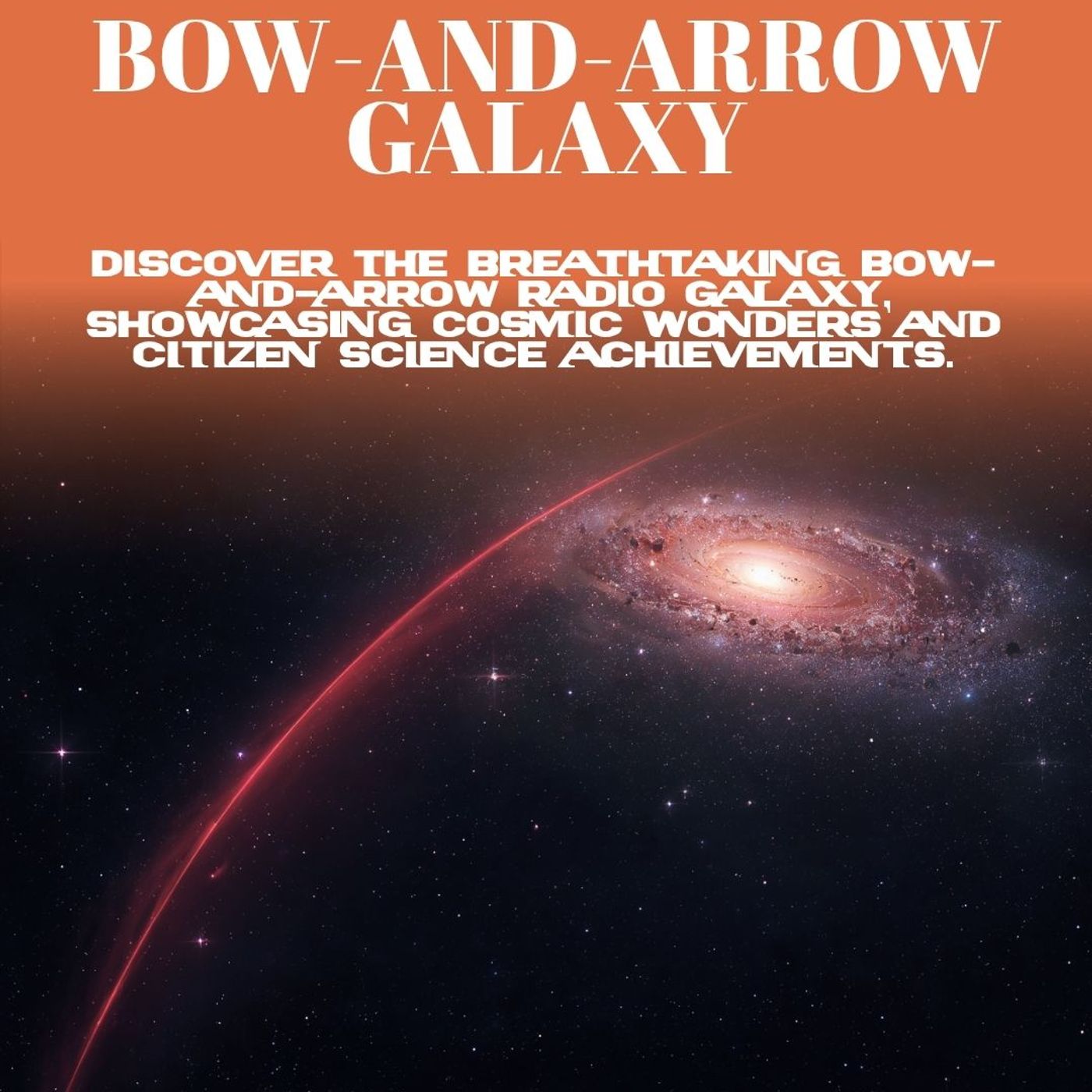
Bow and Arrow Galaxy Discovered, Hayabusa2's Daring Asteroid Flyby, and Mars' Geological Secrets Unveiled
Astronomy Daily S05E127 | Monday, June 29, 2026 Hosts: Anna & Avery | astronomydaily.io | @AstroDailyPod In today's episode: RAD-BAARG — The Bow-and-Arrow Galaxy A citizen scientist scanning LOFAR radio telescope data spotted a galaxy like nothing seen in 25 years — RAD-BAARG stretches 1.8 million light-years and shows what may be the clearest radio signature of a giant cosmic bow shock ev
The Weekend Wrap: NASA's Bold Swift Rescue, Cosmic Demolition Derby Unfolds
Weekend Space & Astronomy News Wrap | Saturday, June 27, 2026 It's our Saturday wrap — and what a week it's been for space and astronomy! Join Anna and Avery for two brand-new stories plus the four biggest headlines from the past five days. THIS WEEK'S STORIES 🚀 NASA's Daring Swift Rescue Mission Launches Today NASA's Swift Boost mission launched this morning, sending the LINK robotic se
60 Million Stars Captured, Cosmic Fog Cleared, and Earth's Oldest Impact Crater Revealed
In this episode of Astronomy Daily (S05E125), hosts Anna and Avery cover six major stories from the frontiers of space science and astronomy, including the most detailed image ever taken of the Milky Way's core, a Hubble discovery that solves a decades-old cosmological mystery, the oldest confirmed asteroid impact crater on Earth, a pair of impossibly light exoplanets, an impending lunar impact fr
Ancient Comet Shatters Time Records, Mars' Life Signs Intensify, and the ISS Faces Controversial Farewell
In this episode of Astronomy Daily, Anna and Avery explore six remarkable stories from the frontiers of space science. JWST has determined that interstellar comet 3I/ATLAS likely formed 10–12 billion years ago — before our Sun existed — making it the oldest object ever chemically characterised. NASA's Perseverance rover has delivered its most robust organic detection yet in Mars's Jezero Crater. E

Roman Telescope Update, China's Shenlong Mystery Deepens, and Quantum Breakthroughs in Space
Story 1 — Roman Space Telescope Arrives at Kennedy NASA's Nancy Grace Roman Space Telescope arrived at Kennedy Space Center on June 21, 2026, beginning a 70-day prelaunch campaign inside the Payload Hazardous Servicing Facility. Launch is targeted no earlier than August 30, 2026, on a SpaceX Falcon Heavy from Launch Complex 39A — eight months ahead of the previous schedule. The observatory's 300-m
Starfall Takes Flight, Roman Telescope Arrives, and Dark Matter's New Secrets Unveiled
Episode Date: Tuesday, 23 June 2026 Runtime: Approximately 18–22 minutes Hosts: Anna and Avery Story Sources & Further Reading STORY 1 — SpaceX Starfall Demo SpaceX launches Starfall Demo mission (June 23, 2026) — SpaceX.com / Space.com / Gizmodo FAA Environmental Assessment for Starfall reentry vehicle operations STORY 2 — Nancy Grace Roman Space Telescope NASA Science: 'NASA's Next Gener
Recommended

Infinite Health with Dr. Arasi Maran

The Daily

World News Tonight with David Muir

The Joe Rogan Experience

English Vocabulary Help

TED Talks Daily

Learn English B1 with Daily News | English Listening Practice

Talk About Talk - Executive & Leadership Communication Skills

English with Olivia | Slow Conversations & Vocabulary

Stand In The Circle

SLOW ENGLISH PODCAST (A1-A2) With Subtitles | Daily Videos | English With Us Podcast

Learn English A2 with Daily News | Simple English Listening Practice
