New Books in Neuroscience
This podcast is a channel on the New Books Network, an academic audio library dedicated to public education. In each episode, scholars discuss their recently published research with another expert in their field. The network offers over 150 channels and more than 28,000 episodes. Listeners can subscribe to a free weekly Substack newsletter and follow on Instagram and Bluesky for updates.
Episodes
Sheila L. Macrine and Jennifer M.B. Fugate, "Embodied Intelligence: Multidisciplinary Perspectives on Natural, Artificial, and Hybrid Systems" (MIT Press, 2026)
Embodied Intelligence: Multidisciplinary Perspectives on Natural, Artificial, and Hybrid Systems (MIT Press, 2026) explores a radical transformation taking place in intelligence research. Rather than focusing exclusively on brains and computer code, the book examines the important role that embodiment plays in producing intelligent, goal-directed behavior.The book brings together experts
Mark Solms, "The Only Cure: Freud and the Neuroscience of Mental Healing" (Pegasus, 2026)
Once dismissed as unscientific, psychoanalytic therapy is proving to be among our most effective medical treatments of any kind - outperforming psychiatric drugs and rivaling vaccines in its power to prevent and heal. Why does it work so well?Perhaps because one of the most controversial figures in psychology was right all along. Neuroscience now confirms much of what Sigmund Freud conjectured ove
The Science of Memory with Steve Ramirez
Today I’m speaking with neuroscientist Stave Ramirez about bullshit and memory. Steve is an associate professor at Boston University, where he runs a lab dedicated to uncovering the mysteries of memory. How memory works, and importantly, how it doesn’t, are crucial questions for understanding everything from the validity of eyewitness testimony to understanding how people overcome traumatic experi
Amy Brann, "Make Your Brain Work: Perform at a Higher Level" (Kogan Page, 2025)
Make Your Brain Work By Amy Brann Neuroscience expert, author, consultant and global speaker
Make Your Brain Work: Perform at a Higher Level (Kogan Page, 2025) is a practical, science-backed guide to improving focus, performance
and mental energy without burning out. Written for people balancing
multiple responsibilities, the book explains how to stay productive,
mentally sharp and in contro
Great Minds in Despair
In this episode of the Language on the Move Podcast, Ingrid Piller speaks with Frank Stahnisch, Professor of the History of Medicine and Health Care at the University of Calgary in Canada, about his new book Great Minds in Despair – The Forced Migration of German-Speaking Neuroscientists to North America, 1933 to 1989 (2025, McGill-Queen’s University Press).
Great Minds in Despair examines the lon
Yosef Grodzinsky, "How Deeply Human Is Language?: Chomsky, the Brain, and the AI Fantasy" (MIT Press, 2026)
How Deeply Human Is Language? Chomsky, the Brain, and the AI Fantasy (MIT Press, 2026) is Yosef Grodzinsky’s exploration of the criticality of the linguistic theories to the design of LLMs. The book dwells on the significance of the marriage between computational and theoretical fields, specifically “engineering and science” on the development of unique Language Learning Models. Yosef maintains t
Samuel Markind, "Music Between Your Ears: How Musical Engagement Powers the Human Brain" (JHU Press, 2025)
Explores the profound power of music to influence brain function and well-being.
IPA 2026 Distinguished Favorite in the Music Category
Why does music influence how we feel so deeply--and what are the scientific mechanisms behind this phenomenon? In Music Between Your Ears: How Musical Engagement Powers the Human Brain (JHU Press, 2025) Dr. Samuel Markind explores the intriguing relationship bet
Alexander Klein, "Consciousness is Motor: William James on Mind and Action" (Oxford UP, 2025)
When it comes to consciousness, William James is well-known for his descriptions of it rather than his theory of it and its relation to the body. In Consciousness is Motor: William James on Mind and Action (Oxford UP, 2025), Alexander Klein elaborates James’ theory of the evolutionary function of consciousness and how conscious states are always linked to the body and always trigger bodily motion
Masud Husain, "Our Brains, Our Selves: What a Neurologist’s Patients Taught Him About the Brain" (Canongate, 2025)
What makes us who we are?Through the stories of seven of his patients, acclaimed Oxford University neurologist Masud Husain shows us how our brains create, change and can even restore our identity. Husain introduces us to a man who ran out of words, a woman who lost all inhibitions and another who believed she was having an affair with the man who was really her husband.These compelling human dram
Adam Zeman, "The Shape of Things Unseen: A New Science of Imagination" (Bloomsbury, 2025)
A compelling insight into how our imagination works, based on the latest scientific research.
People often think of imagination as something used only in creative endeavours. In fact, we use imagination constantly as we reminisce, anticipate, plan, daydream, read, create imagined worlds. The truth is we live in the here and now much less than we tend to think. Imagination isn't the exception in
167* Addiction with Gina Turrigiano (EF, JP)
In Recall This Book's second episode (January 2019) John and Elizabeth spoke with their brilliant Brandeis colleague, the MacArthur-winning neuroscientist Gina Turrigiano, about a number of different facets of addiction. The conversation seems as timely as ever.
What makes an addiction to a morning constitutional different from–or similar to–an addiction to Fentanyl? What are the biological and so
Alan J. McComas, "Consciousness: The Road to Reductionism" (American Scientist, 2025)
Neuroscientific evidence increasingly shows that consciousness is a remarkable but explainable function of a machinelike brain. Alan J. McComas' discusses his article for the American Scientist.
Alan J. McComas is an emeritus professor of medicine at McMaster University in Hamilton, Canada.
Greg is the Executive Director and Founder of the World War II Discussion Forum (wwiidf.org). He also has a
Polina Dimova, "At the Crossroads of the Senses: The Synaesthetic Metaphor Across the Arts in European Modernism" (Penn State UP, 2024)
Inspired by Richard Wagner’s idea of the total artwork, European modernist artists began to pursue multimedia projects that mixed colors, sounds, and shapes. Dr. Polina Dimova’s At the Crossroads of the Senses: The Synaesthetic Metaphor Across the Arts in European Modernism (Penn State UP, 2024) traces this new sensory experience of synaesthesia—the physiological or figurative blending of senses—a
Andreas Killen, "Nervous Systems: Brain Science in the Early Cold War" (Harper, 2023)
In this eye-opening chronicle of scientific research on the brain in the early Cold War era, the acclaimed historian Andreas Killen traces the complex circumstances surrounding the genesis of our present-day fascination with this organ.The 1950s were a transformative, even revolutionary decade in the history of brain science. Using new techniques for probing brain activity and function, researcher
Steve Ramirez, "How to Change a Memory: One Neuroscientist’s Quest to Alter the Past" (Princeton UP, 2025)
As a graduate student at MIT, Steve Ramirez successfully created false memories in the lab. Now, as a neuroscientist working at the frontiers of brain science, he foresees a future where we can replace our negative memories with positive ones. In How to Change a Memory, Ramirez draws on his own memories--of friendship, family, loss, and recovery--to reveal how memory can be turned on and off like
Justin Gregg, "If Nietzsche Were a Narwhal: What Animal Intelligence Reveals About Human Stupidity" (Little, Brown, 2022)
What if human intelligence is actually more of a liability than a gift? After all, the animal kingdom, in all its diversity, gets by just fine without it. At first glance, human history is full of remarkable feats of intelligence, yet human exceptionalism can be a double-edged sword. With our unique cognitive prowess comes severe consequences, including existential angst, violence, discrimination,
Rafael Yuste, "Lectures in Neuroscience" (Columbia UP, 2023)
The human brain is perhaps the most intricate and fascinating object in the known universe. Through a mysterious process, the activity of billions of neurons within a few pounds of matter generates the unfathomable complexity of the mind.Lectures in Neuroscience is a conversational and accessible introduction to the brain. Beginning from basic elements of neuroscience, the acclaimed scientist Ra
How to Make Your Brain Your Best Friend
Your brain is the most remarkable thing in the known universe. Always trying to mend itself, and always trying to protect you, it’s in a constant state of flux — adapting, reconfiguring, finding new pathways. And it has an astonishing capacity for recovery.
Rachel Barr struggled through years of devastating loss, heartache, and uncertainty until neuroscience gave her the first spark of self-bel
Marc Berman, "Nature and the Mind: The Science of How Nature Improves Cognitive, Physical, and Social Well-Being" (Simon and Schuster, 2025)
Dr. Marc Berman, the pioneering creator of the field of environmental neuroscience, has discovered the surprising connection between mind, body, and environment, with a special emphasis on the natural environment. He has devoted his life to studying it. If you sometimes feel drained, distracted, or depressed, Dr. Berman has identified the elements of a “nature prescription” that can boost your ene
Kevin J. Mitchell, "Free Agents: How Evolution Gave Us Free Will" (Princeton UP, 2023)
Scientists are learning more and more about how brain activity controls behavior and how neural circuits weigh alternatives and initiate actions. As we probe ever deeper into the mechanics of decision making, many conclude that agency--or free will--is an illusion. In Free Agents: How Evolution Gave Us Free Will (Princeton UP, 2023), leading neuroscientist Kevin Mitchell presents a wealth of evide
Eduardo Mercado III, "Why Whales Sing" (JHU Press, 2025)
With breathtaking complexity and haunting beauty, the songs of whales have long fascinated scientists. Whales are the only mammals that can sing continuously for ten hours or more, changing the unique songs they sing every year. In Why Whales Sing (JHU Press, 2025), bioacoustician and cognitive scientist Eduardo Mercado transforms our understanding of these enigmatic sounds and proposes a ground
Gaurav Suri and Jay McClelland, "The Emergent Mind: How Intelligence Arises in People and Machines" (Basic Books, 2025)
When we are trying to solve a problem, what happens? We find ourselves weighing arguments, or relying on intuition, then reaching a conscious decision about what to do. What is going on behind the scenes?
In The Emergent Mind: How Intelligence Arises in People and Machines (Basic Books, 2025), Gaurav Suri and Jay McClelland show that our experience is the tip of an iceberg of brain activity that c
Jeffrey D. Sharon, "The Great Balancing Act: An Insider's Guide to the Human Vestibular System" (Columbia UP, 2025)
What's the secret to keeping your balance? The ear does more than hear: it helps us stay stable by perceiving movements and gravity. Elegant sensors deep within the skull detect every twist, turn, and tumble, powering swift reflexes that keep vision and balance steady. This is the vestibular system. It's primordial and ubiquitous: every animal has one, and even plants have a rudimentary version. I
Christopher Kemp, "Dark and Magical Places: The Neuroscience of Navigation" (Norton, 2022)
Inside our heads we carry around an infinite and endlessly unfolding map of the world. Navigation is one of the most ancient neural abilities we have―older than language. In Dark and Magical Places: The Neuroscience of Navigation (Norton, 2022), Christopher Kemp embarks on a journey to discover the remarkable extent of what our minds can do.Fueled by his own spatial shortcomings, Kemp describes th
James Kimmel, Jr., "The Science of Revenge: Understanding the World's Deadliest Addiction—and How to Overcome It" (Random House, 2025)
There is a hidden addiction plaguing humanity right now: revenge. Researchers have identified retaliation in response to real and imagined grievances as the root cause of most forms of human aggression and violence. From vicious tweets to road rage, murder-suicide, and armed insurrection, perpetrators almost always see themselves as victims seeking justice. Chillingly, recent behavioral and neuroi
Frances Egan, "Deflating Mental Representation" (MIT Press, 2025)
The human mind has the curious, even mysterious, ability to generate thoughts about things with which we are not in causal contact, such as when we think about yesterday’s tennis final, or Aristotle, or unicorns. Naturalizing mental content has usually meant explaining how this is possible in terms that eliminate the mystery while retaining commitment to a substantive relationship between mind and
Paul Thagard, "Bots and Beasts: What Makes Machines, Animals, and People Smart?" (MIT Press, 2021)
Octopuses can open jars to get food, and chimpanzees can plan for the future. An IBM computer named Watson won on Jeopardy! and Alexa knows our favorite songs. But do animals and smart machines really have intelligence comparable to that of humans? In Bots and Beasts: What Makes Machines, Animals, and People Smart? (MIT Press, 2021), Paul Thagard looks at how computers (“bots”) and animals measure
Judith Grisel, "Never Enough: The Neuroscience and Experience of Addiction" (Doubleday, 2019)
Not a lot of authors go from spending their early twenties homeless and addicted to cocaine to becoming one of the world’s leading researchers on the neuroscience of addiction. But Dr. Judith Grisel, in her new book Never Enough: The Neuroscience and Experience of Addiction (Doubleday, 2019), uses her personal story to illuminate the ways in which the brain, in collusion with social and biological
Kevin J. Tracey, "The Great Nerve: The New Science of the Vagus Nerve and How to Harness Its Healing Reflexes" (Penguin, 2025)
The vagus nerve is fundamental to our health and vitality, coordinating critical functions from the precise heartbeat we need to exercise or rest to the balance of appetite and digestion. Made up of 200,000 fibers, the vagus nerve sends thousands of electrical signals every second between your brain and your most important organs. Yet despite its essential role in life, important vagus nerve funct
Rebecca Lemov, "The Instability of Truth: Brainwashing, Mind Control, and Hyper-Persuasion" (Norton, 2025)
Because brainwashing affects both the world and our observation of the world, we often don’t recognize it while it’s happening—unless we know where to look. As Rebecca Lemov writes in The Instability of Truth, “Brainwashing erases itself.” What we call brainwashing is more common than we think; it is not so much what happens to other people as what can happen to anyone.
The Instability of Truth ex
Pooja Agarwal, Cynthia Nebel, Veronica Yan, "Smart Teaching Stronger Learning: Practical Tips From 10 Cognitive Scientists" (Unleash Learning Press, 2025)
How can I help my students not only learn my course material but also retain and transfer that information? This is a question that has plagued and intrigued teachers for centuries. In Smart Teaching Stronger Learning: Practical Tips for 10 Cognitive Scientists, the authors provide their readers with evidence-based practices for immediate classroom implementation. Their premise is that small chang
Jeremy Stolow, "Picturing Aura: A Visual Biography" (MIT Press, 2025)
Picturing Aura: A Visual Biography (MIT Press, 2025) by Dr. Jeremy Stolow is the first book of its kind: an extended historical, anthropological, and philosophical study of modern efforts to visualize the hidden radiant force encompassing the living body known as our aura. This rich, interdisciplinary study by Dr. Stolow chronicles the rise and global spread of modern instruments and techniques of
Laura Otis, "Banned Emotions: How Metaphors Can Shape What People Feel" (Oxford UP, 2019)
Who benefits and who loses when emotions are described in particular ways? How do metaphors such as "hold on" and "let go" affect people's emotional experiences? Banned Emotions: How Metaphors Can Shape What People Feel (Oxford UP, 2019), written by neuroscientist-turned-literary scholar Laura Otis, draws on the latest research in neuroscience and psychology to challenge popular attempts to suppre
Nicole C. Nelson, "Model Behavior: Animal Experiments, Complexity, and the Genetics of Psychiatric Disorders" (U Chicago Press, 2018)
Mice are used as model organisms across a wide range of fields in science today--but it is far from obvious how studying a mouse in a maze can help us understand human problems like alcoholism or anxiety. How do scientists convince funders, fellow scientists, the general public, and even themselves that animal experiments are a good way of producing knowledge about the genetics of human behavior?
Yellowlees Douglas, "Writing for the Reader's Brain: A Science-Based Guide" (Cambridge UP, 2024)
What makes one sentence easy to read and another a slog that demands re-reading? Where do you put information you want readers to recall? Drawing on cognitive neuroscience, psychology and psycholinguistics, Writing for the Reader’s Brain (Cambridge University Press, 2025) provides a practical, how-to guide on how to write for your reader. It introduces the five 'Cs' of writing - clarity, continuit
Ciara Greene and Gillian Murphy, "Memory Lane: The Perfectly Imperfect Ways We Remember" (Princeton UP, 2025)
Today I’m speaking with Ciara Greene, co-author with Gillian Murphy of the new book, Memory Lane: The Perfectly Imperfect Ways We Remember (Princeton UP, 2025). Ciara is associate professor in the School of Psychology at University College Dublin, where she leads the Attention and Memory Laboratory. The scientific study of human memory has become even more relevant in an age where we have every te
Peter D. Hershock, "Consciousness Mattering: A Buddhist Synthesis" (Bloomsbury, 2023)
Consciousness Mattering (Bloombury, 2023) presents a contemporary Buddhist theory in which brains, bodies, environments, and cultures are relational infrastructures for human consciousness. Drawing on insights from meditation, neuroscience, physics, and evolutionary theory, it demonstrates that human consciousness is not something that occurs only in our heads and consists in the creative elaborat
Grace Lindsay, "Models of the Mind: How Physics, Engineering and Mathematics Have Shaped Our Understanding of the Brain" (Bloomsbury, 2021)
Models of the Mind: How Physics, Engineering and Mathematics Have Shaped Our Understanding of the Brain (Bloomsbury, 2021) provides a multifaceted and approachable introduction to theoretical neuroscience. It discusses some major topics of the field, including both the milestones from their history and the currently open questions.It's accessible for a general audience, not expecting any previous
Unlocking the Secrets of the Nervous System: A Deep Dive with Dr. George S. Thompson and Patrick Ney
Parenting is an emotional rollercoaster – filled with moments of joy, stress, and everything in between. But what if there was a scientific way to understand and navigate these emotions more effectively? In a compelling new podcast episode, Patrick Ney, Lead Trainer at All About Parenting, sits down with Dr. George S. Thompson to explore the fascinating world of polyvagal theory and its profound i
Adrian Keith Perkel, "Unlocking the Nature of Human Aggression: A Psychoanalytic and Neuroscientific Approach" (Routledge, 2023)
Today I began my discussion with Dr. Adrian Perkel about his new book Unlocking The Nature of Human Aggression: A Psychoanalytic and Neuroscientific Approach (Routledge, 2024) “Aggression is to the mind what the immune system is to the body. It doesn’t seek the fight.” With this perfect mind-body analogy Dr. Perkel proposes a clear way to think theoretically and work clinically with aggression. Th
M. Chirimuuta, "The Brain Abstracted: Simplification in the History and Philosophy of Neuroscience" (MIT Press, 2024)
This book is available open access here. The Brain Abstracted: Simplification in the History and Philosophy of Neuroscience (MIT Press, 2024), Mazviita Chirimuuta argues that the standard ways neuroscientists simplify the human brain to build models for their research purposes mislead us about how the brain actually works. The key issue, instead, is to figure out which details of brain function ar
Steven Lesk, "Footprints of Schizophrenia: The Evolutionary Roots of Mental Illness" (Prometheus, 2023)
Of all the mental illnesses, schizophrenia eludes us the most. No matter the strides scientists have made in neurological research nor doctors have made in psychiatric treatment, schizophrenia remains misunderstood, almost complacently mythologized. Without a reason for the illness, patients feel even more alienated than they already do, families are left hopeless, and doctors struggle to provide
Camilla Nord, "The Balanced Brain: The Science of Mental Health" (Princeton UP, 2024)
There are many routes to mental well-being. In this groundbreaking book, neuroscientist Camilla Nord offers a fascinating tour of the scientific developments that are revolutionising the way we think about mental health, showing why and how events--and treatments--can affect people in such different ways.In The Balanced Brain: The Science of Mental Health (Princeton UP, 2024), Nord explains how ou
Barbara J. Sahakian and Christelle Langley, "Brain Boost: Healthy Habits for a Happier Life" (Cambridge UP, 2025)
Your mental health is as important as your physical health and, in times of stress, it's vital to have enhanced cognition and reserves of resilience. Brain Boost: Healthy Habits for a Happier Life (Cambridge UP, 2025) is packed with practical tips, based on scientific evidence, that will teach you how to implement lifestyle strategies that will improve your brain health, cognition, and overall wel
Charles Foster, "Being a Human: Adventures in Forty Thousand Years of Consciousness" (Metropolitan Books, 2021)
How did humans come to be who we are? In his marvelous, eccentric, and widely lauded book Being a Beast, legal scholar, veterinary surgeon, and naturalist extraordinaire Charles Foster set out to understand the consciousness of animal species by living as a badger, otter, fox, deer, and swift. Now, he inhabits three crucial periods of human development to understand the consciousness of perhaps th
Andrea Scarantino, "Emotion Theory: The Routledge Comprehensive Guide" (Routledge, 2024)
This interview is an exception to our “single author monographs” rule, because the edited collection that is its topic is an intellectual achievement worth making an exception for in over 12 years of New Books in Philosophy podcasts. Emotion Theory: The Routledge Comprehensive Guide: Volume I and Volume II (Routledge, 2024) is a two-volume compendium of 62 chapters on emotion theory written by 101
Rachael Litherland and Philly Hare, "People with Dementia at the Heart of Research: Co-Producing Research through The Dementia Enquirers Model" (Jessica Kingsley, 2024)
People with dementia are uniquely qualified to discuss the challenges of their condition and the features of effective support, but their voices are all too often drowned out in research and debates about policy. According to People with Dementia at the Heart of Research: Co-Producing Research through The Dementia Enquirers Model (Jessica Kingsley Publishers, 2024) by Rachael Litherland & Phil
Anneli Jefferson, "Are Mental Disorders Brain Disorders?" (Routledge, 2024)
The question of whether mental disorders are disorders of the brain has led to a long-running and controversial dispute within psychiatry, psychology and philosophy of mind and psychology. While recent work in neuroscience frequently tries to identify underlying brain dysfunction in mental disorders, detractors argue that labelling mental disorders as brain disorders is reductive and can result in
David Peña-Guzmán: Animals Dream and that Makes Them Morally Considerable (JP)
In his marvelous new book, When Animals Dream: The Hidden World of Animal Consciousness (Princeton UP, 2023), David Peña-Guzmán (SF State as well as the lovely philosophical podcast Overthink) offers up something new in animal studies--"a philosophical interpretation of biological subjectivity." Although we share no linguistic schema with animals there is lots more evidence than just YouTube (octo
Francisco Aboitiz, "A History of Bodies, Brains, and Minds: The Evolution of Life and Consciousness" (MIT Press, 2024)
Francisco Aboitiz is a professor at the Medical School and the director of the Interdisciplinary Center for Neuroscience at Pontificia Universidad Católica de Chile. A History of Bodies, Brains, and Minds: The Evolution of Life and Consciousness (MIT Press, 2024) tells the story of life and nervous systems. It introduces the conceptual framework and terminology of evolution, gives a great overview
Daniel J. Levitin, "Successful Aging: A Neuroscientist Explores the Power and Potential of Our Lives" (Dutton Books, 2020)
In Successful Aging: A Neuroscientist Explores the Power and Potential of Our Lives (Dutton Books, 2020), Daniel J. Levitin delivers powerful insights:• Debunking the myth that memory always declines with age• Confirming that “health span”—not “life span”—is what matters• Proving that sixty-plus years is a unique and newly recognized developmental stage• Recommending that people look forward to jo
Neil Vickers and Derek Bolton, "Being Ill: On Sickness, Care and Abandonment" (Reaktion Books, 2024)
A serious illness often changes the way others see us. Few, if any, relationships remain the same. The sick become more dependent on partners and family members, while more distant contacts become strained. The carers of the ill are also often isolated. This book focuses on our sense of self when ill and how infirmity plays out in our relationships with others.In Being Ill: On Sickness, Care and A
Camilla Nord, "The Balanced Brain: The Science of Mental Health" (Princeton UP, 2024)
There are many routes to mental well-being. In this groundbreaking book, neuroscientist Camilla Nord offers a fascinating tour of the scientific developments that are revolutionising the way we think about mental health, showing why and how events--and treatments--can affect people in such different ways.In The Balanced Brain: The Science of Mental Health (Princeton UP, 2024), Nord explains how ou
Nick Chater, "The Mind Is Flat: The Remarkable Shallowness of the Improvising Brain" (Yale UP, 2019)
Psychologists and neuroscientists struggle with how best to interpret human motivation and decision making. The assumption is that below a mental “surface” of conscious awareness lies a deep and complex set of inner beliefs, values, and desires that govern our thoughts, ideas, and actions, and that to know this depth is to know ourselves. In the The Mind Is Flat: The Remarkable Shallowness of the
Iris Berent, "The Blind Storyteller: How We Reason about Human Nature" (Oxford UP, 2020)
Do newborns think-do they know that 'three' is greater than 'two'? Do they prefer 'right' to 'wrong'? What about emotions--do newborns recognize happiness or anger? If they do, then how are our inborn thoughts and feelings encoded in our bodies? Could they persist after we die? Going all the way back to ancient Greece, human nature and the mind-body link are the topics of age-old scholarly debates
David Badre, "On Task: How Our Brain Gets Things Done" (Princeton UP, 2020)
On Task: How Our Brain Gets Things Done (Princeton UP, 2020) is a look at the extraordinary ways the brain turns thoughts into actions—and how this shapes our everyday lives. Why is it hard to text and drive at the same time? How do you resist eating that extra piece of cake? Why does staring at a tax form feel mentally exhausting? Why can your child expertly fix the computer and yet still forget
John Thomas Maier, "The Disabled Will: A Theory of Addiction" (Routledge, 2024)
John T. Maier's The Disabled Will: A Theory of Addiction (Routledge Press, 2024) defends a comprehensive new vision of what addiction is and how people with addictions should be treated. The author argues that, in addition to physical and intellectual disabilities, there are volitional disabilities - disabilities of the will - and that addiction is best understood as a species of volitional disabi
Anna Abraham, "The Creative Brain: Myths and Truths" (MIT Press, 2024)
A nuanced, science-based understanding of the creative mind that dispels the pervasive myths we hold about the human brain—but also uncovers the truth at their cores. What is the relationship between creativity and madness? Creativity and intelligence? Do psychedelics truly enhance creativity? How should we understand the left and right hemispheres of the brain? Is the left brain, in fact, the sea
Dasha Kiper, "Travelers to Unimaginable Lands: Stories of Dementia, the Caregiver, and the Human Brain" (Random House, 2023)
If you’ve ever worked with dementia patients before, you know how unique and bizarre the experience can be, and how little the stereotypes actually hold up to the experience. Even knowing about the diagnosis often does little to help us in caring for people, and many caregivers find themselves getting sucked into behavioral loops of their own. This is because your brain is not wired to deal with t
The Reality of Scientific Research: A Discussion with John W. Cave
In this episode we speak with Dr. John W. Cave, a scientist and thought leader who has been in the research world for over 20 years. Dr. Cave has worked at a variety of elite research institutions at the intersection of biochemistry, neurology, and brain injury and has long history of mentoring younger scientists. Listen to our conversation for his insight into the reality of research in the scien
Sharrona Pearl, "Do I Know You?: From Face Blindness to Super Recognition" (Johns Hopkins UP, 2023)
In Do I Know You? From Faceblindness to Super Recognition (Johns Hopkins University Press, 2023), Dr. Sharrona Pearl explores the fascinating category of face recognition and the "the face recognition spectrum," which ranges from face blindness at one end to super recognition at the other. Super recognizers can recall faces from only the briefest exposure, while face blind people lack the capacity
The Quest to Understand the Unconscious in Art, Mind, and Brain, from Vienna 1900 to the Present
Eric Kandel was born in Vienna in 1929. In 1938 he and his family fled to Brooklyn, where he attended the Yeshiva of Flatbush. He studied history and literature at Harvard, and received an MD from NYU. He is a professor of biochemistry at Columbia University, and won the 2000 Nobel Prize in Medicine for his research on memory.In addition to his science textbooks, Kandel has written several books f
Luis H. H. Favela, "The Ecological Brain: Unifying the Sciences of Brain, Body, and Environment" (Routledge, 2024)
Ecological psychology holds that perception and action are best explained in terms of dynamic interactions between brain, body, and environment, not in classical cognitivist terms of the manipulation of representations in the head. This anti-representationalist stance, argues Luis Favela, makes ecological psychology deeply at odds with dominant trends in some parts of neuroscience. In The Ecologic
Christian Hansel, "Memory Makes the Brain: The Biological Machinery That Uses Experiences To Shape Individual Brains" (World Scientific, 2021)
If you're interested in memory, you'll find a lot in Memory Makes the Brain: The Biological Machinery That Uses Experiences To Shape Individual Brains (World Scientific, 2021), from cellular processes to unique and interesting perspectives on autism.
Detailed descriptions of cellular processes involved in forming a memory.
Connecting those cellular processes to everyday experiences - like the memo
Charan Ranganath, "Why We Remember: Unlocking Memory's Power to Hold on to What Matters" (Doubleday, 2024)
A new understanding of memory is emerging from the latest scientific research. In Why We Remember: Unlocking Memory's Power to Hold on to What Matters (Doubleday, 2024), pioneering neuroscientist and psychologist Charan Ranganath radically reframes the way we think about the everyday act of remembering. Combining accessible language with cutting-edge research, he reveals the surprising ways our br
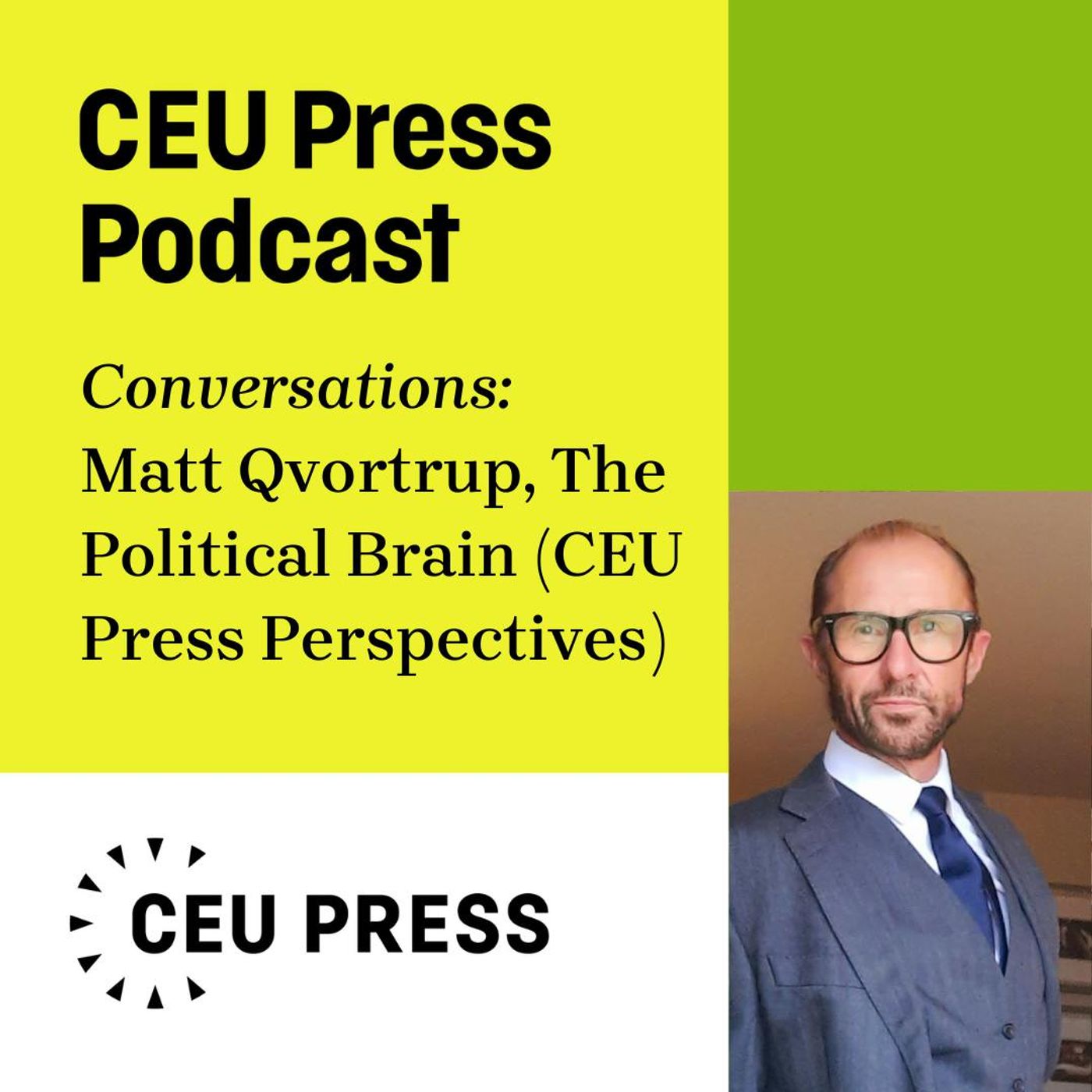
Matt Qvortrup, "The Political Brain: The Emergence of Neuropolitics" (CEU Press, 2024)
In this episode of the CEU Press Podcast, host Andrea Talabér (CEU Press/CEU Review of Books) sat down with Matt Qvortrup (Coventry University) to discuss his new book with CEU Press entitled, The Political Brain: The Emergence of Neuropolitics (CEU Press, 2024).Putting the “science” back into political science, The Political Brain shows how fMRI-scans can identify differences between liberals and
Lawson R. Wulsin, "Toxic Stress: How Stress Is Making Us Ill and What We Can Do About It" (Cambridge UP, 2024)
Our stress response system is magnificent - it operates beneath our awareness, like an orchestra of organs playing a hidden symphony. When we are healthy, the orchestra plays effortlessly, but what happens when our bodies face chronic stress, and the music slips out of tune? The alarming rise of stress-related conditions, such as heart disease, diabetes, and depression, show the price we're paying
Max Bennett, "A Brief History of Intelligence: Evolution, Ai, and the Five Breakthroughs That Made Our Brains" (Mariner Books, 2023)
A Brief History of Intelligence: Evolution, Ai, and the Five Breakthroughs That Made Our Brains (Mariner Books, 2023) tells two fascinating stories. One is the evolution of nervous systems. It started 600 million years ago, when the first brains evolved in tiny worms. The other one is humans' quest to create more and more intelligent systems. This story begins in 1951 with the first reinforcement
Kenneth Miller, "Mapping the Darkness: The Visionary Scientists Who Unlocked the Mysteries of Sleep" (Hachette Books, 2023)
Why do we sleep? How can we improve our sleep?A century ago, sleep was considered a state of nothingness—even a primitive habit that we could learn to overcome. Then, an immigrant scientist and his assistant spent a month in the depths of a Kentucky cave, making nationwide headlines and thrusting sleep science to the forefront of our consciousness.In the 1920s, Nathaniel Kleitman founded the world
Thomas Metzinger, "The Elephant and the Blind: The Experience of Pure Consciousness: Philosophy, Science, and 500+ Experiential Reports" (MIT Press, 2024)
What if our goal had not been to land on Mars, but in pure consciousness? The experience of pure consciousness—what does it look like? What is the essence of human consciousness? In The Elephant and the Blind. The Experience of Pure Consciousness: Philosophy, Science, and 500+ Experiential Reports (MIT Press, 2024)," influential philosopher Thomas Metzinger, one of the world's leading researchers
Sten Grillner, "The Brain in Motion: From Microcircuits to Global Brain Function" (MIT Press, 2023)
C. S. Sherrington said “All the brain can do is to move things". The Brain in Motion: From Microcircuits to Global Brain Function (MIT Press, 2023) shows how much the brain can do "just" by moving things. It gives an amazing overview of the large variety of motor behaviors and the cellular basis of them. It reveals how motor circuits provide the underlying mechanism not just for walking or jumping
Look Again: The Power of Noticing What Was Always There
Today’s book is: Look Again: The Power of Noticing What Was Always There (Atria/One Signal Publishers, 2024), by Tali Sharot and Cass R. Sunstein, a book that asks why stimulating jobs and breathtaking works of art lose their sparkle after a while. People stop noticing what is most wonderful in their own lives. They also stop noticing what is terrible, due to something called habituation. Because
Joshua Paul Dale, "Irresistible: How Cuteness Wired our Brains and Conquered the World" (Profile Books, 2023)
Why are some things cute, and others not? What happens to our brains when we see something cute? And how did cuteness go global, from Hello Kitty to Disney characters?Cuteness is an area where culture and biology get tangled up. Seeing a cute animal triggers some of the most powerful psychological instincts we have - the ones that elicit our care and protection - but there is a deeper story behind
Harry van der Hulst, "A Mind for Language: An Introduction to the Innateness Debate" (Cambridge UP, 2023)
How does human language arise in the mind? To what extent is it innate, or something that is learned? How do these factors interact? The questions surrounding how we acquire language are some of the most fundamental about what it means to be human and have long been at the heart of linguistic theory. Harry van der Hulst's book A Mind for Language: An Introduction to the Innateness Debate (Cambridg
Lawrence Sherman and Dennis Plies, "Every Brain Needs Music: The Neuroscience of Making and Listening to Music" (Columbia UP, 2023)
Whenever a person engages with music--when a piano student practices a scale, a jazz saxophonist riffs on a melody, a teenager sobs to a sad song, or a wedding guest gets down on the dance floor--countless neurons are firing. Playing an instrument requires all of the resources of the nervous system, including cognitive, sensory, and motor functions. Composition and improvisation are remarkable dem
Shelly Kagan, "How to Count Animals, More Or Less" (Oxford UP, 2019)
Most people agree that animals count morally, but how exactly should we take animals into account? A prominent stance in contemporary ethical discussions is that animals have the same moral status that people do, and so in moral deliberation the similar interests of animals and people should be given the very same consideration. In How to Count Animals, More Or Less (Oxford UP, 2019), Shelly Kagan
Coleen T. Murphy, "How We Age: The Science of Longevity" (Princeton UP, 2023)
All of us would like to live longer, or to slow the debilitating effects of age. In How We Age: The Science of Longevity (Princeton UP, 2023), Coleen Murphy shows how recent research on longevity and aging may be bringing us closer to this goal. Murphy, a leading scholar of aging, explains that the study of model systems, particularly simple invertebrate animals, combined with breakthroughs in gen
The Future of Innovation: A Discussion with Min W. Jung
Humans have been so dominant on Earth in large part because of their capacity to innovate – but how does that work exactly? Why can they innovate so much? That issue has been studied by Professor Min W. Jung from the Center for Synaptic Brain Dysfunctions at the Institute for Basic Science in South Korea. He is the author of A Brain for Innovation: The Neuroscience of Imagination and Abstract Thin
Gary Tomlinson, "The Machines of Evolution and the Scope of Meaning" (Zone Books, 2023)
What is meaning? How does it arise? Where is it found in the world? In recent years, philosophers and scientists have answered these questions in different ways. Some see meaning as a uniquely human achievement, others extend it to trees, microbes, and even to the bonding of DNA and RNA molecules. In this groundbreaking book, Gary Tomlinson defines a middle path. Combining emergent thinking about
Neil Cohn, "Who Understands Comics?: Questioning the Universality of Visual Language Comprehension" (Bloomsbury, 2020)
Drawings and sequential images are so pervasive in contemporary society that we may take their understanding for granted. But how transparent are they really, and how universally are they understood? Combining recent advances from linguistics, cognitive science, and clinical psychology, Who Understands Comics?: Questioning the Universality of Visual Language Comprehension (Bloomsbury, 2020) argues
Recommended

Conspiracy Files with Paige Carter

Bad Friends

Learn 50 English Phrases While You Sleep | Everyday English Phrases & Vocabulary
This Past Weekend w/ Theo Von

Dateline NBC

Back to the 80s Radio

Crime Stories with Nancy Grace

Bible Tea
این نقطه
TED Business
Dark Night Tales with Brian King
Fantasy Flex
