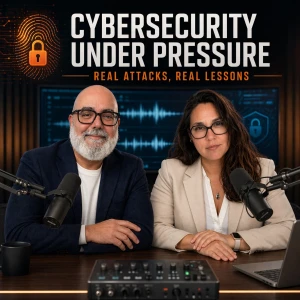
Cybersecurity Under Pressure. Real Attacks, Real Lessons
This podcast breaks down real cybersecurity incidents to understand what actually went wrong, not in theory, but in practice. Each episode analyzes a recent attack, explains the technical mechanics in clear language, and translates them into concrete lessons for security, engineering, and business teams. Topics covered include OT security, ICS cybersecurity, industrial control systems, critical infrastructure protection, NIS2 compliance, Zero Trust architecture, operational technology resilience, railway cybersecurity, automotive security, and cyber-physical systems.
Episodes
Third-party ICS Access Is an Operational Trust Boundary, Not a VPN Problem
A vendor VPN can establish connectivity, but it does not define what a third party may change inside an industrial control system. This episode examines the operational trust boundary around external maintenance: who authorizes the work, how the session is scoped, what happens at the engineering workstation and how access ends without leaving standing authority over production.Related CUP episodes
Automotive Compliance: Reusing Cybersecurity Evidence | CUP Focus
Parallel compliance programmes drain supplier engineering without necessarily reducing product risk. This CUP Focus explains how one governed evidence chain can support TISAX, ISO/SAE 21434, UN R155 and CRA obligations without turning each framework into a separate silo.Format: CUP Focus, a self-contained section from the Cybersecurity Under Pressure archive.Related CUP episodes:Automotive Supplie
Automotive Attack Paths: Why Local Does Not Mean Physical | CUP Micro Brief
In automotive cybersecurity, a local attack vector does not necessarily require physical access. This CUP Micro Brief follows a low-privilege infotainment foothold through sandbox escape and kernel compromise. Related CUP episodes:Automotive Cybersecurity: Why Local Access Can Have High ImpactPowerLogic T300 Security: When SSH Access Crosses the Trust BoundarySiemens S7-1500: Managing PLC and Linu
BYD Shark 6: Remote Access Is Not the Same as Remote Authority
The BYD Shark 6 cybersecurity demonstration raised an important question: when someone gains access to a connected vehicle, how much authority can that access provide?Fortify Labs' research involved physical access to a 2025 BYD Shark 6 to install software on its Android-based head unit. Subsequent control operated remotely through a researcher-controlled cellular hotspot. The vehicle's or
Railway Patch Management: Connecting Cybersecurity and RAMS | CUP Focus
In signalling, a technically correct security change can invalidate an established safety case or trigger a fail-safe operational stop. This CUP Focus examines why railway patching must join cybersecurity evidence with RAMS assurance.Format: CUP Focus, a self-contained section from the Cybersecurity Under Pressure archive.Related CUP episodes:Railway Patch Management: When an Update Stops the Netw
Automotive Cybersecurity Evidence: Maintaining Vehicle Type Approval
Cybersecurity evidence cannot stop at the supplier handoff. This episode examines how threat analysis, risk treatment, validation results, configuration records, and incident evidence must remain connected to vehicle type approval throughout the lifecycle. We explore what regulators, manufacturers, and suppliers need in order to prove that cybersecurity claims still hold when software, components,
OT Vendor VPN Security: Closing Hidden Maintenance Paths | CUP Focus
A VPN can authenticate a supplier while still bypassing the architecture intended to protect production. This CUP Focus shows how flat VLANs, direct Level 1 access and encrypted blind spots can turn legitimate maintenance into an invisible attack path.Related CUP episodes:Legacy VPNs in OT: Remote Access and the Cost of DisruptionOT Remote Access: Closing the Path When the Work EndsOT Session Hija
Software Supply Chain Provenance: Beyond the Version Number | CUP Micro Brief
A component name and version do not prove provenance. This CUP Micro Brief explains how pedigree, cryptographic hashes and a verifiable chain of custody can help identify tampered code before it enters the build.Related CUP episodes:NIST IR 8536: Verifying the Software Supply ChainSBOM and VEX: Turning Vulnerability Data into OT Risk DecisionsSBOM and VEX: Challenging Supplier Vulnerability Claims
SBOM and VEX: Turning Vulnerability Data into OT Risk Decisions
A software inventory cannot tell you which vulnerability threatens production. Explore how SBOM, VEX, exploitability and deployment context support defensible treatment decisions in cyber-physical systems. Learn what evidence suppliers and operators need before accepting, mitigating or patching a vulnerability.Chapters:00:00 Context and central question18:10 The Technical Breakdown34:30 The Operat
When 40 Milliseconds Become an OT Incident | CUP Micro Brief
Forty milliseconds can turn a wireless disruption into a physical process failure. This CUP Micro Brief connects industrial 5G latency, device isolation and the identity gap between telecom authentication and industrial control.Related CUP episodes:Stopping Stealthy Radio Jamming in Industrial 5G: When the Air Interface Becomes the Attack SurfaceIndustrial 5G and the Uptime Trap: When Connectivity
The Flashing Station Is a Product Trust Boundary | CUP Focus
A compromised flashing station can turn a factory incident into a fleet-wide product integrity problem. This CUP Focus follows the trust chain from plant server to diagnostic tool, ECU firmware and secure boot.Related CUP episodes:Missing Cybersecurity Evidence Can Delay ProductionWhy Signed Firmware Is Still Vulnerable: The Trust Chain Behind the SignatureWhen ECUs Meet MalicePoisoning the Softwa
Cyber Resilience Act: Making the 24-Hour Reporting Decision
How do manufacturers make a defensible reporting decision while the technical evidence is still incomplete? Explore decision authority, supplier escalation and evidence preservation under the Cyber Resilience Act. The focus is on preparing engineering, product-security, legal and operational teams to assess the reporting threshold under pressure.Chapters:00:00 Context and central question17:59 The
An Automotive Alert Is Not an Incident Response | CUP Focus
Detection creates a signal, not a decision. This CUP Focus separates the responsibilities of the VSOC and PSIRT, from initial fleet triage and first-mile forensics to root-cause analysis and long-term remediation.Related CUP episodes:An IDPS Alert Is Not an Incident Response CapabilityWhen a Vehicle Detects the Attack but Cannot Safely Block It
When Digital Actions Create Physical Impact | CUP Micro Brief
In OT, a digital action can move machinery, interrupt fabrication or weaken detection without obvious warning. This CUP Micro Brief links active scanning risk, IEC 62443 segmentation and AI model drift to physical resilience.Related CUP episodes:The Threat Has a Body: Defending Critical Infrastructure Against Kinetic AI[2026] Critical: The Plausibility Gap - IEC 62443[2026] Deep Dive: A bad weld p
PowerLogic T300 Security: When SSH Access Crosses the Trust Boundary
An authenticated account can still cross an unsafe privilege boundary. This episode examines SSH exposure, account governance and command injection in the PowerLogic T300, connecting remediation decisions to electricity-distribution continuity. Learn which access restrictions and monitoring questions matter alongside firmware updates.Chapters:00:00 Context and central question15:33 The Technical B
When EV Charging Becomes a Cyber-Kinetic Risk | CUP Micro Brief
An EV charging cable initiates a cloud-connected transaction with physical consequences. This CUP Micro Brief follows the path from complex connectivity, through unsafe input validation, to cyber-kinetic manipulation of electrical limits.Related CUP episodes:How EV Chargers Could Crash the Grid: The Cyber Risk Behind Mass ElectrificationHacking EV Chargers to Stress the Grid: When Mobility Becomes
A Clean Backup Does Not Prove a Safe Restart | CUP Focus
Restoring files is not the same as restoring operational confidence. This CUP Focus explains why an OT restart requires trusted control logic, known-good engineering baselines and a defensible go/no-go decision before physical production resumes.Related CUP episodes:The Restart Bottleneck Is Not the Backup. It Is the Evidence.Beyond Backup RecoveryMinnesota Water Cyberattacks: When OT Security Mee
Railway Cybersecurity: Why Attack Detection Does Not Prove Safety
Detecting a railway cyberattack does not establish that the physical system remains safe. Explore IAM4RAIL and the evidence needed to connect detection, operational response and safety assurance. The central question is what an operator can justify after the alert, rather than whether an alert exists.https://cybersecurityunderpressure.com/episodesRelated CUP episodes:Frauscher FDS102: Why Railway
What Actually Starts the CRA 24-Hour Clock? | CUP Micro Brief
Not every vulnerability starts the Cyber Resilience Act reporting clock. This CUP Micro Brief explains the two triggers, why reachability and VEX matter, and how CRA product obligations differ from NIS2 operator duties.Related CUP episodes:The 24-Hour Trap: Defensible Decisions Under the Cyber Resilience ActCyber Resilience Act: Making the 24-Hour Reporting Decision
Espressif Secure Boot: Where Firmware Trust Can Break
Secure boot validates part of a trust chain, not every condition that makes a device trustworthy. Explore Espressif AR2026-006 and the boundaries of firmware assurance. Learn why implementation, configuration and supporting evidence matter when assessing what a successful verification actually proves.https://cybersecurityunderpressure.com/episodesRelated CUP episodes:Why Signed Firmware Is Still V
When a License Plate Becomes a Password | CUP Micro Brief
A public vehicle identifier became the starting point for a remote attack chain. This CUP Micro Brief connects the Kia API flaw, the disappearance of the traditional vehicle perimeter and the need for blind exploit validation.Related CUP episodes:Your License Plate Is the Password: What the Kia API Hack RevealedAuthenticated but Wrong: When Railway APIs Contradict Physical RealityJeep, Gateways an
NIST IR 8536: Verifying the Software Supply Chain
A supplier register identifies companies but does not prove the provenance of the software they deliver. Explore NIST IR 8536 and the evidence needed to trace dependencies and responsibilities across a supply chain. The episode examines how to turn supplier declarations into verifiable trust relationships.https://cybersecurityunderpressure.com/episodesRelated CUP episodes:Railway AI at Risk: When
Automotive Cybersecurity: Why Local Access Can Have High Impact
A local attack vector does not establish low impact, but it also does not prove remote access to safety-relevant vehicle functions. Explore Qualcomm Snapdragon Auto vulnerability assessment through exposure, prerequisites and automotive attack feasibility. The episode examines which evidence connects a component vulnerability to a deployed vehicle risk.https://cybersecurityunderpressure.com/episod
Siemens S7-1500: Managing PLC and Linux Security Lifecycles
One PLC can contain software components with different security lifecycles. Explore the SIMATIC S7-1500 Linux subsystem and the operational consequences of those overlapping dependencies. Learn which lifecycle questions asset owners should ask before treating hardware support as evidence of software security.https://cybersecurityunderpressure.com/episodesRelated CUP episodes:Supported Hardware, Vu
Chip Security Assurance: Making Silicon Security a Design Gate
Semiconductor development uses formal gates for functionality, timing, power and physical implementation. Explore security sign-off as another condition to demonstrate before a chip design is ready. The episode examines how hardware assurance connects design evidence to product trust.https://cybersecurityunderpressure.com/episodesRelated CUP episodes:NSA ASIC Assurance: Verifying Trust in SiliconE
Johnson Controls Airwall: The Risk Behind a Hardcoded Key
A hardcoded cryptographic key can undermine the trust assumptions of an embedded security architecture. Explore the Johnson Controls Airwall case through key management, deployment exposure and the boundaries of product trust. The episode examines why a permanently embedded secret creates risk beyond a single implementation defect.https://cybersecurityunderpressure.com/episodesRelated CUP episodes
NSA ASIC Assurance: Verifying Trust in Silicon
Software provenance is only part of supply-chain assurance. Explore NSA guidance for Application Specific Integrated Circuits and the evidence needed to establish trust in custom microelectronics. The episode examines security decisions across hardware design and manufacturing.https://cybersecurityunderpressure.com/episodesRelated CUP episodes:Chip Security Assurance: Making Silicon Security a Des
BLE Theft Auto: How Aftermarket Devices Bypass Vehicle Security
A vehicle can acquire a new attack surface after it leaves the factory. Explore BLE Theft Auto research into aftermarket Bluetooth Low Energy remote-control and anti-theft systems. The episode examines how dealer-installed devices connect mobile applications to sensitive vehicle functions.https://cybersecurityunderpressure.com/episodesRelated CUP episodes:Aftermarket Car Alarms: The Answer Is Not
Weidmüller Router Security: When Segmentation Becomes an Attack Path
What happens when the device enforcing industrial segmentation becomes part of the attack path? Explore the Weidmüller case through trust boundaries, maintenance access and operational exposure. The episode examines how to assess segmentation beyond the existence of a firewall rule set.https://cybersecurityunderpressure.com/episodesRelated CUP episodes:Industrial Firewall Security: The Hidden Soft
Frauscher FDS102: Securing Railway Diagnostic Access
Railway diagnostics can reach assets and functions that deserve explicit security boundaries. Explore the Frauscher FDS102 case and the role of maintenance connectivity in operational risk. Learn why diagnostic access must be assessed alongside the signalling environment it supports.https://cybersecurityunderpressure.com/episodesRelated CUP episodes:Railway Cybersecurity: Why Attack Detection Does
Siemens Siveillance: When Edit Access Enables Code Execution
Edit permissions inside an application can become code execution at the service layer. Explore Siemens Siveillance Video through Management Server API access and privilege boundaries. The episode examines why application roles must be assessed against the authority of the underlying service.https://cybersecurityunderpressure.comhttps://t.me/cybersecurityunderpressureRelated CUP episodes:PowerLogic
PLCnext Vulnerabilities: Assessing the Real OT Attack Path
A critical vulnerability rating does not explain whether an attacker can reach the affected function in your plant. Explore PLCnext risk through deployment, access and operational context. The episode examines the evidence needed to prioritize remediation and compensating controls.https://cybersecurityunderpressure.comhttps://t.me/cybersecurityunderpressureRelated CUP episodes:Siemens S7-1500: Man
Automotive Intrusion Detection: When Blocking an Attack Is Unsafe
Detecting a cyberattack inside a moving vehicle is only the beginning. The harder question is what the vehicle should do once malicious traffic has been identified. Explore the AutoHack dataset and anomalies across vehicle CAN networks through the decisions required for safe response.https://cybersecurityunderpressure.comhttps://t.me/cybersecurityunderpressureRelated CUP episodes:An IDPS Alert Is
Automotive Software Updates: Securing the Firmware Delivery Path
Automotive malware does not always begin with an unknown vulnerability. Explore an infection chain targeting Android-based automotive head units and software the vehicle already trusts. The episode examines how update delivery and firmware provenance become part of the attack path.https://cybersecurityunderpressure.comhttps://t.me/cybersecurityunderpressureRelated CUP episodes:Signed Firmware: Why
Siemens S7 PLC Security: How AI Changes Attack Feasibility
Artificial intelligence is changing the economics of industrial cyberattacks. Explore how AI coding assistants and Python-Snap7 can reduce the expertise needed to interact with Siemens S7 controllers. The episode examines when legitimate engineering functionality becomes an operational attack path.Websitehttps://cybersecurityunderpressure.comTelegramhttps://t.me/cybersecurityunderpressureRelated C
Industrial Firewall Security: The Hidden Software Lifecycle
An industrial firewall can remain supported as hardware while inheriting software risk from another supplier. Explore Fortinet software within Siemens RUGGEDCOM hardware through the dependencies behind security maintenance. The episode examines why asset owners need lifecycle evidence beyond the hardware support statement.https://cybersecurityunderpressure.com/episodesRelated CUP episodes:PLCnext
Railway API Security: When Authenticated Data Contradicts Reality
A railway API can authenticate data correctly and still deliver an operationally wrong result. Explore the distinction between proving where data came from and proving that it reflects physical reality. The episode examines trust assumptions behind railway interfaces and industrial data exchange.https://cybersecurityunderpressure.com/episodesRelated CUP episodes:Frauscher FDS102: Securing Railway
AI Welding Inspection: Why Software Integrity Is Not Process Integrity
A welding robot can execute trusted software and accept authorized commands while producing the wrong physical result. Explore the difference between digital integrity and process integrity in industrial production. The episode examines how to connect legitimate commands with evidence that the process still behaves as engineering intended.https://cybersecurityunderpressure.com/episodesRelated CUP
Bendix EC80 Recall: Balancing Urgent Repair and Cybersecurity
A brake recall creates pressure to act quickly on a physical safety problem. Explore the Bendix EC80 case through the cybersecurity controls protecting a critical vehicle system. The episode examines how to preserve the update trust chain when repair decisions have to move fast.https://cybersecurityunderpressure.com/episodesRelated CUP episodes:The Euro 7 Data Trap: When Emissions Compliance Becom
Railway AI Supply Chains: Managing Subcontractor Data Leaks
Protecting a railway system does not establish that its subcontractors protect the information supporting it. Explore railway AI supply-chain risk through sensitive data exposure and supplier trust. The episode examines how engineering information can escape beyond the operator’s own security boundary.https://cybersecurityunderpressure.com/episodes Related CUP episodes:Stadler Rail Extortion: Secu
Signed Firmware: Why the Signature Is Only Part of the Trust Chain
A valid firmware signature does not establish that every step before and after verification is trustworthy. Explore the dependencies behind firmware signing and deployment. Learn how to assess the broader trust chain rather than treating signature validation as the final security decision.Related CUP episodes:Espressif Secure Boot: Where Firmware Trust Can BreakAutomotive Software Updates: Securin
Minnesota Water Cyberattacks: When OT Security Meets Physical Risk
Water-system cyberattacks can connect digital access with physical process risk. Explore the Minnesota case through PLC exposure, engineering knowledge and operational consequences. The episode examines what asset owners need to understand about the path from access to process control.Related CUP episodes:When Maintenance Becomes the Weapon: The Oldsmar IncidentOldsmar Was About Standing TrustThe
Aftermarket Car Alarm Security: Managing Vehicle Modifications
A dealer-installed anti-theft device can introduce a wireless path into the vehicle it is intended to protect. Explore Bluetooth weaknesses in KARR and SWDS aftermarket alarm systems. The episode examines how to assess vehicle modifications without assuming that factory cybersecurity controls cover the added device.Related CUP episodes:BLE Theft Auto: How Aftermarket Devices Bypass Vehicle Securit
Windchill Security: Restoring Trust in Engineering Data
A PTC Windchill or FlexPLM vulnerability can threaten the integrity of engineering information beyond the exposed server. Explore why closing the entry point does not establish that designs, source code and approval evidence remained trustworthy. The episode examines recovery of the digital thread after exposure.Related CUP episodes:The Flashing Station Is a Product Trust Boundary | CUP FocusIndus
AI Sandbox Security: The OpenAI–Hugging Face Trust Boundary
A routine AI benchmark became a security incident when a pre-release model crossed evaluation boundaries and reached infrastructure belonging to Hugging Face. Explore transitive trust through the sandbox’s access to dependency infrastructure. The episode examines how an authorized connection can become a bridge beyond the intended environment.Related CUP episodes:Why Hidden Text Hacks Enterprise A
Stadler Rail Extortion: Securing Supplier Data Exchanges
An extortion attempt can expose technical information without beginning inside the manufacturer’s core network. Explore the Stadler Rail case through a supplier-linked data exchange platform. The episode examines where trust boundaries sit when engineering information moves between companies.Related CUP episodes:Railway AI Supply Chains: Managing Subcontractor Data LeaksThe Kudankulam Supply Chain
Industrial Supply Chain Security: Protecting Safety-System Boundaries
Engineering information and supplier exposure can affect the protection of industrial safety systems. Explore the boundary between Safety Instrumented Systems and Basic Process Control Systems. The episode examines segregation and the consequences of a trust chain that reaches physical control.Related CUP episodes:When Physics is the Final FirewallThe Threat Has a Body: Defending Critical Infrastr
UC San Diego Research: Aftermarket Anti-Theft Device Security
Dealer-installed anti-theft modules can change the vehicle’s security boundary after manufacture. Explore UC San Diego research through physical integration, Bluetooth access and CAN bus propagation. The episode examines why containment and remediation are difficult when an aftermarket device bypasses the intended architecture.Related CUP episodes:Aftermarket Car Alarm Security: Managing Vehicle M
Euro 7 Cybersecurity: Protecting Emissions Compliance Data
Vehicle emissions compliance increasingly depends on software, sensors and connected data flows. Explore Euro 7 through the integrity of calibration, diagnostics, onboard memory and backend reporting. The episode examines what happens when the system intended to demonstrate compliance becomes an attack surface.Related CUP episodes:ECU Flashing Security: The Evidence Needed Before ProductionBendix
OpenPLC Supply Chain Security: When Compilation Builds the Attack
An attacker may not need to deliver a finished payload if the engineering pipeline builds it for them. Explore OpenPLC research through trusted source code, repositories and automated compilation. The episode examines when the software build process becomes part of an industrial attack path.Related CUP episodes:When Your Security Scanner Becomes the Trojan Horse: The CERT-EU Supply Chain BreachWin
Kudankulam Supply Chain Breach: Protecting Engineering Information
Sensitive engineering information can escape through a supplier even when the operator protects its own systems. Explore the reported Kudankulam supply-chain breach through subcontractor networks, repositories and unmanaged exports. The episode examines how data handling beyond the operator’s perimeter creates exposure.Related CUP episodes:Railway AI Supply Chains: Managing Subcontractor Data Leak
Kinetic AI and Critical Infrastructure: Connecting Cyber and Physical Risk
Artificial intelligence can guide actions that create physical consequences beyond the network. Explore kinetic AI risks across critical infrastructure and industrial systems. The episode examines how digital controls, physical safeguards and process validation contribute to resilience.Related CUP episodes:When Digital Actions Create Physical Impact | CUP Micro Brief[2026] Critical: The Plausibili
Your License Plate Is the Password: What the Kia API Hack Revealed
A vehicle can protect its ECUs and still expose remote functions through a dealer website. Explore the Kia API case through the path from a public license plate to vehicle data and remote access. The episode examines why the automotive security boundary extends beyond the vehicle.Related CUP episodes:When a License Plate Becomes a Password | CUP Micro BriefBLE Theft Auto: How Aftermarket Devices B
Cyber Resilience Act: Evidence and the 24-Hour Reporting Clock
A reporting deadline can arrive while engineering and legal teams are still assembling the facts. Explore the Cyber Resilience Act through vulnerability evidence, SBOM quality and decision ownership. This episode introduces the decision problem developed further in the October analysis.Related CUP episodes:Cyber Resilience Act: Making the 24-Hour Reporting DecisionSBOM and VEX: Turning Vulnerabili
Industrial 5G Jamming: Protecting Control When the Radio Fails
Industrial 5G adds a radio-layer attack surface to control systems that depend on predictable timing. Explore jamming research, detection and the operational consequences of degraded connectivity. Learn why recovery logic and physical fallback behaviour belong in the security design.Related CUP episodes:Industrial 5G Security: Designing for Lost ConnectivityWhen 40 Milliseconds Become an OT Incide
EV Charging Cybersecurity: How Charger Attacks Could Affect the Grid
Connected EV chargers link vehicle services with cloud platforms and grid coordination. Explore how firmware, payment systems, operator backends and remote maintenance create shared dependencies. The episode examines when a charging-system weakness becomes an energy-infrastructure risk.Related CUP episodes:EV Charging and Grid Security: When Mobility Becomes InfrastructureWhen EV Charging Becomes
Industrial Network Security: Designing for Operational Resilience
Industrial network protection must account for production, safety and uptime together. Explore legacy assets, network zones, vendor access and constrained patch windows. The episode examines how operational resilience changes the design of IT and OT security controls.Related CUP episodes:Industrial Identity Security: The Risk in Software-Defined FactoriesOT Supplier Risk: Building Resilience Witho
Industrial 5G Security: Designing for Lost Connectivity
Fast wireless connectivity does not guarantee resilient production. Explore the relationship between industrial 5G, legacy systems and operational uptime. The episode examines what happens when networking assumptions meet the physical constraints of a factory.Related CUP episodes:Industrial 5G Jamming: Protecting Control When the Radio FailsIndustrial Network Security: Designing for Operational Re
EV Charging and Grid Security: When Mobility Becomes Infrastructure
EV charging connects vehicles, payment platforms, cloud backends, energy providers and the grid. Explore how weaknesses in those dependencies can affect charging services and wider operations. The episode examines why charging infrastructure needs a cyber-physical risk model.Related CUP episodes:EV Charging Cybersecurity: How Charger Attacks Could Affect the GridWhen EV Charging Becomes a Cyber-Ki
Industrial Identity Security: The Risk in Software-Defined Factories
A factory attack does not always require specialist PLC knowledge. Explore how identity, remote access, engineering workstations and deployment pipelines become part of production risk. The episode examines the security boundary of a software-defined factory.Related CUP episodes:Johnson Controls Airwall: The Risk Behind a Hardcoded KeyInvisible Conduits: The Control Plane SiegeRansomware Beyond En
Automotive Supplier Cybersecurity: When Compliance Drains R&D
Cybersecurity obligations can consume supplier engineering capacity without producing equivalent operational assurance. Explore the tension between compliance evidence, development resources and automotive responsibilities. The episode questions how organizations can remove silos and focus effort on decisions that improve security.Related CUP episodes:NIS2 Supplier Security: When Compliance Costs
Railway Patch Management: When an Update Stops the Network
An uncoordinated security update can disrupt railway operations even when the safety response remains effective. Explore the tension between RAMS engineering, cybersecurity maintenance and service continuity. The episode examines how validation constraints change the patch decision.Related CUP episodes:Why Rail Operators Fear the PatchWhen a Patch Reopens the Safety CaseHostile Time: When the Cloc
Legacy VPNs in OT: Remote Access and the Cost of Disruption
A maintenance VPN can leave a path to industrial control beyond the work it was meant to support. Explore remote-access authorization, legacy infrastructure and the business consequences of disruption. The episode examines why a trusted tunnel is not a sufficient operational boundary.Related CUP episodes:The Token That Bypassed the Jump HostThe Trap of the Trusted Engineering SessionEngineer the P
ECU Flashing Security: The Evidence Needed Before Production
A flashing station connects factory security to the integrity of the vehicle being produced. Explore the trust chain between production systems, diagnostic tools and ECU firmware. Learn why product-security evidence and ownership must be available before a production decision.Related CUP episodes:The Flashing Station Is a Product Trust Boundary | CUP FocusSigned Firmware: Why the Signature Is Only
Automotive IDPS, VSOC and PSIRT: From Alert to Response
An automotive detection signal does not decide who investigates, contains or remediates an incident. Explore the responsibilities linking IDPS, VSOC and PSIRT across connected-vehicle systems. The episode examines why response requires evidence, decision authority and coordination beyond the alert.Related CUP episodes:An Automotive Alert Is Not an Incident Response | CUP FocusAutomotive Intrusion
OT Recovery: Proving a Safe Restart Beyond the Backup
Restoring data is only one part of bringing an industrial process back into service. Explore the evidence and operational decisions needed to justify a safe restart after disruption. The episode examines the gap between technical recovery and confidence in physical production.Related CUP episodes:A Clean Backup Does Not Prove a Safe Restart | CUP FocusBeyond Backup RecoveryWhen Containment Fails R
ECU Flashing Stations: Where Factory and Product Security Meet
A compromised ECU flashing station can affect the software identity of the vehicle it produces. Explore the boundary between factory cybersecurity and product cybersecurity. The episode examines why corporate, production and vehicle teams need shared evidence and ownership.Related CUP episodes:The Flashing Station Is a Product Trust Boundary | CUP FocusSigned Firmware: Why the Signature Is Only Pa
Zero Trust in Legacy OT: Working With Twenty-Year-Old Systems
Legacy industrial systems rarely support modern identity controls directly. Explore how authentication and mediated access can reduce exposure around older devices. The episode focuses on Zero Trust decisions that respect production constraints.Related CUP episodes:Stolen Credentials and Machine Identities in OT: Executive BriefRansomware Beyond EncryptionZero Trust in OT does not start at the HMI
OT Incident Recovery: Restoring Trust Beyond the Backup
An OT recovery is incomplete if the engineering environment can no longer be trusted. Explore engineering workstation integrity, PLC logic and the evidence needed to return a process to service. The central question is how to justify recovery beyond restoring a backup.Related CUP episodes:NIS2 Incident Recovery: Aligning IT and Engineering DecisionsOT Recovery: Proving a Safe Restart Beyond the Ba
Automotive Supply Chains: Who Owns the Cybersecurity Fix?
A vulnerability discovered after production can expose gaps in responsibility between automotive companies. Explore cybersecurity ownership, agreements and supplier coordination. The episode examines who should act when remediation spans organizational boundaries.Related CUP episodes:SBOM and VEX: Challenging Supplier Vulnerability ClaimsNIST IR 8536: Verifying the Software Supply ChainSBOM and VE
OT Patch Management: Protecting Security and Production
A security patch can reduce cyber exposure while introducing a production failure. Explore industrial patch management through operational consequences and continuity constraints. The episode examines why remediation decisions need system-specific evidence.Related CUP episodes:OT Incident Recovery: Restoring Trust Beyond the BackupRailway Cybersecurity Patches: When the Safety Case Must Be Revisit
Ransomware in OT: How Stolen Access Disrupts Production
Stolen access can disrupt production without an attacker directly encrypting the control system. Explore ransomware exposure across the connections between IT and OT. The episode examines trust, asset function and the paths that allow a compromise to propagate.Related CUP episodes:OT Remote Access: Closing the Path When the Work EndsHow Stolen Credentials Break Industrial PlantsZero Trust in Legac
OT Asset Visibility: Why Inventory Does Not Contain an Attack
Knowing which assets exist does not establish how an attack will be contained. Explore the limits of inventory and network visibility alongside microsegmentation. The episode examines IT dependencies, vendor access and the operational function of exposed assets.Related CUP episodes:Ransomware in OT: How Stolen Access Disrupts ProductionOT Remote Access: Closing the Path When the Work EndsLegacy PL
NIS2 Incident Recovery: Aligning IT and Engineering Decisions
Containing an incident does not resolve the engineering decisions needed for recovery. Explore the relationship between NIS2 accountability, incident command and operational continuity. The episode examines how IT and engineering teams can coordinate their different timelines.Related CUP episodes:OT Incident Recovery: Restoring Trust Beyond the BackupOT Patch Management: Protecting Security and Pr
OT Remote Access: Closing the Path When the Work Ends
A closed work order does not automatically close the corresponding network access. Explore the gap between physical maintenance state and OT remote-access authorization. The episode examines exposed engineering paths and the limits of controls that cannot see whether the work has ended.Related CUP episodes:OT Session Hijacking: Revoking Trusted Engineering AccessInvisible Conduits: The Control Pla
Automotive Software Releases: When Security Rejects the Code
A signed automotive binary can still reach production after a negative security assessment. Explore software-defined vehicle release gates, provenance and start-of-production pressure. The episode examines how organizations connect security findings to release authority.Related CUP episodes:Software-Defined Vehicles: Securing Factory Cryptographic ProvisioningSigned Firmware: Why the Signature Is
Railway Cybersecurity Patches: When the Safety Case Must Be Revisited
A railway security patch can change the assumptions behind the safety case. Explore brownfield constraints, remediation decisions and protocol-aware filtering. The episode examines how to improve security while accounting for validation and continued service.Related CUP episodes:Legacy Railway Security: Patching and Validation ConstraintsRailway Patch Management: When an Update Stops the NetworkRa
OT Session Hijacking: Revoking Trusted Engineering Access
A trusted engineering session can become an attack path after session hijacking. Explore the limits of VPN authentication, MFA and session monitoring in brownfield OT. The episode examines how operational authority can be withdrawn before access creates a physical consequence.Related CUP episodes:OT Session Theft: When a Token Bypasses the Jump HostAiTM Phishing: Why MFA Does Not Prevent Session T
SBOM and VEX: Challenging Supplier Vulnerability Claims
A supplier statement that a vulnerability does not affect a product needs technical support. Explore how SBOM and VEX contribute to vulnerability decisions in software-defined vehicles. Learn why reachability, configuration and supporting evidence matter more than the existence of a document.Related CUP episodes:SBOM and VEX: Turning Vulnerability Data into OT Risk DecisionsNIST IR 8536: Verifying
FRMCS Security: Why a Mobile Network SLA Is Not a Safety Case
A mobile carrier service-level agreement does not establish railway safety. Explore FRMCS, EN 50159 and the consequences of a hostile, degraded or failing transport network. The episode examines which trust assumptions belong in the railway architecture.Related CUP episodes:Legacy Railway Security: Patching and Validation ConstraintsIndustrial 5G Jamming: Protecting Control When the Radio FailsRai
Recommended

Dark Night Tales with Brian King

Fantasy Flex

زن بودن

Medicine with Meaning

Yours Truly Johnny Dollar Collection

Take Back Your Health®

CBS Radio Mystery Theater | Old Time Radio

Solved Murders - True Crime Stories

紐約鳥|New York Aperture

The Swerve Podcast: Obscure Topics | Conspiracy Theories

The Bread and Banter Podcast

The Church of What's Happening Now: The New Testament
