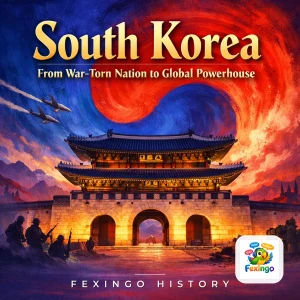
South Korea: From War-Torn Nation to Global Powerhouse — Fexingo History
How did a nation devastated by the Korean War transform into a global economic and cultural powerhouse? Lucas and Luna trace South Korea's extraordinary arc from the fall of the Joseon dynasty through Japanese colonial rule, the division at the 38th parallel, the Korean War, and the authoritarian development era under Park Chung-hee. They explore the chaebol conglomerates, the democratization movement of 1987, and the 1997 Asian financial crisis. Cultural topics include the Hallyu wave, the debate over comfort women, the Sunshine Policy with North Korea, and the 2018 PyeongChang Olympics. Each episode unpacks a specific chapter from the Gwangju Uprising to the IMF bailout to the impeachment of Park Geun-hye.
Episodes

Korea's Land Reform: The Seeds of Democracy
Before the chaebols and before the digital boom, South Korea underwent a radical transformation in land ownership that reshaped its society. In this episode, we explore the agrarian reforms of the early 1950s, when the government redistributed over three million acres from Japanese colonial holdings and wealthy landlords to millions of poor tenant farmers. Lucas and Luna discuss how this policy di
Korea's Five-Year Plans: The Architects of Growth
South Korea's economic miracle didn't happen by accident. In this episode, we trace the rise of the Heavy and Chemical Industry (HCI) drive under Park Chung-hee, focusing on the visionary but controversial figures like Kim Jong-pil and Posco’s Pohang Iron and Steel Works. We explore how South Korea moved from light manufacturing to heavy industry, transforming Ulsan into an industrial hub and layi
Korea's Hidden Labor Crisis: The Unseen Cost of Growth
While the Han River Miracle is often celebrated for its rapid industrialization and economic output, the human toll behind South Korea's ascent remains largely unspoken in mainstream narratives. This episode explores the brutal conditions faced by workers during the heavy industrialization campaigns of the 1970s, focusing on the chemical industry's explosion and the systemic suppression of labor r
The Han River's Dark Secret: Seoul's Hidden War
We often hear about the Han River Miracle, but few discuss the human cost of building it. This episode explores the Cheonggyecheon Stream, a vital waterway that once flowed through the heart of Seoul before being paved over in the name of modernization. Lucas and Luna trace the history of the informal settlements, or jangsan, that lined its banks, home to thousands of displaced families during the
Korea's Silent Resistance: The Church and Democracy
While we often look to the generals and industrialists who built South Korea’s economic miracle, there was another force quietly reshaping the nation’s soul. This episode explores the pivotal role of the Catholic Church and Protestant pastors during the 1960s and 70s under Park Chung-hee’s authoritarian rule. We trace how religious communities became sanctuaries for dissent, organizing the very pr
Korea's First Democracy: The April Revolution
In the spring of 1960, South Korea stood on a precipice. After years of authoritarian rule under Syngman Rhee and the turbulent Second Republic, a fraudulent election sparked mass protests that would reshape the peninsula. This episode explores the April Revolution, focusing on the student activists of Masan who defied police brutality to demand true democracy. We examine the role of high school s
Korea's First Digital Age: The 1980s Tech Boom
In the mid-1980s, South Korea stood on the precipice of a new revolution, one driven not by heavy industry but by silicon and code. This episode explores the birth of Korea’s first true digital age, focusing on the pivotal role of the Electronic Telecommunications Research Institute (ETRI) and the visionaries who built the nation’s computing backbone from scratch. We trace the journey of engineers
The Quiet War: Korea's Cultural Cold War
While previous episodes have covered the brutal physical battles of the Korean War and the rapid industrialization that followed, this episode explores a different kind of conflict: the cultural cold war. We look at how South Korea’s government under Park Chung-hee and subsequent regimes actively managed national identity, suppressing regional dialects and enforcing a standardized Seoul accent to
Korea's 1988 Seoul Olympics: A Political Turning Point
This episode explores how South Korea’s hosting of the 1988 Summer Olympics in Seoul transformed its global image and accelerated democratization. We examine the political maneuvering behind President Chun Doo-hwan’s decision to host, the massive infrastructure projects like the construction of the Olympic Stadium and subway expansions, and the cultural shift from a militarized state to an open so
Korea's Industrial Giants: The Rise of Hyundai and Samsung
This episode explores the origins of South Korea’s chaebols, focusing on how Park Chung-hee’s industrial policy transformed a war-torn agrarian society into an economic powerhouse. We examine the strategic partnerships between the government and private conglomerates like Hyundai and Samsung, highlighting key figures such as Chung Ju-yung and Lee Byung-chull. The narrative details the heavy and ch
The Battle of the Three Rivers: Korea's Forgotten Victory
In this episode, we uncover the Battle of Pochonbo, a little-known but pivotal engagement in October 1937 that cemented Kim Il-sung’s legacy as the founder of the Korean resistance. While Western history focuses on the Pacific War’s major naval clashes, this story centers on a small-scale guerrilla raid in Manchuria against a Japanese garrison. We explore how this operation was less about military
The Imjin River: Korea's Forgotten Stalemate
While the Battle of Pork Chop Hill gets some attention, the real drama of the Korean War’s final phase unfolded along the frozen banks of the Imjin River in early 1953. This episode explores the desperate defense of the British 29th Infantry Brigade and the US 1st Cavalry Division as they held the line against a massive Chinese spring offensive. We look at the tactical decisions made by General Wi
The Korean DMZ: A Divided Peninsula's Living History
This episode moves beyond the political history of the Korean War and the economic rise of South Korea to explore the physical reality of the Demilitarized Zone. We discuss how the DMZ became an accidental sanctuary for biodiversity, hosting species like the white-naped crane and Amur leopard that vanished from the rest of the peninsula. Lucas and Luna examine the tension between military security
Korea's Economic Miracle: The Architects of Growth
We trace the roots of South Korea’s transformation from a war-torn agrarian society to an industrial powerhouse. This episode explores the strategic decisions made in the early 1960s, focusing on Park Chung-hee’s economic planning and the rise of the chaebol system. We examine how policies like the Export Promotion Strategy and the establishment of the Economic Planning Board reshaped the nation.
The Battle of Pork Chop Hill: Korea's Forgotten Stand
While the Korean War armistice was signed in July 1953, the fighting didn't truly stop until October. This episode explores the brutal, grinding stalemate known as the 'Limited War' period, focusing on the Battle of Pork Chop Hill. We examine how this small, insignificant-looking mound became a symbol of resistance for UN forces and why both sides fought over it with such ferocity despite its stra
The Great Han River Miracle: Architects of Growth
While earlier episodes covered the political machinery behind South Korea’s rapid industrialization, this episode focuses on the human and architectural reality of the transformation. We explore how the Han River itself became a symbol of hope and division, from the flooded villages that made way for highways to the Cheonggyecheon stream restoration. We discuss the role of key figures like Park Ch
Seoul's Hidden War: The Secret Battle for Hangang
While previous episodes have chronicled the political coups and industrial policies that built modern South Korea, this episode turns its gaze to the physical landscape of Seoul itself. We explore how the Cheonggyecheon Stream, once a thriving but polluted waterway, was paved over in 1971 during Park Chung-hee’s push for urban expansion. Lucas and Luna trace the stream’s journey from a vital resou
Korea's First Digital Age: The 1980s Tech Boom
While previous episodes covered the heavy industry and political turbulence of Park Chung-hee’s era, this episode explores how South Korea pivoted from steel to silicon. We trace the origins of the nation’s digital infrastructure in the 1980s, focusing on the Electronic Telecommunications Research Institute (ETRI) and the controversial yet visionary decision to mandate computer literacy in schools
Korea's Digital Miracle: Engineers of the Boom
South Korea’s transformation into a global technology leader didn't happen by magic, but through the tireless work of engineers and policymakers who bet on semiconductors when no one else would. This episode explores the creation of the Electronic Telecommunications Research Institute (ETRI) in 1976, a government-funded laboratory that broke foreign monopolies on technology transfer. We follow the
The Forgotten Korean War POWs Who Chose North
Most history books focus on the soldiers who returned home after the Korean War, but a small group made a different choice. This episode explores the Anti-Communist League and the complex reality of those POWs who refused repatriation to South Korea, opting instead for the North. We look at figures like Kim Kyong-hwa and the events surrounding Yeosu, examining how ideology, fear, and survival inte
The Korean DMZ: A Divided Peninsula's Living History
We trace the origins of the Demilitarized Zone, established in 1953 not as a border but as a ceasefire line that hardened into one of the world’s most heavily fortified boundaries. Lucas and Luna explore how this narrow strip of land became an accidental ecological sanctuary, separating two Koreas while preserving rare habitats for cranes, leopards, and wild boars. We examine the human cost of div
The Forgotten Korean War Defectors
Most people know the story of the Korean War as a stalemate that froze the peninsula in place, but there was another war happening right alongside it—one fought by those who refused to stay. In this episode, we explore the lives of the North Korean refugees who defected across the DMZ during the conflict and beyond, seeking freedom in the South. We look at figures like General Lee Yong-ho and the
The Forgotten Architects of Korea's Economic Miracle
We often hear about Park Chung-hee and the chaebols, but who actually designed the blueprints for South Korea’s transformation? This episode uncovers the hidden world of the Iron Cabinet—the technocrats who turned a war-torn nation into an industrial powerhouse. We follow the lives of key figures like Kim Jong-pil in his early bureaucratic role, Park Tae-joon at POSCO, and the engineers who built
Korea's Digital Miracle: The Engineers Behind the Boom
This episode explores how South Korea transformed from a war-torn nation with virtually no natural resources into the world’s leading digital economy. We focus on the pivotal decade of the 1980s and 90s, when the government shifted its strategy from heavy industry to high-tech innovation. Lucas and Luna discuss the role of the Ministry of Science and Technology in establishing research institutes
The Forgotten Women of the Korean War
While the economic miracle and industrialization of South Korea dominate historical narratives, a quieter, more intimate story unfolds in the shadows of the conflict. This episode explores the lives of comfort women during the Korean War, focusing on figures like Lee Yong-soo and the broader community of survivors who sought justice decades later. We examine how the trauma of sexual violence was s
The Day Seoul Burned: Park Chung-hee's Industrial Gambit
This episode revisits the pivotal moment in May 1960 when a student uprising forced President Syngman Rhee from power, triggering the short-lived Second Republic. Rather than focusing on the protest itself, we explore the immediate aftermath: the chaotic vacuum left by Rhee’s resignation and the desperate attempts by the new government to restore order while facing an entrenched, corrupt military
Seoul's Lost Villages: Han River Urban Renewal
Before the gleaming towers of Gangnam and the Miracle on the Han River, Seoul was a city of makeshift settlements clinging to the banks of the Han. This episode explores the human cost and complex legacy of the Gwanghwamun Plaza restoration and the earlier urban renewal projects that displaced thousands of residents from illegal shantytowns in the 1970s. We examine the stories of families who lost
Korean War POWs: The Secret Battle for Freedom
Most histories of the Korean War focus on the front lines, but a quieter, more desperate conflict unfolded inside prisoner-of-war camps. This episode explores the anti-communist resistance organized by South Korean soldiers who refused repatriation to North Korea after the 1953 armistice. We follow the story of General Kim Kyong-hwa and the clandestine network known as the Anti-Communist League, w
Korean Wave: Hallyu's Roots in Soft Power and Culture
While earlier episodes covered the steel, roads, and political upheavals that built modern South Korea, this episode explores the invisible architecture of its global influence: the Korean Wave. We trace how state-sponsored cultural diplomacy evolved from a niche export into a dominant soft power force. Lucas and Luna discuss the pivotal role of the Ministry of Culture, Sports and Tourism in the l
Hwang Jang-yop: The Defector Who Exposed Kim Il-sung
For decades, the truth about North Korea’s leadership was sealed behind an iron curtain of propaganda. This episode uncovers the extraordinary life of Hwang Jang-yop, the architect of Kim Il-sung’s personality cult who risked everything to defect in 1997. We trace his journey from a young revolutionary loyal to the Great Leader to a disillusioned insider who helped design the very system that ensl
The Imo Incident and Korea's Diplomatic Crisis
In 1882, a mutiny by disgruntled Korean soldiers in Seoul sent shockwaves through East Asia, exposing the fragility of the Joseon Dynasty. This episode explores the Imo Mutiny, a pivotal moment when military discontent collided with intense geopolitical rivalry between Qing China, Japan, and rising Korean nationalism. We follow the chaos as Queen Min navigates a desperate flight from the burning p
The Great Korean Alphabet: King Sejong and Hangul
While previous episodes have traced South Korea’s industrial rise and political struggles, this episode turns back to the 15th century to explore the creation of Hangul. We examine how King Sejong the Great, driven by a desire for literacy among commoners, designed a scientifically precise writing system that defied the cultural hegemony of Classical Chinese. Through conversations with scholars an
The Man Who Built Modern Korea: Park Chung-hee's Rise
Before the Han River Miracle, there was Park Chung-hee, a military officer whose coup in 1961 reshaped South Korea’s destiny. This episode explores his early life as an orphaned child soldier under Japanese rule, his training at the Manchukuo Military Academy, and the psychological formation of a leader who would prioritize economic growth above all else. We examine how his authoritarian rule, mar
The Man Who Saved Korea's Soul: Shin Chae-ho
In this episode of Fexingo History, we step away from the industrial boom and political assassinations to explore the intellectual roots of Korean independence through the life of Shin Chae-ho. Born in 1880 during the final days of the Joseon Dynasty, Shin was a historian, poet, and revolutionary who believed that cultural identity was the first line of defense against Japanese colonialism. We tra
The Forgotten Architects of Korea’s Economic Miracle
While Park Chung-hee gets the headlines for South Korea’s rapid industrialization, the real engine was a quiet cadre of technocrats known as the 'Iron Cabinet.' This episode explores how figures like Kim Jong-pil and Park Tae-joon bypassed political chaos to build POSCO, Hyundai, and the export-driven economy that lifted millions out of poverty. We look at the specific policies, the ruthless effic
The Night Seoul Burned: Park Chung-hee's Industrial Gamble
In the mid-1970s, South Korea faced a paradox: rapid industrial growth was strangling its capital. This episode explores the ambitious and controversial demolition of Cheonggyecheon, a polluted open-air stream that had become home to informal markets, slums, and thousands of marginalized families. We trace how President Park Chung-hee’s government justified the project as a civic modernization eff
The Night Seoul Burned: Park Chung-hee's Industrial Gamble
While previous episodes have covered the architectural resilience of Hanyangdoseong and the steel production of POSCO, this episode zooms in on the specific political and economic mechanisms that drove South Korea’s rapid industrialization under Park Chung-hee. We examine the heavy-handed state intervention of the 1960s and 70s, focusing on the creation of the Economic Planning Board and the contr
The Yushin Constitution: Park Chung-hee's Dictatorship
We explore the dark side of the Miracle on the Han River, focusing on the Yushin Constitution enacted by President Park Chung-hee in 1972. After consolidating power through the October Struggle and dissolving the National Assembly, Park established an authoritarian regime that lasted until his assassination in 1979. We examine how this constitution allowed him to rule by decree, suppress dissent,
The Girl Who Defied the Emperor: Park Eom-yi's Final Stand
In 1908, nineteen-year-old Park Eom-yi attempted to assassinate Emperor Meiji of Japan in the Sakuradamon Incident. This episode explores her background as a student at the Japanese-run Girls' High School in Seoul and the complex web of Korean independence activists who supported her. We examine the psychological profile of Park Eom-yi, the immediate aftermath of the failed attack, and how her sac
The Day Seoul Burned: Park Chung-hee's Industrial Gambit
In this episode, we trace the explosive transformation of South Korea from a war-torn dependency to an industrial powerhouse, focusing on the controversial and decisive policies of Park Chung-hee in the mid-1960s. While previous episodes covered the human cost of the Korean War and the early days of reconstruction, we now zoom in on the specific mechanisms of the Han River Miracle. We explore how
Korea's Volunteer Army: The KATUSA That Fought Alongside America
When the Korean War erupted in June 1950, South Korea's army was pushed back to the Pusan Perimeter. But alongside American troops stood a little-known force: Korean Augmentation to the United States Army, or KATUSA. These Korean soldiers were integrated into U.S. units, fighting, dying, and translating in the chaos of war. In this episode, Lucas and Luna explore how the KATUSA program began, from
Queen Min's Last Stand: The 1895 Assassination
In October 1895, a squad of Japanese ronin burst into Gyeongbokgung Palace in Seoul, dragged Empress Myeongseong — better known as Queen Min — from her chambers, and killed her. She was 43. The assassination didn't just end a life; it shattered Joseon's last hope of playing the great powers against each other and set Korea on a path to outright colonization. This episode traces Queen Min's rise fr
Korea's Diplomatic Tightrope: The 1882 Imo Mutiny
In 1882, the Korean peninsula stood at the crossroads of empires. The Imo Mutiny — a violent uprising of Joseon soldiers in Seoul — nearly toppled the dynasty and dragged China, Japan, and the West into a new era of Asian geopolitics. This episode follows the soldiers' grievances over unpaid rice, the murder of Japanese military instructors, the flight of Queen Min, and the Chinese intervention th
Kim Sowol: The Poet of the Unfulfilled Dream
In episode 217 of Fexingo History, Lucas and Luna step away from wars and dynasties to explore the life and work of Kim Sowol, the poet who gave Korea its most beloved verse. From his birth in the border town of Kwaksan to his mysterious death in 1934 at age 31, Sowol's story is one of creativity, melancholy, and a nation's wounded soul under Japanese rule. We read lines from 'Azaleas' and trace h
Seoul's Underground: The 1974 Subway That Reshaped a City
In this episode, Lucas and Luna dig into the story of Seoul's first subway line — the 9.5-kilometer stretch that opened in 1974, just 21 years after the Korean War left the city in rubble. They trace how Park Chung-hee's push for modernization, the oil crisis, and Japanese financing built Line 1, and how it sparked the Han River Miracle's urban transformation. Along the way, they meet the workers
Kim Dae-jung: The Dissident Who Became President
Before he won the Nobel Peace Prize and met Kim Jong-il in Pyongyang, Kim Dae-jung was kidnapped, sentenced to death, and exiled. This episode traces his path from a small port town to the Blue House, through the 1971 election that shook Park Chung-hee's rule, the 1973 abduction in Tokyo, the 1980 death sentence, and the 1997 victory that finally brought democracy's champion to power. Lucas and Lu
Chaebol Roots: How Hyundai Rose From the Ashes of War
From a shattered postwar peninsula to the global stage, the story of South Korea's chaebols is a story of survival, ambition, and tangled politics. This episode traces Hyundai's unlikely rise—starting with founder Chung Ju-yung's early ventures in auto repair and construction, through the Gyeongbu Expressway project that jump-started the nation's modernization, to the shipbuilding gamble that made
South Korea's Steel Giant: POSCO and the Second Miracle
In this episode, Lucas and Luna dive into the story of POSCO, the steel company that powered South Korea's industrial leap after the Korean War. You'll learn about Park Chung-hee's vision for heavy industry, the unlikely partnership with American-trained engineer Park Tae-joon, and how a tiny nation with no iron ore deposits became one of the world's top steel producers. We explore the Fourth Repu
Korea's Hanok: From Joseon Homes to Architectural Rebirth
In this episode of Fexingo History, Lucas and Luna explore the story of the hanok, the traditional Korean house that nearly disappeared in the 20th century and is now experiencing a remarkable revival. From the elegant wooden architecture of the Joseon dynasty to the destruction and neglect of the Japanese occupation and rapid industrialization, the humble hanok carried the memory of Korean life.
The Han River Miracle: How Seoul Rose From the Ashes
In this episode of Fexingo History, Lucas and Luna explore the extraordinary transformation of Seoul from the rubble of the Korean War to a global metropolis. They trace the city's rebirth through the ambitious Han River development projects of the 1960s and 70s, the construction of the Gyeongbu Expressway, and the rise of industrial giants like Hyundai. Along the way, they uncover the human cost
Hallyu's Roots: How Korean Pop Culture Conquered the World
Before BTS and Parasite, there was a quiet cultural wave that began in the late 1990s. In this episode, Lucas and Luna trace the origins of Hallyu — the Korean Wave — from the first dramas that aired in China and Japan to the government policies that deliberately turned culture into an export. They explore how the 1997 Asian financial crisis pushed South Korea to invest in entertainment, how K-pop
The 1953 Korean Armistice: An Unfinished Peace
In this episode of Fexingo History, Lucas and Luna revisit the Korean War's end—or rather, its pause. They explore the brutal last battles that pushed both sides to the negotiating table, the two-and-a-half-year armistice talks that stalled over prisoners of war, and the fragile document signed at Panmunjom on July 27, 1953. The conversation weaves in the human story of POWs who chose defection ov
Hwang Jini: The Poet Who Bent Joseon's Rules
In the rigid Confucian world of sixteenth-century Joseon, one woman moved across class lines with a kind of freedom that unsettled the elite. Hwang Jini was a kisaeng — a courtesan trained in poetry, music, and dance — but she was also a poet whose sijo verses still resonate. This episode follows her life from the northern city of Kaesong, through her education in Chinese classics and Korean song,
Gwanggaeto the Great: Korea's Forgotten Conqueror
In this episode of Fexingo History, Lucas and Luna travel back to the fourth and fifth centuries to meet Gwanggaeto the Great, the warrior king who turned the ancient kingdom of Goguryeo into the dominant power of Northeast Asia. From his stunning conquest of 64 fortresses and 1,400 villages in a single campaign to his monumental stele in Manchuria, Gwanggaeto's legacy reshaped the Korean peninsul
The Seoul City Wall: A Thousand Years of Stone and Survival
In this episode of South Korea: From War-Torn Nation to Global Powerhouse, Lucas and Luna walk the ancient stones of Hanyangdoseong, the Seoul City Wall that has watched over the capital for over six centuries. From its founding by King Taejo of Joseon in 1396, through the Japanese invasions, the Korean War, and the breakneck urbanization of the 20th century, the wall has been demolished, rebuilt,
Korea's Age of Science: The Golden Age of Korean Astronomy
In this episode, Lucas and Luna explore the remarkable achievements of Korean astronomy during the Joseon dynasty. From the bronze age Cheomseongdae observatory to the celestial globe of King Sejong, they uncover how Korean scientists developed sophisticated instruments like the armillary sphere and water clocks, and how they meticulously recorded celestial events including the supernova of 1054 a
The Seoul Fortress: Korea's Century of Walls and Resilience
Before the skyscrapers and K-pop, Seoul was a walled city. In this episode, Lucas and Luna explore the Hanyangdoseong, the fortress that ringed the capital for over 600 years. From its construction in 1396 under King Taejo to its role in the Imjin War and the Japanese occupation, the walls have witnessed invasion, fire, and renewal. Lucas shares stories of the four gates, the secret mountain paths
The DMZ: Korea's 248-Kilometer Scar and Its Secret Wildlife
In this episode, Lucas and Luna step away from the battlefields and into the buffer: the 248-kilometer Demilitarized Zone that has split the Korean Peninsula since 1953. They trace its origins in the Armistice Agreement at Panmunjom, walk through the Joint Security Area, and explore the eerie paradox of a killing field that became an accidental nature reserve. From the abandoned village of Taesung
Korea 505: The Korean War's Deadliest Battle
In Episode 202, we step back to the Korean War's pivotal moment — the Battle of Bloody Ridge, fought in the summer of 1951. Lucas and Luna explore how a seemingly insignificant hill in the Taebaek Mountains became a graveyard for thousands of troops from the UN forces and the People's Volunteer Army. They trace the brutal slog up Hill 983, the tactical decisions of General James Van Fleet, the rol
The 1950 Seoul Retreat: How South Korea Nearly Lost Its Capital
In June 1950, the Korean People's Army smashed through the 38th parallel and captured Seoul in just three days. For the second time in a decade, the city fell to an invading army, and the Republic of Korea government fled south in chaos. This episode follows the frantic retreat from Seoul — the bombing of the Han River bridges, the desperate crowds at Seoul Station, and the collapse of the ROK's f
The 1988 Seoul Olympics: South Korea's Coming-Out Party
In 1988, South Korea stepped onto the world stage with the Seoul Olympics, a glittering spectacle that masked a nation still healing from war, dictatorship, and protest. This episode looks at how the Games became a turning point for the country — from the desperate bid in 1981, to the massive construction projects that transformed the city, to the diplomatic tightrope walk of the Cold War, when No
Korea's Hidden Heritage: The Gaya Confederacy
Long before the Three Kingdoms, a confederacy of city-states on the southern Korean coast—Gaya—forged iron, traded with Japan, and left behind tombs that still puzzle archaeologists. In this episode, Lucas and Luna explore the Gaya: their advanced ironworking, the legendary king Suro and his bride Heo Hwang-ok, their contentious relationship with Silla, and the archaeological treasures like the go
Korea's First Astronaut: Yi So-yeon and the 2008 Soyuz Flight
In 2008, South Korea sent its first citizen into space—but the journey was anything but smooth. Yi So-yeon, a biotech engineer, was selected from over 36,000 applicants, trained for a year in Russia, and launched aboard a Soyuz capsule to the International Space Station. Her 11-day mission made her a national hero, but behind the triumph lay a bitter selection controversy, a last-minute crew swap,
Korea's Forgotten 4.19 Revolution and the Rise of Syngman Rhee
In the spring of 1960, South Korea rose up against its own founding father. Syngman Rhee, once a symbol of anti-colonial resistance, had become an autocrat rigging elections and silencing critics. When students in Masan found a dead body floating in the harbor, their anger ignited a nationwide movement that forced Rhee into exile. This episode explores the April 19 Revolution, from the rigged Marc
Kim Jae-gyu: The Assassin Behind Park Chung-hee's Fall
In this episode of Fexingo History, Lucas and Luna revisit the 1979 assassination of South Korean president Park Chung-hee — but from a fresh angle. This time, they focus on the man who pulled the trigger: Kim Jae-gyu, the director of the KCIA, and his tangled motives of loyalty, ambition, and personal grievance. The conversation unpacks the infamous dinner at the safe house, the chaotic aftermath
Korea's Forgotten War: The Korean War Armistice
In Episode 195, Lucas and Luna step back to the ceasefire that froze the Korean War in place — the 1953 Armistice Agreement signed at Panmunjom. They trace the brutal negotiations that dragged on for two years while the fighting continued, the role of neutral nations like Sweden and Switzerland, and the fate of POWs who chose not to return. They explore why the armistice was signed by generals, no
The 1980 Gwangju Uprising: South Korea's Bloody May for Democracy
In May 1980, the city of Gwangju erupted in defiance against the military dictatorship of Chun Doo-hwan. What began as a peaceful student protest spiraled into a brutal crackdown that left hundreds dead and sparked a nationwide movement for democracy. This episode tells the story of the uprising, from the initial protests at Chonnam National University to the bloody street battles on Geumnam-ro, t
The Seoul Inferno: When Korea Burned Itself Free
In June 1950, a few months after the Korean War began, Seoul fell to North Korean forces. But that's only half the story. The other half is how the South Korean capital became a battlefield twice over — first as a frontline city, then as a scorched-earth target. In this episode, Lucas and Luna trace the three brutal occupations of Seoul, from the chaotic exodus of its citizens to the burning of th
Kim Dae-jung and the Sunshine Policy
How did South Korea's most unlikely president—a former dissident sentenced to death—turn toward the North with a policy of engagement? In this episode, Lucas and Luna trace Kim Dae-jung's journey from assassination survivor to Nobel laureate, unpacking the Sunshine Policy that led to the first inter-Korean summit in 2000. They explore the policy's origins in Kim's philosophy of 'sunlight' over con
South Korea's Family Planning Miracle: The Policy That Shaped a Nation
In this episode, Lucas and Luna explore the surprising story behind South Korea's rapid economic development: a decades-long family planning program that slashed the fertility rate from 6 to 1 children per woman. From the 1962 launch of the national family planning initiative to the famous 'Sanae' birth control campaign, the role of mothers' clubs, and the controversial coercive measures, we uncov
The Chip That Changed Korea: South Korea's Semiconductor Miracle
In this episode, Lucas and Luna explore how South Korea transformed from a war-torn nation into a global semiconductor powerhouse. They trace the origins of the industry back to the 1970s, when Park Chung-hee's government targeted electronics as a strategic sector, and Samsung—then a trading company—made a bold bet on chip manufacturing. The conversation covers the 1983 breakthrough in 64K DRAM pr
Operation Chromite: MacArthur's Gamble at Incheon
In September 1950, South Korea was on the verge of collapse. North Korean forces had pushed the Republic of Korea Army and its UN allies into a tiny defensive perimeter around Busan. In a desperate bid to turn the tide, General Douglas MacArthur proposed a daring amphibious assault at the port city of Incheon, far behind enemy lines. Despite fierce opposition from his own commanders, MacArthur bel
Sewol Ferry: The 304 Souls That Shook South Korea
On April 16, 2014, the Sewol ferry capsized off the coast of Jindo Island, killing 304 people—most of them students from Danwon High School on a field trip to Jeju Island. The disaster exposed catastrophic failures in safety regulation, government response, and corporate negligence. Captain Lee Joon-seok and his crew abandoned the ship while passengers remained trapped. The sinking sparked nationw
The Shot That Changed Korea: Park Chung-hee's 1979 Assassination
In this episode, we dive into the dramatic assassination of South Korean dictator Park Chung-hee on October 26, 1979. The shot that killed Park at a KCIA safehouse, fired by his own intelligence chief Kim Jae-gyu, ended 18 years of authoritarian rule and plunged the nation into chaos. We explore the tense dinner party, the gunfight, the cover-up, and the trial that followed. Was it a desperate act
Gwangju Uprising 1980: South Korea's Bloody May for Democracy
In May 1980, the South Korean city of Gwangju rose up against the newly installed military dictator Chun Doo-hwan. What began as student protests turned into a city-wide uprising as citizens armed themselves, formed a militia, and held their city for ten days. The military's brutal crackdown left hundreds dead and thousands wounded. This episode pieces together the ten-day siege: the spark at Chon
South Korea's Jeju Uprising: The 1948 Massacre That Shaped a Nation
In April 1948, the idyllic island of Jeju erupted in rebellion, sparking one of the deadliest episodes in modern Korean history. Lucas and Luna explore the Jeju Uprising (also known as the Jeju 4.3 Incident) — a bloody confrontation between leftist guerrillas and the US-backed South Korean government that left tens of thousands dead. They trace the roots of the conflict to postwar division, the tr
South Korea's 1997 IMF Crisis and the Gold Donation Campaign
When the Asian Financial Crisis hit South Korea in 1997, the nation that had prided itself on the Han River Miracle found itself on the brink of default. In this episode, Lucas and Luna explore the causes of the crisis—overleveraged chaebols, crony capitalism, and a fragile financial system—and the dramatic response: a $57 billion IMF bailout that came with painful conditions. But the story takes
King Sejong and the Creation of Hangul, Korea's Alphabet
Before smartphones and K-pop, Korea had no alphabet of its own. In 1443, King Sejong the Great set out to create a writing system that commoners could learn in hours. The result: Hangul, a scientifically designed script of 28 letters (now 24). This episode follows Sejong's motivations — his frustration with Chinese characters that excluded the uneducated — and the ingenious principles behind Hangu
The DMZ: Korea's Frozen Frontier and Accidental Eden
In this episode, Lucas and Luna explore the Korean Demilitarized Zone (DMZ) — a 4-kilometer-wide buffer that has frozen the Korean War since 1953. They start with the Armistice Agreement and the creation of the Joint Security Area at Panmunjom, then dive into the 1976 Axe Murder Incident: a poplar-tree pruning that left two US officers dead and nearly triggered a second Korean war. Lucas recounts
The Korean Wave: How South Korea's Pop Culture Conquered the World
After the 1997 Asian Financial Crisis, South Korea made a bold bet: invest in culture. Lucas and Luna explore the origins of the Korean Wave, from the 1998 Basic Law for the Promotion of Cultural Industries to the founding of SM Entertainment, the global sensation of Winter Sonata, and the phenomenon of BTS. Learn how a government policy transformed a nation into a pop culture superpower, shaping
Recommended
Dark Night Tales with Brian King

Fantasy Flex

زن بودن

Medicine with Meaning
Yours Truly Johnny Dollar Collection

Take Back Your Health®
CBS Radio Mystery Theater | Old Time Radio
Solved Murders - True Crime Stories
紐約鳥|New York Aperture
The Swerve Podcast: Obscure Topics | Conspiracy Theories

The Bread and Banter Podcast
The Church of What's Happening Now: The New Testament
