Math! Science! History!
Math! Science! History! explores the human side of scientific discovery, including rivalries, failed attempts, bold ideas, and marginalized voices behind equations and experiments that changed science and technology. Hosted by Gabrielle Birchak, who holds degrees in mathematics and journalism, the show connects codebreaking, astronomy, probability, physics, and innovation to everyday life. New episodes are released twice weekly.
Episodes
The Library of Alexandria: What Really Happened?
After nearly seven years and more than 200 episodes, this is where I say goodbye to Math! Science! History!. The podcast began with my book Hypatia: The Sum of Her Life and grew into something far beyond what I imagined. Thank you for listening, for following me through all of these stories, and for giving me the opportunity to explore the history behind mathematics, science, and the people and id
Descartes' Secret Notebook: The Hidden Math Behind Topology
René Descartes is famous for Cogito, ergo sum and his revolutionary approach to philosophy and mathematics. But he also left behind a mysterious 16-page manuscript written in code. In this episode, we uncover the story of Descartes' hidden notebook, the waterlogged manuscripts that nearly disappeared, and Gottfried Wilhelm Leibniz's dramatic attempt to decipher the coded pages. At the center of th
SCIENCE NEWS TUESDAY: A New Species is Discovered
Scientists have officially identified a new wild cat species in Bolivia and a new snake species from New Guinea—and one of them is named after Guns N' Roses guitarist Slash. But these discoveries are about much more than a cute cat and a rock-star snake. In this episode of How Did We Get Here? Science News Tuesday, we look at how scientists identify new species, why some animals can remain hidden
GH Hardy, Ramanujan, The Search For Proof And The Discovery Of Truth
GH Hardy was a character. He had qualities that were odd, yet endearing. He was a rigorous mathematician. Yet, when he received a letter from Srinivasa Ramanujan, he changed. He learned a new way of equating mathematics, and developed a deep and loving respect for an individual who was never formally educated in math. This is the story of a man who had the ability to see genius in another person
REPOST The Resilience of Subrahmanyan Chandrasekhar
In this episode of Math, Science, History, host Gabrielle Birchak does a repost about Subrahmanyan Chandrasekhar, a 19-year-old prodigy whose curiosity during a two-week sea voyage in 1930 led to a groundbreaking discovery. While sailing from India to England, Chandrasekhar, armed only with a notebook and the vast expanse of the ocean, began questioning the fate of stars after they exhausted thei
REPOST: When Women Gather
What happens when women gather? Throughout the eighteenth century, women across Europe began creating intellectual communities where they could discuss science, mathematics, philosophy, politics, literature, and medicine. During the Enlightenment, these gatherings helped women challenge the idea that intellectual discovery belonged exclusively to men. Women such as Laura Bassi, Maria Gaetana Agnes

FLASHCARDS! Three Lessons from a Tobacco Engineer on Curiosity and Identity
Your job is what you do, not who you are - and that distinction could change your life. Gabrielle Birchak spotlights the astonishing story of Paul Tannery, a daytime engineer in the French tobacco administration whose after-hours curiosity helped reshape the history of mathematics and science.If you've ever felt like your work has started to define your entire identity, this episode offers a power
Paul Tannery: The Tobacco Engineer Who Changed the History of Math
Paul Tannery didn't begin his career intending to become one of the most influential historians of mathematics. He trained as an engineer at the École Polytechnique and spent much of his professional life working in France's state tobacco administration. But after work, Tannery pursued a very different passion: ancient mathematics, astronomy, philosophy, and the history of science. What began as a

MOMENTUM! Solve Your Relationship Equations
In this episode of Momentum Monday, I cover how the ancient mathematician Diophantus, who revolutionized problem-solving by focusing on relationships between numbers, can inspire us to rethink our own relationships. Instead of fixating on fixing others, I challenge you to observe, question, and experiment with your connections, just like solving an equation. Whether it's a coworker, family member
Diophantus, AI, and the Lost Art of Thinking
AI may verify proofs, but it can't replace curiosity. In this episode, I travel back nearly 1,800 years to meet Diophantus of Alexandria and explore how his approach to mathematics still shapes modern problem-solving, from Fermat's Last Theorem to today's AI-assisted research. Along the way, we discover why the real value of mathematics isn't finding answers. it's learning how to think. 🌐 Website
REPOST: From Ancient Greece to AI: Can Mathematics Really Be Patented?
Can mathematics be patented? In this episode, I explore one of the most fascinating questions in mathematics, intellectual property, and computer science by tracing the history of patents from the ancient world to today's software and AI algorithms. Along the way, we'll discover why mathematical ideas themselves remain unpatentable while the innovative ways we apply them can change technology, and

FLASHCARDS! Think Like John Dalton: 3 Scientific Habits You Already Use
You don't have to be a famous chemist to think like one. This week, I share three "flashcards" inspired by John Dalton that reveal how you're already using the same habits of observation, organization, and intellectual curiosity that have fueled scientific discovery for centuries. 🌐 Website: https://www.MathScienceHistory.com ☕Support the show: https://paypal.com/ncp/payment/PR7F7ST49GDNA

MOMENTUM! 3 Success Lessons from John Dalton That Will Change Your Week
Success doesn't begin with talent, it begins with the habits you practice when no one is watching. This week, I share three powerful life lessons from chemist John Dalton that can help you build momentum, overcome obstacles, and develop the kind of character that earns lasting respect. 🌐 Website: https://www.MathScienceHistory.com☕Support the show: https://paypal.com/ncp/payment/PR7F7ST49GDNA
REPOST: How John Dalton's Atomic Theory Changed Science Forever
I'm revisiting one of my first episodes: the story of John Dalton, the self-taught Quaker schoolteacher who never attended university yet gave modern atomic theory its first real momentum. Barred from English universities for his faith, Dalton turned stubborn curiosity into world-changing science, mapping colorblindness before anyone understood it and sketching the first table of elements in a not

FLASHCARDS! Francis Bacon, Margaret Mead, and Paul Erdős on the Science of Everyday Thinking
Your instinct to question evidence, challenge "the way things are," and fall in love with a hard problem isn't a personality quirk; it's the exact thinking that built modern science, anthropology, and mathematics. In this Flashcards Friday episode, I break down three quick "cards" inspired by Sir Francis Bacon, Margaret Mead, and Paul Erdős, and show how their most famous breakthroughs mirror inst
MOMENTUM! Paul Erdős's Secret to Beating Burnout and Staying Focused
The fastest way to solve your toughest problem isn't to grind harder on it, it's to rotate your focus across a few problems at once, the way legendary mathematician Paul Erdős juggled hundreds of unsolved problems at a time. In this episode, I break down the neuroscience of why this "interleaving" beats multitasking, and I hand you seven simple tools to build this Erdős Method into your work week

The Alphabet of Brilliance: 8 LGBTQ+ Scientists Who Changed History | Pride Month Special
For Pride Month, I profile eight scientists across eight identities in the 2SLGBTQI+ community. From the equations underpinning modern physics to the brain cells once dismissed as filler tissue, these researchers shaped the world we live in, often while hiding, fighting for, or paying dearly for who they were. Today I trace the lives of Sofia Kovalevskaya, Alan Turing, Margaret Mead, Ben Barres, C

FLASHCARDS! You Are a Game Theorist!
What if the negotiation strategies, workplace rhythms, and relationship instincts you've relied on your whole life already had names in mathematics? In today's FLASHCARDS! episode of Math! Science! History!, I break down three foundational concepts from game theory: dominant strategy, tit for tat, and Nash equilibrium, and connect each one to the everyday decisions, compromises, and unspoken socia

MOMENTUM! 3 Game Theory Power-Ups to Hack Your Daily Routine
In this episode of Momentum Monday, I cover the unexpected power of game theory, not just for economists or chess players, but as a practical toolkit for smarter decisions in work, relationships, and personal habits. I break down three game-changing strategies: 1) Know Your "Game" (mapping players, rules, and payoffs) 2) Build Your BATNA (your secret weapon for negotiation leverage) 3) Tilt the

Game Theory Explained: The History, Math, and Masterminds Behind It
In this episode, I'm covering the fascinating origin story of game theory, the mathematical framework that explains how we make decisions when our choices depend on what others do. From the chess board to the Cold War, from traffic jams to Nobel Prizes, game theory is hiding everywhere in plain sight. I explore the brilliant, sometimes tortured minds of John von Neumann and John Nash, walk you thr

FLASHCARDS! How You Can Reduce AI Energy Use
In this Earth Day week special of Flashcards Friday, we explore the growing environmental impact of artificial intelligence and digital technology. While AI is revolutionizing our world, it comes with a hidden cost, massive energy consumption and increasing strain on our planet. In this episode, you'll learn how data centers contribute to global electricity use, how your everyday digital habits ad

How AI Quietly Drives Climate Change
In this Earth Day episode, I pull back the curtain on the hidden environmental cost of our digital lives. From streaming videos and sending emails to the explosive growth of artificial intelligence, I explore how the internet, often perceived as clean and intangible, is powered by massive, energy-hungry infrastructure that relies heavily on fossil fuels. I walk through the surprising math behind d

MOMENTUM! Earth Day and Common Ground
In this Earth Day Week episode, I explore how momentum, whether in social movements, politics, or personal relationships, starts with communication, not agreement. Drawing from the origins of the first Earth Day, I highlight how bipartisan collaboration sparked a movement that engaged 20 million Americans. You'll learn how structured dialogue reduces polarization, why understanding values is the

FLASHCARDS! How to Leave a Legacy
Today's episode explores how you can intentionally build a meaningful legacy by learning from Rosalind Franklin, the scientist whose meticulous work uncovered the DNA double helix. Listeners will discover why precision and patience are essential in creating lasting impact, how to stay motivated when recognition is delayed, and how legacy is less about immediate fame and more about what you enable

Rosalind Franklin: The Half-Life of Recognition
What happens when the person who does the most essential work never gets the credit? In this episode of Math, Science, History, I tell the story of Rosalind Franklin, the brilliant, exacting chemist whose X-ray diffraction image, Photo 51, revealed the double helix structure of DNA. From the basement of King's College London to the Nobel Prize ceremony she never attended, this episode traces how r

MOMENTUM! How to Stop Paying the Hidden Brain Tax
In this episode of Monday Momentum, I tackle the silent force that stalls your week before it even starts: overthinking. Drawing on groundbreaking cognitive research, including a Princeton study that found financial stress can drop mental performance by the equivalent of a 13-point IQ loss, and Bluma Zeigarnik's landmark 1927 findings on unfinished tasks, I reveal why mental drag is the hidden tax

FLASHCARDS! Beat Tax Anxiety: Cognitive Tips to Reduce Stress
Tax season can feel overwhelming, even for people who enjoy working with numbers. In this Flashcards Friday episode, Gabrielle breaks down the science behind why taxes trigger stress and offers three practical, math-inspired strategies to make the process more manageable. By understanding how your brain processes complexity and anxiety, you can approach taxes with clarity, structure, and a stronge

The History of Taxes: From Ancient Civilizations to Modern Income Tax
Taxes feel like a modern invention, tied to governments, elections, and April deadlines, but their story stretches back over five thousand years. In this episode of Math! Science! History!, Gabrielle traces the origins of taxation from ancient Mesopotamian clay tablets and Egyptian grain levies to Roman tax farmers, medieval tithes, and the birth of the modern income tax. Along the way, she explor

MOMENTUM! Move Forward with Mentorship!
In this week's Monday Momentum, I explore how mentorship creates forward motion in both your career and your life. Inspired by the Maria Gaetana Agnesi episode, I discuss how seeking guidance and giving guidance in parallel acts like a flywheel, building momentum that carries projects, learning, and personal growth forward. I share actionable tips for finding a mentor, mentoring others, and observ

FLASHCARDS! Six Gates of Access: Why Resources Exist But Women Can't Reach Them
In this episode of Flashcards Friday, I break down a powerful diagnostic framework, the Six Gates of Access, that reveals why resources like healthcare, education, legal help, and business funding can exist on paper while remaining completely out of reach for millions of women. Moving far beyond the question of whether help exists, I map each gate, Awareness, Eligibility, Friction, Capacity, Conti

Maria Agnesi: Calculus Pioneer and Charity Leader
This episode of Math! Science! History! uncovers the true story of Maria Gaetana Agnesi, the 18th-century mathematician mislabeled the "Witch of Agnesi." In this episode I explore her groundbreaking textbook, the social pressures she faced, and her later life of charity. Episode Overview Visit Milan's intellectual salons where young Agnesi dazzled as a polyglot prodigy, only to channel her brillia

FLASHCARDS! How Diversity Drives Scientific Breakthroughs
In this Flashcard Friday episode of Math! Science! History!, we spotlight three groundbreaking scientists whose outsider perspectives didn't just add diversity to their fields, they fundamentally changed what science could discover. From Flossie Wong-Staal's molecular work that cracked the mystery of HIV and transformed AIDS treatment, to Omar Yaghi's Nobel Prize-winning invention of metal-organic
The Math of Matilda
This episode reframes the Matilda Effect not as a simple story of stolen credit, but as a mathematical and institutional process in which small biases compound over time. Drawing on sociology of science, network theory, and citation dynamics, the script explains how cumulative advantage systems, like preferential attachment and the Matthew Effect, amplify early visibility into lasting historical r

FLASHCARDS! Dr. Yvonne Sylvain: Haiti's First Female Doctor
In this Flashcard Friday episode of Math! Science! History!®, host Gabrielle Birchak celebrates Women's History Month and Podcasthon by spotlighting Dr. Yvonne Sylvain, Haiti's first female physician. Born in 1907 into a family of intellectuals and resistance fighters, Dr. Sylvain shattered barriers to become a pioneer in obstetrics, gynecology, and cancer screening. Her story reveals a Haiti rar
Annie Jump Cannon: The Census Taker of the Sky
She looked at starlight and said, I can organize that, and then she did! For Women's History Month, host Gabrielle Birchak profiles Annie Jump Cannon (1863–1941), the American astronomer who took a chaotic universe and filed it into something the world could actually study. Cannon was one of the Harvard Computers, a group of women hired at Harvard College Observatory to analyze photographic glass
SPECIAL: Podcasthon and Espwa Means Hope
It's Podcasthon Week! In this special Women's History Month and Podcasthon episode of Math! Science! History!, I Gabrielle Birchak interviews Angie Maldonado, founder of Espwa Means Hope, a U.S.-based 501(c)(3) nonprofit working in rural, mountainous Haiti. Angie shares the story that sparked Espwa's mission, the stark realities behind maternal and infant mortality, and what "progress" looks like

FLASHCARDS! What Sci-Fi can Teach Science
Science fiction does not need to predict the future to matter. It matters because it trains the mind. In this Flashcards Friday episode, Gabrielle Birchak uses four unforgettable Star Trek moments to show how stories can pressure-test ideas, preview consequences, and build shared language that helps real science move faster and more responsibly. From the chaos of "Spock's Brain" to the furry avala

Mari Wolf: A Hidden Space Age Story
In this episode, I tell the story of Mari Wolf, who wrote sharp, unsettling science fiction in the early 1950s while also working in Computing at Jet Propulsion Laboratory. Her life sits at the intersection of math, imagination, and a Los Angeles culture that treated the future as something you could sketch, test, and argue about late into the night. We follow her through the worlds that shaped he

FLASHCARDS! The Archive that Survives
How does knowledge survive when libraries burn, devices are seized, and archives come under threat? In this Flashcards Friday episode of Math! Science! History!, Gabrielle Birchak takes a closer look at what it actually means to preserve knowledge in the present moment. Using three short flashcards, this episode explores redundancy, cloud storage, and practical threat modeling for scholars, journa

When Knowledge Survives War: Adolphe Rome and Scientific Memory
What does it take to preserve knowledge when libraries burn, records disappear, and history itself is under threat? In this episode of Math! Science! History!, Gabrielle Birchak takes a closer look at the life and work of Adolphe Rome, a meticulous Belgian historian of science whose devotion to ancient mathematics and astronomy reshaped how we understand figures like Ptolemy, Hypatia, and Theon of

FLASHCARDS! Research that Sits in the Margins
A clean success story is rarely the whole story. In this Flashcard Friday episode of Math! Science! History!, Gabrielle Birchak offers a simple method for spotting the people who made breakthroughs possible but did not become the headline. In the Margins episode gives you three practical questions you can use on any science story to find hidden contributors in author lists, acknowledgments, lab re

Hidden Inventors: Black Women, Patents, and Lost Credit
In this episode of Math! Science! History!, Gabrielle Birchak traces the paper trails behind Black women inventors whose ideas reshaped ordinary life, from laundry tools and home design to security systems and medical devices. You will hear how patents, assignments, licensing, and missing records shaped who got credit and who got paid, and why some inventions became household standards while their

FLASHCARDS! The Power of Self-Learning
Self-teaching is not only a way to collect knowledge. It is a life skill that builds self-reliance, career mobility, and mental flexibility over time. In this Flashcard Friday episode, Gabrielle explains why lifelong learning supports brain health and communication, how certificates can make your progress visible on LinkedIn, and why stepping outside your comfort zone sometimes means learning hard

Benjamin Banneker: The African-American Astronomer who shaped D.C.
Benjamin Banneker used math, astronomy, and publication to claim space in a country that tried to deny him authority. This episode follows his path from a Maryland farm to almanacs that carried his name across the young republic, and to the 1791 boundary survey work that helped set the lines of the new federal district. What You'll Learn 1. How Banneker became an astronomer without a formal

FLASHCARDS! Think Clearly Under Pressure
Ever lose a great idea right when you need it, then wish your brain had a "save" button? This episode gives you one. In this Flashcards Friday toolkit, I share three quick prompts you can use to think more clearly, learn faster, and troubleshoot problems without spiraling. You will leave with a simple loop you can apply to school, work, and real-life conversations. What You'll Learn The System Ca

Victorian Thought Photography
A camera was not always needed to "capture" a thought. In the late Victorian era, a few experimenters pressed photographic plates to foreheads and claimed the developed marks were images of the mind. In this episode of Math! Science! History!, we trace the strange rise of "thought photography," why it sounded plausible in an age of new invisible forces, and what these experiments reveal about tech

FLASHCARDS! Talking to Science Skeptics
What do you say when someone doesn't trust science? In this Flashcards Friday episode, I share practical, evidence-based ways to talk about science with skeptics, without attacking, shaming, or arguing past each other. This episode focuses on how evidence actually works, why people reject scientific claims, and how scientists and science communicators can lower defensiveness by explaining methods,

Hobbes vs. Boyle: Who Decides Scientific Facts?
Episode Overview In the 1660s, two towering thinkers, Thomas Hobbes and Robert Boyle, clashed over a strange new machine: the air pump. What looked like a technical disagreement about air and vacuum quickly became something much larger. This episode examines how Boyle's experimental approach and Hobbes's philosophical skepticism shaped the foundations of modern science, and why their dispute sti

FLASHCARDS! The Patience of the Sun Dagger
The Sun Dagger on Fajada Butte in Chaco Canyon is a powerful reminder that understanding is built slowly. Long before textbooks and lab reports, careful observers tracked repeating patterns in light and season, and a community carried that knowledge forward. In today's Flashcards episode, we use the Sun Dagger as a practical thinking tool for modern life: watch first, listen second, explain last.

The Sun Dagger: How Ancient Puebloans Made Calendars from Sunlight
More than a thousand years ago, the Ancestral Puebloans built a working solar calendar without clocks, written mathematics, or mechanical instruments. Etched into stone at Fajada Butte in Chaco Canyon, the Sun Dagger used light and shadow to track solstices and equinoxes with remarkable precision. In this episode, we explore how the Sun Dagger worked, why its spiral design mattered, and what it re

FLASHCARDS! The Hidden Physics of Shoveling Snow
If you enjoy the hidden science behind everyday life, leave a review, subscribe to the podcast and share this episode with someone who is shoveling snow this winter. Shoveling snow looks simple, but it is one of the most punishing everyday tasks your body can perform. In this Flashcard Friday episode, we explore the physics hiding in plain sight every winter, from why lifting snow feels brutal to

REPOST! Laura Bassi, the First Female Physics Professor
Before Isaac Newton's ideas reshaped Europe, his work struggled to gain traction in Italy. This episode revisits the remarkable life of Laura Bassi, the first woman in history to hold an academic chair, and the physicist who championed Newtonian physics against fierce intellectual and social resistance. In 1776, Laura Bassi achieved a historic milestone, becoming the first woman in the world to ho

REPOST! Eponymy and the Sexagesimal Spiral
A viral multiplication spiral once attributed to Nikola Tesla opens the door to a much older mathematical story, one rooted in ancient Sumerian and Babylonian base-60 mathematics. In this episode, we explore how sexagesimal counting shaped everything from clocks and geometry to modern science, and how ideas are often misnamed after the most famous figure rather than the original innovator. Along t

REPOST: The Wake of HMS Challenger
In this repost episode of Math! Science! History!, Gabrielle Birchak speaks with Professor Gillen D'Arcy Wood, author of The Wake of the HMS Challenger: How a Legendary Victorian Voyage Tells the Story of Our Ocean's Decline. Together, they uncover how a nineteenth-century Royal Navy warship transformed into a floating laboratory and gave humanity its first global snapshot of the oceans. From disc

REPOST! The 2220 Holiday Puzzle!
Set in the year 2220, this holiday puzzle episode blends science fiction, real scientific legacies, and mathematical reasoning into an immersive problem-solving adventure. The United Nations Time-Travel Division recruits four brilliant scientists, each descended from historically significant scientific families, and sends them back to 2019 with a radical mission: erase the year 2020 from the timel

REPOST! Eccentric Scientists Holiday Party On!
This episode marks the very first Math! Science! History! holiday puzzle, a tradition built around logic, problem-solving, and a little historical mischief. Rather than a standard narrative episode, this one invites listeners to actively participate, following clues, working through puzzles, and engaging with science and history in a hands-on way. Designed as a holiday "party for the brain," the e

FLASHCARDS! The Universal Riddle of Love
As the year draws to a close, people across cultures have long turned to riddles, puzzles, and quiet forms of reflection. From lantern riddles in China to communal riddles in Africa and contemplative winter traditions in Europe, these practices were never just games. They were tools for slowing down, thinking together, and preparing for change. In this season-ending Flashcard episode, we explore w
The History of Jigsaw Puzzles
Jigsaw puzzles may seem like quiet, domestic pastimes, but their history tells a much bigger story. In this episode of Math! Science! History!, Gabrielle Birchak traces the surprising evolution of the jigsaw puzzle, from its origins as an Enlightenment-era teaching tool to its role as a psychological stabilizer during the Great Depression, and finally to its modern use in cognitive science and bra

FLASHCARDS! Puzzle Brain
If you enjoyed today's Flashcard Friday deep dive, make sure to subscribe, leave a review, and share the episode with a fellow puzzle lover. And don't forget, this last Tuesday was the big Holiday Time-Travel Puzzle Episode, so keep grab your notebook and check it out for prizes and a gift card! You can listen to it here: https://mathsciencehistory.libsyn.com/its-the-math-science-history-holiday-

It's the MATH! SCIENCE! HISTORY! Holiday Puzzle 2025!
It's finally here. The annual math science history holiday puzzle. It's a long one but it is a fun one. When you solve it be sure to send all of your work, handwritten, and your answers too hello at math sciencehistory.com by midnight on December 16th. Be in the top three to get it in first and correct and you will have a chance to win some prizes. All of those in the top three can choose to be

FLASHCARDS! Understanding Light Bulbs: How to Choose the Right One
In this Flashcards Friday episode, we take the science of light bulbs out of the hardware aisle and into everyday life. Most people assume a bulb is just a bulb, but the truth is that the type you choose affects your energy bill, eye comfort, the way your rooms feel, and even the safety of your fixtures. From LEDs to incandescent filaments, from color temperature to socket fit, this episode breaks

Museum After Dark and The Man Who Lit up the Room
Step into a silent museum after closing hours, where moonlight washes over long corridors and the hum of unseen forces seems to guide your every step. In this immersive narrative puzzle episode, four historical artifacts awaken in the darkness to share their stories. Each object reveals a piece of a much larger scientific legacy, one that begins with ancient reverence for a thunderous waterfall a

FLASHCARDS! Science that Makes Scents
Your nose is more powerful than you think. In this episode of Math! Science! History!, we explore the hidden biology behind your sense of smell, how it connects directly to memory and emotion, and why scent has shaped human evolution for more than 500 million years. From safety and attraction to learning and emotional balance, your olfactory system is a biological superpower hiding in plain sight.

Carl Friedrich Gauss: The Genius Who Shaped Modern Science
In this episode of Math! Science! History!, I explore the extraordinary life and legacy of Carl Friedrich Gauss, often called the Prince of Mathematics. From a childhood marked by brilliance to contributions that underpin GPS, machine learning, astronomy, electromagnetism, and modern geometry, Gauss reshaped the scientific world with humility and unwavering precision. You'll learn where the myths

FLASHCARDS! Tryptophan, Mood, and Thanksgiving Science
If you enjoy learning how chemistry, math, and history shape everyday life, follow Math! Science! History! and share this episode with someone still blaming the turkey! Why does tryptophan always get accused of making everyone sleepy after Thanksgiving? Today's Flashcards Friday takes a closer look at the real science behind this famous amino acid , including how it works in the body, why carbohyd

REPOST: Pumpkin Spiced
I'm diving deep into the chemistry of flavor, the history of spices, and the math behind crafting the perfect pumpkin spice latte. So go grab your cup of pumpkin spice whatever, get cozy, and let's explore! To read the podcast's transcripts, visit me at www.MathScienceHistory.com. You can buy my book Hypatia: The Sum of Her Life on Amazon at https://a.co/d/g3OuP9h Until next time, carpe die

FLASHCARDS! Imagination is the Engine of Science
In this Flashcard Friday follow-up to Tuesday's interview with theoretical physicist Dr. Ronald L. Mallett, Gabrielle explores Einstein's famous claim that imagination is more important than knowledge. From Marie Curie's invisible rays to Johannes Kepler's celestial harmonies, this episode traces how imagination transforms human emotion, grief, wonder, curiosity, into world-changing discovery. Lis
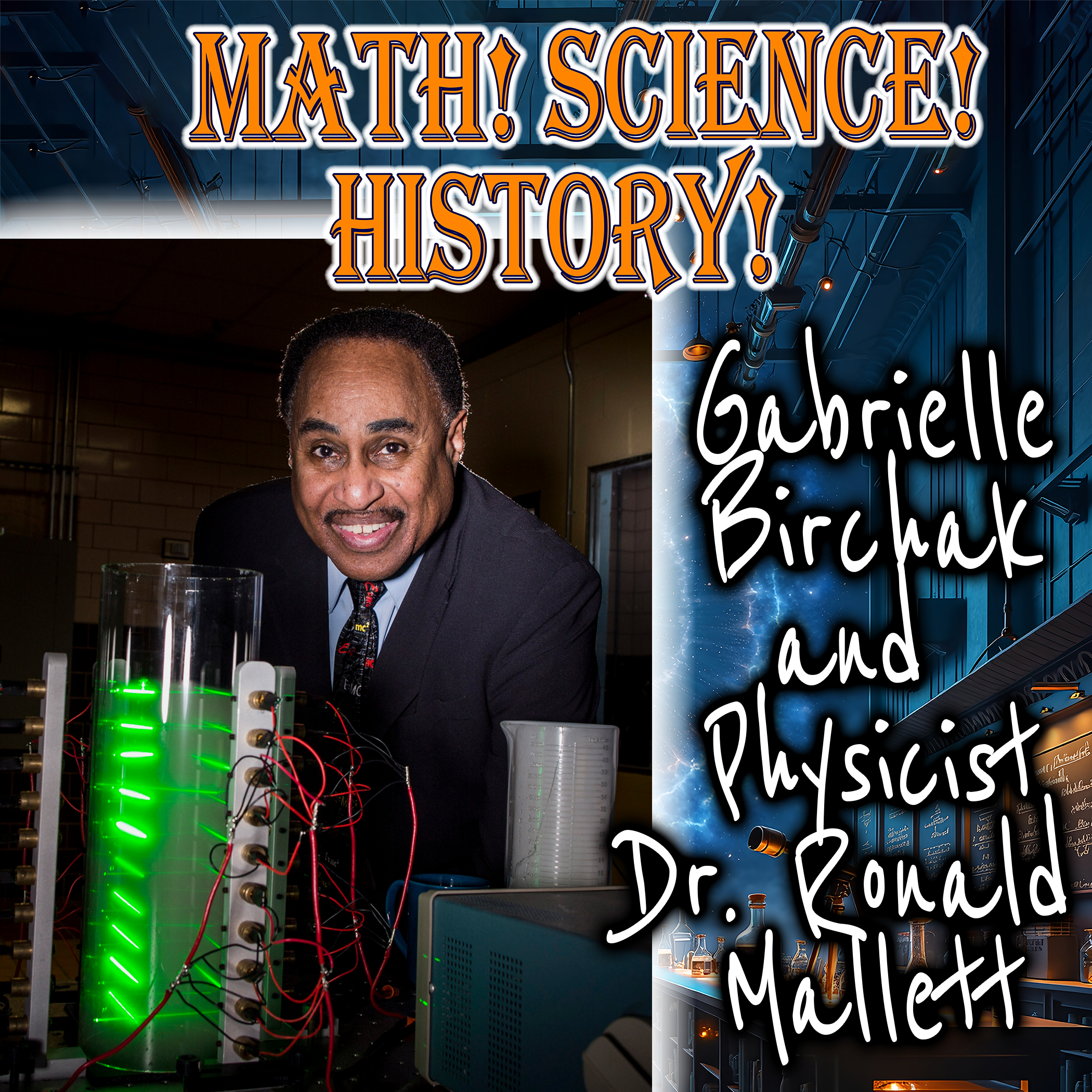
Dr. Ronald Mallett and the Love That Bends Time
In this fascinating conversation, I interview theoretical physicist Dr. Ronald Mallett to explore one of humanity's most extraordinary scientific pursuits: time travel. From the influence of Einstein's general theory of relativity to quantum mechanics and parallel universes, Dr. Mallett shares the story of how his personal loss inspired a lifetime of discovery. Listeners will hear how his work con
FLASHCARDS! Saving Time: The Math and Science of Efficiency
Subscribe to Math! Science! History! wherever you listen to podcasts, and if you love learning how math and science make everyday life better, leave a review and share this episode with a friend who's always running out of time! In this episode of Math! Science! History!, Gabrielle Birchak explores how mathematics and science can help us master the one resource we can't manufacture, time. From the
The Truth about Time Travel
What if you could bend time like taffy, stretching moments, collapsing centuries, and stepping through the folds of history itself? In this episode of Math! Science! History!, Gabrielle explores the myths, literature, and scientific breakthroughs that brought time travel from ancient dreams to modern equations. From the Mahabharata to H.G. Wells, from Einstein's relativity to Ronald Mallett's lase
FLASHCARDS! The Science of Spirits
Raise your glass, and your curiosity. In this Math! Science! History! Flashcard Friday, Gabrielle Birchak takes you into a haunted pub where chemistry and folklore share the same barstool. You'll uncover how distillation mirrors transformation, why vapor behaves like a ghost, and how the energy that fuels both whiskey and legend never truly disappears. This is science told by firelight, a stor

Haunted Machines: The Engineer Proximity Effect and Pauli's Curse
In this Halloween-special episode of Math! Science! History!, your host Gabrielle Birchak explores the strange world where superstition meets science. We dive into why machines sometimes bow to the mere presence of an engineer (the "Engineer Proximity Effect") and how one of the greatest physicists of the 20th century, Wolfgang Pauli, became the subject of an odd legend: wherever he went, lab equi

FLASHCARDS! Conserving Our Oceans
In this Flashcard Friday episode of Math! Science! History!, Gabrielle explores how everyday choices can make a real difference for our oceans. From reducing single-use plastics to supporting sustainable seafood and climate-friendly habits, this episode uncovers the math, science, and history behind ocean conservation, and the powerful impact of small changes. Plastic pollution isn't just a proble
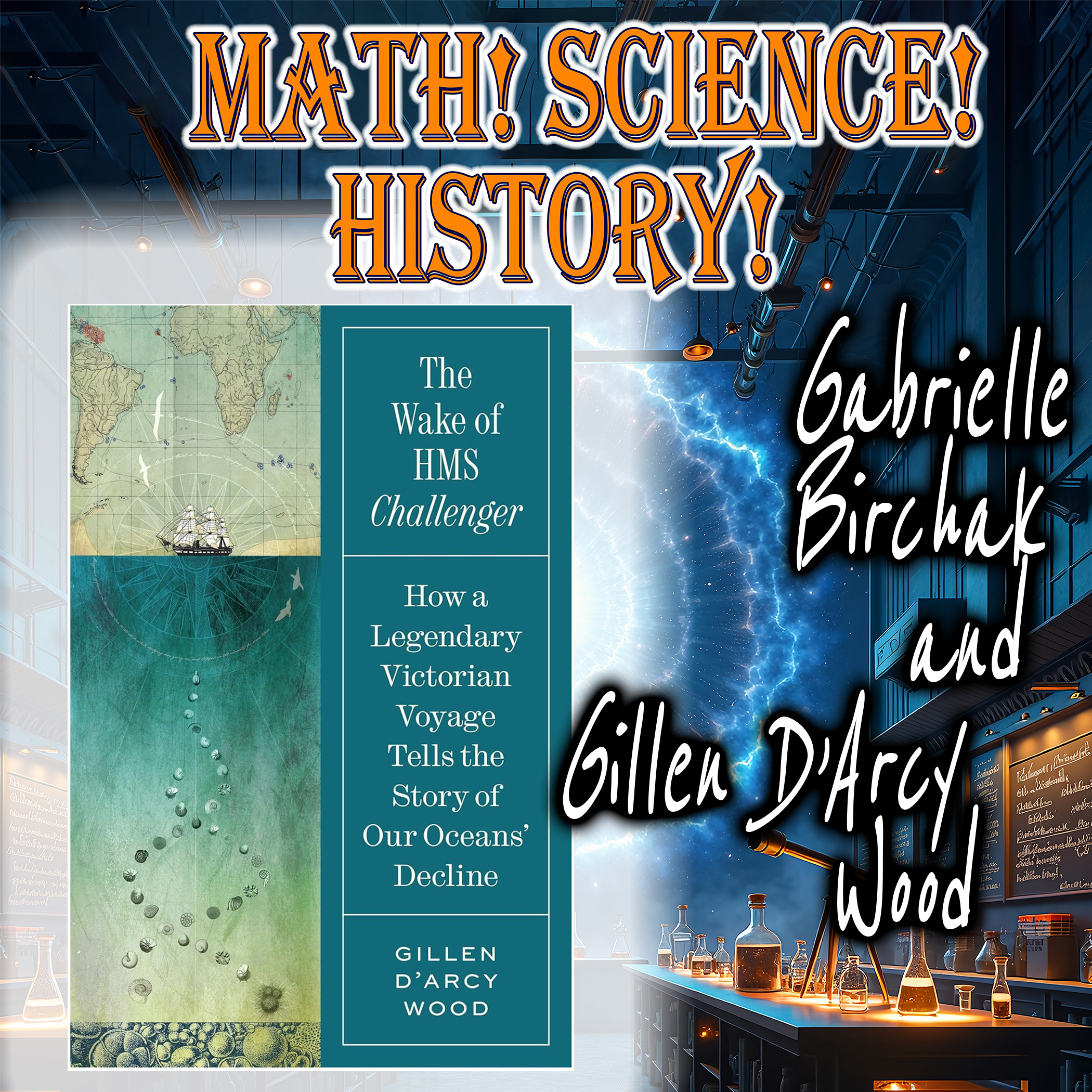
Interview with Gillen D'Arcy Wood - The Wake of HMS Challenger
In this episode of Math! Science! History!, Gabrielle Birchak speaks with Professor Gillen D'Arcy Wood, author of The Wake of the HMS Challenger: How a Legendary Victorian Voyage Tells the Story of Our Ocean's Decline. Together, they uncover how a nineteenth-century Royal Navy warship transformed into a floating laboratory and gave humanity its first global snapshot of the oceans. From discovering

FLASHCARDS: Science Paw-thorship
Publish or Purrish: The Cat Who Co-Authored Physics Episode Overview: In this episode of Math! Science! History!, we uncover the remarkable story of F.D.C. Willard, the Siamese cat who became a published co-author in a world-renowned physics journal. What began as a workaround for rigid authorship conventions turned into a beloved legend in science history. But Willard wasn't alone. We also take

The Wild Ride of Math: From Goats to Rockets
From tallying goats to launching rockets, this episode takes you on a fast-paced, lighthearted journey through the complete history of mathematics. Inspired by D.E. Smith's The History of Mathematics, this is the espresso version — goats, Greeks, calculus cage matches, infinity, and beyond. 3 Things Listeners Will Learn: How early humans counted goats, stars, and time with sticks, pebbles, and sk

FLASHCARDS! Do Math-Believe Science-Learn History
In this Flashcard Friday follow-up to Tuesday's interview with Dr. Kanisorn Wongsrichanalai of the Massachusetts Historical Society, we revisit the numbers that changed the course of history. During the Revolutionary War, smallpox was more dangerous to the Continental Army than the British. By comparing mortality rates, George Washington made a bold, science-driven choice: inoculate his troops. Th

Washington, Adams, and Smallpox: An MHS Interview
In this episode of Math! Science! History!, Gabrielle Birchak speaks with Dr. Kanisorn Wongsrichanalai of the Massachusetts Historical Society about the hidden epidemic that shaped the American Revolution. While battles raged, smallpox quietly threatened to destroy the Continental Army and colonial communities. From George Washington's controversial order to inoculate his soldiers to Abigail Ada
FLASHCARDS FRIDAY: The Physics You Use!
Think physics only lives in textbooks and science labs? Think again. In this episode, we break down how physics is baked into your everyday life, from the way you walk and sip your coffee to how your phone works and why doors are designed the way they are. No jargon, no equations, just real-world science you already use, without realizing it. If you've ever opened a faucet, turned a steering wheel

Ludwig Boltzmann: Entropy, Atoms, and Mental Health
What does it cost to carry a brilliant idea? Ludwig Boltzmann gave us the statistical foundations of entropy and the famous S = k log W, yet his life was marked by relentless skepticism, isolation, and personal struggle. In this episode, we weave Boltzmann's story with the modern mental health crisis in academia, where anxiety, depression, and burnout affect scientists at alarming rates. We'll exp
Recommended
Crickets Corner
History of the Earthquake and Fire in San Francisco

Fox news

K-Drama Obsessed Mamas | Beyond “Just One More Episode!”

True Crime Classics
The Healer Revolution

Becoming: HER with Nikki Spoelstra
Booked, Blonde & Busy w/ Olivia Ponton

McKinsey on Consumer and Retail

megahired.com

Hard Knocks Podcast

Effective Weight Loss for Moms | High protein, Strength Training, Lose Weight, Meal Planning, Fat Loss, Healthy Habits
