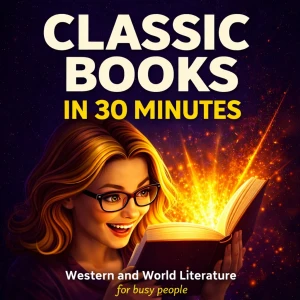
Classic Books in 30 Minutes: Western and World Literature for Busy People
Love the idea of reading the classics but never seem to have the time? This podcast makes it easy. In about 30 minutes, each episode gives you a clear and engaging summary of a major work of Western or world literature—along with the background and historical significance that make it timeless. From Homer to Shakespeare to global masterpieces, you'll hear not just great fiction but also influential works of non-fiction, religion, philosophy, politics, and more. You'll get the stories, the big ideas, and why they still matter today. Perfect for busy people, lifelong learners, or anyone curious about great books without the pressure of finishing every page.
Episodes
The Merry Wives of Windsor, by William Shakespeare (c. 1597-1601)
In The Merry Wives of Windsor (c. 1597–1601), William Shakespeare brings back the boastful, scheming Sir John Falstaff for a lively comedy of romantic mischief, jealousy, and revenge. Short on money and overflowing with confidence, Falstaff decides to court two wealthy married women at the same time, only to discover that Mistress Ford and Mistress Page are more than capable of turning his scheme
The Ambassadors, by Henry James (1903)
In The Ambassadors (1903), American novelist Henry James tells the story of Lambert Strether, a middle-aged American sent to Paris on a mission to persuade his wealthy fiancée's son, Chad Newsome, to return home and take his place in the family business. But when Strether arrives, he discovers that Paris—and Chad himself—are far different from what he expected, forcing him to reconsider his assump
The Pillow Book by Sei Shonagon (c. 1002)
In The Pillow Book (c. 1002), Japanese court lady Sei Shōnagon offers a witty, intimate, and remarkably vivid glimpse into life among the aristocracy of Heian-period Japan. Written while Shōnagon served Empress Teishi, the work is an unusual mixture of personal observations, anecdotes, court gossip, poetry, reflections, and famously opinionated lists of things she finds delightful, irritating, emb
Reflections on the Revolution in France, by Edmund Burke (1790)
In Reflections on the Revolution in France (1790), British statesman and political thinker Edmund Burke delivers one of history's most influential critiques of revolutionary change. Written as the French Revolution was unfolding, Burke challenges the idea that society can simply sweep away its inherited institutions and rebuild itself from abstract principles of reason and equality. Instead, he ar
The Shahnameh, by Ferdowsi (c. 1010)
In The Shahnameh (The Book of Kings, completed c. 1010), Persian poet Ferdowsi tells the sweeping story of Iran from the mythical creation of the world through legendary kings and heroes to the Arab conquest of the Sasanian Empire. Written over several decades and containing roughly 50,000 couplets, this monumental epic is filled with battles, betrayals, romance, supernatural creatures, and tragic
The Poetry of Rumi by Rumi (13th Century)
Step into the extraordinary poetry of Rumi, the thirteenth-century Persian poet and Sufi mystic whose words about love, loss, longing, and spiritual transformation still resonate more than 750 years after his death. We'll explore the remarkable friendship with Shams of Tabriz that transformed Rumi's life, journey through the stories and poetry of the Masnavi and Divan-e Shams, and discover what da
One Thousand and One Nights by Anonymous (Various) (Between the 8th and 14th centuries)
Journey into the extraordinary world of One Thousand and One Nights, the centuries-old collection better known as The Arabian Nights. Discover how the brilliant Shahrazad uses storytelling to survive a murderous king, and explore the unforgettable world of jinn, sailors, thieves, merchants, magical treasures, and impossible adventures that grew around her tale. Along the way, we'll uncover the sur
The Misanthrope by Molière (1666)
What happens when a man becomes so committed to honesty that he can no longer tolerate the hypocrisy and social games of the world around him? In this episode, we explore The Misanthrope, the celebrated comedy by Molière, first performed in 1666. The play follows Alceste, a fiercely principled man who despises flattery, deception, and the superficial manners of high society, even as he finds himse
Sir Gawain and the Green Knight, by Anonymous (Late 14th Century)
What would you do if a mysterious green giant rode into a royal court and challenged you to a game that could cost you your life? In this episode, we explore Sir Gawain and the Green Knight, the anonymous Middle English masterpiece written in the late 14th century, around 1375–1400. Set in the legendary court of King Arthur, the story follows Sir Gawain as he accepts a strange challenge from the e
The Federalist Papers by Hamilton, Madison, and Jay (1787-1788)
What kind of government can preserve liberty without descending into chaos? How should power be divided, checked, and balanced to protect the rights of the people? In this episode, we explore The Federalist Papers, the remarkable collection of 85 essays written by Alexander Hamilton, James Madison, and John Jay under the pen name "Publius" between 1787 and 1788. Published during the debate over th
Utilitarianism by John Stuart Mill (1861)
What makes an action right or wrong? Is morality about following rules, respecting rights, or achieving the best outcomes for the greatest number of people? In this episode, we explore Utilitarianism, the influential philosophical essay by John Stuart Mill, first published in 1861. In this concise but powerful work, Mill defends the idea that happiness is the ultimate measure of morality and respo
A Midsummer Night's Dream by William Shakespeare (1595-1596)
What if a single summer night could turn love upside down, blur the line between reality and fantasy, and leave everyone wondering what was real? In this episode, we dive into A Midsummer Night's Dream, the beloved comedy by William Shakespeare, written around 1595–1596. Set in a magical forest filled with mischievous fairies, confused lovers, and amateur actors preparing a play, this enchanting t
Lysistrata by Aristophanes (411 BCE)
What happens when the women of a war-torn city decide they've had enough—and take matters into their own hands in the most unexpected way imaginable? In this episode, we explore Lysistrata, the bold and hilarious comedy written by Aristophanes in 411 BCE during the Peloponnesian War. Faced with endless conflict between Athens and Sparta, Lysistrata devises a daring plan to force the men to make pe
As I Lay Dying by William Faulkner (1930)
Travel through the dusty backroads of the American South with As I Lay Dying by William Faulkner, published in 1930, a haunting and darkly funny novel that transformed modern storytelling forever. In this episode, we follow the deeply dysfunctional Bundren family as they attempt to carry the body of their deceased mother, Addie Bundren, across rural Mississippi to fulfill her final wish of being b
White Fang by Jack London (1906)
Venture into the frozen wilderness of the Yukon with White Fang by Jack London, first published in 1906, a gripping survival story told largely through the eyes of a wild wolf-dog struggling to survive in a brutal and unforgiving world. In this episode, we follow White Fang from his earliest days in the harsh northern wilderness through encounters with humans who alternately abuse, exploit, fear,
Twelfth Night by William Shakespeare (~1602)
Step into a world of shipwrecks, disguises, mistaken identities, and gloriously tangled romance with Twelfth Night by William Shakespeare, believed to have been written around 1601 to 1602, one of Shakespeare's funniest and most emotionally layered comedies. In this episode, we follow Viola, a clever young woman who disguises herself as a man after surviving a shipwreck, only to become trapped in
Confessions by St. Augustine of Hippo (~400)
Journey into one of the most influential spiritual autobiographies ever written with Confessions by Augustine of Hippo, composed around 397 to 400 AD, a deeply personal and surprisingly relatable exploration of ambition, temptation, regret, faith, and self-discovery. In this episode, we follow Augustine's dramatic transformation from a restless young man chasing pleasure, status, and intellectual
The Communist Manifesto by Karl Marx and Friedrich Engels (1848)
Step into the revolutionary political storm of the 19th century with The Communist Manifesto by Karl Marx and Friedrich Engels, first published in 1848, one of the most influential and controversial political works ever written. In this episode, we explore how Marx and Engels argued that all of human history is driven by class struggle, why they believed capitalism would eventually collapse under
The Flower Garden Sutra (1st-4th Centuries)
Enter the vast and dazzling spiritual universe of the Flower Garden Sutra, also known as the Avataṃsaka Sutra, a monumental Mahayana Buddhist text compiled over several centuries and deeply influential in Chinese, Korean, and Japanese Buddhism. In this episode, we explore a vision of reality unlike almost anything in world literature, where infinite worlds exist within infinite worlds, every being
The Jungle by Upton Sinclair (1906)
Step into the brutal world of industrial Chicago with The Jungle by Upton Sinclair, first published in 1906, a novel that shocked the public and helped change American history. In this episode, we follow Lithuanian immigrant Jurgis Rudkus and his family as they chase the promise of the American Dream, only to find themselves trapped in poverty, exploitation, corruption, unsafe working conditions,
Oliver Twist by Charles Dickens (1837-1839)
Journey into the grimy streets and crowded workhouses of industrial England with Oliver Twist by Charles Dickens, first published in serial form between 1837 and 1839, a novel that transformed social criticism into unforgettable storytelling. In this episode, we follow young Oliver, an orphan born into poverty who escapes brutal workhouses only to stumble into a dangerous world of thieves, con art
The Island of Dr. Moreau by H. G. Wells (1896)
Sail into one of the strangest and most unsettling science fiction novels ever written with The Island of Dr. Moreau by H. G. Wells, first published in 1896. In this episode, we follow the shipwrecked Edward Prendick as he arrives on a remote tropical island ruled by the mysterious Dr. Moreau, a brilliant but terrifying scientist conducting gruesome experiments that blur the line between human and
Strange Case of Dr. Jekyll and Mr. Hyde by Robert Louis Stevenson (1866)
Step into the fog-covered streets of Victorian London with Strange Case of Dr. Jekyll and Mr. Hyde by Robert Louis Stevenson, first published in 1886, a chilling tale that became one of the most famous psychological horror stories ever written. In this episode, we unravel the mystery surrounding the respected Dr. Henry Jekyll and the terrifying Edward Hyde, a violent and disturbing figure who seem
Democracy in America by Alexis de Tocqueville (1835-1840)
Travel back to the turbulent early 19th century with Democracy in America by Alexis de Tocqueville, published in two volumes in 1835 and 1840, a book that became one of the most important examinations of American society ever written. In this episode, we follow the young French aristocrat as he journeys across the United States, studying its politics, culture, religion, prisons, newspapers, fronti
The Principles of Quantum Mechancis by Paul Dirac (1930)
Enter the strange and mind-bending world of The Principles of Quantum Mechanics by Paul Dirac, first published in 1930, a book that helped define the mathematical language of modern quantum physics. In this episode, we explore how Dirac transformed bizarre ideas about particles, waves, uncertainty, and probability into one of the most elegant and influential scientific frameworks ever created. Alo
The Tale of Heike (13th century)
Journey into the rise and fall of samurai power in The Tale of the Heike, the epic Japanese war chronicle compiled in the early 13th century and traditionally associated with stories passed down by wandering blind monks known as biwa hōshi. In this episode, we explore the violent and tragic struggle between the powerful Taira and Minamoto clans during the Genpei War, a conflict filled with doomed
All's Well That Ends Well by William Shakespeare (~1604)
Step into a world of disguises, impossible love, royal manipulation, and one of William Shakespeare's most complicated heroines in All's Well That Ends Well, believed to have been written around 1604 to 1605. In this episode, we unravel the strange and fascinating story of Helena, a brilliant young woman who cures a king, wins a reluctant husband, and then chases him across Europe through schemes
Emma by Jane Austen (1815)
In this episode, we delight in Jane Austen's sparkling and psychologically astute novel Emma (1815), widely considered one of the greatest comedies of manners in English literature. Set in the picturesque village of Highbury, the story centers on the beautiful, clever, and wealthy Emma Woodhouse, a young woman who prides herself on her matchmaking skills and her ability to read the hearts of those
Uncle Tom's Cabin by Harriet Beecher Stowe (1852)
In this episode, we examine Harriet Beecher Stowe's explosive and era-defining novel Uncle Tom's Cabin (1852), the bestselling book of the 19th century that helped ignite the moral outrage leading to the American Civil War. Through a sweeping narrative that moves from a Kentucky plantation to the frozen Ohio River and the brutal cotton fields of the Deep South, Stowe weaves together the stories of
A Passage to India by E.M. Forster (1924)
Here's a polished one-paragraph podcast teaser summary for an episode on E.M. Forster's A Passage to India (1924): "In this episode, we journey into the heart of British colonial India with E.M. Forster's masterful novel A Passage to India (1924), a profound exploration of friendship, race, and the unbridgeable cultural divide under the Raj. At the center of the story is the uneasy relationship be
All Quiet on the Western Front by Erich Maria Remarque (1929)
In this episode, we confront the harrowing realities of war through Erich Maria Remarque's devastating anti-war novel All Quiet on the Western Front (1929), one of the most powerful and influential works of 20th-century literature. Told from the perspective of Paul Bäumer, a young German soldier who enlists with his schoolmates amid the patriotic fervor of 1914, the story unflinchingly chronicles
The Interpretation of Dreams by Sigmund Freud (1899)
In this episode, we dive deep into Sigmund Freud's groundbreaking The Interpretation of Dreams (1899), the revolutionary work that launched modern psychoanalysis and forever changed how we understand the human mind. Blending clinical observation, personal introspection, and bold theoretical innovation, Freud argues that dreams are not random nonsense but the "royal road to the unconscious," fulfil
The Tale of Genji by Murasaki Shikibu (~1008)
In this episode, we explore The Tale of Genji (c. 1008), widely regarded as the world's first novel and one of the greatest masterpieces of Japanese literature, written by the court lady Murasaki Shikibu during the Heian period. This exquisite, sprawling narrative follows the life, loves, and sorrows of the radiant Prince Genji—known as the "Shining Prince"—and later generations connected to him,
Reflections on the Revolution in France by Edmund Burke (1790)
In this episode, we delve into Edmund Burke's fiery and prophetic Reflections on the Revolution in France (1790), the seminal conservative critique of the French Revolution that continues to shape political thought more than two centuries later. Written as a passionate open letter amid the early chaos of 1789, Burke warns against the dangers of abstract rationalism, radical upheaval, and the whole
The Trial and Death of Socrates (Euthyphro, Apology, Crito, and Phaedo) by Plato (~399 BCE - 387 BCE)
In this episode, we examine one of the most profound and influential works in Western philosophy: Plato's The Trial and Death of Socrates (c. 399–387 BCE), a quartet of dialogues—Euthyphro, Apology, Crito, and Phaedo—that together chronicle the final days of Socrates and explore the nature of justice, piety, virtue, and the immortality of the soul. In Euthyphro, Socrates questions the meaning of h
The Age of Innocence by Edith Wharton (1920)
In this episode, we immerse ourselves in the glittering yet suffocating world of 1870s New York high society with Edith Wharton's Pulitzer Prize-winning masterpiece The Age of Innocence (1920). At its heart is Newland Archer, a privileged young lawyer engaged to the beautiful but conventional May Welland, whose carefully ordered life is upended by the arrival of the enigmatic Countess Ellen Olensk
The Oresteia (Agamemnon, Choephori, and Eumenides) by Aeschylus (458 BCE)
In this episode, we confront the raw power and moral complexity of Aeschylus's The Oresteia (458 BCE), the only complete ancient Greek trilogy that has survived intact and one of the greatest achievements in Western drama. Comprising the three plays Agamemnon, The Libation Bearers (Choephori), and The Eumenides, this monumental work traces the cursed House of Atreus across generations of betrayal,
Adam Bede by George Eliot (1859)
In this episode, we step into the rural England of the early 19th century with George Eliot's powerful debut novel Adam Bede (1859), a richly layered tale of love, betrayal, morality, and redemption. Set in the fictional village of Hayslope, the story centers on the honest, hardworking carpenter Adam Bede, whose life unravels when his beloved Hetty Sorrel becomes entangled in a tragic affair with
The Ramayana by Valmiki (~5th century BCE to 3rd century CE)
In this episode, we dive into one of the greatest epics of ancient India, the Ramayana (c. 5th century BCE – 3rd century CE), the timeless tale of Prince Rama's heroic journey of duty, love, and righteousness. Attributed to the sage Valmiki, this magnificent Sanskrit epic follows Rama's exile, the abduction of his beloved wife Sita by the demon king Ravana, and Rama's epic quest— aided by his loya
The Elements by Euclid (~300 BCE)
In this episode, we journey back to ancient Alexandria to unpack Euclid's monumental The Elements (c. 300 BCE), the most influential mathematics textbook ever written and a cornerstone of Western thought for over two thousand years. With unmatched clarity and logical rigor, Euclid systematically presents the foundations of geometry through definitions, postulates, and common notions, then builds a
A Vindication of the Rights of Woman by Mary Wollstonecraft (1792)
In this episode, we explore Mary Wollstonecraft's groundbreaking A Vindication of the Rights of Woman (1792), one of the earliest and most powerful feminist manifestos ever written. Fueled by the revolutionary spirit of her time, Wollstonecraft delivers a fierce, rational argument that women are not naturally inferior to men but have been deliberately kept in a state of ignorance and dependence by
An Enquiry Concerning the Principles of Morals by David Hume (1751)
In this episode, we dive into David Hume's masterful An Enquiry Concerning the Principles of Morals, the philosopher's elegant and accessible investigation into what truly drives human morality. Hume boldly argues that reason alone is powerless to motivate ethical action—instead, our moral judgments spring from sentiment and feeling, rooted in a natural sympathy for others. With his trademark clar
The Merchant of Venice by William Shakespeare (~1596)
Step into the high-stakes courtrooms and bustling Rialto of 16th-century Italy as we explore William Shakespeare's most provocative and debated play, The Merchant of Venice, believed to have been written between around 1596. In this episode, we unpack a story that is part romantic comedy and part courtroom thriller, centered on the precarious bond between a vengeful moneylender and a noble merchan
A Christmas Carol by Charles Dickens (1843)
Join us for a festive journey through Charles Dickens' timeless classic A Christmas Carol, first published in 1843. In this episode, we dive into the story of Ebenezer Scrooge, the miserly old man whose heart is transformed by a night of ghostly visits from Christmas past, present, and yet to come. From chilling specters to joyous revelations, we explore the rich characters, the moral lessons abou
Alice's Adventures in Wonderland by Lewis Carroll (1865)
Follow a curious young girl down the rabbit hole in Alice's Adventures in Wonderland, the beloved 1865 fantasy novel by Lewis Carroll. What begins as a simple daydream becomes a wildly imaginative journey through a world where logic bends, animals talk, and absurd rules govern everything from tea parties to croquet matches with flamingos. In this episode, we explore how Lewis Carroll blended playf
An Essay Concerning Human Understanding by John Locke (1689)
Step into the foundations of modern philosophy with An Essay Concerning Human Understanding, the landmark 1689 work by John Locke. In this sweeping exploration of the human mind, John Locke set out to investigate where knowledge comes from and what the limits of human understanding might be. Rejecting the idea of innate ideas, Locke argued that the mind begins as a "blank slate," shaped by experie
Narrative of the Life of Frederick Douglass, an American Slave by Frederick Douglass (1845)
Step into one of the most powerful firsthand accounts in American history with Narrative of the Life of Frederick Douglass, an American Slave, the groundbreaking 1845 autobiography by Frederick Douglass. In stark, unforgettable prose, Frederick Douglass recounts his childhood in slavery, the brutal realities of plantation life, and the intellectual awakening that convinced him that literacy and fr
The Mahabharata by Vyasa (400BCE-400CE)
Enter the vast and dramatic world of The Mahabharata, the monumental Sanskrit epic traditionally attributed to the sage Vyasa and compiled around 400 BCE–400 CE. Spanning kings, warriors, gods, and moral dilemmas, this immense work tells the story of a dynastic struggle between the Pandavas and the Kauravas that culminates in the great battle of Kurukshetra. Along the way it explores timeless ques
The Meaning of Relativity by Albert Einstein (1922)
Step into the mind of one of history's greatest scientists with The Meaning of Relativity, the influential 1922 work by Albert Einstein. Based on a series of lectures Einstein delivered at Princeton University, the book presents a clear but rigorous explanation of the ideas behind general relativity—his revolutionary theory that space, time, gravity, and motion are woven together into a single geo
The Book of Healing by Ibn Sina (1027)
Journey into one of the great monuments of medieval science with The Book of Healing, the sweeping philosophical and scientific encyclopedia written in 1027 by the Persian polymath Ibn Sina. Far more than a medical manual, Ibn Sina's work—known in Arabic as Kitab al-Shifa—set out to "heal" the mind through knowledge, bringing together logic, natural science, psychology, mathematics, and metaphysic
The Red and the Black by Stendhal (Marie-Henri Beyle) (1830)
Step into the turbulent world of ambition, class, and desire in The Red and the Black, the groundbreaking 1830 novel by Stendhal, whose real name was Marie-Henri Beyle. Set in post-Napoleonic France, the story follows Julien Sorel, a brilliant but restless young man of humble origins who is determined to rise through the rigid social hierarchy using intellect, charm, and calculated ambition. Inspi
The Gospel of Sri Ramakrishna by Mahendranath Gupta (1897-1932)
Step into the spiritual world of nineteenth-century India through The Gospel of Sri Ramakrishna, the celebrated English translation of conversations recorded by Mahendranath Gupta, a schoolteacher and devoted disciple who wrote under the pseudonym "M." Gupta originally published these accounts in Bengali as Sri Sri Ramakrishna Kathamrita in five volumes between 1897 and 1932, based on detailed not
Two Treatises of Government by John Locke (1689)
Two Treatises of Government, written by John Locke and published in 1689, is a foundational work of modern political philosophy that reshaped ideas about power, rights, and legitimate government. In the first treatise, Locke dismantles arguments for absolute monarchy, while in the second he lays out a theory of government based on natural rights, consent of the governed, and the rule of law. He ar
Tom Jones by Henry Fielding (1749)
Tom Jones (Officially "The History of Tom Jones, a Foundling") written by Henry Fielding and published in 1749, is a lively comic novel that helped define the modern English novel. The story follows Tom Jones, a warmhearted but impulsive young man, as he navigates love, class boundaries, mistaken identities, and moral missteps on his journey toward maturity. Beneath its humor and episodic adventur
A Portrait of the Artist as a Young Man by James Joyce (1916)
A Portrait of the Artist as a Young Man, written by James Joyce and published in 1916, is a coming-of-age novel that traces the intellectual and emotional development of Stephen Dedalus. The book follows Stephen from childhood through early adulthood as he struggles with family expectations, religious authority, national identity, and artistic ambition. Joyce's evolving prose style mirrors Stephen
The Trial by Franz Kafka (1925)
The Trial, written by Franz Kafka and published posthumously in 1925, is a haunting novel about power, guilt, and the absurdity of modern bureaucracy. The story follows Josef K., a man arrested and prosecuted by a remote, opaque legal system without ever being told what crime he has committed. As he struggles to navigate endless procedures and shifting authorities, the novel captures a sense of an
In Search of Lost Time by Marcel Proust (1913-1927)
In Search of Lost Time, written by Marcel Proust and published in seven volumes between 1913 and 1927, is a monumental exploration of memory, time, and consciousness. The novel traces the narrator's inner life as seemingly small experiences—most famously the taste of a madeleine—unlock vast landscapes of recollection and emotion. Rather than relying on plot, Proust builds meaning through reflectio
Hamlet by William Shakespeare (1600)
Hamlet, written by William Shakespeare around 1600, is one of the most complex and enduring tragedies in Western literature. The play follows Prince Hamlet of Denmark as he grapples with grief, betrayal, and the moral weight of avenging his father's murder. Torn between action and reflection, Hamlet's introspection turns the drama inward, exploring doubt, conscience, madness, and the search for tr
Ulysses by James Joyce (1922)
Ulysses, written by James Joyce and published in 1922, is one of the most ambitious and influential novels of the modern era. Set over a single day in Dublin, the book follows Leopold Bloom, Stephen Dedalus, and Molly Bloom through ordinary moments rendered extraordinary by Joyce's radical use of stream-of-consciousness, wordplay, and mythic structure. Paralleling Homer's Odyssey, the novel transf
Madame Bovary by Gustave Flaubert (1856)
Madame Bovary, written by Gustave Flaubert and published in 1856, is a foundational work of literary realism that explores the dangers of romantic illusion. The novel follows Emma Bovary, a young woman trapped in a dull provincial marriage who longs for passion, luxury, and meaning beyond her everyday life. Flaubert's precise, unsentimental prose exposes how Emma's dreams, shaped by novels and soc
The Adventures of Huckleberry Finn by Mark Twain (1884)
The Adventures of Huckleberry Finn, written by Mark Twain and published in 1884, is a landmark novel of American literature that blends humor, adventure, and sharp social critique. Told through the voice of Huck, a boy fleeing an abusive home, the story follows his journey down the Mississippi River with Jim, an enslaved man seeking freedom. Along the way, Twain exposes the hypocrisy, cruelty, and
The General Theory of Relativity by Albert Einstein (1915)
The General Theory of Relativity, developed by Albert Einstein and published in 1915, fundamentally changed our understanding of space, time, and gravity. Instead of viewing gravity as a simple force between objects, Einstein showed that massive objects curve spacetime itself, and that motion follows this curvature. This theory explained previously mysterious phenomena, such as the precise orbit o
Twelve Years a Slave by Solomon Northup (1853)
Twelve Years a Slave, written by Solomon Northup and published in 1853, is a searing firsthand account of slavery in the antebellum United States. Northup, a free Black man living in New York, describes his kidnapping, illegal enslavement, and twelve years of forced labor on plantations in Louisiana. The narrative exposes the routine brutality, legal corruption, and moral hypocrisy that sustained
The Platform Sutra by Huineng (8th Century)
The Platform Sutra, attributed to Huineng and compiled in the 8th century CE, is a foundational text of Chan (Zen) Buddhism that reshaped how enlightenment is understood. Rather than emphasizing gradual practice, ritual, or scholarly learning, the text teaches the idea of sudden enlightenment, arguing that awakening comes from direct insight into one's own nature. Through sermons, debates, and aut
The Spirit of the Laws by Montesquieu (1748)
The Spirit of the Laws by Montesquieu (published in 1748) is one of the most influential works of political thought in modern history. In this sweeping study, Montesquieu argues that laws cannot be one-size-fits-all; they must reflect a society's culture, geography, economy, and traditions. Most famously, he develops the idea of separation of powers, warning that liberty collapses when legislative
Silas Marner by George Eliot (Mary Ann Evans) (1861)
Today we explore George Eliot's (Mary Ann Evans) beautifully crafted 1861 novel, Silas Marner: The Weaver of Raveloe, a masterful tale of isolation, injustice, and profound moral redemption. The story begins with Silas Marner, an honest, deeply religious weaver who is unjustly framed for theft by his supposed best friend and forced to flee his home and community. He settles in the rural village of
The Three Musketeers by Alexandre Dumas (1844)
This week, we plunge into the swashbuckling world of 17th-century France with Alexandre Dumas's timeless 1844 novel, The Three Musketeers. The adventure begins when the hot-headed young Gascon, d'Artagnan, arrives in Paris seeking his fortune, only to quickly cross paths and exchange challenges with the three inseparable, legendary Musketeers of the King's Guard: the noble Athos, the vain Porthos,
Far from the Madding Crowd by Thomas Hardy (1874)
Today we return to the Wessex countryside to explore Thomas Hardy's compelling 1874 novel, Far from the Madding Crowd, a deeply romantic yet realistic portrayal of rural life and the perilous nature of human passion. The story centers on the fiercely independent and highly capable Bathsheba Everdene, who inherits a large farm at a young age, disrupting the traditionally male-dominated world of far
The Prince and the Pauper by Mark Twain (1881)
This week, we explore Mark Twain's delightful yet pointed 1881 historical novel, The Prince and the Pauper, a book that marked a significant departure from his usual American subjects to delve into Tudor England. The story centers on an incredible, chance meeting between two boys born on the same day: Edward VI, the young Prince of Wales, and Tom Canty, a poor boy living in the wretched slums of L
Promotheus Bound by Aeschylus (5th Century BCE)
Today we travel back to ancient Greek tragedy to confront the raw power and theological challenge of Aeschylus's seminal play, Prometheus Bound, a work that stands as a profound exploration of resistance against overwhelming power and the genesis of human civilization. The drama centers entirely on Prometheus, the Titan who defied the tyrant Zeus by stealing fire and foreknowledge and giving these
Being and Time by Martin Heidegger (1927)
Today we confront one of the most challenging and consequential philosophical texts of the 20th century, Martin Heidegger's 1927 masterpiece, Being and Time (Sein und Zeit). Heidegger's central project is to revitalize the fundamental question of Being (Sein), a question he argues has been forgotten since the ancient Greeks, by undertaking a detailed analysis of the only entity for whom Being is a
Peer Gynt by Henrik Ibsen (1867)
This week, we leap into the wildly imaginative and darkly philosophical dramatic poem, Peer Gynt (1867), by the Norwegian master Henrik Ibsen. The story follows the title character, Peer Gynt, a charming, boastful, and utterly self-centered young man who flees his responsibilities and embarks on a lifelong, globe-trotting journey defined by fantasy, self-deception, and the constant avoidance of co
The Phenomenology of Spirit by G.W.F. Hegel (1807)
This week, prepare for a philosophical challenge as we tackle G.W.F. Hegel's monumental and notoriously difficult 1807 work, Phenomenology of Spirit (Phänomenologie des Geistes). This book is not a traditional philosophy text but a sweeping, epic narrative—an intellectual autobiography of Consciousness itself—as it journeys from its most basic sensory experiences toward absolute philosophical know
The Return of the Native by Thomas Hardy (1878)
Today we turn to Thomas Hardy's unforgiving, elemental world of Wessex to examine his 1878 novel, The Return of the Native. The entire psychological and dramatic mood of the book is dominated by Egdon Heath, a massive, ancient, and somber stretch of land that acts less as a setting and more as a powerful, brooding character itself. The central conflict arises from the return of Clym Yeobright to h
Vanity Fair by William Makepeace Thackeray (1848)
This week, we enter the swirling, satirical social landscape of William Makepeace Thackeray's 1848 masterpiece, Vanity Fair: A Novel without a Hero. Set during the Napoleonic Wars, this expansive novel takes its name from John Bunyan's The Pilgrim's Progress, portraying London society as a perpetual fairground of folly, greed, and moral corruption. The story brilliantly contrasts the lives of two
The Lady of the Camellias by Alexandre Dumas fil (1848)
This week, we turn our attention to Alexandre Dumas fils's passionate and heartbreaking 1848 novel, The Lady of the Camellias (La Dame aux camélias), the definitive tragic love story that inspired Verdi's opera La Traviata. The story is a first-person account of the doomed romance between Marguerite Gautier, a beautiful and celebrated Parisian courtesan (or demimondaine) who suffers from consumpti
Idylls of the King by Alfred Tennyson (1859-1885)
Join us as we explore Alfred, Lord Tennyson's sweeping, monumental poetic cycle, Idylls of the King (published between 1859 and 1885). This work is Tennyson's ambitious, deeply personal retelling of the Arthurian legends, presented not merely as adventure stories, but as a symbolic epic tracing the rise and catastrophic fall of King Arthur's noble kingdom and his utopian vision for Camelot. . We d
Middlemarch by George Eliot (Mary Ann Evans) (1872)
Today we immerse ourselves in the sprawling, richly detailed world of George Eliot's (Mary Ann Evans) 1872 masterpiece, Middlemarch: A Study of Provincial Life. Set in a fictional English town just before the Great Reform Act of 1832, the novel weaves together the lives of multiple characters, exploring the social, political, and personal dynamics of the era. The central thread follows the intelli
Fathers and Sons by Ivan Turgenev (1862)
This week, we travel to 1860s Russia to dissect Ivan Turgenev's highly controversial and intensely debated 1862 novel, Fathers and Sons (Otsy i deti). The story centers on the return of Arkady Kirsanov to his family estate, accompanied by his brilliant, arrogant, and iconoclastic friend, Yevgeny Bazarov. Bazarov is the embodiment of a new, radical intellectual movement known as Nihilism, which fie
A Connecticut Yankee in King Arthur's Court by Mark Twain (1889)
Travel with us through the ages as we delve into Mark Twain's hilarious and biting 1889 satirical novel, A Connecticut Yankee in King Arthur's Court. The story centers on Hank Morgan, a practical, technologically savvy 19th-century American foreman from a Colt arms factory, who is somehow transported back in time after a blow to the head, landing him squarely in 6th-century Camelot. . We explore t
Recommended
Medicine with Meaning

Yours Truly Johnny Dollar Collection

Take Back Your Health®
CBS Radio Mystery Theater | Old Time Radio
Solved Murders - True Crime Stories
紐約鳥|New York Aperture
The Swerve Podcast: Obscure Topics | Conspiracy Theories

The Bread and Banter Podcast
The Church of What's Happening Now: The New Testament
Busted Open

Deadline: White House

Panda Show - Picante
