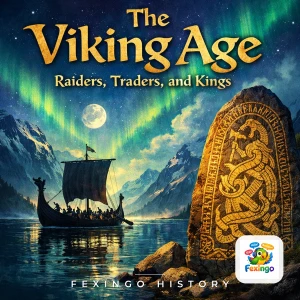
The Viking Age: Raiders, Traders, and Kings — Fexingo History
This podcast explores the Viking Age from the late eighth to the eleventh century, covering Scandinavian raids, trade, and exploration across Europe and the North Atlantic. It discusses key figures like Ragnar Lodbrok and Leif Erikson, as well as events such as the Lindisfarne raid and the Norman Conquest. Hosts Lucas and Luna examine archaeological evidence, sagas, and the transition from paganism to Christianity. The show also addresses the legacy of violence, slavery, and cultural exchange, offering a nuanced view of Viking society.
Episodes

The Vikings and the Silk Road: Eastern Trade Routes
While Western Europe remembers the Viking raid, a vast network of rivers connected Scandinavia to Baghdad. This episode explores the Volga and Dnieper trade routes, where Norsemen became merchants and diplomats in the Islamic Caliphate. We follow the journey from Birka to Sarif al-Rus, examining how Arab silver fueled the Scandinavian economy and how figures like Ibn Fadlan witnessed life on these
Viking Glass and the Roman Antiquity Luxury Trade
This episode explores the surprising depth of Viking trade networks by focusing on the luxury item of glass, which has often been overshadowed by discussions of silver and slaves. We trace how Vikings acquired Roman-era glass through Merovingian Frankia and Byzantine connections, revealing a sophisticated demand for status symbols in Northern Europe. The narrative highlights specific sites like Bi
The Battle of Svolder: How Norway's King Vanished
In 999 or 1000 CE, the sea off the coast of Sweden erupted in violence during the Battle of Svolder. King Olaf Tryggvason of Norway, a man known for his ruthless conversion of Scandinavia to Christianity and his towering stature, faced a coalition of enemies including Harald Sigurdsson, Svein Forkbeard of Denmark, and Eric Hakonsson of Lade. This episode explores the tactical nightmare of naval wa
Viking Glass: The Roman Antiquity Luxury Trade
We often picture Viking trade in terms of silver, slaves, or furs, but one of the most prestigious goods flowing north from the Mediterranean was glass. In this episode, we trace the journey of Merovingian and Byzantine glassware through the hands of traders like the Radhanites, reaching as far as the markets of Hedeby and Birka. We look at how these fragile luxury items were not just decorative o
Viking Runestones: The Ancient Texts of Memory
We step away from the battlefield and the trade route to look at what Vikings actually wrote about themselves. This episode explores the rise of runestones in Sweden during the late Viking Age, specifically focusing on the powerful Jarlabanke family of Uppland. Lucas and Luna discuss how these stone monuments functioned as public records, detailing inheritance laws, land ownership, and the shift t
The Battle of Stamford Bridge: England's Last Great Viking Victory
On September 25, 1066, the last great Viking army marched onto English soil under King Harald Hardrada. This episode traces the dramatic campaign from their arrival in the Tyne to the brutal siege of York and the fateful confrontation at Stamford Bridge. We examine how Harald and his ally Tostig Godwinson navigated the fractured politics of Anglo-Saxon England, defeating the northern earls Edwin a
Viking Glass: Roman Antiquity's Luxury Trade
Long before the longship dominated the seas, Northern Europe was hooked on a different kind of treasure: glass. In this episode, Lucas and Luna trace the surprising journey of Merovingian and Byzantine glassware from the Mediterranean to the fjords of Scandinavia. We explore how these fragile, luminous objects became powerful status symbols for Viking chieftains, traded along routes that stretched
Viking Iron Smelting: The Industrial Heart of the North
While popular imagination often fixates on the raiding fleets and runestones of the Viking Age, the true engine of Scandinavian power was its iron industry. This episode explores the massive scale of early medieval iron production in Sweden’s Bergslagen region, specifically at sites like Lappfjärd and Hällby. We examine how bog iron was extracted, processed in bloomery furnaces, and turned into th
The Viking Siege of Paris: Storming the Seine
In this episode, we travel back to November 856 to witness one of the most audacious attempts by Norse raiders to conquer Western Europe. While earlier episodes covered the Danelaw in England and the Byzantine Guard, here we focus on the siege of Paris, a city that refused to fall despite being surrounded by water. We examine the leadership of Sigfred and Björn Ironside, who united disparate Vikin
The Forgotten Viking Queen Who Conquered Dublin
In this episode of The Viking Age, we turn our attention to a figure often overshadowed by the legendary raiders and kings: Aud the Deep-Minded. While previous episodes have explored the siege of Paris and the political maneuvering of Harald Bluetooth, we focus on Aud’s extraordinary journey from Orkney to Ireland. We trace her rise as a powerful chieftain in Dublin during the mid-9th century, det
The Day Harald Bluetooth Baptized Denmark
In this episode of The Viking Age, we leave behind the raiding ships and runestones to explore the quiet revolution that turned Scandinavia from a patchwork of pagan tribes into a unified Christian kingdom. We focus on King Haraldr Blátanngjǫn, known in English as Harald Bluetooth, and his pivotal role in the late tenth century. Through the Jelling stones—massive granite monuments he commissioned
Viking Women: The Shieldmaiden Myth and Legal Reality
We often picture the Viking Age as a realm of men—raiders, kings, and warriors—but the archaeological and legal record tells a more complex story. In this episode, we explore the lives of Norse women who wielded power not just through myth, but through law and land ownership. We look at figures like Aud the Deep-Minded, who navigated political exile to found settlements in Iceland, and Freydis Eir
The Viking Blood Eagle: Myth vs Reality
We strip away the layer of medieval Icelandic legend to find the historical reality behind one of the most infamous acts in Viking lore. In this episode, Lucas and Luna examine the saga accounts of Egill Skallagrímsson and King Eystein Beli, focusing on the ritual known as the blood eagle. We explore how these stories were likely literary devices used to demonstrate extreme grief or vengeance rath
Viking Age: The Hidden Economy of Silver and Slaves
While the raid on Paris or the conquest of London often dominates our narrative, the true engine of Viking expansion was a sophisticated economic system built on silver and human labor. In this episode, we trace the Volga Trade Route, following Arab dirhams from the Abbasid Caliphate up through the rivers of Rus to Scandinavia. We explore how figures like Sigurd Ring and the Jarlabanke families us
The Siege of Paris: How Vikings Stormed the Seine
In Episode 248, Lucas and Luna explore the relentless Viking siege of Paris in 885 AD, a pivotal moment that reshaped medieval Europe. We follow Sigfred and Björn Ironside as they lead a massive fleet up the Seine, confronting Bishop Gozlin and Count Odo of Paris within the fortified Île de la Cité. This episode details the brutal winter campaign, the failure of Frankish scorpions, and the eventua
The Secret Life of Viking Runes
We often think of Viking runes as simple markers for the dead or boasts on stones, but in tenth-century Sweden, they were a sophisticated commercial network. This episode explores the Jarlabanke clan of Uppland, who used Younger Futhark inscriptions to manage land, debt, and social standing. We look at how runes functioned as legal contracts, recording transactions between freeholders and slaves,
The Byzantine Guard: Vikings in Constantinople
While earlier episodes explored Viking raids on Paris and the trade routes to the Volga, this episode turns east toward Miklagarðr. We follow the journey of Varangian warriors who crossed Europe not to plunder, but to serve as the Emperor’s elite bodyguards. Lucas and Luna trace the formation of the Varangian Guard from its inception under Basil II to its legendary battles against the Rus’ revolt
The Viking Siege of London: A Day of Fire and Blood
In 1014, the death of King Sweyn Forkbeard sent shockwaves through Northern Europe, triggering a violent power struggle in England between the Danish claimant Cnut and the restored Anglo-Saxon king Æthelred the Unready. This episode examines the pivotal siege of London that year, where the city’s stubborn resistance delayed Cnut’s coronation for months. We explore the tactical decisions made by th
Viking Ice Roads and the Trade of Skirnir
While we often picture Vikings as raiders or ocean navigators, their most enduring empire was built on winter ice. This episode explores the Skridufinnar and the vital 'ice roads' that connected Scandinavia to the interior of Russia and the Byzantine Empire during the long freezes. We trace the journey of traders who hauled goods across frozen lakes and rivers using sledges, a practice documented
Viking Naval Warfare: The Skjaldborg Shield Wall
While we often think of Viking raids as chaotic skirmishes, their naval power was built on rigid discipline and sophisticated tactics. In this episode, Lucas and Luna explore the skjaldborg, or shield wall, not just as a land formation but as a crucial element of Viking maritime strategy. We look at how longships served as floating platforms for infantry combat, the role of the huscarl in maintain
The Viking Ship Burial: Oseberg and the Afterlife
In this episode, we explore the most spectacular archaeological find in Scandinavia: the Oseberg ship burial. We examine how two high-status women were interred around 834 AD with four horses, a cart, sledges, and hundreds of household items, revealing the complex beliefs of the Norse about death and status. Lucas walks us through the excavation history, the debates over whether these were queens
The Slave Trade That Built Viking Kings
While earlier episodes explored Viking warfare, trade goods like glass and silver, and the legal power of women, Episode 241 turns to the dark engine of the Viking economy: the slave trade. We trace how Norse raiders transformed from opportunistic pirates into professional slavers, capturing thousands in Britain, Ireland, and mainland Europe to sell in the bustling markets of Dublin, Hedeby, and t
Viking Glass: The Luxury Trade of Roman Antiquity
We trace the journey of high-status glassware from Byzantine workshops to Scandinavian burials, exploring how objects like those found in the Oseberg and Birka sites functioned as diplomatic currency and status symbols. Lucas and Luna examine the archaeological evidence of Merovingian and Frankish trade networks, discussing how recycled glass and imported vessels reinforced political alliances amo
Viking Coins: The Silver Economy of the North
For centuries, we’ve pictured Vikings as raiders breaking into monasteries or traders bartering furs for silk. But the reality was far more complex and financially sophisticated than either stereotype suggests. In this episode, Lucas and Luna explore the intricate world of Viking silver currency, focusing on the Arab Dirham that flooded Scandinavia in the tenth century. We trace the journey of the
Viking Runes: The Secret Network of the North
In this episode, we explore how the Viking Age’s most famous legacy—their runic inscriptions—functioned as a sophisticated communication network long before written letters became common. We examine the Younger Futhark alphabet, its sixteen characters, and how it was adapted from older Germanic scripts for everyday use across Scandinavia. Lucas and Luna discuss specific examples like the Jarlabank
Viking Runes: How Literacy Built an Empire
We often imagine Vikings as illiterate raiders who left no written record, but that is a profound misconception. This episode explores how the Norse people adopted and adapted the Latin alphabet to create the Younger Futhark runes, transforming them from simple magical markers into a sophisticated administrative tool. We look at the thousands of runestones raised across Scandinavia, particularly i
The Day Vikings Conquered London
In 851 AD, the Great Heathen Army did something unprecedented. They didn't just raid and retreat from England; they stayed to fight a full-scale war against Alfred the Great's forces. This episode explores the Battle of Aclea, where Ubba Ragnarsson led a massive Viking force into southern Wessex. We look at how the Anglo-Saxon Chronicle describes this clash, focusing on the tactical differences be
Viking Glass: Roman Luxury in Scandinavia
While the Viking Age is often defined by iron and blood, a quiet revolution was happening in the chests of Scandinavian elites: glass. This episode traces the journey of Roman and Byzantine glassware from the Mediterranean to the frozen shores of Sweden and Denmark. We explore how archaeological finds at sites like Birka, Oseberg, and Vendel reveal a complex trade network that predated the famous
Viking Glass: Luxury Trade and Status in Scandinavia
We explore the unexpected world of Viking-age luxury goods, focusing on how glass became a currency of power and prestige in Northern Europe. While raids get the headlines, archaeological finds from Birka, Oseberg, and Vendel reveal a sophisticated demand for Roman and Byzantine antiques. Lucas walks us through the journey of these fragile treasures—recycled vessels, colored shards, and imported g
The Viking Siege of Paris: Storming the Seine
In this episode, we examine the winter siege of Paris in 885–886 AD, a pivotal moment that reshaped the political landscape of West Francia. While previous episodes touched on Viking raids, this deep dive focuses on the specific military engineering and urban defense strategies employed during the attack on the Île de la Cité. Lucas traces the movements of Sigfred’s fleet up the Seine and details
The Siege of Paris: How Vikings Stormed the Seine
In 885 AD, a fleet of forty Viking ships arrived at the gates of Paris, marking the beginning of a siege that would last two months and change the course of European history. This episode explores the tactical brilliance and sheer desperation of the defense mounted by Bishop Gozlin and Count Odo against the seasoned warriors led by Sigfred and Björn Ironside. We examine the Frankish use of scorpio
The Day Vikings Conquered London: The Great Heathen Army
In 865, a new kind of Viking army arrived in East Anglia. They were not raiders seeking quick silver and fleeing before the summer ended. They were settlers with a plan to conquer England. Lucas and Luna explore how Ivar the Boneless, Halfdan Ragnarsson, and Ubba led the Great Heathen Army to York, then London, and finally Winchester. We look at the fall of three Anglo-Saxon kingdoms in just five
Viking Glass: Roman Trade and Luxury in Scandinavia
This episode explores the surprising presence of Roman and Byzantine glass fragments in Viking Age burial sites across Northern Europe. We examine how luxury items from antiquity survived into the ninth and tenth centuries, found in graves at Birka, Vendel, and Oseberg. Lucas and Luna discuss the economic implications of these finds, challenging the notion that the Vikings only traded in bullion a
Viking Glass: The Luxury Trade of Roman and Byzantine Antiquity
While we often think of Vikings as raiders or traders in silver and slaves, their elite society was deeply intertwined with the luxury markets of late antiquity. This episode explores how Viking chieftains in Scandinavia acquired and displayed Roman glass, Byzantine silks, and Frankish metalwork long before the first raids on Lindisfarne. We look at archaeological finds from sites like Birka and V
Viking Women: Shieldmaidens, Law, and Landownership
We often picture Vikings as raiders in horned helmets, but the archaeological record and Icelandic sagas reveal a far more complex reality for women in Norse society. In this episode, we explore the legal power of Viking women, focusing on figures like Gudrun Osvifursdottir from the Laxdæla Saga and the practical authority granted by laws such as Handaefing. We examine how women could own land, in
Eirik Bloodaxe: The Tragic End of a Viking King
Episode 227 moves beyond the longships and raiding parties to explore the political fragmentation that defined late tenth-century Scandinavia. We focus on Eirik Haraldsson, known as Eirik Bloodaxe, who ruled Norway after his father Haraldr hárfagri but lost his throne through a combination of brutal internal strife and external pressure from Olaf Tryggvason. This episode examines the saga accounts
The Siege of Paris: Vikings Storm the Seine
In this episode, we look at the Great Heathen Army's winter siege of Paris in 885 AD, a pivotal moment that tested the limits of Viking naval power against Frankish urban fortifications. Lucas and Luna trace the movements of Godfrey, Siward, and Björn Ironside as they navigored the Seine to besiege the city under Abbot Gozlin’s defense. We examine the Frankish military engineering, including the u
Viking Women: Shieldmaidens, Landowners, and Legal Power
We often imagine the Viking Age through the lens of longships and conquest, but the lives of women in Scandinavia were defined by legal agency, economic independence, and complex social structures. In this episode, we explore the reality behind the shieldmaiden myth, examining how Norse law granted women rights to own land, initiate divorce, and inherit property in a way that was remarkably progre
Viking Monks: How Raiders Became Pilgrims to Jerusalem
For anyone coming with us through these conversations about Northern Europe, we often focus on the sword and the ship. But in the late tenth century, a different kind of Viking journey began, one that took warriors from Scandinavia not to the coasts of Francia or the markets of Baghdad, but to the holy sites of Jerusalem. This episode explores the phenomenon of the Northmen pilgrims who traveled a
The Siege of Paris: Vikings Storm the Seine
In 885 AD, a massive Viking fleet descended upon Paris, turning the city into a crucible of medieval warfare. This episode explores the Siege of Paris, where Rollo and Sigfred led thousands against Charles the Bald's defenses. We examine the Frankish military engineering, including the use of scorpions and boiling oil, and how the siege lasted months. Lucas and Luna discuss the role of Nithard and
Viking Siege Tactics: The Storming of Paris
In 845, a fleet of forty ships under the chieftain Ragnar Lothbrok approached the walls of Paris. This episode explores how Viking raiders adapted their naval warfare tactics for urban sieges, turning longships into floating platforms for archers and battering rams. We examine the historical accounts from Nithard and Astronomer Hincmar, detailing the negotiation of tribute, the strategic use of th
Viking Weapons and the Warrior Ethos
In this episode of The Viking Age, Lucas and Luna explore the tools and mentality of Viking warfare, from the ubiquitous spears and axes to the prized swords like the Ulfberht. They discuss the craftsmanship of pattern-welded blades, the role of shields in the shield-wall, and the social status attached to weapons. The conversation also touches on the cultural significance of weapons in Norse myth
Viking Kings and the Thing That Bound Them
In Episode 220, Lucas and Luna explore how the Viking chieftains became kings—and how the ancient thing assemblies both enabled and restrained their power. They trace the rise of Harald Fairhair, the first king to unite Norway, and the law-speaker who made Christianity a legal choice at the Althing in 1000. Along the way, they unpack the role of the hird, the leidang levy, and the grudging consent
The Thing That Made Viking Kings
In this episode, Lucas and Luna dig into the strange machinery of Viking kingship — how a society of free farmers and proud chieftains slowly bent around a single ruler. They trace the shift from local strongmen to regional warlords to something like the High Kings of the sagas, and the surprising tools that made it stick: oaths, law codes, land grants, and the church. Along the way they meet figu
The Battle of Svolder: A Viking Civil War
In the year 1000, a coalition of Norse kings and Danish lords ambushed King Olaf Tryggvason of Norway as he sailed home from Wendland. The Battle of Svolder, fought somewhere in the Baltic, became one of the most legendary naval engagements of the Viking Age. Lucas and Luna explore the political maneuvering that led to the battle, the 'longest ship ever built' — the Ormen Lange — and the enduring
Viking Runestones: Women Who Raised Them
Lucas and Luna step back to the runestones of the Viking Age, but this time they follow the women. From the granite slabs raised by widows and mothers in eleventh-century Sweden to the enigmatic inscriptions that bear only a woman's name, this episode pieces together what runestones can tell us about female agency, grief, and power. Hear about the remarkable 'brother stones' of Jarlabanke's family
Viking Runestones: Voices of the Dead in Stone
In this episode of The Viking Age, Lucas and Luna explore the runestones of Scandinavia — not as museum relics, but as personal messages carved by the living for the dead. They visit the Jelling stones in Denmark, where Harald Bluetooth proclaimed his conversion to Christianity, and the Kjula runestone in Sweden, which remembers a father through the story of his war-band. They discuss the runic al
The Rus Khaganate's Lasting Echo: A Viking State in the East
In the shadow of the Khazar Khaganate, a Viking people known as the Rus carved out a trading empire along the Volga and Dnieper rivers. This episode digs into the Rus Khaganate, a shadowy state that may have preceded Rurik's dynasty by a century. Lucas and Luna explore the pivotal role of the Khazars, the flow of Abbasid silver that funded Viking expansion, and the enigmatic inscription from the A
The Varangian Runestones: Norse Voices from Byzantium
In this episode, Lucas and Luna explore the Varangian runestones — dozens of carved stones raised across Scandinavia in the 11th century by Norse warriors who served in Byzantium. They follow the journey of the Varangian Guard from the fjords to Miklagarðr, the Great City, examining what the stones reveal about identity, status, and the ties between Scandinavia and the Byzantine Empire. From the f
Viking Trade Routes: From the Volga to the Silk Road
In this episode of The Viking Age, Lucas and Luna explore the vast trade networks that connected Scandinavia to the Byzantine Empire, the Abbasid Caliphate, and even China. They discuss the crucial role of the Rus Khaganate in controlling the Volga route, the flow of silver dirhams into the Norse world, and the goods that traveled in both directions—from furs and slaves to silk and spices. The con
Viking Silver and the Hoard Economy
In this episode of The Viking Age, Lucas and Luna explore the silver that fueled Viking expansion, from the dirhams of the Abbasid Caliphate to the hack silver of the Cuerdale Hoard. They discuss how silver was weighed, tested, and hoarded, and how it transformed Viking society from raiding to trading. The conversation touches on the silver mines of the Islamic world, the trade routes that brought
The Rus Khaganate's Rival: Volga Bulgaria's Viking Encounters
In this episode, Lucas and Luna explore the fraught relationship between the Rus Khaganate and Volga Bulgaria, two powers vying for control of the Volga trade route in the 9th and 10th centuries. They delve into the diplomatic missions described by Ibn Fadlan, the tensions that led to raids and counter-raids, and the eventual conversion of Volga Bulgaria to Islam. Through the lens of trade, tribut
The Rus Khaganate: A Viking State in the East
In this episode of The Viking Age, Lucas and Luna explore the Rus Khaganate, a Viking-led state in what is now Russia, flourishing from the late 8th to the mid-9th century. They examine the enigmatic figure of the khagan, the title taken by the Rus rulers, and the early trade networks that connected them to the Abbasid Caliphate through silver dirhams. The episode traces the journey from Staraya L
The Varangian Runestones: Norse Voices from Byzantium
In this episode of The Viking Age, Lucas and Luna explore the Varangian runestones—memorials raised by Norse warriors who served in the Byzantine Empire's elite guard. They discuss famous stones like the Piraeus Lion and the Ed stone, how these inscriptions reveal personal stories of travel, death, and distant service, and what they tell us about the lives of these mercenaries. Along the way, they
Viking Shipbuilding: Secrets of the Longship
In this episode, Lucas and Luna dive into the engineering marvels behind the Viking Age's most iconic vessels. They explore the evolution from the early Nydam oak boats to the sleek, sea-worthy longships that carried raiders and traders across the Atlantic. The conversation covers the clinker-built hull, the flexible keel, the square sail, and the revolutionary use of the Baltic Sea's pine tar. Th
Leif Erikson: The Viking Who Reached America
Before Columbus, before the Norse sagas became famous, a crew of Greenlanders sailed west into the unknown and found a new world. This episode follows Leif Erikson's journey from the fjords of Norway to the coast of Vinland, using the sagas and archaeology to separate legend from fact. We explore the routes, the landmarks, the tensions with the Skrælingar, and the brief, fragile Norse presence in
The Rus Khaganate: How Vikings Built the First Russian State
Before Rurik and the Kievan Rus, there was the Rus Khaganate — a shadowy Viking-led state along the Volga that traded furs for silver, sparred with the Khazars, and sowed the seeds of the first Russian realm. In this episode, Lucas and Luna dig into the controversial evidence: Ahmad ibn Rustah's travelogue, Ibn Fadlan's chilling account of a Rus ship burial, the Annals of St. Bertin's mysterious '
Viking Law and the Althing: Iceland's Viking Assembly
In this episode of The Viking Age, Lucas and Luna explore the Althing, Iceland's Viking-era assembly, and the law that held it together. They trace its origins at Thingvellir, where chieftains gathered each summer to settle disputes, pass laws, and elect the lawspeaker. They discuss the role of the goðar, the chieftain-priests who dominated the assembly, and the surprising ways justice was served—
Viking Women: Power, Property, and the Sagas
In this episode of The Viking Age, Lucas and Luna step away from the usual raids and kings to explore the lives of Viking women. From the influential queens Thyra and Gunnhild to the pioneering settler Aud the Deep-Minded, we uncover how women wielded power through property, marriage, and even divorce. We look at the law codes that gave them surprising rights, the sagas that preserve their stories
The Rus Khaganate: How Vikings Forged the First Russian State
In this episode of The Viking Age, Lucas and Luna dig into the Rus Khaganate—the shadowy Norse-led polity that flickered into existence along the Volkhov and Volga rivers centuries before Rurik's more famous dynasty. Drawing on the eyewitness accounts of Ahmad ibn Rustah and Ibn Fadlan, we piece together how Scandinavian trader-warriors, known as the Rus, established a powerful khaganate at Staray
The Rus Khaganate: A Viking State in the East
Before Rurik and the birth of Russia, there was the Rus Khaganate—a shadowy Viking polity that thrived along the Volga and Dnieper rivers. In this episode, Lucas and Luna explore how Swedish Norse traders and warriors, known as the Rus, established a powerful state centered on Staraya Ladoga and possibly Novgorod, exacting tribute from Slavic and Finnic tribes and trading furs, wax, and slaves for
The Rus Khaganate: Vikings of the East
Before Rurik and the birth of Russia, a shadowy group of Norse traders and raiders known as the Rus established a powerful state along the Volga and Dnieper rivers. In this episode, Lucas and Luna explore the origins of the Rus Khaganate, drawing on Arabic and Persian accounts like Ibn Rustah and Ibn Fadlan, as well as the controversial Nestor Chronicle. They discuss the Rus as slave traders and f
The Rus Khaganate: Before Rurik and the Birth of Russia
Before Rurik and the Kievan Rus, a shadowy polity known as the Rus Khaganate dominated the Volga trade routes. In this episode, Lucas and Luna explore the archaeological and literary evidence for this early state, from the hillfort at Staraya Ladoga to the accounts of Arab travelers like Ibn Rustah and Ibn Fadlan. They discuss the possible origins of the Rus, their role in the fur and slave trade
Viking Kings and the Sacred Well at Uppsala
In this episode, Lucas and Luna uncover the religious heart of the Viking Age: the great temple at Gamla Uppsala in Sweden. They explore what Adam of Bremen wrote about the golden temple and its grim sacrifices, the legendary Yngling dynasty buried in the royal mounds, and how archaeology complicates the story. From the well of offerings to the sacred grove, and from the disputed site of the templ
The Rus Khaganate: Before Rurik and the Birth of Russia
Long before Rurik and the Viking Rus of Kiev, there was an earlier state — the Rus Khaganate — a shadowy realm that may have been the first Viking polity in the East. This episode digs into the fragmentary evidence: the Arab traveller Ibn Rustah's account of an island capital, the enigmatic title 'Khagan' adopted by its ruler, and the amber trade routes that tied the Baltic to the Caspian. We expl
The Varangian Guard's Last Stand: 1000 AD
In this episode, Lucas and Luna explore the shadowy world of Viking mercenaries in the Byzantine Empire, focusing on the pivotal year 1000 AD when the Varangian Guard was formally established by Emperor Basil II. They uncover the brutal recruitment in Scandinavia, the harrowing journey through the Dnieper River rapids, and the legendary status of Harald Hardrada. Discover how the Varangians blende
The Rus Khaganate: Before Rurik and the Birth of Russia
In this episode, we explore the murky origins of the Rus Khaganate, the state that predates Rurik and the birth of Russia. Using early Arab sources like Ibn Rustah and Ibn Fadlan, Lucas and Luna trace the Rus as traders and raiders on the Volga, their relationship with the Khazar Khaganate, and the famous funeral of a Rus chieftain that Ibn Fadlan described. We look at the debate over whether the
The Last Viking Kingdom: Pagan Resistance in the Baltic
In this episode of The Viking Age, Lucas and Luna travel to the Baltic shore, where the Viking Age didn't end in 1066. They explore the kingdom of the Wends, a Slavic people who held off Christian crusaders for over a century. The story centers on the temple-fortress of Arkona on the island of Rügen, and the great pagan ruler Pribislav, whose defeat in 1168 saw the last organized cult of the old g
The Rus Khaganate: Before Rurik and the Birth of Russia
Before Rurik, before the Rurikids, there was the Rus Khaganate—a shadowy, often-overlooked polity that controlled the Volga trade route and may have been the first state on the territory of what would become Russia. In this episode, Lucas and Luna untangle the mystery of the Rus Khaganate: Who were these Rus? Was their ruler truly a khagan, a title borrowed from the Khazars? How did they thrive on
Rune Stones: Messages from the Viking Age
In this episode of The Viking Age, Lucas and Luna explore the world of rune stones — the carved monuments that Vikings left behind. From the Jelling stones in Denmark to the rune-stone craze in Sweden, they discuss what these inscriptions tell us about Viking society, religion, and commemoration. They look at the famous stones raised by Harald Bluetooth and other kings, the more personal stones ca
The Varangian Guard: Vikings of the Byzantine Empire
In this episode of The Viking Age, we explore the Varangian Guard, the elite Norse and Anglo-Saxon warriors who served as the personal bodyguard of the Byzantine emperors in Constantinople. Lucas and Luna trace the Guard's origins from the Rus' expeditions down the Dnieper to the mercenary companies that earned the emperor's trust. They discuss famous members like Harald Hardrada, who returned to
Silver of the North: Viking Hoards and Trade
What did Viking wealth actually look like? This episode follows the silver that moved through the Norse world—from hack-silver and Arabic dirhams to the great hoards buried from Russia to the British Isles. We trace the trade routes that brought silver from Baghdad to the Baltic, the role of weighed money in a coin-poor economy, and the violent ends that left hoards in the ground. Along the way we
Rollo and the Founding of Normandy: Vikings Become Normans
In 911, a Viking warlord named Rollo (Hrólfr) made a deal with the Frankish king Charles the Simple that would change Europe. After besieging Chartres, Rollo accepted the Treaty of Saint-Clair-sur-Epte, gaining land along the Seine in exchange for fealty, conversion to Christianity, and defense against other Norse raiders. This episode explores the reality behind the legend of Rollo, the terms of
Cnut the Great: Architect of the North Sea Empire
This episode of The Viking Age explores the remarkable career of Cnut the Great, the Danish king who forged a North Sea empire spanning England, Denmark, Norway, and parts of Sweden in the early 11th century. Lucas and Luna discuss Cnut's conquest of England in 1015-16, including the battles of Assandun and the division of the kingdom with Edmund Ironside. They examine the famous story of Cnut com
Brunanburh 937: The Battle That Forged England
In A.D. 937, King Athelstan of Wessex faced a formidable coalition of Norse-Gael, Scottish, and Strathclyde armies at Brunanburh. The battle, immortalized in a towering Old English poem, is often called the day England was truly born. This episode takes you inside the alliances, the battlefield tactics, and the aftermath that made Athelstan the first king to rule all of Britain. We explore the rol
The Conversion of Iceland: Law, Pagans, and a Single Compromise
In the year 1000, Iceland stood at a crossroads. The Alþingi, the island’s parliament at Þingvellir, was split between Christians and pagans. Armed conflict loomed. How did the law-speaker Þorgeir Ljósvetningagoði broker a peace that made Christianity the official religion while allowing continued private worship of the old gods? This episode unpacks the political negotiations, the role of the law
Stamford Bridge: The Battle That Ended the Viking Age
In September 1066, King Harald Hardrada of Norway landed in northern England with a massive invasion fleet, aiming to seize the English crown. This episode follows his campaign from the victory at Gate Fulford to the decisive and bloody Battle of Stamford Bridge, where Harold Godwinson's English army caught the Vikings off guard. We explore Harald's ambitions, the role of the treacherous Tostig Go
Viking Ships: Longships, Knarrs, and the Technology of Raid and Trade
This episode of The Viking Age dives into the vessels that powered Norse expansion across the North Atlantic and into Europe. Lucas and Luna explore the design and use of the iconic longship for warfare, and the sturdy knarr for trade and settlement. They discuss the clinker-built construction method, the archaeological finds at Oseberg, Gokstad, and Skuldelev, and the navigation techniques that a
Stiklestad and the Making of Saint Olaf
In 1030, King Olaf Haraldsson fell at the Battle of Stiklestad, a defeat that paradoxically secured Norway's Christianization and his own sainthood. This episode traces Olaf's life from Viking raider to exiled king, the political and religious tensions that led to the battle, and how his death reshaped Norwegian identity. We explore the opposing factions—the peasant army led by chieftains like Kal
Harald Hardrada: The Last Viking King
Harald Hardrada, the legendary Norse king and former Varangian Guard in Constantinople, returns to claim the throne of Norway and England. This episode traces his journey from exile in Kievan Rus to his service under the Byzantine emperor, his rise to power in Norway, and his ill-fated invasion of England that ended at Stamford Bridge in 1066. We explore how his death marked the end of the Viking
Recommended

True Crime Classics

The Healer Revolution

Becoming: HER with Nikki Spoelstra

Booked, Blonde & Busy w/ Olivia Ponton

McKinsey on Consumer and Retail

megahired.com

Hard Knocks Podcast

Effective Weight Loss for Moms | High protein, Strength Training, Lose Weight, Meal Planning, Fat Loss, Healthy Habits

The Human-Animal Connection - Pet Life Radio Original

Infinite Health with Dr. Arasi Maran

The Daily

World News Tonight with David Muir
