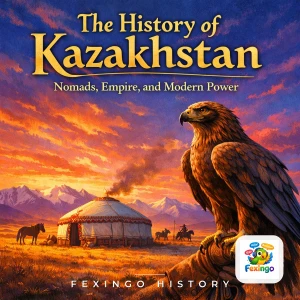
The History of Kazakhstan: Nomads, Empire, and Modern Power — Fexingo History
This podcast explores the vast and complex history of Kazakhstan, from the ancient Scythian gold to the modern nuclear geopolitics. Hosts Lucas and Luna guide listeners through the rise of nomadic empires, the Mongol conquest, the Kazakh Khanate, and the Russian colonial era. They delve into Soviet industrialization, the Stalinist famine, the gulag legacy, and the space age at Baikonur. The show also covers Kazakhstan's post-Soviet nation-building, oil boom, and the tensions between authoritarianism and reform. Along the way, it highlights Kazakh culture, including the epic hero Alpamysh, dombra music, and the ritual dish beshbarmak.
Episodes

Kazakhstan's Nomadic Constitution: The Yasa and Legal Tradition
We have already explored the grand battles of Kenesary Khan and the tragic famine of Asharshylyk, but today we turn to the invisible architecture that held Kazakh society together for centuries. This episode examines the Zheti Zhargy, or Seven Charters, the customary law code that functioned as the nomadic constitution of the steppe. We look at how these unwritten rules governed everything from wa
Kazakhstan's Nomadic Constitution: The Yasa and Legal Tradition
We often think of the Kazakh Khanate as a loose confederation of tribes, but beneath the surface lay a sophisticated legal framework known as the Zheti Zhargy. This episode explores how this 'Seven Charters' system governed daily life, resolved disputes, and maintained order across the vast steppes long before Russian colonization. We examine the specific laws regarding marriage, inheritance, and
The Dzungar Genocide and Kazakh Survival
While earlier episodes explored the Golden Age of the Khanate and the later Soviet tragedies, Episode 257 turns back to the seventeenth and eighteenth centuries for a darker chapter: the Dzungar-Kazakh Wars. This was not merely a border skirmish but an existential conflict that nearly erased the Qazaq people. We examine the brutal campaigns of Galdan Boshugtu Khan and Tsewang Rabtan, and how the s
The Khanate's Hidden Wars: Kazakh Resistance to Russia
While earlier episodes explored the Silk Road, Soviet nuclear shadows, and the tragic famine of the Asharshylyk, this episode uncovers the centuries-long military struggle that defined Kazakhstan’s sovereignty. We focus on the period between the 18th and early 20th centuries, when the Kazakh Khanate faced existential threats from both the Dzungar Empire and the expanding Russian Empire. Lucas walk
The Kazakh Khanate's Golden Age Under Kasim Khan
We explore the peak of the Kazakh Khanate under Kasim Khan in the early sixteenth century, a period often overshadowed by later Soviet history or ancient nomadic myths. While earlier episodes covered the brutal famines and nuclear tests, this episode focuses on the diplomatic and military zenith that defined Kazakh sovereignty. We examine how Kasim Khan navigated the fragile balance between the dy
The Alash Orda: Kazakhstan's Lost Experiment in Independence
In the chaos following the 1917 Russian Revolution, a group of Kazakh intellectuals and nobles formed the Alash Orda, establishing one of the first modern democratic governments in Central Asia. Led by figures like Alikhan Bukeikhanov and Mahmud Kozbayev, they attempted to build a secular, multi-ethnic state that respected both Islamic traditions and Kazakh nomadic customs while navigating the vio
Kazakhstan's Golden Age: The Khanate's Peak Under Kasim
While previous episodes have traced the formation of the Kazakh Khanate and its eventual fragmentation into three hordes, this episode zooms in on the brief but brilliant window between 1521 and 1533 when Khan Kasim unified the tribes. We explore how Kasim forged a centralized state that rivaled the great empires of his time, moving beyond loose tribal confederations to establish clear laws and di
The Great Famine: How Stalin Starved Kazakhstan
This episode examines the Asharshylyk, the catastrophic famine of 1930–1933 that devastated Kazakhstan under Joseph Stalin’s forced collectivization policies. While historians often focus on the Holodomor in Ukraine, this event claimed nearly half of Kazakhstan’s entire ethnic Kazakh population, a demographic catastrophe rarely discussed in Western history courses. Lucas and Luna trace how Filipp
Kazakh Eagle Hunters: The Living Legacy of the Burkitshi
While much has been written about Kazakhstan’s Soviet history and its ancient nomadic roots, fewer stories explore the living bridge between them: the art of golden eagle hunting. This episode dives into the world of the Burkitshi, the master falconers who keep this thousand-year-old tradition alive in the Altai Mountains. We follow the lineage from the Saka warriors of the Golden Man era to moder
Kazakhstan's Nuclear Legacy: Semipalatinsk and the People's Cost
While earlier episodes touched on the Soviet nuclear shadow, this deep dive focuses on the human cost of the Semipalatinsk Test Site. We explore the lives of those living in its shadow, from children born with deformities to the scientists who doubted the safety of the tests. Discover how the Polygone became a landscape of silence and suffering, and meet activists like Galina Starovoitova who foug
The Great Game: How Russia and Britain Divided Central Asia
In the late nineteenth century, the vast steppes of Kazakhstan became the chessboard for a silent, high-stakes rivalry between two global empires. This episode explores the Great Game, focusing on the strategic annexation of the Kazakh territories by the Russian Empire and the looming threat from British India. We examine how local khans and tribal leaders navigated shifting alliances, from the in
Kenesary Khan: The Last Stand of the Kazakh Khanate
We trace the dramatic, often overlooked final chapter of the independent Kazakh Khanate through the life of Kenesary Kasymov. After decades of fragmented resistance and failed diplomacy with the Russian Empire, Kenesary emerged in 1837 as a charismatic leader determined to restore the sovereignty his ancestors had lost. This episode explores how he united the three zhuz under a single banner, impl
The Silk Road's Northern Gateway: Otrar and the Mongol Siege
While earlier episodes explored the Kazakh Khanate’s nomadic roots and the Soviet era’s heavy toll, this episode turns back to the thirteenth century to examine one of the most pivotal moments in Central Asian history: the siege of Otrar. We explore how this fortified city on the Syr Darya became the flashpoint for Genghis Khan’s massive invasion of the Khwarazmian Empire. Lucas and Luna discuss t
Kazakhstan's Nuclear Legacy: Semipalatinsk's Hidden Cost
This episode explores the human and environmental toll of the Semipalatinsk Test Site, where the Soviet Union conducted over four hundred nuclear explosions between 1949 and 1989. We examine the lives of those who lived in the shadow of the tests, from herders exposed to fallout to the brave activists like Galina Starovoitova who fought for closure. The narrative covers the secret city of Polygone
The Silk Road's Hidden Bridge: Karakhanid Legacy
This episode explores the Karakhanid Khanate, the first Turkic dynasty to adopt Islam and bridge the gap between steppe nomadism and urban civilization. We examine Mahmud al-Kashgari’s Diwan Lughat al-Turk, a monumental dictionary that preserved Old Turkic language and culture in the 11th century. Lucas and Luna discuss the capital of Balasagun, the political structure of the Bogra Khan title, and
Kazakhstan's Golden Eagle Hunters: Ancient Legacy
While previous episodes explored the vast political upheavals and famines of the Kazakh steppe, this episode turns to a quieter, enduring tradition that has survived empires and collectivization: the art of eagle hunting. We follow the lineage of the Burkitshi, or master falconers, whose practices trace back to the Saka warriors buried in the Issyk Kurgan thousands of years ago. Lucas and Luna dis
Kazakh Eagle Hunters: The Golden Man's Living Legacy
Long before the Soviet Gulags or the nuclear tests at Semipalatinsk, the Kazakh steppe was defined by a bond between humans and birds of prey. This episode explores the ancient art of eagle hunting, or burkitshi, a tradition that survived centuries of conquest and collectivization. We trace the lineage from the Scythian warriors buried in the Issyk Kurgan alongside their golden-clad hunters to mod
The Golden Road: Silk Road Cities of Kazakhstan
While we’ve traced the nomadic khans and the Soviet tragedies, the story of Kazakhstan is also written in stone along the ancient trade routes. This episode explores the Oghuz Yabgu State and its capital, Yengi-Kent, where merchants from Chang’an met caravans from Baghdad. We look at how cities like Turkistan and Taraz became crucibles of culture, hosting mosques, Buddhist temples, and Nestorian c
Kazakhstan's Soviet Nuclear Shadow: Semipalatinsk
This episode explores the human cost of the Semipalatinsk Test Site, where the Soviet Union conducted over four hundred nuclear and chemical weapons tests between 1949 and 1989. We examine the lives of those living in the shadow of the Polygone, including the brave activist Galina Starovoitova who fought to expose the truth, and the enduring legacy of radiation on Kazakh soil. From the early days
The Golden Man: Scythian Gold and Kazakh Identity
This episode explores the discovery of the Issyk Kurgan in 1969 and its legendary occupant, the Golden Man. Lucas and Luna trace the journey from a Soviet archaeological dig in the Zhetysu region to the modern reclamation of these artifacts as symbols of national pride. We examine the intricate gold armor, the significance of the horned headdress, and how this single find reshaped Kazakhstan's und
Nur-Sultan to Astana: The Story of a Capital
We trace the dramatic renaming and relocation of Kazakhstan’s capital, from the Soviet-era Akmolinsk to the monumental Astana, and finally back to its historic name. Lucas and Luna explore the political motivations behind these shifts, focusing on the visionary (and controversial) construction project led by President Nursultan Nazarbayev in the late 1990s. We examine how a new city was raised fro
Nauvoo's Hidden Legacy: Kazakhstan's Ancient Trade Routes
While the world looks to the Soviet era or the Great Game for Kazakhstan’s history, this episode uncovers the deeper, often overlooked roots of its modern identity through the lens of ancient trade and cultural synthesis. We explore how the Silk Road wasn't just a conduit for goods but a bridge for ideas, shaping the Kazakh steppe long before Russian colonization. Lucas and Luna discuss the archae
The White Horde's Last Stand: Kenesary Khan
In the shadow of imperial expansion, Kenesary Khan emerged as the last great leader to unite the Kazakh tribes against Russian colonization. This episode explores his rise in the 1830s, drawing on the traditional zhuz system and Islamic legitimacy to challenge the Orenburg Commission. We trace his military campaigns across the steppe, from victories near Turkestan to the brutal suppression by Tsar
The Silk Road's Living Library: Orality in the Kazakh Steppe
We often think of empires as built on stone and paper, but the Kazakh Khanate was constructed from memory. In this episode, we explore how the oral tradition—the akyns, the zhyrau, and the intricate genealogies called shezhe—became the legal and cultural backbone of a nomadic society that had no written constitution. We look at the legendary poet Jangar, whose epic tales preserved the laws of the
The Soviet Nuclear Shadow: Kazakhstan's Semipalatinsk Tests
This episode dives into the decades-long tragedy of the Semipalatinsk Polygon, where the Soviet Union conducted over four hundred nuclear tests. We explore the human cost borne by the Kazakh people, from the initial 'blessing' of employment to the devastating health consequences that followed. Lucas and Luna discuss the secrecy surrounding the site, the role of local figures like Magzhan Zhumabaye
The Kazakh Khanate's Birth and the Zhuz System
In this episode of Fexingo History, we trace the pivotal moment in 1465 when Kerei and Janibek broke away from the Abu'l-Khayr Khanate to found the Kazakh Khanate. We explore how this act of migration defined a new political identity rooted in freedom, or 'qazaq', and examine the structural genius of the zhuz system that organized the steppe into Senior, Middle, and Junior tribes. Lucas and Luna d
The Soviet Nuclear Shadow: Kazakhstan's Semipalatinsk Tests
For anyone coming with us through these conversations about Central Asia, we have previously explored the nomadic roots, the Silk Road cities, and the tragic famines of the Kazakh steppe. But there is another layer to this land’s modern history, one written not in horse hair or wheat, but in radiation. This episode dives into the Semipalatinsk Test Site, known locally as Polygone, where the Soviet
The Soviet Trap: How Kazakhstan Survived the Gulag
This episode moves beyond the well-documented Great Famine of Asharshylyk to explore the political and penal architecture that made it possible. We examine how the Soviet regime transformed the Kazakh steppe into a vast labor camp system, centered around the Karlag complex and the notorious Stepprog. By looking at the lives of specific prisoners like the poet Magzhan Zhumabayev and the administrat
The Great Famine: Kazakhstan's Silent Tragedy
In this episode of the Fexingo History podcast, Lucas and Luna turn their attention to one of the twentieth century’s most devastating yet under-discussed catastrophes: the Asharshylyk. While earlier episodes have explored the Kazakh Khanate, the Silk Road, and the fierce resistance of figures like Khansha Bopai against the Dzungars, we now move into the Soviet era. The story begins with Filipp Go
The Steppe's Hidden Warlords: The Kazakh Khanate's Rise
We left the steppe with the echoes of Tamerlane’s gates and the lost libraries of the Silk Road, but the story of Kazakhstan is not just about cities that fell or empires that passed through. It is about the people who refused to stay put. In this episode, we trace the fragile, brilliant genesis of the Kazakh Khanate in the 1450s. We explore how two princes, Kerei and Janibek, broke away from the
The Silk Road's Hidden Bridge: The Karakhanid Legacy
Long before the Soviet rockets or the Imperial Russian forts, the Kazakh steppe was a crossroads of empires and faith. In this episode, Lucas and Luna explore the rise of the Karakhanid Khanate in the 10th century, a pivotal moment when nomadic Turkic tribes adopted Islam and ushered in the first major literary renaissance of Central Asia. We trace how Mahmud al-Kashgari compiled the Diwan Lughat
The Kazakh Khanate: From Nomadic Roots to Steppe Empire
While previous episodes have explored the fall of Silk Road cities, the brutality of Soviet collectivization, and the space race at Baikonur, this episode returns to the foundational moment of modern Kazakhstan: the birth of the Kazakh Khanate in 1465. We trace how Kerei and Janibek broke away from the Abul-Khayr Khan to establish a new political identity on the Zhetysu steppe. The conversation ex
The Great Famine of 1930s Kazakhstan
In 1930, the Soviet Union launched a radical policy of forced collectivization in Kazakhstan that would trigger one of the twentieth century's deadliest humanitarian catastrophes. Under the direction of Filipp Goloshchyokin, local authorities mandated the seizure of all livestock and the dissolution of traditional nomadic lifestyles, leading to mass starvation known as Asharshylyk. This episode ex
The Kazakh Steppe's Forgotten Famine: Asharshylyk
We are turning to the Great Famine of 1930-1933, known in Kazakhstan as Asharshylyk, a catastrophe that erased nearly half the population. While often overshadowed by the Holodomor and the Soviet famines in Russia, this event was uniquely devastating for the nomadic people of the steppe. We explore how Filipp Goloshchyokin, the first secretary of the Kazakh ASSR, implemented radical collectivizati
The Great Game: Britain's Race for Central Asia
In the mid-nineteenth century, the British Empire and Tsarist Russia engaged in a silent, strategic contest for influence over the vast steppes of Central Asia. This episode explores how this geopolitical rivalry, known as the Great Game, reshaped the political landscape from Afghanistan to the Kazakh Khanate. We trace the movements of key figures like General Charles Stoddart and Captain Alexande
The Kazakh Steppe's Forgotten Famine: A Silent Tragedy
We left off with the birth of the Kazakh Khanate and the Zhuz system, but the story of Kazakhstan is not just one of empires rising and falling—it is also a story of survival against staggering odds. This episode turns to the Asharshylyk, the catastrophic famine of 1931–1933 that decimated the Kazakh population. We explore how Soviet policies under Filipp Goloshchyokin transformed the nomadic way
The Great Game: Russia's Silent Conquest of the Steppe
We’ve covered the Khanates, the famines, and the Soviet era, but we haven’t truly explored how the Kazakh steppe became part of the Russian Empire without a single declared war. In this episode, Lucas and Luna trace the gradual, bureaucratic annexation of the Three Zhuz during the 18th and 19th centuries. We look at why Ablai Khan played both sides, how the Russian military built forts like Orenbu
The Kazakh Khanate's Birth and the Zhuz System
In this episode, we trace the origins of the Kazakh Khanate in the late 15th century, focusing on the pivotal moment when two sultans, Kerei and Janibek, broke away from the Abu'l-Khayr Khanate to forge their own identity on the fertile lands of Zhetysu. We explore how this migration crystallized the social structure known as the zhuz system—the Great, Middle, and Little Hordes—which organized kin
The Great Famine of 1932-33: Kazakhstan's Silent Tragedy
In this episode, we explore the devastating famine known as Asharshylyk that struck the Kazakh Steppe between 1931 and 1933. While often overshadowed by famines in Ukraine or Russia, this catastrophe was unique in its near-total destruction of a nomadic culture. We examine how Soviet policies under Filipp Goloshchyokin forced sedentarization, confiscated livestock, and banned traditional grazing,
The Steppe's Lost Library: Chinggis Khan and the Uyghur Script
Before Genghis Khan conquered vast swathes of Eurasia, he faced a critical administrative problem: how to record laws, tax records, and diplomatic correspondence for an empire that spanned continents but lacked a unified written system. This episode explores the unlikely moment in 1204 when the Mongol leader captured the Uyghur scribe Tahwugchi and ordered him to adapt the Old Uyghur alphabet for
The Kazakh Steppe's Lost Silk Road Metropolis: The Rise and Fall of Syganak
In this episode, Lucas and Luna travel back to the banks of the Syr Darya to explore Syganak, once one of the most magnificent cities on the Silk Road. Long before it was a footnote in history books or a ruin visited by few, Syganak was a bustling metropolis where Sogdian merchants traded with Turkic khans and Islamic scholars debated theology under starlit skies. We trace its founding in the earl
The Great Game: How Russia and Britain Divided Central Asia
In the mid-nineteenth century, two global empires locked eyes across the vast, windswept expanse of Central Asia. This episode traces the geopolitical chess match known as the Great Game, focusing on how the Russian Empire’s southward expansion into the Kazakh Steppe directly threatened British interests in India. We explore the diplomatic maneuvers, spy networks, and military skirmishes that defi
Kazakh Steppe's Sacred Springs: The Healing Waters of Mankistau
In this episode, Lucas and Luna explore the sacred springs of the Mangystau Peninsula, a harsh desert landscape on the Caspian Sea that has been a spiritual crossroads for nomads, Sufis, and Silk Road travelers for centuries. They discuss the geological marvel of the Karagiye Depression, the legend of the healing waters of Tamshaly, and the underground mosques of Beket-Ata and Shakpak-Ata, carved
Kazakh Steppe's Lost Silk Road Metropolis: The Rise and Fall of Syganak
In this episode, Lucas and Luna explore Syganak, a once-thriving Silk Road city on the Syr Darya that became a political fulcrum between Kazakh khans and Central Asian powers. From its Sogdian origins to its destruction by the Dzungars, Syganak witnessed the rise of the Kazakh Khanate, served as a refuge for Kerei and Janibek, and later became a battleground between the Khanate and the Khanate of
The Gates of Tamerlane: A Kazakh City's Stand
In 1503, a young Kazakh khan faced the most feared conqueror of the age. Muhammad Shaybani had already taken Samarkand, Bukhara, and Herat, but when his armies arrived at the walls of Sauran, they met something unexpected—a fortress that would not break. This episode tells the story of the Siege of Sauran, a pivotal moment in Kazakh history that halted Shaybani's advance and forged a legend of res
Kazakh Steppe's Last Nomad Queen: Bopai Khanum's Dzungar War
In this episode, Lucas and Luna dive into the life of Bopai Khanum, the formidable Kazakh queen who led her people through the brutal Dzungar invasions of the 18th century. A widow at thirty, Bopai took command of the Kazakh Khanate's defense when her son was too young to rule, forging alliances, raising armies, and negotiating with distant empires. Her greatest moment came at the Battle of Anrakh
The Last Nomad Princess: Khansha Bopai's Steppe Uprising
In this episode of The History of Kazakhstan, Lucas and Luna step back from the Silk Road cities and Soviet cosmodromes to meet a figure history almost erased: Bopai Khanum, the warrior princess who led Kazakh resistance against the Dzungar invaders in the early 18th century. Known as the 'Mother of the Steppe,' Bopai commanded armies, negotiated with khans, and defended the Kazakh lands when they
The Kazakh Steppe's Other Eagle: The Saker Falcon
In episode 212, Lucas and Luna turn from the golden eagle of the berkutchi to a quieter, fiercer hunter of the Central Asian skies: the saker falcon. Discover how this bird, known in Kazakh as itelgi, was trained by nomadic falconers for centuries, prized by khans from the Golden Horde to the Kazakh Khanate, and even became a diplomatic gift that moved empires. We trace the falcon's role in the an
Kazakh Steppe's Iron Horses: The Kazakh Cavalry in WWII
In this episode, Lucas and Luna explore the role of Kazakh cavalry and infantry in World War II, focusing on the 100th and 101st National Cavalry Divisions. They discuss the formation of these units, their combat in the Battle of Moscow, and the stories of soldiers like Bauyrzhan Momyshuly, whose Panfilov Division became legendary. The conversation touches on the Kazakh SSR's contribution of over
The Kazakh Steppe's Soviet Star: Baikonur Cosmodrome
In this episode, Lucas and Luna explore the history of the Baikonur Cosmodrome, from its secret origins in the Kazakh steppe to its role as the world's first and largest space launch facility. They discuss the harsh conditions faced by the first builders and cosmonauts, the strategic decision to place the site in the remote desert, and the legacy of Soviet spaceflight on Kazakhstan. The episode to
Kazakh Steppe's Iron Cage: The Akmola Gulag
In the late 1940s, the Soviet Union built a network of labor camps in the barren steppe of northern Kazakhstan, with its center at Akmola (now Astana). This episode examines the Akmola Gulag, a place where political prisoners, including thousands of women, were held in isolation. We follow the story of one prisoner, the writer Alexandra Kollontai's niece, and the medical doctor Natalia Luzina, who
The Kazakh Steppe's Silk Road Cities: Otrar and the Fall of a Civilization
In this episode of The History of Kazakhstan, Lucas and Luna explore the ancient Silk Road city of Otrar, once a thriving hub of trade, scholarship, and culture on the Kazakh steppe. They trace its rise from a Sogdian settlement to a major center under the Karakhanids and Khwarezmshahs, and its catastrophic destruction by Genghis Khan's Mongol army in 1219—a siege that left the city in ruins and r
The Kazakh Steppe's Last Nomad Cartographer: Chokan Valikhanov
In this episode of The History of Kazakhstan, Lucas and Luna explore the brief, dazzling life of Chokan Valikhanov, the 19th-century Kazakh scholar, explorer, and cartographer who bridged nomadic culture and the Russian Empire. From his education in Omsk to his secret mission to Kashgar, where he mapped the Silk Road city in disguise, Valikhanov's work reshaped European knowledge of Central Asia.
Kazakhstan's Dombra: The Soul of the Steppe
In episode 206, Lucas and Luna explore the dombra, the two-stringed lute that has carried Kazakh history for centuries. From its origins in ancient Turkic burial mounds to its role in epic poetry and modern national identity, the dombra is more than an instrument—it's a voice. They discuss the legendary akyns who used it to chronicle steppe life, the Soviet era's uneasy relationship with nomadic c
Kazakh Steppe's Forgotten Famine: The 1931–33 Hunger
In this episode, Lucas and Luna explore the Kazakh famine of 1931–33, a catastrophe that killed over a million people and reshaped the steppe. They discuss the forced collectivization under Stalin, the sedentarization campaign that devastated nomadic herders, and the role of local officials like Filipp Goloshchyokin. The episode examines the famine's suppression in Soviet historiography, the Kazak
The Kazakh Steppe's Sacred Wolves: From Turkic Myth to Modern Flag
In this episode, Lucas and Luna trace the wolf through Kazakh history, from the Turkic creation myth of Asena to the gray wolf on Kazakhstan's flag. They explore the wolf's role in steppe cosmology, its appearances in epic poetry like Kozy Korpesh and Bayan Sulu, and its surprising survival in Soviet-era symbolism. The conversation also touches on the wolf as a national emblem after independence,
Kazakhstan's Seven Rivers: A Land of Migrants
In this episode, Lucas and Luna explore the Zhetysu — the 'Seven Rivers' region of southeastern Kazakhstan — a crossroads of migration, conquest, and cultural exchange for over two millennia. They trace the Silk Road's northern route through cities like Taraz and Almaty, discuss the waves of nomadic peoples from the Saka to the Dzungars, and consider how the region's geography shaped its history.
The Kazakh Steppe's Other Nomads: The Dungans of 1881
In this episode, Lucas and Luna explore the story of the Dungans, a Chinese Muslim people who fled persecution in 19th-century China and found refuge in the Kazakh steppe. Following the brutal suppression of the Dungan Revolt (1862-1877), thousands of survivors crossed the border into Russian Central Asia, settling in what is now Kazakhstan and Kyrgyzstan. Lucas tells the tale of their leader, Bai
Kazakh Steppe Money: The Rise and Fall of the Tenga
Before the tenge, before the ruble, the Kazakh steppe had its own strange and resilient currencies. In this episode, Lucas and Luna trace the history of money in Kazakhstan, from the silver coins of the Silk Road caravanserais to the paper notes of the Soviet era, and finally to the dramatic introduction of the tenge in 1993, when a newly independent nation had to invent its own economy overnight.
Kazakh Steppe's Sacred Trees: The Grove of Aisha-Bibi
For episode 200, Lucas and Luna step away from the khans and cosmodromes to explore a quieter marvel of the Kazakh steppe: the mausoleum of Aisha-Bibi, an 11th-century monument wrapped in a legend of forbidden love. Built from intricately carved terracotta tiles, the structure has survived earthquakes, the Mongol conquest, and Soviet neglect. Lucas recounts the tragic story of Aisha-Bibi and her l
Kazakh Eagle Hunters: The Ancient Bond of Berkutchi
In this episode of The History of Kazakhstan, Lucas and Luna explore the ancient tradition of berkutchi — the Kazakh practice of hunting with golden eagles. They trace the bond between hunter and bird from the steppe nomads of the 15th century to the present day. Lucas reveals how the golden eagle, or berkut, was trained for hunting wolves and foxes, and how this skill was passed down through gene
The Kazakh Steppe's Silent Witness: The Karaganda Coal Basin
In this episode of The History of Kazakhstan, Lucas and Luna descend into the Karaganda coal basin, a region that powered the Soviet Union and reshaped Kazakh identity. They trace its origins from the 19th-century discovery of coal by the Kazakh shepherd Appak Baizhanov to its transformation under Stalin into a gulag labor camp system. The conversation covers the grim realities of the Karlag camps
The Kazakh Steppe's Hidden Heart: The Betpak-Dala
In this episode, Lucas and Luna venture into the Betpak-Dala, the vast and unforgiving 'Hungry Steppe' of central Kazakhstan. They trace the region's role from ancient nomadic refuge to Soviet-era testing ground and modern-day conservation challenge. Along the way, they discuss the legendary figure of Dzhambul Dzhabayev, the akyn whose poetry bridged nomadic tradition and Soviet propaganda, and th
The Kazakh Steppe's Last Nomad Poet: Dina Nurpeisova
Kazakh music has a female thread few know. Dina Nurpeisova, blind since childhood, became the steppe's most celebrated dombra player and composer in the early Soviet era. This episode follows her from a 1917 aul to the stage of Alma-Ata's 1936 Kazakh Art Decade in Moscow, where her kui 'Bulbul' — 'The Nightingale' — stunned audiences. We hear how her teacher Kurmangazy forged a tradition of instru
Kazakhstan's Kazakh Language: From Arabic Script to Latin Revival
In this episode, Lucas and Luna explore the turbulent history of the Kazakh language and its alphabet. They begin with the 19th-century Kazakh intellectual Akhmet Baitursynuly, who adapted the Arabic script to fit Kazakh phonetics, and his tragic fate under Stalin. The conversation then shifts to the Soviet era's forced switch to Latin in the 1920s, part of a broader policy of 'korenizatsiia' or i
The Kazakh Steppe's Last Great Khan: Kenesary's Final Stand
In this episode, we explore the dramatic final years of Kenesary Kasymov, the last great Kazakh khan who led a rebellion against the Russian Empire in the 1840s. Lucas and Luna examine how Kenesary, a grandson of Ablai Khan, united the three zhuzes in a desperate bid to preserve nomadic sovereignty. They follow his campaigns from the Kokshetau hills to the Chu River, his brutal siege of Akmola for
The Kazakh Steppe's Iron Spine: The Trans-Aral Railway
In this episode, Lucas and Luna trace the rails of the Trans-Aral Railway, the late-19th-century line that knifed through the Kazakh steppe, linking the Russian Empire's heartland to Turkestan. Built during a railway mania sparked by Sergei Witte, the line ran from Orenburg to Tashkent, crossing the hungry steppe north of the Aral Sea. Its construction, shrouded in malaria and mirages, drove the r
The Kazakh Steppe's Iron Spine: The Trans-Aral Railway
In this episode of The History of Kazakhstan, Lucas and Luna explore the building of the Trans-Aral Railway, a project that transformed the Kazakh steppe in the early 20th century. They trace the line from Orenburg to Tashkent, passing through the hungry steppe where the 1916 Urkun revolt would later erupt. Lucas tells the story of how Russian engineers and local laborers laid tracks across 1,800
Kazakhstan's Post-Soviet Border Delimitation
In this episode of The History of Kazakhstan, Lucas and Luna dive into the messy, decade-long process of drawing the borders of the newly independent republic. After the Soviet collapse in 1991, Kazakhstan had to negotiate its frontiers with Russia, China, and the other Central Asian states. Lucas recounts how the old Soviet internal borders became international boundaries overnight, and how Kazak
Kazakhstan's Kazakh Language: From Latin Script to Lenin's Latin
How did the Kazakh language survive centuries of nomadic life, Russian imperial rule, and Soviet planning? In episode 190, Lucas and Luna trace the Kazakh alphabet's journey from Arabic script to Latin in the 1920s, then to Cyrillic under Stalin, and back toward Latin in independent Kazakhstan. Along the way they meet Akhmet Baitursynuly, the linguist who adapted Arabic to Kazakh and was later exe
The Kazakh Steppe's Last Nomads: The 1930s Sedentarization
In the 1930s, Soviet authorities forced Kazakhstan's nomadic herders off the steppe and into settled farming collectives. This episode explores the policy of sedentarization, the harsh winter of 1931, the famine that followed, and the permanent reshaping of Kazakh society. We follow the story through the eyes of herders who lost their livestock, the Soviet officials who enforced the policy, and th
Kazakhstan's Epic Poem Kozy Korpesh and Bayan Sulu
In this episode, Lucas and Luna explore the origins and legacy of Kazakhstan's most beloved epic poem, Kozy Korpesh and Bayan Sulu. They trace the story's roots to the 8th or 9th century, its evolution through oral tradition, and the roles of the zhirau and akyn in preserving it. The poem's romantic tragedy—with its themes of love, betrayal, and honor—is a window into nomadic values and social str
The Kazakh Steppe's Last Nomadic Wave: The Volga Ural Cossacks
In this episode of Fexingo History, we trace a forgotten chapter of Kazakhstan's past — the Volga Ural Cossack host and its role in the Russian Empire's steppe frontier. From the 16th-century raids of the Yaik Cossacks to the brutal suppression of the Pugachev Rebellion, we explore how these warrior-settlers became both instruments and victims of imperial policy. We follow the Cossack lines that c
Virgin Lands: How Khrushchev Tamed the Kazakh Steppe
In the 1950s, Nikita Khrushchev launched a colossal agricultural experiment: plowing millions of hectares of Kazakhstan's pristine steppe to grow grain. The Virgin Lands campaign transformed the land and people of the Kazakh SSR, bringing a flood of migrants, mechanized farming, and unintended ecological disaster. This episode traces the ambitious scheme—from the first sown fields in 1954 to the d
Kerei and Zhanibek The Birth of the Kazakh Khanate
In the 15th century, the steppes of Central Asia were in turmoil as the Khanate of Abu'l-Khayr disintegrated. Two restless sultans, Kerei and Zhanibek, descendants of Chingis Khan, led a mass migration east into the lands of Moghulistan, where they founded a new nomadic state. That state became the Kazakh Khanate, and its people came to be known as the Kazakhs — free wanderers. In this episode, Lu
Baikonur: The Steppe Launchpad That Made the Space Age
From the desolate Kazakh steppe, the Soviet Union launched the first satellite and the first human into space. This episode tells the story of Baikonur Cosmodrome – born in secrecy as Tyuratam, hidden behind a fake village name, and now leased by Russia until 2050. We explore how a nomadic landscape became the cradle of space exploration, the impact on local communities, the rise of the Soyuz rock
Chokan Valikhanov: The Kazakh Scholar Who Mapped Central Asia
In this episode of The History of Kazakhstan, we explore the life and legacy of Chokan Valikhanov (1835–1865), a Kazakh ethnographer, explorer, and soldier who bridged the steppe and the Russian Empire. Descended from Khan Ablai, Valikhanov was educated at the Omsk Cadet Corps and later befriended Dostoevsky in exile. He undertook daring expeditions to the Tian Shan and Kashgar, disguised as a mer
Kenesary Kasymov: The Kazakh Rebellion That Shook the Steppe
In the early 19th century, the Russian Empire tightened its grip on the Kazakh steppe, fragmenting the ancient zhuz system. But one man, Kenesary Kasymov—grandson of the famed Ablai Khan—defied the encroaching power. This episode traces his decade-long rebellion from 1837 to 1847, a desperate bid to restore the Kazakh khanate. We explore his military tactics, how he united Uly, Orta, and Kishi Zhu
The 1916 Urkun Kazakhstan's Forgotten Revolt
In 1916, Tsar Nicholas II ordered the conscription of Central Asian men for labor battalions, sparking a massive uprising across the Kazakh steppe. Known as the Urkun, this revolt saw Kazakh and Kyrgyz rebels attack Russian settlements, only to face brutal reprisals that killed hundreds of thousands. This episode focuses on the forgotten hero Amangeldy Imanov, who led a fierce guerrilla campaign i
The Aral Sea Disaster: Kazakhstan's Shrinking Inland Sea
The Aral Sea was once the world's fourth-largest lake, but by the 2000s it had shrunk to a fraction of its former size. This episode dives into the environmental catastrophe that struck Kazakhstan and Uzbekistan as Soviet irrigation projects diverted the Syr Darya and Amu Darya rivers to grow cotton. We explore the collapse of the fishing industry, the toxic dust storms that poisoned communities,
Recommended
Dark Night Tales with Brian King

Fantasy Flex

زن بودن

Medicine with Meaning

Yours Truly Johnny Dollar Collection

Take Back Your Health®

CBS Radio Mystery Theater | Old Time Radio

Solved Murders - True Crime Stories
紐約鳥|New York Aperture
The Swerve Podcast: Obscure Topics | Conspiracy Theories

The Bread and Banter Podcast

The Church of What's Happening Now: The New Testament
