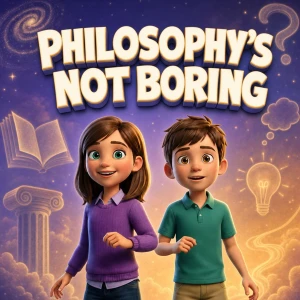
Philosophy's Not Boring is a podcast designed for curious kids aged 4-12 and the adults listening with them. Fictional AI hosts Mira and Finn explore philosophy, psychology, and religion as interconnected questions about how we make sense of the world. Each episode tackles a real thinker or concept, from personal identity to differing beliefs about the soul, and connects it to everyday life. Rather than providing simple answers, the show presents multiple viewpoints and notes which questions remain unsettled. It aims to stay even-handed on matters of faith, describing beliefs from the outside without telling listeners what to believe.
Episodes

Who was Saint Martin?
Have you ever had just one piece of your absolute favorite candy left, and a friend asks for it? It's super hard to share when you don’t have much! But what if you could just snap it in half? In this episode of Philosophy is Not Boring, Mira and Finn explore an amazing 1,700-year-old story about a Roman soldier named Martin who did exactly that—but with something way more important than candy

What is the Stroop Effect?
Have you ever noticed that once you learn how to read, you completely lose the ability to turn it off? In 1935, an American psychologist named John Ridley Stroop discovered a fascinating brain glitch! Imagine looking at the word "RED" but it is printed in bright blue ink. Your mission is to name the ink color out loud as fast as you can without reading the word. It sounds incredibly easy

Who was Heraclitus?
Have you ever looked at a picture of yourself as a baby and thought, "Is that really me?!" Well, you are not the only one asking that brain-bending question! Travel way back in time to around 500 BCE in the ancient city of Ephesus, where a brilliant philosopher named Heraclitus asked a world-famous puzzle: Can you step into the exact same river twice? He said no! Because water is always

What is Diwali?
Have you ever imagined walking down a street glowing with thousands of tiny, flickering lamps? Welcome to Diwali, the spectacular Festival of Lights! Celebrated by millions of people around the world, this amazing holiday features colorful rangoli patterns, dazzling fireworks, and giant boxes of delicious sweets called mithai. But did you know that different religions light these lamps for complet

What is a facial expression?
Have you ever wondered if a smile means the exact same thing everywhere in the world? Or could a smile actually mean you're angry in a different country?! In this mind-bending episode of Philosophy is Not Boring, Mira and Finn explore the amazing science of faces! Travel back to 1967 with an American psychologist named Paul Ekman. He journeyed all the way to the highlands of Papua New Guinea

What is a pilgrimage?
Imagine going on a vacation where you don't relax at the beach, but instead, you walk for a whole month until your feet are covered in blisters! Why would anyone choose to do that? Welcome to the fascinating world of pilgrimages! Join Mira and Finn as they explore why millions of people travel thousands of miles to visit holy places around the world.
Discover the Hajj, where over a million M

What is the Liar's Paradox?
Have you ever felt like your brain was completely tied in a knot? Get ready for the ultimate puzzle! Imagine someone walks right up to you and says, "Everything I say is a lie." Wait... if they are telling the truth, then they really are lying. But if they are lying, then they must be telling the truth! How is that even possible?! This brain-breaking glitch is called the Liar's Para

What is the McGurk Effect?
Have you ever wondered if your eyes can actually hear? It sounds like a superpower, but it is a real trick your brain plays on you every single day! Back in 1976, two scientists named Harry McGurk and John MacDonald accidentally discovered a mind-bending illusion. They played an audio recording of a voice saying "ba" over a video of a person's lips mouthing "ga." But inste

What is democracy?
Imagine you are on a giant wooden ship in the middle of a dangerous, stormy ocean! Who should steer? Should it be a trained, expert captain who knows how to read the stars, or should all the passengers take a vote? In this brain-twisting episode, Mira and Finn travel back over two thousand years to Ancient Athens to answer a massive question: What is democracy, and is it really the fairest way to

What is a Zen koan?
Have you ever tried to solve a riddle that is actually impossible? What if the whole point of a puzzle is to completely break your brain? Welcome to the wild world of the Zen koan! In the 1700s, a famous Japanese Zen teacher named Hakuin asked his students a brain-twisting question: 'Two hands clap and there is a sound. What is the sound of one hand?' Students would spend months—even yea

Why do we pick sides?
Have you ever been on the playground and suddenly found yourself in an intense game of "sneakers versus boots"? Why do our brains pick sides so incredibly fast, even over silly, meaningless things? In this mind-bending episode of Philosophy is Not Boring, Mira and Finn uncover the hidden secrets of how humans form groups! First, we travel back to 1970 to meet researcher Henri Tajfel. He

What is Halloween?
Get ready to uncover the ultimate mystery of spooky season! Have you ever wondered why we celebrate Halloween on October 31st, or why it is called Halloween in the first place? Join Mira and Finn on Philosophy is Not Boring as they travel back in time to discover the secret history of this famous holiday! It turns out, Halloween comes from an old phrase meaning All Hallows' Eve, the night bef

Who was Ibn Sina?
Have you ever tried to feel absolutely nothing? It’s almost impossible! You can always feel your toes in your shoes or hear your own heartbeat. But what if you couldn't? Join Mira and Finn on a mind-bending journey back to the early 1000s to meet a brilliant Persian doctor and philosopher named Ibn Sina! During the Islamic Golden Age, Ibn Sina created one of the most famous and spooky thought

How did babies count?
Have you ever wondered what is going on inside a tiny baby's head? Do they only know how to sleep, cry, and eat snacks, or are their brains already working super hard? For a long time, famous thinkers believed babies were born with a "blank slate"—like an empty computer with zero programs installed! But in 1992, a scientist named Karen Wynn at the University of Arizona decided to te

Who was John Stuart Mill?
Have you ever wanted to eat a whole gallon of double chocolate fudge ice cream for dinner and thought, 'It's my body, it's my choice!'? Well, get ready to test that idea! Travel back to 1859 England to meet a super-smart philosopher named John Stuart Mill. He was a certified genius who started learning Ancient Greek when he was just three years old! When he grew up, he wrote a

What is the invisible gorilla?
Have you ever been staring right at something, like a missing Lego piece or the ketchup in the fridge, but you literally cannot see it? Get ready for a mind-bending episode that will change how you look at the world! In 1999, psychologists Daniel Simons and Christopher Chabris set up a famous experiment at Harvard University. They asked students to watch a video of people passing basketballs and c

What is the Amish community?
Imagine waking up tomorrow and deciding to get rid of your family car, the television, and all the iPads for good! Sounds crazy, right? But for the Amish community, living without modern technology isn't a punishment—it's a thoughtful choice! Travel back in time with Mira and Finn to 1500s Switzerland to discover the origins of the Anabaptists, and find out why thousands later settled in

What is a blank slate?
Have you ever looked closely at a tiny, squishy newborn baby and wondered... what is actually going on inside their head? Are they thinking, or is their brain totally empty? Join Mira and Finn on Philosophy is Not Boring for a mind-bending puzzle! In 1689, an English philosopher named John Locke argued that babies are born knowing absolutely nothing. He called their minds a "Tabula Rasa"

What is sibling rivalry?
Do you ever wonder why your brother or sister can drive you absolutely bananas?! You are definitely not alone! In this exciting episode of Philosophy is Not Boring, Mira and Finn dive into the wild world of family psychology to answer a huge question: Why do the people we live with annoy us the most? It turns out, there is an amazing scientific reason behind all those arguments! We'll explore

What is a phobia?
Have you ever wondered why you might be terrified of a tiny little spider in the bathtub, but you aren't scared of getting into a fast-moving car every day? It turns out, our fears aren't just silly glitches in our brains—they are ancient survival tools! Join Mira and Finn as they explore the wild world of fear and phobias. You'll discover the amygdala, a tiny, almond-shaped part of

What is naive realism?
Have you ever gotten into a massive argument over something silly, like whether a hot dog is a sandwich, and felt one hundred percent sure you were right? You're not alone! In this fascinating episode, Mira and Finn explore the big question: why do people disagree?
Journey back over two thousand years to ancient India to hear the famous parable of the blind men and the elephant! When a group

What is Eid?
Imagine trying not to eat a single snack or take a sip of water from sunrise to sunset for an entire month! That’s exactly what millions of Muslims do during the holy month of Ramadan to practice patience and gratitude. But when that month finally ends? It’s time for one of the biggest, most joyful celebrations on the planet: Eid!
Join Mira and Finn on a delicious and heart-warming journey to dis

What is the purpose of life?
Have you ever watched a tiny ant carrying a crumb and wondered... what is it actually doing? What is the point of it all? That little mental jolt you just felt is the biggest question ever asked: What is the purpose of life? In this amazing episode of Philosophy is Not Boring, Mira and Finn go on a global adventure to find the answer!
First, we look at science! Biology tells us our drive is survi

What is the Spotlight Effect?
Have you ever tripped in the cafeteria, spilled your milk, or worn your shirt inside out by accident? Did you feel like the whole world stopped just to stare at you? That terrible feeling is called the Spotlight Effect, and it might just be a giant trick your brain is playing on you! Join Mira and Finn as they explore a brilliant and super funny experiment from the year 2000. Psychologist Thomas G

What is the Turing Test?
Have you ever wondered if your tablet, smartphone, or smart speaker is actually thinking, or just pretending? In this mind-boggling episode of Philosophy is Not Boring, Mira and Finn tackle a massive question: Can a computer think?! Back in 1950, a genius mathematician named Alan Turing decided to stop arguing about what the word "think" means and created a super fun hide-and-seek game i

What is confirmation bias?
Have you ever been absolutely sure you were right about something, only to find out you were totally wrong? Welcome to the ultimate brain trap! In this mind-bending episode of Philosophy is Not Boring, Mira and Finn dive into a sneaky psychological puzzle from 1960. A clever psychologist named Peter Wason challenged people to figure out his secret math rule using the numbers 2, 4, and 6. It sounds

Why did religions make food rules?
Have you ever wondered why your lunchbox might hold a secret story about the universe? It’s true! For thousands of years, billions of people around the world have followed special rules about what they can and cannot eat. But why? Join Mira and Finn as they explore the fascinating philosophy behind religious food rules! Discover why Jewish people keep Kosher and never mix meat with milk, and what

What is Existentialism?
Have you ever wondered if you were born with a set personality, kind of like the instructions printed on the back of a toy box? Or do you invent yourself from scratch every single day? Join Mira and Finn on a time-traveling adventure to a packed, rock-star-level lecture in Paris in 1945! We are meeting a famous French philosopher named Jean-Paul Sartre who completely flipped how people think about

What is attachment theory?
Have you ever noticed how a toddler at the playground is having the absolute best time, but the second their grown-up steps away, they burst into tears? Are they just being dramatic? For a long time, experts thought hugging a crying baby too much would spoil them and make them weak. But today, Mira and Finn are exploring a mind-bending idea that proves the exact opposite!
Join us as we dive into

Who were the Greek gods?
Imagine a massive, window-shaking thunderstorm hits! Who do you blame for the lightning and the mud? Today, we might say it's just the weather, but for thousands of years, people thought a powerful, angry god was throwing lightning bolts from the sky!
Welcome to the wild world of the Greek gods! Join Mira and Finn as they explore "polytheism"—the belief in many gods. Why did the Gr

What is the social contract?
Imagine you are on a playground with a massive tire swing, but suddenly, all the teachers vanish! There are zero rules! Would it be a wonderful, fun paradise, or a total disaster? Join Mira and Finn on Philosophy is Not Boring as they tackle a massive, brain-twisting question: What would actually happen if there were no rules at all?
Travel back in time to 1651 to meet an English philosopher nam

Who is Durga?
Imagine a shape-shifting demon that turns into a giant water buffalo and is so powerful that none of the gods can beat him! What do the heroes do? They combine all their superpowers into one brand-new superhero! Enter the Hindu goddess Durga. She rides a fierce lion and has ten arms, each holding a magical weapon given to her by the other gods. But she's not just an epic warrior; she represen

Why do we dream?
Have you ever woken up after riding a flying purple turtle or running from a giant slow-motion marshmallow? Dreams are totally weird, but what are they actually for? Join Mira and Finn on a mind-bending journey inside the human brain to find out! Back in nineteen fifty-one, a scientist named Eugene Aserinsky wanted to know what happens when we sleep. He taped safe little sensors to his eight-year-

What is Utilitarianism?
Imagine you have a giant, delicious chocolate cake. Should you eat it all yourself for maximum happiness, or share it so everyone gets a little bit? Welcome to the fascinating world of Utilitarianism! In this fun episode of Philosophy is Not Boring, Mira and Finn explore a huge question: is the right thing to do whatever makes the most people happy?
Travel back to 1789 to meet Jeremy Bentham, a p

What is the Aboriginal Dreaming?
Imagine if a map wasn't a picture on a screen or a piece of paper, but was actually a song! Welcome to the amazing world of Aboriginal Australian cultures, the oldest continuous cultures on Earth! For over 50,000 years—way before the ancient pyramids were built and while woolly mammoths were still walking around—Aboriginal peoples have shared a beautiful philosophy known as the Dreaming.
Bu

What is free will?
Have you ever reached for a piece of popcorn before you even realized you wanted it? Who is really making those choices—you, or your brain? Get ready for a mind-bending mystery! In 1983, a scientist named Benjamin Libet did a famous experiment in San Francisco that completely shocked the world. He asked volunteers to flick their wrists whenever they felt like it while watching a super-fast clock.

What is the placebo effect?
Have you ever scraped your knee, and it magically felt better just because a grown-up put a totally normal plaster on it? That is not magic—it is actually a mind-bending superpower hiding inside your own brain! In this episode, Mira and Finn uncover one of the biggest mysteries in science: the placebo effect. Join us as we travel back to the 1950s to meet Henry Beecher, a Harvard doctor who notice

What is the problem of induction?
How do you know the sun will actually rise tomorrow? Because it always has? Well, get ready to have your mind completely blown! In this episode of Philosophy is Not Boring, Mira and Finn dive into a massive brain-puzzle from 1748 called the Problem of Induction!
A brilliant Scottish philosopher named David Hume pointed out a wild idea: just because something happened a thousand times in the past

Who was St Francis of Assisi?
Did you know there was a man who called the sun his brother and the moon his sister? Meet St Francis of Assisi! He didn't start out as a holy man. Actually, he was a rich, popular party kid who loved wearing the fanciest velvet clothes! But after a year in prison during a war, he decided to give away absolutely everything—even the clothes he was wearing right in the middle of town!
Instead o

What is object permanence?
Have you ever played peekaboo with a tiny baby and wondered why they laugh so incredibly hard? To you, it's just a simple game of hiding your face. But to a baby, you are performing the greatest magic trick in the universe! Join Mira and Finn as they uncover the wild world of baby brains and a famous Swiss thinker named Jean Piaget. In the 1920s, Piaget watched kids play and realized somethin

Who was Gandhi?
Have you ever had a bully take your toy, and a grown-up just told you to "ignore" them? It sounds so unfair, right?! But what if refusing to fight back was actually the most powerful weapon in the world? Welcome to the incredible true story of Mohandas Gandhi! In the 1930s, the powerful British Empire ruled India and made a totally ridiculous law: it was illegal for Indian people to make

What is Sukkot?
Imagine leaving your perfectly comfortable, warm house to eat all your meals outside in a tiny hut... for a whole week! That is exactly what Jewish families all around the world do during the incredible autumn festival of Sukkot! In this fascinating episode of Philosophy is Not Boring, Mira and Finn explore the amazing tradition of building a sukkah. Did you know that the roof of this special shel

Who was Epicurus?
If someone gave you a billion dollars right now, what would you buy to be perfectly happy? A solid gold go-kart? A chocolate milk river? A robot that makes infinite pizzas? Well, an ancient Greek philosopher named Epicurus said that all the fancy stuff in the world won't actually make you happy! Over 2,300 years ago, Epicurus bought a beautiful garden outside Athens and turned it into a schoo

What is laughter?
Have you ever noticed how hard it is to stay quiet when someone else starts giggling? Even if nothing funny happened, you just burst out laughing too! But what exactly is laughter, and why is it so catching? Join Mira and Finn on an undercover science mission to find out! In the 1990s, a psychologist named Robert Provine became a "laugh-detective." He secretly listened to 1,200 laughs in

What is a soul?
Have you ever wondered what makes you... YOU? Think about it—you’ve grown so much since you were a tiny baby, but deep down, you still feel like the exact same person! Is there an invisible, magical spark inside driving you like a pilot in a spaceship? Join Mira and Finn as they explore one of history’s greatest mysteries: What is the soul? We’ll travel back to Ancient Egypt, where people believed

What is hindsight bias?
Have you ever watched a tense mystery movie, seen the surprise ending, and yelled, "I knew it all along!"? Well, did you really know it, or is your brain playing a massive trick on you? Welcome to the wild world of Hindsight Bias! In this mind-bending episode, Mira and Finn uncover one of the weirdest glitches in human memory. You'll learn all about a brilliant psychologist named Ba

What is the Fermi Paradox?
Have you ever looked up at the night sky and wondered, if the universe is so giant, where are all the aliens? Our galaxy alone has billions of stars and even more planets, so space should be packed with zooming spaceships! But instead, it is completely, incredibly quiet. Why is nobody saying hello?
In 1950, a brilliant scientist named Enrico Fermi was eating lunch when he suddenly asked this exac

What is childhood amnesia?
Have you ever looked at old photos of yourself as a baby and realized you don't remember any of it? You're not alone! In this exciting episode of Philosophy is Not Boring, Mira and Finn dive into one of the biggest mysteries of the human brain: childhood amnesia! Join us as we explore why almost nobody has real memories from before they were three years old. Did your brain just drop them

What is grace in Christianity?
Imagine you made a HUGE mistake—like dropping your parents' computer in the mud—but instead of getting grounded, you got a giant ice cream cake and a massive party! Sounds completely crazy, right? But that is exactly what the concept of "grace" is all about!
In this fascinating episode, Mira and Finn explore an idea that totally breaks the normal rules of fairness. You'll hear

Who was J.L. Austin?
Have you ever thought about how weird it is to make a promise? One second there’s no rule, and the next second—BOOM—you owe your friend a cookie! It’s basically like magic! In this mind-bending episode of Philosophy is Not Boring, Mira and Finn explore what actually happens when we say words like "I promise," "I apologize," or "I bet you." We travel back to the mid-20

What is art?
Imagine walking into a super fancy art museum, turning a corner, and seeing... a toilet?! In 1917, an artist named Marcel Duchamp bought a normal, factory-made urinal, signed a fake name on it, called it “Fountain,” and entered it into a huge art show! The judges panicked and hid it. But this one sneaky prank broke everyone’s brains and started a giant argument that is still going on over a hundre

What is the Holiday Paradox?
Have you ever noticed that sitting in a boring waiting room feels like a thousand years, but playing your favorite video game makes an hour zoom by in five seconds?! Join Mira and Finn as they uncover one of the biggest mysteries of the human mind! Did you know you actually have two clocks? There is the physical clock ticking on the wall, and the secret psychological clock inside your brain! Psych

What is karma?
Have you ever heard someone say "that's karma!" when something bad happens? Well, the true ancient meaning of karma is way cooler—and a little weirder—than a giant cosmic scoreboard! Join Mira and Finn as they explore a massive philosophical idea from ancient India that changed the world. You'll discover that karma actually just means "action." In Hinduism and Buddhis

Who was Aristotle?
Have you ever wished for the absolute perfect friend? Someone who never gets annoyed, always wants to play your favorite games, and is never, ever too busy for you? Sounds amazing, right! But what if that perfect friend was actually... a robot?
Join Mira and Finn on Philosophy is Not Boring as they ask a massive question: Could an AI or a machine ever be your true friend? To find the answer, we

What is beauty?
Have you ever wondered why you love the look of a bright orange sunset, a shiny red fire truck, or an awesome rhinoceros beetle? Where does that "beauty" actually live? Is it trapped inside the physical object, or is it just a happy feeling happening inside your own brain? Join Mira and Finn as they explore a huge, mind-bending mystery! Travel back to the 1700s during the Enlightenment t

What is the Good Samaritan?
Have you ever dropped your papers in the hallway and watched kids walk right past you without helping? Why do good people sometimes ignore someone who needs a hand? In this amazing episode, Mira and Finn dive deep into one of the biggest mysteries of human kindness! We start way back in the 1st Century with a famous story told by Jesus: the Good Samaritan. In it, a surprising outsider stops to hel

What is Rastafari?
Did you know there is a major world faith that might be younger than your great-grandparents? It all started in the year 1930 when a man named Ras Tafari Makonnen was crowned Emperor of Ethiopia! To many people in Jamaica, this unconquered African king was a powerful sign of hope, and it sparked a whole new way of seeing the world called Rastafari. Join Mira and Finn on Philosophy is Not Boring as

What is the purpose of sleep?
Have you ever been totally stuck on a hard video game level, a tricky math problem, or a new skateboard move, only to try it again the next day and nail it on the very first try? It feels like magic, but it is actually one of the coolest mysteries of the human brain! Join Mira and Finn as they dive into the wild science of sleep. You might think going to bed is just hitting a pause button, but it

Who was George Berkeley?
Have you ever heard the famous riddle: If a tree falls in a forest and absolutely nobody is around to hear it, does it make a sound? It seems impossible to answer! But what if the secret to solving it is just realizing we're using two totally different dictionaries in our heads? In this mind-bending episode, Mira and Finn explore one of the greatest traps in the history of philosophy! We&apos

Who was Confucius?
Imagine waking up to a world with absolutely no rules, where everyone is fighting all the time! How would you fix it? Two and a half thousand years ago, during the chaotic and violent "Spring and Autumn" period in Ancient China, a towering teacher named Kong Fuzi—better known as Confucius—tried to do exactly that! Did he want to build a massive army? Nope! Did he want to create super str

What is a tickle robot?
Have you ever wondered why you can’t tickle yourself? It’s a mystery that even the ancient Greek philosopher Aristotle tried to solve over two thousand years ago! Join Mira and Finn as they uncover the massive, mind-bending secret hidden inside your own head. You’ll meet Sarah-Jayne Blakemore, a brilliant British neuroscientist who finally cracked the case by building something totally wild: a rea

What is the voice in your head?
Have you ever noticed that you have a tiny narrator inside your brain? When you read a book silently or think about your favorite animal, do you hear a voice talking? It turns out, that invisible voice is full of wild scientific secrets! In this mind-bending episode, Mira and Finn explore what exactly the voice in your head really is. You'll discover a secret human superpower called subvocali

Who was Ludwig Wittgenstein?
Have you ever had a massive argument with your friends over whether a hot dog is actually a sandwich? Or what exactly makes a game a "game"? Welcome to the wildest, messiest problem in human history: language! In this brain-bending episode of Philosophy is Not Boring, Mira and Finn dive into the amazing ideas of Ludwig Wittgenstein, one of the 20th century's most intense thinkers. W

What is luck?
Have you ever rolled a double six in a board game and felt like you had magical powers? It feels like the universe is totally on your side! But is luck real, or is it just a feeling? In this mind-bending episode of Philosophy is Not Boring, Mira and Finn dive into the amazing science of probability and the ancient philosophy of luck! Discover why mathematicians say dice have absolutely zero memory

What is the Butterfly Effect?
Have you ever wondered if a tiny butterfly flapping its wings in Brazil could cause a giant tornado all the way in Texas? It sounds like superhero magic, but it is actually real science! Join Mira and Finn on Philosophy is Not Boring as we dive into a mind-boggling idea called the Butterfly Effect!
In 1961, a scientist named Edward Lorenz was working at MIT, using a giant, clunky computer to pred

What is Hare Krishna?
Have you ever walked down a busy city street and suddenly heard drums, tiny cymbals, and joyful singing? You might have just seen the Hare Krishna tradition in action! In this special episode inspired by a listener's amazing question, Mira and Finn dive into the fascinating history of Bhakti yoga, the path of love and devotion. Travel back 500 years to ancient India, where a teacher named Cha

Who was Marcus Aurelius?
Imagine being the most powerful person in the entire world! You could order everyone to eat ice cream for breakfast or build a giant rollercoaster in your bedroom! But what if, instead of bossing everyone else around, you spent all your time bossing yourself around? That is exactly what the Ancient Roman Emperor Marcus Aurelius did! Over two thousand years ago, Marcus ruled a massive empire, but h

What is the Baha'i Faith?
Have you ever wondered why there are so many different religions in the world? What if they weren't actually rivals fighting against each other, but just different chapters of one giant, epic storybook? In this mind-bending episode, Mira and Finn explore the Baha'i faith! Founded in Persia in the 1800s by a man named Baha'u'llah, it is one of the youngest major world religions.

What is the Zeigarnik Effect?
Have you ever wondered why a TV show cliffhanger drives you totally crazy, or why that big homework project you haven't started nags at you all weekend long? Your brain is actually trying to help you! In this fascinating episode of Philosophy is Not Boring, Mira and Finn travel back to a bustling 1920s café in Vienna to meet a brilliant psychologist named Bluma Zeigarnik. She noticed somethin

What is the Veil of Ignorance?
Imagine there is only one piece of delicious chocolate cake left, and you have to share it with your sibling. How do you make sure it is split perfectly fair? Easy! One person cuts the cake, and the other person gets to pick their slice first! That means the cutter will make the pieces exactly perfectly equal, because they don't want to get stuck with a tiny crumb!
Today on Philosophy is Not

What is a Quaker?
Imagine being in a room with no teacher, no boss, and absolutely no rules about what to do next—except that everyone sits in total, peaceful silence for an entire hour! It sounds totally impossible to most of us, but that is exactly how a religious group called the Quakers worships! In this episode, Mira and Finn explore the amazing history of the Quakers and their biggest idea: the "Inner Li

What is a growth mindset?
Have you ever been told you are super smart, a certified genius, or completely brilliant? It feels totally amazing, right?! But what if being called a genius actually makes you worse at solving your very next problem? Join Mira and Finn on this mind-blowing episode of Philosophy is Not Boring as they uncover a massive secret about human brains! We are exploring the famous puzzle experiments by Sta

All about Aristotle?
Have you ever wondered how someone becomes brave? Is it a magical gift you are just born with, or can absolutely anyone learn it? In this amazing episode of Philosophy is Not Boring, Mira and Finn dive into the brilliant mind of the ancient Greek philosopher Aristotle to uncover a massive secret: building your character is exactly like learning to play Minecraft or riding a bike! Aristotle believe

What is Anicca?
Have you ever felt sad on the very last day of summer vacation? You wish you had a magic pause button to make the fun last forever! But what if the fact that things end is actually the best news ever? In this mind-bending episode, Mira and Finn explore a huge idea from Buddhism called anicca, or impermanence. It means that absolutely nothing lasts forever—and that is exactly what makes life so bea

What is a flow state?
Have you ever looked up from building a massive Lego spaceship or reading a fantastic book and realized two whole hours just vanished into thin air? Where did the time go?! Join Mira and Finn on this episode of Philosophy is Not Boring as they uncover the incredible psychological secret behind our absolute best moments! We are diving into the mind of famous psychologist Mihaly Csikszentmihalyi (pr

Who was Laozi?
Have you ever tried so hard to untie a knot that it just got tighter? Or tried to balance on a skateboard, only to wobble and fall? We are usually told that to win or be strong, we have to push harder. But what if the secret to true strength is actually... letting go?
Join Mira and Finn on Philosophy is Not Boring as they travel back in time to ancient China to meet a wise thinker named Laozi! He

What was the monkey fairness experiment?
Have you ever felt completely outraged when a friend or sibling got a bigger piece of cake than you? You probably yelled, "That is NOT fair!" But did grown-ups invent the rules of fairness, or were we born already knowing them? Join Mira and Finn on an exciting episode of Philosophy is Not Boring as they explore one of the most famous and hilarious science experiments ever filmed! In 200

What is the Experience Machine?
Imagine a magical machine that could give you any experience you ever wanted—for the rest of your life! Want to fly to space, hit a game-winning home run, or eat a giant mountain of chocolate ice cream? Once you plug in, it feels one hundred percent real, but your actual body is just floating in a tank in a laboratory. Would you do it?
In this mind-bending episode, Mira and Finn explore a famous

What is Sufism?
Have you ever tried to be the absolute best version of yourself? We are always trying to level up, earn gold stars, and improve! But what if the ultimate goal of life wasn't to improve "you", but to completely let go of being a separate person altogether?
Join Mira and Finn as they explore Sufism, a beautiful mystical tradition inside the religion of Islam that flips everything we

Who was Donald Winnicott?
Imagine having perfectly perfect parents. They never burn the toast, always play exactly what you want, and never make you wait for anything. Sounds like a dream, right? Well, prepare to have your mind blown! In this episode of Philosophy is Not Boring, Mira and Finn discover why a completely perfect, totally frictionless life is actually a terrible idea! Travel back in time to mid-twentieth centu
Recommended

Learn English Fast! English Snacks with Amber - Short Lessons to Speak English Like a Native
این نقطه

This Past Weekend w/ Theo Von

100 Greatest Old Time Detective Stories

Fantasy Flex

Classic Radio Theater with Wyatt Cox

Take Back Your Health®

Solved Murders - True Crime Stories

Old Time Radio - Gunsmoke

ESPN SportsCenter Update

Back to the 80s Radio
Heaven’s Gate Academy
