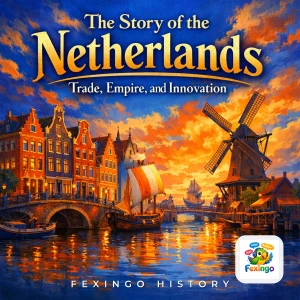
The Story of the Netherlands: Trade, Empire, and Innovation — Fexingo History
The Story of the Netherlands traces the rise of a small nation that shaped the modern world through trade, empire, and innovation. It covers the Dutch Revolt, the Golden Age, and the VOC's role in early globalization. The show explores colonial legacies, figures like William of Orange and Rembrandt, and the Netherlands' transition to a constitutional monarchy. It also considers the country's modern identity as a hub of commerce, water management, and progressive policies. Hosts Lucas and Luna guide listeners through centuries of Dutch history with an emphasis on how pragmatic and tolerant thinking influenced global development.
Episodes

The Dutch Golden Age: How Paintings Built a Nation
While earlier episodes explored the VOC’s spice routes and the engineering of polders, this episode examines the cultural engine that sustained the Dutch Republic during its peak. We focus on the art market of the 17th century, specifically how painters like Rembrandt van Rijn, Frans Hals, and Johannes Vermeer transformed visual art into a commodity for a burgeoning middle class. Lucas and Luna di
Dutch Canal Cities: Urban Planning and Social Order
While previous episodes covered the engineering of polders and the financial mechanics of the stock market, this episode explores the physical manifestation of Dutch power: the canal city. We examine how Amsterdam’s Grachtengordel was designed not just for trade, but as a statement of republican virtue and social control. Lucas and Luna discuss the architectural precision of the Herengracht, the r
The Dutch Tulip Mania Crash That Built Modern Finance
In this episode of The Story of the Netherlands, we leave behind the familiar narratives of windmills and dike-building to explore the financial innovation that fueled the Gouden Eeuw. While previous episodes touched on the Republic's engineering feats and military history, we now dive into the speculative frenzy of the mid-17th century bulb trade. We examine how a rare flower variety known as Sem
The Dutch Golden Age's First Billionaires
We explore how the Dutch Republic, a small nation of marshes and dikes, became the world’s first economic superpower during the seventeenth century. While previous episodes covered windmills, tulip mania, and naval espionage, this episode focuses on the human architects of wealth: the merchant princes of Amsterdam. We dive into the life of Pieter de Hooch, whose paintings reveal the quiet luxury o
Dutch Tulip Mania: The First Financial Crash
In 1636, Amsterdam exploded into a frenzy of speculative trading over rare tulip bulbs. This episode explores the bizarre economic bubble known as tulip mania, where contracts for future bulbs traded for sums equal to a master craftsman’s annual wage. We follow the story through key figures like the anonymous merchants who drove prices up and the sudden collapse that left many bankrupt. By examini
The Dutch Republic's Secret War on Silence
While the Dutch Golden Age is celebrated for its paintings and stock markets, a quieter revolution was taking place in the printing houses of Amsterdam. This episode explores how the Dutch Republic became the information hub of Europe through an unprecedented culture of censorship and free speech. We follow the journey of Remonstrant theologians who challenged state orthodoxy, the role of anonymou
Dutch Golden Age: The Forgotten War of Ink and Paper
While the Dutch Republic is often celebrated for its maritime dominance, naval battles, and the sheer volume of trade goods flowing through Amsterdam’s ports, a quieter but equally potent conflict was waged with words. In this episode, we explore the 'War of Ink' that defined the intellectual landscape of the seventeenth century. We trace how the invention of the printing press transformed the Net
How the Dutch Built a Nation Above Sea Level
In Episode 254, we shift our gaze from the gilded halls of Amsterdam and the high seas of the VOC to the muddy, waterlogged reality of the Dutch landscape itself. For centuries, the Netherlands was not just a place where people lived, but a constant battle against the ocean. This episode explores the ingenious engineering feats that turned marshland into fertile polders, the rise of the heemraad a
Dutch Engineers and the Battle for Dry Land
Before the windmills drained the polders, there was a desperate, decades-long struggle against the sea that nearly destroyed the young Dutch Republic. This episode explores the catastrophic breach of the Zandkreek in 1672, known as the Rampjaar or Disaster Year, when French forces exploited tidal gates to flood parts of Holland. We trace how this military strategy forced the States General to make
Dutch Windmills: Engineering the Dutch Landscape
This episode explores the mechanical ingenuity behind the iconic Dutch windmill, tracing its evolution from simple post mills to complex smock and tower designs that drained the Zuyderzee. We examine how heemraads and waterschaps organized labor and capital to create polders, transforming swamp into arable land. The conversation highlights specific engineering feats like the fantail mechanism for
Dutch Golden Age: The Rise of the World's First Stock Market
Before modern financial centers like New York or London existed, Amsterdam was already trading shares in distant voyages. This episode explores the creation of the Vereenigde Oostindische Compagnie and how its founders solved a massive logistical problem by inventing the joint-stock company. We look at Isaac Grotius’s legal theories on free seas, the role of the Beurs van Berlage in facilitating d
Dutch Glass: The Transparent Luxury of the Golden Age
We trace the rise of Dutch glassmaking from its humble origins in Heemskerk to the sophisticated factories of Alkmaar during the seventeenth century. Lucas and Luna explore how Pieter de Grebber and local artisans moved beyond simple window panes to create flint glass, rivaling Venetian cristallo. We look at the trade routes that brought silica sand and potash, the technological shifts that allowe
Dutch Glass: The Transparent Luxury of the Golden Age
While we often think of the Dutch Golden Age in terms of paintings, ships, or tulips, a quieter revolution was happening in the workshops of Amsterdam and Haarlem. This episode explores the rise of the Dutch glass industry, which managed to break the Venetian monopoly on high-quality glassware by the mid-17th century. We’ll look at how Dutch artisans adapted Murano techniques to create flint glass
The Dutch Masters and the Birth of Art Criticism
While previous episodes explored the VOC’s spice routes, Delftware, and windmill engineering, Episode 248 turns inward to the cultural engine that fueled the Golden Age: the art market. We examine how Rembrandt van Rijn, Frans Hals, and Johannes Vermeer navigated a society where art was not just luxury but liquid capital. The conversation traces the rise of the art dealer as a distinct profession,
Dutch Canal Locks: Engineering the Low Countries
In this episode, Lucas and Luna explore the hidden hydraulic engineering that transformed the Netherlands from a swampy delta into a prosperous republic. While previous episodes touched on windmills and dikes, we focus specifically on the lock systems—particularly the innovative swing locks and later, the pound locks—that allowed ships to navigate between varying water levels without draining land
The Dutch Republic's First Digital Age: Tulip Mania
In the winter of 1636, Amsterdam’s coffee houses transformed into frantic trading floors where bulbs changed hands for sums rivaling a master craftsman’s annual wage. This episode explores the unprecedented financial innovation behind Tulip Mania, focusing on the invention of futures contracts and the role of windhandel, or wind trade. We follow the journey of exotic bulbs from Constantinople to L
The Dutch War of the Bucket: A Medieval Siege
In 1304, the Republic of Venice laid siege to the island city of Chioggia in a brutal conflict known as the War of the Bucket. While the name suggests a focus on stolen kitchenware, this episode reveals how the clash between Genoa and Venice reshaped Mediterranean power dynamics. We explore the strategic importance of the lagoon, the role of Andrea Doria’s naval tactics, and the legendary capture
Dutch Naval Spies and the Battle of Matanzas Bay
In this episode, we explore how the Dutch Republic used naval intelligence to shatter Spanish power. We focus on Piet Hein’s capture of the Spanish Silver Fleet at Matanzas Bay in 1628. Lucas and Luna discuss Isaac de l'Olive’s spy networks, Johan de Witt’s strategic planning, and the geopolitical impact of seizing the Zilvervloot. This hidden war of ink and paper helped fund the Eighty Years' War
Dutch East India Company Spies and Quinine
While we often remember the Dutch Golden Age for its art, tulips, and windmills, the true engine of their power was a shadowy network of intelligence gathering and medical innovation. In this episode, we explore how the Vereenigde Oostindische Compagnie (VOC) built an invisible empire not just through trade ships, but through spies like Isaac de l'Olive and Johan de Witt, who gathered critical pol
Dutch Republic’s Forgotten Laborers and the VOC
We often picture the Dutch Golden Age through the lens of merchants, painters, and ships, but the engine that drove this empire relied on a vast, invisible workforce of indentured servants. In this episode, we explore the lives of those bound by contract to the Vereenigde Oostindische Compagnie, known as the VOC. From the crowded alleys of Amsterdam to the humid ports of Batavia, these men and wom
Dutch Dikes and the Battle for Dry Land
We often think of the Dutch Golden Age in terms of ships, maps, or paintings, but the true foundation of their wealth was the land itself. In this episode, we explore the immense engineering feats that turned swamp into soil. We look at the Zuyderzee Works, the intricate system of polders, and the heemraden who managed water rights. From the post mill to the steam pump, discover how the Dutch foug
The Dutch Golden Age’s Hidden Labor: The Indentured Servant
While the Dutch Republic is celebrated for its maritime dominance, financial innovations, and cultural flourishing during the seventeenth century, a darker reality underpinned this prosperity: the widespread use of indentured servitude. This episode explores how young men and women from across Europe were lured or coerced into signing contracts to work in the Netherlands and its colonies, particul
The Dutch Republic's Forgotten Civil War of Ink
In Episode 239, we step away from the ships and paintings to explore the intellectual battlefield that defined the Dutch Golden Age. We trace the life of Baruch Spinoza, the young philosopher whose radical ideas about God and nature sparked a firestorm in Amsterdam’s coffee houses. Through the eyes of his friend Jan Six, we see how the Republic’s famous tolerance became a weapon against itself whe
Dutch Delftware: The Blue Pottery That Conquered the World
In this episode, Lucas and Luna explore how the Dutch Republic transformed from a swampy northern outpost into a global consumer powerhouse through one unlikely medium: ceramic pottery. While earlier episodes covered the VOC’s spice trade and high finance, we dive into the workshops of Delft where artisans struggled to replicate the elusive white porcelain of Ming Dynasty China. We meet Jan van Ca
Dutch Golden Age: The Invisible War of Ink and Paper
While we often think of the Dutch Golden Age through its ships, paintings, or tulips, the true engine of their global dominance was paper. This episode explores how the Netherlands became the printing press capital of the world, exporting not just goods but ideas. We follow the journey of the rag supply chain from local washhouses to massive mills in the Zaanstreek, where innovative water-powered
Dutch Golden Age Architecture and the Rise of Urban Luxury
We step away from the VOC’s ships and spies to explore how the Dutch Republic built its physical identity during the seventeenth century. Lucas and Luna examine the architectural revolution that transformed Amsterdam, Haarlem, and Leiden from muddy river towns into centers of European luxury. We look at the specific materials—like Venetian glass imported through the Zaanstreek region—that allowed
The Dutch Golden Age’s Secret Currency: Tulip Bulbs
In this episode of The Story of the Netherlands, we peel back the layers of one of history’s most famous financial bubbles. While earlier episodes covered the VOC’s spice trade and maritime insurance, we focus on the unexpected world of tulip speculation in the winter of 1636–1637. Lucas walks us through how a rare flower from Ottoman Turkey became a speculative asset traded on the coffee tables o
The Dutch Navy That Shattered Spain's Armada
In the late sixteenth century, the Dutch Republic was a fledgling state fighting for survival against the overwhelming military might of the Spanish Empire. This episode explores how the Dutch turned to the sea not just for trade, but as a weapon of war. We follow the career of Piet Hein, the privateer who captured the Spanish Silver Fleet at Matanzas Bay in 1628, delivering a financial and psycho
Dutch Quinine and the Global Plague War
This episode explores how the Dutch Republic turned a bitter bark into a geopolitical superpower. We trace the origins of quinine, the world’s first effective antimalarial drug, from its discovery in the Andes to its cultivation in Java. Lucas and Luna discuss the VOC’s secret monopoly on cinchona trees, the role of Governor-General Joan Maetsuycker in establishing plantations, and how controlling
The Dutch Republic's Invisible Army of Spies
While the VOC’s ships and fluyts are well-documented, the Dutch Republic’s survival often rested on a quieter, more perilous network. This episode explores the clandestine intelligence apparatus that protected the fledgling United Provinces during the Eighty Years' War and the subsequent Golden Age. We follow the trail of Isaac de l'Olive, a merchant-spymaster who turned trade routes into informat
Dutch Naval Intelligence and the Spy Networks of the Golden Age
While previous episodes explored the fluyt ships, the VOC’s military might, and Amsterdam’s financial innovations, this episode uncovers the shadowy intelligence apparatus that made Dutch dominance possible. We focus on the 'Secret Council' (Geheime Raad) established in 1624, which coordinated espionage across Europe and Asia. Lucas and Luna discuss how spies like Isaac de l’Olive used diplomatic
Dutch Windmills: The Machines That Built a Nation
We often picture the Netherlands as a land of tulips and canals, but its true foundation was laid by iron and wood against the sea. This episode explores the engineering marvel of the windmill, specifically the post mill and the later smock mill, which were not just romantic symbols but essential industrial tools. We look at how these machines drained the polders to create arable land, ground grai
Dutch Delftware: The Blue Pottery That Conquered the World
While Amsterdam’s canals and VOC ships dominate our earlier stories, this episode explores a quieter revolution in household aesthetics. We trace the rise of Delftware, or Delfts Blauw, from its humble origins as an imitation of expensive Chinese porcelain to a global export that defined Dutch artistic identity. Lucas and Luna discuss how Jan van Call and other potters in Delft developed the tin-g
The Dutch East India Company's Secret Weapon
While we often think of the Dutch Golden Age through the lens of windmills and tulips, the true engine of their power was a radical financial invention: the joint-stock company. In this episode, Lucas and Luna explore the creation of the Vereenigde Oostindische Compagnie, or VOC, in 1602. We dive into how the States General of the Netherlands solved a crisis of competition and piracy by pooling ca
Dutch Golden Age Science: Microscopes, Telescopes, and Truth
While we have explored the VOC’s colonial reach and the engineering of polders, this episode turns to the intellectual engine of the Dutch Golden Age. Lucas and Luna discuss how Middelburg became a global hub for optical innovation. We follow Zacharias Janssen and his alleged invention of the microscope, the precision grinding of lenses in Zaanstreek, and the scientific breakthroughs of Willebrord
The Dutch Painters Who Built an Invisible Empire
While we have explored the VOC’s spice monopolies, sugar refineries in Recife, and the engineering marvels of the Beemster Polder, this episode turns inward to the canvas. We examine how the Dutch Golden Age art market functioned as a financial engine rivaling the East India Company. Lucas traces the rise of Rembrandt van Rijn and Jan Vermeer, detailing their workshop economies, the role of mercha
Dutch Golden Age Science: The Microscope and the Telescope
While Amsterdam’s canals and VOC ships defined the Dutch Golden Age economically, a quieter revolution was transforming how humanity saw the world. This episode explores the rise of Dutch lens grinding in the late 16th and early 17th centuries, focusing on figures like Zacharias Janssen and Constantijn Huygens. We trace how optical instruments—the microscope and the telescope—shifted from curiosit
The Dutch Golden Age’s Invisible Engine: Credit and Insurance
While earlier episodes explored the VOC's spice monopolies, the engineering of polders, and the brutal realities of colonial slavery, Episode 224 uncovers the financial architecture that made it all possible. Lucas and Luna trace the invention of modern banking through Amsterdam’s Beurs and the Wisselbank. They examine how the city became the credit center of Europe, enabling risk-sharing through
The Dutch Tulip Mania Bubble and Financial Innovation
In 1637, the Netherlands experienced a financial phenomenon that still echoes in modern markets: Tulip Mania. While often dismissed as a simple story of irrational exuberance where bulbs replaced gold, the reality was far more complex and deeply intertwined with the rise of modern finance. This episode explores the mechanics of the Amsterdam bulb trade, focusing on the role of the 'windhandel' or
Dutch Cartography: Maps That Built an Empire
In this episode of The Story of the Netherlands, we explore how the Dutch Golden Age was drawn before it was fought. While previous episodes covered the VOC’s spice monopolies and the engineering of polders, Lucas and Luna turn their attention to the invisible infrastructure of empire: cartography. We trace the rise of the Blaeu family in Amsterdam, whose world maps became status symbols for Europ
Dutch Glass: The Invisible Empire of Venetian Glassmakers
While the Dutch are famous for their ships and spices, a quieter revolution was happening in Amsterdam’s workshops. This episode explores how the Dutch Republic became the world’s leading producer of glassware, largely by attracting skilled artisans from Venice and Germany. We follow the journey of Giovanni Carlo Battaglia, a master glassblower who fled the strict regulations of the Venetian Repub
The Droger: How Wind and Salt Dried the Dutch Empire
In this episode, Lucas and Luna explore the quiet engine of Dutch seafaring: the droger, a shallow-draft vessel that dried salted herring at sea, extending the Dutch herring fishery into the far North Sea and beyond. They trace the droger's evolution from a simple open boat to a two-masted 'dogger' that could carry a crew of fifteen and process fish while the fleet pressed on. The conversation tou
Amsterdam's Canals: The Art and Economics of the Grachtengordel
In this episode of The Story of the Netherlands, Lucas and Luna explore how Amsterdam's famous canal ring — the grachtengordel — was not just a pretty face but a sophisticated piece of urban planning driven by trade, tax incentives, and a booming economy. They trace the city's expansion in the early 1600s, the engineering decisions that shaped its concentric waterways, and how the canals became a
The Dutch Tea Clippers: Speed, Steam, and the China Race
In the mid-19th century, Dutch merchants watched the British tea trade explode and decided they wanted a piece of the action. But the Dutch East India Company was gone, the monopoly was dead, and the China tea market was a brutal, fast-moving game. Enter the Dutch tea clippers—sleek, swift, and built to outrun the British on the long voyage from Canton to Rotterdam. This episode follows the shipwr
The Dutch Beer Industry: Brewing a City's Golden Age
In this episode, Lucas and Luna explore how beer shaped Amsterdam's Golden Age. From the city's early breweries to the rise of large-scale production, they trace the industry that turned a modest port town into a brewing powerhouse. Along the way, they uncover the role of water quality, the influence of the Baltic grain trade, and the surprising connections between brewers and the world of art. Fe
The Dutch Lottery: Gambling, Crowdfunding, and the Bonds of Empire
In this episode of The Story of the Netherlands, Lucas and Luna explore the Dutch lottery as a financial instrument that helped build the Dutch empire. From the early municipal lotteries of the fifteenth century to the massive state-run lotteries of the seventeenth, they uncover how a passion for gambling funded public works, colonial ventures, and even the construction of the Amsterdam canal ring
The Dutch Dike Counts: Van Den Bosch and the Water Defense
In this episode, Lucas and Luna explore the overlooked heroes of the Dutch Golden Age: the dike counts and water boards that held back the sea. They trace the evolution from medieval 'dike counts' (dijkgraven) to the sophisticated regional water authorities that made the polders possible. The conversation focuses on the pivotal figure of Floris van den Bosch, a 13th-century dike count whose leader
The Dutch Beemster Polder: Engineering an Empire's Breadbasket
In this episode of The Story of the Netherlands, Lucas and Luna explore the remarkable story of the Beemster Polder, one of the first major land reclamation projects in Dutch history. They trace the engineering marvels of the early 17th century, when windmills and dykes transformed a shallow lake into fertile farmland. Through the lens of figures like Jan Adriaanszoon Leeghwater and the wealthy Am
Dutch Warships of the Golden Age: The Fluyt and the Line of Battle
In this episode of The Story of the Netherlands, Lucas and Luna explore the warships that carried the Dutch Republic to naval dominance in the seventeenth century. They trace the evolution from the humble fluyt, a cargo carrier designed for efficiency and speed, to the purpose-built warships that fought in the Anglo-Dutch Wars and the Battle of Texel. Along the way, they discuss the shipyards of t
The Dutch Sugar Refining Boom: Amsterdam's Sweet Transformation
In this episode, Lucas and Luna explore how a small but potent industry transformed Amsterdam in the seventeenth century: sugar refining. From the first refineries in the 1590s, powered by a workforce of skilled German and Sephardic Jewish migrants, to the rise of the sugar baker's guild, this is the story of how colonial raw sugar from Brazil and the Caribbean became a refined luxury product that
The Dutch Brewers Who Tamed the Baltic Grain Trade
In this episode of The Story of the Netherlands, Lucas and Luna explore how Dutch brewers transformed the Baltic grain trade into a global industry. Starting with the basics of pilsner and lager, they trace the rise of the Dutch brewing towns like Delft and Gouda, and the crucial role of the Baltic herring trade. They dive into the story of the Hooft family, who used their brewing wealth to fund m
The Dutch Brazil Adventure: Sugar, War, and the Fall of Recife
In this episode of The Story of the Netherlands, Lucas and Luna dive into the short-lived but dazzling Dutch colony of Brazil. After the Dutch West India Company seized Recife in 1630, Johan Maurits van Nassau-Siegen turned a pirate outpost into a thriving sugar capital, complete with a grand palace and a botanical garden. But the good times faded fast: the Portuguese revolted in 1645, the Dutch l
The Dutch Beemster Polder: Engineering an Empire's Breadbasket
In this episode of The Story of the Netherlands, Lucas and Luna explore the remarkable story of the Beemster Polder, a seventeenth-century land reclamation project that turned a shallow lake into fertile farmland. They discuss the engineering genius of Jan Adriaanszoon Leeghwater, his windmill-driven drainage system, and the political maneuvering that made it possible. The episode covers the role
The Dutch Salt Trade: From the Caribbean to the Baltic
In this episode, Lucas and Luna explore the crucial but often overlooked role of salt in the Dutch Golden Age. From the solar salt pans of the Caribbean island of Bonaire to the Baltic herring fisheries, salt was the invisible commodity that preserved food, powered industries, and filled the VOC's coffers. They trace the Dutch salt trade from its early dependence on the Bay of Bourgneuf in France,
The Dutch Colonial Governor Who Defied the VOC
In 1629, Jan Pieterszoon Coen, the ruthless architect of the Dutch East India Company's spice monopoly, returned to Batavia to find a city in crisis. But his most dangerous enemy wasn't a rival trader or a native prince—it was his own successor, Jacques Specx, and the members of the Council of the Indies who had grown fat on corruption. In Episode 207, we step into the tense world of Dutch colonia
The Dutch East India Company's Spice Monopoly: Nutmeg and the Banda Islands
In this episode, Lucas and Luna explore how the Dutch East India Company secured its monopoly on nutmeg, the most coveted spice of the seventeenth century. They trace the VOC's brutal campaign on the Banda Islands, the role of Jan Pieterszoon Coen, the massacre at Banda Neira, and the exile of the Bandanese people. The story covers the Company's ruthless enforcement of the monopoly, the forced cul
The Dutch Slave Trade: Profit, Pain, and the Middle Passage
In this episode, Lucas and Luna examine the Dutch role in the transatlantic slave trade, a dark chapter that fueled the Golden Age. They follow the journey of the WIC ship St. Jan, which in 1637 carried the first enslaved Africans from Angola to Brazil, and discuss the brutal conditions of the Middle Passage. Lucas explains how the Dutch captured Elmina Castle from the Portuguese in 1637, gaining
The Dutch Beemster Polder: Engineering an Empire's Breadbasket
When the Dutch dug the Beemster lake dry in 1612, they didn't just reclaim land — they invented a new kind of landscape. This episode follows the financiers, engineers, and laborers who turned a dangerous inland sea into a grid of fertile pastures, transforming Dutch agriculture and influencing city planning for centuries. We meet Jan Adriaenszoon Leeghwater, the master millwright who oversaw the
The Dutch Brazil Adventure: Sugar, War, and the Fall of Recife
In this episode, Lucas and Luna dive into the Dutch Republic's boldest Atlantic gamble: the conquest of Brazil's sugar coast. From the 1624 capture of Bahia to the fall of Recife in 1654, they follow the rise and fall of Dutch Brazil, a colony that nearly became the centerpiece of a global empire. Along the way, they meet the brilliant but controversial governor Johan Maurits van Nassau-Siegen, wh
The Dutch Whale Trade: Oil, Bones, and Arctic Ambition
In the seventeenth century, Dutch whalers braved the icy waters of the Arctic to hunt bowhead whales, turning blubber into oil that lit Europe's lamps and bones into corsets. This episode follows the rise of the Smeerenburg settlement on Spitsbergen, the brutal competition with English and Danish rivals, and the ingenious 'flensing' techniques that made Dutch whaling the most efficient in the worl
The Dutch Herring Trade: How a Humble Fish Built an Empire
Before the VOC, before the tulips, there was herring. In this episode, Lucas and Luna trace the improbable rise of the Dutch Republic on the back of a small, silvery fish. From the invention of gibbing – a technique that preserved herring at sea – to the massive haringbuizen that dominated the North Sea, the herring trade was the Netherlands' first global industry. Discover how the Dutch wrested c
Dutch Innovations: The Windmill Sawmills of the Zaan
In this milestone episode of The Story of the Netherlands, Lucas and Luna explore the ingenious wind-powered sawmills of the Zaanstreek, the industrial heart of the Dutch Golden Age. They trace the rise of the houtzaagmolen — a revolutionary technology that mechanized timber sawing and fueled the shipbuilding boom. Discover how Cornelis Corneliszoon's patent in the 1590s transformed the region int
The Dutch East India Company's Tea Trade and the Rise of Amsterdam
In this episode, Lucas and Luna trace the Dutch East India Company's pivotal role in bringing tea from China to Europe, transforming Amsterdam into the continent's tea capital by the late 17th century. They discuss the challenges of the China trade, the first direct shipment of tea in 1607, the establishment of a trading post at Canton, and the VOC's shift from pepper to tea. Along the way, they e
The Dutch WIC: Privateers, Slaves, and Atlantic Ambition
In 1621, the Dutch West India Company was founded to strike at Spain's Atlantic empire. This episode follows the WIC from its early privateering triumphs — Piet Heyn's capture of the Silver Fleet at Matanzas Bay — to its darker ventures in the transatlantic slave trade, and its eventual decline. Lucas and Luna explore how the company's letters of marque blurred the lines between warfare and piracy
The Dutch Sea Beggars: Privateers Who Forged a Nation
Long before the Dutch East India Company ruled the waves, a ragtag fleet of dispossessed nobles, fishermen, and pirates—the Sea Beggars, or Watergeuzen—turned the tide of the Eighty Years' War. In this episode, Lucas and Luna trace their rise from outlawed exiles to the unlikely liberators of Brielle in 1572, a towns-by-town conquest that ignited the Dutch Revolt. We follow their early defeats at
The Dutch Hanseatic City of Kampen and the Botter Fleet
In this episode of The Story of the Netherlands, Lucas and Luna explore the lesser-known but crucial role of the Hanseatic city of Kampen and the botter, a flat-bottomed fishing boat that sustained local communities for centuries. They discuss Kampen's rise as a trading hub on the IJssel, its rivalry with Amsterdam, and the gradual decline of its maritime power. The conversation then shifts to the
The Dutch Grain Trade: Amsterdam's Baltic Lifeline
In this episode of The Story of the Netherlands, Lucas and Luna explore the Dutch grain trade, the foundation of the Republic's economic miracle. They trace the shipment of rye and wheat from the Vistula River in Poland to Amsterdam's bustling harbors, where Dutch ships controlled the Baltic routes. The conversation covers the moedernegotie, or 'mother trade,' which fed the Dutch cities and fueled
De Gouden Eeuw: The Dutch Diamond Polishing Revolution
In this episode of The Story of the Netherlands, Lucas and Luna uncover the dazzling world of the Dutch diamond trade — a story of craftsmanship, monopoly, and the cutting edge of 17th-century technology. Discover how Amsterdam became the world's diamond capital, from the invention of the scaif by Lodewijk van Berquem to the secretive workshops on the Nieuwe Zijds Achterburgwal. Learn about the ro
The Dutch Wood Trade: Timber, Ships, and the Baltic Lifeline
Before the VOC's spice fleets and the WIC's Atlantic ventures, there was wood. In this episode, Lucas and Luna trace the Dutch wood trade from the Baltic forests of Norway and Poland to the shipyards of the Zaanstreek, where oak and pine became the bones of the Golden Age. They follow the flottas down the Vistula, the sawmills of Saendam, and the timber yards of Amsterdam, showing how a seemingly
The Dutch Beemster Polder: A Seventeenth-Century Land Reclamation
In 1612, Dutch engineers drained a shallow lake north of Amsterdam and turned it into a patchwork of fields and canals that still shapes the landscape today. This episode tells the story of the Beemster Polder — a bold experiment in land reclamation that became a model for the world. We trace the technical marvels: the windmills that lifted water, the careful surveying that divided the land into g
The Dutch Polder: How Windmills and Water Built a Nation
In this episode of The Story of the Netherlands, Lucas and Luna explore the ingenious and relentless Dutch battle against the sea—the creation of polders. From the earliest terpen and dikes to the revolutionary windmills that powered the Golden Age, we trace how the Dutch literally shaped their own land. We meet the engineers and innovators like Jan Adriaenszoon Leeghwater, whose daring plans drai
Amsterdam's First Coffeehouse: A Sip of the Golden Age
Before the VOC sailed east, before the Wisselbank smoothed out the currency, before the tulip bulb ever changed hands, Amsterdam's first coffeehouse opened its doors in 1663. In this episode, Lucas and Luna trace how a single cup of coffee brewed a revolution in Dutch society. From the Ottoman world where coffee was a political tool to the cramped, smoke-filled rooms of the Warmoesstraat, they exp
The Founding of the Dutch East India Company
In 1602, the Dutch Republic did something unprecedented: it merged a patchwork of rival Asian trading companies into a single, state-backed monopoly. This episode unpacks the political manoeuvring behind the Vereenigde Oost-Indische Compagnie (VOC), focusing on Johan van Oldenbarnevelt's role, the Staten-Generaal's charter, and the creation of the Heeren XVII. We explore how the VOC gained quasi-s
Abel Tasman: The Dutch Navigator Who Found New Zealand
In this episode, Lucas and Luna explore the remarkable voyages of Abel Tasman, the Dutch explorer who, in 1642-1644, became the first European to sight Tasmania, New Zealand, and parts of Australia's coast. Commissioned by the VOC under Governor-General Anthony van Diemen, Tasman set out from Batavia to chart the mysterious 'Great South Land'. Lucas recounts the journey's dramatic moments: the nam
The World’s First Stock Market: Amsterdam’s Financial Revolution
In 1602, the Dutch East India Company (VOC) launched the world's first initial public offering, creating shares that could be traded on the Amsterdam Stock Exchange. This episode explores how the VOC’s need for massive capital led to the invention of modern corporate finance, complete with dividends, speculation, and the first recorded short seller, Isaac le Maire. Join Lucas and Luna as they trac
The Dutch in Ceylon: Cinnamon, Conquest, and the VOC’s Island Empire
In the 1600s, the Dutch East India Company set its sights on the spice-rich island of Ceylon, today's Sri Lanka. Already famous for its cinnamon, the island was controlled by the Portuguese, who had monopolized the trade for decades. This episode follows the Dutch conquest—from the treaty with King Rajasingha II of Kandy to the capture of Colombo, Galle, and Jaffna under the brilliant but ruthless
The Dutch Spice Monopoly: Nutmeg and the Banda Islands
In this episode, Lucas and Luna explore how the Dutch East India Company (VOC) seized control of the world's most valuable spice: nutmeg. They travel to the remote Banda Islands in the eastern Indonesian archipelago, where nutmeg and mace grew naturally nowhere else on earth. Lucas recounts the VOC's early trade agreements with Bandanese leaders, the arrival of English competitors, and the ruthles
New Netherland The Dutch Colony That Became New York
In this episode, Lucas and Luna explore the Dutch colony of New Netherland, the fur-trading outpost that grew into the multicultural heart of the future New York. They trace the colony's founding by the West India Company in 1624, the iconic purchase of Manhattan by Peter Minuit, and the turbulent governorship of Peter Stuyvesant. The conversation covers the colony's diverse population, the patroo
The Dutch at the Cape: Jan van Riebeeck and the Birth of Cape Town
In 1652, the Dutch East India Company established a tiny refreshment station at the southern tip of Africa—a place that would grow into Cape Town. This episode follows the early years of the Cape Colony under commander Jan van Riebeeck. We explore the VOC's strategic need for fresh supplies on the long voyage to Batavia, the encounters with the indigenous Khoikhoi, the introduction of slavery in 1
The Dutch Tulip Trade: Bulbs, Bubbles, and the First Crash
In the 1630s, the Dutch Republic became gripped by a frenzy over tulip bulbs—a speculative mania that saw single bulbs trade for more than a skilled craftsman's annual wage. This episode explores how the tulip, originally from the Ottoman Empire, became a luxury status symbol, the role of the VOC in importing bulbs, and the rise of 'florists' who bred rare color patterns. We follow the story of th
Recommended

Crickets Corner

History of the Earthquake and Fire in San Francisco

Fox news

K-Drama Obsessed Mamas | Beyond “Just One More Episode!”

True Crime Classics

The Healer Revolution

Becoming: HER with Nikki Spoelstra

Booked, Blonde & Busy w/ Olivia Ponton

McKinsey on Consumer and Retail

megahired.com

Hard Knocks Podcast

Effective Weight Loss for Moms | High protein, Strength Training, Lose Weight, Meal Planning, Fat Loss, Healthy Habits
