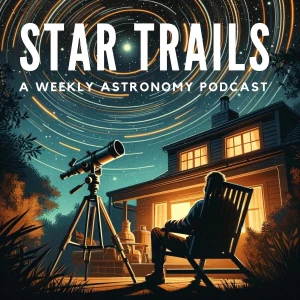
Star Trails: From Backyard Astronomy to Cosmic Wonder
Star Trails is a weekly astronomy podcast that starts in your backyard and expands to the edge of the universe. Each episode offers a guide to the night sky across North America, covering constellations, planets, moon phases, and celestial events. It also explores the science, history, and perspective of astronomy, from ancient skywatchers to modern spacecraft, revealing the beauty and mystery of the cosmos.
Episodes
The Moon That Sends Us Its Ocean
Saturn has a moon with a hidden ocean, and that ocean is spraying samples of itself into space.Enceladus is only about 310 miles wide, but beneath its brilliant shell of ice lies a global saltwater ocean warmed by the pull of Saturn. Along its south pole, enormous fractures release water vapor and tiny frozen grains. NASA's Cassini spacecraft flew through that spray and found salts, organic compou
A Black Hole Is Pointing at Us
A black hole in our galaxy appears to be aiming a relativistic jet almost directly toward Earth. That sounds like a reasonably good opening line for October.The object, IRAS 18293−0941, is a binary system about 12,000 light-years away. A stellar-mass black hole is feeding on material from a massive companion star and launching jets at no less than roughly two-thirds the speed of light. Because one
There Was a Planet That Swallowed a Moon
What if Venus once had a moon, and then destroyed it?A new study suggests that under plausible conditions, an ancient Venusian moon could have slowly migrated inward, crossed the Roche limit and ultimately been torn apart or swallowed by the planet. And Venus may not be the only hungry object in our cosmic neighborhood: another recent study explores whether the young Sun could have consumed a supe
Dyson Spheres: The Heat Has to Go Somewhere
What if the first evidence of an advanced alien civilization isn’t a message, but a star whose energy books don’t quite balance?This week, we explore the strange history and surprisingly real science of Dyson spheres, from Olaf Stapledon and Freeman Dyson to the unforgettable Star Trek: The Next Generation episode “Relics.” We’ll learn why a vast swarm of orbiting collectors makes more sense than
Rivers Through the Dark
Galaxies carry the evidence of their past. When the Milky Way captures a dwarf galaxy or tears apart a globular cluster, it leaves behind long, ghostly ribbons of stars called stellar streams. These streams preserve the history of ancient collisions, and their shapes may trace the invisible dark matter surrounding a galaxy.This week, we follow the stellar wreckage left behind by galactic cannibali
Little Red Dots at Cosmic Dawn
The James Webb Space Telescope has uncovered hundreds of tiny red points in the early universe. They are extraordinarily compact, unexpectedly bright and strangely quiet in the X-ray and radio wavelengths where an active black hole should reveal itself.Astronomers call them “little red dots,” but that modest nickname conceals one of the most intriguing mysteries of the Webb era.In this episode, we
Did the Milky Way Flip?
The Milky Way looks permanent from our place inside it, a great band of stars stretching across the night sky. But new research suggests our galaxy may once have been oriented in a completely different direction, perhaps reorienting by more than 90 degrees during its violent youth.This episode explores the evidence for the Milky Way's possible ancient flip and, even more remarkably, how astronomer
When Black Holes Twist Spacetime
What happens when a black hole spins? According to general relativity, it doesn't simply rotate in space, it actually drags spacetime around with it.This episode explores the strange phenomenon known as frame dragging, from its first predictions more than a century ago to new observations that may let astronomers watch it at work around supermassive black holes. We'll visit a distant black hole wh
Listening to the Heartbeat of the Milky Way
Most amateur astronomers spend their nights collecting light. But what if you could study our galaxy without looking through a telescope at all?In this episode, we sit down with amateur astronomer and radio enthusiast Hap Griffin to explore the fascinating world of backyard radio astronomy. Using a homemade radio telescope consisting of a recycled microwave dish, and less than $100 worth of electr
Is there a Black Hole in Our Backyard?
What if the mysterious "Planet Nine" isn't a planet at all?In this episode, we journey to the distant frontier of our Solar System to explore one of astronomy's strangest modern hypotheses: the possibility that the unseen object influencing the orbits of distant icy worlds could actually be a primordial black hole, an ancient relic formed in the first moments after the Big Bang.Along the way, we'l
How Jupiter Almost Destroyed the Solar System
For generations, we've pictured the Solar System as a stable and orderly place: planets forming where they are today and quietly orbiting the Sun for billions of years. But what if that picture is wrong?In this episode, we explore the Grand Tack Hypothesis, a fascinating idea suggesting that Jupiter may have migrated deep into the young Solar System before reversing course and heading back outward
A Summer Sky Road Trip
Summer is almost here, and with it comes one of the richest observing seasons of the year.In this episode, we take a road trip through the summer sky, exploring the constellations, deep-sky objects, planets, meteor showers, and celestial events that will define the next three months of stargazing. Along the way we'll visit the Summer Triangle, cruise through the star clouds of the Milky Way, stop
From the Archive: Star Party Stories
Back in November of 2024, I attended a star party hosted by the Midlands Astronomy Club and recorded what became one of my favorite episodes of Star Trails. This week, while taking a short break to recharge and prepare future episodes, I thought it would be the perfect time to revisit that night under the stars.In this remastered archive presentation, we’ll head out to a dark-sky observing site wh
The Birth and Death of Galaxies
This week we conclude our month-long journey through galaxies by exploring one of the biggest questions in astronomy: how galaxies are born, evolve, and eventually die.We begin in the aftermath of the Big Bang, tracing how tiny fluctuations in matter slowly grew into the first galaxies. Along the way, we explore starburst galaxies, galactic recycling, and the remarkable realization that the elemen
The Hidden Universe: Cosmic Structures in the Dark
This week we continue our month-long journey through the world of galaxies, but this time, we venture into one of astronomy’s darkest frontiers. Beyond the glowing spirals and brilliant star clouds lies a universe filled with hidden structures, invisible matter, and mysteries that continue to challenge modern science.We venture into the Zone of Avoidance, a cosmic blind spot created by the dust an
When Galaxies Collide
This week we continue our month-long journey through the world of galaxies, but this time, we move beyond what galaxies are and explore what galaxies actually do. It turns out these vast islands of stars are anything but static. They collide, merge, exchange gas and dust, fling stars into deep space, and sometimes grow by consuming smaller neighbors in a process astronomers call galactic cannibali
Where the Milky Way Begins… and Ends
This week, we begin a new month-long journey into one of the most awe-inspiring subjects in astronomy: Galaxies.We start close to home by exploring our own galaxy, the Milky Way, and asking a deceptively simple question: where does a galaxy actually end? Along the way, we’ll explore spiral arms, dark matter, supermassive black holes, the hidden structure of our galactic halo, and the faint ghostly
The Invisible Architecture of the Universe, with Dr. Enrique Lopez Rodriguez
In this episode we step behind the scenes of modern astronomy to explore a side of the universe you can’t see, at least not directly.We sit down with Professor Enrique López Rodríguez, an extragalactic astronomer at the University of South Carolina and one of the leading researchers in the United States studying magnetic fields in galaxies.The conversation also dives into the complex behavior of s
From Gears to Code: Computing the Cosmos
In this episode, we explore the role of computers in astronomy. From the ancient Antikythera Mechanism and the human “computers” of the Harvard College Observatory, to the rise of electronic machines, supercomputers like the Cray-2, and modern programming languages like Fortran and Python, we trace the evolution of how we’ve learned to model and understand the universe.Along the way, we dive into
Radio Astronomy: Listening to the Universe
In this episode, we move beyond what the eye can see and into a universe that has been quietly speaking all along.Radio astronomy has transformed our understanding of the cosmos, not by capturing images, but by detecting faint signals that have traveled across space for billions of years. From the accidental discovery of radio waves from the Milky Way by Karl Jansky, to the detection of the afterg
Space Oddity: The Harmony of Isolation
What makes a song feel like space? In this special bonus episode of Star Trails, we take a deep dive into the song "Space Oddity," not just as a piece of music, but as a story of distance, disconnection, and drift.Released in 1969 at the height of the space race, Bowie’s breakout hit arrived alongside humanity’s first steps on the Moon. The BBC even used it during their coverage of the Apollo 11 M
Photon by Photon: A Journey Through Observatories
This week we step inside one of astronomy’s most iconic spaces: the observatory.Drew visits Melton Memorial Observatory and sits down with director Martin Bowers to explore what a nearly 100-year-old, urban observatory still offers today. From public viewing nights to hands-on learning, we look at how these classic domes continue to connect people with the night sky, even under city lights.Then, w
The Edge of the Solar System
This week we leave the familiar planets behind and venture into the farthest reaches of our Solar System, into regions where the Sun’s influence begins to fade and the boundaries of our cosmic neighborhood grow uncertain.We explore the Kuiper Belt, a vast disk of icy remnants left over from the formation of the planets, and travel even farther into the mysterious Oort Cloud, a distant, spherical h
Moons: The Solar System’s Secret Worlds
The most intriguing places in our solar system might not be planets at all. This week we turn our attention to some of the most fascinating and unusual worlds in our solar system: its moons.For most of human history, we assumed moons were quiet, lifeless companions like our own. But as spacecraft ventured deeper into the outer solar system, a very different picture emerged.Some moons erupt with vo
The Case of Pluto: Discovery, Demotion, and Redemption
In 2006, a group of astronomers gathered in Prague and made a decision that shocked the world: Pluto was no longer a planet.But the story of Pluto is far more complicated—and far more fascinating—than that single vote.In this episode of Star Trails, we reopen the case. From Percival Lowell’s search for the mysterious “Planet X” to Clyde Tombaugh’s painstaking discovery using a blink comparator, we
Beyond the Frost Line: The Giant Planets of Our Solar System
This week we leave the rocky inner planets behind and journey into the deep cold of the outer solar system. From the storm-wracked atmosphere of Jupiter to the ringed elegance of Saturn and the mysterious ice giants Uranus and Neptune, these distant worlds reveal how strange and varied our planetary neighborhood truly is.Along the way we explore how the solar system formed, why the inner planets a
Four Worlds, One Sun; Plus, a Total Lunar Eclipse
In this milestone 100th episode of Star Trails, we bring the cosmos back home.After months of exploring distant stars, nebulae, and black holes, March begins with a tour of our own neighborhood: Mercury, Venus, Earth, and Mars, four rocky worlds born from the same protoplanetary disk 4.5 billion years ago, yet shaped into radically different outcomes.We’ll visit Mercury, the tiny planet that helpe
How Stars Die (Including the One That Keeps Us Alive)
In this episode, we wrap up our month-long series on stars by exploring their final acts.Most stars don’t explode. They grow old. We’ll follow the Sun’s future as it swells into a red giant, sheds its outer layers, and becomes a dense white dwarf held up not by heat, but by quantum mechanics itself. Along the way, we’ll examine planetary nebulae like the Ring Nebula and the Dumbbell Nebula, and lo
The Quiet Majority of Stars
This week we take a nerdy detour into the lives of stars by building a tiny simulated galaxy in Python. We form half a million stars, roll the clock forward 10 billion years, and discover something counterintuitive: nearly all of them are still shining. The stars that dominate our constellations, the bright, showy ones, are statistically the least likely to survive. The night sky, it turns out, is
What Stars Do While They’re Alive
Stars are easy to take for granted. They rise, they set, and they seem unchanged from one night to the next. But in this episode of Star Trails, we shift our focus to what stars are actually doing right now, shaping nebulae, building solar systems, regulating star formation, and quietly organizing the structure of galaxies around them.We explore stellar nurseries like the Orion and Eagle Nebulae,
What a Star Is (and What It Isn’t)
This week, we begin a month-long exploration of the most familiar objects in the night sky, and wonder why they’re still so often misunderstood.In this episode, we take a deep dive into what a star really is, and just as importantly, what it isn’t. We’ll talk about how stars form, why they live such turbulent lives, how light escapes their interiors over immense spans of time, and why the stars we
The Myth of the Perfect Night
What if the problem isn’t the sky, but our expectations?In this episode we step back from targets, charts, and techniques to talk about something every stargazer eventually encounters: the myth of the perfect night. Clear horizons, steady seeing, and flawless gear. Astronomy culture often presents these moments as normal, when in reality they’re exceptions. Most nights are compromised, interrupted
Choreography of the Cosmos: Why the Sky Never Stands Still
In this episode, we continue our January series for new stargazers by exploring one of the most quietly mind-bending truths in astronomy: everything is moving, including you. Even when you’re standing motionless in your backyard, you’re traveling through space at extraordinary speed, carried along by Earth’s rotation, its orbit around the Sun, the Sun’s journey through the Milky Way, and the motio
Night of the Hunter: A Deep Dive into Orion
This week we slow down and spend the night with one of the sky’s most iconic constellations: Orion. We'll use the mighty hunter as a guide, learning how his stars can point the way to other landmarks in the winter sky, from blazing Sirius to Aldebaran and the Pleiades. Along the way, we explore Orion’s rich mythology, his role in ancient cultures, and the remarkable deep-sky objects hidden within
How to Begin (or Begin Again) With the Night Sky
The first episode of a new year is a good time to slow down, zoom out, and reset. In this episode, we welcome new and returning listeners alike for a thoughtful reintroduction to stargazing, one that sets aside checklists, gear anxiety, and the pressure to “do it right,” and instead focuses on patience, curiosity, and learning the sky where you are.Along the way, the episode explores the idea of t
Winter’s Beacons (And a Holiday Gift)
As the year winds down, we make one last stop beneath the night sky for the week of December 21–27, marking the arrival of the winter solstice, the longest night of the year and a quiet turning point in Earth’s journey around the Sun.In this short holiday episode, we reflect on what the solstice means from an astronomical perspective, why ancient cultures saw it as a rebirth of light, and how it g
How to Build a Time Machine
For the season finale of Star Trails, we’re building a “time machine” the only way we know how: with physics, not plot holes. Drew takes a tour through the time-travel stories that shaped his 80s childhood—Back to the Future, Star Trek IV, The Time Machine, Bill & Ted, and even Disney’s wonderfully unhinged The Black Hole—and then sets them beside the actual rules of our universe. We’ll look a
Eras of the Universe (Taylor’s Version)
This week, we’re doing something chaotic: we’re mapping the entire history of the universe onto the musical eras of Taylor Swift. And yes, the science is absolutely real.From the Big Bang to the heat death of everything, each of Taylor’s albums becomes a chapter in the cosmic timeline. We’ll travel through the Primordial Universe, the formation of the first stars, galaxy evolution, black hole fire
Sad Astronomy: Reflections on Distance, Death, and Meaning
This episode begins with auroras and interstellar objects and ends somewhere much closer to the heart. After catching up on the week’s sky – dark moonless nights, Mercury in the dawn, meteor activity, and the quiet unraveling of comet 3I/Atlas – we shift into something different.We’ll explore the idea of “sad astronomy”: the loneliness of deep space, the slow death of stars, the fragility of space
Playing Dice with the Universe
This week on Star Trails, we let the universe decide.We fire up a real quantum computer to generate pure randomness — the seed for a million-universe simulation of the famous Drake Equation. Each run explores how many intelligent civilizations might exist in our galaxy, from barren voids to thriving cosmic metropolises. The results are startling, the implications profound, and the method delightfu
A Postcard to the Cosmos: Recreating the Arecibo Signal
This week on Star Trails, we explore the messages written across the cosmos — from faint comets in our own skies to the coded signals we’ve sent into the void. Drew shares a quick report from his local astronomy club’s fall star party, where hopes of photographing Comet A6 Lemmon met the familiar mix of excitement, haze, and grilled hamburgers under imperfect skies.Then we turn from backyard obser
The Silence Between the Stars
As Halloween approaches, we drift into one of astronomy’s most haunting questions: if life in the universe is so likely, where is everybody? This week, we explore the famous Fermi Paradox — from Enrico Fermi’s lunchroom question to Frank Drake’s mathematical quest for cosmic company.Along the way, we revisit humanity’s attempts to speak into the void — the Arecibo Message, the golden records aboar
Echoes from the Cosmic Graveyard
The veil between life and death is thin in late October, and not just on Earth. This week on Star Trails, we take a haunting journey through The Cosmic Graveyard, a place where dead suns still glow, galaxies devour one another, and the faint aftershocks of ancient explosions echo across time. From the slow cooling of white dwarfs to the bottomless depths of black holes, we explore the universe’s q
The Mid-October Sky and The House of a Thousand Mirrors
The nights are growing longer, the air is sharpening, and the Moon is finally stepping aside. In this week’s episode, we look to the skies from October 12th through the 18th, and discover a season in transition: Saturn still reigning in the south, Jupiter climbing before dawn, Venus returning to the morning sky, and the Orionid meteor shower quietly stirring to life. With the waning Moon, late-wee
Unsolved Mysteries of the Cosmos (and a Supermoon Too)
The Harvest Supermoon rises over crisp autumn nights as Saturn reigns in the southeast and Pegasus climbs the eastern sky. In this week’s episode of Star Trails, we examine the celestial highlights of October 5–11 — including lunar encounters with Saturn and the Pleiades, the Draconid meteor shower, and a check-in on interstellar Comet 3I/ATLAS.Then, as the night deepens, we open the cosmic case f
Star Trails will return on October 5
It’s been a short break due to technical issues, travel, and life in general, but the show is far from gone. Thanks to everyone who wrote in asking about it — your messages mean the world.Here’s what’s happening in the night sky from September 28 – October 4:September 28: A waxing crescent Moon appears, climbing higher each evening.September 30: The Moon reaches first quarter, brightening the even
Tempus Fugit: Time in Space and Sky
This week we explore both the night sky and the cosmic tick-tock of time itself. The Moon waxes from half-lit to nearly full, while Saturn shines golden in Pisces with its razor-thin rings. Jupiter and Venus rule the morning skies, and the faint Aurigid meteors and Comet Lemmon make cameo appearances for early risers. In the second half of the show, we dive into the strange and fascinating world o
A Dark Sky for Us, and a New Moon for Uranus
This week we head outward to the seventh planet, where the James Webb Space Telescope has revealed a brand-new moonlet orbiting Uranus. Barely six miles across, this tiny world is so small you could, in theory, walk around it in a single day. But is “walking” even possible when the surface gravity is only a whisper? We run the numbers and explore what it would feel like to live in such a micro-gra
The Black Moon & the Milky Way’s Hidden Companions
Under a rare seasonal Black Moon, this week’s sky rewards early risers and deep-sky wanderers alike. We start with a whisper-thin crescent slipping closer to the Sun each morning, then pivot to a dawn showcase where Mercury reaches greatest elongation while Venus and Jupiter stack higher above the horizon. On Tuesday and Wednesday a paper-thin crescent Moon joins the lineup—a perfect wide-field ph
Perseids, Planets, and the Smell of Space
This week we’re chasing Perseids and planetary pairings while the Moon slowly makes room for darker skies. We’ll explore which constellations are hiding in plain sight, from the narrow spear of Sagitta to the twisting coils of Draco, and we’ll take a tour of some underappreciated deep sky objects along the way.You’ll learn when and where to spot the Venus-Jupiter conjunction, how Mercury is making
The Sturgeon Moon and the Fossil in the Dark
This week we bask in the glow of the bright Sturgeon Moon, trace the shifting positions of planets from twilight to dawn, and watch as a few late-season meteors streak across the sky.Later in the show, we journey beyond Neptune to meet a newly discovered distant object named Ammonite—a cosmic fossil whose strange orbit may upend one of the most compelling mysteries in astronomy: the existence of P
Meteors, Mars, and a Betelgeuse Breakthrough
This week we're watching the skies—and catching up on a stellar mystery. Dual meteor showers light up the pre-dawn hours, Mars gets cozy with the Moon, and a recently discovered nova continues to shimmer faintly in the south.Later in the show, we check out a brand new discovery that may have finally cracked a thousand-year-old puzzle. Betelgeuse, the red supergiant in Orion, has long puzzled astro
The Quiet Planet and the Loud Sky
With the Moon going dark midweek, we take a look at some targets in deep-sky territory, plus some dazzling planetary pairings. Also, learn why now might be a good time to rise to the bold (and slightly bonkers) challenge of trying to spot Pluto! It’s not for the faint of aperture, but it’s a fun stretch goal for the ambitious skywatcher.Then, in the second half of the episode, the night gets stran
A Star in Someone Else’s Sky
This week we take a look at the night sky from July 13th to the 19th, highlighting a waning Moon, brilliant morning planets, and the first whispers of the Perseid meteor shower.We’ll check in on Venus dancing near the Pleiades, Saturn’s steady climb toward opposition, and Jupiter’s quiet return to the predawn sky. You’ll also hear what deep-sky targets are best viewed under the darkening moonlight
Weighty Matters and Wandering Worlds
This week we kick things off with a deceptively simple listener question: What exactly is mass? From beach balls to black holes, we explore how mass shapes the universe, and our understanding of gravity.Then we turn our eyes to the night sky, where the Full Buck Moon rises low on the horizon, showing off the inspiring Moon Illusion. We’ll cover what planets are visible, what to look for in the com
Cosmic Fireworks and a Crazy Week of Space News
own. Highlights include a close encounter between the Moon and Mars, a subtle meteor shower, and a dazzling pre-dawn lineup of planets.In the second half of the show, we check out some of the most fascinating space news of the season, including:An asteroid that could impact the Moon in 2028The largest comet ever discovered, already active far beyond SaturnA distant spiral galaxy challenging our id
Blazars, Bootids and a Blackout Moon
This week we explore one of the darkest, and most dynamic, weeks of the season for stargazing. With a New Moon on June 25th, we get a prime window to explore the deep sky, from the glowing heart of the Milky Way to the subtle shimmer of noctilucent clouds and the unpredictable June Bootids meteor shower.There’s also a stunning series of planetary pairings, including Venus and the Moon at dawn, and
Under the Same Stars: Ancient Astronomy
The week of June 15th to the 21st includes a waning Moon approaching perigee, a lineup of bright planets at both dusk and dawn, and the breathtaking rise of the Milky Way’s galactic core in the southeastern night sky.But we’re also turning back the celestial clock. To honor the summer solstice on June 21st, the longest day of the year. We’ll explore how ancient cultures around the world used the s
Sunspots, Moon Tricks, and Meteors at Dawn
This week there’s a sky full of surprises. From the lowest full moon in nearly two decades—the golden-hued Strawberry Moon—to the elusive Arietid meteor shower peaking in broad daylight, there’s a lot to see… or at least know is happening above.We’ll also track the current planetary lineup, including Mercury’s brief appearance next to Jupiter and some early morning views of Venus and Saturn. Then,
Urban Alignments and Cosmic Parking Spots
As June begins, the night sky greets stargazers with a blend of familiar favorites. This week we highlight a picturesque conjunction between Mars and the crescent moon, and Venus shines brightly as the Morning Star. Saturn lingers low in the early morning hours, and the Summer Triangle begins to dominate the eastern sky, signaling the slow approach of summer nights.We take a look at some of the ac
New Moon Week and the Mystery of Missing Green Stars
This week the New Moon arrives—perfect conditions for spotting deep-sky wonders. Discover five must-see celestial objects to track down while the skies are dark, from ancient globular clusters to swirling galaxies.Then, we dig into a colorful cosmic mystery: why do we see red, blue, and yellow stars—but never green ones? We explain how star temperatures and light spectra play a role in the colors
Erased from the Charts, but Still Etched in the Stars
As the Moon wanes and the morning planets take center stage, we turn our gaze to a part of the sky rarely discussed on Star Trails: the Southern Hemisphere. In this episode, we take a journey through time and space to uncover the story of Argo Navis, the largest constellation that no longer exists.We explore the celestial ship’s breakup into Carina, Vela, and Puppis, and dive into the nebulae, sta
A Crown, a Ghost Planet, and a Star That Ate Another Star
In this week’s episode we’re chasing mysteries in all directions — from the icy edges of our solar system to the fiery hearts of dying stars.First, we explore the renewed buzz around Planet Nine, the theoretical ninth planet that may be lurking far beyond Pluto. New infrared data from decades-old space telescopes has astronomers wondering if we’ve finally glimpsed this long-suspected giant — or pe
Tracking Vesta and Exploring Alien Worlds
This week we start with the waxing Moon as it heads toward May’s micromoon, the Flower Moon. Jupiter and Mars light up the western sky, while Venus, Saturn, and elusive Mercury put on a show before sunrise. Don’t miss your chance to spot Vesta — one of the brightest and biggest asteroids visible from Earth — as it reaches peak visibility this week. Later in the show, we venture far beyond our sola
Cosmic Rebels & Celestial Farewells
This week we say goodbye to Comet SWAN as it disintegrates on its first — and last — visit to the inner solar system. With a New Moon offering ideal stargazing conditions, we turn our attention to the Summer Triangle, Venus and Saturn’s pre-dawn pairing, and Mars dances near the Beehive Cluster.In the second half, we spotlight the galaxy’s rebellious loners: runaway stars. From the aftermath of su
Dawn Patrol: Planets, Meteors, and a Wandering Comet
Not every week is packed with drama in the skies, but that doesn’t mean it’s empty! This short episode covers the best of what is happening: the Lyrids peaking, a rare comet making an appearance, and a graceful planetary alignment to catch before sunrise.For more episodes and resources for backyard astronomers, visit www.startrails.show. Share the wonder of the stars with friends and continue your
Crows, Cosmic Collisions, and the Coming Lyrids
This week is a period of shifting moonlight, planetary pairings, and hidden wonders – oh, and there’s a new comet on its way around the sun, now visible in binoculars in the morning sky!We spotlight two underrated constellations: Corvus, the mythic crow tangled in Apollo’s wrath, and Canes Venatici, the quiet hunting dogs guarding a treasure trove of galaxies.Plus, we gear up for the Lyrids meteor
Sky Serpents and Space Legends
This week we journey through a sky filled with symbolism, science, and stories. April’s Full “Pink Moon” makes its appearance — this time as a micromoon, smaller and subtler than a supermoon, yet just as rich in seasonal lore. In the early morning hours, Venus, Saturn, and Mercury gather in a rare planetary trio low on the eastern horizon.As night falls, the great celestial serpent Hydra winds its
Galaxy Season: A Deep Sky Adventure
In this episode, we’re kicking off Galaxy Season, that magical stretch of springtime nights when the Northern Hemisphere gets some of the clearest views of deep-sky galaxies. From Bode’s Galaxy and the Cigar Galaxy in Ursa Major to the stunning Whirlpool Galaxy and the elusive Needle Galaxy, we’ll explore some of the best targets for backyard stargazers.We’ll also talk about why galaxies are so ca
Spring Skies, a Solar Eclipse, and the Shadow of a Black Hole
In this episode we explore the night sky from March 23-29, highlighting the waning crescent moon, a lineup of bright planets, and an upcoming partial solar eclipse—though not everyone will get a chance to see it.This week, we also take a look at two constellations that mark the arrival of spring: Virgo and Cancer. From galaxy clusters in Virgo to the Beehive Cluster in Cancer, there’s plenty to di
Planets Fade, Leo Roars, and the Equinox Arrives
The night sky is shifting this week as Venus and Mercury take their leave from the evening sky—at least for now. Jupiter shines in Taurus, Mars lingers near Gemini’s twin stars, and Leo rises high, showcasing its dazzling triplet of galaxies.Speaking of cosmic wonders, a listener wrote in with a great question: Why do astronomers say “water ice” instead of just “ice”? We break it down, from Martia
Blood Moon Rising: A Total Lunar Eclipse
A total lunar eclipse is on the way! This week, the Worm Moon will turn a deep red as Earth’s shadow completely covers it. We break down when and where to watch this Blood Moon on the night of March 13–14, plus the science behind its eerie glow.Meanwhile, Saturn disappears into the Sun’s glare, but Mercury, Venus, Jupiter, and Mars remain visible. Drew shares tips on spotting Mercury just after su
Cosmic Collisions: Asteroids, Comets, and the Science of Planetary Defense
This week on Star Trails, we explore the fascinating world of space rocks—asteroids, comets, and meteors—and their impact on our planet and beyond. With recent talk of asteroid 2024 YR4 making headlines (don’t worry, it won’t hit us!), we break down what these celestial objects are, where they come from, and what makes them so important to study.We'll also take a look at the Tunguska and Chelyabin
Dark Skies, Elusive Light, and Pluto’s Legacy
With the New Moon arriving this week, we’re in for some of the darkest skies of the month—perfect for stargazing! In this episode, we’ll track down the elusive Zodiacal Light, a faint cosmic glow that many mistake for lingering twilight. Mercury returns to the evening sky, joining a stunning planetary lineup. Later, we’ll dive into a selection of deep-sky treasures, from open clusters to ghostly g
Venus at Peak Brilliance and the Voyager Golden Record
Join us for a skyward journey as Venus blazes at its brightest this week, offering a perfect chance to observe its changing phases—and a centuries-old enigma known as the Ashen Light. Discover the science behind Venus’ evolving crescent, Galileo’s historic observations, and the theories surrounding that mysterious glow on the planet’s night side.Then, we travel far beyond the solar system to uncov
The Snow Moon & The Pale Blue Dot: A Cosmic Perspective
This week on Star Trails we explore the Snow Moon, February’s luminous full moon, and uncover the fascinating folklore behind its many names. Then, we turn our gaze to some lesser-known wonders—Camelopardalis, the Giraffe, and Monoceros, the Unicorn—two faint but remarkable constellations hiding celestial treasures.Later in the episode we roll back the clock to February 14, 1990, and revisit one o
One Year of Star Trails: A Journey Through the Cosmos and Time
This week marks a special milestone for Star Trails — our one-year anniversary! Join us as we reflect on the origins of the show, its experimental beginnings, and the journey that has brought us here.As usual, we’ll start with what you can see overhead this week, including the Moon’s waxing phases, planetary highlights like Venus, Mars, Jupiter, and Saturn, and notable celestial alignments featuri
Hunting the Hunter: Orion’s Myth and Marvels
Join us as we journey through the wonders of late January’s sky. From the waning crescent moon to the dazzling dance of Venus and Saturn, the week offers incredible opportunities for planet watchers and deep-sky explorers alike.Our spotlight turns to Orion, the mighty hunter, a constellation brimming with mythological intrigue and astronomical marvels. We’ll explore the fiery brilliance of Betelge
Stars 101: The Building Blocks of the Cosmos
In this episode we’re stripping astronomy down to its essentials: stars. Discover how these glowing spheres of plasma form from vast stellar nurseries, evolve through dramatic life cycles, and shape the cosmic tapestry we see overhead. We’ll discuss the colors of stars — why some glow red while others blaze in brilliant blue-white — and how this reveals their temperature, size, and lifespan.Ever w
The Wolf Moon and Mars: Spooky Occultations & Planetary Oddities
Join us this week for a spectacular cosmic event: On January 13th – the Moon will briefly occult Mars, causing the red planet to vanish from sight for about an hour. Discover the “why” behind this eerie alignment and how it’s all tied to the ecliptic plane — our Solar System’s celestial highway.We’ll take a moment to learn about a prominent constellation this time of year, Gemini. You’ll want to s
Recommended

TED Talks Daily

Learn English B1 with Daily News | English Listening Practice

Talk About Talk - Executive & Leadership Communication Skills

English with Olivia | Slow Conversations & Vocabulary

Stand In The Circle

SLOW ENGLISH PODCAST (A1-A2) With Subtitles | Daily Videos | English With Us Podcast

Learn English A2 with Daily News | Simple English Listening Practice

پلی لیست | PlayList
Conspiracy Files with Paige Carter

Bad Friends

Learn 50 English Phrases While You Sleep | Everyday English Phrases & Vocabulary

This Past Weekend w/ Theo Von
