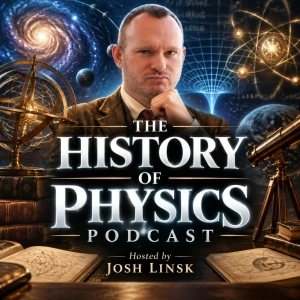
The History of Physics Podcast
The History of Physics Podcast traces how humans have tried to understand motion, matter, light, and the cosmos, from ancient Greek natural philosophy through the Scientific Revolution and modern physics. Episodes cover figures such as Galileo, Kepler, Newton, and Einstein alongside thermodynamics, electromagnetism, optics, relativity, quantum theory, nuclear and particle physics, and cosmology. The show examines famous experiments, rivalries, failed theories, instruments, laboratories, and the social and technological contexts that shaped scientific change. It tells the human story behind the equations and the long arc of discovery that built modern physics.
Episodes

Kepler’s Break from Circularity: How Ellipses Revolutionized Astronomy
In this episode we trace how Tycho Brahe’s precise observations forced Johannes Kepler to abandon the long‑held belief that planets move in perfect circles. By discovering elliptical orbits, Kepler not only resolved planetary speed variations but also laid the geometrical groundwork for Newtonian gravity and modern celestial mechanics.
Learn more about your ad choices. Visit megaphone.fm/adchoices

Aristarchus' Heliocentric Revolution: Putting the Sun at the Center
In this episode we trace Aristarchus of Samos’s bold claim that the Earth orbits a gigantic sun—an idea that pre‑dated Copernicus by nearly a millennium. We explore his geometric reasoning, the backlash from geocentric authorities, and how his numbers seeded a paradigm shift that only blossomed when technology caught up.
Learn more about your ad choices. Visit megaphone.fm/adchoices

The Mohist Camera Obscura: From Speculation to Experiment
In this episode we follow the Chinese Mohists’ first recording of the camera obscura around 500 BCE, turning a speculative idea into an experiment that challenged contemporary notions of light and image. We trace its journey through Ibn al‑Haytham’s 10th‑century experiments and see how it laid groundwork for telescopes, lenses, and modern imaging.
Learn more about your ad choices. Visit megaphone.

Galileo’s Telescope: How One Refracting Tube Revolutionized Astronomy
From Lippershey’s first patent to Galileo’s Sidereus Nuncius, this episode follows the birth of modern observational astronomy. It explores how a modest telescope unveiled moons around Jupiter, phases of Venus, and a new world view that overturned centuries‑old geocentrism.
Learn more about your ad choices. Visit megaphone.fm/adchoices

When Heavy Bodies Fell Fast? The Oxford Calculators’ Quest to Quantify Gravity
Explore how 14th‑century scholars at Merton College set out to mathematically describe falling bodies, challenged Aristotle’s long‑standing view, and laid groundwork that would later inspire Newton and the modern physics of motion.
Learn more about your ad choices. Visit megaphone.fm/adchoices

Eddington’s 1919 Eclipse: The First Test of Einstein’s General Relativity
In this episode we follow Arthur Eddington and his team as they set out on the 1919 total solar eclipse to measure starlight bending, a key test of Einstein’s General Relativity. We explore the technical challenges, the political backdrop of post‑war Britain, and how that single measurement reshaped our understanding of gravity, observation, and science communication.
Learn more about your ad choi

The Trinity Test: How a 1945 Explosion Redefined Physics
Explore how the first nuclear detonation at White Sands served as a high‑stakes physics experiment that validated neutron diffusion theory, set new safety and environmental standards, and seeded technologies that underpin modern particle accelerators, fusion research, and quantum diagnostics.
Learn more about your ad choices. Visit megaphone.fm/adchoices

Al‑Biruni's Mountain‑Horizon Experiment: Redrawing Earth's Size in 11th‑Century Persia
In this episode we trace how Al‑Biruni used a simple mountain peak to measure the planet’s radius, challenging contemporary assumptions and laying groundwork for modern geodesy. We explore his methods, the scientific milieu of Ghazni, and the lasting impact on astronomy and measurement.
Learn more about your ad choices. Visit megaphone.fm/adchoices

Boltzmann, Microstates, and the Arrow of Time
This episode follows Ludwig Boltzmann’s revolutionary statistical approach to entropy, showing how his counting of microstates resolved the paradox between reversible microscopic laws and irreversible macroscopic behavior. We explore the debate with Loschmidt and Clausius, the cosmological implications of a low‑entropy beginning, and how this legacy underpins modern thermodynamics, black‑hole phys

Galileo’s Leaning Tower Legend: Myth and the Roots of Experimental Physics
This episode traces how the legendary story of Galileo dropping cannonballs from the Leaning Tower—whether true or embellished—shaped scientific thinking about free fall, challenged Aristotle, and set the stage for Newtonian mechanics. We dig into Renieri’s 1610 experiment, the cultural forces that kept the myth alive, and how modern simulations reveal what really happened.
Learn more about your a

Halley's Comet Prediction: How 1705 Forecasts Shaped Modern Physics
In this episode we trace John H. Halley’s bold 1705 forecast that a comet would return every ~75 years, the first real test of universal gravitation. We explore how his calculation validated Newtonian physics, sparked debates about tides and celestial mechanics, and laid groundwork for today’s orbital dynamics.
Learn more about your ad choices. Visit megaphone.fm/adchoices

Faraday's Field: How Moving Magnets Unlocked Electricity
John‑Sutton Faraday’s 1831 experiment showed that changing magnetic fields generate electric currents, reshaping physics and paving the way for modern electrical technology. The episode traces the experiment’s origins, its reception by contemporaries, and its ripple effects on industry, theory, and society.
Learn more about your ad choices. Visit megaphone.fm/adchoices

The Solar Neutrino Mystery: How a Missing Particle Changed Physics
From Ray Davis’ chlorine experiment in 1968 to the eventual discovery of neutrino oscillations, this episode traces how a puzzling deficit of solar neutrinos forced physicists to rethink both stellar fusion and particle physics. It examines key figures—John Bahcall, Bruno Pontecorvo, and the teams at Super‑Kamiokande and SNO—and shows how this mystery reshaped our understanding of the Sun and earn

Bohr’s Quantum Jumps: How One Postulate Rewrote Atomic Physics
Niels Bohr’s 1913 atomic model introduced the idea of quantized angular momentum and quantum jumps, resolving the puzzling hydrogen spectrum and laying the groundwork for modern quantum theory. The episode traces how this single postulate sparked a revolution in physics, influencing laser technology, quantum computing, and our fundamental understanding of atoms.
Learn more about your ad choices. V

Faraday’s Spinning Disc: From Misstep to Modern Electromagnetism
Explore how Michael Faraday’s experimental curiosity and an initial misconception about static electricity led to the discovery of electromagnetic induction, the formulation of Lenz’s law, and the eventual theoretical unification by Maxwell—shaping everything from generators to modern quantum spintronics.
Learn more about your ad choices. Visit megaphone.fm/adchoices

Einstein vs. Bohr: The Reality Debate that Shaped Modern Physics
This episode traces the fierce 1920s clash between Albert Einstein and Niels Bohr over whether quantum phenomena are real or merely probabilistic descriptions. From Einstein’s hidden‑variable insistence to Bohr’s complementarity principle, we uncover how their arguments set the stage for Bell’s theorem, entanglement experiments, and today’s quantum technologies.
Learn more about your ad choices. V

Aristarchus and the First Heliocentric Idea: How a Greek Mathematician Set the Stage for Modern Astronomy
Explore how Aristarchus of Samos challenged the ancient worldview by proposing that the Sun sits at the center of the universe. Discover his crude measurements, the scientific debates that followed, and how his ideas echoed through centuries to spark the heliocentric revolution.
Learn more about your ad choices. Visit megaphone.fm/adchoices

The Neutron Mystery: How a Misstep Sparked Nuclear Physics
Explore how James Chadwick’s 1932 experiment in Cambridge uncovered the neutron after a surprising neutral radiation signal, how skeptics challenged and later validated the finding, and why this breakthrough launched nuclear reactors, weapons, and space propulsion.
Learn more about your ad choices. Visit megaphone.fm/adchoices

Aristotle’s Falling‑Body Myth: From Ancient Misconception to Modern Experiment
From Aristotle’s 4th‑century claim that heavier bodies fall faster to Galileo’s Tower of Pisa experiment, this episode traces how early tests overturned a long‑standing myth and reshaped the physics of gravity. It highlights key figures like Philoponus, Galileo, and Newton, showing how experimental rigor replaced Aristotelian intuition.
Learn more about your ad choices. Visit megaphone.fm/adchoice

Avicenna’s Mayl and the Dawn of Impulse Theory
Explore how Avicenna’s 11th‑century Persian scholar introduced mayl—a notion of intrinsic motion—challenging Aristotle and sowing seeds that would eventually blossom into Newtonian inertia. We trace the idea through later thinkers like Philoponus and al‑Baghdādī, examining its philosophical roots, experimental aspirations, and lasting influence on modern physics.
Learn more about your ad choices.

Eratosthenes' Shadow: The First Global Measurement
From a simple gnomon in 240 BCE to an estimate of Earth's circumference within a few percent, this episode follows ancient Greek astronomer Eratosthenes and how he used shadows to quantify our planet. It shows how early measurement, critical questioning, and knowledge sharing paved the way for modern scientific methodology.
Learn more about your ad choices. Visit megaphone.fm/adchoices

Mozi’s Pinhole: The Ancient Chinese Camera Obscura that Sparked Modern Optics
In this episode we trace how a 2,600‑year‑old observation of light through a tiny hole—recorded by the philosopher Mozi—laid the first geometric foundation for optics. We explore how this simple experiment challenged prevailing ideas about light in ancient China, influenced Tang‑dynasty art and perspective, and prefigured later developments from Euclid to Maxwell.
Learn more about your ad choices.

Ørsted’s Twitching Compass Needle: How One Experiment Sparked Electromagnetism
In spring 1820, Hans Christian Ørsted discovered that an electric current deflects a compass needle, revealing the intimate link between electricity and magnetism. This simple experiment set off a chain of discoveries—from Faraday’s induction to Maxwell’s equations—that underpin modern electrical technology.
Learn more about your ad choices. Visit megaphone.fm/adchoices

Tycho’s 1572 Supernova: Shattering Aristotle’s Immutable Heavens
Tycho Brahe’s 1572 supernova startled a world that still believed in immutable heavens. By measuring its position with unprecedented precision and finding no parallax, he proved the new star lay beyond the Moon—upending Aristotelian cosmology and laying groundwork for Kepler and modern astronomy.
Learn more about your ad choices. Visit megaphone.fm/adchoices

Ibn al‑Haytham and the Collapse of the Eye‑Beam Myth
In this episode we trace how the ancient eye‑beam theory—claiming sight was an outward missile—held sway for centuries until Ibn al‑Haytham’s pinhole experiment in 12th‑century Cairo provided a reproducible refutation. We explore his experimental method, its impact on scientific methodology, and the long‑term shift toward empirical optics that paved the way for modern physics.
Learn more about you

Michelson–Morley Null Result: How a ‘Failure’ Sparked Relativity
The episode traces how Albert A. Michelson and Edward W. Morley's 1887 interferometer experiment—expecting to detect the elusive ether wind—returned a null result that upended prevailing physics, ultimately paving the way for Einstein’s theory of relativity. We explore the experiment’s design, its reception in the scientific community, and the chain reaction of experiments it inspired.
Learn more

Michelson–Morley and the Demise of Ether: The Experiment That Shaped Modern Physics
In 1887, Michelson and Morley's null result shattered the century‑old ether hypothesis, forcing physicists to rethink light’s behavior and paving the way for Einstein’s special relativity. This episode traces that pivotal experiment, its technological roots in interferometry, and the broader ripple it created—from Lorentz transformations to GPS timing and LIGO’s gravitational‑wave detectors.
Learn

Einstein Proves Atoms with Brownian Motion: Why It Still Matters
In this episode, Josh dives into Einstein’s 1905 Brownian motion paper that finally proved atoms existed, tracing the path from Robert Brown’s pollen observations to Jean Perrin’s experimental confirmation. He explores how this breakthrough cemented statistical mechanics, reshaped measurement standards, and laid groundwork for modern materials science and nanotechnology. The story shows how a simp

Clausius and the Birth of Entropy: From Steam Engines to Information Theory
This episode follows Rudolf Clausius as he transforms a practical problem in steam engine design into the concept of entropy—a cornerstone of modern thermodynamics, statistical mechanics, and even information theory. We trace his work from Carnot’s 1824 insights through Maxwell’s kinetic theory, examine how entropy became a predictive law, and explore its lasting influence on physics, engineering,

Thales and the First Natural Explanation
From a market in Ionia to the birth of scientific reasoning, this episode follows Thales of Miletus as he uses observation and geometry to argue that all matter is made of water. We trace how his bold hypothesis challenged mythic explanations, sparked predictive astronomy, and laid the groundwork for modern experimental physics.
Learn more about your ad choices. Visit megaphone.fm/adchoices

Aryabhata’s Rotating Earth: Myth, Misstep, or Early Breakthrough
Explore how 5th‑century Indian astronomer Aryabhata challenged the static Earth model by proposing that our planet rotates on its axis. The episode traces his calculations, contemporary debates, and the lasting impact of this early insight on later astronomy and modern physics.
Learn more about your ad choices. Visit megaphone.fm/adchoices

Einstein’s Brownian Motion: The Proof That Atoms Really Exist
Einstein’s 1905 paper on Brownian motion linked microscopic thermal agitation to observable particle jitter, offering a testable prediction about atoms. Jean Perrin’s meticulous experiments confirmed the theory, providing concrete evidence that atoms exist and solidifying statistical mechanics. The episode examines how this breakthrough shifted physics from speculation to empirical certainty and s

Huygens Builds a Better Clock: From Pendulum Theory to Reliable Time‑Keeping
Christiaan Huygens’ breakthrough in pendulum clocks—turning Galileo’s observation into the cycloidal escapement—revolutionized precision time‑keeping, reshaped navigation at sea, and set a precedent for experimental physics. This episode explores his mathematics, collaborations, and lasting legacy.
Learn more about your ad choices. Visit megaphone.fm/adchoices

The Telescope That Turned the Sky Into a Laboratory
Galileo’s first practical telescope revealed Jupiter’s moons, sunspots, and a rugged moon, challenging Aristotelian cosmology and sparking advances in optics, measurement, and scientific culture. This episode traces how that tiny spyglass reshaped observation, theory, instrumentation, funding models, and even modern high‑resolution probes.
Learn more about your ad choices. Visit megaphone.fm/adcho

Tycho Brahe’s 1572 Supernova: The Event That Shattered Celestial Perfection
In November 1572 a bright new point in the sky challenged Aristotle’s immutable heavens. Tycho Brahe’s meticulous measurements proved the star was a supernova beyond the Moon, reshaping astronomy and laying groundwork for cosmology and quantum physics.
Learn more about your ad choices. Visit megaphone.fm/adchoices

Dirac’s 1928 Prediction of Antimatter: From Equation to Positron
In 1928 Paul Dirac wrote a relativistic wave equation that mathematically demanded negative‑energy states, hinting at antimatter. His theoretical insight set the stage for Carl Anderson’s 1932 observation of the positron, reshaping particle physics and leading to everyday technologies such as PET imaging.
Learn more about your ad choices. Visit megaphone.fm/adchoices

Michelson–Morley Null Experiment: How a ‘Nothing’ Result Still Shapes Physics
The episode explores the 1887 Michelson–Morley interferometer, its unexpected null result that challenged the ether hypothesis, and how that failure sparked Einstein’s special relativity. It traces the experiment’s legacy—from precision tests of Lorentz invariance to modern gravitational‑wave detectors like LIGO—and highlights why a ‘nothing’ finding can be one of physics’ most transformative mome

Galileo’s Cannonball Parabola: From Pisa Tower to Modern Physics
In 1609, Galileo dropped balls from the Leaning Tower of Pisa and discovered that projectile motion follows a parabolic curve—an insight that would shape classical mechanics, engineering, and even data science today. This episode unpacks how his humble experiment broke Aristotelian conventions, forged links to Newton’s laws, and echoes in GPS satellites and rocket trajectories.
Learn more about yo

Archimedes and the Near‑Invention of Calculus
This episode explores how Archimedes’ method of exhaustion foreshadowed integral calculus, tracing its impact from ancient geometry through Newton’s fluxions to modern mathematical thought. We examine his geometric techniques, key contemporaries, and the long‑term influence on physics and engineering.
Learn more about your ad choices. Visit megaphone.fm/adchoices

Eddington’s 1919 Eclipse: Einstein’s Gravity Bends Light
Follow Arthur Eddington’s daring 1919 eclipse expedition that measured starlight deflection, providing the first experimental confirmation of Einstein’s General Relativity and reshaping our view of gravity.
Learn more about your ad choices. Visit megaphone.fm/adchoices

Boltzmann & the Arrow of Time: Myth, Paradox, and Legacy
Explore Ludwig Boltzmann’s 19th‑century gamble that statistical physics could explain why entropy rises, the fierce challenges from Loschmidt, Zermelo, and others, and how his ideas seeded modern thermodynamics, cosmology, and even quantum information. The episode traces the debate’s roots, its impact on science policy, and what the arrow of time means today.
Learn more about your ad choices. Visi

Frog Leg Twitches: Galvani’s Experiment That Sparked Bioelectricity
In this episode we follow Giovanni Battista Galvani’s startling observation of a frog’s leg twitching when struck by a metal rod, the spark that pushed physics from static charge to dynamic currents. We explore how the debate with Alessandro Volta led to the voltaic pile and laid the foundation for modern electrophysiology and electrical engineering.
Learn more about your ad choices. Visit megapho

The Double‑Slit Experiment: One Particle at a Time
From Thomas Young’s early 1800s demonstration to the modern quantum‑computing era, we trace how the humble double‑slit setup has reshaped our understanding of waves and particles, challenged interpretations, and driven technology from cryptography to gravitational wave detectors.
Learn more about your ad choices. Visit megaphone.fm/adchoices

de Broglie’s Matter‑Wave Hypothesis: How One Equation Reshaped Physics
From a 1920s leap in thinking to today’s quantum technologies, we trace Louis de Broglie's bold proposal that particles have wavelengths, the experiments that proved it, and how this insight fuels modern physics.
Learn more about your ad choices. Visit megaphone.fm/adchoices

Copernicus Moves the Earth: What Everyone Expected—and What Nature Did Instead
In this episode we dive into Nicolaus Copernicus’ audacious heliocentric model that flipped the universe on its axis. We trace how his geometry challenged centuries of astronomy, the experimental limits of the era, and the ripple effects through Kepler, Newton, and modern cosmology.
Learn more about your ad choices. Visit megaphone.fm/adchoices

Chadwick Finds the Neutron: Why It Still Matters
In the early 1930s at Cambridge’s Cavendish Laboratory, James Chadwick uncovered a neutral particle hidden in alpha‑particle bombardments of beryllium. His meticulous measurements proved the neutron’s existence, resolving atomic number–mass conflicts and opening doors to nuclear reactions, reactors, weapons, and modern research tools.
Learn more about your ad choices. Visit megaphone.fm/adchoices

Clausius and the Birth of Entropy – From Steam Engines to Thermodynamic Insight
Explore how German physicist Rudolf Clausius, chasing steam engine efficiency, inadvertently coined entropy. This episode traces his 1850 paper, the collapse of caloric theory, and the ripple effects that forged modern thermodynamics.
Learn more about your ad choices. Visit megaphone.fm/adchoices

Newton’s Universal Gravitation: From Falling Apples to Moon Orbits
Explore how Isaac Newton combined observations of falling apples and celestial motion into the first universal law of gravity, reshaping physics and setting the stage for modern science.
Learn more about your ad choices. Visit megaphone.fm/adchoices

Einstein’s Falling Elevator: From Thought Experiment to Weightless Reality
Explore how Einstein’s 1907 free‑falling elevator idea birthed the equivalence principle, reshaped our understanding of gravity and time, and laid the groundwork for modern GPS technology.
Learn more about your ad choices. Visit megaphone.fm/adchoices

Heisenberg’s Uncertainty Principle: Why It Still Matters
From its birth in Heisenberg’s 1927 letter to Pauli, the uncertainty principle reshaped quantum mechanics and challenged classical intuition. The episode traces how the idea emerged from matrix mechanics, sparked debates between Einstein and Bohr, and became a cornerstone for modern technologies like quantum computing and gravitational‑wave detection. It shows why this seemingly abstract limit rem

Aryabhata’s Earth‑Spinning Revelation: The 499 CE Rotating‑Earth Revolution
In this episode we trace how a 23‑year‑old Aryabhata, in 499 CE, argued that Earth rotates on its axis, using eclipse observations and geometry to calculate a sidereal day and circumference. We explore how his daring claim challenged the prevailing Greek and Vedic models, sparked debate across India and the Islamic world, and laid groundwork for later astronomers.
Learn more about your ad choices.

Hearing the Universe: Penzias & Wilson’s 1965 Cosmic Background Discovery
An unexpected hiss in a Bell Labs horn antenna turned into proof of the Big Bang. In this episode we trace how Arno Penzias and Robert Wilson’s meticulous measurements, Robert Dicke’s theoretical predictions, and the ensuing confirmation reshaped cosmology and set a new standard for observational science.
Learn more about your ad choices. Visit megaphone.fm/adchoices

Fission Unveiled: How Meitner & Frisch Rewrote Nuclear Physics
In this episode we trace the moment when Lise Meitner spotted barium in irradiated uranium and realized a nucleus could split, sending Otto Frisch to confirm it. The discovery of nuclear fission not only unlocked atomic energy but also reshaped global politics through the Manhattan Project and the rise of nuclear power. Join us as we follow the science, the people, and the geopolitical ripple that

Ptolemy’s Epicycles: How Ancient Astronomy Laid the Groundwork for Modern Physics
From Alexandria’s star charts to Copernicus’s heliocentric tables, Ptolemy’s system of circles upon circles kept astronomy alive for a millennium and seeded the iterative modeling that underlies Newton, Maxwell, and today’s data pipelines. The episode traces how this geometric trick bridged cultures, institutions, and scientific epochs.
Learn more about your ad choices. Visit megaphone.fm/adchoice

Mass Becomes Energy: From E=mc² to the Nuclear Chain Reaction
This episode traces how Einstein’s early mass‑energy idea evolved into the discovery of nuclear fission, the birth of chain reactions, and the profound scientific, political, and cultural impact that followed—from 1905 relativity to 1942 Chicago Pile‑1 and beyond.
Learn more about your ad choices. Visit megaphone.fm/adchoices

Galileo's Leaning Tower Experiment: Myth, Measurement, and the Birth of Modern Physics
This episode examines the famous but debated story of Galileo dropping weights from Pisa to challenge Aristotle’s ideas about falling bodies. We trace how the experiment—real or imagined—shaped the concept of uniform acceleration, influenced Newton’s laws, and sparked a broader debate about measurement standards in early modern science.
Learn more about your ad choices. Visit megaphone.fm/adchoice

Avicenna’s Mayl: From Persian Impetus to Newtonian Inertia
Explore how the 11th‑century Persian scholar Avicenna introduced the idea of “mayl,” an early form of impetus that challenged Aristotle’s view and foreshadowed Newton's law of inertia. The episode traces the transmission of this concept through Islamic scholarship into European thinkers like Gassendi and Buridan, culminating in its influence on modern physics.
Learn more about your ad choices. Vis

When a Comet Came Early: Halley's Prediction, Newton's Gravity, and the Birth of Orbital Perturbation
Edmond Halley’s daring forecast of a returning comet set the stage for the first real test of universal gravitation. When the 1758 apparition arrived a few weeks late, astronomers uncovered Jupiter’s subtle tug on its path, sparking the development of perturbation theory that underpins modern celestial mechanics.
Learn more about your ad choices. Visit megaphone.fm/adchoices

The Oxford Calculators: Unveiling Uniform Acceleration in Medieval Physics
Explore how the 14th‑century Oxford Calculators challenged Aristotle’s falling‑body law by applying geometry to motion, discovering that acceleration is independent of mass. Their work set the stage for Newton and modern kinematics, illustrating the power of translation and cross‑cultural scholarship.
Learn more about your ad choices. Visit megaphone.fm/adchoices

Democritus’s Atom Theory: The First Spark of Modern Physics
From the bustling agora of Abdera to the particle detectors at CERN, this episode traces how Democritus’s idea that all matter is composed of tiny, indivisible particles set the stage for modern chemistry and physics. We examine the philosophical roots, Dalton’s experimental confirmation, and how the atom has evolved into the sub‑atomic world we explore today.
Learn more about your ad choices. Vis

Carnot's Thermodynamic Ceiling: How a Young Engineer Redefined Heat Engines
In 1824, Sadi Carnot showed that the efficiency of any heat engine is limited by its operating temperatures—a discovery that set the foundation for modern thermodynamics and reshaped industrial design. This episode traces Carnot’s reasoning, the scientific context before his insight, the reaction from contemporaries, and how his theorem continues to guide engineers today.
Learn more about your ad

Tycho’s Nova & Archimedes’ Lever: From Sky Shocks to Mechanical Foundations
This episode follows Tycho Brahe’s meticulous observations of the 1572 supernova that proved the heavens could change, and traces how Archimedes’s lever theorem laid the groundwork for modern mechanics. We explore the science, the instruments, the political support, and the lasting impact on physics and engineering.
Learn more about your ad choices. Visit megaphone.fm/adchoices

Eratosthenes' Shadow Experiment: Measuring the Earth in 240 BCE
In 240 BCE, Eratosthenes used a shadow‑casting stick to estimate the Earth’s circumference, pioneering large‑scale measurement of our planet. His method combined geometry with careful observation, laying groundwork for modern cartography and navigation.
Learn more about your ad choices. Visit megaphone.fm/adchoices

Hertz’s First Spark: The Birth of Invisible Radio Waves
In this episode we follow Heinrich Hertz as he proves Maxwell's electromagnetic waves with a spark‑gap transmitter, turning abstract equations into tangible radio waves. We explore how his experiments challenged the ether hypothesis, opened the door to wireless communication, and reshaped physics in the late 19th century.
Learn more about your ad choices. Visit megaphone.fm/adchoices

Eddington’s 1919 Eclipse Experiment: First Proof That Gravity Bends Light
In this episode we trace how a daring 1919 solar‑eclipse expedition led by Arthur Eddington captured the tiny deflection of starlight, delivering the first empirical confirmation that gravity curves space. We explore Einstein’s prediction, the experimental challenges, the controversy over data, and the lasting impact on modern physics.
Learn more about your ad choices. Visit megaphone.fm/adchoices

Vera Rubin and the Discovery of Dark Matter
Vera Rubin’s meticulous measurements of spiral galaxy rotation curves revealed a startling anomaly—stars far from galactic centers moved at unexpected speeds, pointing to unseen mass.
Her work laid the empirical foundation for the dark matter hypothesis and reshaped our understanding of cosmology.
Explore how Rubin's data, rigorous methodology, and persistence overturned Newtonian expectations and

Tycho’s 1577 Comet: The Night That Crushed the Crystal Spheres
When Tycho Brahe recorded a bright comet in November 1577, he forced Aristotle’s crystal‑sphere model to collapse and opened the way to empirical astronomy. This episode traces how meticulous naked‑eye measurements, early triangulation, and international data sharing dismantled ancient cosmology, inspired Kepler’s planetary laws, and laid foundations for modern celestial mechanics.
Learn more abou

Faraday’s Magnetic Spark: From Coil to Global Power
In this episode we trace James Clerk Faraday’s 1831 experiment that revealed how a moving magnet induces electricity. We explore how his empirical laws, the ‘lines of force’, paved the way for Maxwell’s equations and the birth of electric generators that powered the Industrial Revolution. The story shows how curiosity, simple apparatus, and a bold insight sparked an entire era of technology.
Learn

Boltzmann’s Arrow of Time: From Entropy to the Quantum Age
Ludwig Boltzmann’s H‑theorem laid the statistical foundation for entropy, revealing why the universe seems to flow forward in time. In this episode we trace how his insight sparked debates from Poincaré’s recurrence to black‑hole thermodynamics and even modern data science.
Learn more about your ad choices. Visit megaphone.fm/adchoices

Einstein’s Light Quanta: How a 1905 Idea Turned Photons Into Particles
Einstein’s 1905 insight that light comes in discrete packets—photons—challenged the prevailing wave model and laid the groundwork for quantum mechanics. This episode traces the birth of the photon concept, its experimental validation through the photoelectric effect, and how it sparked modern technologies like lasers, quantum cryptography, and superconducting qubits.
Learn more about your ad choic

The Pinholes That Sparked Modern Optics: From Ancient China to Maxwell
This episode traces the journey of the Mohist camera obscura, an early pinhole experiment recorded by 5th‑century BCE Chinese scholars. It explores how this simple observation led to systematic studies by Alhazen and Kepler, ultimately feeding into Maxwell’s field theory and reshaping our understanding of light.
Learn more about your ad choices. Visit megaphone.fm/adchoices

Democritus & the Ancient Atom: How 5th‑Century Greek Thought Sparked Modern Physics
Explore how Democritus’ bold claim that matter is built from indivisible atoms and void laid a mechanistic worldview that later powered Newton, Dalton, and quantum physics. We trace his philosophical laboratory to modern atomic theory, revealing why this ancient speculation still fuels curiosity today.
Learn more about your ad choices. Visit megaphone.fm/adchoices

Faraday’s 1831 Experiment: The Moment That Ignited Electric Power
In this episode we dive into Michael Faraday’s groundbreaking experiment with a moving magnet and a coil, uncovering how the change in magnetic flux creates an electric current. We trace its impact from the early generators that lit factories to the foundational principles behind Maxwell’s equations and modern electromagnetism.
Learn more about your ad choices. Visit megaphone.fm/adchoices

Solar Neutrino Mystery: From Discrepancy to Oscillation
In the 1960s, physicists found a puzzling shortfall in solar neutrinos that challenged our understanding of stellar fusion. This episode traces how John Bahcall’s predictions, Davis’s underground experiment, and Bruno Pontecorvo’s bold hypothesis converged to reveal neutrino oscillations—transforming particle physics and opening new questions about the universe.
Learn more about your ad choices. V

Chadwick’s Neutron Discovery: Experiment, Calculation, Impact
In 1932, James Chadwick used alpha‑particle bombardment of beryllium to reveal the neutral neutron—a finding that resolved mass‑charge inconsistencies and paved the way for nuclear fission. The episode traces his clever experimental setup, the data that convinced skeptics, and how the neutron became central to modern physics.
Learn more about your ad choices. Visit megaphone.fm/adchoices

Schrödinger’s Wave Misstep: From Failed Equation to Quantum Revolution
Discover how Erwin Schrödinger’s bold attempt to turn electrons into waves almost flopped, yet set the stage for matrix mechanics and the modern quantum framework—unpacking the science, the culture, and the unexpected ripple effects that reshaped physics.
Learn more about your ad choices. Visit megaphone.fm/adchoices

Hertz’s Spark‑Gap Experiment: Revealing Invisible Radio Waves
In this episode we trace how James Clerk Maxwell’s theoretical prediction of electromagnetic waves led Heinrich Hertz to the first laboratory confirmation using a spark‑gap transmitter and receiver. We explore the technical challenges, the debate over light as a wave, and how this breakthrough sparked the wireless revolution that shaped modern communication.
Learn more about your ad choices. Visit

Calculus Wars: How Newton, Leibniz, and Their Notation Changed Physics Forever
Explore the fierce 17th‑century battle over calculus between Newton and Leibniz, how their conflicting notations shaped physics, and why that debate still echoes in modern equations.
Learn more about your ad choices. Visit megaphone.fm/adchoices

The Pisa Drop: Galileo’s Tale of Two Falling Balls
In this episode we investigate the legendary experiment where Galileo supposedly dropped two balls from the Leaning Tower of Pisa to prove that weight does not affect acceleration. We trace the story’s origins, debate its historicity, and explore how it helped overturn Aristotelian physics, set the stage for Newton’s laws, and shaped modern experimental methods.
Learn more about your ad choices. V

Archimedes and the Birth of Calculus: How an Ancient Idea Shaped Modern Physics
In this episode we trace Archimedes’ geometric method of exhaustion, a proto‑calculus that paved the way for Newton’s laws, Maxwell’s equations, and quantum mechanics. We explore how his 3rd‑century insights into limits and infinitesimals seeded the mathematical language that governs today’s physics experiments and theories.
Learn more about your ad choices. Visit megaphone.fm/adchoices
Recommended

The Bread and Banter Podcast

The Church of What's Happening Now: The New Testament

Busted Open

Deadline: White House

Crickets Corner

History of the Earthquake and Fire in San Francisco

Fox news

K-Drama Obsessed Mamas | Beyond “Just One More Episode!”

True Crime Classics

The Healer Revolution

Becoming: HER with Nikki Spoelstra

Booked, Blonde & Busy w/ Olivia Ponton
