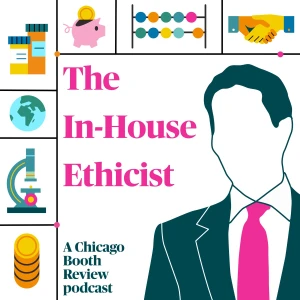
The In-House Ethicist
John Paul Rollert 28 episodes Oct 15, 2026
The In-House Ethicist explores moral dilemmas people face at work, in society, and at home. Host John Paul Rollert avoids simple feel-good answers and instead applies a "Great Books" approach associated with the University of Chicago. The show draws on history, literature, philosophy, political economy, contemporary culture, and business experience. It is a Chicago Booth Review podcast aimed at listeners who want to think harder about ethical questions.
Episodes
I'm Losing Adam Smith's Religion
Over the past decade, polls have consistently shown that young people are far less enamored with capitalism than the generations that preceded them. Their crisis of faith in the system is met with consternation by their elders, who are often inclined to wonder aloud What's the matter with these kids, today? In this episode of the In-House Ethicist, John Paul Rollert explores why some of his own st
Soon We'll All Be Influencers
What will the world look like for our grandchildren a century from now? The economist John Maynard Keynes famously asked this question in his 1928 essay, "Economic Possibilities for our Grandchildren," and the future he saw included a world of plenty and 15-hour work weeks. In this episode of the In-House Ethicist, John Paul Rollert follows Keynes's lead and looks another 100 years into the future
Money On My Mind
Money weighs on the minds of almost everyone from time to time, but the way a rich person tracks his stock gains and the poor man tallies his pennies is different in degree and kind. In this episode of the In-House Ethicist, John Paul Rollert takes up the different ways in which money can preoccupy us, drawing on insights of writers like John Maynard Keynes, Karl Marx, and William Shakespeare as w
CEO's, You Can Forget about Milton Friedman
When it was first published in The New York Times in 1970, Milton Friedman's "The Social Responsibility of Business Is to Increase Its Profits" heralded a new way of thinking about the mission of a company and helped to shift Corporate America from a stakeholder vision of capitalism to one that gave shareholders pride of place. In this episode of the In-House Ethicist, John Paul Rollert looks at s
Bring in the Craftsman
Today, when we think of craft-based products, we tend to think of high end goods: Ferraris, Ferragamo shoes, and fine wines. But are the crafts merely reserved for the super wealthy, and what can we learn from the spirit of craftsmanship in a modern mechanized world? In this episode of the In-House Ethicist, John Paul Rollert takes up the modern legacy of craftsmanship as embodied in Oxxford cloth
Uber and the Dark Arts of Algorithmic Management
You don't need to be a card carrying communist to appreciate the familiar tension between employees and management, but what happens when your boss is an app? In this episode of the In-House Ethicist, John Paul Rollert explores the ways in which Uber has tried to perfect the art of app based management. He catalogues the ways in which the company nudges and controls its drivers and discusses how t
Money's Dark Magic
Money can buy you a lot of nice things, but what about when its power goes beyond the ability to purchase a penthouse or a Porsche? When money allows us to buy non-material goods – such as status, power, or personal advancement – how does it change the way we look at ourselves and how we decide to spend our days? In this episode of the In-House Ethicist, John Paul Rollert draws on a wide array of
Yelp to the Rescue
Trust is crucial in commercial transactions. We want to know if the people we do business with are reliable, but if we don't know them personally, how can we be so sure that we should trust the individual on the other side of the negotiating table or the shop counter? In this episode of the In-House Ethicist, John Paul Rollert takes up questions of trust in business, a matter he became attuned to
Lying Is Just Part of Business. Right?
When it comes to marketing, negotiations, and salesmanship, companies seem to tolerate a lot of what we might call "little white lies." Does such permissiveness say something essential about business, or does it say more about the type of people who typically conduct it? In this episode of the In-House Ethicist, John Paul Rollert takes up the role of lying in business. He considers a classic essay
Guess What! The Company Does Not Care About You
As children, the way our parents look at us often gives us the impression that we are the most important person in the world. Yet as we grow older, we often find that we've gone from being the center of the universe to a tiny cog in a corporate machine. In this episode of the In-House Ethicist, John Paul Rollert takes up why we often feel that companies don't care about us. As he explains, it's no
Make Way For The New Puritans
There is a group of young men online who spend a lot of time talking about what they call "productivity hacks." They are obsessed with how to make their days more productive, but their advice seems more consistent making a promising individual more like a robot than a fully formed human being. In this episode of the In-House Ethicist, John Paul Rollert explores this productivity fad and ties it to
The Fallacy of the Valedictorian
Being at the head of the class has many benefits, but we all know that academic success isn't a one way ticket to the C-Suite. What the classroom rewards and what professional success requires are not one and the same thing – a lesson that some Valedictorians among us seem to learn the hard way. In this episode of the In-House Ethicist, John Paul Rollert reflects on what Valedictorian-types should
Hotdogs and Hard Choices
Unless you're a sociopath, it's normal to feel like there are some duties you owe others and to the world around you. We feel compelled to clean up after ourselves when we make a mess or to check in Mom when she isn't feeling well. But when we think about the full scope of the duties that might oblige us – should we do something about climate change or global poverty? – we can quickly find ourselv
The Many Faces of Capitalism
When people think about capitalism, they don't think of abstract ideas at the heart of an economic system. They think about the things that system produces: the products, the companies, and perhaps most notably, the people. Just as capitalism has changed with technology and culture over time, so have the people most associated with it, from Benjamin Franklin to the suspendered stockbrokers of the
Customers Gone Wild
Is the customer always right? In a world in which all sales are final, some buyers are bound to get duped. But if the customer's always right, what can retailers do about unreasonable customers? In this episode of The In-House Ethicist, John Paul Rollert looks for a balance between honoring customers and indulging them.
You think you're frugal but maybe you're just cheap
Why is being frugal a virtue? And where exactly do we draw the line between being "frugal" and being "cheap"? In this episode of The In-House Ethicist, John Paul Rollert traces the history of frugality from the 18th century to today, explaining why it continues to be relevant as a moral yardstick.
must you loose your morals on wall st?
Michael Lewis's Liar's Poker is a frank and ugly behind-the-scenes account of life as a young associate in the world of Wall St finance. The book is 35 years old, but the basic dilemma at its heart – whether follow your conscience or your bank balance—remains pertinent. In this episode of The In-House Ethicist, John Paul Rollert reflects on what the book tells us about ourselves and our profession
American Psycho Revisited
Stakeholder capitalism is the idea that business should be about more than just making money. That seems a world away from the brash financial types of Bret Easton Ellis's 1991 novel 'American Psycho,' or the 1987 movie 'Wall Street.' But in this episode of the The In-House Ethicist, Chicago Booth's John Paul Rollert asks how much we have really moved on, and reflects on the continuing relevance o
Handouts? Hold On!
Some people say that you don't help the poor by giving them money, but by giving them opportunities to earn money. This is behind the periodic campaigns to limit welfare benefits in order to encourage work. But is a handout necessarily different from a hand-up? In this episode of The In-House Ethicist, John Paul Rollert reflects on how we think about helping the poor and charitable giving.
The kids are alright
What is within the power of free markets? What can capitalism do for society, what can't it do, and what should it do? On this episode of the The In-House Ethicist, Booth's John Paul Rollert explores how many people came to have an unshakeable faith in capitalism's broad ability to solve nearly any problem, while the experience of others has left them skeptical. In the era after "the end of histor
Hey Jeff Bezos. How About You give a 100 Billion to the Humanities
What should the uber wealthy do with their money? How can they leave a lasting legacy? And what responsibilities do they have to society at large? On this episode of the The In-House Ethicist, Booth's John Paul Rollert reflects on the role of those at the very top of the 1 percent.
Is Being a Selfish Jerk Really in Your Self Interest?
Individuals acting in their own self-interest are, according to classical economics, an important part of a productive, efficient economy. And yet, selfishness is among the personality traits best known for impeding healthy human relationships. How do we separate the two concepts? On this episode of The In-House Ethicist, John Paul Rollert explores how we define the line between them, and why tha
Chick-Fil-A and Activist Capitalism
When a business's customers object to its conduct, they generally have two options: exit (vote with their wallets and cut ties with the company) and voice (boycott, protest, or otherwise raise awareness of their complaint). Social media has changed the calculus behind this choice for both individuals and companies. On this episode of the The In-House Ethicist, John Paul Rollert considers the impac
The Rotten Apples of Steve Jobs
Streaming services love a good tech startup business story, preferably one featuring a quirky CEO devoid of self-awareness, with an oversized ego and grandiose sense of ambition and purpose, and one finger always resting on the self-destruct button. Hence Super Pumped, the story of Travis Kalanick and Uber, The Dropout, about Elizabeth Holmes and Theranos, and WeCrashed, the tale of Adam Neumann a
Boardroom Bullies
Many of us have seen bullying behavior at work. And though we might not like to admit it, many of us have failed to do anything about it. That can reflect the difficult trade-offs that come with calling out bullying: subjecting ourselves and others to scrutiny, completely changing the dynamic between colleagues, and potentially damaging your own career. In this episode of The In-House Ethicist, Jo
Does It Matter If You Sell Out?
What does it mean to sell out? What should we make of the tradeoffs we accept between our personal aspirations and professional successes? At what point do such tradeoffs become ethically problematic? On this episode of The In-House Ethicist, John Paul Rollert considers what makes someone a sellout—and whether being one really matters.
Clean your own toilet for a change.
One of the byproducts of growing inequality is that many wealthier people grow up, live, and work without ever knowing someone who is poor or struggling financially. On this episode of The In-House Ethicist, John Paul Rollert explores if the wealthy have an obligation to know what life is like for those on the lower end of the income spectrum?
Buck Passing and Buck Raking
Thanks to the growth of index funds, more and more of us own passive investments. To what extent are we responsible for what goes into those index funds? In this episode of the In-House Ethicist, Chicago Booth's John Paul Rollert asks if there really is such a thing as a truly "passive" investment.
Recommended
Dark Night Tales with Brian King

Fox news
CBS Radio Mystery Theater | Old Time Radio

Old Time Radio Mystery, Suspense, & Horror

ABC News Update

Learn English Fast! English Snacks with Amber - Short Lessons to Speak English Like a Native

این نقطه
This Past Weekend w/ Theo Von

100 Greatest Old Time Detective Stories

Fantasy Flex
Classic Radio Theater with Wyatt Cox

Take Back Your Health®
