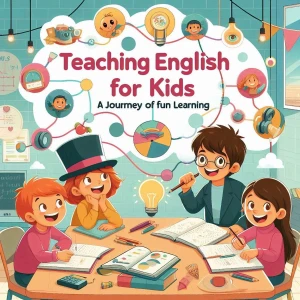
Teaching English to Kids: A Journey of Fun Learning
Teaching English to Kids: A Journey of Fun Learning bridges the gap between ELT theory and practical classroom activities. Each episode covers SLA theory, classroom management, curriculum planning, and phonics, then translates them into game-based learning. Discover creative strategies for storytelling, songs, and lesson design that spark curiosity and build confidence in young learners. Join a community of educators transforming language learning with evidence-based strategies and playful inspiration.
Episodes
From talk to text : What a child's brain has to juggle to write in English.
Send us Fan MailHe told you a hilarious story about his dog. So why did he write only three flat sentences?This week we reach the fourth and final skill of the season: writing. And we start with what makes it the hardest juggling act in the classroom — and what we can do to lighten the load.In this episode, you'll discover:Why children say more than they write – Hayes & Flower's mode
From words to worlds : How children move from reading words to understanding stories.
Send us Fan MailShe reads every word correctly. So why can't she tell you what happened?Last week we cracked the code. This week we look at what happens after the code: how children move from reading words to building a whole story in their heads, and how to choose texts that make them want to keep reading.In this episode, you'll discover:Why decoding can leave no room for meaning – LaBe
What a child's brain has to do to learn to read in English
Send us Fan MailShe's a great reader — in Spanish. So why does said come out as "sa-eed"?This week we cross into our third language skill of the season: reading. And we start underneath the classroom, with what a child's brain actually has to build to turn marks on a page into meaning.In this episode, you'll discover:Why no child is born to read – Dehaene's neuronal r
From Words to Conversation – Turn-Taking, Dialogue and Assessing Oral Production
Send us Fan MailShe can produce a perfect sentence. She just can't have a conversation with it.Last week we found the words and the willingness to speak. This week we build the machine that turns isolated sentences into real, back-and-forth talk. Topics: turn-taking rules almost nobody teaches (Sacks, Schegloff & Jefferson), linguistic vs. interactional competence, whether children really
Speaking Skills: How to build oral fluency through meaningful interaction
Send us Fan MailFor three weeks we have built the listening foundation. This week, we let them speak.Some children understand everything and say almost nothing. Others repeat everything and freeze when asked a real question. Both raise the same question: how do we get from comprehension to communication?In this episode, you'll discover:Why speaking is the most cognitively demanding of the fou
Supporting Materials and Visual Resources for Listening Development
Send us Fan MailLast week, we explored four strategies for improving listening skills. This week, we focus on something often overlooked but absolutely essential: the role of supporting materials and visual resources in listening development.Visual resources—ranging from images and videos to infographics and realia—have been shown to enhance comprehension and retention, fostering a more engaging a
Strategies for improving Listening Skills – From passive hearing to active comprehension.
Send us Fan MailLast week, we explored why listening is the foundation of all language acquisition. This week, we move from theory to practice.In this episode, we dive into four powerful, research‑backed strategies for improving listening skills in young learners: collaborative learning, scaffolding techniques, technology integration, and formative assessment.Drawing on cognitive, social, and inte
The Foundation of Fluency: Why Listening Comes First and How to Build It
Send us Fan MailSeason 3 is here – and we're starting where language acquisition itself starts: with listening.Over the past two seasons, we've built our foundational toolkit and developed the Mindful Facilitator's mindset. Now, in Season 3, we apply everything we've learned to the four core language skills. And we begin with the skill that underpins all others: listening.Recen
A Season of Growth, A Future of Impact - Let's wrap up season 2
Send us Fan MailIt's the Season 2 finale! After 17 episodes of exploring the neuroscience of play, vocabulary recycling, TPR, project‑based learning, word walls, visual organisers, and the art of being a Mindful Facilitator, we've reached the end of our journey – and it's time to celebrate.In this special finale episode, host Paola Pando brings together the most important ideas from
Visual Organisers – Building connected vocabulary for deep learning.
Send us Fan MailWord walls make vocabulary visible. Visual organisers make vocabulary connected. Together, they create a classroom where vocabulary is not just taught – it is lived.In this episode, we explore the neuroscience behind why graphic organisers, concept maps, the Frayer Model, and semantic feature analysis build the semantic networks that are essential for fluency. Learn how these tools
How Word Walls Build a Language-Rich Environment
Send us Fan MailYour classroom walls are silent. But what if they could teach? In this episode, we explore how word walls and visual organisers create a language-rich environment where vocabulary is constantly recycled, visible, and unforgettable.Discover the neuroscience behind why visible vocabulary lowers the Affective Filter, reduces cognitive load, and builds the semantic networks essential f
The Neuroscience of Play – Why games are not an extra, but an essential
Send us Fan MailThink back to your own childhood. What do you remember most vividly? The worksheets? The grammar drills? The vocabulary lists?Probably not. What you remember are the games – the moments when learning felt like play. That's not a coincidence. It's how the human brain is wired.In this episode, we explore the neuroscience of play – why games are not just a fun way to end a l
Little Hands, Big Ideas – Project-Based Learning for Young English Minds
Send us Fan MailWhat's the most memorable learning experience have you ever had? Was it a worksheet? A grammar drill? A vocabulary list?Probably not. The most powerful learning happens when we are doing – creating, solving, building, and collaborating. That's exactly what Project-Based Learning (PBL) offers.In this episode, we explore how PBL transforms the young learner's English c
The Vocabulary Recycling Revolution – Why revisiting words is the engine of fluency.
Send us Fan MailYou taught the vocabulary. They passed the quiz. Two weeks later, it's gone. Sound familiar?This is the linear teaching trap – and it's one of the most common design flaws in language programmes. The 2024 Hamdane & Hamdane study found that vocabulary recycling is not just "helpful" – it is compulsory for enhancing young learners' productive abilities, p
The Silent Period – Why silence is not empty, and what to do while they listen.
Send us Fan MailA new student joins your class. She watches. She follows instructions. She points when asked. But she doesn't speak. Weeks pass. Still, almost no words.Is something wrong? No. She is in the Silent Period – a natural, necessary, and deeply active phase of second language acquisition.In this episode, we explore the neuroscience of the Silent Period: what is actually happening in
The Stress‑Free Assessment – How to know what they know without a single test
Send us Fan MailFriday afternoon. A vocabulary test. Students freeze, guess, or cry. Days of grading later, you learn almost nothing new – except that tests are stressful.Traditional testing often measures anxiety, not acquisition. But assessment can be different – quick, stress‑free, and genuinely informative.In this episode, we explore five low‑prep, brain‑friendly assessment strategies you can
Curriculum that teaches itself – Smart design for more impact and less stress.
Send us Fan MailDoes lesson planning drain your energy before you even step into the classroom? What if your curriculum could do more of the heavy lifting, freeing you to focus on what matters most – your students?In this milestone episode, we bring together everything we've learned across two seasons to tackle the ultimate sustainable teaching challenge: curriculum design that reduces planni
Universal Design for Learning + Individualised Education Plan: Not Opponents. Partners. 🧩
Send us Fan MailUniversal Design for Learning (UDL) asks: “How can I design for the many?” An individualised education plan (PEI/IEP) asks: “How can I support the one?” Are these two frameworks opponents – or partners?In this episode, we dismantle the false dilemma and show how UDL and IEP exist on a single continuum of support. Drawing on the Tiered Support Pyramid, we explore how proactive unive
IEP Explained: When one student needs their own roadmap
Send us Fan MailWhat happens when Universal Design for Learning (UDL) isn't enough? For most students, a well-designed, inclusive classroom provides the pathways they need. But some learners—those with dyslexia, ADHD, autism, or other learning differences—require something more targeted: an individualized roadmap.In this episode, we explore the Individualized Education Program (IEP). Learn wh
The Sustainable Classroom: Building Systems That Last Beyond the Lesson
Send us Fan MailYou have the tools from Season 1. You have the Mindful Facilitator's mindset from Season 2. Now, how do you sustain this high-quality practice without burning out? In this episode, we tackle the essential question of teacher sustainability through the lens of cognitive science and habit formation.Explore how Cognitive Load Theory explains why decision fatigue drains your energ
The Power of We: Understanding peer scaffolding and collaborative learning
Send us Fan MailWhat if the most powerful teaching resource in your classroom wasn't you—but the students themselves? In this episode of "The Mindful Facilitator," we explore the transformative power of peer learning. Discover how mirror neurons create shared emotional experiences, why Vygotsky's Zone of Proximal Development is inherently social, and how peer interaction natura
The Delicate Dance of Fading: When to step back so they can step up.
Send us Fan MailYou've built the scaffolds. You've supported their every step. Now comes the hardest part: letting go. In this pivotal episode of "The Mindful Facilitator," we explore the art and science of fading—the deliberate, strategic withdrawal of support that leads to true learner independence.Building on Vygotsky's concept of internalization and fresh 2025 research
The Gift of Error: Understanding Interlanguage and Responding with Purpose
Send us Fan MailWhat if a student's mistake wasn't a failure, but a window into their developing brain? In this enlightening episode of "The Mindful Facilitator," we reframe errors as essential data for responsive teaching. Explore Larry Selinker's foundational concept of Interlanguage—the unique linguistic system each learner constructs—and discover why errors are not jus
The power of scaffolding: Knowing when to hold on and when to let go
Send us Fan MailWhat is the perfect amount of help to give a struggling student? How do we support them without doing the work for them? In this crucial episode of "The Mindful Facilitator," we dissect the art and science of Scaffolding—the core skill of responsive teaching. Grounded in Vygotsky's Zone of Proximal Development, we explore the neuroscience of "desirable difficult
The grammar of movement: Teaching language through action.
Send us Fan MailTotal Physical Response (TPR) is so much more than "Simon Says." In this episode of "The Mindful Facilitator," we explore TPR as a profound, neuroscience-backed strategy for teaching complex grammar. Discover the concept of Embodied Cognition—how performing an action while hearing language creates a fused, multi-sensory memory trace in the brain.We dive deep int
The Observant Teacher: Formative Assessment as your superpower.
Send us Fan MailWelcome to Season 2 of "Teaching English to Kids: A Journey of Fun Learning"! This season, we're shifting our focus to you, The Mindful Facilitator. Building on the foundational toolkit from Season 1, we now hone our most powerful instrument: our teacher expertise.In this premiere episode, we explore the transformative power of Formative Assessment—not as a test, but
A year of insight - 2026 Teaching Resolutions
Send us Fan MailAs we close a remarkable year of discovery, join Paola Pando for a special reflective finale. This is not a typical episode; it’s a celebration and a synthesis of our entire journey together.In this powerful season wrap-up, we revisit the transformative ideas that have shaped our teaching: from the neuroscience of The Storytelling Brain and the principles of Universal Design for Le
Grammar Unboxed: Teaching structure through meaning to Young Learners.
Send us Fan MailIs teaching grammar to children about rules or patterns? In this transformative episode, we dismantle the traditional approach and rebuild it through the lenses of neuroscience and the Natural Approach. Join host Paola Pando as we explore why explicit rule-teaching often fails young brains and how to leverage their innate talent for pattern detection instead.Drawing on the work of
The Playful Lexicon: Using games to build deep, lasting vocabulary.
Send us Fan MailAre vocabulary lists leaving your students bored and forgetful? What if play was the most serious teaching strategy you could use? In Episode 16, we dive into the compelling research behind using games as a primary tool for vocabulary acquisition. Moving beyond "just for fun," we explore how games create the perfect low-anxiety environment for comprehensible input and out
Cracking the code with joy: Embedding phonics in meaningful practice
Send us Fan MailHow can we transform essential phonics instruction from a rote exercise into a joyful, integral part of a dynamic language classroom? In Episode 15 of "Teaching English to Kids: A Journey of Fun Learning," we perform the perfect synthesis. Building on last week’s research on Differentiated Phonics, we now connect it directly to the timeless teaching principles from Dr. Jo
Beyond the ABCs - Differentiated Phonics for Powerful EFL Literacy
Send us Fan MailIs teaching phonics to English language learners just about repeating sounds? What if a one-size-fits-all approach is actually holding your students back? In this transformative episode of Teaching English to kids: A journey of fun learning, we move beyond the basics to explore a groundbreaking, research-backed framework: Differentiated Phonics Instruction.We dive deep into a compe
Ten Timeless Principles for Teaching English to Young Learners
Send us Fan MailWhat are the foundational, non-negotiable principles that every teacher of young learners needs to know? After exploring specific strategies from storytelling to learning centers, this episode distills decades of expert wisdom into ten powerful, practical ideas that form the bedrock of effective and joyful English teaching.Drawing from Joan Kang Shin's seminal work, we explore
The Power of Stations: Creating dynamic language centers for differentiated learning.
Send us Fan MailAre you looking for a sustainable way to move beyond whole-class instruction and truly meet the diverse needs of every student in your classroom? In this essential episode of Teaching English to Kids: A Journey of Fun Learning, we take a deep dive into one of the most effective instructional strategies: learning centers.Building on our previous discussions about Universal Design fo
The Playful Classroom: Why games are a power tool for vocabulary building
Send us Fan MailReady to transform vocabulary lessons from tedious memorization to joyful, effective learning experiences? In this energizing episode of Teaching English to Kids: A Journey of Fun Learning, we dive deep into the powerful role of games in language acquisition.Building on our previous discussions about storytelling, music, and inductive learning, we explore how games naturally combin
The great debate: Teaching rules vs. Letting kids discover the language
Send us Fan MailShould we explicitly teach grammar rules to children, or should we let them discover patterns naturally through context and experience? This fundamental question lies at the heart of effective language teaching for young learners.In this thought-provoking episode of Teaching English to Kids: A Journey of Fun Learning, we explore the critical differences between deductive and induct
Designing for All: How UDL transforms your ESL classroom.
Send us Fan MailWhat if you could plan your lessons to reach every learner from the very start—without last-minute adjustments or feeling stretched thin? Imagine a classroom where barriers to learning are minimized, and every student has a clear path to engagement and success.In this transformative episode of Teaching English to Kids: A Journey of Fun Learning, we dive into Universal Design for Le
Reaching every learner: Practical strategies for mixed-ability classrooms.
Send us Fan MailDo you find yourself teaching to the "middle" of your class, leaving both advanced learners bored and beginners behind? You're not alone. Managing a classroom where students learn at different paces is one of the most common yet challenging aspects of teaching.In this essential episode of Teaching English to Kids: A Journey of Fun Learning, we tackle the mixed-abilit
The rhythm of learning: Why music is a powerful tool for young English brains.
Send us Fan MailReady to make English vocabulary and phrases stick in your students' minds like their favorite song? In this energizing episode of Teaching English to Kids: A Journey of Fun Learning, we explore one of the most powerful and underutilized tools in language education: music.Discover how melodies, rhythms, and songs create superhighways to memory and fluency in young learners. We
The ultimate guide to choosing & using storybooks in ELT for kids
Send us Fan MailYou know storytelling is powerful for language acquisition. But with so many children's books available, how can you be sure you're picking the most effective one for your students' specific level? The wrong choice can lead to frustration or boredom, but the right book can unlock a world of comprehension and vocabulary growth.In this practical, actionable episode of
The Storytelling Brain: How reading aloud unlocks language acquisition
Send us Fan MailWhat if one of the oldest, most joyful activities you do with your students is also the most scientifically powerful method for language learning?In this episode, we move beyond seeing storytelling as just a "fun activity" and reveal it as an essential, brain-building tool for language acquisition. We dive into the fascinating intersection of neuroscience, linguistics, an
The power of play: How games build real language skills
Send us Fan MailAre you tired of students who know vocabulary but freeze when it's time to speak? You've drilled the words, but true confident communication still feels out of reach. What's the missing piece? Play.In this episode of Teaching English to Kids: A Journey of Fun Learning, we explore the powerful connection between play-based learning and English learning. We'll mov
The child’s brain and Language Learning
Send us Fan MailEver wondered why children can pick up a second language with such astonishing ease while adults often struggle? It’s not magic—it’s neuroscience! In this fascinating episode, host Paola Pando, a veteran teacher trainer with over 20 years of experience, delves into the powerful concepts of brain plasticity and implicit memory. Discover how a child’s brain is uniquely wired to absor
How children learn a second language (Part 1)
Send us Fan MailIn this episode, we explore the foundational theories of learning that help us understand how children acquire a second language. From Behaviorism’s repetition and reinforcement, to Cognitivism’s focus on active construction of knowledge, to Vygotsky’s sociocultural perspective on interaction, and Krashen’s Input Hypothesis on comprehensible input—we look at how each approach expla
Why is Teaching English to Kids So Hard?
Send us Fan MailFeeling overwhelmed by fidgeting students and failed lesson plans? You're not alone. In this very first episode of "Teaching English to Kids: A Journey of Fun Learning," host Paola Pando dives into the unique challenges of teaching Young Learners. We explore the science behind short attention spans, the reality of classroom management, and the pressure to get results
Recommended
Crickets Corner

History of the Earthquake and Fire in San Francisco

Fox news

K-Drama Obsessed Mamas | Beyond “Just One More Episode!”

True Crime Classics

The Healer Revolution

Becoming: HER with Nikki Spoelstra

Booked, Blonde & Busy w/ Olivia Ponton

McKinsey on Consumer and Retail

megahired.com

Hard Knocks Podcast

Effective Weight Loss for Moms | High protein, Strength Training, Lose Weight, Meal Planning, Fat Loss, Healthy Habits
