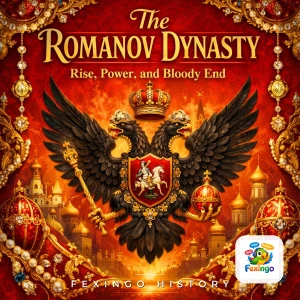
The Romanov Dynasty: Rise, Power, and Bloody End — Fexingo History
This podcast traces the three-century rule of the Romanov dynasty, from the Time of Troubles to the Bolshevik execution of Nicholas II. Hosts Lucas and Luna explore the reigns of Peter the Great, Catherine the Great, and the last tsar, while covering events like the Decembrist Revolt, the emancipation of the serfs, and the rise of Rasputin. The show examines how autocracy, Orthodox Christianity, and the secret police sustained the empire, and how industrialization and World War I brought it down. It reflects on the lasting fascination with the Romanovs, from the mystery of Anastasia to modern Russian symbolism.
Episodes

Romanovs and the 1905 Revolution
We explore the terrifying winter of 1905 when the Romanov dynasty faced its first true existential threat. The story begins on Bloody Sunday, January 9th, as Father Gapon leads a peaceful procession to the Winter Palace, only to be met by Imperial Guards. We trace how this massacre ignited the nationwide unrest that included general strikes, mutinies like the Battleship Potemkin, and the formation
The Romanovs and the Mystery of Rasputin
This episode explores the complex relationship between Grigori Rasputin and the Romanov family, focusing on his influence over Tsarina Alexandra Feodorovna due to her son Alexei's hemophilia. We examine how Rasputin’s spiritual guidance and medical advice shaped court politics during Nicholas II’s reign. The narrative covers Rasputin’s early life in Siberia, his rise to St. Petersburg, and the gro
The Romanovs and the Architecture of Imperial Control
This episode moves beyond the well-trodden paths of revolution, spies, and royal tragedy to examine the physical infrastructure of the Russian Empire. We explore how Tsar Nicholas II and his predecessors used urban planning, monumental architecture, and state-sponsored art not just as decoration, but as tools of political control. From the grand boulevards of St. Petersburg to the imposing facades
Romanovs and the Golden Yoke's Hidden Cost
While we have explored the Romanovs' military campaigns, secret police operations, and cultural patronage, this episode turns to the invisible architecture of their power: the poll tax, or podushnaya podat. Introduced by Peter the Great in 1718, this radical fiscal reform shifted the burden from household units to individual adult males, fundamentally altering Russian society. We examine how this
The Romanovs and the Cult of the Golden Yoke
We often think of the Russian Empire’s wealth as flowing from gold mines or imperial conquest, but a significant portion of state revenue came from a peculiar and burdensome tax: the poll tax. Known locally as the podushnaya podat, this head tax was instituted by Peter the Great in 1718 to fund his ambitious military reforms and the new capital at St. Petersburg. Unlike land taxes that could fluct
The Romanovs and the Lost Fabergé Eggs
While history remembers the Romanovs for their political upheaval and tragic end, few stories capture their aesthetic zenith like the Imperial Easter Eggs. This episode explores the secret world of Peter Carl Fabergé, the jeweler who transformed religious tradition into secular opulence for Tsar Alexander III and Nicholas II. We trace the creation of the famous Coronation Egg and the mysterious Mi
The Romanovs' Secret War on Crime
This episode dives into the complex and often contradictory world of Imperial Russian policing during the late 19th century. We explore the rise of Sergei Zubatov, a police chief who believed that if workers couldn't rebel legally, they would do so violently. This led to the creation of 'Zubatovshchina,' state-sponsored worker associations designed to channel dissent into harmless avenues like mut
The Romanovs and the Silk Road's Forgotten Trade
This episode explores the intricate web of commerce that bound the Russian Empire to Central Asia and China, moving beyond the military conquests covered in earlier episodes. We focus on the Treaty of Kyakhta of 1727, which established a regulated trade framework between the Qing Dynasty and Imperial Russia, allowing for the exchange of tea, furs, and silk. The narrative highlights the role of mer
The Romanovs and the 1905 Revolution
We explore the seismic shift of 1905, when the Romanov dynasty faced its first true existential crisis. This episode moves beyond the familiar narrative of Rasputin and World War I to examine Bloody Sunday, the St. Petersburg massacre that shattered the myth of the Tsar as a benevolent father figure. We look at how Grand Duke Sergei Alexandrovich’s brutal repression in Moscow backfired, radicalizi
Romanovs' Lost Heir: The Hemophilia Crisis
This episode explores the tragic burden of hemophilia within the Romanov dynasty, a genetic condition inherited from Queen Victoria that shaped the fate of Imperial Russia. We examine Tsarevich Alexei Nikolaevich’s fragile life, his dependence on the enigmatic Grigori Rasputin, and how this private medical crisis eroded public trust in Nicholas II and Alexandra Feodorovna. Through letters, medical
Romanovs and the Opium Wars: Tea, Trade, and Tolerance
While popular history often treats the Romanov empire as a static autocracy, the late nineteenth century saw Tsar Alexander III navigate a delicate diplomatic tightrope between St. Petersburg and Beijing. This episode explores the Treaty of Kyakhta, the backbone of Russo-Chinese relations, and how the Romanovs managed the lucrative but controversial tea trade from Siberia to the imperial table. We
Romanovs and the Opium Wars: Tea, Trade, and Tolerance
While history often frames the Romanov empire through the lens of military conquest or religious schism, Episode 250 explores a quieter, more complex thread: the diplomatic and economic entanglement with Qing China. We trace how Tsar Alexei Mikhailovich and his successors navigated the Treaty of Kyakhta in 1727, establishing a fragile peace that allowed Russian merchants to import tea while managi
The Romanovs and the Cult of the Golden Yoke
This episode explores the economic and social underpinnings of the Russian Empire, focusing on the system of direct taxation known as podushnaya podat. We examine how Peter the Great restructured the state's finances by shifting from household-based levies to a poll tax on individual souls, a move that fundamentally altered the relationship between the serf and the state. Lucas and Luna discuss th
Romanovs' Lost Heir: The Hemophilia Crisis
This episode explores the genetic curse that haunted the Romanov dynasty from its inception. We trace the lineage of Tsarevich Alexei Nikolaevich and his mother, Empress Alexandra Feodorovna, to their common ancestor Queen Victoria of Britain. Through the lens of modern genetics, we examine how X-linked recessive hemophilia became a political liability for the Russian Empire. The conversation deta
The Romanovs' Hidden War: The Russo-Japanese Conflict
While the world remembers the Romanovs for their opulence and eventual downfall, few realize that Nicholas II’s reign was defined by a catastrophic gamble in the Far East. This episode explores the Russo-Japanese War of 1904–1905, a conflict that shattered the myth of European invincibility and reshaped global power dynamics. We trace the diplomatic failures leading to the siege of Port Arthur, th
The Romanovs' Last Dance: Ballet, Politics, and Power
While we have explored the Romanovs' legal codes, financial struggles, and military campaigns in Central Asia, this episode turns to the Imperial Theatres of St. Petersburg and Moscow. We examine how Empress Elizabeth Petrovna and Catherine the Great used ballet not merely as entertainment, but as a tool of statecraft and cultural legitimization. You will hear about the French influence on Russian
The Romanovs' Lost Heir: The Legend of Anastasia
In this episode, Lucas and Luna turn away from the well-trodden paths of taxation, law, and the Great Game to explore one of history’s most enduring mysteries: the survival of Grand Duchess Anastasia Nikolaevna. While previous episodes covered her tragic death at the Ipatiev House in Yekaterinburg and the subsequent execution by the Bolsheviks under Yakov Yurovsky, this conversation dives into the
Romanovs and the Opium Wars: Tea, Trade, and Tolerance
While Western powers fought opium wars in China, the Romanov Empire navigated a quieter but equally complex conflict along its southern borders. This episode explores how Tsar Alexander III and his ministers managed the delicate balance between Christian Orthodoxy and Islamic populations in Central Asia. We look at the role of General Mikhail Skobelev’s conquests, the administration of the Turkest
The Romanovs and the Great Siberian Railway
While earlier episodes explored the political intrigues of St. Petersburg and the tragic final days in Yekaterinburg, this episode shifts focus to the massive infrastructure project that bound the Russian Empire together: the Trans-Siberian Railway. We examine Tsar Alexander III’s visionary decision to connect European Russia with the Pacific, a feat of engineering that faced immense geographical
The Romanovs' Secret War on Crime
While we often remember the Romanovs for their opulence and eventual downfall, few discuss the sophisticated, terrifyingly efficient police state they built to maintain it. This episode explores the Okhrana, the Tsar's secret police, and the complex web of informants, spies, and agents provocateurs that kept a lid on revolutionary sentiment for decades. We dive into the life of Yevno Azef, the dou
The Romanovs and the Silk Road's Forgotten Trade
This episode explores the intricate web of trade, diplomacy, and cultural exchange that defined the Russian Empire’s relationship with Central Asia and China during the nineteenth century. We examine how the Romanovs navigated the complexities of the Great Game while simultaneously fostering economic ties through the Treaty of Kyakhta and the Trans-Caspian Railway. Listeners will discover the role
The Romanovs' Forgotten Daughter: Maria Nikolaevna
We often focus on the tragedy of Anastasia or the mysticism surrounding Rasputin, but Grand Duchess Maria Nikolaevna offers a different window into the Romanov world. Born in 1899, she was known as 'Mia,' a lively and athletic child who defied the stiff etiquette of the Imperial court. This episode explores her relationship with her father Nicholas II, her role during the early years of World War
The Romanovs' Secret Spies: The Okhrana's Dark Arts
This episode explores the hidden world of the Okhrana, the Tsar’s secret police force that operated from 1880 to 1917. We trace how this shadowy organization infiltrated revolutionary circles, using agents provocateurs like Yevno Azef to sabotage uprisings before they began. Lucas and Luna discuss the psychological toll on the spies, the moral compromises made in the name of loyalty to the Crown,
The Romanovs' Last Stand: The Execution of the Imperial Family
On the night of July 16–17, 1918, in a damp basement in Yekaterinburg, the Romanov dynasty met its violent end. This episode moves beyond the myths of Anastasia and the mysticism of Rasputin to examine the cold, bureaucratic mechanics of the Bolshevik execution order. We trace the path of Yakov Yurovsky, the commandant tasked with silencing Tsar Nicholas II, his wife Alexandra, their five children
Romanovs and the Great Game: Central Asian Conquest
While the Romanovs are often remembered for their tragic end in Yekaterinburg or their lavish lives in St. Petersburg, a significant portion of their power came from the brutal expansion into Central Asia. This episode explores the late nineteenth-century race against the British Empire to dominate the Silk Road regions, focusing on the conquest of the Khanates of Khiva, Bukhara, and Kokand. We lo
The Romanovs' Forgotten War: The Siege of Port Arthur
In this episode, we turn away from the intrigues of St. Petersburg and the personal tragedies of the last Tsar to examine the military disaster that shattered Russia’s prestige on the world stage. We trace the origins of the Russo-Japanese War through the lens of Admiral Stepan Makarov, a brilliant naval commander whose death at the hands of a Japanese mine marked a turning point in modern warfare
Romanovs and the Imperial Finances
In this episode, Lucas and Luna explore the complex financial machinery that sustained the Romanov dynasty from the time of Peter the Great through Nicholas II. They discuss the establishment of the State Bank, the role of Sergei Witte in industrializing Russia, and the controversial poll tax known as podushnaya podat. The conversation delves into how the empire funded its vast military expansions
The Romanovs and the Great Game in Central Asia
While we often look to St. Petersburg for the center of Romanov power, the dynasty’s true strategic anxiety lay thousands of miles away in the steppes of Central Asia. In this episode, Lucas and Luna explore how the Russian Empire transformed from a European monarchy into a continental empire through the brutal, complex process of conquest in Turkestan. We trace the military campaigns led by gener
The Romanovs and the Russian Soul: Orthodoxy & Identity
We explore how the Romanov dynasty weaponized faith to consolidate power, focusing on the schism between the state church and the Old Believers. Lucas and Luna trace the conflict from Patriarch Nikon’s reforms in the 1650s through the exile of Avvakum, examining how religious uniformity became a tool for imperial control. The episode details the brutal suppression of dissent, the survival of secre
The Romanovs and the Rise of Russian Ballet
Before Rasputin’s mysticism or the Bolshevik uprising, Imperial Russia was forging a global cultural identity through dance. This episode explores how the Romanov court transformed ballet from a French import into a distinctively Russian art form. We trace the journey from Peter the Great’s early attempts to introduce Western manners to the establishment of the Imperial Theatres in St. Petersburg
Romanovs and the Russian Soul: Orthodox Faith & Identity
While we often focus on the political machinations, wars, and personal dramas of the Romanov dynasty, this episode explores the spiritual bedrock that held the empire together for three centuries. We examine how the Tsars used Orthodoxy not just as a religion, but as a tool of statecraft and identity. Lucas walks us through the schism of the 17th century, the fierce reforms of Patriarch Nikon, and
The Romanovs and the Cult of the Golden Yoke
In this episode, Lucas and Luna peel back the layers of imperial taxation to reveal how the Russian state extracted wealth from its people. We focus on the podushnaya podat, or soul tax, a per capita levy introduced by Peter the Great that fundamentally altered the social fabric of the Empire. Unlike land taxes which fluctuated with harvest yields, the soul tax was a fixed burden tied to individua
The Romanovs' Forgotten Daughter: Grand Duchess Maria Nikolaevna
We often focus on the tragedy of Anastasia or the mysticism of Rasputin, but Episode 229 turns its gaze to Grand Duchess Maria Nikolaevna, the eldest daughter of Nicholas II. While her sisters were studied for their talents and charms, Maria was defined by her quiet dignity and severe myopia. This episode explores how a girl born into the pinnacle of imperial power navigated a world that offered h
The Romanovs' Lost Heir: The Legend of Anastasia
For anyone stepping into history with us episode by episode, we often look at the grand sweep of empire—the battles, the treaties, the architecture. But sometimes the most enduring legacy is a ghost story. This episode explores the decades-long mystery surrounding Grand Duchess Anastasia Nikolaevna, the youngest daughter of Nicholas II. We trace the timeline from the Ipatiev House in Yekaterinburg
The Romanovs and the Iron Fist of Law
We step away from the palaces and bloodlines to examine the legal architecture that held the Russian Empire together for three centuries. This episode explores the creation of the Sobornoye Ulozheniye of 1649, the code that formalized serfdom and centralized autocratic power under Tsar Alexis. We trace how this single document transformed the social fabric of Russia, binding peasants to the land a
The Romanovs and the Golden Yoke of Taxation
While popular culture fixates on the opulence of the Winter Palace or the mysticism of Rasputin, the true engine of the Romanov empire was its relentless extraction of wealth from its people. In this episode, we explore the history of the poll tax, known in Russian as podushnaya podat', which transformed serfdom from a feudal bond into a state-managed property asset. We trace how Peter the Great r
The Romanovs' Lost Heir: The Legend of Anastasia
In Episode 225, Lucas and Luna explore the enduring mystery of Grand Duchess Anastasia Nikolaevna, the youngest daughter of Tsar Nicholas II. While previous episodes covered the family’s final days at the Ipatiev House in Yekaterinburg and the tragic fate of Tsarevich Alexei, this episode focuses on the legend that Anastasia survived the Bolshevik execution. We trace the story from the chaotic yea
The Romanovs' Forbidden Gardens: Peterhof's Secret History
While the Winter Palace and Fabergé eggs dominate the popular imagination of the Romanov dynasty, there was another stage for imperial power that demanded equal spectacle and cost more than a small war: the Peterhof Grand Palace and its surrounding gardens. This episode explores how Peter the Great imported the concept of Versailles to the Baltic coast, not just as a vacation home, but as a politi
The Romanovs' Lost Heir: The Legend of Anastasia
While most episodes focus on the political machinery or tragic executions of the Romanov dynasty, this episode explores one of history’s most enduring mysteries: the disappearance of Grand Duchess Anastasia. We trace the timeline from the Ipatiev House in Yekaterinburg in July 1918 to the sudden appearance of a woman named Anna Anderson in Berlin decades later. Lucas walks through the specific cla
Romanovs and the Okhrana: Spies, Traps, and the Azef Affair
While we often focus on the imperial court’s glitter or the tragic end of Nicholas II, this episode dives into the shadowy machinery that kept the Romanovs in power for centuries: the Okhrana, Russia’s secret police. We trace the evolution from Ivan the Terrible’s Oprichnina to the sophisticated surveillance state of the late 19th century, focusing heavily on the infamous case of Yevno Azef. As bo
The Romanovs and the Secret Police: From Oprichnina to Okhrana
While previous episodes have touched on the Fabergé eggs, the ballet, and the tragic end of the last Tsar, this episode dives into the machinery of control that held the empire together for over three centuries. We trace the lineage of state surveillance from Ivan the Terrible’s Oprichniki to the sophisticated, often brutal, network of the Okhrana under Nicholas II. Lucas and Luna explore how the
Grigori Rasputin: Healer, Mystic, and the Romanovs' Last Hope
In this episode, Lucas and Luna explore the improbable rise of Grigori Rasputin, the Siberian peasant who became the most trusted figure in the Romanov court. From his early days as a strannik in Pokrovskoye to his influence over Tsarina Alexandra, Rasputin's story is one of faith, politics, and scandal. The conversation traces his arrival in St. Petersburg in 1903, his meetings with the imperial
The Romanovs and the Secret Police: From Oprichnina to Okhrana
In this episode of Fexingo History, Lucas and Luna trace the shadowy evolution of Russia's secret police, from Ivan the Terrible's oprichniki to the Okhrana's network of spies and provocateurs. They explore how Peter the Great's Preobrazhensky Prikaz, Nicholas I's Third Section, and Alexander III's Okhrana shaped the Romanov dynasty's survival and downfall. Along the way, they uncover the Paris Ok
The Romanovs and the Imperial Hunt: Power, Ritual, and the Wild
In this episode of Fexingo History, Lucas and Luna explore the Romanov dynasty's relationship with hunting—a pastime that was far more than sport. From the medieval hunt of Tsar Alexei Mikhailovich, with its falconry and bear hunts, to the elaborate imperial hunts of Nicholas II at Spala and Białowieża, hunting served as a stage for power, diplomacy, and personal escape. They discuss the role of t
The Last Romanov Wedding: A Dynasty's Final Celebration
In late 1894, Nicholas II married Princess Alix of Hesse, a love match that became the last grand imperial wedding of the Romanov dynasty. Just weeks before, Alexander III had died in Livadia, and the ceremony in the Winter Palace's chapel was shadowed by mourning, yet filled with ornate ritual and glittering jewels. This episode explores the week of events — the funeral and wedding intertwined, t
The Romanovs and the Trans-Siberian Railway
In this episode, Lucas and Luna explore the monumental construction of the Trans-Siberian Railway under the Romanovs. They discuss the visionary but flawed leadership of Sergei Witte, the engineering challenges of the world's longest railroad, the brutal conditions faced by convict laborers, and the railway's role in the Russo-Japanese War. The episode also examines how the railway became both a s
The Romanovs and the Ice Road of the Baltic Fleet
In this episode, Lucas and Luna brave the frozen Gulf of Finland to uncover the story of Russia's Baltic Fleet in 1710, just after the Battle of Poltava. They follow Vice Admiral Cornelius Cruys, a Dutchman in Peter the Great's service, as he led a flotilla of 11 ships-of-the-line and 4 frigates through the treacherous ice to capture Vyborg, a fortress that had defied Russian sieges for centuries.
The Romanovs' Silk Road: Trade, Tea, and the Great Game
Before the Romanovs were emperors of a vast continental empire, they were merchants, dealing in furs, wax, and honey along the Silk Road. In this episode, Lucas and Luna trace the family's commercial roots from Novgorod and the Hanseatic League to the Muscovy Company's search for a northeast passage, and then leap to the nineteenth-century Great Game, where Russian tea caravans and British spies c
The Romanovs and the Ice Palace of 1740
In the winter of 1739–40, on the frozen Neva River in St. Petersburg, a bizarre and brutal spectacle unfolded: an ice palace built entirely of ice, with ice furniture, ice cannon, even an ice bath and ice wedding. This episode explores how Empress Anna Ioannovna, whose reign was already marked by the brutal Bironovshchina, commissioned the structure to humiliate her court jester, Prince Mikhail Go
The Romanovs' Shadow War: The Secret Treaty of Björkö
In 1905, as Russia reeled from revolution and defeat in the Russo-Japanese War, Nicholas II secretly signed a defensive alliance with Kaiser Wilhelm II of Germany at the Finnish island of Björkö. This episode explores the treaty's origins, the personal diplomacy between two autocrats, and how it nearly redrew the map of Europe—until the tsar's own ministers buried it. We trace the secret railway n
Siberian Exile: The Romanovs' Frozen Prison
When the Romanovs exiled their enemies, they didn't just send them away — they sent them to a place designed to erase them. This episode follows the journey from St. Petersburg's Peter and Paul Fortress to the katorga camps of Nerchinsk, where Decembrists, revolutionaries, and even the Romanovs' own relatives endured a fate worse than death. We trace the tsars' elaborate system of forced labor and
A Romanov Tsar's Daughter Who Ruled Alone
In 1741, a 32-year-old woman seized the Russian throne with the help of the Preobrazhensky Regiment, overthrowing the infant emperor Ivan VI. Elizabeth Petrovna, daughter of Peter the Great, ruled for twenty years, yet her reign is often remembered for its glittering balls and her personal vanity. But behind the court splendor, Elizabeth made decisions that reshaped Russia's place in Europe. She c
Alexei and the Russian Navy: A Fleet Built on Blood and Bureaucracy
Before Peter the Great, Russia was a landlocked giant with only a dream of the sea. This episode follows the unlikely path from Tsar Alexei Mikhailovich's ambitious but ill-fated first warship, the Oryol, to the creation of a real navy under his son. We trace the construction of the Oryol at a village on the Oka River, its sad end at the hands of Stepan Razin's rebels, and the forgotten Dutch and
The Romanovs and the Imperial Russian Ballet
In this episode, Lucas and Luna explore the Romanov dynasty's deep entanglement with the Imperial Russian Ballet, from its imperial charter under Alexander II to the revolutionary premieres of Stravinsky's The Firebird and The Rite of Spring. They trace the rise of the Mariinsky Theatre, the choreographic genius of Marius Petipa, and the seismic impact of Sergei Diaghilev's Ballets Russes, which c
The Romanovs' Last Ball: 1903 and the Winter Palace
In February 1903, the Romanovs threw the most opulent costume ball in Russian history. The Winter Palace glittered with jewel-encrusted boyar gowns and fur-trimmed kaftans as Nicholas II and Alexandra dressed as Tsar Alexei and his consort. But beneath the surface of this lavish spectacle lay an empire already fracturing—revolution was brewing, and the ball would be the dynasty's final great displ
Lies, Letters, and the Last Tsar: The Romanovs' Forged Past
In episode 206, Lucas and Luna dig into a story the Romanovs themselves tried to erase: the centuries of forged documents, invented genealogies, and rewritten histories that propped up their throne. From the forged 'Testament of Peter the Great' that fueled 19th-century paranoia to the Romanovs' own claim of descent from Rurik, they trace how a dynasty built on myth tried to control its own story
Fyodor Dostoevsky and the Romanovs: A Writer's Trial
Before he was Russia's greatest novelist, Fyodor Dostoevsky stood before a firing squad, blindfolded, waiting for the volley that would end his life. At the last second, the sentence was commuted to four years of hard labor in Siberia. This episode of the Romanov Dynasty podcast explores the fraught relationship between the writer and the imperial family. We examine the Petrashevsky Circle, the mo
The Winter Palace: Stage of Empire and Revolution
In this episode, Lucas and Luna explore the Winter Palace as more than a royal residence — a stage where the Romanovs projected power, celebrated victories, and, ultimately, lost their grip on Russia. From its baroque origins under Empress Elizabeth to the fires of 1837 and the siege of 1917, the palace witnessed balls and bloodshed. They discuss the palace's architecture, its role in court ritual
The Romanovs and the Romanovs' Cossack Guard
In this episode of Fexingo History, Lucas and Luna trace the Romanov dynasty through the lens of one of its most enduring institutions: the Cossack guard. From the Zaporozhian Sich and the Don Cossacks to the Pugachevshchina and the final days of the empire, we explore how the tsars both relied on and feared these fierce horsemen. We look at the atamans, the sotnias, and the stanytsias, and how th
The Romanovs' Fabergé Eggs: Imperial Splendor and Ruin
In this episode of The Romanov Dynasty, Lucas and Luna explore the glittering world of the Fabergé eggs — the ultimate symbol of Romanov wealth, artistry, and impending doom. From the first Imperial egg crafted for Alexander III in 1885 to the final, unfinished egg of 1917, they trace how these jewelled masterpieces mirrored the dynasty's rise and fall. Discover the role of Carl Fabergé and his wo
The Romanovs' Secret Weapon: The Cossack Guard
In this episode, Lucas and Luna explore the Romanovs' reliance on the Cossacks, the warrior horsemen who served as the dynasty's police, border guards, and shock troops for centuries. From the Zaporozhian Sich to the Don Cossack host, we trace how these fiercely independent communities became instruments of tsarist power—and how that loyalty was tested in the 1905 revolution and World War I. Learn
Nicholas II's Coronation: The Khodynka Tragedy
In May 1896, Nicholas II's coronation in Moscow was shadowed by the Khodynka Field disaster, where over a thousand people died in a stampede during the distribution of coronation gifts. This episode explores the events leading up to the tragedy, the inadequate response by imperial authorities, and how the new tsar's decision to continue celebrations rather than mourn deepened public disillusionmen
The Decembrists: Russia's First Revolutionary Uprising
In December 1825, a band of aristocratic officers gathered on Senate Square in St. Petersburg to oppose the new tsar, Nicholas I. Their revolt lasted barely a day, but it ignited a century of revolutionary dreams. This episode follows the Decembrists from the Napoleonic Wars and the secret societies that spawned them to the dramatic interregnum between Alexander I and Nicholas I. We meet Sergei Mu
Anna Ioannovna and the Iron Curtain of Romanov Rule
In this episode of The Romanov Dynasty, Lucas and Luna step back from the well-trodden path of Peter the Great and Catherine the Great to examine the often-overlooked reign of Empress Anna Ioannovna (1730–1740). We begin with a brief look at the succession crisis after Peter's death, when the Supreme Privy Council tried to impose conditions that would have made Anna a figurehead. Her dramatic reje
The Romanovs and the October Manifesto: A Constitution for Russia
In 1905, revolution shook the Romanov dynasty to its core. Strikes, mutinies, and the assassination of Grand Duke Sergei Alexandrovich forced Nicholas II to make an impossible choice: grant a constitution or watch his empire collapse. This episode unpacks the October Manifesto — the document that created Russia's first parliament, the Duma, and the pseudo-constitutional experiment that followed. W
The Romanovs' Secret Police: The Okhrana and the Birth of Modern Espionage
In this episode of Fexingo History, Lucas and Luna dive into the shadowy world of the Okhrana, the Romanovs' secret police. From its founding in 1881 after the assassination of Alexander II to its role in the 1917 revolutions, the Okhrana was a pioneer of modern surveillance and counterintelligence. Discover how agents like Pyotr Rachkovsky ran operations from Paris, how the infamous Yevno Azef wa
Anna Leopoldovna: The Regent Time Forgot
Before Catherine the Great, before Elizabeth, there was Anna Leopoldovna — the German-born regent who ruled Russia for barely a year, caught between a baby emperor, a scheming court, and the shadow of her own mother. In Episode 195 of The Romanov Dynasty, Lucas and Luna explore Anna's improbable rise: her marriage to Anton Ulrich of Brunswick, the coup that put her infant son Ivan VI on the throne
The Romanovs' Game of Thrones: Ivan the Terrible's Missing Son
In this episode, Lucas and Luna unravel one of the most enduring mysteries of the Romanov dynasty: the death of Ivan the Terrible's son and heir, Tsarevich Ivan Ivanovich, in 1581. Was it a tragic accident during a heated argument, or a cold-blooded murder that reshaped Russian history? They examine the eyewitness accounts, the famous painting by Ilya Repin, and the political fallout that led to t
The Rasputin Factor: Mystic, Healer, and Romanov Downfall
In this episode, Lucas and Luna examine the enigmatic figure of Grigori Rasputin and his catastrophic influence on the final years of the Romanov dynasty. They trace his rise from a Siberian peasant ('starets') to the trusted healer of Tsarevich Alexei, who suffered from hemophilia. The conversation reveals how Rasputin's apparent ability to stop the boy's bleeding convinced Empress Alexandra of h
The Romanovs' Siberian Railroad: Iron Road to Empire
In this episode, Lucas and Luna explore how the Trans-Siberian Railway reshaped the Russian Empire and ultimately hastened the Romanovs' fall. They trace its origins under Alexander III, the role of Sergei Witte as finance minister, the engineering challenges of Lake Baikal, and the strategic ambitions that drove construction through Siberia and toward the Pacific. The conversation covers the rail
The Romanovs and the Russo-Turkish War: 1877-78
In this episode of Fexingo History, Lucas and Luna explore the Russo-Turkish War of 1877–78, a conflict that redrew the map of the Balkans and set the stage for World War I. They follow the dramatic Siege of Plevna, where Russian and Romanian forces faced a determined Ottoman defense led by Osman Pasha, and examine the crucial role of Mikhail Skobelev, the 'White General,' whose bold tactics captu
The Last Tsar's War: Russia in World War I
In 1914, Nicholas II led the Russian Empire into a war that would shatter it from within. This episode traces the catastrophic first months of Russia's involvement in World War I—from the disastrous Battle of Tannenberg to the shell crisis that crippled the army. We follow the doomed general Alexander Samsonov, the surprising rise of the War Industries Committees, and the slow unraveling of the ts
Empress Elizabeth and Russia's Seven Years' War Triumph
In this episode of The Romanov Dynasty, we explore the reign of Empress Elizabeth Petrovna (1741–1762), the daughter of Peter the Great who led Russia into the Seven Years' War and transformed her court into a center of European culture. We follow her path to power — a bloodless coup that toppled the infant Ivan VI — then trace Russia's stunning victories over Frederick the Great at Kunersdorf and
Tsar Alexis, Patriarch Nikon, and the Great Russian Church Schism
The 17th century was a time of religious turmoil for Russia. Tsar Alexis Mikhailovich, the second Romanov ruler, presided over a kingdom still healing from the Time of Troubles. But the greatest crisis of his reign came not from foreign invasion, but from within the Orthodox Church. Patriarch Nikon's sweeping liturgical reforms aimed to align Russian practice with Greek traditions, but they sparke
Russo-Japanese War: How a Distant Conflict Doomed the Romanovs
In 1904, Tsar Nicholas II plunged Russia into a war with Japan over imperial ambitions in Manchuria and Korea. The conflict, marked by the siege of Port Arthur, the massive land battle at Mukden, and the devastating naval defeat at Tsushima, exposed the Romanov regime's military and administrative weaknesses. Lucas and Luna explore how this distant war triggered the 1905 Revolution, forced Nichola
Bloody Sunday 1905: The Day the Tsar Lost the People
In January 1905, a peaceful march of workers and their families led by Father Georgy Gapon approached the Winter Palace to present a petition to Tsar Nicholas II. Instead of sympathy, they were met with rifle fire. The bloodshed on that Sunday shattered the myth of the Tsar as the little father of his people and ignited the 1905 Russian Revolution. In this episode, Lucas and Luna explore the event
Paul I: The Romanov Emperor Murdered by His Own Court
Before the Decembrists, before Alexander II's reforms, there was Paul I—a tsar so volatile that his own son, the future Alexander I, conspired in his murder. In this episode, Lucas tells the story of Paul's four-year reign: his obsession with Prussian military order, his crackdown on the nobility, his construction of the fortress-like Mikhailovsky Castle, and the treacherous plot that ended his li
Why the Romanovs Sold Alaska to America
In 1867, Russia sold Alaska to the United States for $7.2 million—a deal that still baffles many. But behind the sale lies a story of imperial desperation, family feuds, and strategic calculation. In this episode of The Romanov Dynasty, Lucas and Luna explore how Tsar Alexander II, reeling from the Crimean War's devastation, was persuaded by his brother Grand Duke Constantine to unload a frozen as
1913 Romanov Tercentenary: Glittering Illusion
In 1913, the Romanov dynasty celebrated 300 years on the Russian throne with a lavish, carefully orchestrated festival aimed at reinforcing imperial legitimacy. This episode takes you inside the tercentenary: the pilgrimage to Kostroma's Ipatiev Monastery, where Mikhail Romanov had been elected tsar in 1613; the grand ceremonies in Moscow and St. Petersburg; the specially commissioned Fabergé eggs
Peter the Great and the Birth of St. Petersburg
In this episode, Lucas and Luna dive into the transformative reign of Peter the Great, focusing on the Great Northern War against Sweden and the audacious founding of St. Petersburg. They explore Peter's early struggles, the pivotal Battle of Poltava in 1709, and how a swampy delta on the Neva became Russia's 'window to the West.' Along the way, they touch on Peter's ruthless modernization, from t
Recommended

True Crime Classics

The Healer Revolution

Becoming: HER with Nikki Spoelstra

Booked, Blonde & Busy w/ Olivia Ponton

McKinsey on Consumer and Retail

megahired.com

Hard Knocks Podcast

Effective Weight Loss for Moms | High protein, Strength Training, Lose Weight, Meal Planning, Fat Loss, Healthy Habits

The Human-Animal Connection - Pet Life Radio Original

Infinite Health with Dr. Arasi Maran

The Daily

World News Tonight with David Muir
