The Itch: Allergies, Asthma, Eczema & Immunology
The Itch: Allergies, Asthma & Immunology 181 episodes Nov 5, 2026
The Itch is a podcast about environmental and food allergies, asthma, eczema, and immunology. Hosted by Kortney, who lives with food allergy, and Dr. Gupta, an allergist/immunologist, it mixes science with the everyday realities of living with these conditions. Episodes include deep dives and interviews covering both medical facts and lifestyle aspects. The show aims to make immunology and allergy topics understandable and useful without relying on Dr. Google.
Episodes

#182: Tests Used to Diagnose Systemic Mastocytosis
Getting a diagnosis of systemic mastocytosis takes about 8 years on average. The symptoms aren't specific, many doctors rarely see it, and each test tells only part of the story.
Kortney and Dr. Payel Gupta are joined by Dr. Tony Hunter, a hematologist at Winship Cancer Institute of Emory University. This episode builds on our first episode (#67) about testing. We walk through each test, what it c

#181 - The INTEGUMENT-OLE Trial: Roflumilast Cream for Kids Ages 2 to 5
Many parents worry about using eczema creams on young kids for a long time. In this episode of The Itch Review, we look at a study of roflumilast cream.
Kortney and Dr. Payel Gupta are joined by allergist Dr. Michael Blaiss to review "Long-Term Safety and Efficacy of Once-Daily and Proactive Twice-Weekly Roflumilast Cream 0.05% for Mild-to-Moderate Atopic Dermatitis in Children Aged 2-5 Years Fro

#180: What Is Eczema (Atopic Dermatitis)?
Atopic dermatitis is the most common type of eczema. It is not just dry skin. A weak skin barrier and an overactive immune system work together to cause dry, itchy, inflamed skin.
Kortney and Dr. Payel Gupta are joined by Dr. Ted Lain, a board-certified dermatologist and host of the Science of Skin podcast. We go back to the basics: what atopic dermatitis is, why it itches so much, what it looks l

#179 - What Pharmacists Around the World Recommend for Allergies
The pharmacist is often the first person you talk to about allergies. So what are they thinking about when they hand you that box of antihistamines?
Dr. Gupta and pharmacist Dr. Suzanne Soliman went to the World Congress of Pharmacy in Montreal. They asked pharmacists from the UK, Ghana, Portugal, Argentina, Uruguay, and Malaysia about three patients they might meet at the counter. Kortney joins D

#178 - What Is Hereditary Angioedema (HAE)?
Hereditary angioedema (HAE) is a rare genetic condition that causes attacks of swelling in the skin, the belly, and sometimes the throat. Because it looks like an allergic reaction, it is often missed for years.
Kortney and Dr. Payel Gupta are joined by Dr. Marc Riedl, Professor of Medicine and Clinical Director of the US HAEA Angioedema Center at UC San Diego, to set the stage for our three-part

#177 - Treating Chronic Hives in Special Populations (Women, Pregnancy, Kids, Older Adults & Multiple Conditions
Chronic hives guidelines give doctors a roadmap for treatment, but not everyone fits the same path. Pregnancy, breastfeeding, menopause, childhood, getting older, and living with more than one chronic condition can all change how chronic spontaneous urticaria (CSU) is treated.
Kortney and Dr. Payel Gupta are joined by Dr. Allison Ramsey, an allergist and immunologist, to walk through the special p

#176: SM Perspectives - The Doctor's Experience of Treating Systemic Mastocytosis
We hear a lot about the struggles patients face on their systemic mastocytosis journey, the years of normal labs, the feeling of not being believed. But have you ever wondered what that feels like from the doctor's side?
Kortney and Dr. Payel Gupta are joined by Dr. Alexander Kim, an allergist and immunologist who co-directs the Mast Cell Disorders Program at UC San Diego, for an honest look at wh

# 175 - Your Mast Cell Disorder Questions, Answered
Mast cell disorders can feel confusing, especially with so much information floating around online and on social media. In this episode, we cut to the chase and tackle the most common mast cell disorder FAQs, straight from the community.
Dr. Dareen Siri joins us to work through community questions on mast cell disorders one by one, from what a mast cell actually is to testing, treatment, diet, and

#174 - Choosing Between Chronic Hives Treatment Options
How do you decide what is the right medication for you after antihistamines are not working to manage your chronic hives?
Dr. David Lang, one of the authors of the new chronic urticaria guidelines (still in review), walks through every advanced treatment option the way he would if he had as much time as possible with a patient in his office. Along with Dr. Gupta, they cover the three treatments av

#173 - Busting the Biggest Biologics Myths for COPD, Asthma, and Nasal Polyps
Starting a biologic can feel intimidating, especially if you are worried it means being on medication forever, or wondering if it will actually replace your inhaler or your next sinus surgery. After this episode, we hope your biggest biologics questions are answered.
Kortney and Dr. Payel Gupta are joined by Dr. Giselle Mosnaim, an allergist and immunologist, to walk through the united airway, wha

#172 - Why Needing Systemic Steroids for Asthma Is a Warning Sign
Needing oral steroids for your asthma is a signal, not just a setback. It could be a sign that your asthma is not actually under control, even if you feel like you're managing it day to day.
Dr. Wes Sublett joins us to talk about why relying on steroid bursts is a warning sign, not a solution. Dr. Sublett breaks down what actually counts as an asthma exacerbation, the real risks of frequent oral s

#171 - Rescue Inhaler Changes in the Newest Asthma Guidelines
For decades, the rescue inhaler was simple: feel tight, take a puff, breathe easier. But the newest asthma guidelines have changed what's actually recommended inside that inhaler, shifting away from plain albuterol toward a combination inhaler that treats symptoms and inflammation at the same time.
Kortney and Dr. Payel Gupta are joined by Dr. Bill McCann, allergist and CEO of Allergy Partners, to

#170 - When Asthma Peak Week Hits Adults
Most asthma peak week coverage focuses on kids heading back to school. But adults with asthma are just as much at risk, and often don't realize it until they're already in trouble.
Kortney and Dr. Payel Gupta are joined by allergist Dr. Ashwin Shankar to talk about why asthma peak week hits adults hard, how normalizing symptoms can quietly put you at risk, and what steps to take before the season

#169 - What a School Nurse Wants Parents to Know About Asthma Peak Week
Every September, doctors see a jump in asthma attacks and ER visits. It's called Asthma Peak Week, and it usually hits the third week of September, right when families are settling into their school routines.
Kortney and Dr. Payel Gupta are joined again by Liz Elliott, a nurse administrator in school health services for Montgomery County, Maryland, and a returning guest from our food allergy epis

#168 - Wildfire Smoke and Your Lungs, What You Need to Know
Wildfire smoke used to feel like someone else's problem. Now it can show up on air quality alerts hundreds of miles from any actual fire, and for anyone with asthma, that hazy sky can mean real trouble breathing.
In this episode, Kortney and Dr. Gupta are joined by Dr. Neelu Tummala, an ENT physician and climate health expert, to talk about why wildfires are getting more frequent and intense, what

#167 - How Is Chronic Rhinosinusitis Without Nasal Polyps Diagnosed and Treated?
Chronic rhinosinusitis without nasal polyps (CRSsNP) is the type that makes up most chronic sinusitis cases. It's often mistaken for allergies, a lingering cold, or migraines, which can delay a proper diagnosis for years.
Dr. Gupta and Kortney sit down with Dr. Anju Peters, an allergist at Northwestern University's Feinberg School of Medicine, to unpack how this condition is actually diagnosed, wh

#166 - How Pregnancy and Your Baby's Gut Microbiome Play a Role in Food Allergy Prevention
Food allergy prevention is something most families think about once a baby starts eating. But the gut microbiome begins developing before birth, and what happens during pregnancy matters for the development of food allergies.
This is a bonus episode from our conversation with Dr. Carina Venter. The clip did not make it into Episode 165, but it was too good not to share. Dr. Payel Gupta and Kortney

#165: Gut Microbiome's Role in Food Allergies
You have probably heard the word "microbiome", but what does it actually mean for someone living with a food allergy?
Dr. Carina Venter, a registered dietitian, joins us to break down the gut’s role in food allergies. She explains what the microbiome is, how it connects to the immune system, and what families can realistically do right now to support a healthier gut.
What we cover in this episode

#164 - New Chronic Hives Guidelines: A Look at What's Changing
In this journal club episode, we break down the draft of the Chronic Urticaria Guidelines: 2026 AAAAI/ACAAI Joint Task Force (JTF) on Practice Parameters GRADE- and Institute of Medicine-based recommendations. We explain what counts as chronic hives, why the guideline leans on second-generation non-drowsy antihistamines, what to do when those are not enough, and what is new for both adults and kid

#163 - Understanding Chronic Spontaneous Urticaria: Hives Demystified
Join Kortney and Dr. Payel Gupta as they unpack chronic spontaneous urticaria. Together, they define what hives actually are, explain how CSU is different from an allergic reaction and other types of hives, and walk through what is happening under your skin to cause all that itching.
This episode was originally published June 6, 2024. We re-released it on June 25, 2026 with a new intro as the perf

#162 - JAK Inhibitors for Eczema: A non-steroidal option
Treatment options for eczema have come a long way, with many new non-steroidal choices. One type is the JAK inhibitor, which offers two things people have long wanted: a non-steroidal option and a more advanced option that, unlike a biologic, does not require injection.
Kortney and Dr. Payel Gupta sit down with returning guest Dr. Nicole Chase, to break down what a JAK inhibitor actually is, how t

#161 - BREATHE: The Digital Asthma Management Tool
Most adults with asthma never receive education about managing their condition, even though it is proven to help with better asthma control. The reason comes down to access. In this episode, we explore a digital platform called BREATHE, built from the ground up to change that.
Dr. Payel Gupta and Kortney sit down with the two lead authors behind “Development and Usability of a Digital Asthma Self-

#160 - Meet the President of the AAAAI, Dr. Carla Davis
We are continuing our series of interviewing thought leaders in the field of allergy and immunology. Dr. Gupta and Kortney sit down with Dr. Carla Davis, the president of the American Academy of Allergy, Asthma and Immunology.
What we cover in this episode about Dr. Davis and the AAAAI
What the AAAAI is and why it matters to patients. A 7,000-member organization working behind the scenes to suppo

#159 - Food Allergy Anxiety in Teens: Risk-Taking, Social Pressure, and How to Help
Kortney and Dr. Payel Gupta are joined by Tamara Hubbard, MA, LCPC, a licensed clinical professional counselor and food-allergy parent. Together, they dig into what food allergy anxiety actually looks like in teenagers, why some teens take more risks as they get older, and what parents can do to support their teens without making things worse.
What we cover in this episode is about food allergy an

#158 - Managing Food Allergy Anxiety in Kids
Food allergy anxiety in kids is real, and it does not always look like fear. It can show up as tantrums, clinginess, control-seeking behaviors, or a child who refuses to eat at a restaurant. Child life specialist and therapist Kelsey Mora joins Kortney and Dr. Payel Gupta to unpack what is really going on.
What we cover in our episode about managing anxiety in kids
Food allergy anxiety does not

#157 - Dating, Kissing, and Intimacy with Food Allergies
Mia Silverman, food allergy advocate, joins us to talk about the real emotional and practical side of dating with food allergies. From what the research says about kissing risks to setting boundaries to why your allergies might actually be the best filter you have.
What we cover in this episode about dating with food allergies
When to tell someone about your food allergies. Mia shares why she bri

#156 - Is Your Asthma Worse Than It Should Be? Signs of Uncontrolled Asthma
If you have asthma, there is a good chance you have learned to live around it. You sleep with your inhaler on the nightstand. You skip the walk because you know it will leave you breathless. This is called uncontrolled asthma, and it is more common than you think. But here is the thing: none of that is normal, and none of it is something you have to accept.
Dr. Juanita Mora, allergist and immunolo

#155 - Did I Cause My Child's Food Allergy?
When a child is diagnosed with a food allergy, one of the first things many parents wonder is, "Did I do something wrong?" and "Did I cause my child's food allergy?" You question if it was something you ate or didn't eat during pregnancy, whether you breastfed long enough, or if you introduced foods too late. The guilt is real, and it is incredibly common.
Kortney and Dr. Payel Gupta sit down with

#154 - What Providers Need to Know About Uncontrolled Asthma
If you treat patients with asthma, this episode is for you. Not just allergists, but GPs, pediatricians, family medicine doctors, urgent care providers, and anyone who sees a patient with asthma in their practice.
Dr. Cherie Zachary, current president of the American College of Allergy, Asthma and Immunology, joins Kortney and Dr. Payel Gupta to talk about why uncontrolled asthma remains a serious

#153 - Food Allergy Bullying: How to Talk to Your Child and Their School
Food allergy bullying is more common than most parents realize, and most kids never bring it up on their own. Research shows it affects up to 1 in 3 children with food allergies, and the signs can be easy to miss: a lunchbox that keeps coming home full, a sudden reluctance to go to school, or quietly backing off from safe food habits to avoid standing out.
In this episode, psychologist Dr. Amanda

#152 - How to Advocate for Better Healthcare
Kortney and Dr. Payel Gupta sit down with Nissa Shaffi, MS, Director of Advocacy at the Allergy & Asthma Network, to talk about what patient advocacy really means, how the healthcare system works as a whole, and how everyday people with allergies, asthma, and related conditions can learn to use their voice to push for real change.
What we cover in this episode is patient advocacy for allergy a

#151 - What Allergists Think About Antihistamines
If you have ever taken an antihistamine labeled "non-drowsy" and still ended up foggy and tired, you are not imagining it. Allergists have a lot to say about that label and about the foggy feeling that comes with allergy season in general.
In part two of our live recordings from the AAAAI conference in Philadelphia, Kortney and Dr. Payel Gupta talk to allergists from across the US about what they

# 150 - What Allergists Really Think About Your Allergy Nasal Spray
Ep. 150: What Allergists Really Think About Your Allergy Nasal Spray
If you have ever grabbed a nasal spray off the pharmacy shelf, used it for a few days, and given up because nothing seemed to be happening, you are not alone. And according to the allergists we spoke to at the AAAAI conference in Philadelphia, that is not uncommon.
In this episode, Kortney and Dr. Payel Gupta share real conversat

#149 - What is Chronic Rhinosinusitis without Nasal Polyps
Chronic sinusitis without nasal polyps is the most common form of chronic sinusitis. Even so, most patients spend years without a clear explanation, cycling through antibiotics that do not address what is actually going on.
In this episode, Kortney and Dr. Payel Gupta are joined by Dr. Michael Blaiss and Dr. Anju Peters, an allergist and immunologist at Northwestern University who co-authored the

#148 - How Do You Know Your Chronic Hives Are Under Control?
Chronic hives that come and go without warning are exhausting physically and emotionally. But here is something many patients don't realize: feeling "okay" is not the same as being well controlled.
Kortney and Dr. Gupta are joined by Dr. Tom Chacko, a board-certified allergist and immunologist based in Atlanta, to discuss what good hives control actually looks like and what to do when you are not

#147 -The REMIX Trial: Remibrutinib for Chronic Hives
If you have chronic hives and antihistamines aren't helping, there's a new treatment option to know about. In this episode of The Itch Review, we spotlight "Remibrutinib in Chronic Spontaneous Urticaria" published in The New England Journal of Medicine, March 2025.
This article looks at the REMIX trials, which tested whether remibrutinib, a BTK inhibitor, can help adults whose chronic spontaneous

#146 - How to treat chronic rhinosinusitis with nasal polyps (CRSwNP)
Chronic rhinosinusitis with nasal polyps, or CRSwNP, is a condition driven by ongoing inflammation. That is why treatment is not a one-time fix and why polyps can come back even after surgery. In this episode, Dr. Payel Gupta and Kortney are joined by Dr. Maeve O'Connor, a board-certified allergist and immunologist, to walk through CRSwNP treatment options.
This episode is released around World An

#145 - How to Improve Indoor Air Quality (Part 2 of 2)
We spend about 90% of our time indoors. But what's actually in that air we breathe, and why does it matter so much for people with asthma, allergies, and eczema?
This is part two of our series about indoor air quality. We discuss how you can improve your indoor air quality. Kortney shares her experience living in Germany, where ventilating your home isn't just a suggestion, it's practically a life

#144 - How Indoor Air Quality Impacts Allergic Disease (Part 1 of 2)
We spend about 90% of our time indoors. But what's actually in that air we breathe, and why does it matter so much for people with asthma, allergies, and eczema?
This is a two-part series about indoor air quality.
In the first part, we break down the three main categories of indoor air pollutants: particulate matter (PM2.5 and PM10), volatile organic compounds (VOCs), and biological allergens lik

#143 - Meet the President of the ACAAI: Dr. Cherie Zachary
We continue our tradition of interviewing the incoming president of the American College of Allergy, Asthma & Immunology to learn what is top of mind for the field and what it means for patients and families.
Dr. Cherie Zachary joins us to share her personal journey into allergy and immunology as both a lifelong patient and clinician. She explains what the ACAAI does and why increasing represe

#142 - Inside Allergy & Asthma Network: Education, Advocacy, and Patient Voice
Allergy & Asthma Network has spent more than four decades helping people living with asthma, allergies, and related immune conditions navigate care, access trustworthy education, and make their voices heard.
In this episode, we talk with Lynda Mitchell, CEO of Allergy & Asthma Network. Lynda shares how becoming a food allergy and asthma mom in the early 1990s shaped her career and led her

#141 - The Peds-AIRQ explained: pediatric asthma control
Asthma is one of the most common long-term conditions in children. It is a leading cause of missed school and emergency room visits. Doctors use tools (validated questionnaires) to assess how well a child’s asthma is controlled and whether their medicine is helping. Some tools only ask about symptoms, which can miss children who are still at risk for asthma attacks.
The lead author, Dr. Kevin Murp

#140 - Why Sleep Matters for Allergies, Asthma, and Eczema
Sleep plays a critical role in managing allergies, asthma, and eczema, yet it is often overlooked in conversations about allergic disease.
Sleep affects mood, focus, immune function, and inflammation, all of which influence how allergic conditions show up day to day. Poor sleep can worsen asthma symptoms, increase allergy flares, and make eczema harder to control. At the same time, allergies and a

#139 - Understanding Food Allergy Labels & "May Contain" in the U.S.
Reading food labels can feel like a full-time job when you or your child has food allergies. Even when you know what to avoid, labels can still be confusing, especially when you run into “may contain” warnings.
Marion Groetch, a registered dietitian with decades of experience in food allergy care and education, joins us to unpack all things food labels. Together, we break down U.S. allergen labeli

#138 - Prevalence of KIT D816V in anaphylaxis or systemic mast cell activation
Clonal mast cell disease is often missed because symptoms vary from person to person, tryptase levels can be normal, and bone marrow biopsies are hard to get. For some people, unexplained or very severe anaphylaxis may be an early sign of a clonal mast cell disease.
In this episode, we review “Prevalence of KIT D816V in anaphylaxis or systemic mast cell activation,” published in October 2025 in th

#137 - Diagnosing Chronic Rhinosinusitis with Nasal Polyps (CRSwNP)
Persistent congestion, pressure, or a reduced sense of smell often gets mistaken for allergies or a stubborn cold when it may be something more, like chronic rhinosinusitis with nasal polyps (CRSwNP). Getting the right diagnosis is the first step toward real relief.
Dr. Tonya Farmer, a board-certified ENT, joins Kortney and Dr. G to explain how chronic rhinosinusitis with nasal polyps (CRSwNP) is

#136 - Food Allergy Treatments: What to Ask Your Doctor
Avoidance has long been the standard for managing food allergies. But new options, such as oral immunotherapy (OIT) and biologic medications like Xolair (omalizumab), are changing the landscape. With more choices available, many patients and parents are wondering how to start the conversation with their allergist and what questions to ask.
Kortney and Dr. Payel Gupta talk with Dr. Shahzad Mustafa,

#135 - Food Allergies in School: A School Nurse’s Perspective
When it comes to keeping kids with food allergies safe at school, school nurses are often the quiet heroes behind the scenes. From managing allergy action plans and emergency responses to training teachers and organizing care for hundreds of students, their role is essential, but often misunderstood.
Kortney and Dr. Payel Gupta sit down with Elizabeth Elliott, a school nurse and President of the M

#134 - How Dupilumab Reduces Mucus Burden in Asthma - VESTIGE Trial
Mucus plugging is a challenge in asthma care. It’s thick, sticky mucus that blocks the airways and doesn’t respond to regular inhalers. Even when inflammation improves, these plugs can lower lung function, limit how well medicine works, and make asthma harder to control.
In this episode, we break down the study: “Effect of Dupilumab on Mucus Burden in Patients with Moderate-to-Severe Asthma,” publ

#133 - What is Chronic Rhinosinusitis with Nasal Polyps (CRSwNP)?
Living with constant congestion, facial pressure, or a loss of smell can make daily life exhausting. For many people, these symptoms are more than just allergies or a lingering cold. They may be signs of chronic rhinosinusitis with nasal polyps (CRSwNP).
Dr. Rohit Katial joins Kortney and Dr. G to unpack what CRSwNP really is, how it develops, and why type 2 inflammation plays such a key role. Tog

#132 - Boundaries & Communication in Food Allergy Families
Navigating food allergies is tough enough, but adding family dynamics to the mix can make things even more complicated. When loved ones don’t understand you or your child’s allergies or dismiss the rules meant to keep them safe, it can lead to conflict, hurt feelings, and stress for everyone involved.
Kortney and Dr. Payel Gupta sit down with psychologist Dr. Amanda Whitehouse to talk about how fa

#131 - What Is a BTK Inhibitor?
For decades, allergists have focused on blocking what happens outside the mast cell: histamine, IgE, and interleukins. But now, there’s a new way to stop allergic inflammation before it even starts: by targeting what happens inside the cell with BTK Inhibitors.
Dr. Payel Gupta and Kortney are joined by Dr. Matthew Giannetti to unpack what BTK actually does and why inhibiting it represents an excit

# 130 - How Telemedicine Improves Access to Care for Food Allergies
Seeing your allergist on a screen instead of in the office might feel strange at first, but for many people with allergies, telehealth isn’t just convenient. it’s effective.
In this episode, we sit down with telemedicine pioneer Dr. Jay Portnoy to explore how virtual allergy care works, what it can and can’t do, and how it’s helping patients get the care they need without the wait or the long dri

#129 - Omalizumab for Multiple Food Allergies – The OUtMATCH Trial
Multiple food allergies are a daily stressor for millions of families. From avoiding social events to fearing accidental exposures, it can feel like living in a constant state of alert. Until recently, there were no FDA-approved treatments that targeted more than one allergen at a time.
In this episode, we break down the study: “Omalizumab for the Treatment of Multiple Food Allergies,” published i

#128 - Is Chronic Spontaneous Urticaria an Autoimmune Disease?
When people get hives or swelling, they often think it’s caused by an allergy. But in the case of chronic spontaneous urticaria (CSU), the culprit is often your own immune system. CSU isn’t your typical allergic reaction, instead, it’s frequently an autoimmune condition, where the immune system misfires and activates mast cells without any external trigger.
In this episode, Dr. Payel Gupta and Kor

#127 - Management of indolent mastocytosis - A clinical yardstick
Indolent Systemic Mastocytosis (ISM) is a rare but often underrecognized clonal mast cell disorder. From random hives to gut pain and brain fog, ISM can feel like a medical mystery.
We continue our review of “Management of indolent mastocytosis and mast cell activation syndrome - A clinical yardstick,” published in June 2025 in The Annals of Allergy, Asthma & Immunology. This is Part 2 of our

#126 - Management of mast cell activation syndrome - A clinical yardstick
Mast cell activation syndrome (MCAS) is a confusing and often misunderstood condition. If you’ve ever wondered about MCAS symptoms, serum tryptase testing, or how treatments like antihistamines, sodium cromolyn, and even omalizumab fit in, this episode is here to help.
We review the findings from “Management of indolent mastocytosis and mast cell activation syndrome - A clinical yardstick,” publis

#125 - Parents’ Guide to Asthma Peak Week
As September approaches, many families notice asthma symptoms getting worse. Ragweed pollen, viral infections, cooler nights, and the stress of back-to-school routines all combine to create Asthma Peak Week, a time when asthma attacks and ER visits spike across the country.
Asthma mom, Sherrina Gibson, joins us to share how her family prepares her 11-year-old daughter for fall asthma challenges. S

#124 - Asthma peak week and understanding triggers
As summer winds down and September approaches, many people with asthma notice their symptoms getting worse. This is no coincidence as more asthma triggers appear during this time of year, from pollen and viruses to stress and weather changes. This combination peaks during Asthma Peak Week, a time when asthma attacks and ER visits spike across the country.
Allergist Dr. Kristin Sokol joins us to di

#123: Supporting the Mental Health of Allergy Parents
Parenting a child with food allergies can feel overwhelming and isolating. We're joined by licensed therapist and food allergy mom Tamara Hubbard, MA, LCPC, to talk about her new book, May Contain Anxiety, and the often overlooked mental health challenges that food allergy parents face.
We explore how chronic stress, fear, and anxiety can affect parenting, relationships, and family dynamics. Plus,

#122 - Mortality in adult patients with chronic spontaneous urticaria: A real-world cohort study
Do adults with chronic spontaneous urticaria (CSU) have a higher risk of death over time compared to people without hives?
We review the findings from “Mortality in adult patients with chronic spontaneous urticaria: A real-world cohort study,” published in April 2025, in The Journal of Allergy and Clinical Immunology. While CSU is often considered a non-life-threatening condition, this large study

#121 - Avapritinib versus Placebo in Indolent Systemic Mastocytosis - PIONEER Trial
What happens when you target the root cause of indolent systemic mastocytosis?
In this episode of The Itch Review, we unpack key findings from the article “Avapritinib versus Placebo in Indolent Systemic Mastocytosis,” published on May 23, 2023, in NEJM Evidence.
Indolent Systemic Mastocytosis (ISM) is a rare chronic disease with life-altering symptoms. Until recently, treatment options were limit

#120 - Back to School with Food Allergies: Accommodations, Epinephrine & Preparing Your Child
Is it too early to start planning for school when summer has just begun? Not if your child has food allergies.
Dr. Nikki Chase, a board-certified allergist-immunologist, joins us to share what families need to know to prepare for a safe and successful school year. From school forms and emergency plans to when to self-carry epinephrine and how to teach self-advocacy, this episode is filled with pra

#119 - Processing Emotions After Anaphylaxis: Navigating Guilt, Family Reactions, and Moving Forward
Have you ever wondered what happens after an anaphylactic reaction?
How do you process everything that went down, from ingesting the allergen to using epinephrine? In this candid conversation, Kortney sits down with Tamara Hubbard, a licensed clinical professional counselor, to unpack the emotional aftermath of a severe allergic reaction.
Kortney shares her own recent experience of self-administer

#118 - Do Indolent Systemic Mastocytosis Patients & Providers Agree on Symptom Control?
Do patients and their healthcare teams view the impact of indolent systemic mastocytosis on quality of life in the same way?
In this episode of The Itch Review, we unpack key findings from a May 4, 2025, descriptive study from The Journal of the Advanced Practitioner in Oncology, “Patient and Advanced Practitioner Perspectives on Symptom Burden and Symptom Management in Indolent Systemic Mastocyto

#117 - BATURA Trial: Does a Combo Inhaler Help Mild Asthma?
There have been countless advances in controller therapies for asthma, but our go-to rescue inhaler, a quick-relief bronchodilator, hasn’t changed in decades.
In this episode of The Itch Review, we spotlight “As-Needed Albuterol–Budesonide in Mild Asthma” published in The New England Journal of Medicine, May 19, 2025. This article looks at the BATURA trial, which tested whether adding budesonide t

#116 - Why Fexofenadine Is Considered a Truly Non-Sedating Antihistamine
Have you ever wondered whether fexofenadine (Allegra®) really doesn’t make you drowsy?
In this episode of The Itch Review, we dissect a July 2024 systematic review from Current Medical Research & Opinion, “Why fexofenadine is considered a truly non-sedating antihistamine with no brain penetration.”
This rigorous systematic review pools over 60 human studies from PET brain-scan trials and Prop
#115 - Managing Food Allergies in College-Aged Students (Ages 18-21)
Stepping into young adulthood also means stepping up as the primary manager of your food allergies.
For teens and young adults with food allergies, early adulthood is an exciting but challenging shift. It’s the first time you’re the primary communicator, managing everything from dining halls to doctor’s appointments on your own. Add in new living spaces, new friends, and a growing social life, and
#114 - Managing Food Allergies in Teenagers (Ages 12–18)
Independence, risk-taking, and peer pressure. Welcome to the teenage years with food allergies!
Managing food allergies during the teen years poses new challenges. Tweens and teens are gaining independence, navigating social pressures, and taking more responsibility for their health. But this is also the stage where risky behavior peaks, and the risk for severe allergic reactions is highest. That’
#113 - Managing Food Allergies in Children (Ages 5–11)
How do you help your child go from knowing they have a food allergy to actually managing it in everyday life?
This is the stage when everything starts to shift. Between the ages of 5 and 11, your child is learning how to describe symptoms, speak up at school, and navigate birthday parties. They’re also watching you closely and picking up how to talk about food allergies based on how you do it.
In
#112 - Managing Food Allergies in Babies and Toddlers (Ages 0–5)
How do you keep a baby or toddler safe with food allergies when they put everything in their mouths and can’t yet explain how they feel?
This stage of life is full of firsts, not just for your child, but for you as a parent managing food allergies. From introducing new foods to navigating daycare and watching for reactions in a child who can’t speak yet, there are countless moments you’ll need to
#111 - Food Allergy Basics for All Ages
Just diagnosed with a food allergy and feeling lost? You’re not alone and don’t have to figure out food allergy life by yourself. We’re here to help you understand food allergy basics: what causes allergic reactions, how to recognize symptoms, and how to manage your allergy safely, every day.
This is the second episode in our Food Allergies: Ages & Stages, and it’s all about building a strong
#110 - Early Introduction of Allergenic Foods: Preventing Food Allergies Before They Start
Did you know you could potentially reduce your baby’s risk of developing food allergies by up to 80%?
That’s the power of early allergen introduction. Feeding a baby the top 9 allergens consistently starting between 4 to 6 months can make a life-changing difference.
We’re launching a brand-new series about food allergies at various stages of life. Whether you’re just starting solids, navigating a
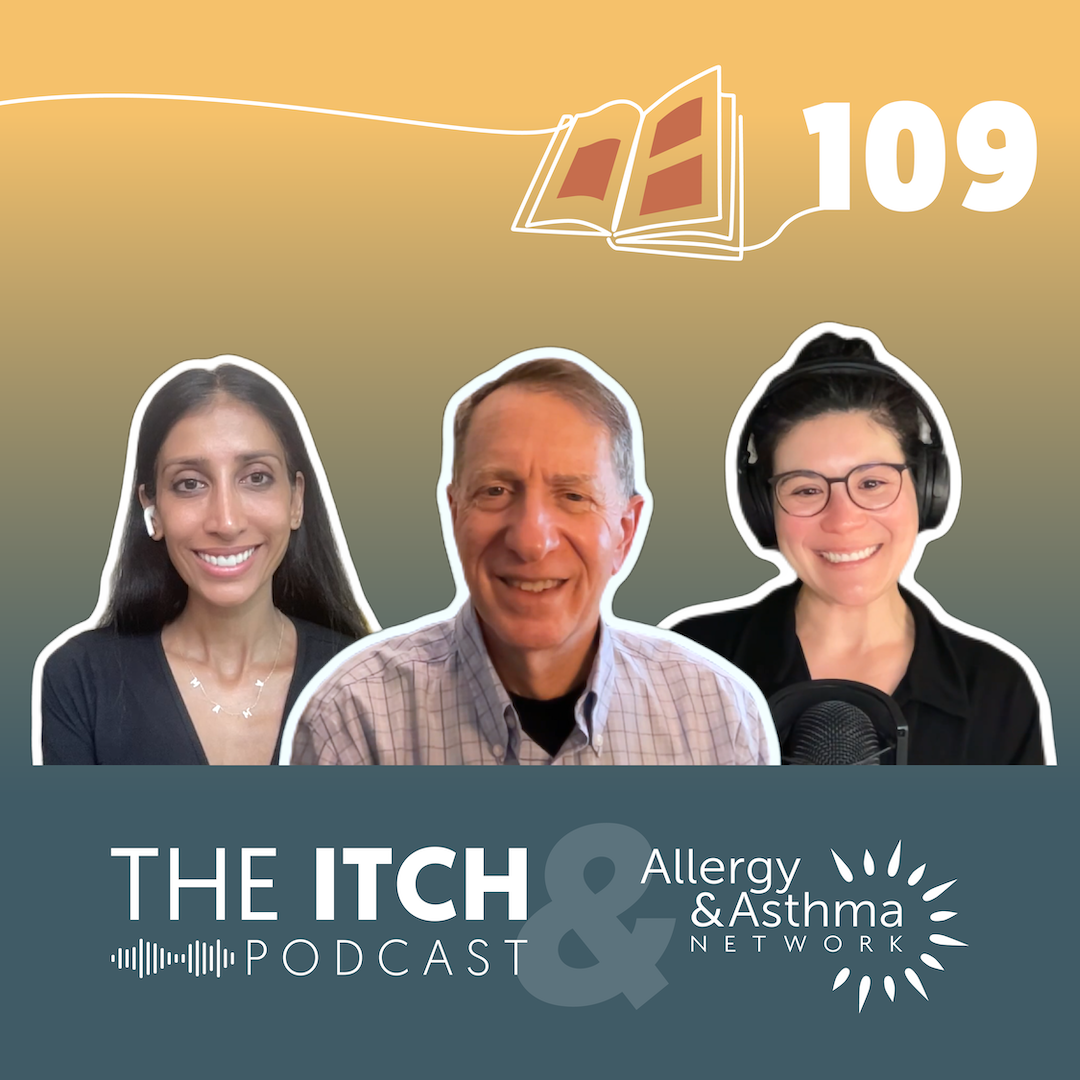
#109 - Tezepelumab & Nasal Polyps: Inside the WAYPOINT Phase III Trial
Have you wondered why having more drug options matters for chronic rhinosinusitis with nasal polyps?
In the inaugural episode of our new series, The Itch Review, co-hosts Kortney and Dr. Payel Gupta, along with special guest Dr. Michael Blaiss, unpack the journal article "Tezepelumab in Adults with Severe Chronic Rhinosinusitis with Nasal Polyps," published in the New England Journal of Medicine o

#108 - Interview with Dr. James Tracy, ACAAI President
Ever wonder who’s working behind the scenes to improve allergy care nationwide?
In this episode, we sit down with Dr. James Tracy, the 2024-2025 president of the American College of Allergy, Asthma & Immunology (ACAAI), to explore how the College supports both patients and clinicians. Dr. Tracy shares how he got involved, what drives his leadership, and what’s ahead for the future of allergy a

#107 - Understanding Hives in the Latinx Population
Ever wonder how culture and language barriers affect diagnosing chronic spontaneous urticaria (CSU) in Latinx patients?
In this episode, allergist Dr. Juanita Mora joins Kortney and Dr. Gupta to discuss chronic spontaneous urticaria (hives) and the unique challenges faced by the Latinx community. They highlight the importance of cultural competency in health care and the barriers that Latinx patie

#106: The Risks and Realities of Steroid Overuse for Eczema
Have you ever wondered if steroids are the best choice for managing your eczema?
While both topical and oral steroids offer quick relief from severe eczema flares, understanding their long-term risks and safer alternatives can dramatically improve your quality of life.
In this episode, Dr. Mondana Ghias joins Kortney and Dr. Gupta to discuss the complex role of systemic corticosteroids in eczema

#105 - Understanding Oral Corticosteroid Overuse in Asthma
Ever wonder if the “asthma shot” from the ER, or those go-to steroid pills for your asthma flares, might be doing more harm than good?
Dr. Dipa Sheth joins us to discuss the common pitfalls of relying too heavily on oral corticosteroids (OCS), also known as oral steroids. We unpack why these systemic medications should generally be reserved for short-term use. She also shares how improving asthma
#104 - Achieving Control in Type 2 Inflammation
What does "control" mean when managing allergic conditions, and how can you achieve it?
When you have asthma, eczema, nasal polyps, or other conditions caused by type 2 inflammation, reaching a state of control can dramatically improve your quality of life. But what does "control" really mean? Is it the same as a cure? And what steps should you take if your current treatment isn't working?
In this
#103 - Pediatric Type 2 Inflammation: can we slow or stop allergic conditions in children?
Can you slow down the atopic march and prevent kids from developing more allergic diseases?
Type 2 inflammation plays a central role in allergic diseases, which impact children from infancy through adulthood. From eczema and asthma to food allergies and allergic rhinitis, these conditions are all connected through an underlying immune response: Type 2 inflammation. But is there a way to prevent th
Recommended

Crime Stories with Nancy Grace

Conspiracy Files with Paige Carter

Bible Tea
Dark Night Tales with Brian King

Fox news

CBS Radio Mystery Theater | Old Time Radio

Old Time Radio Mystery, Suspense, & Horror

ABC News Update

Learn English Fast! English Snacks with Amber - Short Lessons to Speak English Like a Native

این نقطه

This Past Weekend w/ Theo Von

100 Greatest Old Time Detective Stories
